Tuesday, October 29, 2024

Biden announces $3B to reduce carbon emissions at US ports, 'the linchpin to America’s supply chain'

MATTHEW DALY
Updated Tue, October 29, 2024
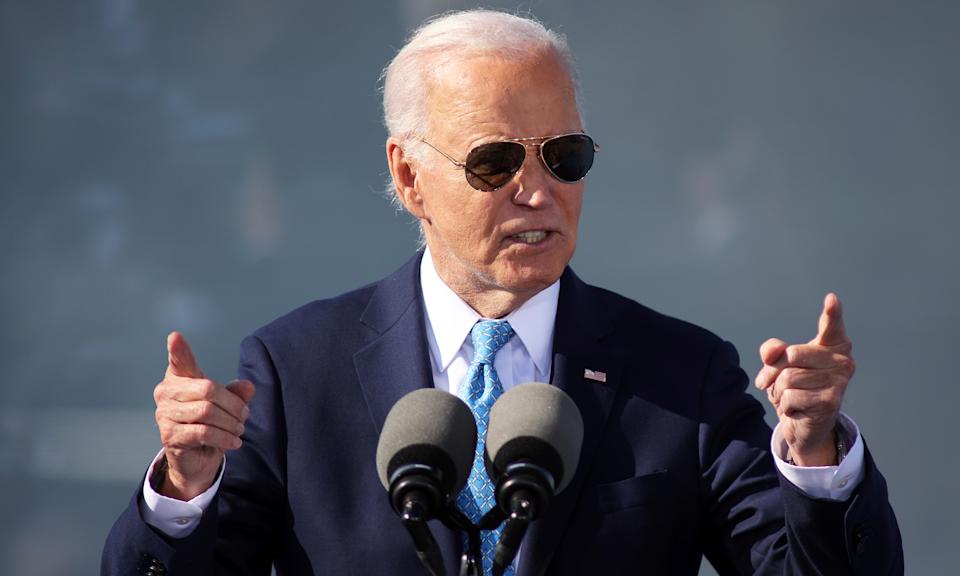
President Joe Biden speaks during an event about his Investing in America agenda, Tuesday, Oct. 29, 2024, at the Dundalk Marine Terminal in Baltimore. (AP Photo/Daniel Kucin Jr.)ASSOCIATED PRESS

President Joe Biden speaks during an event about his Investing in America agenda, Tuesday, Oct. 29, 2024, at the Dundalk Marine Terminal in Baltimore. (AP Photo/Daniel Kucin Jr.)ASSOCIATED PRESS

Maryland Gov. Wes Moore speaks, Tuesday, Oct. 29, 2024, at the Dundalk Marine Terminal in Baltimore. (AP Photo/Daniel Kucin Jr.)ASSOCIATED PRESS

President Joe Biden speaks during an event about his Investing in America agenda, Tuesday, Oct. 29, 2024, at the Dundalk Marine Terminal in Baltimore. (AP Photo/Daniel Kucin Jr.)ASSOCIATED PRESS

President Joe Biden walks into BMORE LICKS, a homemade ice cream business in Baltimore, Tuesday, Oct. 29, 2024, after speaking the Port of Baltimore. (AP Photo/Mark Schiefelbein)ASSOCIATED PRESS

FILE - The cargo ship Dali is stuck under part of the structure of the Francis Scott Key Bridge after the ship hit the bridge, Tuesday, March 26, 2024, as seen from Pasadena, Md. (AP Photo/Mark Schiefelbein, File)ASSOCIATED PRESS

Baltimore Mayor Brandon M. Scott speaks, Tuesday, Oct. 29, 2024, at the Dundalk Marine Terminal in Baltimore. (AP Photo/Daniel Kucin Jr.)ASSOCIATED PRESS

Gov. Wes Moore, D-Md., speaks before President Joe Biden arrives to speak at the Port of Baltimore in Baltimore, Tuesday, Oct. 29, 2024. (AP Photo/Mark Schiefelbein)ASSOCIATED PRESS

President Joe Biden speaks during an event about his Investing in America agenda, Tuesday, Oct. 29, 2024, at the Dundalk Marine Terminal in Baltimore. (AP Photo/Daniel Kucin Jr.)ASSOCIATED PRESS


WASHINGTON (AP) — The Biden administration is awarding nearly $3 billion to boost climate-friendly equipment and infrastructure at ports across the country, including Baltimore, where a bridge collapse killed six construction workers in March and disrupted East Coast shipping routes for months.

President Joe Biden announced the federal funding Tuesday during a visit to the city's main port, saying the money will improve and electrify port infrastructure at 55 sites nationwide while supporting an estimated 40,000 union jobs, reducing pollution and combating the climate crisis. The presidential visit, a week before Election Day, was intended to highlight efforts by Biden and Vice President Kamala Harris to promote clean energy while protecting and creating jobs.

“Ports are the linchpin to America’s supply chain,'' Biden said in a speech at Dundalk Marine Terminal, near the site of the March 26 bridge collapse that closed commercial shipping traffic for nearly three months. A small blue and white sign near the site reminded passersby, “Project funded by President Joe Biden’s Inflation Reduction Act,'' the 2022 law approved with only Democratic votes.

While the grant announcement appeared timed to help Harris' campaign for president, Biden seemingly ignored those concerns as he followed Maryland Democratic Gov. Wes Moore to the outdoor podium, flanked by metal ship containers. “I think he may be the best governor in the country,” Biden said of Moore, bypassing a chance to praise Harris’ running mate, Minnesota Gov. Tim Walz.

Biden used his speech to repeatedly criticize former President Donald Trump, and he took an indirect swipe at a controversy Trump is facing after appearing at a weekend rally in New York where racist comments were made about Puerto Rico. Biden emphasized that federal funding for ports includes Puerto Rico. At one point, he even reminded himself with a laugh, “Don’t get going, Joe. Slow up.”

The Port of Baltimore, one of the busiest on the East Coast, is a major hub for the import and export of motor vehicles and farm equipment. More than 20,000 workers support port operations, including unionized longshoremen and truckers.

The Baltimore port and others across the country “keep goods moving — keep the economy strong,″ Biden said. “And they employ over 100,000 union workers, from Teamsters to longshoremen. But for too long, they’ve run on fossil fuels and aging infrastructure, putting workers at risk and exposing nearby communities to dangerous pollution.″


The new funding will help ports and communities across the country cut operating costs and keep consumer prices down, "while slashing carbon pollution and supporting an estimated 40,000 new, good-paying jobs to support clean energy manufacturing all across America,'' Biden said.

“This is about environmental justice,'' he added, citing studies that show higher childhood asthma, cancer and lung and heart disease in residents who live near U.S. ports.

Grants announced Tuesday include $147 million for the Maryland Port Administration to buy and install cargo-handling equipment and trucks to transition the port into a zero-greenhouse-gas-emission facility.

The Maryland port is among 55 ports across 27 states and territories that will receive nearly $3 billion through the Clean Ports Program administered by the Environmental Protection Agency. Ports receiving money include the Port Authority of New York and New Jersey, the Detroit-Wayne County Port Authority, the ports of Savannah and Brunswick, Georgia, as well as Philadelphia, Los Angeles and Oakland, California.


The grants are funded by Biden's landmark climate law approved in 2022, the largest investment in clean energy in U.S. history.

Protecting people and the environment “doesn't come at the expense of a booming economy," EPA Administrator Michael Regan said before Biden's visit, offering an implicit rebuke to Trump and other Republicans who have complained that strict environmental regulations hinder the economy. “In fact, healthy communities and a strong economy go hand in hand," Regan said.

The grant announcements, which follow $31 million in federal funds to rehabilitate a section of Baltimore's Dundalk Marine Terminal, come a week after the owner and manager of the cargo ship that caused the deadly bridge collapse agreed to pay more than $102 million in cleanup costs to settle a lawsuit brought by the U.S. Justice Department.

The settlement does not cover any damages for rebuilding the bridge, a project that could cost close to $2 billion. The state of Maryland has filed its own claim seeking those damages, among others.


Funding though the Clean Ports program will slash more than 3 million metric tons of planet-warming carbon dioxide emissions equivalent to energy use by nearly 400,000 homes for one year, Regan said. It also will cut 12,000 short tons of nitrogen oxides and other harmful pollutants, he said.

John Podesta, senior White House adviser for international climate policy, said the grants will help fulfill a promise by Biden and Harris to “rebuild our nation’s infrastructure and tackle the climate crisis ... and uplift the communities who’ve borne the brunt of pollution."

In February, the EPA announced two separate funding opportunities for U.S. ports, a competition to directly fund zero-emission equipment and infrastructure and a separate competition for climate change and air-quality programs. More than $8 billion in requests from applicants across the country were received.

Democratic Sen. Alex Padilla of California hailed the grant announcement, which includes more than $1 billion for seven California ports. The Port of Los Angeles will receive $411 million, the largest award in the country.


“California’s ports move the goods that power our economy," Padilla said Tuesday, noting that state ports process about 40% of all containerized imports and 30% of U.S. exports. The EPA grants will help decarbonize the U.S. supply chain “to produce cleaner air in neighboring communities and meet our climate goals while creating green jobs,” Padilla said.

___

Associated Press writers Will Weissert in Washington and Ayanna Alexander in Baltimore contributed to this story.

Top US container ports awarded $1.6B to electrify

John Gallagher
Tue, October 29, 2024 

The Port of Los Angeles received $412 million for zero-emission equipment. (Photo: Port of Los Angeles)

WASHINGTON — The Biden administration has released $3 billion in funding aimed at cutting pollution at U.S. ports, with roughly half of that going to electrify some of the country’s largest container operations.

Of the 55 grant applicants across 27 states that were awarded money from the Environmental Protection Agency’s Clean Ports Program, the top five winners – the ports of Los Angeles, New York/New Jersey, Virginia, Baltimore and Oakland, California – received $1.6 billion.


Biden speaking at the Port of Baltimore on Tuesday. Credit: The White House

Much of that funding will go toward electric drayage trucks and cargo-handling equipment, along with charging infrastructure and battery energy storage systems.

“The new $3 billion in funding will strengthen supply chains, make American businesses more competitive, and keep consumer prices down while slashing carbon pollution and supporting an estimated 40,000 good paying jobs at ports across America,” said President Joe Biden, speaking at the Port of Baltimore on Tuesday.

The Maryland Port Authority, which oversees the port, will receive $146 million from the program, which is funded by appropriations provided by the Inflation Reduction Act.

The biggest grant winner, the Port of Los Angeles, which received $412 million, will use the money to buy 425 pieces of battery-electric, human-operated cargo-handling equipment and to deploy 250 electric drayage trucks. It will also provide $50 million for workforce development, including union-related jobs.

“The men and women of the ILWU [International Longshore and Warehouse Union] are thrilled to learn of this over $400 million investment by the U.S. EPA,” said ILWU Local 13 President Gary Herrera, in a news release.

“Human operated, zero-emission cargo-handling equipment is the gold standard for maritime port operations not only because it protects good jobs while cleaning the air, but is also the most efficient and cost-effective in terms of port operations, while additionally providing the necessary safeguards against cyber threats to our national security.”

The Virginia Port Authority, the second-largest grant winner, receiving $380 million, will use the funds to replace more than 150 pieces of old port-handling equipment at its Norfolk International Terminals and Richmond Marine Terminal with electric equipment including specialized cranes, forklifts, shuttle carriers for moving containers, and electric locomotives.

“This grant is truly transformative for our port and our community,” said Virginia Port Authority Executive Director Stephen Edwards, in a news release. “It will make our operations more efficient and sustainable, enhance our capabilities and allow us to continue making strides toward becoming the U.S. East Coast’s first net-zero port.”

Funding will be used for similar zero-emission equipment purchases and electric infrastructure for container operations at the Port of New York and New Jersey, which received $347 million, and the Port of Oakland, which received $322 million.

Biden lauds Port of Baltimore reopening, infrastructure investments

Mike Heuer
Tue, October 29, 2024 

President Joe Biden lauded the rapid re-opening of the Port of Baltimore during an outdoor event Tuesday afternoon and is pictured giving remarks at a Diwali celebration in the East Room of the White House on Monday. Pool Photo by Jim Lo Scalzo/UPIMore

Oct. 29 (UPI) -- President Joe Biden cited the reopening of the Port of Baltimore in June as evidence of the great things that can be done by investing in America and its infrastructure.

Biden spoke at an open-air event on a dock at the Port of Baltimore and lauded the port's re-opening after that deadly Francis Scott Key Bridge collapse that killed six bridge workers in March.

Biden said union workers and federal agencies made it possible to open the port about 2.5 months after the bridge collapse.

"The middle class built this country, and unions built the middle class," Biden said.

After the cargo ship Dali struck the bridge and caused its collapse early in the morning on March 26, Biden said 30,000 people lost their daily route to work, school and home and "40,000 paychecks" were put at risk.


Salvors with the Unified Command perform a controlled demolition and precision cutting of section 4 of the Francis Scott Key Bridge on May 13 as part of the efforts that re-opened the port 78 days after the deadly bridge collapse. File Photo by Christopher Rosario/U.S. Army Corps of Engineers/UPIMore

"We did everything possible to open this port as fast as possible," Biden said. "We removed 50,000 tons of concrete and steel."

Many estimated it would take six months to re-open the port, but Biden said, "You cleared it in 78 days."

He said $60 million in federal funding and grants helped fund the cleanup and kept businesses open.

Now that the port is reopened, Biden said 8,000 people are back to work and the Port of Baltimore handles 100,000 tons of cargo every day.

"We won't stop until a new bridge is finished," Biden said. "We have to build it back better than before."

He wants Congress to fully fund new bridge construction this year and cited the Port of Baltimore and the pending replacement of the Francis Scott Key Bridge as examples of his "Investing in America" policy.

One of two shipping containers located near the stage held an "Investing in America" sign.

Other examples Biden cited as part of his infrastructure and investment policy include $3 billion in funding from the Inflation Reduction Act for projects in 27 states and territories and $447 million to upgrade equipment and energy at the Port of Baltimore.

He said the port and other locations have depended on fossil fuels for too long, which causes "dangerous pollution" that afflicts children with asthma, heart disease, lung disease and cancer.

Cutting costs at the nation's port facilities will extend supply chains, make businesses more competitive, lower consumer costs and create 40,000 new jobs, Biden said.

He cited the Port of Baltimore as an example, where 2,000 new jobs were created for longshoremen, iron workers and others.

Those are "good-paying union jobs you can raise your families on," Biden said. "This is what we call 'investing in America.' It's working!"

Biden said the United States has the world's strongest economy thanks to legislation enacted during his presidency, including the Chips and Science Act, Inflation Reduction Act and fighting climate change.

The United States is the only nation that emerges from a crisis, like the COVID-19 pandemic, stronger than what it was before the crisis occurred, Biden added.

He said his administration created a record 16 million new jobs, wages are up and inflation is down to the same rate it was before the pandemic.

His administration brought jobs and factories back to the United States, he said, and 19 million new business applications have been filed since he took office.

"Consumer confidence is up [and] the economy is growing," Biden said. "The middle class is doing well."

He said he felt a sense of pride with the rapid reopening of the Port of Baltimore.

"A true measure of a person is not how often you get knocked down," Biden said. "It's how fast you get back on your feet."

"That's what 'Baltimore Strong' is," Biden added. "Let's keep working together."

The president spoke for about 15 minutes during the event that started at 2 p.m. EDT and ended about 30 minutes later.


Biden in Baltimore: Key Bridge funding, ice cream and a $147 million pledge for Port of Baltimore

Jeff Barker, The Baltimore Sun
Tue, October 29, 2024 


BALTIMORE — President Joe Biden, continuing to make Baltimore a symbol of his administration’s push to upgrade aging infrastructure, pledged $147 million in grants to reduce greenhouse gas emissions at the Port of Baltimore.

He also reiterated his pledge to fully fund the replacement of the Francis Scott Key Bridge. That commitment must be made by Congress, which hasn’t yet passed legislation to fund the project at 100%.

“We won’t stop until the new bridge is finished completely,” Biden said Tuesday at the Dundalk Marine Terminal in Baltimore. “I call on Congress to fully fund it this year.”

The Maryland Port Administration will receive $145 million in Environmental Protection Agency grants to purchase zero-emission cargo handling and other equipment, and new heavy-duty transport trucks and locomotives, according to the White House. It said the port also will receive $2 million to help it “chart a path to greater emissions reductions in the future.”

The infusion of money is expected to ultimately lead to 2,000 jobs as the projects occur over the next three to four years, according to administration estimates.

The aid is part of a $3 billion national investment in ports that was part of the Inflation Reduction Act signed by Biden in 2022. It is aimed at reducing pollution for port workers and surrounding communities and creating union jobs.

Biden spoke at the marine terminal in front of a red, white and blue sign reading, “President Joe Biden. Investing in America.” Shipping vessels were visible in the water behind him.

Before Biden spoke, Mayor Brandon Scott, Democratic Sen. Ben Cardin, Baltimore County Executive Johnny Olszewski Jr., and other Maryland lawmakers thanked the president for his support of Baltimore and the port.

“Thank you, President Biden, for coming to our rescue and being with us all the way,” Cardin said, thanking Biden in particular for his pledge to obtain 100% federal funding to replace the Key Bridge following its collapse that killed six construction workers and halted activity at the Port of Baltimore in March.

Speaking before Biden, Gov. Wes Moore recounted the Key Bridge collapse in March.

“The Port of Baltimore is back,” Moore said. “It’s great that today we’re here because of a triumph.”

Biden’s speech, one week before the presidential election, was part of a push by national Democrats to promote the administration’s efforts to upgrade aging infrastructure. Biden has joked that Republicans who voted against a massive infrastructure package in 2021 now seek to claim credit for large projects in their districts.

The $146 million for Maryland will come from a grant program called “Clean Ports” that the state’s port administration applied for and is administered by the EPA, which lists the project start date as Feb. 1.

Biden has made Baltimore a symbol of his push to upgrade ports, roads, bridges, transit systems and broadband.

In 2021, the Democratic president toured the port to celebrate the passage of the infrastructure improvement legislation that came as American ports, particularly along the West Coast, experienced jams that spurred price jumps for many products as the nation recovered from the coronavirus pandemic.

More recently, Biden visited Baltimore following the Key Bridge collapse.

He pledged then that his administration would help clear the channel — that was completed in June — and secure full federal funding for the bridge replacement.

The $147 million is distinct from the push by Maryland lawmakers to secure 100% funding from Congress for the replacement of Key Bridge. That effort is ongoing, and Maryland Democratic Sen. Chris Van Hollen said Tuesday that the state’s federal delegation hopes to have that approval from Congress by the end of the year.

Biden headed from the port to BMORE LICKS, a popular Canton ice cream store.

“Oh my god, Joe Biden is here,” a passerby shouted.

The small shop became a news conference venue as Biden was asked about North Korean troops and Vice President Kamala Harris’ campaign speech Tuesday night.

Biden said he planned to watch Harris’ speech in Washington but not attend. “It’s for her,” he said.

The corner shop, with a mural of an ice cream cone on an outside wall, advertises “homemade hard ice cream” and “flurries.”

Czech power company CEZ signs deal with Britain's Rolls-Royce SMR to build modular nuclear reactors
An aerial view of Czech Temelin nuclear plant in Temelin, South Bohemia, Czech Republic, (Milan Knize/CTK via AP) · 

Tue, October 29, 2024 at 4:37 AM MDT 1 min read

PRAGUE (AP) — The Czech power company CEZ signed a deal Tuesday with Britain’s Rolls-Royce SMR to form a strategic partnership to develop and deploy small modular nuclear reactors.

Under the agreement, CEZ will acquire a 20% share in Rolls-Royce SMR for which it will pay several billion Czech crowns (hundreds of millions of dollars).

CEZ plans to build the first small modular reactor at the existing Temelin nuclear plant in the first half of the 2030s.

The partnership is expected to result in up to 3 GW energy sources installed in the Czech Republic. CEZ will also participate in other projects by Rolls-Royce SMR in Europe and around the world.

The Czech state has an almost 70% stake in the company.

“It’s an important moment for ensuring energy security of the Czech Republic,” Czech Prime Minister Petr Fiala said.

A power plant using a small modular reactor by the British company should produce 470 MW for 60 years, CEZ said in a statement.

Small modular reactors are a type of nuclear reactor that can generate up to roughly one-third the amount of power of a traditional reactor. Developers say small reactors will be built faster and at a lower cost than large power reactors, scaling to fit the needs of a particular location.

The Czech Republic relies on six nuclear reactors to generate more than a third of its electricity and plans to rely on nuclear power and renewable resources after deciding to phase out coal for energy generation by 2033 to reduce carbon emissions.

CEZ is expected to sign a contract by March with South Korea’s KHNP to build at least two nuclear reactors in Czechia.
GM CEO Mary Barra on the politics of EVs, the future of AVs, and moving away from China

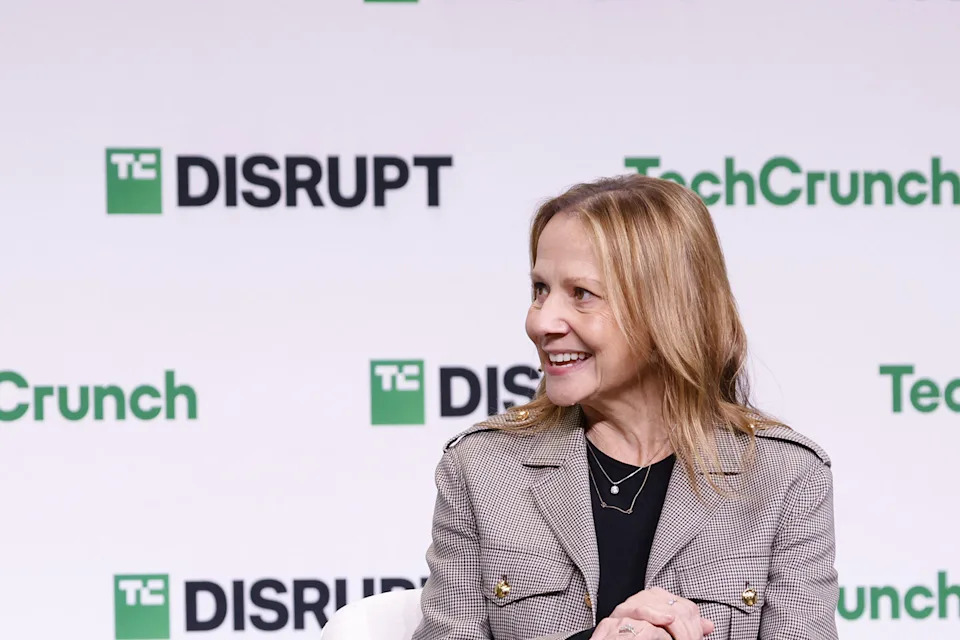
SAN FRANCISCO, CALIFORNIA - OCTOBER 29: (L-R) Matt Rosoff and Mary Barra, Chair & CEO of General Motors, speak onstage during TechCrunch Disrupt 2024 Day 2 at Moscone Center on October 29, 2024 in San Francisco, California.
 (Photo by Kimberly White/Getty Images for TechCrunch)

 TechCrunch
Rebecca Bellan
Tue, October 29, 2024 


“I never thought the propulsion of a vehicle would become a political issue,” GM Chairman and CEO Mary Barra said on stage at TechCrunch Disrupt on Tuesday.

While the executive didn’t expand on this statement, former President Trump has railed against EVs and claimed, wrongly, that there is a mandate to make and sell electric vehicles in the United States.


“General Motors’s goal is to just keep providing great vehicles, keep supporting the charging infrastructure to be more robust …and opening up the Tesla charging network, as well, so people choose it because it’s a great vehicle,” Barra continued. “And that’s the journey we’re working on, while we’re getting battery costs down. We’re still looking for battery innovation to get energy density up, cost down, all those things are going to be unlocks.”

Lowering battery costs could help lower the price of EVs. Affordability is top of mind for Barra who said it major factor for consumers.

“That’s why we’re so excited to have the Equinox and the Blazer on that because we’re getting into the affordable range, especially when you look at an Equinox EV that will be starting in that mid $30,000 range,” she said.

“But they want affordability with the right range,” she continued. And that sweet spot is really 300 miles before people start getting range anxiety.

Finally, accessibility to working, well lit, easy to pay for charging stations is what consumers want.

“Charging is just going to continue to get better,” she said, noting that GM has spent hundreds of millions of dollars to help boost charging infrastructure in partnership with companies like EVgo.

While EVs are a key component to Barra's vision for GM, autonomy, cybersecurity and a strategy for China are also important. Here are some of the highlights.
Cruise will still help GM transform the industry

“I became the CEO in 2014, and in 2015 we actually spent quite a bit of time in Silicon Valley, at Stanford and other places within the leadership team,” Barra said. “What were the technologies that were really going to transform our industry? We started looking at those. And autonomy was one.”

She noted that when GM acquired Cruise in 2016, the automaker kept its hands out of the AV startup’s business and let it develop as a startup would, which did lead Cruise to commercialize fully driverless robotaxi in San Francisco. Cruise’s permits to operate were suspended after a safety incident last October.

Nonetheless, Barra is still bullish on the possibilities for AVs to drive safety. She also believes the Cruise investment will continue to help GM one day provide personal autonomous vehicles.

GM will someday make a purpose-built AV

Following Cruise’s safety incident, the company scrapped its plans to produce the Origin, a purpose-built AV with no steering wheel or pedals. While Barra acknowledged that there are challenges to getting such a vehicle onto public roads – namely federal motor vehicle safety standards – she believes an AV built without human controls is still in the future for GM.

Keeping data secure

Electric vehicles today are computers on wheels, and as a result, they collect a lot of data, including the environment in which the car is driving, how the car is performing, and driving behavior. That data could contain sensitive information, which is something Barra says GM is prioritizing.

“I take cybersecurity really seriously from a vehicle perspective, because again, if something goes wrong, it can have dire consequences,” Barra said. “So that’s something we’ve been investing in for years. Privacy as well, treating data with respect and continuing to raise the bar on how to manage data and make sure we’re doing the right thing.”


It should be noted that GM is among a number of automakers who were sharing consumer driving data with insurance companies, the NYT reported earlier this year. GM has since stopped sharing that data with LexisNexis Risk Solution and Verisk, two data brokers that created risk profiles for the insurance industry, and also hired an executive to oversee customer privacy.

Moving away from China

Barra has referred to competing for EV market share in China as a “race to the bottom,” and she doubled down on those comments Tuesday.

“There’s a lot going on from a political perspective,” she said. “Our business in China is shifting.”

During the third quarter, GM’s China JV lost $137 million, compared with a $192 million profit a year ago. That’s because it’s tough to compete with domestic brands that have government backing to produce excellent vehicles at low costs.

“The competition is just continuing,” she said. “From a pricing perspective, it’s lower and lower and lower. And so you have to look at what’s the sustainable business? Because the situation that’s there right now is not sustainable. We have 100 or so companies, less than a handful are profitable.”
80% Of The World's Wealth Is Inherited


Adrian Volenik
BENZINGA
Mon, October 28, 2024

On a recent episode of the Joe Rogan Experience, Rogan and his guest Shane Smith, co-founder of VICE Media, dove into one of Rogan’s favorite topics: the absurd inequalities of the modern world. The two discussed what Rogan described as a depressing reality—around 80% of the world's wealth is inherited.

Although this statistic is flawed, Rogan expressed his thoughts openly. “That’s how you make monsters,” he said. His point? When wealth is handed down generation after generation, it creates a cycle that locks people into their positions—some are born with it all while others get nothing. And the people with inherited wealth? They aren't necessarily equipped to handle it responsibly.

Smith added that most people worldwide never get a real chance at wealth or, as he puts it, they “don’t have a kick at the can.” If you’re born into the wrong family, in the wrong place, at the wrong time, you stay stuck.

Unlike the rags-to-riches success stories often glamorized in popular culture, the real story behind the world’s billionaires is often one of privilege passed down from generation to generation.

Though estimates vary, research shows that much global wealth is handed down rather than earned. For instance, according to research, around 10.2% of billionaires received their wealth through inheritance while 29.6% of billionaires credit both inheritance and self-sufficiency for their wealth.

Furthermore, according to new data from The Guardian, all billionaires under 30 have inherited their wealth, illustrating the growing significance of generational transfer in wealth building. These include people like the Del Vecchio siblings, who inherited stakes in their family's luxury eyewear company Luxottica (OTC:ESLOY) or Livia Voigt, who became a billionaire at 19 thanks to her share in her grandfather's company, WEG Industries.

This concentration of wealth isn't just about money. There’s access—as people who inherit wealth also get connections, opportunities and social status—things that make it easier to stay on top and harder for others to catch up. Rogan and Smith explained that when wealth is concentrated like this, it creates a society where the rich keep getting richer while everyone else struggles to keep up.

Rogan also spoke about how the United States is still the ‘promised land’ for those seeking opportunities. He said, “This really is the promised land. It really is, I mean, clearly not for everybody, but also there’s a possibility the opportunity awaits itself right here. It really is the greatest country the world has ever known."
GNOMES OF ZURICH ON THE MOVE

Swiss companies set sights on India as $100 billion trade pact promises more opportunities


Mon, October 28, 2024 
By John Revill

ZURICH (Reuters) - Investments in India by Swiss companies such as engineering group ABB and transport firm Kuehne+Nagel are on the rise, with a $100 billion regional trade deal expected to further open it up to businesses long geared towards China.

India's appeal has already reflected a broader shift among businesses in Europe eager to balance the costs of a U.S.-China trade spat and recognition that the Chinese economy is, by comparison to India, losing steam.

But the trade and economic partnership (TEPA) signed in March with the European Free Trade Association, whose biggest member is Switzerland, is likely, when ratified, to provide an extra incentive to Swiss investment as it will slash tariffs on exports from chocolates to watches and machinery.

Under the deal, EFTA, whose other members are Norway, Iceland and Liechtenstein, will invest $100 billion in India and will benefit from easier and cheaper access to the Indian market of 1.4 billion people. India expects the agreement to boost its exports of pharmaceuticals, clothing and machinery.

"India is now really booming," said Morten Wierod, CEO of ABB, an electrical and industrial automation supplier expanding its Indian footprint after its orders there increased by an average of 27% per annum in the last three years.

To meet demand, ABB has been building factories, offices and showrooms in India, with eight projects completed since 2023, increasing its workforce from 6,000 to 10,000 since 2020.


Now ABB's number 5 market, India is on track to become its third biggest after the U.S. and China in a few years, Wierod said.

"Our investments in India are supporting that growth, both with more local manufacturing, but with much more R&D so that you can make designs in India, for India," he said.

Although India is gaining importance, ABB is still committed to China, Wierod said, a view shared by other companies Reuters spoke to.

TARIFFS REDUCED

No companies Reuters spoke to said they were investing in India specifically because of TEPA, which has yet to come into force, but the Swiss government and business advocates expect the deal will boost trade and investments.

The pact still requires parliamentary approval, and is expected to become effective in either late 2025 or early 2026.

Rapid growth in India has fuelled Swiss interest. The IMF expects the Indian economy to grow 7% this year and 6.5% in 2025, outpacing forecasts of 4.8% and 4.5% for China. The IMF expects that trend to continue through the end of the decade.


China has long attracted more Swiss direct investment, but in 2021-2022 India took the lead, according to data from the Swiss National Bank.


"Doing business in China has become less easy as its economy there has been doing less well, and there is also the risk of large scale conflicts - economic or otherwise - with China," said Philippe Reich, chairman of the Swiss-Indian Chamber of Commerce, who called the trade deal a "game changer".

According to Reich, around 350 Swiss companies already operate in India, and more will follow.

TEPA will reduce tariffs on 94.7% of exports to zero from an average of 22% now, giving Swiss companies an edge over counterparts in the European Union and Britain, which are still negotiating agreements with India, business minister Guy Parmelin said.

In return for EFTA-based firms investing $100 billion over 15 years - which aims to create 1 million jobs - India has promised to provide a favourable investment climate.

What this means has not been specified in detail beyond the tariff changes, but both sides have agreed to identify investment opportunities and help companies deal with problems.


"The TEPA will benefit everyone," Parmelin told Reuters, pointing to the reduction of tariffs and administrative burdens.

'RED CARPET'


Florin Mueller, head of the Swiss Business Hub - part of the Swiss Trade Promotion Agency in Mumbai - said TEPA would put India "on the map" for Swiss companies and roll out a "red carpet for them to come and invest".

Smaller firms such as Feintool are setting up there. The precision component specialist is building its first Indian factory near the western city of Pune which will employ up to 200 people when it opens next year.


The plant, which will make parts for the reclining mechanism in car seats, will meet demand from Indian and international customers for a local supplier which makes it easier and quicker to get the right components.

"We see huge potential in India," said Feintool's India managing director Tobias Gries.

Swiss exports to India are still modest. India bought only 1.5% of total Swiss mechanical and electrical exports in 2023, though its share grew by nearly 8%.

Meanwhile, Kuehne+Nagel is increasing its India workforce to 4,800 from 2,850 since 2019, and opening new logistics centres in Chennai, Gurugram and Kolkata this year.

India managing director Anish Jha said government schemes such as India's National Logistics Plan, which has seen big investments in road, rail and ports, were helping.

The initiative is easing transport costs, fuelling growth and supporting Kuehne+Nagel, whose India revenues are rising at more than double the rate of the group overall.

"We see significant growth in India and we are committed to increasing our presence here," Jha said. "We're very optimistic."

(Reporting by John Revill; Editing by Dave Graham and Alison Williams)
US voters concerned about post-election violence and efforts to overturn the results: AP-NORC poll

GARY FIELDS
Updated Mon, October 28, 2024 

WASHINGTON (AP) — American voters are approaching the presidential election with deep unease about what could follow, including the potential for political violence, attempts to overturn the election results and its broader implications for democracy, according to a new poll.

The findings of the survey, conducted by The Associated Press-NORC Center for Public Affairs Research, speak to persistent concerns about the fragility of the world’s oldest democracy, nearly four years after former President Donald Trump's refusal to accept the 2020 election results inspired a mob of his supporters to storm the U.S. Capitol in a violent attempt to stop the peaceful transfer of power.

About 4 in 10 registered voters say they are “extremely” or “very” concerned about violent attempts to overturn the results after the November election. A similar share is worried about legal efforts to do so. And about 1 in 3 voters say they are “extremely” or “very” concerned about attempts by local or state election officials to stop the results from being finalized.

Relatively few voters — about one-third or less — are “not very” or “not at all” concerned about any of that happening.

Trump has continued to lie about fraud costing him reelection four years ago and is again forecasting that he can lose this time only if the election is rigged against him, a strategy he has deployed since his first run for office. His allies and the Republican National Committee, which he reshaped, have filed lawsuits around the country that are a potential prelude to post-election legal challenges should he lose.

“I thought after Jan. 6 of 2021, the GOP would have the sense to reject him as a candidate,” Aostara Kaye, of Downey, California, said of Trump. “And since they didn’t, I think it just emboldened him to think he can do anything, and they will still stick with him.”

Many voters think Trump won't concede if he loses

Trump's wide-ranging attempts to reject the will of the voters and remain in power after his 2020 loss have led to concerns that he will again fail to concede should he lose to Vice President Kamala Harris.

Nearly 9 in 10 voters said the loser of the presidential election is obligated to concede once every state has finished counting its votes and legal challenges are resolved, including about 8 in 10 Republicans. But only about one-third of voters expect Trump to accept the results and concede if he loses.

Democrats and Republicans have widely divergent views on the matter: About two-thirds of Republican voters think Trump would concede, compared to only about 1 in 10 Democrats.

The same concern does not apply to Harris. Nearly 8 in 10 voters said Harris will accept the results and concede if she loses the election, including a solid majority of Republican voters.

Democrats and Republicans divided on who would weaken democracy

Members of both parties have broad concerns about how American democracy might fare depending on the outcome of the November election.

Overall, about half of voters believe Trump would weaken democracy in the U.S. “a lot” or “somewhat” if he wins, while about 4 in 10 said the same of Harris.

Not surprisingly, Americans were deeply divided along ideological lines. About 8 in 10 Republicans said another term for Trump would strengthen democracy “a lot” or “somewhat," while a similar share of Democrats said the same of a Harris presidency.


About 9 in 10 voters in each party said the opposing party’s candidate would be likely to weaken democracy at least “somewhat” if elected.

Kaye, a retired health care system worker, called Trump an “existential threat to the Constitution.” One prospect she said frightens her is that if Trump wins, he likely will not have the guardrails in his new administration that were in place in the last one.

Republican voter Debra Apodaca, 60, from Tucson, Arizona, said it's Harris who is a greater threat to democracy. She said President Joe Biden's administration has placed too great a priority on foreign aid and shown a lack of concern for its own people.

“Our tax dollars, we’re just sending it everywhere. It’s not staying here. Why aren’t we taking care of America?” she said. “Why should we pay taxes if we’re just sending it away?”


That lack of concern also includes the border, she said, adding that a Harris win would be “the end to the Border Patrol.”

The January 6th attack on the Capitol is a dividing line

Part of what divides voters on their views of American democracy is the Jan. 6 attack on the U.S. Capitol and who is to blame. Democrats and independents are much more likely than Republican voters to place “a great deal” or “quite a bit” of responsibility on Trump.

Susan Ohde, an independent voter from Chicago and a retiree from the financial sector, said she’s concerned that “crazy people will buy the misinformation that they’re given,” leading to another such attack.


Giovanna Elizabeth Minardi of Yucaipa, California, said other issues are more important in this year's election. She said her chief concern is the economy and feels that high prices, especially in her home state, are chasing off businesses and creating a dependency on government. It's a dependency Harris wants to continue, said Minardi, a children and family services advocate.

Views about the Jan. 6 attack are not the only ones where voters split along ideological lines. Following Trump's lead, a majority of Republicans maintain that Biden was not legitimately elected. Nearly all Democrats and about 7 in 10 independents believe Biden was legitimately elected.

Other aspects of the political system are divisive too

This year's presidential campaign has highlighted one aspect of the American political system that some believe is undemocratic — the use of the Electoral College to elect the president rather than the popular vote. Trump and Harris have concentrated their campaign events and advertising in seven battleground states that represent just 18% of the country's population.


About half of voters think the possibility that a candidate could become president by winning the Electoral College but losing the popular vote is a “major problem” in U.S. elections. As with many other issues, the question also reveals a partisan divide: About two-thirds of Democrats say the potential for an Electoral College-popular vote split is a major problem, compared to about one-third of Republicans.

Debra Christensen, 54, a home health nurse and Democrat from Watertown, Wisconsin, is opposed to the Electoral College that could give Trump the White House even if he loses the popular vote for the third time.

“In this day and age with technology what it is, why can’t we have one person one vote?" she said.

___


The poll of 1,072 adults was conducted Oct. 11-14, 2024, using a sample drawn from NORC’s probability-based AmeriSpeak Panel, which is designed to be representative of the U.S. population. The margin of sampling error for registered voters is plus or minus 4.2 percentage points.

___


Social Media Mocks Joe Rogan's Reason Why Kamala Harris Interview Hasn't Happened

David Moye

Podcaster Joe Rogan was mocked on social media Tuesday after offering his explanation for why his proposed interview with Kamala Harris hasn’t taken place.

In a post on X, formerly Twitter, Rogan said he’d like to “just have a nice conversation and get to know her as a human being,” but prefers the vice president do a full three hours in his studio in Austin, Texas.

Donald Trump agreed to those terms when he did Rogan’s show last week, and CNN reports that his running mate, JD Vance, is scheduled to tape an episode tomorrow. But the Harris campaign, citing a busy schedule in the last week before the election, asked Rogan to come to Harris and to limit the interview to an hour. So Rogan demurred.

Political commentators on social media thought Rogan’s request a little bit out of line for a variety of reasons ― including his own ego.

Rogan’s reluctance to travel to Harris was the subject of much snark.

One fellow podcaster found it strange that Rogan was willing to fly to interview comedian Artie Lange, but is skittish about traveling to interview a world leader.

But “Inside Edition” correspondent Lisa Guerrero suggested the real reason for Rogan’s reluctance to interview Harris is that it would require actual work on his part.

“I think Joe Rogan is afraid to interview Kamala Harris because that would require a great deal of research and preparation that he is not equipped to do,” she said.