Monday, December 23, 2024


Offshore Wind Drives Shipyard Expansion - In Dubai

DP World
Image courtesy DP World

Published Dec 22, 2024 10:06 PM by The Maritime Executive


Offshore wind development is driving shipyard expansion in an unexpected place - Dubai, the glittering financial hub of the Arab world. 

Last week, GE Vernova and DP World's shipyard division Drydocks World announced that they have won the transmission-system contract for Ostwind 4, a new 2 GW offshore wind farm in the Baltic Sea. The project team will deliver a high voltage DC connection for the project, a first for the area. On completion in 2031, it will deliver enough power for up to two million households. 

Drydocks World's portion of the scope includes the fabrication of the farm's offshore converter platform. The jacket and topsides will be built in Dubai, shipped to the Baltic and installed off Rugen Island. 

Last week, just in time for the award, DP World held an inaugural ceremony for the opening of a large yard expansion that will give it more room for projects like Ostwind 4. According to DP World, the expansion increases fabrication capacity by 40 percent and yard capacity by 25 percent, helping Drydocks World to carry out multiple large-scale projects at the same time. It has the largest load-out jetty in the Middle East and Africa, capable of handling structures weighing up to 37,000 tonnes - perfect for large topsides structures. 

"The South Yard expansion is a testament to Drydocks World’s commitment to innovation and sustainable growth," said Sultan Ahmed bin Sulayem, Group Chairman & Chief Executive Officer at DP World. "As the demand for cutting-edge energy solutions rises globally, this facility will enable us to lead in renewable energy infrastructure." 

According to DP World, the South Yard expansion is fully powered by solar electricity from the nearby Sheikh Mohammed bin Rashid Al Maktoum Solar Park, reducing its carbon footprint. 


Report: Policy Rethink Needed for India’s 2030 Offshore Wind Goal
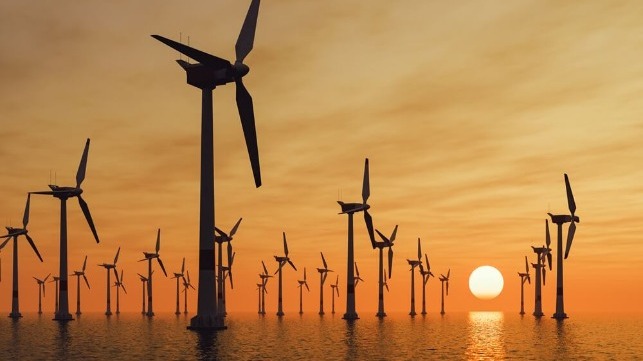
Offshore wind farm at sunset
iStock / imaginima

Published Dec 22, 2024 2:21 PM by The Maritime Executive


The last two years has seen India take significant steps to spur the development of offshore wind energy. A notable milestone was the approval of the $821 million Viability Gap Funding (VGF) program back in June, intended to incentivize the development of the first 1 GW of offshore wind capacity. But India’s current levels of government support fall short in delivering the 37 GW offshore wind capacity goal by 2030, according to a report released last week.

The report by the International Institute for Sustainable Development (IISD) and the Center for Study of Science, Technology and Policy (CSTEP) found that the cost gap to make offshore wind competitive in India is still high, requiring sustained government subsidies and policy support. The offshore wind could take at least 12 years to reach the grid parity in India. The cost gap identifies how much the cost of clean power needs to drop to reach cost parity with conventional sources such as coal.

While the recent VGF scheme is an important development, the report claims that it may be insufficient given that the cost gap per GW of capacity is around $1.1 billion. Thus, to achieve the aspirational goal of 37 GW by 2030, the total cost gap is estimated at $61 billion, or $8.75 billion per year between 2024 and 2030.

“India’s clean energy ambition is remarkable, and delivering on these goals will require bold investments and policy alignment. Emerging technologies like offshore wind represent transformative opportunities for the country’s energy landscape but need sustained support to realize the potential,” said Swasti Raizada, Policy Advisor at IISD and co-author of the report.

In the view of the high cost gap in deploying offshore wind in India, the report recommends several policy options. This includes postponing the 2030 capacity goal to allow costs to fall, but not delay provision of support. The sooner India starts deployment, the sooner domestic costs will decline. Further, the government could consider a new model for pooling renewable energy, so that offshore wind is bundled with cheaper clean energy sources to create demand and secure off takers for initial projects. For instance, solar PV is already cheaper than new coal and gas installations in India.

Meanwhile, government support for the offshore wind sector extends to port infrastructure, strengthening the domestic supply chain. Recently, the government designated V.O. Chidambaranar (VOC) Port in Tamil Nadu as an offshore wind port. As a result, the port on Saturday announced it will construct a terminal for handling windmill blades and accessories. The terminal will feature two berths, with quay length of 370 meters.


 

Video: Containership Rolls Over While Loading in Istanbul

containership rolled over
Ikproper loading caused the small containership to roll onto its side (YouTube)

Published Dec 23, 2024 11:09 AM by The Maritime Executive


A small containership docked in Turkey’s main container port lost stability and rolled onto its side this morning, December 23, during the loading operation. Port officials are working to contain the damage and clean up from the vessel.

The vessel named Amnah (5,200 dwt) was loading containers at the Ambarli Port in Istanbul when it started listing toward the dock and eventually rolled onto its side. The incident was reported at 0400 local time and in the videos crewmembers can be seen on the deck.

Turkish officials reported there were 15 crew aboard and that five jumped into the water and swam to safety. The other ten were rescued from the vessel. One crewmember suffered minor injuries and was taken to a hospital.


The ship was built in 1996 and was operating until recently for Russia’s Fesco shipping company. Databases reflected it transferred owners to a company in Belize as of October 2024 and is managed from Turkey. The ship is registered in Comoros.

Officials believe the vessel was improperly loaded causing it to lose stability. They reported an investigation would be undertaken to determine what happened during the loading process.

A containment boom was strung around the vessel to prevent pollution. 


Another Allision Disrupts Ireland-UK Ferry Services

Isle of Innisfree
Isle of Innisfree (Gordon Leggett / CC BY 4.0)

Published Dec 22, 2024 11:36 PM by The Maritime Executive


After two allisions damaged the terminal used for the Dublin-Holyhead ferry route earlier this month, Irish Ferries pivoted to open a new route between Dublin and Fishguard. On Friday, that route was also temporarily shut down by a dock allision on the inaugural voyage

During Storm Durragh in early December, two separate allisions damaged the Terminal 3 berth used by Irish Ferries, "resulting in part of the berthing structure collapsing and rendering it unusable," according to Holyhead Port. Drone footage of the scene appears to show that a mooring dolphin was toppled over into the water. 

The damage shut down the port until January 15, forcing traffic between Wales and Dublin to reroute. An initial assessment suggested that the port would be back up and running by December 20, but further investigation showed that the damage was more serious than expected, Irish Taoiseach Simon Harris told local media. 

Stena Line and Irish Ferries ordinarily operate up to five ferries a day from Holyhead, and the shutdown impedes freight and passenger transport. "We're really going to struggle to get goods delivered to both the high street and for internet shopping" in time for Christmas, Irish Road Haulage Association President Ger Hyland told Afloat.ie. 

To resolve the bottleneck, Irish Ferries and Stena Line have worked with the Welsh government and other ports in the region to find alternatives. Ken Skates, Cabinet Secretary for Transport and North Wales, pledged to "leave no stone unturned in urgently identifying alternative solutions." Both lines have reassigned vessels and set up temporary services between Dublin and Fishguard, a port 90 miles to the south of Holyhead.   

On Friday, the ferry Isle of Innisfree was arriving at Fishguard for its first voyage on the new route when it hit the quay, putting a hole in the starboard bow. 

Isle of Innisfree quickly returned to service, according to Irish Ferries' online tracker. The ferry is on the schedule for normal departures beginning Monday. 


India Permits Crew to Depart After Year of Detention in Smuggling Case

Paradip India
The bulker and its crew has been held for a year after cocaine was discovered aboard when it arrived a Pradip in India (Paradip Port file photo)

Published Dec 23, 2024 11:34 AM by The Maritime Executive


More than a year after Indian officials first detained a Vietnamese-managed bulker on suspicion of cocaine smuggling the crew of the vessel is being released. This came after the crew earlier this month staged a work stoppage to protest their long detention and repeated efforts by the shipping company to have the vessel released.

A total of 12 of the 21 crewmembers, according to The Times of India, were released this morning, December 23, in Paradip Port and will be permitted to travel home. Officials told the newspaper that their release came only after 11 replacements, seven from Vietnam and four from India, had boarded the ship named Debi. Nine additional crewmembers remain aboard the ship but will be released when their replacements arrive.

The ordeal began when Debi, a 37,196 dwt bulker arrived from Indonesia on November 30, 2023, and first went into the anchorage and then moved to the terminal in the Indian port. The 611-foot bulker is registered in Panama and managed by a company in Vietnam. It was scheduled to transport a cargo of steel plate to Denmark.

A longshoreman spotted packages concealed from view and attached to the underside of a crane and reported it to the port authority. An inspection recovered 22 kilos of cocaine, which was reported to be the largest bust in Paradip Port. It had been attached to the cranes with magnets.

Indian authorities detained the ship and seized the crew’s electronics to determine if they were involved in the smuggling. They have remained in detention although no legal charges were filed against the crew. One engineer after an altercation on the ship jumped in an apparent suicide attempt but was rescued. The crew finally went on strike in late November while the ship had been transferred to the dock for replenishment.

An Indian court had ordered the ship sold. According to the news reports, the court rejected a new appeal this month to have the ship released. 

The ship will continue to be detained according to the newspaper reports. 
 

FSG Shipyards Get Temporary Financing from German State to Continue Work

ALL CAPITALI$M IS STATE CAPITALI$M

The two shipyards are receiving temporary financing to maintain operations in January (FSG file photo)

Published Dec 23, 2024 12:48 PM by The Maritime Executive


The bankrupt German shipbuilding group FSG-Nobiskrug Holding received temporary financing to keep the operations open while efforts continue to seek permanent investors. The group had been forced into a contentious insolvency order by the German courts despite assertions from the yard’s owners that they would be refinanced.

Germany’s Federal Minister of Economics, Robert Habeck, accepted an invitation from the union IG Metal and visited the shipyard in Flensburg today, December 23, to discuss the situation and pledge his support in the rescue efforts. While at the shipyard, the minister met with the two provisional insolvency administrators while announcing that the State of Schleswig-Holstein’s Guarantee Bank was providing insolvency funds and loans to keep the operations going.

Christoph Morgen who is acting as the administrator for the FSG yard said the monies would ensure the operating costs are secured till the end of January. He emphasized however that the time is short to find investors for the yards.

The FSG shipyard dates back to 1872 and in recent years has been building RoRo ferries. It went through a prior insolvency in 2020 also overseen by Morgens. Investor Lars Windhorst rescued the yard and combined it with the Nobiskrug yard in Rendsburg which has also been in operation for over 120 years. Since 2000, Nobiskrug has specialized in luxury superyachts.

Morgens said the goal was to continue work on the RoRo being built for SeaRoad while reporting potential investors had visited the yard. He is targeting completing a transaction by February 1 noting that the two yards would likely be separated going to two different investors. He emphasized the potential for naval shipbuilding as well as supporting the offshore wind energy sector.

The Rendsburg location is being overseen by provisional insolvency administrator Hendrik Gittermann. He told reporters that there had been good interest in Nobiskrug Yachts and FSG Nobiskrug Design. He said he was “pleasantly surprised” by the level of inquiries coming from aboard.

The shipyards had faced months of financial troubles with media reports of back pay and overdue bills. An insurance provider was the company that forced the group into the insolvency process. Media reports indicate employees received their November pay and Christmas bonus payment on December 18.

Minister Habeck stressed the importance of shipbuilding as an industry to Germany and the yards' contribution to the economy in northern Germany. He said he would work personally to help preserve the two yards.

Windhorst at the time of the filing had contended that he was working on refinancing. He said the actions would force a government response while asserting the matter would be resolved quickly.

The reports indicate the intent is to place the two shipyards with private investors that can revitalize the operations. The German government earlier this year stepped in to save the Meyer Werft shipyard in Papenburg. In that case, the German government guaranteed loans and provided capital taking temporary ownership of the company from the Meyer family. The goal is to transition the Meyer shipyard back to private ownership in the next few years.
'Build your army': Trump’s Pentagon pick wants Christian nationalist 'boot camps' for kids


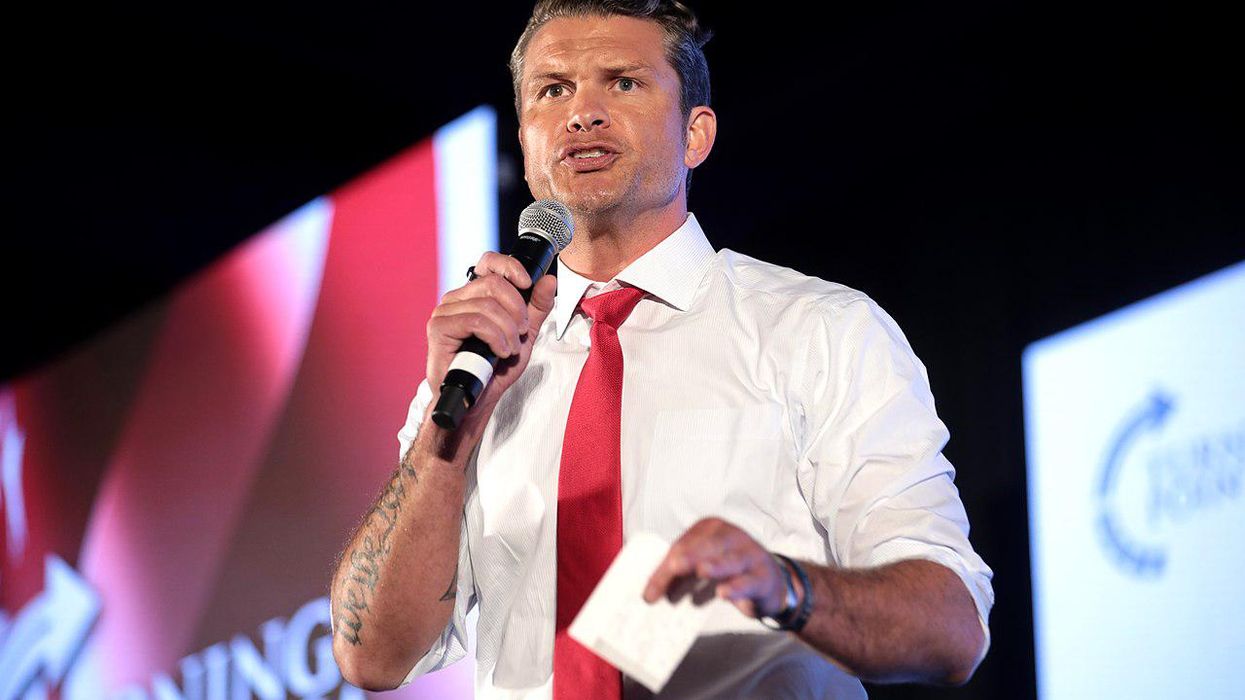
Fox News' Pete Hegseth speaking at the 2019 Teen Student Action Summit, hosted by Turning Point USA at the Marriott Marquis in Washington, D.C., Gage Skidmore
November 26, 2024

Fox News personality Pete Hegseth, who President-elect Donald Trump has nominated to be the potential next defense secretary, recently called for radically transforming the public education system in order to accommodate a Christian nationalist vision.

That's according to Salon writer Amanda Marcotte, who highlighted Hegseth's remarks in a November episode of the "CrossPolitic" podcast. In that podcast — which is hosted by two men with close ties to far-right chattlel slavery apologist pastor Douglas Wilson — Hegseth called for an "educational insurgency" of "classical Christian schools."

In the interview promoting his book "Battle for the American Mind," Hegseth agreed with host Toby Sumpter, who said: "I think we need to be thinking in terms of these classical Christian schools are boot camps for winning back America."

"That's what the crop of these classical Christian schools are gonna do in a generation," Hegseth said. "Policy answers like school choice, while they're great, that's phase two stuff later on once the foothold has been taken, once the recruits have graduated boot camp."

"We call it a tactical retreat," Hegseth added, using overtly militaristic language. "We draw out in the last part of the book what an educational insurgency would look like, because I was a counterinsurgency instructor in Afghanistan and kind of the phases that Mao [Zedong] wrote about. We're in middle phase one right now, which is effectively a tactical retreat where you regroup, consolidate, and reorganize. And as you do so, you build your army underground with the opportunity later on of taking offensive operations in an overt way."

Marcotte pointed out that the conversion of public schools to far-right Christian indoctrination spaces is already underway in some red states. She observed that Oklahoma education superintendent Ryan Walters is mandating that all schools show students a video in which he attacks the "radical left" and "woke teachers' unions" and delivers a lengthy prayer for the protection of Trump. She also noted that Walters has already proposed spending millions in taxpayer dollars on putting Trump's branded Bibles in public school classrooms.

"So far, this flagrant violation of the Constitution hasn't worked. The state attorney general stepped in and declared that Walters cannot mandate the viewing of his propaganda. Some school districts refused, though it's quite possible others gave in out of an unwillingness to fight with Walters to defend their students," Marcotte wrote. "More importantly, this is just an escalation of an all-out effort by Walters to turn Oklahoma's public schools into exactly the 'boot camps' building up the 'army' of Christian nationalists that Hegseth and his cronies imagine."

Click here to read Marcotte's article in full.

Trump’s pick to lead Federal Housing Agency has openly fought efforts to help poor

ProPublica
December 23, 2024

Republican presidential nominee and former U.S. President Donald Trump dances as he leaves the stage at a campaign rally at the Rocky Mount Event Center in Rocky Mount, North Carolina, U.S., October 30, 2024. REUTERS/Jay Paul

ProPublica is a Pulitzer Prize-winning investigative newsroom. 

As Donald Trump’s nominee to run the U.S. Department of Housing and Urban Development, Scott Turner may soon oversee the nation’s efforts to build affordable apartments, protect poor tenants and aid the homeless. As a lawmaker in the Texas House of Representatives, Turner voted against those very initiatives.

Turner supported a bill ensuring landlords could refuse apartments to applicants because they received federal housing assistance. He opposed a bill to expand affordable rental housing. He voted against funding public-private partnerships to support the homeless and against twobills that called merely to study homelessness among young people and veterans.

Behind those votes lay a deep-seated skepticism about the value of government efforts to alleviate poverty, a skepticism that Turner has voiced again and again. He has called welfare “dangerous, harmful” and “one of the most destructive things for the family.” When one interviewer said receiving government assistance was keeping recipients in “bondage” of “a worse form to find oneself in than slavery,” Turner agreed.

Such views would seemingly place Turner at odds with the core work of HUD, a sprawling federal agency that serves as a backstop against homelessness for millions of the nation’s poor, elderly and disabled. With an annual discretionary budget of $72 billion, the department provides rental assistance to 2 million families, oversees the country’s 800,000 public housing units, fights housing discrimination and segregation and provides support to the nation’s 650,000 homeless. If Turner’s record indicates how he will direct the agency’s agenda, it is those clinging to the bottom of the housing market who have the most to lose, researchers and advocates said.

“It just doesn’t seem to me like this is someone who is at all aligned with what the values of that agency should be,” said Cea Weaver, director of the advocacy group Housing Justice for All. “It’s a deregulatory agenda, and it’s an anti-poor people agenda.”

Shamus Roller, executive director of the National Housing Law Project, said Turner’s views, if translated into policy, could increase homelessness. “If, at a fundamental level, you believe that people getting assistance with their rent when they’re very poor and struggling, if you think that’s actually dependence and a bad thing, you’re going to try to undermine those programs,” he said.

One former colleague offered a more optimistic view of Turner’s stewardship of HUD. “My sense of him is he will try to help people,” said Richard Peña Raymond, a Democratic Texas House member who served on a committee with Turner. “I do think he’ll do a good job.”

Turner did not respond to detailed questions. A spokesperson for the nominee said: “Of course ProPublica would try and paint a negative picture of Mr. Turner before he is even given the opportunity to testify. We would expect nothing less from a publication that solely serves as a liberal mouthpiece.”

The Trump transition team and HUD did not respond to requests for comment. Trump’s announcement of Turner’s nomination praised him for “helping lead an Unprecedented Effort that Transformed our Country’s most distressed communities” as head of a White House council that promoted opportunity zones, a plan to spur investment in low-income neighborhoods by offering generous tax breaks, during Trump’s first administration. “Under Scott’s leadership,” the announcement went on, “Opportunity Zones received over $50 Billion Dollars in Private Investment!”

Turner is hardly the only Trump cabinet nominee to display skepticism or outright hostility toward the work of agencies they may lead. But, while other nominees have faced intense scrutiny in recent weeks, Turner has attracted little public attention and said even less about his intentions, beyond vowing to “bring much-needed change” to HUD, as he wrote on Facebook last month. ProPublica pieced together his views on housing through a review of legislative records and of Turner’s public speeches, podcast appearances and sermons at the Plano, Texas, megachurch where he is a pastor.

A possible HUD agenda for Turner can be found in Project 2025, the Heritage Foundation’s recommendations for a conservative presidential administration. The report calls for cutting funding for affordable housing, repealing regulations that fight housing discrimination, increasing work requirements and adding time limits for rental assistance and eliminating anti-homelessness policies, among other changes. The Project 2025 chapter on HUD lists Ben Carson, the department secretary during the first Trump administration and a mentor to Turner, as its author. Carson, as secretary, was involved in efforts to end an anti-segregation rule, add work requirements for housing assistance and make it harder to prove housing discrimination.

Turner’s views appear to be deeply rooted in his upbringing outside Dallas, where he was, as he later put it, “a young kid from a broken home, from a poor family.” His parents’ relationship was “filled with violence, domestic violence, abuse, a lot of anger [and] alcohol.” Years later, as a legislator, Turner said that his sister had been “on state assistance and wasn’t feeding [Turner’s] nephew while she was on drugs.” (ProPublica was unable to locate Turner’s sister for comment.)

Football proved an escape. Turner received a scholarship to play for the University of Illinois Urbana-Champaign, and then he went on to a nearly decadelong career in the National Football League. He began transitioning into politics while still in the league, interning for California Rep. Duncan Hunter, a Republican who years later would be convicted of stealing from his campaign account. After an unsuccessful run for a California congressional seat in 2006, Turner moved back to Texas and was elected in 2012 to the state House of Representatives, where he served for four years.

There, Turner solidified his position as a deeply conservative member opposed to many government interventions into the housing market, legislative records show. He voted against supporting foreclosure prevention programs. He opposed legislation to help public housing authorities replace or rehabilitate their property (although he voted for a minor expansion of that bill two years later). He also sought to require drug testing for poor families applying for government assistance, the Houston Chronicle reported at the time. Turner did support some modest housing assistance measures, such as bills helping housing developments for seniors and in rural areas seek low-income housing tax credits.

During his time in office, Turner was the lead author of 17 substantive bills. None were related to housing, and none of them became law.

“He’s a very nice guy,” but “he didn’t really make much of a legislative impression,” said a former high-ranking Republican Texas lawmaker, who requested anonymity to speak candidly about a former colleague. “He didn’t leave a deep footprint.”

That did not stop Turner, however, from mounting an audacious bid for the House speakership, a move reportedlybackedby Tim Dunn, a West Texas pastor and oil billionaire who has used his fortune to push the state Legislature far to the right. Turner’s speaker campaign failed, but it helped solidify his position within Texas’ deep-red Christian political milieu, where he has remained ever since.

Turner is an associate pastor at Prestonwood Baptist Church, a political force in Texas that has counted numerous statewide elected officials as congregants. Jack Graham, the church’s senior pastor, prayed over Trump at an event in October and praised his electoral victory from the pulpit in November. Turner’s skepticism about government assistance has found its way into his sermons there, where he has derided the “perverse incentives created by the government and the welfare system, which in turn creates an epidemic of fatherlessness in our country.”

Turner or his political staffers also used campaign money to attend three conferences held by WallBuilders, an organization that seeks “to reveal the historical truths” about the “Christian foundation of our nation,” campaign finance records show. In 2016, Turner gave a $10,000 gift to WallBuilders from his campaign account.

Turner’s allies on the Christian far right also include Ziklag, a secretive network of ultrawealthy Christian families and religious influencers that support Trump. As ProPublica reported, Ziklag has raised millions of dollars as part of a larger mission to help Christian leaders “take dominion” over key areas of American society, from education and business to media and government. This year, Ziklag spent millions of dollars to mobilize Republican-leaning voters in swing states despite being a tax-exempt charity that isn’t allowed to intervene in politics. (A lawyer for Ziklag previously told ProPublica that the organization does not endorse candidates for political office.)

In June 2019, Turner and his wife, Robin, attended a private Ziklag conference at the Broadmoor luxury resort in Colorado Springs, Colorado, according to photos of the event posted by an attendee. At the time, Turner was working in the first Trump administration as executive director of the White House Opportunity and Revitalization Council, where he served as a public salesman for the opportunity zones initiative. Turner has praised the program as a way to improve neighborhoods with high poverty and unemployment rates. Previous reporting by ProPublica found that the program was exploited by wealthy, politically connected investors, which drew scrutiny from members of Congress.

Internal documents obtained by ProPublica and Documented show that Ziklag members sought to take advantage of the program; in May 2019, Ziklag said in one of its newsletters that members of the group had met with three administration officials about opportunity zones. “The administration informed the group they are in a state of listening and learning about the program,” the document reads. “Ziklaggers are exploring additional avenues to make an impact on the program moving forward.”

After leaving the Trump administration, Turner started a nonprofit that promotes “Christ-centered reading enhancement programs” for children and helps people get driver’s licenses. He also became “chief visionary officer” at the multifamily housing developer JPI.

Now, if confirmed, Turner will be in charge of an agency with some 10,000 employees at a critical time. “We’re dealing with a pretty terrible housing crisis all across the country,” said Roller, of the National Housing Law Project. HUD will be “essential to any effort” to solve it.


Jesse Coburn covers cities, housing and transportation for ProPublica. He’s interested in how the second Trump administration will reshape federal policy in those areas, particularly at the Department of Housing and Urban Development and the Department of Transportation. If you work for one of those agencies or are affected by their work, he’d like to hear from you. You can email him at jesse.coburn@propublica.org, or reach him via phone, Signal or WhatsApp at 917-239-6642. His mailing address is: Jesse Coburn, ProPublica, 155 6th Avenue, 13th Floor, New York, NY 10013.


FAMILY VALUES

'Prostitution, statutory rape, illicit drug use': Damning Matt Gaetz ethics report leaks

Brad Reed
December 23, 2024 
RAW STORY

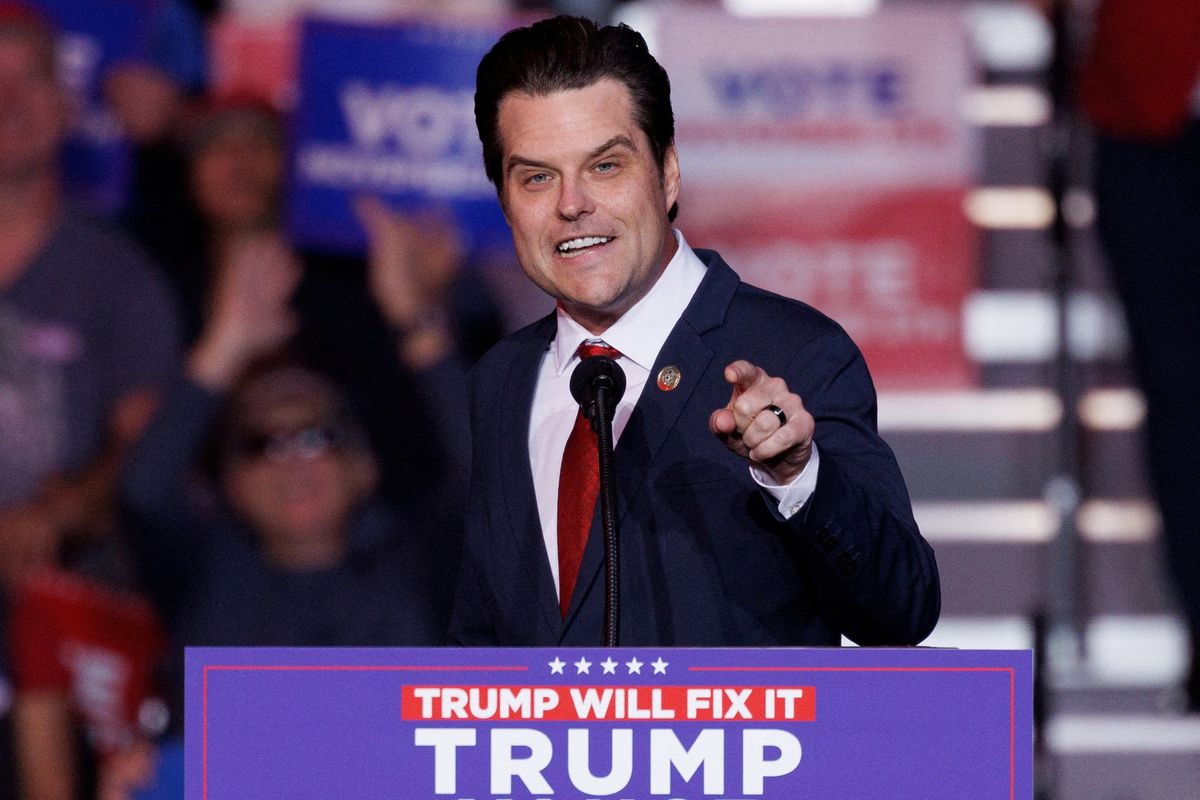
FILE PHOTO: Republican U.S. Representative Matt Gaetz speaks at a campaign rally for Republican presidential nominee and former U.S. President Donald Trump in Henderson, Nevada U.S. October 31, 2024. REUTERS/Mike Blake/File Photo

A copy of the House Ethics Committee's report into former Rep. Matt Gaetz (R-FL) obtained by CBS News alleges that the Florida Republican engaged in a number of illegal activities.

The 37-page report, which is due to be released on Monday, writes that "there is substantial evidence that Representative Gaetz violated House Rules and other standards of conduct prohibiting prostitution, statutory rape, illicit drug use, impermissible gifts, special favors or privileges, and obstruction of Congress."

The report relies on a combination of witness testimony, text message exchanges, and Venmo receipts to make the case that Gaetz repeatedly violated the law while serving as a Florida congressman.

Among the damning findings in the report are that Gaetz paid multiple women for sex in the past, including a girl who at the time was only 17 years old.

The report refers to the then-17-year-old girl whom Gaetz allegedly paid for sex as "Victim A," and it details her own direct testimony to the House Ethics Committee.

"Victim A recalled receiving $400 in cash from Representative Gaetz that evening, which she understood to be payment for sex," the committee writes. "Victim A said that she did not inform Representative Gaetz that she was under 18 at the time, nor did he ask her age."

Gaetz last week denied that he ever had sexual contact with a minor, although he did acknowledge that "in my single days, I often sent funds to women I dated -- even some I never dated but who asked."

Gaetz also said that "it’s embarrassing, though not criminal, that I probably partied, womanized, drank and smoked more than I should have earlier in life" and insisted that "I live a different life now."

Gaetz had originally been President-elect Donald Trump's choice to serve as United States attorney general, though he quickly withdrew his candidacy after it became clear that he would not have the votes to be confirmed.
'Eerie parallel' seen in Elon Musk's grip over GOP: historian

Brad Reed
December 23, 2024 
RAW STORY

Elon Musk participates in a SpaceX Demonstration Mission 2 Launch Briefing in 2020. (NASA/Bill Ingalls)

X owner Elon Musk flexed his political muscles last week when he used his platform to kill a bipartisan deal to keep the federal government open.

According to Vanderbilt University historian Nicole Hemmer, this kind of outside influence is hardly novel for Republicans, who for decades received their marching orders from the late right-wing radio host Rush Limbaugh.

Writing at MSNBC, Hemmer argued that there are "eerie historical parallels" between Limbaugh's influence over the party and what Musk is pulling off right now.

"For three decades, right-wing radio host Rush Limbaugh bent the party to his will by dangling the threat of his millions of loyal listeners — and reliable voters — over their heads," she wrote. "As Musk tests the power of X to discipline Republican lawmakers, he is also testing whether he can replicate Limbaugh’s singular influence over the GOP — and whether he can use his power to both amplify Donald Trump’s political will and assert his own as well."

However, Hemmer also noted that there were clear limits to Limbaugh's powers and that Musk may soon find he has some of the same limitations.

"Limbaugh had the power to destroy but not create, something Musk is beginning to learn about his own posting politics," she wrote. "Hours into Musk’s online tirade, Trump and Vice President-elect JD Vance joined in, pressuring Republicans to oppose the deal. They did, scuttling the bipartisan agreement and substituting a Musk-Trump alternative that went up for a vote the next day. That bill, too, failed. A government shutdown was only avoided with hours to spare — and without a debt ceiling hike, Trump’s chief demand."

Hemmer also cautions Republican lawmakers that they "may want to think twice before handing their power over to an antidemocratic and unpredictable billionaire," although she doubts that many of them will see that way "given their track record on that front."
Musk's Threat to Primary Democrats Sparks Fresh Call for Ban on Super PACs

"If there's ever been a time to discuss serious campaign finance reform, it is now," one advocate said. "We are sliding into a new era of American oligarchy, and unless we take decisive action, the integrity of our democracy is at risk."


Elon Musk attends The 2022 Met Gala Celebrating "In America: An Anthology of Fashion" at The Metropolitan Museum of Art on May 2, 2022 in New York City.
(Photo: Dimitrios Kambouris/Getty Images for The Met Museum/Vogue)

Olivia Rosane
Dec 21, 2024
COMMON DREAMS

Trump-backer and richest person alive Elon Musk's role in almost forcing a government shutdown this week has revived calls for campaign finance reform, both nationally and within the Democratic Party.

As part of his campaign against a bipartisan continuing resolution (CR) that would have funded the government through March 14, Musk said that Republicans who voted for the bill should lose their seats during the 2026 midterms and that he would fund moderate primary challengers to Democrats in safe districts.

"The threat of limitless super-PAC spending from the world's wealthiest man could have proven enough to shut down the federal government days before Christmas," Joseph Geevarghese, the executive director of Our Revolution, told Common Dreams. "If there's ever been a time to discuss serious campaign finance reform, it is now. We are sliding into a new era of American oligarchy, and unless we take decisive action, the integrity of our democracy is at risk."

"How about the House add campaign finance reform to the CR so Republicans and Democrats alike can stop being so scared about what a billionaire man-child thinks before they vote on anything around here?"

Before the shutdown showdown, Musk was already incredibly influential in politics as a financial backer: He spent at least $277 million on the campaigns of President-elect Donald Trump and other Republicans in 2024, including over $19 million on House races alone. Musk also spoke at Trump campaign rallies and was tapped by the president-elect to co-lead a new Department of Government Efficiency with fellow billionaire VivekRamaswamy.

However, his efforts to sink a spending bill revealed by House Speaker Mike Johnson (R-La.) on Tuesday raised fresh concerns about his influence on elected politicians. His initial barrage of complaints against the CR—posted on his social media site X on Wednesday—precipitated a statement against the bill by Trump and Vice President-elect JD Vance. Johnson never brought the bill up for a vote.

As part of his initial Wednesday tweet storm, Musk wrote, "Any member of the House or Senate who votes for this outrageous spending bill deserves to be voted out in 2 years!"

In response to Musk's threats, Rep. Richard Neal (D-Mass.), the ranking member of the Ways and Means Committee, gave an impassioned speech on the House floor on Thursday.

"Can you image what the next two years are going to be like if every time that Congress works its will and then there's a tweet? Or from an individual who has no official portfolio, who threatens members on the Republican side with a primary and they succumb?" Neal said.

Musk, in response to a video of Neal's speech, tweeted, "Oh… forgot to mention that I'm also going to be funding moderate candidates in heavily Democrat districts, so that the country can get rid of those who don't represent them, like this jackass."

The statement sparked outrage and resistance from congressional Democrats.

"Everyone knows I'm always ready," Neal toldBusiness Insider, while the Democrats on the Ways and Means Committee tweeted out sarcastic memes.


Rep. Alexandria Ocasio-Cortezcalled for change on social media on Friday, writing, "How about the House add campaign finance reform to the CR so Republicans and Democrats alike can stop being so scared about what a billionaire man-child thinks before they vote on anything around here?"

Ultimately, after another Republican-led spending bill failed to clear the House on Thursday, Johnson introduced a paired-down CR that included key measures backed by Democrats such as relief for disaster victims and aid for farmers. That bill passed the House on Friday and the Senate early Saturday, narrowly averting a government shutdown that would have deprived hundreds of thousands of federal employees of paychecks over the holidays.

But Musk's intervention established a precedent "that should upset every American who believes in our democratic form of government," Sen. Bernie Sanders (I-Vt.) said.

"Musk is getting carried away with himself, using his limitless fortune and his ownership of X to try to turn American politics to the authoritarian right," former U.S. Labor Secretary Robert Reich wrote on his Substack on Friday.

"Wealth inequality is rapidly undermining our democracy," Reich continued. "Musk is the poster boy for a wealth tax."

Musk's primary challenge to Neal bolstered calls for the Democratic National Committee (DNC) to ban super-PAC spending in its primaries.

"Elon Musk, worth $455 billion, spent $277 million to buy the Republican Party," Sanders staff director Warren Gunnels wrote on social media on Friday. "He has also pledged to replace Democrats in primaries with those who represent his special interests. If the DNC doesn't ban super PACs in primaries, what will this picture look like in 2 years?"

Reich also argued that "the DNC must bar dark money and limit campaign contributions in all Democratic primary campaigns. The incoming chair of the DNC, selected on February 1, should make this a key part of their strategy for the 2026 midterms and beyond."