Sunday, December 29, 2024

Israel contacted Assad via WhatsApp for years: Report

December 28, 2024


A view of the WhatsApp logo displayed on a smartphone. [Dilara İrem Sancar – Anadolu Agency]


Israel reportedly engaged in secret communications with the ousted Bashar Assad’s regime in recent years using the messaging app WhatsApp, Anadolu reported, citing Yedioth Ahronoth.

It said Israel conducted covert operations to establish contact with Assad and his inner circle, sending messages through Israeli intelligence agents posing as “Musa” on WhatsApp. The messages allegedly reached high-ranking officials in Damascus.

One operation reportedly sought to negotiate a secret deal where Assad would halt the transfer of weapons to Lebanon in exchange for lifting international sanctions against his regime.

The report noted that by the end of 2019, Yossi Cohen, then-chief of Israel’s intelligence agency, Mossad, was scheduled to meet Assad in the Kremlin. Assad, however, backed out of the meeting.
The Military Intelligence Directorate, known as Aman, allegedly sent the messages to then-Syrian Defense Minister Ali Abbas following Israeli airstrikes on targets it claimed were linked to Iran or Hezbollah in Syria.

Assad, Syria’s leader for nearly 25 years, fled to Russia after anti-regime groups took control of Damascus on Dec. 8, ending the Baath Party’s regime, which had been in power since 1963.​​​​​​​

The takeover came after Hayat Tahrir al-Sham fighters captured key cities in a lightning offensive that lasted less than two weeks.

Israel has occupied territories in Syria, Lebanon and Palestine for decades and continues to reject calls to withdraw or to establish an independent Palestinian state with East Jerusalem as its capital, based on pre-1967 borders.
\

From Squid Game to Blackpink, how South Korea became a culture powerhouse

Jake Kwon
BBC News
Reporting fromSeoul

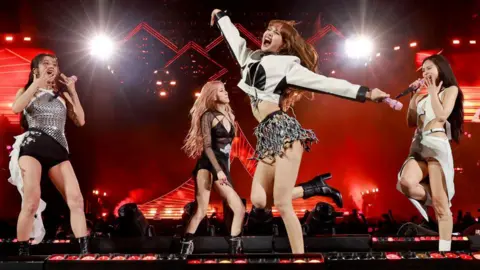
South Korean pop bands like Blackpink are a big hit globally - and among the country's best-known cultural exports


Evan Barringer was 14 years old when he stumbled onto Full House, a South Korea romcom where two strangers are forced to share a house.

Sitting in his house in Memphis, he hit play assuming it was an Asian remake of a beloved American sitcom from the 1980s. It wasn’t until the third episode that he realised they had nothing in common save the name. But he was hooked.

That accidental choice changed his life. Twelve years on, he is an English teacher in South Korea - and he says he loves it here: “I have got to try all the foods I’ve seen in K-dramas, and I’ve gotten to see several of the K-pop artists in concerts whose lyrics I used to study Korean.”

When Evan discovered Full House in 2012, South Korean entertainment was a blip in the world’s eye. Psy’s Gangnam Style was the best-known Korean pop export at the time.

Today, there are more than an estimated 220 million fans of Korean entertainment around the world – that’s four times the population of South Korea. Squid Game, Netflix's most popular show ever, has just returned for a much-anticipated second season.

How did we get here?

The so-called Korean Wave swept the world, experts say, when the success of streaming met American-inspired production value. And Korean entertainment – from pop music and mushy dramas to acclaimed hits built around universal themes – was ready for it.

No more 'Candy girls': The powerful women breaking K-drama barriers


‘I lost nine teeth filming Squid Game’: BBC on set with show’s director


BTS and Blackpink are now familiar names on the global pop circuit. People are swooning over sappy K-dramas from Dubai to India to Singapore. Overseas sales of all this Korean content - including video games - is now worth billions.

Last month, after 53-year-old poet and novelist Han Kang won the Nobel Prize for her literature, online boards were full of memes noting South Korea’s “Culture Victory” — a reference to the popular video game series Civilisation.

And there were jokes about how the country had achieved the dream of founding father Kim Koo, who famously wrote that he wished for Korea to be a nation of culture rather than might.

As it turns out, this moment had been in the making for years.


It's all in the timing


After South Korea’s military dictatorship ended in 1987, censorship was loosened and numerous TV channels launched. Soon, there was a generation of creators who had grown up idolising Hollywood and hip-hop, says Hye Seung Chung, associate professor of Korean Film Studies at the University of Buffalo.

Around the same time, South Korea rapidly grew rich, benefitting from an export boom in cars and electronics. And money from conglomerates, or chaebols as they are known, flowed into film and TV production, giving it a Hollywood-like sheen.

They came to own much of the industry, from production to cinemas. So they were willing to splurge on making movies without worrying much about losses, Prof Chung says.

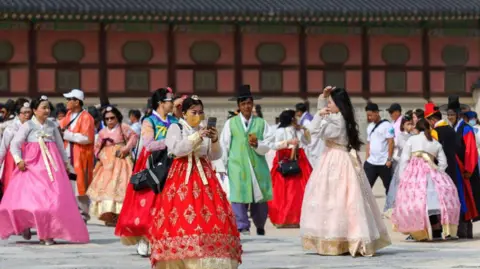
Korean entertainment is also a big tourist draw, with visitors dressing up in period costumes when they visit Seoul's Gyeongbokgung Palace

K-pop, meanwhile, had become a domestic rage in the mid-90s, propelling the success of groups such as HOT and Shinhwa.

This inspired agencies to replicate the gruelling Japanese artist management system.

Scout young talent, often in their teens, and sign them onto years-long contracts through which they become “perfect” idols, with squeaky clean images and hyper-managed public personas. As the system took hold, it transformed K-pop, creating more and more idols.

By the 2000s, Korean TV shows and K-pop were a hit in East and South East Asia. But it was streaming that took them to the world, and into the lives of anyone with a smartphone.

That’s when the recommendation engine took over – it has been key in initiating Korean culture fans, taking them from one show to the next, spanning different genres and even platforms.

The alien and the familiar


Evan says he binged the 16 hour-long episodes of Full House. He loved the way it took its time to build the romance, from bickering banter to attraction, unlike the American shows he knew.

“I was fascinated by each cultural difference I saw - I noticed that they don’t wear shoes in the house,” he recalls. So he took up Netflix’s suggestions for more Korean romcoms. Soon, he found himself humming to the soundtracks of the shows, and was drawn to K-pop.

He has now begun watching variety shows, a reality TV genre where comedians go through a series of challenges together.
Advertisement

Evan Barringer, an English teacher in South Korea, became a fan of K-content when he was a teen, living back home in the US


As they work their way through the recommendations, fans are immersed in a world that feels foreign yet familiar – one that eventually includes kimchi jiggae, a spicy kimchi stew, and kalguksu, a seafood and kelp noodle broth.

When Mary Gedda first visited South Korea, she went looking for a bowl of kimchi jjigae, as she had seen the stars do on screen numerous times.

“I was crying [as I ate it]. It was so spicy,” she says. “I thought, why did I order this? They eat it so easily in every show.”

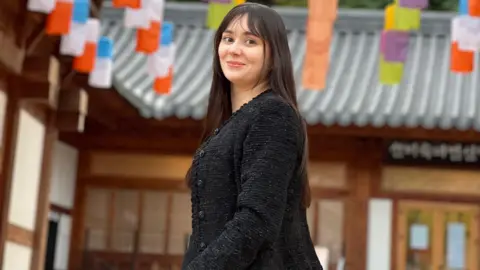
Mary, an aspiring French actor, now lives in Seoul. Originally a K-pop fan, she then discovered K-dramas and learned Korean. She has starred in a few cameo roles as well. “I got lucky and I absolutely love it,” she says.

For Mary, food was a big part of the appeal because she saw such a variety of it on K-dramas. Seeing how characters build relationships over food was familiar to her, she says, because she grew up in the French countryside in Burgundy.

Mary Gedda
Mary learned Korean after discovering K-pop and K-dramas

But there is also the promise of romance, which drew Marie Namur to South Korea from her native Belgium. She began watching K-dramas on a whim, after visiting South Korea, but she says she kept going because she was “pretty much attracted to all those beautiful Korean men”.

"[They] are impossible love stories between a super-rich guy and a girl who is usually poor, and, you know, the guy is there to save her and it really sells you a dream."

But it is Korean women who are writing most of these shows – so it is their imagination, or fantasy, that is capturing the interest (and hearts) of other women across the world.

In Seoul, Marie said she was “treated like a lady”, which hadn’t happened “in a very long time”, but her “dating experience is not exactly as I expected it to be”.

“I do not want to be a housewife. I want to keep working. I want to be free. I want to go clubbing with my girlfriends if I want to, even though I'm married or in a relationship, and a lot of guys here do not want that.”

International fans are often looking for an alternative world because of disappointment with their own society, Prof Chung says.

The prim romances, with handsome, caring and chivalrous heroes, are drawing a female audience turning away from what they see as hypersexual American entertainment. And when social inequality became a stronger theme in Korean films and shows - such as Parasite and Squid Game – it attracted global viewers disillusioned with capitalism and a yawning wealth divide in their countries.

Netflix
A scene from Love Next Door: Romantic K-dramas have become a staple of streaming platforms everywhere

The pursuit of a global audience has brought challenges as well. The increasing use of English lyrics in K-pop has led to some criticism.

And there is now a bigger spotlight on the industry's less glamorous side. The immense pressure stars face to be perfect, for instance, and the demands of a hyper-competitive industry. Creators behind blockbuster shows have alleged exploitation and complained about not being fairly compensated.

Still, it’s great to see the world pay attention to Korea, Prof Chung says. She grew up in a repressive South Korea, when critics of the government were regularly threatened or even killed. She escaped into American movies.

When Parasite played in the cinema of the small American town where she lives, she saw on the faces of other moviegoers the same awe she felt as a child watching Hollywood films: “It feels so great that our love is returned.”

‘Hidden in plain sight’: YouTuber shares footage of ‘eerie’ drones flying ‘in deliberate formations’ in New Jersey

BySumanti Sen
Dec 29, 2024
HINDUSTAN TIMES


YouTuber CJ Faison captured the footage as he ventured from the Pine Barrens to the ocean 26 miles east on a boat, carrying his night vision video camera.

A YouTuber has shared footage he claims shows drones flying off the New Jersey coast in “deliberate formations” over the Atlantic Ocean. Former stock car racer and self-proclaimed paranormal investigator CJ Faison ventured from the Pine Barrens to the ocean 26 miles east on a boat, carrying his night vision video camera.
YouTuber shares footage of ‘eerie’ drones flying ‘in deliberate formations’ in New Jersey (CJ Faison/YouTube)

In the 45-minute video, the Delaware YouTuber with 600,000 subscribers claimed to be “doing something no YouTuber or news outlet has done.”

CJ Faison’s footage

Faison teased in the video that “we think we uncovered the truth” about the recent drone sightings over the Garden State, which have left many baffled. The debate over what the drones are and who is operating them is ongoing, but no solid explanations have been provided by authorities.

Faison’s footage, which was taken from the rented boat, does not provide any clear image of what he claimed were drones that emerged from the ocean. His camera captured a series of blinking lights. Faison suggested that the lights blinked in a pattern similar to the lights of commercial aircraft.

Faison wrote in the video's caption, “The drones in New Jersey have been seen coming from the Ocean for several weeks. We found UAP Drones in the middle of the ocean 100%. This is something they don't want you to see. UAP Drones have been seen coming from the ocean and over land for months now. But no one has investigated these claims until now.”

“They’re blending in,” Faison said in the footage. “Hidden in plain sight!”

Some of the alleged drones in the footage appeared to dart across the horizon, moving quickly. “It’s wild,” the YouTuber exclaimed. “It’s eerie.”

“This is only the beginning,” Faison warned. “I have so many questions. What’s launching these drones? How are they staying airborne for hours? What’s their energy source? And why here? Why New Jersey?”

This week, New Jersey officials said that the number of drone sightings has deceased after FAA-imposed restrictions on New York and New Jersey airspace. Very little activity was reported around Christmas.

The FBI said it investigated around 5,000 of the reports it received from the public, according to New York Post. About 100 of them were deemed credible.


A Russian Victory in Ukraine will Usher In a New Age of Empires that will Soon Collide with One Another, Surkov Says

Paul Goble

Saturday, December 28, 2024

 – Vladislav Surkov, a Kremlin advisor sometimes referred to as Putin’s brain and thus worth listening to fir insights into the latter’s thinking, says that a Russian victory in Ukraine will lead Russia to turn toward the West and usher in a new age of empires that will inevitably collide with one another.
    The first of these consequences, he says, won’t involve “the restoration of vulgar Westernism but only be about a reasonable reduction in the current Asian bias” and will mean that having defeated Ukraine, Russia will have “cut through another window on Europe”

 (actualcomment  ru/parad-imperializmov-2412271244.html


    The other major consequence of a Russian victory, Surkov continues, is that it will usher in a new era of imperialism as more and more leaders and peoples seek to acquire imperial possessions. That means that “bipolar disorder in international relations … is being replaced by multi-polar disorder, sometimes for some reason mistaken for recovery.”
    At present, “imperialism is an indecent, almost obscene term in the modern political lexicon.” And undoubtedly many will not call this new impulse imperialism. But using a different term does not change the essence of the situation: “empires are being revived, and empires will collide.”

Ukraine, a Late-Capitalist War Effort

Years into the war with Russia, the Ukrainian state has not resorted to widespread nationalizations or labor conscription. Unlike the total mobilizations of the last century, Ukraine’s war effort heavily relies on market mechanisms and civilian donations.

December 28, 2024
Source: Jacobin


Image by Oleksandr Ratushniak, Creative Commons 4.0


Walk around Kyiv’s city center during a blackout evening in the holiday season, and sooner or later, you’ll come across Tsum — a multistory high-end department store, complete with its doorman in a caped overcoat and top hat. In scheduled blackouts that now last from four to eight hours each day, one-quarter of Kyiv’s population and millions more across Ukraine are left in darkness and many also without heating. Yet, Tsum’s facade shines with thousands of golden lights, above lavish Christmas displays of luxury fashion brands.

We might be tempted to interpret the spectacle as a display of brazen corruption or stark inequality. This seems especially true if we know that those lights are not powered by the mall’s own private generator — which operates only during emergency blackouts — and that Tsum is owned by Rinat Akhmetov, one of Ukraine’s wealthiest oligarchs, who also controls DTEK, the country’s largest private energy provider. But keep walking, and you’ll discover that many other shops are also brightly lit. Tsum is one of many exceptions to the supposedly egalitarian rules of energy rationing.

Many in Ukraine — ranging from economists to politicians and ordinary citizens — believe there is more behind those shiny Christmas decorations than mere state capture by wealthy interests. They argue that there are rational economic reasons to keep the lights on, even when millions are plunged into darkness. By staying open and attractive, with festive lights and luxurious Christmas displays, the high-end stores on Kyiv’s main street generate precious revenue and pay taxes — funds that directly support the country’s defense.

After living for more than one year in Ukraine — and having visited many regions and almost all the various front lines — I have often been surprised to discover how many Ukrainians agree with this perspective and how often a consumerist mentality and market-based mechanisms lie at the core of Ukraine’s war effort.
Privatizing War

One of my first interviews in Ukraine was with Artem Denysov, the founder of Veteran Hub, the largest private NGO that supports former military personnel. A military psychologist with a clear-eyed perspective on the conflict, Denysov wasn’t troubled at all by the fact that, after a decade of military operations in the east and years of full-scale war, the public efforts to support veterans remained a joke — with Soviet-era laws that still offer obsolete entitlements such as telephone connections and new radios for wounded soldiers. “States are inherently incapable,” he told me. “Better to leave things in the hands of private, resourceful citizens.”

One of the most striking examples of the privatization of the war effort can be found across Kyiv’s metro stations. It’s a marketing campaign by the Third Assault Brigade, the primary military wing of the far-right Azov movement. The ads feature striking images of beautiful young women embracing or gazing longingly at burly soldiers in full tactical gear. The campaign has been criticized for its sexist depiction of women, but even more striking is the fact that it was privately funded and produced by the military unit itself. The website it links to does not belong to the Army or the Ministry of Defense; instead, it’s the Third Assault Brigade’s private portal, used for recruiting members, raising funds, and sharing videos and other promotional materials.

Since volunteers can choose which unit to join and conscripts can request a transfer through the official military app with just a few taps, there is fierce competition among Ukrainian units to attract the best and fittest recruits. The Third Assault Brigade is just the most prominent example of a military unit effectively leveraging a marketing machine. Nearly every unit attempts to do the same.

Market mechanisms also shape the demand side of recruitment. The higher a civilian’s usual wages, the less likely they are to be recruited, due to both formal and informal exemptions. Salaries are often regarded as a barometer of an individual’s utility to the economy — and, by extension, to the war effort. At a certain point, the taxes a person generates are considered more valuable than their potential contribution on the battlefield. In Ukraine, several proposals have been made in parliament to formalize this approach by explicitly linking exemptions from mobilization to the pay scale. Such efforts have faced criticism, but this perspective — those who earn more shouldn’t be mobilized — remains widely supported among elites and economists.

Military units also compete for donations. Nearly every brigade in Ukraine covers part of its needs through civilian donations or alternative means, such as soldiers’ private wages and personal funds. Military shops, which supply everything from winter jackets to bulletproof vests, have become a booming business in Ukraine and people set up temporary tent shops at crossroads and villages near the front line.

Money is needed for everything — from clothing and drones to rent. Soldiers often have to cover their own accommodation costs, and housing near crowded front lines can be as expensive as in downtown Kyiv. Tuareg, a forty-four-year-old lieutenant commanding a drone company in the 92nd Brigade, whom I met in Kupyansk on the northeastern front, told me that nine out of ten drones in his unit are either donated by civilians or purchased with their contributions. One effective way to secure more, he explained, is by demonstrating the unit’s success in using them. A video of a drone striking a Russian tank, shared on the brigade’s Telegram channel, can generate thousands of dollars in new donations. This creates a strong incentive for Ukrainian military units to carry out actions that can be filmed and showcased to the public.

A unit with well-trained drone pilots equipped with the latest equipment is also at lower risk of being sacrificed as riflemen in the trenches. However, the Third Assault Brigade — with its sleek website, well-appointed private recruitment centers, and fully equipped soldiers — is an exception. Most brigades are composed of mobilized men in their forties who receive minimal training and are poorly equipped. These units can barely afford any advertisements and often rely heavily on charity. Some cannot even do that, as they lack the manpower to navigate the bureaucratic hurdles required to secure donations.

I visited such a unit in the spring, near the Vovchansk axis in the north — an artillery company of the 57th Brigade. The soldiers told me that only one member of the company was older than their equipment, a self-propelled howitzer built in 1976 in nearby Kharkiv. They had to purchase most of their clothing and raise funds to cover gas and repairs for the company’s vehicles.
State Intervention and Its Limits

In such a situation, one might expect the state to be desperately scraping the bottom of the barrel for resources needed at the front lines. Deep cuts have indeed been made to everything that could be sacrificed, with education bearing the brunt, while indirect taxes have been increased. Yet, for the rest, the government has adopted a strictly neoliberal approach to the war — albeit one heavily subsidized by foreign countries, which now cover around half of Ukraine’s total budget.

There has been no widespread nationalization, no conscription of workers, and no rationing of consumer goods — as so often was the case in the past during long, attritional conflicts, when states grew into giant war-planning machines with broad powers of intervention. In Ukraine, the defense sector has grown from around 120,000 workers in 2014 to 300,000 today — a considerable increase, if not particularly remarkable after a decade of war. It consists of roughly five hundred companies, one hundred of which are state-owned, accounting for about half of the total output. However, private companies often take center stage, such as the military clothing brand M-TAC, which outfits President Volodymyr Zelensky in his iconic olive-green fatigues.

Meanwhile, the government pursued peacetime privatization plans and continued cutting red tape — or at least claimed to — in the interest of making Ukraine more attractive to international investors. The tax system was only reformed a couple of months ago. For nearly three years of a war widely described as existential for the country, taxes remained at prewar fiscal haven levels. Economists in Kyiv, along with many others, argue that more intrusive interventions would simply drive a larger portion of the economy underground or push it abroad, thereby undermining revenue generation efforts.

It’s more than just an application of the infamous Laffer Curve; the real concern is that, given current national and especially international constraints, this laissez-faire approach may be the only viable option. If the state raises taxes too much, or if it begins forcing luxury shops to turn off their lights or starts nationalizing their generators in the name of the war effort, sales will fall and businesses and their clients would simply relocate abroad, depriving the government of vital fiscal revenues. At the same time, foreign investors and international partners might criticize such measures as authoritarian or anti-market, potentially damaging the international relations Kyiv depends on for survival. Many would agree with this perspective.

War in the modern age has often been waged by the poor, while the upper classes have found ways to avoid military service. However, what is happening with the war in Ukraine is different in both scale and intent. The current system is defended as rational and purposeful, rather than merely accepted as an inevitable evil.

Corruption is widespread in the military and procurement offices. Wealthy war profiteers involved in prominent scandals face criticism. However, the media and many Ukrainians tend to blame the government and the “Soviet heritage” much more often than the current system.
Shared Constraints

Russia remains less dependent on international networks and far more authoritarian, allowing for greater freedom for the political leadership to remold the economy and society. Ukrainian sociologist Volodymyr Ishchenko has written about a Russian “military Keynesianism,” in which the state’s drive to fund the war has led to a genuine redistribution — moving resources from the top of society to the bottom, particularly to defense sector workers and those employed in the so-called “special military operation.”

And yet the differences between the two countries’ ways of war are more quantitative than qualitative. Russian brigades also run advertising campaigns, compete for donations, and seek to market their military actions. It was a Russian private military unit, the Wagner Group, that even went so far as to mutiny against the government, briefly — though only temporarily — breaking the state monopoly on violence.

Meanwhile, the Russian economy is carefully managed to remain as civilian and consumer-oriented as possible. Elvira Nabiullina, governor of Russia’s central bank, and Russia’s top economic leaders respond in a manner similar to Kyiv’s economists when discussing how to manage the economy during wartime. Those Russian elites advocating for full societal mobilization and the implementation of a total war economy have largely been sidelined — at least for now. Even as Vladimir Putin frames the war as an existential and civilizational struggle against the collective West, the lights must remain on in Moscow’s Tsum, just as they do in its Kyiv counterpart.

If further proof is needed, the war in Ukraine, according to preliminary studies, is the first in a century where ethnic Russian soldiers are underrepresented in the list of casualties, while poorer and less-educated minority groups are overrepresented. While this conflict is, in many ways, more “Russian” than either World War II or Afghanistan, it is also the one where the comparatively more prosperous ethnic Russians are paying the least, proportionally. Or, as a Ukrainian POW camp guard put it to me, “I’ve never seen anyone from Moscow here.”

The truth is that both Russia and Ukraine operate within partially shared constraints and contexts. Whether we are discussing ways of funding underequipped units, efforts to prevent capital from fleeing the country or the power of sanctions to block the export of quasi-military goods, none of the participants can completely escape the iron rule of late capitalism and globalization.

The war, which began with Putin’s full-scale invasion of Ukraine, marks a historical first. This is neither a counterinsurgency operation against a rebellious militia nor a conflict between poor nations with fragile institutions. It is the first genuine clash between two quasi-peer leviathans of the late-capitalist era.

The last time we witnessed a conflict of such proportions, the imperial and totalitarian states of the first half of the twentieth century waged all-encompassing wars that mobilized entire populations, brought new groups into the labor force, and generated huge expectations for changes in the social model. However, these life-or-death struggles also led to destruction unseen both before and since, pushing nations to the brink of societal collapse.

In contrast, neoliberal, late-capitalist societies, when confronted by peer nations for the first time, have waged war striving to preserve their civilian economic and social structures as much as possible. They have fought with one eye on the battlefield and the other monitoring investor sentiment and capital markets. It may sound cynical, but this attitude has also resulted in a war that, while still awful and bloody, has been much more limited than similar conflicts in the past.

Russian Anti-War Political Prisoners Must Be Included in Any Eventual Putin-Trump Deal Over Ukraine


By Boris Kagarlitsky International Solidarity Campaign
December 27, 2024
Source: Socialist Project


Dear friends,

The accession of Donald Trump to the presidency of the United States raises the possibility of the incoming US administration following through on Trump’s pledge to negotiate some kind of ceasefire agreement in Russia’s war on Ukraine.

One possible plan that is reportedly under consideration is that of retired lieutenant-general Keith Kellog whom Trump has named special envoy for the Russia-Ukraine war. Kellogg’s proposal would confront the Ukrainian government with a US arms cut-off if president Zelensky resists his plan for a “peace-for-land” exchange while threatening the Russian Federation with increased military support to Ukraine should president Putin refuse to come to the negotiating table.

The Boris Kagarlitsky International Solidarity Campaign, whose three goals are winning the unconditional release of all anti-war political prisoners in the Russian Federation, promoting discussion of Kagarlitsky’s work and campaigning for intellectual freedom, believes that any deal that may ultimately be concluded between Trump and Putin must include the release of anti-war political prisoners in the Russian Federation and the Ukrainian territories it currently occupies, and that this measure should extend to all anti-war political prisoners, not just to a selection made by the Russian authorities.

Specifically, it should include all those jailed for expressing opposition to the war, protesting against it and engaging in actions to hinder it that did not entail the deliberate deprivation of life of innocent parties.

Moreover, the Campaign supports the position that has been clearly expressed by Boris Kagarlitsky himself: that the freeing of anti-war political prisoners should be unconditional, without any requirement for those released to go into exile, either beyond or within the borders of the Russian Federation.


Myths and the truth about the enemies of our enemies

We create the anarchy we'd like to see in the world

From Lukas Borl

Let me start by asking a question: Are the enemies of our enemies automatically our friends and allies? This is a question that people have always asked themselves when deciding with whom and how to ally in pursuit of their goals. Even today, questions of this kind are relevant to us. For example: if our enemy is Putin and his supporters, is anyone who takes up arms and uses them against Putin’s supporters automatically our friend and ally? Some may argue that a question posed in this way is too vague to be answered immediately. I will therefore try to be more specific. I will describe a few specific people who have died in the war in Ukraine and have become uncritically glorified martyrs for quite a few people.

1) Yuri Samoylenko / Юрий Самойленко

The obituary on the website of the Anarchist Federation states “Yuri Samoylenko: a great organiser of anti-fascist resistance”. But on his tombstone it says ‘Right Sector officer’.

source: https://x.com/Voxkomm/status/1678148412347404288

________________________________

The question arises: Can both of these statements be true, or are they mutually exclusive? Let each answer for himself. And if anyone has trouble finding the answer, here is some basic information about the Right Sector that may serve as useful clues.

Right Sector (Ukrainian: Пра́вий се́ктор [právyj séktor]) is the name of a Ukrainian nationalist party founded on March 22, 2014. The movement combines radical Ukrainian nationalism in the tradition of Stepan Bandera and the Ukrainian Insurgent Army (UPA).

Right Sector supporters carry a flag with a portrait of Stepan Bandera, Kiev, January 1, 2015

________________________________

And who was this Stepan Andriyovich Bandera? He was the leader and chairman of the radical wing of the Organisation of Ukrainian Nationalists (OUN-B). In 1939, he collaborated with Nazi Germany and organized a military unit under the German Wehrmacht. Bandera pledged the cooperation of the new Ukrainian state with Nazi Germany under Hitler, with the final remark “Glory to the heroic German army and its Führer Adolf Hitler”. The declaration was accompanied by violent pogroms.

And what was the Ukrainian Insurgent Army (UPA)? It was an armed unit of the Organisation of Ukrainian Nationalists (OUN), more precisely its radical faction led by Stepan Bandera (OUN-B). The organisation is seen as highly controversial, especially for its association with the Nazi occupiers and for its massacres of civilians.

I will now ask two questions, clearly and specifically. Was Yuri Samoylenko – i.e. the fallen Right Sector officer – a hero who should be praised because he was an enemy of the Putinists, just as the anarchists are? Was this enemy of our enemies our friend and ally? Let everyone answer for themselves.

2) Roman Legar / Романа “Ісуса” Легара

“On 9 June 2024, an anarchist, soldier of the Azov Brigade, our comrade and close friend Roman Legar was killed,” wrote his obituary on the Revolutionary Action profile (Революційна Дія). A few lines later, it says: “The hardships of his service and environment did not break Roman, he remained faithful to his anarchist convictions until the end.”

Does this mean that the Azov Brigade, infamous for its collaboration with the far right, was transformed into a formation for people with anarchist convictions? Again, let everyone answer for themselves.

3) Sergey Petrovichev / Сергей Петровичев

The Autonomous Action website announced death of Sergey Petrovichev, also known by the names “Rubin” and “Vasili Volgin“. “We mourn the martyrdom of our comrade who gave his life for the freedom of all nations.” the website says. “Sergey Petrovichev: the unbreakable anarchist from Russia” reads again the obituary on the Anarchist Federation website. But on his personal FB profile, the same Sergey Petrovichev posted a photo of himself proudly posing with neo-Nazi Maxim Martsinkevich. He uploaded the photo 2 days after Maxim’s death with comments about how people should “avenge” him.

source: https://www.facebook.com/photo.php?fbid=3293046094106365

________________________________

So the question is: Has the political situation really changed so much with the war in Ukraine that being an “unbreakable anarchist” now means something like being a “friend of a neo-Nazi”? I’ll leave the question unanswered. As a clue, I will now cite information from the antifa.cz website about the White Rex clothing brand, in front of whose logo “unbreakable anarchist” Sergey Petrovichev posed with neo-Nazi Maxim “Tesak” Martsinkevich.

White Rex is a Russian clothing brand that focuses on combat sports. Although the owner is all obfuscation and denial, one doesn’t have to be much of a guru to figure out that White Rex is primarily targeting neo-Nazis. The brand was founded in 2008 by Denis Nikitins with the idea that it should bring together people with similar views and beliefs while raising some money for “charity”. By charity, he means financial support for incarcerated neo-Nazis, whom he calls “prisoners of conscience.” (…) In 2011, White Rex started a series of its own tournaments called “Duch Vojna” (Spirit Warrior). Although they are not exclusively for neo-Nazis, it is clear that they are primarily intended for them. (…) During the last event in December 2012, a well-known neo-Nazi activist from Format18, Maxim “Tesak” Martsinkevich, spoke at the event.

And some more essential information about the aforementioned Martsinkevich (Максим Марцинкевич in Russian). He first gained public attention as the leader of the far-right youth group Format 18, which was presented as the “armed wing” of the National Socialist Society. The number 18 is the code or symbol for the name “Adolf Hitler”, as the letter A is the first and H is the eighth in Latin. Members of Format 18 attacked Asian migrant workers and homeless people. They filmed the attacks and uploaded the videos to the internet.

Martsinkevich was sentenced three times in prison for inciting racial or ethnic hatred. The first time was in 2007 after he disrupted political debates by shouting “Sieg Heil!” at a book club in Moscow. In 2009, he was again convicted for making a video with racist content. In the autumn of 2013, he was again accused of publishing new videos with racist remarks. During his next sentence in 2020, an investigation was opened into his involvement in hate killings. He confessed to involvement in a series of murders motivated by racist ideology. According to the investigation, the victims were several men of non-Slavic appearance (mostly Central Asian migrants) and a Russian sex worker. Martsinkevich testified against other participants in the murders and led investigators to some of the victims’ bodies, but was soon found dead in his cell.

That’s right, this is the man that the “unbreakable anarchist” Sergey Petrovichev took pictures with, defended and called for revenge after he was found dead in a prison cell.

Final summary

A friend of a neo-Nazi and a murderer is presented to us as an “unbreakable anarchist”, a Right Sector officer as a “great organizer of anti-fascist resistance” and an Azov soldier as a “man with an anarchist mindset”.

Why do I have the feeling that something is wrong here? Or are my feelings deceiving me, because according to some people I am just a confused dogmatist and sectarian who does not understand the meaning of pragmatism? Who knows? Make up your own mind.

Lukáš Borl, December 2, 2024


Life under Russian occupation


DECEMBER 20, 2024

Two new pieces of research from the Luhansk Regional Human Rights Centre Alterpravo paint a grim picture in the Russian-occupied territories of Ukraine.

Forced Reality is the first in a series of planned analytical papers covering the lives of people in the temporarily occupied territories. The deaths of a high number of civilians during the hostilities and the occupation of the region by the Russian army has led many economically active people to leave. This, and the inward migration of Russians, is significantly changing the population’s composition.

It is extremely difficult for local residents of these territories to get jobs, most of which go to collaborators. Employees even of state-funded institutions are often not paid for months, as Russia has begun reducing the funding for the occupied territories since the summer of this year.

After the occupation, average consumer food prices increased significantly and, in some cases, were twice as high. Additionally, people are forced to eat expired food due to lack of refrigeration, choice or money. Local products are being squeezed out of the market and replaced by goods produced in Russia, which are of much lower quality.

In 2024, the amount of humanitarian aid provided to the occupied territories decreased significantly. The priority is the elderly, from whom the occupation administrations expect the greatest loyalty. Food queues are often hours-long. Moreover, food aid is instrumentalised and presented as a reward for ‘correct’ behaviour – for example, it is available only to those with a Russian passport.

The water supply is erratic. In occupied Mariupol, tap water is green or rusty  and has an unpleasant odour. Despite the poor quality, residents are expected to pay for water services.

Medical services are in disarray, with shortages of both staff and equipment. “During the occupation,” says the Report, “the proper supply of medicines has not been established, which leads to a shortage of medicines, artificially inflated prices and the use of fraudulent schemes to deliver them to the occupied territory.” Medical services are also being used to force through Russian passportisation of citizens – free medical services in the occupied territories are available only if one has a Russian passport.

In 2023, in-depth preventive medical examinations were used as a pretext for deporting Ukrainian children to the Russian Federation. Those children who were allegedly diagnosed with medical problems were sent ‘for treatment’ to the Russian Federation and did not return.

The Russians have not given permission for the evacuation of citizens through a humanitarian corridor from these territories. Only the international organisations of the UN system and the Red Cross operate in the territories. Ukrainian humanitarian organisations have no access.

The report concludes: “The Russian authorities are deliberately working to ensure that the survival of local residents in all occupied territories of Ukraine is possible only if they obtain Russian citizenship, are loyal to the ‘new government and new order’, and integrate into the new social structure. Access to basic human needs, such as food, water and medical services, is impossible without it.”

International law requires an occupying force to provide for all the basic needs of the civilian population, including food, water, and healthcare. The Russian regime, in its pursuit of integrating these territories, is destroying this principle.

Resistance continues

Also from Alterpravo comes the November edition of Life Under Occupation, a monthly update on the situation facing Ukrainian territories under occupation. It reports that the Third Committee of the UN General Assembly adopted a 14-page resolution calling Russia’s actions against Ukraine a  “war of aggression” and spelling out some of its crimes, including torture and ill-treatment of prisoners.

Other updates in the bulletin include: the confiscation in occupied Crimea of 1,200 businesses belonging to people considered ‘unfriendly’ to Russia; the denial of entry of residents into the occupied territories; the confiscation of grain and vegetables from farmers; the emptying of public libraries of Ukrainian literature and their replacement by Russian imperial propaganda; compulsory Russification in schools and a ban on teaching Ukrainian in some areas, with children aged 12 and over forced to take an oath of allegiance to the Russian Federation.

Exacerbating the public health disaster, in some territories residents receiving social and pension payments have been informed that from 1st January 2025, payments will be suspended for those who do not have Russian citizenship.

Despite the brutality of the occupation and the persecution suffered by activists, non-violent resistance continues across the temporarily occupied territories.

The latest bulletin of the Ukraine Information Group is available here. Follow the work of the Ukraine Solidarity Campaign here.

Image: Military base at Perevalne during the occupation the Autonomous Republic of Crimea and the city of Sevastopol by Russian troops in 2014. Source: http://www.ex.ua/76677715 Author: Anton Holoborodko (Антон Голобородько), licensed under the Creative Commons Attribution-Share Alike 3.0 Unported license.


What Motivated Putin to Invade Ukraine?
  
Dec 29 2024 •  E-International Relations 

Download PDF


miss.cabul/Shutterstock


Ukraine was plunged into a catastrophic and perilous war in 2022 when Russia’s invasion led to widespread devastation and human suffering not seen in Europe since the conflicts in the former Yugoslavia during the early 1990s. Numerous analysts and commentators contend that Vladimir Putin’s decision to invade Ukraine stems from a broader imperialistic ambition, indicative of a long-standing desire to expand Russia’s influence and control over neighbouring territories. These perspectives imply that the invasion is not merely a spontaneous act but rather a calculated manoeuvre within a larger strategy aimed at reclaiming and dominating regions historically associated with Russian power.


Play
Unmute


Loaded: 1.66%

Fullscreen


‘Putin is an imperialist who must be stopped now, or he will become more dangerous’, said US Senator Chuck Grassley (2023). Patrick Smith of NBC News says, ‘Russia’s invasion of Ukraine has raised fears that Putin is intent not only on claiming its neighbour and former Soviet republic but potentially has his eye on Poland, Finland and the Baltics, among others’ (2022). ‘It’s clear now that Putin’s endgame is nothing short of a revanchist imperialist remaking of the globe to take control of the entire former Soviet space’, says Evelyn Farkas, an American national security advisor (Politico, 2022). Strobe Talbott, former US deputy secretary of state from 1994 to 2001, says, ‘Putin certainly has an endgame in mind: It’s recreating the Russian Empire with himself as tsar’ (Politico, 2022). After Ukraine, the Kremlin’s next targets could be Moldova and the Baltic countries, Admiral Michel Hofman, Belgian Chief-of-Defense, warned (Hulsemann, 2023). Alexander J. Motyl argues that Putin’s Russia is attempting to invade other countries in a manner reminiscent of Hitler’s ambitions in the 1940s.


The striking similarities between Vladimir Putin’s Russia and Adolf Hitler’s Germany are not accidental. Both regimes had — the past tense is intentional — the same historical trajectory because both were the product of imperial collapse and its destabilizing aftermath on the one hand and the emergence of a strong leader promising to make the country great again on the other (Motyl, 2022).

According to Jonathan Katz, Putin ‘is this century’s equivalent to Hitler, and the threat he poses to Europe, U.S. and global security extends far beyond the current conflict in Ukraine’. (Herman, 2022) ‘Putin is proving to be the “Hitler of the 21st century’ with the invasion of Ukraine, said Leo Varadkar, Ireland’s deputy premier (Independent, 2022).

Putin’s Russia exists as a closed and repressive regime. There is a tendency among Western observers to interpret every conflict through the lens of the Second World War. This uncritical comparison is not only overly simplistic but also potentially dangerous. Many within the Western political and media elite seem to have adopted this shallow perspective. While it is undeniable that Putin is a brutal leader, he does not exhibit the same genocidal tendencies characteristic of Hitler’s regime. Interpreting Putin’s actions through the lens of World War II and Nazi Germany fails to accurately capture the motivations behind his regime’s invasion of Ukraine. Such comparisons often lead to a simplistic and unilluminating understanding of the conflict in Ukraine.

Putin’s rise to power and consolidation resemble those of a conventional autocrat who is satisfied with personal power and enrichment; however, he lacks the geopolitical ambitions and ideological motivations similar to those of Hitler’s Third Reich, as Richard Evans explains:


Putin’s aims are limited. They’re very ambitious, but they have limits. Hitler’s aims were unlimited. He literally wanted to conquer the world, and his central belief was the racial question — he saw history in terms of racial struggle. Putin, however, is a Russian nationalist. He believes that Ukrainians are Russian, not that they are an inferior race. (Millan, 2023)

In a similar vein, Rajiv Sikri, a seasoned Indian diplomat with considerable expertise in the region, suggests that President Putin’s objectives may be somewhat constrained.


He would probably want to have a pro-Russian, or at least not a hostile, government in Kyiv, and for Ukraine to be a neutral state like Finland, Sweden or Austria. … Putin’s interest in Ukraine is limited to the eastern, Russian-speaking parts of Ukraine, not Western Ukraine which has dominated Ukrainian politics since the Maidan revolution of 2014 (Politico, 2022).

Vladimir Putin emerged as a formidable hardline leader largely due to his actions in 1999, when he ordered the intense bombardment of Grozny, the capital of Chechnya, a small Muslim republic in southern Russia with a population of approximately 1.5 million. Since the end of World War II, no other city has endured such extensive bombing. Numerous other cities and towns throughout Chechnya were also left in ruins, resulting in the deaths of thousands of Chechen fighters and tens of thousands of civilians. Thomas de Waal, a journalist who reported on Chechnya in the 1990s, observes notable similarities between Putin’s war in Chechnya in 1999 and the conflict in Ukraine in 2022.


The use of heavy artillery, the indiscriminate attacking of an urban center. They bring back some pretty terrible memories for those of us who covered the Chechnya war of the 1990s. …There was a project to restore Chechnya to Russian control, and nowadays in 2022, to restore Ukraine to the Russian sphere of influence… And there was no Plan B. Once the people started resisting, which came as a surprise in Chechnya and is coming as a surprise in Ukraine, there was no political Plan B about what to do with the resistance (in Myre, 2022).

Since his original appointment as Prime Minister by Yeltsin in 1999, followed by his assumption of the role of Acting President later that year, Putin has led the country as an authoritarian Russian nationalist. His governance is defined not by ideological zeal, but by a focus on pragmatic decision-making. This form of authoritarian Russian nationalism reflects a ‘pick-and-mix approach to ideology.’ (Faure, 2022) There are numerous historical figures from both the Tsarist Russian and Soviet periods, alongside certain ideologues that he selectively incorporates to shape his somewhat ambiguous ideology. A significant factor influencing Moscow’s policy may not be linked to a single individual or ideological framework; instead, it can be associated with the Izborsky Club, a right-wing think tank that provides insights into the pragmatic ideological foundations of the Putin regime.

Founded at the end of 2012, the Izborsky Club embodies the ideological foundations that provide insight into Putin’s decision to invade Ukraine. The club advocates for Eurasianism, promoting the expansion of Moscow’s control and influence over a region encompassing the former Soviet Union. The think tank functioned as a central gathering place for a considerable number of self-identified nationalists and anti-liberals, all unified by the overarching aim of influencing the future of the Russian state. (Laruelle, 2016: 630) The club was founded in 2012 in the quaint town of Izborsk, situated in Pskov Oblast in north-western Russia, just across the border from Estonia. Its establishment coincided with the celebration of the city’s 1,150th anniversary, which inspired the club’s name. Following its inception, additional meetings were held in various locations, including Yekaterinburg, Ulyanovsk, St. Petersburg, Saratov, Bryansk, Belgorod, Tula, Kaluga, Omsk, Nizhny Novgorod, Orenburg, and Donetsk, as well as in regions such as Yakutia, Dagestan, and Crimea.


The Izborsky Club has significant financial resources and maintains strong ties to the Kremlin. While Kremlin spokesperson Dmitry Peskov has denied any connections to the club, it has been awarded grants totaling 10 million rubles from the Presidential Administration, functioning as a non-profit organization. The inaugural meeting was attended by Vladimir Medinsky, who was the Minister of Culture of the Russian Federation at the time and is currently a personal advisor to Putin. Several regional governors and presidents of various state republics, including Yakutia, Dagestan, and Chechnya, were also present (Zygar, 2023).

Alexandr Prokhanov, a veteran nationalist author, activist, and editor of the newspaper Zavtra, serves as the founder and chairman of the organization. Prokhanov is closely linked with influential Orthodox businessmen, including Konstantin Malofeev, who is reportedly a key financier of the Donbas insurgency in eastern Ukraine. Notable members include Bishop Tikhon, an Orthodox priest and best-selling author rumoured to be Putin’s personal confessor; economist and politician Sergei Glaz’ev, who acts as an adviser to Putin; Moscow State University professor and right-wing philosopher Alexander Dugin, often referred to as ‘Putin’s brain’; and oligarchs Oleg Rozanov, Yuri Lastochkin, and Aleksandr Notin. Additionally, the group features Communist Party leader Gennady Zyuganov, Uzbek Shamil Sultanov, who coordinates the Kremlin’s strategy in the Islamic world, as well as leading TV news anchors Mikhail Leontev and Maksim Shevchenko (Laruelle, 2016).

Putin has distanced himself from the Club, never attending its meetings, and the organization has not been closely associated with him. This stance aligns with his preference for pragmatism, steering clear of the Club’s overtly right-wing, Russian imperialist agendas. Many observers have aptly described Putin as an opportunist rather than a strategist driven by ideology. Nonetheless, this does not change the fact that the Club’s discourse and narrative not only mirror but also contribute to the broader narrative of Putin’s regime (Bacon, 2018).

In the aftermath of the annexation of Crimea and the beginning of the conflict in Ukraine in 2014, the Izborsky Club’s agenda, which advocated for the unity of the ‘reds’ and ‘whites,’ resonated with the Putin regime’s persistent emphasis on national cohesion. Throughout 2014, Putin’s speeches mirrored the language and style of Club members, asserting that Crimea is the spiritual and political heart of Russia. The Club’s 2016 Doctrine of Russian World document included ‘the protection of ethnic Russians’ rights against the “Russophobia” of the Ukrainian ruling elites, dominated by “neo-Nazis.”’ (Faure, 2023). In October 2021, the Club issued a new manifesto called Ideology of Russian Victory, which can be considered the most elaborate doctrinal platform justifying war in Ukraine (Laruelle, 2022).

All things considered, and with the war now approaching its third year, the level of destruction in Ukraine has reached proportions not witnessed in Europe since World War II and the end does not yet seem to be in sight. Putin commenced this war anticipating a swift and uncomplicated victory, but he misjudged the determination of the Ukrainian people to defend their homeland. Conversely, Ukraine and NATO overestimated their ability to overcome Russia on the battlefield.

References

Al Jazeera (2022). ‘Ukraine-Russia crisis: What is the Minsk agreement?’, 9 February, https://www.aljazeera.com/news/2022/2/9/what-is-the-minsk-agreement-and-why-is-it-relevant-now

Aleem, Zeeshan (2022). ‘Russia’s Ukraine invasiuon may have been preventable’, MSNBC, 4 March, https://www.msnbc.com/opinion/msnbc-opinion/russia-s-ukraine-invasion-may-have-been-preventable-n1290831

Allan, Duncan (2020). ’The Minsk Conundrum: Western Policy and Russia’s War in Eastern Ukraine’, 22 May, Chatham House, https://www.chathamhouse.org/2020/05/minsk-conundrum-western-policy-and-russias-war-eastern-ukraine-0/minsk-implementation

Allison, Graham (2015). ‘The Thucydides Trap: Are the U.S. and China Headed for War?’, the Atlantic, 24 September, https://www.theatlantic.com/international/archive/2015/09/united-states-china-war-thucydides-trap/406756/

Bacon, Edwin (2018). ‘Policy change and the narratives of Russia’s think tanks’, Palgrave Communications, 4/94, https://www.nature.com/articles/s41599-018-0148-y

BBC (2022). ‘IMF: Ukraine economy could shrink as much as 35%’, BBC News, 14 March, https://www.bbc.co.uk/news/business-60743592


Calabresi, Massimo (2014). ‘Inside Putin’s East European Spy Campaign’, Time, 7 May, https://time.com/90752/inside-putins-east-european-spy-campaign/

Cohen, Stephen F. (2010). ‘An interview with Stephen Cohen’,Journal of International Affairs, Spring/Summer 2010, Vol. 63, No. 2., 191-205, https://ciaotest.cc.columbia.edu/journals/jia/v63i2/f_0022003_18160.pdf

Cohen, Stephen F. (2017). ‘The New Cold War Is Already More Dangerous Was Its Predecessor’, the Nation, 11 October, https://www.thenation.com/article/archive/the-new-cold-war-is-already-more-dangerous-than-was-its-predecessor/

Courtney, W. (2023) ‘Russia’s Appetite May Extend Beyond Ukraine’, https://www.rand.org/pubs/commentary/2023/02/russias-appetite-may-extend-beyond-ukraine.html

Crisis Group (2024). ‘Conflict in Ukraine’s Donbas: A Visual Explainer’, https://www.crisisgroup.org/content/conflict-ukraines-donbas-visual-explainer

Dalio, Ray (2023). ‘A US-Chinese Led World Peace?’, 16 October, https://www.linkedin.com/pulse/us-chinese-led-world-peace-ray-dalio/

Faure, Juliette (2022). ‘The Deep Ideological Roots of Russia’s War’, Le Monde diplomatique, April, https://mondediplo.com/2022/04/03ideology

Faure, Juliette (2023). ‘What role did ideology play in triggering Russia’s invasion of Ukraine’, the Russia Programme, October, https://therussiaprogram.org/onlinepaper_8

Grassley, Chuck (2023). ‘Putin is an imperialist who must be stopped now or he will become more dangerous’, https://www.grassley.senate.gov/news/remarks/putin-is-an-imperialist-who-must-be-stopped-now-or-he-will-become-more-dangerous

Guardian (2024). ‘Russia-Ukraine war’, 6 January, https://www.theguardian.com/world/live/2024/jan/06/russia-ukraine-war-aid-white-house-putin-zelenskiy

Herman, Steve (2022). Voa News, 8 March, https://www.voanews.com/a/is-putin-the-new-hitler-/6476408.html

Hulsemann, Laura (2023). ‘Putin could attack Baltics and Moldova next, says Belgian army chief’, Politico, 19 December, https://www.politico.eu/article/belgian-army-chief-hofman-putin-attack-after-ukraine-baltics-moldova-next-russia/

Independent (2022). ‘Putin is “Hitler of the 21st century”, says Ireland’s Leo Varadkar’, 25 February, https://www.independent.co.uk/news/world/europe/putin-russia-ukraine-varadkar-hitler-b2023656.html

KSE -Kyiv School of Economics (2023). ‘The total amount of damage caused to the infrastructure of Ukraine due to the war reaches $151.2 billion — estimate as of September 1, 2023’, 3 October, https://kse.ua/about-the-school/news/the-total-amount-of-damage-caused-to-the-infrastructure-of-ukraine-due-to-the-war-reaches-151-2-billion-estimate-as-of-september-1-2023/

Laruelle, Marlene (2016). ‘The Izborsky Club, or the New Conservative Avant-Garde in Russia’, the Russian Review, Volume 75, issue 4, pp. 626-644.

Laruelle, Marlene (2022). ‘What is the ideology of a mobilized Russia’, Russia.Post, 4 October, https://russiapost.info/politics/war_ideology

Leipold, J. D. (2015). ‘Milley: Russia No.1 threat to US’, US Army, 10 November, https://www.army.mil/article/158386/milley_russia_no_1_threat_to_us

Lynch, Lily (2023). ‘The realists were right’, the New Statesman, 2 September, https://www.newstatesman.com/the-weekend-essay/2023/09/ukraine-war-realists-right

Millan, Eva (2023). ‘Historian Richard J. Evans: “Putin’s goals are very ambitious; Hitler’s had no limits”’, El Pais, 18 August, https://english.elpais.com/culture/2023-08-18/historian-richard-j-evans-putins-goals-are-very-ambitious-hitlers-had-no-limits.html

Motil, Alexander J.(2022), ‘Putin’s Russia rose like Hitler’s Germany—and could end the same’, the Hill, 5 March, https://thehill.com/opinion/national-security/3470515-putins-russia-rose-like-hitlers-germany-and-could-end-the-same/

Myre, Greg (2022). NPR, 12 March, https://www.npr.org/2022/03/12/1085861999/russias-wars-in-chechnya-offer-a-grim-warning-of-what-could-be-in-ukraine

NATO (2023 i). ‘NATO 2022 Strategic Concept’, NATO, 3 March, https://www.nato.int/cps/en/natohq/topics_210907.htm

NATO (2023). ‘NATO Secretary General Jens Stoltenberg in a conversation on ”The Road to Vilnius” at the Brussels Forum’, NATO, 24 May, https://www.nato.int/cps/en/natohq/opinions_214799.htm

New York Times (2023). ‘Troop Deaths and Injuries in Ukraine War Near 500,000, U.S. Officials Say’, 18 August, https://www.nytimes.com/2023/08/18/us/politics/ukraine-russia-war-casualties.html

Politico (2022). ‘What does Putin really want?’, 25 February, https://www.politico.com/news/magazine/2022/02/25/putin-russia-ukraine-invasion-endgame-experts-00011652

Quinn, Ben (2014). ‘Prince Charles reported to have likened Vladimir Putin to Hitler’, the Guardian, 21 May, https://www.theguardian.com/uk-news/2014/may/21/prince-charles-reported-to-have-likened-putin-to-hitler

Reuters (2022). ‘What are the Minsk agreements on the Ukraine conflict?’, 21 February, https://www.reuters.com/world/europe/what-are-minsk-agreements-ukraine-conflict-2022-02-21/

Shlapentokh, Dmitry (2009). Review of Marlene Laruelee’s Russian Eurasianism: An Ideology of Empire, Revue D’etudes Comparatives Est-Ouest, n.40, pp. 197-198, https://www.cairn.info/revue-d-etudes-comparatives-est-ouest1-2009-2-page-197.htm

Smith, Patrick (2022). ‘Putin compares himself to Peter the Great in fight to expand Russia’, NBC News, 10 June, https://www.nbcnews.com/news/world/putin-ukraine-russia-tsar-peter-great-imperialism-rcna32909.

Swain, Judith L. (2008). ‘Our United States legacy: lessons learned from the British Empire’, Journal of Clinical Investigation, Nov 3; 118(11): 3802–3804, https://www.ncbi.nlm.nih.gov/pmc/articles/PMC2575706/

Vincent, Faustine (2023). ‘The secret carnage of military losses in Ukraine’, Le Monde, 24 August, https://www.lemonde.fr/en/international/article/2023/08/24/behind-the-secrecy-of-military-losses-in-ukraine-carnage-on-a-massive-scale_6107230_4.html

Washington Post (2023). ‘Putin plans for a long struggle in Ukraine. The U.S. needs to do the same’, Washington Post Opinion, 23 August, https://www.washingtonpost.com/opinions/2023/08/23/ukraine-18-months-aid-war/

Zygar, Mikhail (2023). ‘The Man Behind Putin’s Warped View of History’, the New York Times, 19 September, https://www.nytimes.com/2023/09/19/opinion/putin-russia-medinsky.html