Sunday, December 29, 2024

Higher Education Must Champion Democracy, Not Surrender to Fascism

Critical education must become a key organizing principle to defeat the emerging authoritarianism in the US.
December 28, 2024

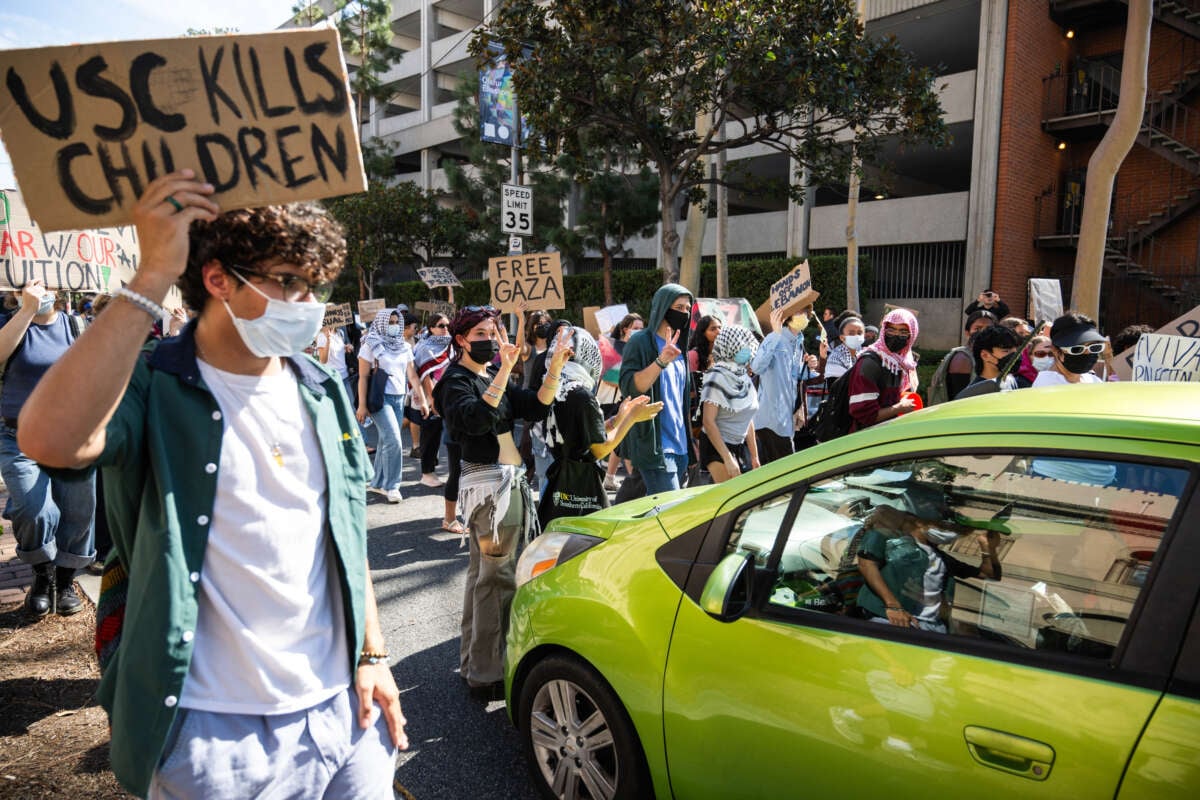
USC students walk out of class and march around their campus in support of Palestinians and the divest movement on October 7, 2024, in Los Angeles, California.Sarah Reingewirtz, Los Angeles Daily News / SCNG via Getty Images


Truthout’s December fundraiser is our most important of the year and will determine the scale of work we’ll be able to do in 2025. Please support us with a tax-deductible donation today.

For decades, neoliberalism has systematically attacked the welfare state, undermined public institutions and weakened the foundations of collective well-being. Shrouded in the alluring language of liberty, it transforms market principles into a dominant creed, insisting that every facet of life conform to the imperatives of profit and economic efficiency.

But in reality, neoliberalism consolidates wealth in the hands of a financial elite, celebrates ruthless individualism, promotes staggering levels of inequality, perpetuates systemic injustices like racism and militarism, and commodifies everything, leaving nothing sacred or untouchable. Neoliberalism operates as a relentless engine of capitalist accumulation, driven by an insatiable pursuit of unchecked growth and the ruthless concentration of wealth and power within the hands of a ruling elite. At its core, it’s a pedagogy of repression: crushing justice, solidarity and care while deriding critical education and destroying the very tools that empower citizens to resist domination and reclaim the promise of democracy.

As neoliberalism collapses into authoritarianism, its machinery of repression intensifies. Dissent is silenced, social life militarized and hate normalized. This fuels a fascistic politics which is systematically dismantling democratic accountability, with higher education among its primary targets. For years, the far right has sought to undermine education, recognizing it as a powerful site of resistance. This has only accelerated, as MAGA movement adherents seek to eliminate the public education threat to their authoritarian goals

Vice President-elect J.D. Vance openly declared “the professors are the enemy.” President-elect Donald Trump has stated that “pink-haired communists [are] teaching our kids.” In response to the Black Lives Matter protests following George Floyd’s killing, MAGA politicians like Sen. Tom Cotton openly called for deploying military force against demonstrators.

Critical pedagogy must expose the false equivalence of capitalism and democracy, emphasizing that resisting fascism requires challenging capitalism.

The authoritarian spirit driving this party is crystallized in the words of right-wing activist Jack Posobiec, who, at the 2023 Conservative Political Action Conference, said: “We are here to overthrow democracy completely. We didn’t get all the way there on January 6, but we will. After we burn that swamp to the ground, we will establish the new American republic on its ashes.” This is more than anti-democratic, authoritarian rhetoric. It also shapes poisonous policies in which education is transformed into an animating space of repression and violence, and becomes weaponized as a tool of censorship, conformity and discrimination.

Related Story

Trump’s Anti-Immigrant Fearmongering Exposes Extent of Fascism’s Rise in 2024
A new poll offers an alarming wake-up call about how normalized violence has become in this era of gangster capitalism. By Henry A. Giroux , Truthout October 21, 2024


As authoritarianism surges globally, democracy is being dismantled. What does this rise in illiberal regimes mean for higher education? What is the role of universities in defending democratic ideals when the very notion of democracy is under siege? In Trump’s United States, silence is complicity, and inaction a moral failing. Higher education must reassert itself as a crucial democratic public sphere that fosters critical thought, resists tyranny and nurtures the kind of informed citizens necessary to a just society.

Trump’s return to the presidency marks the endpoint of a deeply corrupt system, one that thrives on anti-intellectualism, scorn for science and contempt for reason. In this political climate, corruption, racism and hatred have transformed into a spectacle of fear, division and relentless disinformation, supplanting any notion of shared responsibility or collective purpose. In such a degraded environment, democracy becomes a hollowed-out version of itself, stripped of its legitimacy, ideals and promises. When democracy loses its moral and aspirational appeal, it opens the door for autocrats like Trump to dismantle the very institutions vital to preserving democratic life.

The failure of civic culture, education and literacy is starkly evident in the Trump administration’s success at emptying language of meaning — a flight from historical memory, ethics, justice and social responsibility. Communication has devolved into exaggerated political rhetoric and shallow public relations, replacing reason and evidence with spectacle and demagoguery. Thinking is scorned as dangerous, and news often serves as an amplifier for power rather than a check on it.

Corporate media outlets, driven by profits and ratings, align themselves with Trump’s dis-imagination machine, perpetuating a culture of celebrity worship and reality-TV sensationalism. In this climate, the institutions essential to a vibrant civil society are eroding, leaving us to ask: What kind of democracy can survive when the foundations of the social fabric are collapsing? Among these institutions, the mainstream media — a cornerstone of the fourth estate — have been particularly compromised. As Heather McGhee notes, the right-wing media has, over three decades, orchestrated “a radical takeover of our information ecosystem.”
Universities’ Neoliberal Audit Culture

As public-sector support fades, many institutions of higher education have been forced to mirror the private sector, turning knowledge into a commodity and eliminating departments and courses that don’t align with the market’s bottom line. Faculty are increasingly treated like low-wage workers, with labor relations designed to minimize costs and maximize servility. In this climate, power is concentrated in the hands of a managerial class that views education through a market-driven lens, reducing both governance and teaching to mere instruments of economic need. Democratic and creative visions, along with ethical imagination, give way to calls for efficiency, financial gain and conformity.

This neoliberal model not only undermines faculty autonomy but also views students as mere consumers, while saddling them with exorbitant tuition fees and a precarious future shaped by economic instability and ecological crisis. In abandoning its democratic mission, higher education fixates on narrow notions of job-readiness and cost-efficiency, forsaking its broader social and moral responsibilities. Stripped of any values beyond self-interest, institutions retreat from fostering critical citizenship and collective well-being.

Pedagogy, in turn, is drained of its critical content and transformative potential. This shift embodies what Cris Shore and Susan Wright term an “audit culture” — a corporate-driven ethos that depoliticizes knowledge, faculty and students by prioritizing performance metrics, measurable outputs and rigid individual accountability over genuine intellectual and social engagement.

In this process, higher education relinquishes its role as a democratic public sphere, shifting its mission from cultivating engaged citizens to molding passive consumers. This transformation fosters a generation of self-serving individuals, disconnected from the values of solidarity and justice, and indifferent to the creeping rise of authoritarianism.


In an age of resurgent fascism, education must do more than defend reason and critical judgment — it must also mobilize widespread, organized collective resistance.

The suppression of student dissent on campuses this year, particularly among those advocating for Palestinian rights and freedom, highlights this alarming trend. Universities increasingly prioritize conformity and corporate interests, punishing critical thinking and democratic engagement in the process. These developments lay the groundwork for a future shaped not by collective action and social equity, but by privatization, apathy and the encroachment of fascist politics.

Education, once the bedrock of civic engagement, has become a casualty in the age of Trump, where civic illiteracy is celebrated as both virtue and spectacle. In a culture dominated by information overload, celebrity worship and a cutthroat survival ethic, anti-intellectualism thrives as a political weapon, eroding language, meaning and critical thought. Ignorance is no longer passive — it is weaponized, fostering a false solidarity among those who reject democracy and scorn reason. This is not innocent ignorance but a calculated refusal to think critically, a deliberate rejection of language’s role in the pursuit of justice. For the ruling elite and the modern Republican Party, critical thinking is vilified as a threat to power, while willful ignorance is elevated to a badge of honor.

If we are to defeat the emerging authoritarianism in the U.S., critical education must become a key organizing principle of politics. In part, this can be done by exposing and unraveling lies, systems of oppression, and corrupt relations of power while making clear that an alternative future is possible. The language of critical pedagogy can powerfully condemn untruths and injustices.
History’s Emancipating Potential

A central goal of critical pedagogy is to cultivate historical awareness, equipping students to use history as a vital lens for understanding the present. Through the critical act of remembrance, the history of fascism can be illuminated not as a relic of the past but as a persistent threat, its dormant traces capable of reawakening even in the most robust democracies. In this sense, history must retain its subversive function — drawing on archives, historical sources, and suppressed narratives to challenge conventional wisdom and dominant ideologies.

The subversive power of history lies in its ability to challenge dominant narratives and expose uncomfortable truths — precisely why it has become a prime target for right-wing forces determined to rewrite or erase it. From banning books and whitewashing historic injustices like slavery to punishing educators who address pressing social issues, the assault on history is a calculated effort to suppress critical thinking and maintain control. Such assaults on historical memory represent a broader attempt to silence history’s emancipatory potential, rendering critical pedagogy an even more urgent and essential practice in resisting authoritarian forces. These assaults represent both a cleansing of history and what historian Timothy Snyder calls “anticipatory obedience,” which he labels as behavior individuals adopt in the service of emerging authoritarian regimes.

The fight against a growing fascist politics around the world is more than a struggle over power, it is also a struggle to reclaim historical memory. Any fight for a radical democratic socialist future is doomed if we fail to draw transformative lessons from the darkest chapters of our history, using them to forge meaningful resolutions and pathways toward a post-capitalist society. This is especially true at a time when the idea of who should be a citizen has become less inclusive, fueled by toxic religious and white supremacist ideology.
Consciousness-Shifting Pedagogy

One of the challenges facing today’s educators, students and others is the need to address the question of what education should accomplish in a historical moment when it is slipping into authoritarianism. In a world in which there is an increasing abandonment of egalitarian and democratic impulses, what will it take to educate young people and the broader polity to hold power accountable?

In part, this suggests developing educational policies and practices that not only inspire and motivate people but are also capable of challenging the growing number of anti-democratic tendencies under the global tyranny of capitalism. Such a vision of education can move the field beyond its obsession with accountability schemes, market values, and unreflective immersion in the crude empiricism of a data-obsessed, market-driven society. It can also confront the growing assault on education, where right-wing forces seek to turn universities into tools of ideological tyranny — arenas of pedagogical violence and white Christian indoctrination.


History is not a closed book — it is a call to action, a space for possibility.

Any meaningful vision of critical pedagogy must have the power to provoke a radical shift in consciousness — a shift that helps us see the world through a lens that confronts the savage realities of genocidal violence, mass poverty, the destruction of the planet and the threat of nuclear war, among other issues. A true shift in consciousness is not possible without pedagogical interventions that speak directly to people in ways that resonate with their lives, struggles and experiences. Education must help individuals recognize themselves in the issues at hand, understanding how their personal suffering is not an isolated event, but part of a systemic crisis. In addition, activism, debate and engagement should be central to a student’s education.

In other words, there can be no authentic politics without a pedagogy of identification — an education that connects people to the broader forces shaping their lives, an education that helps them imagine and fight for a world where they are active agents of change.

The poet Jorie Graham emphasizes the importance of engaging people through experiences that resonate deeply with their everyday lives. She states that “it takes a visceral connection to experience itself to permit us to even undergo an experience.” Without this approach, pedagogy risks reinforcing a broader culture engrossed in screens and oversimplifications. In such a context, teaching can quickly transform into inaccessible jargon that alienates rather than educates.
Resisting Educational “Neutrality”

In the current historical moment, education cannot surrender to the call of academics who now claim in the age of Trump that there is no room for politics in the classroom, or the increasing claim by administrators that universities have a responsibility to remain neutral. This position is not only deeply flawed but also complicit in its silence over the current far right politicization of education.

The call for neutrality in many North American universities is a retreat from social and moral responsibility, masking the reality that these institutions are deeply embedded in power relations. As Heidi Matthews, Fatima Ahdash and Priya Gupta aptly argue, neutrality “serves to flatten politics and silence scholarly debate,” obscuring the inherently political nature of university life. From decisions about enrollment and research funding to event policies and poster placements, every administrative choice reflects a political stance. Far from apolitical, neutrality is a tool that silences dissent and shields power from accountability.

It is worth repeating that the most powerful forms of education today extend far beyond public and higher education. With the rise of new technologies, power structures and social media, culture itself has become a tool of propaganda. Right-wing media, conservative foundations, and a culture dominated by violence and reality TV created the fertile ground for the rise of Trump and his continued legitimacy. Propaganda machines like Fox News have fostered an anti-intellectual climate, normalizing Trump’s bigotry, lies, racism and history of abuse. This is not just a political failure — it is an educational crisis.

In the age of new media, platforms like Elon Musk’s X and tech giants like Facebook, Netflix and Google have become powerful teaching machines, actively serving the far right and promoting the values of gangster capitalism. These companies are reshaping education, turning it into a training ground for workers who align with their entrepreneurial vision or, even more dangerously, perpetuating a theocratic, ultra-nationalist agenda that views people of color and marginalized groups as threats. This vision of education must be rejected in the strongest terms, for it erodes both democracy and the very purpose of education itself.
Education as Mass Mobilization

Education, in its truest sense, must be about more than training students to be workers or indoctrinating them into a white Christian nationalist view of who does and doesn’t count as American. Education should foster intellectual rigor and critical thinking, empowering students to interrogate their experiences and aspirations while equipping them with the agency to act with informed judgment. It must be a bold and supportive space where student voices are valued and engaged with pressing social and political issues, cultivating a commitment to justice, equality and freedom. In too many classrooms in the U.S., there are efforts to make students voiceless, which amounts to making them powerless. This must be challenged and avoided at all times.

Critical pedagogy must expose the false equivalence of capitalism and democracy, emphasizing that resisting fascism requires challenging capitalism. To be transformative, it should embrace anti-capitalist principles, champion radical democracy and envision political alternatives beyond conventional ideologies.

In the face of growing attacks on higher education, educators must reclaim their role in shaping futures, advancing a vision of education as integral to the struggle for democracy. This vision rejects the neoliberal framing of education as a private investment and instead embraces a critical pedagogy as a practice of freedom that disrupts complacency, fosters critical engagement, and empowers students to confront the forces shaping their lives.

In an age of resurgent fascism, education must do more than defend reason and critical judgment — it must also mobilize widespread, organized collective resistance. A number of youth movements, from Black Lives Matter and the Sunrise Movement to Fridays for Future and March for Our Lives, are mobilizing in this direction. The challenge here is to bring these movements together into one multiracial, working-class organization.

The struggle for a radical democracy must be anchored in the complexities of our time — not as a fleeting sentiment but as an active, transformative project. Democracy is not simply voting, nor is it the sum of capitalist values and market relations. It is an ideal and promise — a vision of a future that does not imitate the present; it is the lifeblood of resistance, struggle, and the ongoing merging of justice, ethics and freedom.

In a society where democracy is under siege, educators must recognize that alternative futures are not only possible but that acting on this belief is essential to achieving social change.

The global rise of fascism casts a long shadow, marked by state violence, silenced dissent and the assault on critical thought. Yet history is not a closed book — it is a call to action, a space for possibility. Now, more than ever, we must dare to think boldly, act courageously, and forge the democratic futures that justice demands and humanity deserves.

This article is licensed under Creative Commons (CC BY-NC-ND 4.0), and you are free to share and republish under the terms of the license.

Henry A. Giroux currently holds the McMaster University Chair for Scholarship in the Public Interest in the English and Cultural Studies Department and is the Paulo Freire Distinguished Scholar in Critical Pedagogy. His most recent books include: The Terror of the Unforeseen (Los Angeles Review of books, 2019), On Critical Pedagogy, 2nd edition (Bloomsbury, 2020); Race, Politics, and Pandemic Pedagogy: Education in a Time of Crisis (Bloomsbury 2021); Pedagogy of Resistance: Against Manufactured Ignorance (Bloomsbury 2022) and Insurrections: Education in the Age of Counter-Revolutionary Politics (Bloomsbury, 2023), and coauthored with Anthony DiMaggio, Fascism on Trial: Education and the Possibility of Democracy (Bloomsbury, 2025). Giroux is also a member of Truthout’s board of directors.
Palestine Solidarity Coalition Wins Major Local BDS Victory in California

Alameda County has agreed to divest from Caterpillar and other companies that directly profit from Israeli apartheid.
December 28, 2024
A Palestinian waves a Palestinian flag towards a bulldozer during an Israeli raid in the centre of Jenin, in the occupied West Bank, Palestine, on September 2, 2024.RONALDO SCHEMIDT / AFP via Getty Images

Independent journalism like Truthout has been struggling to survive for years – and it’s only going to get harder under Trump’s presidency. If you value progressive media, please make a year-end donation today.

Organizers and workers from across Alameda County, California, scored a major victory for the BDS movement on December 10th, successfully pressuring the Board of Supervisors to vote to develop an ethical investment policy that, when implemented, could move tens of millions of dollars in investments out of companies profiting off of Israel’s genocide and system of apartheid.

The County Treasurer, who is an independent elected official, also announced that he had already dropped $12 million in bonds in Caterpillar (CAT), which directly profits from Israeli apartheid and the ongoing genocide, after sustained organizing from county residents and organizations requesting him to do so. He further pledged to dump the county’s remaining CAT bond, worth $20 million.

This vote comes after months of grassroots organizing and pressure, including from many organizers with Bay Area Divest! (BAD!) and the East Bay Democratic Socialists of America’s (EBDSA) “Divest from Apartheid” campaign.

“Organizing local governments to divest from Israeli apartheid and genocide is our chapter’s top priority,” said Zach Weinstein, co-chair of EBDSA. “It’s been incredible to see the combined power of organized workers, faith communities, racial justice organizations, Palestinian and Arab-led groups, and Jewish anti-zionists to win this major victory for the Palestine solidarity movement in the US, even as state repression of that movement continues to escalate.”

Thousands of Alameda County residents signed petitions, made phone calls, and sent emails to their County supervisors calling on them to divest from companies like Caterpillar. In November, well over one hundred people came out in person to pack the Board of Supervisors’ hearing room in support of divestment. Even more attended the hearing this month, with supporters also filling an overflow room across the street.


Labor unions like SEIU 1021, as well as the Alameda County Labor Council, played a pivotal role in supporting the campaign. The Alameda County Labor Council, a regional cross-union body with an influential role in local politics, passed a resolution supporting local divestment campaigns. “Since Israel began their most recent assault on Palestinians over a year ago, our members have been leaders in doing what we can to stand in solidarity with Palestine and in opposition the US government’s role in these genocidal attacks — from organizing actions at our workplaces, to divesting our own dues from companies that profit from war, apartheid and climate change,” said Felix Thomson, a shop steward with SEIU 1021. “From our over 100 rank-and-file members of SEIU 1021 Members for Palestine to our Local President, we have made this a priority issue in our union. It’s clear that the Board of Supervisors felt they had to pay attention to this level of organization from the workers who keep this county running.”

Alameda County is the first U.S. county to divest in this manner, and, once this policy is fully developed and implemented, it will be the largest jurisdiction in the US to have divested from Israel, following the Bay Area cities of Richmond and Hayward, California and a handful of other cities across the country.

“Along with other Bay Area organizers, we will continue to organize to ensure that this policy is faithfully developed and implemented and to get other Bay Area governments to follow Alameda County’s lead,” said Weinstein. “Millions of people of conscience across the US will continue to resist this country’s complicity in the ongoing genocide, displacement, and oppression of Palestinians — until Palestine is free, from the river to the sea.”

Vish Soroushian is a contributor to Mondoweiss.
Biden Officials Pressured US-Funded Food Monitor to Retract Gaza Famine Warning

The findings of famine conditions in north Gaza have been corroborated by myriad experts and aid groups.
December 27, 2024

Palestinians gather to receive food cooked by a charity kitchen amid a hunger crisis in Deir el-Balah, Central Gaza Strip, on December 19, 2024.
Majdi Fathi / NurPhoto via Getty Images

Akey international food insecurity monitor retracted a report warning of imminent famine in Israeli-sieged north Gaza after the Biden administration pressured the group to do so, new reporting finds.

Earlier this week, the Famine Early Warning System Network (FEWS NET) put out a report warning that deaths due to starvation were reaching the threshold of famine in north Gaza, as Israel has blocked nearly all humanitarian aid from entering the region for months now.

The U.S.-funded FEWS NET is supposed to provide unbiased analyses of food insecurity in regions across the world. Other groups, like researchers for the UN-backed Integrated Food Security Phase Classification (IPC), have also corroborated findings of imminent famine in north Gaza, if it’s not already happening across all of Gaza; many human rights advocates have noted that official famine declarations often happen belatedly, not until long after conditions have reached catastrophic levels.

But, despite the tranche of evidence showing that FEWS NETS’s finding that Palestinians in north Gaza are experiencing famine-level hunger is accurate, U.S. officials pushed FEWS NET to retract the report, The Associated Press found.

Citing Biden administration officials, the publication said that the U.S. Agency for International Development (USAID) directly asked for a retraction. Earlier this week, the U.S. ambassador to Israel, Jack Lew, also put out a statement saying that the data used for the report is “outdated and inaccurate” — though, even if the data were old, it may reflect better conditions than the current record low levels of aid allowed into Gaza by Israeli authorities.


Report: US Sitting on Nearly 500 Reports of US Weapons Killing Civilians in Gaza
Officials are reportedly ignoring the Biden administration’s own weapons guidance to continue fueling Israel’s genocide. By Sharon Zhang , Truthout October 30, 2024


Now, the FEWS NET website says that the report is “under review” and is slated to be re-released next month.

Human rights experts have condemned the Biden administration’s actions — one of countless moves showing total fealty to Israel and its genocidal fervor in Gaza.

“To reject a report on starvation in northern Gaza by appearing to boast about the fact that it has been successfully ethnically cleansed of its native population is just the latest example of Biden administration officials supporting, enabling and excusing Israel’s clear and open campaign of genocide in Gaza,” said the Council on American-Islamic Relations (CAIR) in a statement.

“The Biden administration quibbling over the number of people desperate for food in Gaza seems a politicized diversion from the fact that the Israeli government is blocking access to virtually all food,” said former Human Rights Watch Executive Director Kenneth Roth.

Roth pointed out that the Biden administration likely asked for the suppression of the report in order to help cover up the fact that the U.S. is the top foreign backer of Israel’s starvation campaign and military aggression in Gaza.

Indeed, for months, U.S. agencies and top officials have worked in concert to obfuscate findings, even internal ones, that Israel is blocking humanitarian aid from reaching Palestinians — despite the obvious reality on the ground in Gaza reported by a litany of sources.

Earlier this month, the UN reported that food availability in Gaza has reached an all-time low and that the entire aid operation is nearing collapse due to Israel’s blockade, attacks on aid, and allowance and potential funding of gangs that are seizing and looting aid convoys.
Republican lawmaker's 'racist' anti-Kwanzaa post slammed by his own constituents
 AlterNet
December 28, 2024 


Shutterstock

The Kwanzaa holiday is now officially in full swing, but one Republican state senator from Arizona is publicly railing against it on social media.

In a December 26 post to his X account, senator T.J. Shope — who represents parts of Pinal, Pima and Maricopa Counties — slammed Kwanzaa as a "fake anti-American, anti-Christian 'holiday' celebrated by our governor," and included a photo of a Kwanzaa display at the state capitol in Phoenix set up by the office of Arizona Democratic Governor Katie Hobbs.

The Phoenix New Times reported that Shope's tweet has been panned by African American leaders from his district. This includes the Afri-Soul Education Center (ASEC) owner Darlene Little, who set up a Kwanzaa display at the Arizona state capitol last year. One of the Black-owned businesses the ASEC incubated has its own Kwanzaa display at the capitol to commemorate this year's holiday.

“It’s just informative for people who want to hear it,” Little said. “Nobody makes you go. Nobody makes you listen.”

Kwanzaa was invented in the 1960s by Black separatist Maulana (formerly Ron) Karenga, who currently chairs the African Studies Department at Long Beach State University in California. Karenga wrote that he wanted to "give Black people an alternative to the existing holiday of Christmas and give Black people an opportunity to celebrate themselves and their history, rather than simply imitate the practice of the dominant society." The holiday runs between December 26 and January 1, and celebrates principles like creativity, faith, unity and self-reliance.


Darlene Little wrote off Shope's comments about Kwanzaa, saying that he was entitled to his opinion and that modern society means that the Black community no longer needs whites to "co-sign" or even understand their traditions. But Patience Ogunbanjo, who runs the food truck Lasgidi Cafe, said the senator's tweet was "a bit prejudiced" and "could be defined as racist."

"It reflects the misunderstanding of the profound culture and the cultural significance of Kwanzaa for a lot of African Americans, not only in Phoenix, not only in Arizona, but across the United States," Ogunbanjo said.

READ MORE: Celebrating Kwanzaa


Click here to read the Phoenix New Times' full article.
'Can't wait for Biden 28!' Observers stunned by bombshell report about President


David McAfee
December 28, 2024 
 RAW STORY


U.S. President Joe Biden reportedly said that he regrets dropping out of the race for President because he believes he could have beaten Donald Trump, leading to a variety of onlooker reactions.

The Washington Post reported that the President regrets departing the 2024 presidential race after pressure from allies to step aside. The outlet cited sources familiar with Biden's thinking.

The news caused shockwaves on social media.

Former Trump campaign aide A.J. Delgado said, "Hate to say it but I wonder if he's right."

"Harris did so BADLY (didn't flip a SINGLE county he won) and I think he might've pulled off the 'retaining the blue wall', which is all that was needed," Delgado wrote Saturday. "People didn't want to vote for Harris, a woman, but many would've voted for Biden."

Former Trump lawyer Jenna Ellis also weighed in on the news, saying, "Well this makes sense."

"Joe Biden is the only one who can’t remember how bad Joe Biden’s cognitive deficiencies are," the indicted conservative wrote.

Self-described "political junkie" Russell Drew said, "I regret that Joe Biden entered the 2024 race to begin with."


"And there was no way that he was gonna defeat Donald Trump after that first debate performance," Drew wrote. "Kamala Harris gave Democrats a fighting chance, and she came within a whisker of winning it all."

Caroline Glick, host of the Caroline Glick Show and a New York Post columnist, said, "Biden needn't regret bowing out of the race."

"He can run simply run again in 2028!" Glick wrote. "Can't wait for Biden 28!"

AMERIKA; PRISON NATION

Other States Banned Forced Prison Labor. Why Didn’t California?

The liberal state voted to keep prison slavery in its constitution, but the national movement to ban it isn’t deterred.
December 28, 2024
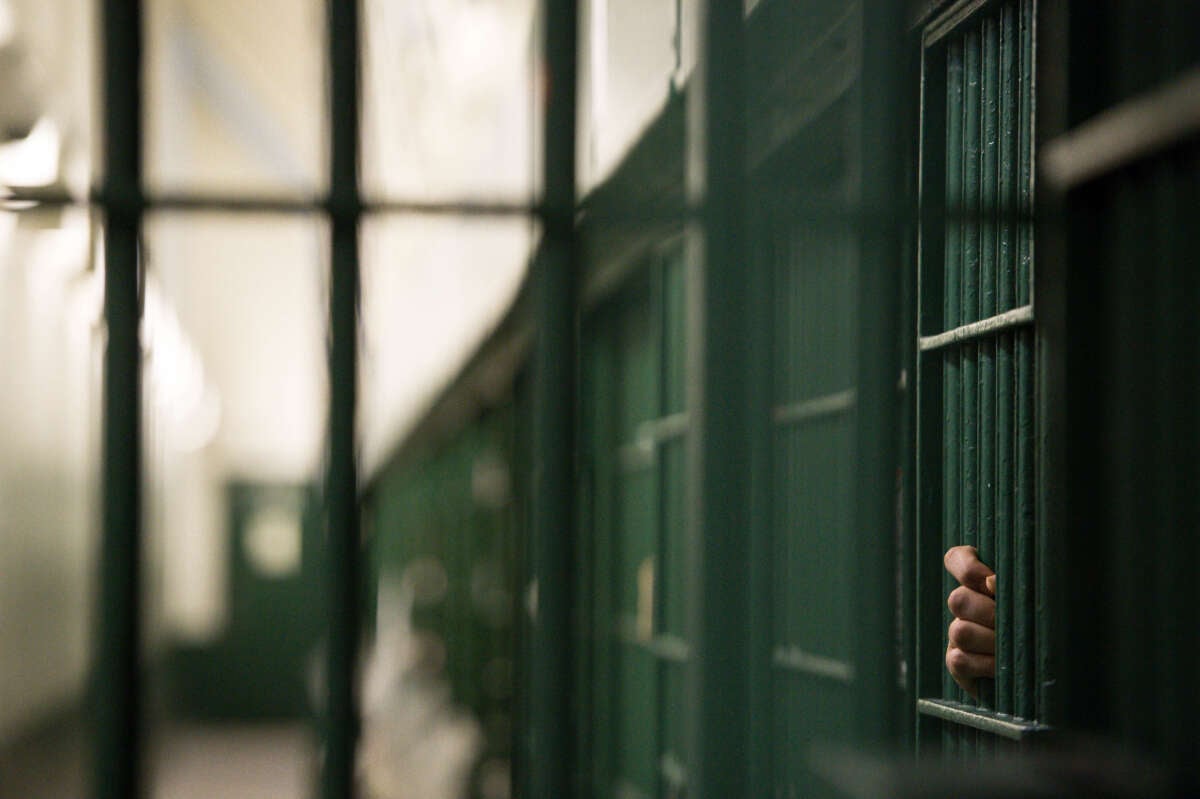
Los Angeles County's Men's Central Jail seen on February 22, 2018, in Los Angeles, California.Sarah Reingewirtz / MediaNews Group / Pasadena Star-News via Getty Images

Despite the state’s Democratic majority, more than 53 percent of Californians voted against a ban on slave labor in state prisonsProposition (Prop) 6 would have amended the state constitution by removing a provision that allows incarcerated people to be forced to work. Though it would not ban “voluntary” work in these facilities, it would prevent prison authorities from compelling an individual to work as punishment for a crime. California’s constitution currently mirrors the 13th Amendment’s notorious exception, which bans slavery except “as punishment for a crime.” That “loophole” underpins the link between capitalism and the carceral state. Nationwide, more than 790,000 people in state and federal prisons are estimated to be working — typically in maintenance jobs within their facilities, and sometimes in manufacturing, agricultural and public-service enterprises — generating several billion dollars in revenue annually, according to a 2022 ACLU report. Tens of thousands of them are in California, often earning less than $1 per hour.

Esteban Núñez, chief strategy consultant for the Anti-Recidivism Coalition, one of the groups spearheading the Prop 6 campaign, said the defeat of the measure underscored the need for “more voter education” about what the amendment was meant to accomplish, since many voters may have been confused by the somewhat arcane wording to “eliminate involuntary servitude for incarcerated persons” (written by the attorney general’s office). He noted that, despite Californians’ seeming apprehension about the measure, several other states, even Republican-dominated ones, have approved similar bans in recent years.

“This is something that, of course, was personal to a lot of us because we had lived experience with forced labor,” Núñez told Truthout. For many formerly incarcerated advocates like him, ending forced labor behind bars opens opportunities for more productive activities and positive change, like college courses and job training. “Forced labor really prohibits people’s ability to prioritize rehabilitation, and rehabilitation is really what’s going to drive down recidivism,” he added. “Those programs and education are just really vital to preparing somebody to come home.”

California’s Prison Labor Regime


California’s prison-industrial complex is one of the largest in the country, incarcerating people at a higher rate than most states. The state holds more than 91,000 people in custody as of last November, mostly Latinx and Black men — an ample captive workforce that delivers a variety of goods and services to the government: fighting wildfires, manufacturing office furniture, catering, and, after the pandemic broke out, producing face masks (even as they reportedly were forbidden from wearing masks themselves).

The ballot question, which had no organized opposition campaign and was championed by civil rights organizations and the state’s Reparations Task Force, was framed as a step toward “restor[ing] human dignity” and redressing structural racism in prison.

Related Story

Homemade Food Packages Were a Lifeline in Prison. New York Has Banned Them.
My mother used to send taffy to brighten life behind bars. Facing the holidays is grim under New York’s new rules. By E. Paris Whitfield , Truthout December 23, 2024


But some saw it differently, raising criticisms that seemed rooted in the notion that incarcerated people should have to work to pay the cost of their imprisonment and their supposed debt to society. An editorial in the San Jose Mercury News argued, “The fundamental question here is whether inmates should be required to provide work that contributes toward their room and board. We believe they should, just as the rest of us on the outside who have not committed crimes must also do.” The editorial board also argued that allowing incarcerated people to refuse work might pave the way for more mass work stoppages. (A major prison labor strike erupted in 2016, with tens of thousands of workers in multiple states protesting what they called inhumane and exploitative conditions.)

Additionally, political unease about the public cost of paying incarcerated workers fairly may have drawn opposition. An effort to institute a ban through California’s state legislature in 2022 ran into pushback from the Department of Finance, which estimated that implementing the measure would cost an additional $1.5 billion annually if incarcerated workers became entitled to earn a minimum wage, instead of the typical current pay rates of less than $1 an hour. The price tag led both Democratic and Republican lawmakers to back away from the measure. (In this past election cycle, Prop 6 and its accompanying legislation avoided direct projections of fiscal costs by instead “requir[ing] wages for work assignments in county and city jail programs to be set by local ordinance.”)

Abolitionists acknowledge that eliminating prison slavery will be costly for the governments and companies that have long benefited from it. “There is a price to be paid for abolishing slavery, there’s no question,” Andrew Ross, a professor of social and cultural analysis at New York University and co-author of Abolition Labor: The Fight to End Prison Slavery, told Truthout. “But what the legislators don’t do is focus on the benefit,” including the economic gains not just for incarcerated workers but also for their families and communities, which are often distressed, impoverished and disproportionately Black, Brown and Indigenous. Incarcerated workers could better support themselves and their families with decently paid voluntary jobs, which would alleviate dependence on the informal underground economy of prison “hustles” and, once released, help them stably transition to the mainstream economy.
State by State

Though it is a setback for the abolitionist movement, the defeat of Prop 6 comes on the heels of several successful efforts to end slavery in state prisons in a number of other, even more conservative, states. In Nevada this year — a state that Donald Trump won narrowly — voters approved a ballot initiative to abolish prison slavery via constitutional amendment by a 21-point margin, indicating that such proposals have moral appeal across party lines.

Colorado was the first state since the signing of the 13th Amendment to remove the “slavery exception” from its constitution in 2018. Utah, Nebraska, Alabama, Oregon, Tennessee and Vermont followed with similar ballot initiatives. Alabama’s 2022 abolition referendum included several other measures that removed explicitly racist provisions of the state constitution, including school segregation policies and a prohibition on racial miscegenation.

A bill recently introduced in the New York State legislature would amend the state’s constitution to “abolish slavery without exception,” and a companion bill lays out a framework of labor standards and rights for incarcerated workers. Incarcerated workers would be paid at least the state minimum wage — a massive raise from current hourly wages that typically run under a dollar — as well as workplace health and safety protections, which are crucial for the many high-risk maintenance jobs that incarcerated workers often perform, such as asbestos abatement.

On the national level, advocates face a tougher fight to amend the U.S. Constitution’s 13th Amendment. A bill introduced last year declares “the continued existence of slavery and involuntary servitude antithetical to the democratic values, norms, and mores of the United States and can undermine the moral credibility of our country on the global stage.” However, such an amendment would require a two-thirds majority of both chambers of Congress to move forward for ratification by the states — likely impossible with Republicans in control of the House and Senate.

Led by civil and human rights organizations as well as faith and labor groups, the movement to end prison slavery runs parallel to the contemporary abolition movement, which broadly envisions dismantling carceral institutions — which have disproportionately targeted Black communities since the end of chattel slavery — in order to replace them with community-focused systems of justice.

Abolishing forced prison labor is a step toward removing the capitalist infrastructure that has been built around the systematic exploitation of the incarcerated workforce. The vast majority of the incarcerated workforce is employed in maintenance jobs that keep prisons running, such as janitorial work. About 15 percent work for government-run enterprises and public works, according to the ACLU report’s estimates, while private industries employ less than 1 percent. Shifting all these workers into a system of voluntary labor would require an exponential increase in their wages, especially if incarcerated workers became eligible for standard state minimum wages or prevailing wage standards set for their respective industries. According to a recent study by Edgeworth Economics, transitioning to a voluntary paid workforce would put between $11.6 billion and $18.8 billion of annual wages into imprisoned workers’ pockets, and better-paid work in prison would translate into better economic prospects for workers once they are released.

Much of the advocacy around abolishing prison slavery does not go so far as to call for the abolition of prison itself, and some activists say they are above all focused on resolving the immediate human rights crisis of forced labor in prisons. But activists say if forced labor ends in prison, the whole infrastructure of the carceral state will become less economically viable. An obligation to treat incarcerated workers fairly and equally would shake the foundations of a social institution that has been designed for centuries to maximize suffering and exploitation. And empowering the incarcerated with real labor rights would enable them to hold authorities accountable and organize collective resistance to abuse.

“It would alter the balance of power in the prisons quite significantly if incarcerated people have the right to refuse ill-paid and unsafe work,” Ross said. “Because the ability to force people to work is absolutely key to the power of the jailor.”

But advocates acknowledge that ending forced labor in prison is an incremental shift that would not immediately end ingrained practices of oppression in the carceral system; labor remains an everyday part of prison life, and coercive treatment is endemic to the environment. Indeed, incarcerated workers have filed lawsuits in Alabama and Colorado, claiming they have still been forced to work and faced punishment for refusing, despite their states’ prison slavery bans. Those ongoing legal battles reveal how, beyond policy remedies, creating the conditions for true abolition demands sustained vigilance and organizing.

“Formal measures like this are not sufficient, but they’re necessary,” Ross said. “They put you down on the road to freedom, but the road is unbuilt, and you have to then build it.”

Michelle Chen is a contributing editor at Dissent Magazine, and a contributing writer at The Nation, In These Times and Truthout. She is also a co-producer of the “Asia Pacific Forum” podcast and Dissent Magazine’s “Belabored” podcast, and teaches history at the City University of New York. Follow her on Twitter: @meeshellchen.


'Barbaric violence': Video of inmate being beaten to death sparks call for 'immediate action'


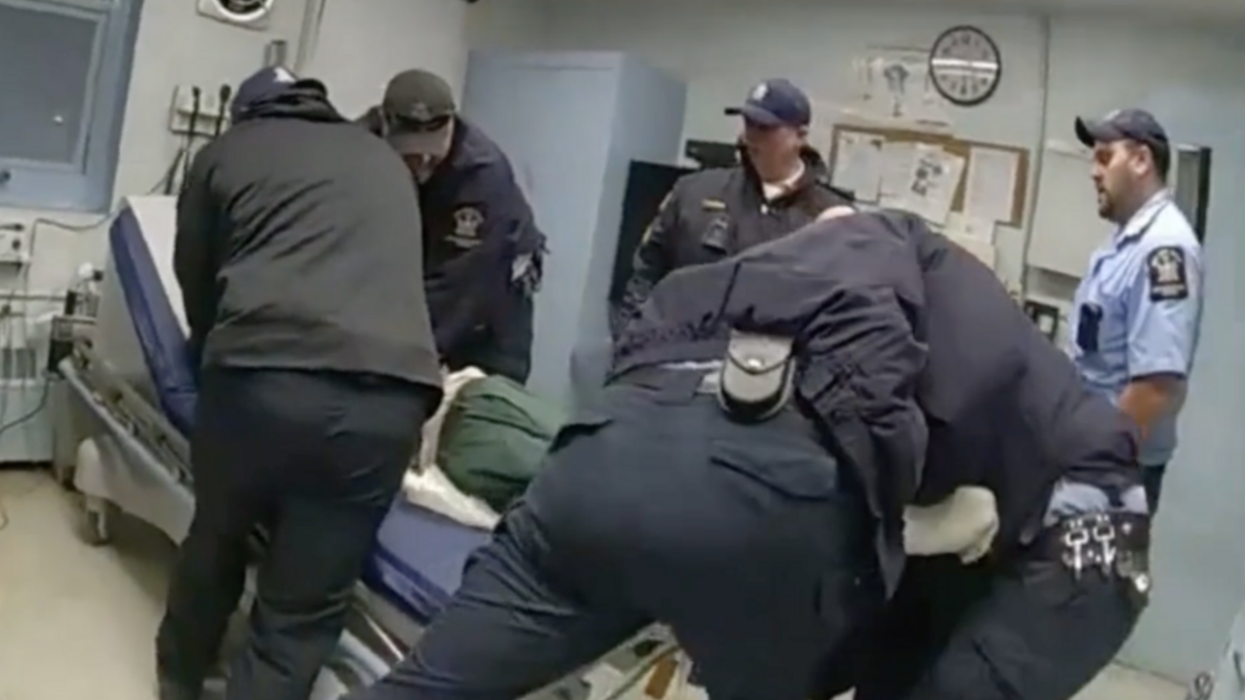
Body camera footage of Marcy Correctional Facility officers beating Robert Brooks on December 9, 2024 (Image: Office of New York Attorney General Letitia James)

December 28, 2024
ALTERNET

On Friday, the Office of New York Attorney General Letitia James released body camera footage from the night that Marcy Correctional Facility inmate Robert Brooks was beaten to death. Now, calls are mounting for those involved to be held criminally accountable.

Politico reported that both New York Democratic Governor Kathy Hochul and New York state senator Julia Salazar — who chairs the senate's Crime Victims, Crime and Correction Committee — are both demanding answers and justice. The video shows several officers standing around Brooks, who had just arrived at Marcy after being transferred from the Mohawk Correctional Facility in Oneida County, taking turns beating him while he was restrained in handcuffs and leg shackles. Just six hours after the beating, Syracuse.com reported that Brooks died from his injuries at Wynn Hospital in Utica.

While officers hadn't turned on their body cameras, the video footage was obtained via "standby" mode that captures video without accompanying audio. While there are 13 officers and one nurse involved, none have yet been charged with a crime. Hochul has called for all of those involved in Brooks' fatal assault to be fired. And in a public statement, she seemingly suggested that additional action beyond termination could follow.

READ MORE: 'Shame': Homeless woman who was in labor and needed care was given ticket instead

"Like all New Yorkers, I was outraged and horrified after seeing footage of the senseless killing of Robert Brooks," Hochul stated Friday. "The State of New York has zero tolerance for individuals who break the law, and I am committed to holding everyone involved fully accountable."

Sen. Salazar posted a statement to X condemning the "unconscionable violence" displayed by the officers in the body camera footage. She noted that while some of those involved have already been suspended without pay and others have resigned, she noted that she "fully expect[s] all officers involved to be criminally charged for their respective roles in enabling and committing barbaric violence against Robert Brooks, ultimately killing him." She also called Brooks' death a "profound policy failure that demands immediate action."

"Marcy Correctional Facility cannot remain open. The brutal killing of Robert Brooks would be more than enough to demand the closure of Marcy," Salazar stated. "However, there have been additional, previous reports of unconscionable violence against incarcerated individuals by staff at Marcy and at other [Department of Corrections and Community Supervision] facilities. My office has received these reports, and I have urged those with power to investigate these reports to do so."

Brooks was serving a 12-year sentence for stabbing his girlfriend several times. At the time of his transfer to Marcy, Brooks had served seven years of that sentence. Those involved are Officers Mathew Galliher, Nicholas Anzalone, David Kingsley, Nicholas Kieffer, Robert Kessler, Michael Fisher, Christopher Walrath, Michael Along, Shea Schoff, David Walters, Anthony Farina, Michael Mashaw, Glenn Trombly and Nurse Kyle Dashnaw.

READ MORE: 'Brutal and unacceptable': Calls for arrest of NYPD cop who put woman in Er during protests

Click here to read Politico's full report, and click here to view the body camera footage posted to Attorney General James' website (some of the footage is graphic and may be upsetting to some viewers.)

'Godfather of AI' demands strict regulations to stop technology from wiping out humanity

Image by Metamorworks, Shutterstock
Artificial Intelligence has a gender bias problem

December 29, 2024

Warning that the pace of development of artificial intelligence is "much faster" than he anticipated and is taking place in the absence of far-reaching regulations, the computer scientist often called the "Godfather of AI" on Friday said he believes chances are growing that AI could wipe out humanity.

Speaking to BBC Radio 4's "Today" program, Geoffrey Hinton said there is a "10% to 20%" chance AI could lead to human extinction in the next three decades.

Previously Hinton had said he saw a 10% chance of that happening.

"We've never had to deal with things more intelligent than ourselves before," Hinton explained. "And how many examples do you know of a more intelligent thing being controlled by a less intelligent thing? There are very few examples. There's a mother and baby. Evolution put a lot of work into allowing the baby to control the mother, but that's about the only example I know of."

Hinton, who was awarded the Nobel Prize in physics this year for his research into machine learning and AI, left his job at Google last year, saying he wanted to be able to speak out more about the dangers of unregulated AI.

"Just leaving it to the profit motive of large companies is not going to be sufficient to make sure they develop it safely."

He has warned that AI chatbots could be used by authoritarian leaders to manipulate the public, and said last year that "the kind of intelligence we're developing is very different from the intelligence we have."

On Friday, Hinton said he is particularly worried that "the invisible hand" of the market will not keep humans safe from a technology that surpasses their intelligence, and called for strict regulations of AI.

"Just leaving it to the profit motive of large companies is not going to be sufficient to make sure they develop it safely," said Hinton.

More than 120 bills have been proposed in the U.S. Congress to regulate AI robocalls, the technology's role in national security, and other issues, while the Biden administration has taken some action to rein in AI development.

An executive order calling for "Safe, Secure, and Trustworthy Development and Use of Artificial Intelligence" said that "harnessing AI for good and realizing its myriad benefits requires mitigating its substantial risks." President-elect Donald Trump is expected to rescind the order.

The White House Blueprint for an AI Bill of Rights calls for safe and effective systems, algorithmic discrimination protections, data privacy, notice and explanation when AI is used, and the ability to opt out of automated systems.

But the European Union's Artificial Intelligence Act was a deemed a "failure" by rights advocates this year, after industry lobbying helped ensure the law included numerous loopholes and exemptions for law enforcement and migration authorities.

"The only thing that can force those big companies to do more research on safety," said Hinton on Friday, "is government regulation."

AI has a stupid secret


Photo by Sandy Millar on Unsplash


December 27, 2024


Two of San Francisco’s leading players in artificial intelligence have challenged the public to come up with questions capable of testing the capabilities of large language models (LLMs) like Google Gemini and OpenAI’s o1. Scale AI, which specialises in preparing the vast tracts of data on which the LLMs are trained, teamed up with the Center for AI Safety (CAIS) to launch the initiative, Humanity’s Last Exam.

Featuring prizes of US$5,000 (£3,800) for those who come up with the top 50 questions selected for the test, Scale and CAIS say the goal is to test how close we are to achieving “expert-level AI systems” using the “largest, broadest coalition of experts in history”.

Why do this? The leading LLMs are already acing many established tests in intelligence, mathematics and law, but it’s hard to be sure how meaningful this is. In many cases, they may have pre-learned the answers due to the gargantuan quantities of data on which they are trained, including a significant percentage of everything on the internet.

Data is fundamental to this whole area. It is behind the paradigm shift from conventional computing to AI, from “telling” to “showing” these machines what to do. This requires good training datasets, but also good tests. Developers typically do this using data that hasn’t already been used for training, known in the jargon as “test datasets”.

If LLMs are not already able to pre-learn the answer to established tests like bar exams, they probably will soon. The AI analytics site Epoch estimates that 2028 will mark the point at which the AIs will effectively have read everything ever written by humans. An equally important challenge is how to keep assessing AIs once that rubicon has been crossed.

Of course, the internet is expanding all the time, with millions of new items being added daily. Could that take care of these problems?

Perhaps, but this bleeds into another insidious difficulty, referred to as “model collapse”. As the internet becomes increasingly flooded by AI-generated material which recirculates into future AI training sets, this may cause AIs to perform increasingly poorly. To overcome this problem, many developers are already collecting data from their AIs’ human interactions, adding fresh data for training and testing.

Some specialists argue that AIs also need to become “embodied”: moving around in the real world and acquiring their own experiences, as humans do. This might sound far-fetched until you realise that Tesla has been doing it for years with its cars. Another opportunity is human wearables, such as Meta’s popular smart glasses by Ray-Ban. These are equipped with cameras and microphones, and can be used to collect vast quantities of human-centric video and audio data.
Narrow tests

Yet even if such products guarantee enough training data in future, there is still the conundrum of how to define and measure intelligence – particularly artificial general intelligence (AGI), meaning an AI that equals or surpasses human intelligence.

Traditional human IQ tests have long been controversial for failing to capture the multifaceted nature of intelligence, encompassing everything from language to mathematics to empathy to sense of direction.

There’s an analagous problem with the tests used on AIs. There are many well established tests covering such tasks as summarising text, understanding it, drawing correct inferences from information, recognising human poses and gestures, and machine vision.

Some tests are being retired, usually because the AIs are doing so well at them, but they’re so task-specific as to be very narrow measures of intelligence. For instance, the chess-playing AI Stockfish is way ahead of Magnus Carlsen, the highest scoring human player of all time, on the Elo rating system. Yet Stockfish is incapable of doing other tasks such as understanding language. Clearly it would be wrong to conflate its chess capabilities with broader intelligence.

But with AIs now demonstrating broader intelligent behaviour, the challenge is to devise new benchmarks for comparing and measuring their progress. One notable approach has come from French Google engineer François Chollet. He argues that true intelligence lies in the ability to adapt and generalise learning to new, unseen situations. In 2019, he came up with the “abstraction and reasoning corpus” (ARC), a collection of puzzles in the form of simple visual grids designed to test an AI’s ability to infer and apply abstract rules.

Unlike previous benchmarks that test visual object recognition by training an AI on millions of images, each with information about the objects contained, ARC gives it minimal examples in advance. The AI has to figure out the puzzle logic and can’t just learn all the possible answers.

Though the ARC tests aren’t particularly difficult for humans to solve, there’s a prize of US$600,000 to the first AI system to reach a score of 85%. At the time of writing, we’re a long way from that point. Two recent leading LLMs, OpenAI’s o1 preview and Anthropic’s Sonnet 3.5, both score 21% on the ARC public leaderboard (known as the ARC-AGI-Pub).

Another recent attempt using OpenAI’s GPT-4o scored 50%, but somewhat controversially because the approach generated thousands of possible solutions before choosing the one that gave the best answer for the test. Even then, this was still reassuringly far from triggering the prize – or matching human performances of over 90%.

While ARC remains one of the most credible attempts to test for genuine intelligence in AI today, the Scale/CAIS initiative shows that the search continues for compelling alternatives. (Fascinatingly, we may never see some of the prize-winning questions. They won’t be published on the internet, to ensure the AIs don’t get a peek at the exam papers.)

We need to know when machines are getting close to human-level reasoning, with all the safety, ethical and moral questions this raises. At that point, we’ll presumably be left with an even harder exam question: how to test for a superintelligence. That’s an even more mind-bending task that we need to figure out.

Andrew Rogoyski, Innovation Director - Surrey Institute of People-Centred AI, University of Surrey

This article is republished from The Conversation under a Creative Commons license. Read the original article.


Gas Exports and AI Boom Poised to Spike Energy Prices for Consumers Under Trump

The expansion of AI data centers and a rush to export fracked gas is rapidly reshaping the energy landscape.
December 27, 2024

A ship is docked as the sun sets on November 16, 2023, at the Port of Corpus Christi in Corpus Christi, Texas.Jon Shapley / Houston Chronicle via Getty Images

As the Biden administration scrambles to shield President Joe Biden’s climate legacy from Donald Trump in its waning days, the president-elect is staring down serious political dilemmas over the future of energy.

Two remarkable trends — a rush to lock-in major fracked gas exports for decades to come, and Big Tech’s growing thirst for energy to run supercomputers at artificial intelligence (AI) data centers — are rapidly escalating debates over fossil fuels and the climate crisis. After attacking Biden over inflation and high gasoline prices, Trump will be expected to keep energy costs down as more domestically produced fuel is gobbled up by AI or shipped overseas.

The fossil fuel industry is relishing these developments as it pushes to expand the market for cheap fossil gas produced by the fracking boom. However, allowing the industry to have its way could result in more climate-warming pollution as well as higher prices for already frustrated consumers and businesses on Trump’s watch.

Climate activists declared a victory in January when the Biden administration paused permit approvals for massive new liquified natural gas (LNG) export terminals along the Gulf Coast to give the Energy Department time to update its analysis of the potential economic impacts. Trump and Republicans in Congress railed against the pause as a handout to climate activists and pledged to “unleash” the fossil fuel industry from government oversight and climate regulations once Trump takes office.

Oil and gas companies rewarded Trump with $14 million in campaign donations during the last six months of his campaign (Trump had asked for $1 billion). However, as critics and now the Energy Department point out, exporting large amounts of fossil gas to other countries puts upward pressure on prices at home. Trump has pledged to lift the pause on Energy Department permits for LNG export infrastructure as proposals for massive terminals in Louisiana and Texas face local protests, but increasing exports could allow the Democratic opposition to attack Trump and the GOP when Americans face higher energy bills.


Natural Gas Is a Climate Scam — and Consumers Are Paying for It
Despite the fracking boom, the price of natural gas for US households has skyrocketed by 52 percent since 2016. By Mike Ludwig , Truthout May 4, 2024


The Energy Department’s much-anticipated economic analysis of future LNG exports dropped last week, and environmentalists are already planning to leverage the findings to challenge Trump’s pro-polluter agenda.

Energy Secretary Jennifer M. Granholm said the analysis exposes a “triple-cost increase” to U.S. consumers from increasing LNG exports — an increase in domestic fossil gas prices, an increase in the cost of electricity for homes and businesses, and an increase in prices passed down to consumers by manufacturers who are also paying more for energy.

“Special scrutiny needs to be applied toward very large LNG projects,” Granholm said in a statement. “An LNG project exporting 4 billion cubic feet per day — considering its direct life cycle emissions — would yield more annual greenhouse gas emissions by itself than 141 of the world’s countries each did in 2023.”

While not a forecast of future global energy markets, the report models various scenarios for U.S. LNG exports and urges caution when considering permits for large terminals where fracked gas is processed, liquefied and loaded onto ocean tankers. Allowing the industry to expand and export more gas would increase domestic prices by up to 31 percent by 2050, with the greatest impacts concentrated in the Gulf South, the same region already shouldering much of the industry’s pollution.

Granholm said the U.S. should also be strategic about where U.S. exports are sold. China’s demand for LNG is expected to nearly double by 2030, Granholm said, and several Chinese entities have already inked deals with existing or proposed LNG export terminals. Leaders of both parties consider China a top economic and geopolitical competitor, and Trump and Vice President-elect J.D. Vance often rail against the country to the delight of their supporters.

As the world’s top fossil gas producer, the U.S. can meet both domestic and global demand in all modeled scenarios, according to the analysis. The question is whether American consumers will benefit from the fracking boom by paying lower prices for goods and fuel. The industry generally favors exports, which keep prices high despite the massive volume of gas produced in the U.S., including on publicly owned lands leased to fracking companies by the federal government.

Granholm is a Democrat and former attorney general of Michigan. Trump’s pick to lead the Energy Department, Chris Wright, is the CEO of a fossil fuel company who donated to Trump’s campaign and said as recently as 2023 that the climate crisis does not exist.

Louisiana Gov. Jeff Landry, a Republican champion of proposed LNG export terminals facing protests from residents in his state, predictably lashed out at the Energy Department’s analysis. Pointing to data showing that LNG exports create jobs, the U.S. Chamber of Commerce and other pro-industry groups dismissed the report as misleading and politically motivated.

“What’s really politically motivated here is the power of the oil and gas industry over the Chamber of Commerce which has Chevron and other direct players in the LNG industry that bankroll that press statement,” said Tyson Slocum, director of the energy program at the watchdog group Public Citizen, in an interview. “It’s the chamber playing politics here, we are playing with facts.”

Slocum said the fossil fuel industry makes far bigger profits from exporting fracked gas than selling it domestically. Horizontal fracking, a controversial method of producing oil and gas, unlocked massive gas reserves across the U.S. over the past 15 years. So much gas was produced that prices plummeted, Slocum said, and the industry is aggressively searching for ways to expand the market.

“And now they’ve hit on what they believe is a goldmine, they have a two-fer, they have a situation where you have massive brand-new demand for gas happening simultaneously — LNG exports and AI data centers,” Slocum said. “The gas industry is aggressively pushing the narrative that the only solution is more fracking, more gas-powered power plants, more LNG.”

While the Biden administration attempted to slow LNG exports with the permitting pause and economic analysis, officials have not shown the same caution with AI data centers that house supercomputers used to crunch the massive amounts of data consumed by artificial intelligence programs. This requires huge amounts of energy and large volumes of water to keep the systems cool, but the industry is growing rapidly and is expected to consume up to 17 percent of all energy in the U.S. by 2030.

“The natural gas industry is exploiting these events and even encouraging these events to simply make America and the world as addicted to natural gas as possible,” Slocum said.

Last week, The Washington Post reported that the White House is drafting a plan to open up public lands for the construction of AI data centers along with power plants to fuel them. Environmental regulations would reportedly be eased to facilitate faster construction, and the power plants would be fueled by fossil gas, which would be eventually replaced by wind or solar at some unidentified time in the future.

Environmental and public interest groups quickly slammed the plan, saying it could allow the gas-burning power plants to exceed pollution limits and give data centers priority access to energy over other consumers on the electric grid.

“At best, this approach risks American families paying more for power and suffering the consequences of more health harming pollution from power plants,” said Abe Scarr, director of the U.S. PIRG Education Fund’s Energy and Utilities Program, in a statement. “At worst, it leaves American families in the dark, while AI siphons up all the energy on the grid.”

In Arizona, where politicians engineered a data center construction boom with lucrative tax breaks, consumers now face an 8 percent rate hike to pay for new electricity infrastructure, according to The Washington Post. Some Indigenous communities in the state do not have electricity at all, but the rate hike is making room for data centers and a growing population, not bringing power to rural tribal lands.

The Biden administration has not specifically commented on the reported plan to open up public lands to AI data centers, and it remains unclear whether an executive order will be issued before Biden leaves office. In a statement to The Post, the White House said the administration “is continuing to work with all stakeholders to ensure the U.S. leads the world in AI, and AI data centers are powered by clean energy without raising electricity costs for consumers.”

Balancing the rush to export more LNG and the energy demands of data centers with the needs of an electorate fed up with inflation and high prices will soon be Trump’s job. Trump scoffs at the climate crisis, but the costs associated with climate change are rising as well, with extreme weather and other impacts costing the U.S. about $150 billion each year. The incoming president may fantasize about using the vast quantities of “liquid gold” produced in the U.S. to pay down federal debt, but he may soon discover that slashing regulations and “unleashing” fossil fuels may not deliver the results that he expects.

'Big hammer': AI power needs rapidly take a toll on electric grids powering Americans’ homes


View of the United States at night from space (Image: NASA Goddard Space Flight Center)


December 28, 2024
ALTERNET


The growing power requirements of artificial intelligence (AI) data centers are now already having a negative impact on millions of Americans, according to a new report.

Bloomberg reported Friday that in many major metropolitan centers, AI data centers are gobbling up so much electricity that the quality of power residents are receiving is starting to go down. As AI continues to proliferate, its footprint on local power grids could present a risk to older home appliances and fragile municipal infrastructure.

According to Bloomberg, many of the distorted power readings it analyzed based on hundreds of thousands of home sensors are within 50 miles of an AI data center. This includes homes in both urban and rural areas, and manifests in the form of "bad harmonics." The publication reported that those bad harmonics — in which waves of electricity traveling into a home are excessively distorted — "can force home electronics to run hot, or even cause the motors in refrigerators and air conditioners to rattle" and cause "billions of dollars in damage."

Aside from questions over whether residents will have enough electricity to run their homes, the growing electricity demand for AI data centers has also led to concerns over whether these power distortions could pose a physical danger to residents if a power surge destroys an appliance or causes an electrical fire. Hasala Dharmawardena, who is a senior engineer of power systems modeling studies at the North American Reliability Corp., warned that decision-makers "need to understand those risks," as AI is "such a big hammer" on local electrical grids.

"The data center is a very large load," he said. "Take your house and increase that by 10,000. That is the difference between your house and a data center."

Thanks to the growing AI industry, U.S. demand for electricity is expected to jump by 16% by 2030, according to a study conducted by Washington D.C. consulting firm Grid Strategies. That's more than triple the 2023 estimate in projected demand. And without significant investments in bolstering electric grid infrastructure, the threat posed by bad harmonics is likely to worsen. Metro areas with the most AI data centers include the Northern Virginia/D.C. metro area, the Dallas-Fort Worth metro area, the San Francisco Bay Area, Phoenix, Arizona, Atlanta, Georgia and Chicagoland.

"Harmonics are a pretty good canary in the coal mine for early signs of stress and problems," said Whisker Labs CEO Bob Marshall, whose company tracks power quality in real time.


Op-Ed: What’s wrong with private debt, apart from the headlines?


ByPaul Wallis
DIGITAL JOURNAL
December 28, 2024


The dollar weakened after the release of US inflation data and the Federal Reserve's forecast for interest rates. — © GETTY IMAGES NORTH AMERICA/AFP MARK WILSON

There’s a quietly overflowing bathtub of market news about private debt. It’s growing quite rapidly, and the finance guys aren’t complaining. Private debt is sourced from non-bank lenders.

Private debt is seen as risky. The headlines about private debt, correctly for a change, paint a much more complex picture. Private debt is also seen as an opportunity for investors, private debt funds, etc.

You can be forgiven for thinking there’s more than a slight whiff of “payday loan” in the media image of private debt. There’s some basis for that. Defaults are at decade-long highs,

It’s important not to minimize the complexities of this situation.

Much of this debt has been festering away since before the pandemic. The rise in interest rates has made the original debts more expensive. “Leverage” has been a four-letter word since the 1980s, when people could still read balance sheets.

The almost incestuous relationship between debt and those “great numbers” which usually precede every corporate crash and burn also needs to be understood. Debt first became fashionable in the 1980s. It became a plague in the 1990s.

Only the unnaturally low rates kept these huge debts viable in the corporate environment. Well, that and “creative accountancy”. It’s never been a particularly healthy environment.

Private debt, however, also includes individuals, and small and medium businesses. That’s a sort of confetti-like motif of individual messes. The market never really addresses this very large undercurrent in cash flow.

This multilevel demand for debt is the really significant issue.

It looks far too much like the demand for money to meet rising costs has simply transferred itself to the debt market. There’s nothing reassuring about that. Those price rises in the last few years were massive and cumulative, and the debt market wasn’t exactly in robust health before they began.

The global economy is also not in good shape. The anti-global idiots seem to have forgotten where their money ultimately comes from.

Any expensive breeze could blow down this house of credit cards. Never mind blowing away dodgy loans issued on flimsy credit ratings. Global Main Street is paying the bills, barely, but how much debt can it support?

There’s another side to this which is usually overlooked entirely. Many of these lenders are tough as nails. They don’t make mistakes. I did some work for hard money lenders in California a few years ago. Those guys don’t mess about.

Hard money lending means collateral backing. Ironically, it’s safer for borrowers and lenders than “debt on demand” can ever be.

Even more ironically, it’s the traditional form of moneylending. It’s had thousands of years of practice. Debt is managed by the realities of the loan. You can’t usually even think about on selling a bad risk, either.

Which is where the wheels fall off for soft money loans. This huge amount of capital also increases the amount of money in the market. It supports inflation and price rises in general.

If price rises weren’t supported by debt, they’d be totally non-viable. Nobody would expect markets to simply absorb such big price increases without some sort of balancing act. Debt is in effect creating debt.

The problems are:

So many people also make big money out of writing loans. You can’t expect them to stop and take up basketweaving instead.

In such absurdly deregulated markets, it’s hard to stop people from writing irresponsible loans.

There are laws in place, but those laws had almost no impact in 2008, either.

Taking out a loan right now is incredibly risky because nobody knows what the US economy will be like in 2025.

Let’s put it this way:

Dumb is as dumb does.

The big money is on dumber than ever.

________________________________________________________

Disclaimer
The opinions expressed in this Op-Ed are those of the author. They do not purport to reflect the opinions or views of the Digital Journal or its members.