Monday, December 30, 2024

ISRAEL

Court rejects police request for access to phones of arrested anti-government activists

Judge says no grounds for far-reaching measure against protesters nabbed on Saturday night; court also rebukes police for detaining one protester overnight in prison without cause

By Jeremy Sharon
29 December 2024

TIMES OF ISRAEL (TOI)

Police clash with demonstrators during a protest calling for the release of Israeli hostages held in the Gaza Strip, in Jerusalem, December 28, 2024. 
(Chaim Goldberg/ Flash90)

The Jerusalem Magistrate’s Court on Sunday rejected a police request to obtain access to the phones of several anti-government demonstrators who were arrested on Saturday night, saying that the crime of which they are suspected, disturbing the public order, does not justify such measures.

The activists’ attorney had strongly opposed the intrusive action, insisting it bore no connection to the protesters’ alleged violation and warning that it would open the door to further abuse of such powers by the police.

The judge also rejected the police’s request to bar the activists from participating in protests outside the homes of public figures and denied a request by the police for a restraining order against them.

In a further setback for the police, the same judge rebuked the force for holding one of the protester overnight in a women’s prison in Ramle, without justification, in violation of police procedure.

The woman was arrested for disturbing the public order and the unlawful use of fire or flammable substance for using what the police said was a smoke grenade, but what the judge determined to be a legal smoke candle.

The judge rejected the police’s claims that the woman was dangerous and said she should not have been detained overnight, but rather released on restricted conditions.


Police clash with demonstrators during a protest calling for the release of Israeli hostages being held in the Gaza Strip, in Jerusalem, December 28, 2024.

(Chaim Goldberg/Flash90)

The police arrested the five activists on Saturday following demonstrations held outside the Prime Minister’s Residence in Jerusalem, and in Kikar Safra outside City Hall, where they were calling for a deal for the release of the hostages held by Hamas in Gaza.

In the arrest of the activists from the Prime Minister’s Residence protest, police officers in a patrol car initially detained and questioned the protesters, just after they left the demonstration in their vehicle, but then sent them on their way.

Several minutes later, however, the same patrol car pulled them over again, officers searched the car for an effigy that had been used at the protest, and although they did not find it or anything else incriminating, arrested the four activists.

While the four were subsequently released, the police insisted on keeping their phones.

The police’s justification for the request to obtain access to the phones was to check whether there had been “illegal organization ahead of the demonstration.”

In reply to a question from Judge Chavi Toker, the police representative acknowledged in court that the only illegal activity at the demonstration allegedly committed by the activists was “disturbing public order” and the unlawful use of a megaphone.

Attorney Yoni Nussbaum, who represented the activists, warned that if the court acceded to the police request, “Tomorrow morning, they’ll take everyone’s phone from them.”

He also objected to the strict conditions for release set by the police, including a restraining order from being present in Jerusalem for 15 days and a ban on participating in a protest against a public figure for 15 days.

Toker said that the allegations against the protesters did not justify the police request to gain access to their phones, and rejected the measure.

She also rejected the police’s request for a ban on the suspects’ participation in protests against public figures.


Police clash with demonstrators during a protest calling for the release of Israeli hostages held in the Gaza Strip, in Jerusalem, December 28, 2024.

 (Chaim Goldberg/Flash90)

In the hearing for the fifth woman arrested, for the use of the smoke candle at the demonstration in Kikar Safra, the police representative conceded that the smoke device the woman used was not dangerous, but accused her of having thrown it during the protest.

The woman was arrested on charges of the unlawful use of fire or a flammable substance, and for disturbing the public order.

Nussbaum, who represented this protester as well, insisted that the video footage the police representative showed the court did not show her throwing the object, and said that it was a completely legal smoke device available for purchase in regular shops for around NIS 50.

Nussbaum also pointed out that when he got to the police station at 12:30 a.m., the woman was ready to admit to the charges, and that there was, therefore, no need to detain her overnight in prison.

“I cannot understand why she was [held] overnight in Neve Tirtza [women’s prison]. Why?” demanded the lawyer.

Toker appeared to side with Nussbaum, saying that in light of the fact that the woman was not dangerous, “the [police] officer has no authority to detain [her], even until the detainee is brought before the court.”

She added that the proper procedure was to establish restricted release conditions at the police station, not while the suspect is in prison.
China: Blogger Liu Hanbin detained for one month after exposing a land seizure scandal


Reporters Without Borders (RSF)
29 December 2024

A police officer maintains order at a site in Hohhot, Inner Mongolia, China, 17 February 2022. Costfoto/Future Publishing via Getty Images

The blogger posted a video in which he mentioned a case of farmers protesting against the seizing of their land by officials.

This statement was originally published on rsf.org on 27 December 2024.

Reporters Without Borders (RSF) calls on the Chinese regime to immediately release Liu Hanbin, a blogger detained for a month after publishing information about a protest by farmers opposing forced land seizures. Liu is the 125th journalist detained by Beijing.

This 27 December 2024 will mark one month since Chinese blogger Liu Hanbin, also known by his pen name Wen Yi Fan, has been detained by the police. He was arrested in the capital of Inner Mongolia Hohhot in northern China, and is currently being held at the city’s Detention Centre No. 1.

The 52-year-old blogger has been charged with “picking quarrels and provoking trouble”, a crime punishable by up to five years in prison, after he published a video on the Chinese social media WeChat in which he mentioned a case of farmers protesting against the seizing of their land by officials. On 6 December, police denied Liu’s request for bail, claiming the case was “significant and complex.” The blogger has also been denied access to his lawyer.

“Chinese blogger Liu Hanbin was only serving the public interest by shedding light on abuses linked to land seizures, and should never be detained, let alone denied the right to meet with his lawyer. We call on the international community to build up pressure on the Chinese authorities to secure Liu’s release alongside the 124 other journalists and press freedom defenders detained in the country.”
Cédric Alviani, RSF’s Asia-Pacific Bureau Director

Liu is well-known for his reports on regional news in Inner Mongolia, which he shared on his WeChat account. His recent posts include reports on illegal sand mining, and various wrongdoings by local authorities, such as a recent case of police violence against a teenager.

In China, independent journalists and press freedom defenders who address issues deemed sensitive by the regime often face charges of “picking quarrels and provoking trouble”. Zhang Zhan, a journalist sentenced to four years in prison in 2020 for reporting on the Covid-19 outbreak, is an emblematic example. Released in May 2024, she has been criminally detained under the same charge since August 2024, this time after posting information on social media about the harassment of activists in China.

Since Xi Jinping came to power in 2012, he has fostered a media culture reminiscent of the Maoist era, where seeking information or sharing it freely is criminalised. RSF’s report ”The Great Leap Backwards of Journalism in China”, reveals the regime’s extensive efforts to control media outlets and the dissemination of information — both domestically and internationally.

China, the world’s biggest prison for journalists and press freedom defenders with at least 125 media workers currently behind bars, is ranked 172nd out of 180 countries in RSF’s 2024 World Press Freedom Index.
CRYPTOZOOLOGY IS DANGEROUS

Two men found dead ‘while looking for Bigfoot’ in US national forest

Sam Courtney-Guy
Published December 29, 2024 
METRO UK
The victims’ families grew fearful after they failed to return home on Christmas Eve

Two men have been found dead after setting off on an expedition to find the mythical Bigfoot creature, police in the US state of Oregon said.

The victims, aged 37 and 59 and from the city of Portland, were found in a wooded area of the Gifford Pinchot National Forest in Washington State, according to authorities.

The pair, who told relatives they would get home on Christmas Eve, appeared to have died of exposure after failing to prepare adequately for the trek.

They were reported missing at around 1am on Christmas Day, prompting a three-day search involving 60 volunteers and rescue experts who used dogs and drones.

Skamania County Sheriff’s Office said the pair’s family told police the men were likely in danger because they were looking for the so-called Sasquatch.

Gifford Pinchot National Forest covers a vast area of 1.3 million acres and its winter conditions can be challenging even for experienced hikers.

The men were found after the search area was narrowed down when CCTV footage led authorities to their car.
The pair’s disappearance sparked a huge three-day search

Bigfoot, generally described as a large two-legged human-like or ape-like creature, has featured widely in folk tales and unverified ‘sightings’ in America and Canada.

No scientifically accepted evidence of the creature’s existence has ever been uncovered, but surveys have found more than 1 in 10 Americans believe it is real.

The belief is thought to be most popular in the Pacific Northwest (which includes the state of Oregon) where Bigfoot is seen as a cultural icon.

Expiditions to find the Sasquatch are said to be a popular past-time among Bigfoot believers.

‘The Skamania County Sheriff’s Office extends our deepest sympathies and condolences to the families of the loved ones lost in this tragic incident,’ authorities said.
'Nuclear demolition': Columnist flags 'MAGA's real World War III' the media is missing


David McAfee
December 29, 2024
RAW STORY

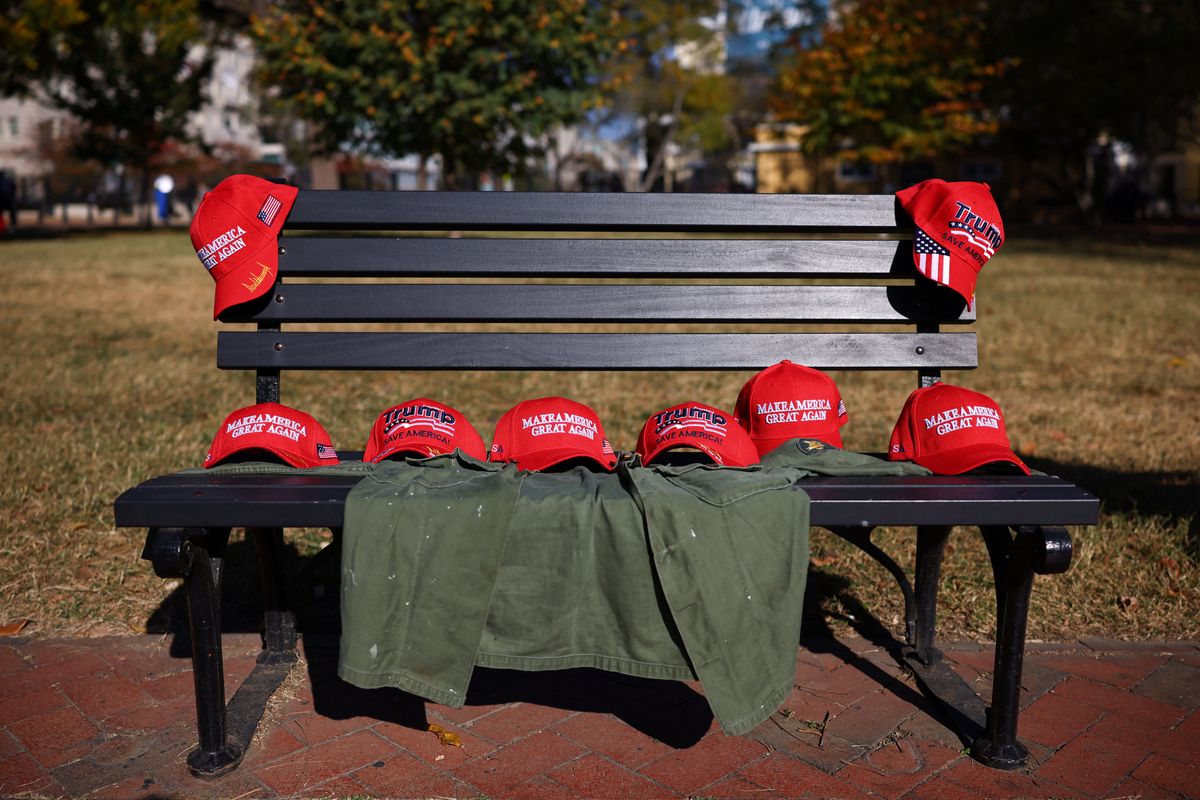
MAGA hats are laid out on a bench outside of the White House, after Republican Donald Trump won the U.S. presidential election, in Washington, D.C., U.S., November 6, 2024. REUTERS/Daniel Cole

While mainstream media is talking about potential invasions of Greenland and Panama, Donald Trump and Elon Musk are making advancements in their real war effort, according to a columnist's analysis.

National opinion columnist for the Philadelphia Inquirer, Will Bunch, is no stranger to issues related to the president-elect.

Bunch Sunday published an opinion piece in which he argues we should "forget Greenland" and Panama.

"In a world where the news doesn’t stop getting more bat-guano crazy just because it’s Christmas, where a phony war between the United States and Denmark consumes more electrons than the heartbreakingly real ones in Gaza and Ukraine, you might have missed a major escalation in the world conflict that matters most," Bunch writes. "The unrelenting and wildly successful war on facts, also known as truth."

Bunch goes on to call out specific news outlets he says are missing the bigger picture.

"This significant surrender on the war against propaganda, and the campaign against a holdout pocket of resistance in Wikipedia, got scant attention in a mainstream media that was decimated both morally and economically over the course of 2024. Instead, the scribes at the New York Times, Washington Post and elsewhere were on the scavenger hunt for a new batch of shiny objects planted by the nominal president-elect: wild threats to take over the Panama Canal and Greenland and maybe even Canada," the piece states. "Forget Greenland. My strong — and maybe naive? — hunch is that Denmark’s vast, mineral-rich Arctic territory won’t prove to be 2025’s Sudetenland, but Trump’s blustery and out-of-left-field pitch for American lebensraum is important as the leading edge of Team MAGA’s real World War III — against any consensus on objective truth."

He then adds, "The tactical goals for Musk (lower taxes, the end of government regulations, preferential deals with the U.S. government, and — yes, Bond fans — global domination) and for Trump (disappearing his criminal cases while monetizing the American presidency) are very much in sight. Their strategy for getting there — the real WWIII that doesn’t involve storming Panama — is the nuclear demolition of objective reality."

Read the piece here.

Trump or Musk should buy Greenland themselves instead of US annexation: Senior Russian official

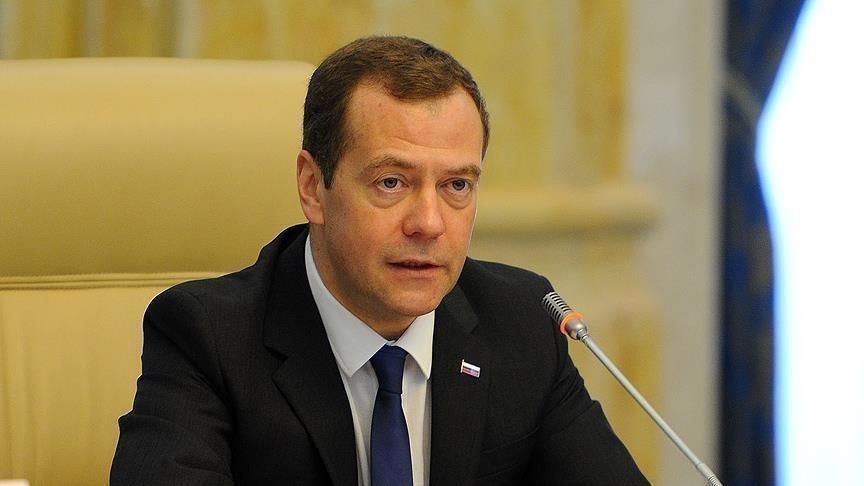
Dmitry Medvedev says president-elect or his billionaire friend 'could just buy land, making it their private property'

Elena Teslova |29.12.2024 - TRT/AA


MOSCOW

A senior Russian official on Sunday weighed in on US President-elect Donald Trump’s controversial proposal for the US government to purchase Greenland or other foreign territories, saying that instead, Trump or his close ally Elon Musk should personally open their wallets to buy the land they want.

"Not sure why the US, as a country, needs to annex Canada, Greenland, or even Britain, and take back the Panama Canal. There's a more civilized way: @realDonaldTrump and @elonmusk could just buy the land, making it their private property," Dmitry Medvedev, a former Russian president and premier, and currently deputy chair of the Russian Security Council, wrote on X.

It was not clear if the post was written as a serious proposal.

This month Trump reiterated his stated wish from his first term to control the autonomous Danish territory of Greenland, calling it an “absolute necessity.” Denmark quickly rebuffed his proposal.

Since winning his ticket back to the White House in November, Trump has also repeatedly called Canadian Prime Minister Justin Trudeau "the governor of the great state of Canada,” as if it were a US state.

He also said the US may retake control over the Panama Canal if the current conditions of its use are not reviewed.

Musk, the owner of electric carmaker Tesla and social media platform X, is currently ranked the world’s richest man, with a worth of some $219 million, though it is doubtful if any of the territories in question would go for sale at any price.


Chess grandmaster Magnus Carlsen returns to a tournament after a dispute over jeans is resolved

CAN'T BE A WORLD TOURNAMENT WITHOUT THE WORLD GM

AP |
Dec 30, 2024

NEW YORK — Top-ranked chess player Magnus Carlsen is headed back to the World Blitz Championship on Monday after its governing body agreed to loosen a dress code that got him fined and denied a late-round game in another tournament for refusing to change out of jeans

.

Lamenting the contretemps, International Chess Federation President Arkady Dvorkovich said in a statement Sunday that he'd let World Blitz Championship tournament officials consider allowing “appropriate jeans” with a jacket, and other “elegant minor deviations” from the dress code.

He said Carlsen's stand — which culminated in his quitting the tournament Friday — highlighted a need for more discussion “to ensure that our rules and their application reflect the evolving nature of chess as a global and accessible sport.”

Carlsen, meanwhile, said in a video posted Sunday on social media that he would play — and wear jeans — in the World Blitz Championship when it begins Monday.

“I think the situation was badly mishandled on their side,” the 34-year-old Norwegian grandmaster said. But he added that he loves playing blitz — a fast-paced form of chess — and wanted fans to be able to watch, and that he was encouraged by his discussions with the federation after Friday's showdown.

“I think we sort of all want the same thing,” he suggested in the video on his Take Take Take chess app’s YouTube channel. “We want the players to be comfortable, sure, but also relatively presentable.”

The events began when Carlsen wore jeans and a sportcoat Friday to the Rapid World Championship, which is separate from but held in conjunction with the blitz event. The chess federation said Friday that longstanding rules prohibit jeans at those tournaments, and players are lodged nearby to make sartorial switch-ups easy if needed.


An official fined Carlsen $200 and asked him to change pants, but he refused and wasn't paired for a ninth-round game, the federation said at the time. The organization noted that another grandmaster, Ian Nepomniachtchi, was fined earlier in the day for wearing sports shoes, changed and continued to play.


Carlsen has said that he offered to wear something else the next day, but officials were unyielding. He said “it became a bit of a matter of principle,” so he quit the rapid and blitz championships.

In the video posted Sunday, he questioned whether he had indeed broken a rule and said changing clothes would have needlessly interrupted his concentration between games. He called the punishment “unbelievably harsh.”

“Of course, I could have changed. Obviously, I didn’t want to,” he said, and “I stand by that.”
CRIMINAL CAPITALI$M

AstraZeneca Execs Sentenced to Prison for Fraud

By Nick Koutsobinas | Sunday, 29 December 2024 | NEWSMAX

A sweeping fraud investigation in China has led to prison sentences for multiple AstraZeneca executives, including Leon Wang, the company's former international chief, and has led to the implication of more than 100 of the company's employees, Highwire reported Friday.

The case centered around pushing fraudulent genetic testing to qualify patients for AstraZeneca's lung cancer drug Tagrisso.

In 2019, according to court documents, two AstraZeneca sales reps advocated for a partnership with Genowise Corp. Genowise Corp, a Chinese genetic testing company, would provide fake positive test results to qualify patients for AstraZeneca's lung cancer drug.

Chen Bin, AstraZeneca's East China sales director for oncology drugs, encouraged sales staff to send cancer patients' biopsy samples to "partnered genetic testing institutions" to "convert" the samples to test positive for the genetic mutation T790M.

The drug company's sales representatives and regional managers have admitted to altering the test results. The Chinese investigation has led to multiple decade-long prison sentences for senior-level employees and arrests of the executives and shareholders. Notably, 13% of the pharmaceutical company's revenue comes from China.


Nick Koutsobinas, a Newsmax writer, has years of news reporting experience. A graduate from Missouri State University’s philosophy program, he focuses on exposing corruption and censorship.
Op-Ed: People don’t want to work? Guess again, morons.


By Paul Wallis
December 29, 2024
DIGITAL JOURNAL

How will digital workspaces progress? — Image by © Tim Sandle

Years of idiotic generation-bashing have led to this particularly stupid statement: “People don’t want to work.” Great minds will no doubt come up with a dumber assessment but let’s stick to this one.

Let’s start with the obvious.

WRONG. They don’t want to work for nothing, and they want to have lives.

The constant bleating self-righteous headlines tell a long irritating story of ignorance and ineptitude. Wages are now useless. The workplace environment is often hellish and absurdly stressful. People turn over fast due to multiple good reasons.

The paranoid penny-pinching surveillance-obsessed management culture is utterly insufferable for many.

Unrealistic and absurdly costly demands like “back to the office” don’t help people struggling to pay rent, health, and power. You can pay for your long time-consuming commute or eat, apparently.

This imbecility effectively turns 8 hour days into far more expensive 12 hour days and bites deeply into wages and savings. That can never be sustainable in this massively overpriced economy.

Thanks to the cost of living, the ordinary job, particularly a low-wage job is now a form of extended torture, and it looks like it’s about to get a lot worse.

It’s not a complete mystery how this happened. The banal, simplistic certainties of jobs and careers were completely blindsided. A job now means nothing and a career is, at best, likely to be patchy.

People have been infamously working more than one job just to meet rent and living costs for well over a decade. Food banks are supporting incredible numbers of people. According to one person I spoke to from a food bank, they say more people should be using them.

Contrast this cluster of stupidities with the “one job was enough to raise a family and own a house” of 60 years ago. That was pretty much true.

You couldn’t call it flashy, but it worked. People had lives, too. The society was healthier, crime was much lower, and there were actual opportunities.

You could at least convince yourself that you had a credible future.

Not anymore.

The Millennials and Gen Z don’t and can’t believe it. They can’t own homes, and it’s a miserable, unhygienic, and hyper-neurotic living environment in so many ways.

How are they supposed to achieve anything?

They’re trying to live in an economic environment that no longer functions. Ground-level data is all bad. If you look at the global medication stats, you’ll see that things aren’t great. Some of these meds are even dietary supplements, used to manage deficiencies in basic nutrition.

Gen Alpha will be totally feral, with so many good reasons. They have nothing but economic hardship to look forward to, particularly with AI hoovering up so many jobs.

They have no reason to do anything but go into survival mode. “The system” is effectively dead. I doubt you could convince the Mills, Z or Alphas that the system ever worked because the system has basically killed their chances.

We’ll leave out the politics.

Suffice to say that the word “politics” is now a synonym for “insanity”

For progressives like me, that’s incredibly infuriating. Who told you sanctimonious morons to just babble on while civilization collapsed? You’re as bad as they are.

What’s needed is the exact opposite, The world needs a lot of competence on the job. That’s what jobs are supposed to do, and who’s supposed to be doing them, in case the topic ever comes up. Not ridiculous greedy little nobodies who screw up everything they touch and get overpaid for it.

A gang member said years ago that there was no point in working a low-wage day job when he could make thousands a day illegally. Sound familiar? I remember hearing that 50 years ago.

So let’s get back to this “Nobody wants to work” idiocy. In the absence of leadership which has taken mediocrity to new heights of ineptitude, what are you supposed to do?

The only thing you can do.

Create a life for yourself. Go indie.

Be a contractor or whatever so you can work on your own terms doing work you’re good at. Just make sure you get paid. Get useful skills like a trade or something that can’t be automated overnight. Be your own boss, if for no other reason than it’s much less annoying.

It can be quite frustrating and worrying working with “whatever” in the market.

if you know how to hustle, you can work on your terms.

Good luck.

______________________________________________________

Disclaimer
The opinions expressed in this Op-Ed are those of the author. They do not purport to reflect the opinions or views of the Digital Journal or its members.

REPUBLIC OF IRELAND

Minister hails uptake of free contraception scheme


Stephen Donnelly has highlighted the uptake of the free contraception scheme in 2024 (Brian Lawless/PA)

By Jonathan McCambridge, PA
Today 


It is projected that 320,000 women in Ireland will have accessed an expanded free contraception scheme in 2024, Health Minister Stephen Donnelly said.

The minister highlighted the uptake of the scheme, with data from January to September this year showing that approximately 245,000 people accessed it at least once.

This compares to just under 189,000 women who accessed the scheme in 2023, when it was available to women aged 17–30.

In January, it was extended to women aged 31, and was further expanded in July to include women aged 32 to 35.

It’s one of many developments in women’s health in recent years that reflect our ongoing efforts to provide a quality, accessible and equitable health service
Stephen Donnelly

Mr Donnelly said: “We introduced the free contraception scheme in recognition of the barriers that many women faced in accessing contraception affordably.

“No-one should have to bear disproportionate financial costs because of their gender.

“I’m very pleased by the strong uptake in the scheme, which is providing women with financial freedom when making choices about their reproductive health.

“Since its launch in September 2022 we have expanded it rapidly in response to clear demand.

“It’s one of many developments in women’s health in recent years that reflect our ongoing efforts to provide a quality, accessible and equitable health service for all, regardless of ability to pay.”

The scheme is open to women, girls and other people identifying as transgender or non-binary, who are ordinarily resident in Ireland and for whom prescription contraception is deemed suitable by their doctors.

Almost 2,400 GPs and 2,050 pharmacies are providing services under the scheme.
Barbados fishing industry still reeling from hurricane aftermath

Will Grant
BBC
Mexico, Central America and Cuba Correspondent
Reporting from Bridgetown, Barbados

Hurricane Beryl took its toll on the island's fishing fleet

There are few clearer signs of the destructive power that Hurricane Beryl unleashed on Barbados in July than the scene at the temporary boatyard in the capital, Bridgetown.

Scores of mangled and cracked vessels sit on stacks, gaping holes in their hulls, their rudders snapped off and cabin windows broken.

Yet these were the lucky ones.

At least they can be repaired and put back out to sea. Many others sank, taking entire family incomes with them.

When Beryl lashed Barbados, the island's fishing fleet was devastated in a matter of hours. About 75% of the active fleet was damaged, with 88 boats totally destroyed.

Charles Carter, who owns a blue-and-black fishing vessel called Joyce, was among those affected.

"It's been real bad, I can tell you. I had to change both sides of the hull, up to the waterline," he says, pointing at the now pristine boat in front of us.

It has taken months of restoration and thousands of dollars to get it back to this point, during which time Charles has barely been able to fish.

"That's my living, my livelihood, fishing is all I do," he says.

"The fishing industry is mash up," echoes his friend, Captain Euride. "We're just trying to get back the pieces."
Advertisement


Charles Carter has no other livelihood but fishing


Now, six months after the storm, there are signs of calmer waters. On a warm Saturday, several repaired vessels were put back into the ocean with the help of a crane, a trailer and some government support.

Seeing Joyce back on the water is a welcome sight for all fishermen in Barbados.

But Barbadians are acutely aware that climate change means more active and powerful Atlantic hurricane seasons - and it may be just another year or two before the fishing industry is struck again. Beryl, for example, was the earliest-forming Category 5 storm on record.

Few understand the extent of the problem better than the island's Chief Fisheries Officer, Dr Shelly Ann Cox.

"Our captains have been reporting that sea conditions have changed," she explains. "Higher swells, sea surface temperatures are much warmer and they're having difficulty getting flying fish now at the beginning of our pelagic season."
Advertisement


A crane was used to get the repaired vessels back in the sea


The flying fish is a national symbol in Barbados and a key part of the island's cuisine. But climate change has been harming the stocks for years.

At the Oistins Fish Market in Bridgetown, flying fish are still available, along with marlin, mahi-mahi and tuna, though only a handful of stalls are open.

At one of them, Cornelius Carrington, from the Freedom Fish House. fillets a kingfish with the speed and dexterity of a man who has spent many years with a fish knife in his hands.

"Beryl was like a surprise attack, like an ambush," says Cornelius, in a deep baritone voice, over the market's chatter, reggae and thwack of cleavers on chopping boards.

Cornelius lost one of his two boats in Hurricane Beryl. "It's the first time a hurricane has come from the south like that, normally storms hit us from the north," he said.

Although his second boat allowed him to stay afloat financially, Cornelius thinks the hand of climate change is increasingly present in the fishermen's fate.

"Right now, everything has changed. The tides are changing, the weather is changing, the temperature of the sea, the whole pattern has changed."

The effects are also being felt in the tourism industry, he says, with hotels and restaurants struggling to find enough fish to meet demand each month.
Advertisement


Dr Shelly Ann Cox is well aware of the effects of climate change


For Dr Shelly Ann Cox, public education is key and, she says, the message is getting through.

"Perhaps because we are an island and we're so connected to the water, people in Barbados can speak well on the impact on climate change and what that means for our country," she says.

"I think if you speak to children as well, they're very knowledgeable about the topic."

To see for myself, I visited a secondary school – Harrison College – as a member of a local NGO, the Caribbean Youth Environmental Network (CYEN), talked to members of the school's Environmental Club about climate change.

The CYEN representative, Sheldon Marshall, is an energy expert who quizzed the pupils about greenhouse gases and the steps they could take at home to help reduce carbon emissions on the island.

"How can you, as young people in Barbados, help make a difference on climate change?" he asked them.
Advertisement


The pupils at Harrison College are concerned for the future


Following an engaging and lively debate, I asked the pupils how they felt about Barbados being on the front line of global climate change, despite having only a small carbon footprint itself.

"Personally, I take a very pessimistic view," said 17-year-old Isabella Fredricks.

"We are a very small country. No matter how hard we try to change, if the big countries – the main producers of pollution like America, India and China – don't make a change, everything we do is going to be pointless."

Her classmate, Tenusha Ramsham, is slightly more optimistic.

"I think that all great big leaps in history were made when people collaborated and innovated," she argues. "I don't think we should be completely disheartened because research, innovation, creating technology and education will ultimately lead to the future that we want."

"I feel if we can communicate to the global superpowers the pain that we feel seeing this happen to our environment," adds 16-year-old Adrielle Baird, "then it would help them to understand and help us collaborate to find ways to fix the issues that we're seeing."

For the island's young people, their very futures are at stake. Rising sea levels now pose an existential threat to the small islands of the Caribbean.

It is a point on which the Prime Minister of Barbados, Mia Mottley, has become a global advocate for change – urging greater action over an impending climate catastrophe in her speech at COP29 and calling for economic compensation from the world's industrialised nations.
Advertisement


Steven Bourne has had to put off his retirement


On its shores and in its seas, it feels like Barbados is under siege - dealing with issues from coral bleaching to coastal erosion. While the impetus for action comes from the island's youth, it is the older generations who have borne witness as the changes unfold.

Steven Bourne has fished the waters around Barbados his whole life and lost two boats in Hurricane Beryl. As we look out at the coastline from a dilapidated beach-hut bar, he says the island's sands have shifted before his very eyes.

"It's an attack from the elements. You see it taking the beaches away, but years ago you'd be sitting here, and you could see the water's edge coming upon the sand. Now you can't because the sand's built up so much."

By coincidence, in the same bar where I chatted to Steven was Home Affairs Minister Wilfred Abrahams, who has responsibility for national disaster management.

I put it to him that it must be a a difficult time for disaster management in the Caribbean.

"The whole landscape has changed entirely," he replied. "Once upon a time, it was rare to get a Category Five hurricane in any year. Now we're getting them every year. So the intensity and the frequency are cause for concern."

Even the duration of the hurricane season has changed, he says.

"We used to have a rhyme that went: June, too soon; July, standby; October, all over," he tells me. Extreme weather events like Beryl have rendered such an idea obsolete.

"What we can expect has changed, what we've prepared for our whole lives and what our culture is built around has changed," he adds.

Fisherman Steven Bourne had hoped to retire before Beryl. Now, he says, he and the rest of the islanders have no choice but to keep going.

"Being afraid or anything like that don't make no sense. Because there's nowhere for we to go. We love this rock. And we will always be on this rock."

Algeria demands France to admit its colonial crimes

Algerian President Abdelmadjid Tebboune launched a critique against France, demanding recognition of its colonial crimes and condemning the lasting impacts of French rule in Algeria.


AP

Algerian president Abdelmadjid Tebboune delivers a speech during an inauguration ceremony in the presidential palace, in Algiers, Algeria, on Dec. 19, 2019. / Photo: AP


Algerian President Abdelmadjid Tebboune launched a strong critique on Sunday against France over the lingering effects of its colonial rule on his country.

This came during a speech delivered before both chambers of parliament addressing the nation in which he presented the achievements of his first presidential term from 2019-2024 and outlined his agenda for his second term, which began in September, according to an Anadolu correspondent.

Tebboune said Algeria demands that France acknowledge its crimes committed during the colonial period from 1830-1962, emphasizing that the country seeks no material compensation.

"We are pursuing the dignity of our ancestors," he said.

"The number of Algerian martyrs throughout the 132 years of colonisation is 5.6 million, and no amount of money can compensate for the loss of even one martyr during the resistance or armed struggle,” he stressed.


'Genocidal'

The remarks came amid a severe political crisis between Algeria and France which led to the withdrawal of Algeria's ambassador and the summoning of the French ambassador.

Algerian authorities attributed this escalation to "hostile acts committed by French foreign intelligence on Algerian soil."

Tebboune also recalled the atrocities committed by the French colonial army, particularly under General Thomas Robert Bugeaud, governor-general of Algeria from 1841-1847, whom he described as "genocidal."

He reiterated his commitment to addressing the colonial-era files with France and pointed out that France continues to hold 500 skulls of Algerians who were decapitated in the 19th century and taken to Paris.

"We have only managed to recover 24 skulls so far," he noted.

On the domestic front, Tebboune announced plans to launch a dialogue with political parties early next year "to strengthen state independence and bolster internal unity."

He said the dialogue, for which an exact start date was not specified, would be "inclusive and deep," culminating in the introduction of new laws governing political parties and associations

.