Wednesday, January 22, 2025


After 10 Years, Iran Opens Naval Base at Jask
Iran base
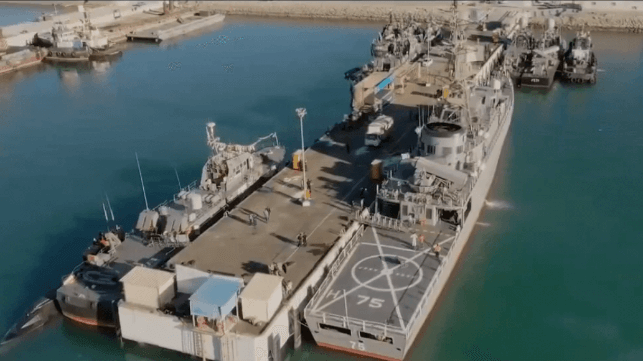
Jask naval base opening ceremony (Iranian MoD / Fars)

Published Jan 19, 2025 2:02 PM by The Maritime Executive


For some time, the Iranian authorities have sought to build up their maritime access to the open seas by developing port infrastructure outside the Gulf, acknowledging the vulnerability of dependency on free and uninterrupted access through the Straits of Hormuz.

This objective can be seen in the construction of the 1,000-km 42-inch pipe bringing oil from the crude collection point at Goreh in Bushehr Province to a new oil export terminal at Jask Mobarak, a project which was supposed to support three single-point moorings and a throughput of one million barrels per day.   Despite the huge investment and the inauguration of the pipeline on July 22, 2021, the oil terminal is hardly being used, with the last tanker spotted loading on September 19 last year.

It appears to be a similar tale of watered-down ambition in the naval domain, apparent when on January 16 the Armed Forces Chief of Staff Major General Mohammad Bagheri, Iranian Army Commander Major General Abdolrahim Mousavi and the Iranian Navy (Nedaja) Commander Rear Admiral Shahram Irani opened the first phase of the new naval base at Jask-Hojdan, in a quay-side ceremony (top).

Present at the opening ceremony was a visitor from Bandar Abbas, the Moudge Class frigate IRINS Dena (F75), along with other vessels usually seen alongside in the old port of Jask: the submarines IRINS Fateh (S920) and a Ghadir Class midget, tied up alongside Hendijan Class auxiliaries IRINS Hendijan (A1401) and Bamregan (A1406), two Kaman Class patrol boats (one probably IRINS Neyzeh (P231)) and two Kaivan Class patrol craft. 

Previously, the Nedaja has used the northern harbor mole of the busy commercial and fishing port at Jask as the base for ships assigned to its 2nd Naval Region.
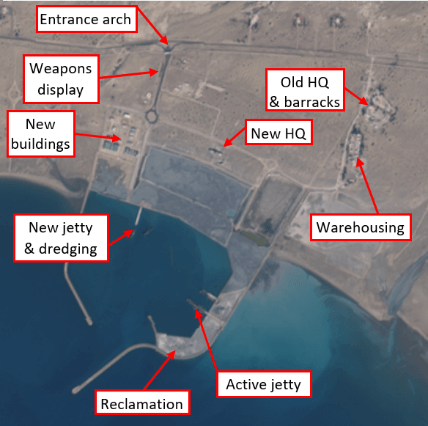
Nejada 2nd Naval Region base at Jask (September 15 – Sentinel-2 / Jonathan Campbell-James)

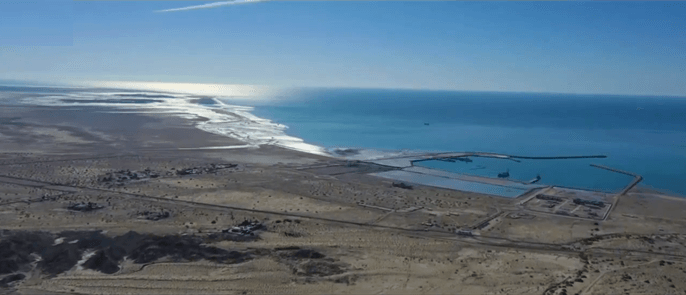
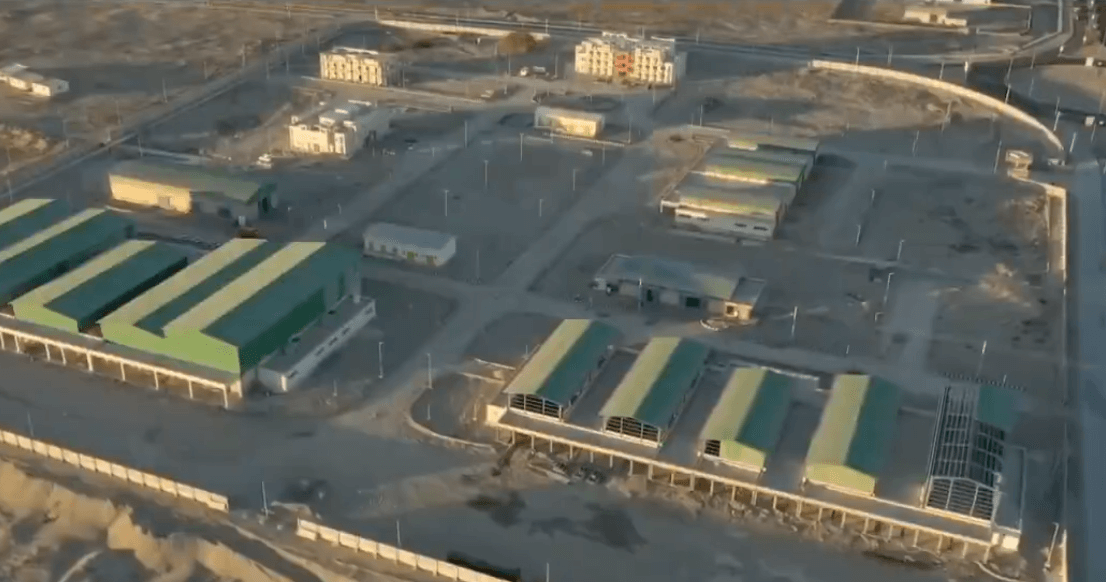
The new facility, still under construction after ten years, is 12 miles east of Jask, and is exclusively for naval use. At present only one jetty is active, but two others are under construction. Building work has progressed extremely slowly since the impressive main gate was completed in 2015, with only a small stretch of road within the base asphalted in the last few weeks, ahead of the opening ceremony.  Work on a new Headquarters building appears to be stalled. The crews of the Jask-based vessels may have few creature comforts at the new out-of-town facility until further construction work is completed.
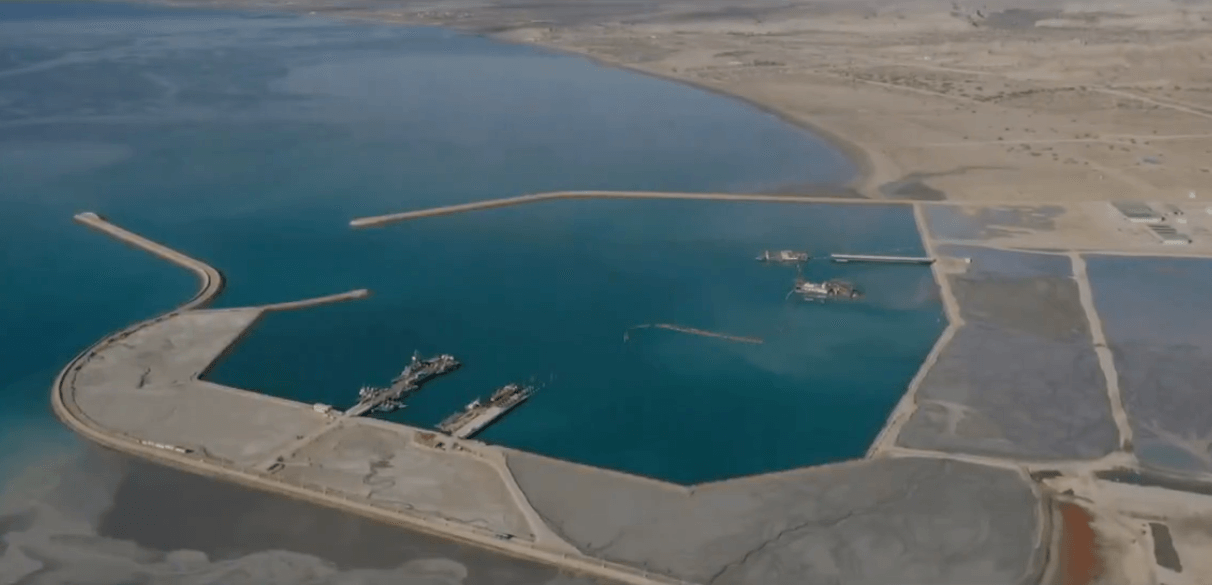
Sparse, underdeveloped infrastructure at the Jask naval base (Iranian MOD / Fars)

On display within the base was a selection of naval weaponry, including the short range/low altitude Azerakhsh air defense missile system, a 300-mile-range Ababil 5 reconnaissance and attack drone, and Valfajr heavy homing torpedoes. 

Also paraded was a coastal defense battery of truck-mounted Talaiyeh anti-ship cruise missiles – a system derived from the Russian KH-55 system with a 650-mile range. Nejada is likely to be building protective underground garaging for these systems in the hills to the north of the base.

Main gate and equipment display, Jask Naval Base (Fars News/Iran MoD)
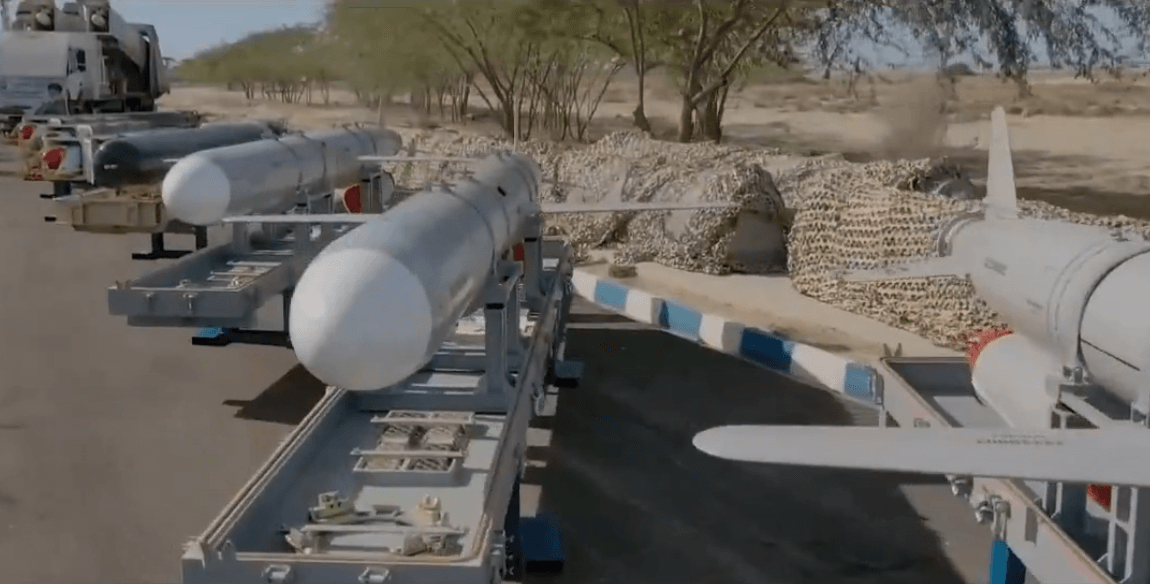
Equipment display, Jask base (Iranian MoD / Fars)

Strategically, it would make sense to have a larger naval footprint at this base, but the slow pace of development suggests that this is not likely to occur in the near term. However, a report carried by Press TV said that the newly-commissioned intelligence collection vessel IRINS Zagros (H313) is to be home-ported at the new base.  But after the sinking of IRINS Kharg (A431) off Jask in June 2021, there may also be concerns that access to the open seas is a two-edged sword and a potential vulnerability.


 

Yemen's Houthi Rebels Signal Plan to Release Seized Car Carrier

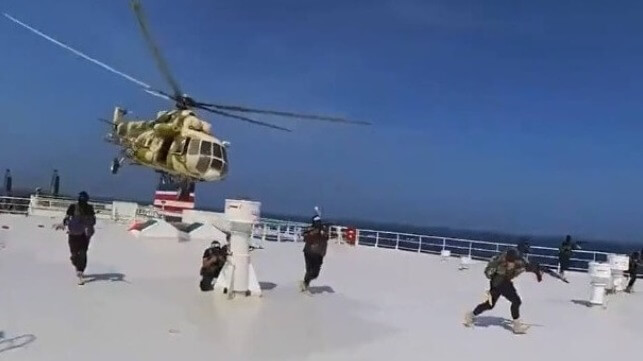
Houthi fighters land on the deck of the Galaxy Leader in a choreographed boarding operation (Houthi Military Media)

Published Jan 21, 2025 4:39 PM by The Maritime Executive


After announcing a long-awaited halt to attacks on merchant shipping in the Red Sea, Yemen's Houthi militant group said Tuesday that it is preparing to release the car carrier Galaxy Leader, which it captured in late 2023. 

The group's commando forces boarded the PCTC by helicopter and seized control of the bridge on November 19, 2023, taking the crew and the vessel hostage. It was the group's first high-profile attack on shipping after the start of the war in Gaza, and it presaged countless Houthi attacks to follow. The Houthis cited the Israeli-linked ownership interests of the ship's commercial operator, UK-based Ray Car Carriers, in justifying the seizure. 

The militants diverted the vessel to an anchorage near Hodeidah, Yemen and opened it to the public, making it a popular tourist attraction for Yemenis. At one point shortly after the ship's capture, there were enough sightseers on the top deck that the crowd was visible in satellite surveillance imaging. 

For the crew, the ordeal was far less joyous. They have been held in a foreign land for more than a year, despite constant appeals from the IMO and the International Chamber of Shipping for their release. ICS noted that many of the crew had already been aboard the ship for long hitches before they were captured, and some were nearing the two-year mark since they left their homes, with few opportunities to contact family and friends. ICS Secretary General Guy Platten called their continued detention "unconscionable."  

The government of the Philippines also attempted to intercede to secure the freedom of 17 Filipino seafarers on board, but without success. The remainder of the crew includes three Ukrainians, two Bulgarians, two Mexicans and one Romanian, reflecting the global nature of shipping and crewing. 

The attack on Galaxy Leader was only the beginning of a year-long Houthi blockade of the Red Sea. Over the course of the campaign, Houthi fighters attacked more than 100 vessels with missiles, drones and bomb boats, sinking two ships and killing four seafarers.

Up until last weekend, Houthi forces continued to claim new attacks on U.S. Navy warships, including the carrier USS Harry S. Truman. These attacks were often intense: In a recent example, Naval Surface Forces commander Vice Adm. Brendan McLane reported that the crew of USS Spruance had to shoot down three incoming ballistic missiles, three cruise missiles and seven suicide drones in a single engagement. 

No strikes on U.S. warships have been reported. However, the campaign to intercept and prevent Houthi attacks has cost the U.S. Navy several billion dollars and more than 200 missiles, including 80 SM-6 dual-role antiaircraft/antiship missiles valued at $4 million each - depleting an expensive and hard-to-replace inventory.


Tanker Sanctions Hit Russia's Kozmino Oil Export Terminal

Kozmino
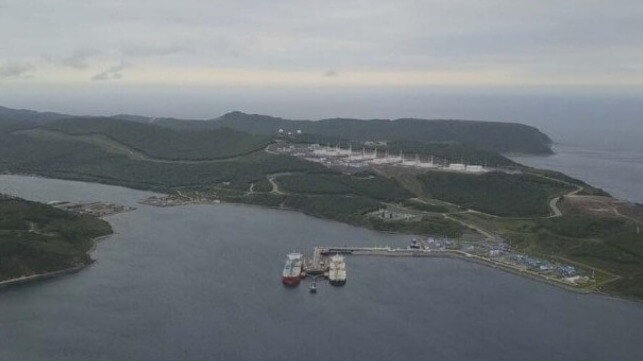
Tankers at the Kozmino oil terminal on Russia's Pacific coast. The ESPO blend sold from Kozmino has traded above the G7 price cap since it began in 2022 (file image)

Published Jan 21, 2025 9:37 PM by The Maritime Executive


The Russian port of Kozmino is a reliable earner for the nation's oil and gas sector, pumping out 900,000 barrels a day of premium Siberian crude for Chinese buyers. Kozmino's ESPO blend has consistently sold at full-rate market prices despite two years of Western sanctions, with few interruptions. That now appears to be changing due to U.S. sanctions on the "dark fleet," the collection of obscurely-owned, aging tankers that circumvent the G7 "price cap" on Russian crude exports. 

Earlier this month, the Biden administration imposed blocking sanctions on 180 Russian vessels, including about 160 tankers. The package targeted ships operated by state-owned Sovcomflot, as well as a collection of older ships held by anonymous firms. U.S. Treasury blocking sanctions create serious compliance risks for any entity that interacts with the sanctioned vessel, and a key stakeholder in the "dark fleet" trade - Shandong Port Group, the giant Chinese refining complex - let it be known that it would no longer accept sanctioned tankers. 

This package of sanctions covered about three-quarters of the tanker fleet that serves the short run between Kozmino and coastal ports in China, including Shandong. According to Bloomberg, the anchorage near the Kozmino loading terminal is now filling up with idle vessels, with nine tankers sitting just offshore - many more than normal. 

Even if Russia is able to source new unsanctioned tonnage to continue the trade at normal volume, the price of transport will go up. Given the clear risk of a vessel getting sanctioned for calling at Kozmino, Aframax charter rates for the run have skyrocketed, with brokers reporting prices of up to $5-7 million for a single voyage. 

More sanctions may be coming under the Trump administration. Over the past two days, President Donald Trump has suggested that Russian President Vladimir Putin needs to negotiate an end to his war in Ukraine, and that more penalties are possible if he doesn't. 

"I think he's destroying Russia by not making a deal. I think Russia's going to be in big trouble. You take a look at their economy. You take a look at inflation in Russia," Trump said Monday. 

In conversation with reporters on Tuesday, Trump said that it "sounds likely" that if Putin does not begin peace talks, more sanctions might be on the table. 


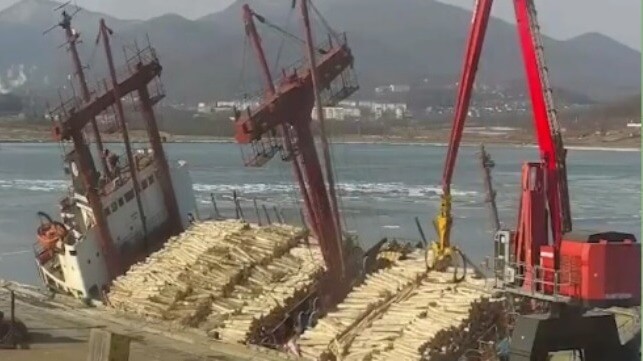
Video: Russian Cargo Ship Tilts Spilling Timber Cargo Load

cargo loss
Vessel began to tilt and the the cargo was lost (Nakhodka Transport Prosecutor's Office/Telegram)

Published Jan 20, 2025 1:56 PM by The Maritime Executive


Russian officials are investigating an incident last week in which a cargo of logs being loaded became unstable. It caused the vessel to tilt to starboard and dump a portion of its cargo into the harbor. No one was injured during the incident.

The vessel is the Stepan Geits, built in 1983 in Japan and operating since 1996 under the Russian flag. It is part of the Lesprom Network which operates a wood products marketplace. The vessel, which is 4,800 dwt and 297 feet (90.5 meters) in length, was docked in the Russian east coast port of Nakhodka, near Vladivostok. 

A load of logs was being put aboard when on the afternoon of January 16, the ship suddenly began to tilt to starboard. The logs began rolling off the ship with the Nakhodka Transport office reporting approximately 1,000 cubic meters of the cargo fell into the harbor. The vessel regained stability and returned to an even keel but suffered damage.


In the video of the incident, crewmembers can be seen jumping to safety onto the pier as the vessel begins to list. A crane is operated near the bow loading the cargo.

Records show that the cargo ship was cited for deficiencies during a Port State Inspection in Dalian, China in November for issues including the structural conditions of ballast, fuel, and other tanks. The Transport Prosecutor’s Office said it was establishing the circumstances of the loss of the deck cargo. Reports indicated the cargo may not have been properly secured.

The timber product was removed from the water the Transport Office reported.


Video: Indonesia Authorities Rescue Crew from Listing Cargo Ship

listing cargo ship
The aging cargo vessel was listing after taking on water (Kementerian Perhubungan)

Published Jan 21, 2025 2:46 PM by The Maritime Executive


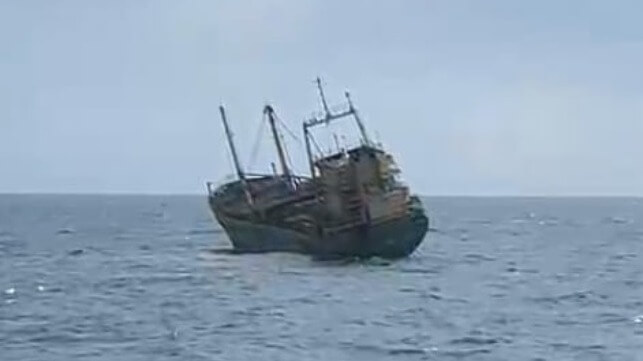
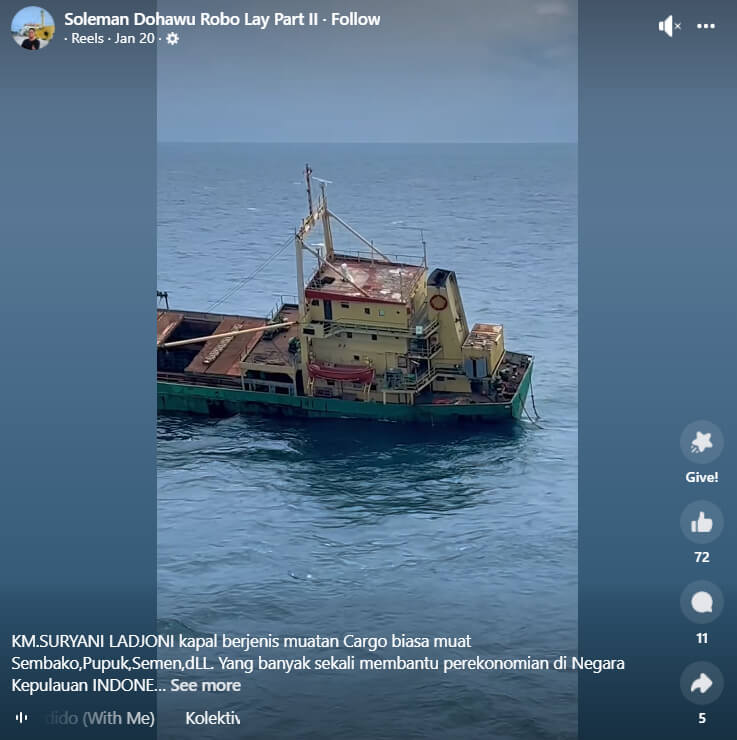
The maritime authorities in Indonesia are reporting the successful rescue of 18 crewmembers from an aging general cargo vessel. The ship, Suryani Ladjoni (2,380 dwt) had taken on a list with the captain reporting the vessel had developed leaks. The authorities report by the time they reached the vessel it had a 25 degree list to port.

The Tanjung Perak Port Authority and local rescue station were notified of the emergency on Saturday, January 18. According to the SAR team, the captain of the vessel which was built in 1977 reported the ingress of water. The general cargo vessel was sailing near Madura Island off the northeastern coast of Java, east of the city of Surabaya. The vessel was heading to Surabaya from Banjarmasin when the situation arose.


The captain of the vessel requested an evacuation and the patrol boat KM Palung Mas was sent. When it reached the area the patrol boat initially anchored but due to unfavorable weather conditions was not able to commence the rescue. It was determined that the crew of the cargo ship would enter the vessel’s rafts.

The patrol boat raised anchor and was able to maneuver so that the crew could come alongside in the rafts. They were pulled up to the deck of the rescue vessel which later transported them to Teluk Lamong Port. The survivors were provided with medical treatment with no causalities reported.

The authorities are warning the cargo ship did not sink. It is currently drifting at 0.2 knots moving eastward. Vessels in the area are being warned of the potential dangers.


Deckhand Dies in Fishing Vessel Capsizing off La Rochelle

Dragon 17
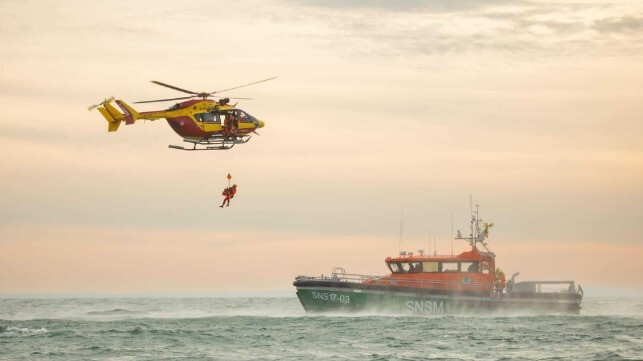
The Dragon 17 civil defense helicopter in an exercise (file image courtesy Dragon 17)

Published Jan 20, 2025 9:44 PM by The Maritime Executive


French rescuers have recovered the body of a fisherman who died in a capsizing off Ile d'Oleron on Monday morning.

At about 0550 hours on Monday morning, the French SAR center at Etel (Cross d'Etel) received an EPIRB alert from the gillnetter Rose des Vents at a position off Ile d'Oleron, in the Bay of Biscay. The French Navy mobilized a rescue helicopter, and rescue society SNSM dispatched a response boat out of the nearby port of La Rochelle. 

The Rose des Vents had been capsized by a heavy wave earlier that morning. The two crewmembers, the skipper and a 22-year-old deckhand, survived the capsizing. They climbed atop the upturned hull, which continued to be battered by waves in the rough conditions. After a few minutes, a wave swept them off the hull; the skipper hung on and made it back on top, but the deckhand disappeared. 

The boat was close enough to shore that the skipper managed to swim to safety and self-rescue on shore. He reached a house at about 0630 and notified the local fire department of the capsizing - and the missing deckhand. 

The search for the missing man continued with support from a civil defense helicopter aircrew. Good Samaritans assisted the search on the water, despite very poor weather conditions. At about 1230 hours, the helicopter aircrew found the deckhand, who was unresponsive; he was declared dead at 1400 hours. 


Feasibility Studies ID Technology to Address Fugitive Methane Emissions

LNG bunkering
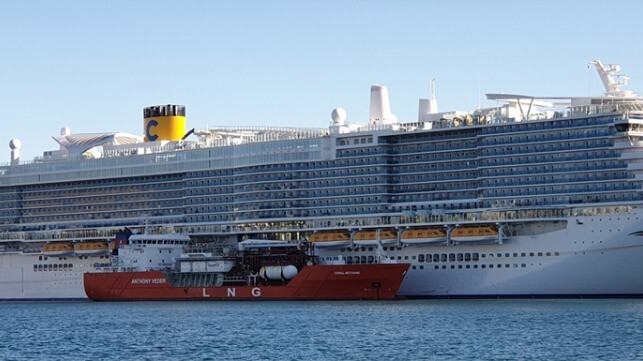
Fugitive emissions happen along the supply chain such as during bunkering (Port of Marseille Fos))

Published Jan 21, 2025 7:43 PM by The Maritime Executive


An industry collaboration known as the Safetytech Accelerate reports its latest round of supported feasibility studies has shown strong potential to cut fugitive methane emissions in the maritime industry. They report after the successful studies efforts are now underway to advance these research projects to on-ship trials as soon as possible.

Fugitive emissions happen across the LNG supply chain ranging from loading to engine delivery. While short-lived they represent another source of harmful unburnt methane entering the environment in addition to the more widely discussed methane slip where unburnt methane enters the exhaust during the combustion problem.

The Safetytech Accelerator launched its flagship Methane Abatement Maritime Innovation Initiative (MAMII) in September 2022 bringing together industry leaders, technology innovators, and maritime stakeholders with a focus on measuring and mitigating methane emissions in the maritime sector and also seeks to promote the adoption of solutions to reduce and eliminate methane emissions. This latest effort involved industry leaders Chevron, Carnival Corporation, Shell, and Seapeak as well as three technology supplies.

The group reports that identifying, quantifying, and mitigating fugitive emissions is another element of the effort. It says that it is another essential element to achieve industry-wide decarbonization goals.

Three companies and their technologies were the focus of the completed technology feasibility studies. Xplorobot which provides handheld devices and an AI-powered platform to detect and measure fugitive emissions studied the warm side of the gas fuel line evaluating the efficacy of the technology in detecting and quantifying methane emissions. For this technology, the next step is to deploy the kit in the field to further validate and optimize the technology.

A second study explored acoustic cameras from Sorama evaluating the viability for monitoring on LNG carriers. Strategically placed and handheld cameras detect the emissions by visualizing sound and vibration fields in 3D. A six-month pilot scoped the use of four fixed cameras aboard. They believe it demonstrated a capability to quickly identify the source of emissions and would provide a cost-effective option for ship operators.

Framergy studied its technology which would be used to store and purify methane to significantly reduce emissions during planned and unplanned venting events. The methane would be captured and stored at a lower pressure than conventional methods using the company’s filtering membrane made of a metal-organic framework material. Captured methane has the possibility of reuse or sale.

The Safetytech Accelerator reports the three studies show the potential to detect, measure, and mitigate methane emissions on LNG-powered ships. While methane slip – the unburnt release of methane during combustion – remains the largest source of methane emissions, they believe this work adds another critical element to the overall effort addressing methane emissions. The group is also supporting efforts to reduce emissions from engine exhausts. 

The Anchor Partners for the MAMII effort total more than 20 leading shipping and energy companies. Beyond the four companies that participated in these studies, others working with the effort include MSC, Lloyd’s Register, GTT, NYK, Mitsui O.S.K., CMA CGM, and others. 


Sulfur Energy Storage Could Provide Low-Cost Green Propulsion

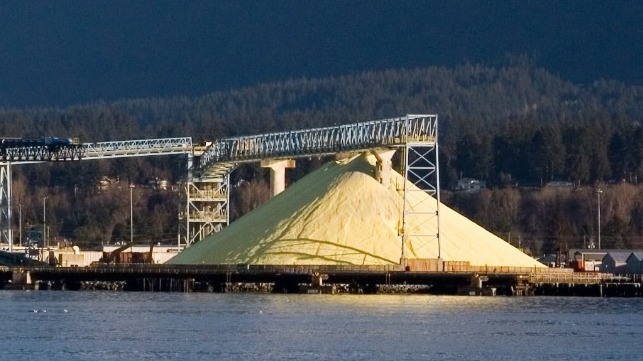
Sulfur storage mound, Vancouver (Kimon Berlin / CC BY SA 2.0)

Published Jan 21, 2025 10:28 PM by Harry Valentine


Advances in the chemistry of thermal reactions involving sulphur, oxygen and hydrogen can generate temperatures of 900 to 1200-deg C that can sustain the operation of externally heated gas/air turbine engines. The byproducts of the chemical reaction can be decomposed using intense heat and reused for multiple repeat cycles.

Introduction

The history of thermal energy storage for mobile applications dates back to the 1800s, involving a submarine that carried an insulated tank of saturated water at over 100-pounds/square-inch at 327 deg F. Modern solar thermal power plants use molten salt thermal storage at 1020 deg F. While latent-heat-of-fusion metallic compounds and mixtures combine very long usable service life with high storage density, thermal energy storage duration is short-term. While the reaction of mixing certain chemicals produces heat, it is possible to store the chemicals separately over extended duration until heat is needed.

Heat-producing chemical reactions involving some chemicals are actually reversible. A consortium based in Germany known as Pegasus is undertaking pioneering research into using sulphur thermochemistry to produce heat capable of sustaining the operation of externally-heated turbine engines. The reaction is intended to be reversible, with an external source of heat (like a shoreside nuclear reactor) decomposing the reaction byproducts into a form that can repeatedly be reused.

Heat of Formation

 The combustion of hydrocarbon liquid fuel with oxygen releases heat and produces new compounds such as steam and carbon dioxide. While electrolysis can separate hydrogen from oxygen, only photosynthesis from the natural world can separate carbon from oxygen. There are heat-producing chemical reactions that produce new compounds that can subsequently be thermally decomposed back to the original constituents and made available for future reuse to generate heat. Such is the case for mixing compounds of hydrogen, sulphur and oxygen, with sulphuric acid (H2SO4) first being decomposed into water (H2O), sulphur dioxide (SO2) and oxygen (O2).

 A second stage involves sulphur dioxide being decomposed to produce elemental sulphur, which is then stored.

When energy is desired, the reaction of sulphur with oxygen produces temperatures of up to 2,200 degrees F, with the heat of reaction being sufficient to sustain the operation of an externally-heated turbine engine connected to a bottom-cycle steam engine. If successful and viable, the research efforts of the Pegasus consortium have potential to form the basis of future ship propulsion.

Ship Propulsion

Research from Pegasus suggests that 50 hours of operation of an engine of 67,000 horsepower would require 5,000 metric tonnes of sulphur and 16,000 metric tons of sulphuric acid. A ship weighing 200,000 tonnes requires 100,000 horsepower to sail at 25 knots. Slowing the ship to 12.5 knots would reduce power requirement to 10,300kW or 13,800 horsepower, allowing for up to 235 hours of engine operation and a sailing distance of over 2,500 nautical miles. Following arrival at port, the spent compound would be transferred to barges that would sail to nearby a high-temperature nuclear power plant, where the compound would be thermally decomposed for reuse.

While still at port, other barges would arrive to deliver sulphur and sulphuric acid from a thermal recycling facility, to provide power for the next voyage. Future ships powered by sulphur thermal technology would sail between ports located near to a high-temperature nuclear power plant, or a solar thermal power plant capable of operating at the temperatures required to thermally decompose sulphur dioxide and recycle sulphur compounds for future application. While the original research focused on stationary thermal energy storage application, the sulphur thermal storage technology has potential in a mega-size transportation vehicle such as a ship.

Cost Issues

While gasoline might contain as much as 45,000 kilojoules per kilogram, sulphur holds some 12,500 kilojoules per kilogram. During early 2024, gasoline incurred a cost of $0.11 per kilowatt-hour while sulphur incurred a cost around $0.02 per kilowatt-hour. While it is presently not possible to recycle the combustion byproducts of gasoline to produce new gasoline, it is technically possible to thermally decompose sulphur dioxide to produce sulphur for future reuse generating heat. In ship propulsion, sulphur technology would be restricted to ships that sail at low speed and might make frequent stops to refuel.

There would be potential for ships powered by sulphur technology to sail coastal services and be assigned to short-sea shipping operation in regions of the world where high-temperature thermal technology would be available. Sulphur-based thermal storage technology would likely have to prove itself in stationary application, involving solar thermal power plants and high-temperature nuclear power plants where sulphur technology might be recycled during overnight off-peak periods. Once proven in stationary application over an extended duration including involving seasonal energy storage over extended time duration, experiments involving ship propulsion might begin.

Conclusions

While the maritime sector is subject to governmental pressure to reduce carbon exhaust emissions, some carbon reduction technologies incur high cost and raise the operating cost of a ship. Other evolving technologies actually reduce ship operating cost. At the present state of research, sulphur thermal storage technology offers the possibility of simultaneously reducing carbon emissions and overall operating cost. The ideal scenario would involve a single thermal power plant providing for the operation of a small fleet of vessels powered by sulphur thermal storage technology while engaged in coastal shipping and short-sea shipping.

WAR IS GOOD FOR BUSINESS

Container Lines Eye a Less Profitable Future With Calm in Red Sea

Evergreen
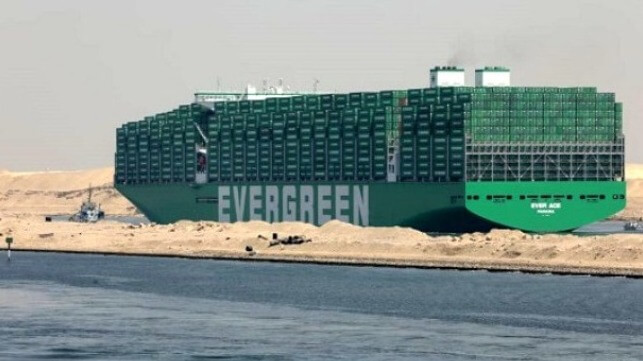
A sight that may soon return: an Evergreen boxship transits the Suez Canal (file image courtesy Evergreen)

Published Jan 21, 2025 10:44 PM by The Maritime Executive


The world's top container carriers and their investors are warily eyeing a return to the Red Sea-Suez route after a year of profitable disruption - but the return will not happen quickly, executives and maritime security advisors say. 

Beginning in late 2023, Houthi attacks gradually forced most liners to reroute around the Cape of Good Hope, adding weeks to each voyage and boosting ton-mile demand. As carriers pulled in every available ship to cover the extra time and distance on Asia-Europe routes, a looming overcapacity problem evaporated, replaced by an unexpectedly tight market and a boom in freight rates. As a result, carriers have had a profitable year - but there are revenue challenges ahead. 

Thanks to a ceasefire in Gaza, Houthi leaders have pledged to halt attacks on shipping. In expectation that liners may soon have to return to the Red Sea to remain competitive, analysts have downgraded the stocks of some ocean carriers in expectation of overcapacity and falling rates. Investors have already begun reducing exposure to the ocean freight segment in anticipation of lower earnings ahead. 

Blue-chip operator Maersk, the largest publicly-traded carrier, has lost about a tenth of its share price since the first rumors of a Gaza ceasefire emerged earlier this month. Jefferies has downgraded its rating to hold. Hapag-Lloyd, Maersk's partner on the Gemini Cooperation network, has also shed about eight percent of its share price since the start of the year. 

Israeli-owned carrier Zim, which sustained Israel's maritime logistics throughout the Gaza operation, has seen its stock slide by about a quarter since early January. Jefferies has lowered its price target for Zim, but kept its hold rating on the firm's shares. 

There is still no certainty about whether the Houthis will uphold their Red Sea truce pledge, which hinges in part on the progress of peace negotiations between Israel and Hamas. Houthi leaders have promised to watch Israel's implementation of the Gaza ceasefire carefully, and to resume attacks on Western shipping if fighting in the territory resumes. The truce also hinges on whether the U.S. and UK resume airstrikes on Houthi targets - another factor outside of the shipping industry's control. 

"Merchant vessels continue to be at risk due to fragility of the ceasefire and potential for Houthi subjectivity resulting in singular attacks," cautioned UK maritime security consultancy Ambrey. "A reduction of risk to shipping is assessed almost certain to occur gradually."


Panama Audits Hutchison PPC After Trump's Complaints of Chinese Influence

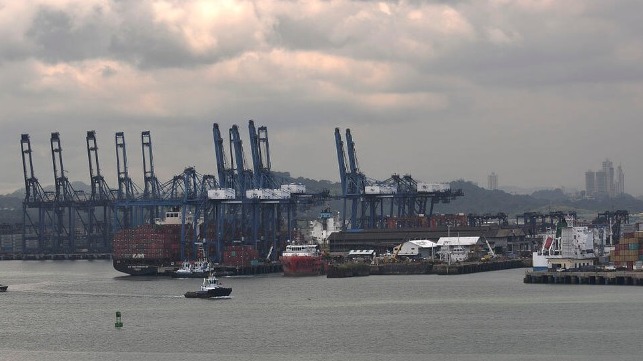
Hutchison PPC's Balboa container terminal (file image courtesy Gualberto107 / CC BY SA 3.0)

Published Jan 21, 2025 7:42 PM by The Maritime Executive


After criticism from President Donald Trump about the Panama Canal's operations, the Panamanian government has announced an audit of the local unit of Hutchison Port Holdings, the Hong Kong-based giant that manages container terminals near each end of the waterway. Hutchison is a Chinese firm, and Trump has accused Panama of allowing China to "operate" the Canal, which was held by the U.S. up until 1999. The president has pledged to "take back" the Canal Zone, declaring his ambitions to "expand our territory."

Ahead of Trump's inauguration, Panamanian Comptroller General Anel Bolo Flores promised to conduct a probe to ensure that Hutchison is in compliance with its 25-year concession for the Balboa and Cristobal container terminals. The Panama Maritime Authority renewed the concession for Hutchison's Panama Ports Company in 2021, under a previous administration, and Flores said that the local branch of Hutchison would be subjected to a "severe and strong" financial audit. He did not specify whether the sudden audit was related to Trump's statements. 

Hutchison is the world's largest commercial container terminal operator, with 53 locations around the globe. While it is not necessary to transact with Hutchison to pass through the Panama Canal, many container ships do stop to drop off and pick up cargo at Hutchison's Balboa facility, the busiest transshipment terminal in Latin America.

Hutchison's largest known shareholders include the Li Ka-shing family of Hong Kong (30 percent) and the American private equity fund BlackRock (two percent).

Top image: Hutchison PPC's Balboa container terminal (file image courtesy Gualberto107 / CC BY SA 3.0)


Trump Elevates Sola to Head Federal Maritime Commission

FMC Sola
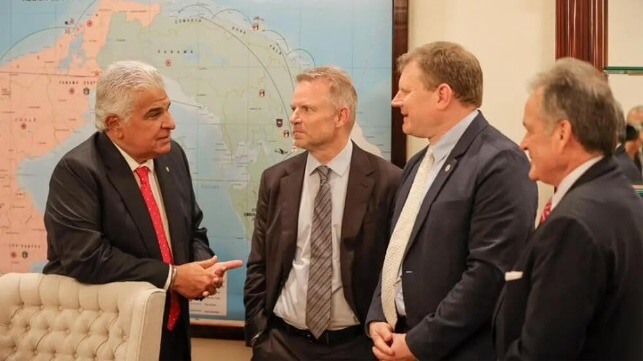
Sola then commissioner with Chairman Maffei meeting with Panama President Jose Mulino (FMC)

Published Jan 21, 2025 3:58 PM by The Maritime Executive


Louis Sola a commissioner on the Federal Maritime Commission is being elevated to chairman of the regulatory body by President Donald Trump. The White House released a listing of 15 designees to lead agencies ranging from transportation to labor, communications, Securities Exchange Commission, on Monday which announced the new role for Sola.

He was nominated to the FMC in November 2018 during the first term of Donald Trump and was nominated for a second term by President Joe Biden. Last year, 73 trade groups and associations sent an open letter to the U.S. Senate Committee on Commerce, Science, and Transportation overwhelmingly supporting the nomination of Carl Bentzel and Louis Sola for a second term.

A Floridian, Sola has had a long career in the maritime sector as well as being a businessman in private enterprise. Prior to his nomination for the FMC, he was a commissioner on the Florida Board of Pilots Commissioners which is responsible for overseeing licensing and regulating harbor pilots. His business career includes more than a decade as a licensed ship and mega yacht broker, and before that in finance where he developed international strategies focusing on the maritime sector in Latin America. He lived in the Panama Canal Zone for a period of time in the late 1990s and early 200s. Sola also served for 11 years in the U.S. Army.

On his resume, he points to his efforts at the FMC leading the federal fact-finding investigation on the effects of COVID-19 on the cruise industry and the programs to strengthen the refund mechanisms for cruise passengers. Sola has also been active in the efforts for maritime fuels, international trade, and freedom of navigation.

Sola in November released a letter that was sent to then President-elect Trump recommending that Commissioner Rebecca F. Dye be designated Chairman of the Federal Maritime Commission. He spoke of her deep knowledge and respect in the industry saying the appointment would send a “powerful message of stability and resolve to shippers, port operators, and international trade partners. It would demonstrate to the world that the United States is prepared to protect its supply chains, mitigate economic disruptions, and uphold the principles of fair and efficient trade.”

Speaking at the LNG Bunkering Summit 2024 in Florida in December, Sola outlined a bold agenda for U.S. energy and trade policies under the incoming Trump administration. He declared that the “war on fossil fuels exports is over” framing a vision of renewed investment in energy and trade infrastructure that aligns with the priorities of agencies like the Export-Import Bank of the United States (EXIM Bank) and the U.S. International Development Finance Corporation (DFC). 

Similarly, during a speech on trade with Latin America and U.S. exports, Sola discussed “America First” initiatives, including the expansion of liquefied natural gas (LNG) facilities. He emphasized the critical role of U.S. exports in supporting the economic growth and stability of the maritime sector.

Under Sola, the FMC will continue to implement the reforms of the Ocean Shipping Act which seeks to strengthen the position of U.S. exports and shippers. It could play a critical role as the new Trump administration moves to reshape global trade. Trump has also asserted he will take control of the Panama Canal to protect America's maritime interests.

Sola replaces Daniel Maffei who was named in 2021 as chairman of the FMC by President Joe Biden. Maffei was confirmed to serve another term by the United States Senate on May 14, 2024, and is now listed as a commissioner on the board.

The Trump White House also will need to address a current vacancy on the FMC board. Commissioner Carl Bentzel, who had also been nominated to the FMC by Trump, in November was named president of the National Association of Waterfront Employers, the trade association for terminal operators and seaports.