Wednesday, January 22, 2025

Why Labour Can’t Fix the UKs Polycrisis


January 22, 2025
Faceboo

Photograph Source: Kirsty O’Connor / No 10 Downing Street – OGL 3

The UK’s decrepit first-past-the-post electoral system virtually guarantees a two-party grip on parliamentary power. Since WW2 the two parties in question have been the Conservatives and Labour, with the Conservatives enjoying 3 long spells in power,1950-64, 1979-1997, and 2010-2024, countered only by Labour’s Blair/Brown ascendency in 1997-2010.

Labour’s single term in power from 1945-1950, however, saw the momentous creation of the UK’s welfare state, which started to erode as a policy choice when Margaret Thatcher became prime minister in 1979– a phase that was also coterminous with the onset of the neoliberalism of which she was a devotee.

The UK has been in a long-term polycrisis: a chronically weak economy since the 1970s; increased inequality while the crippling outcomes of Tory austerity and Brexit remain overlooked and unaddressed; lip-service in dealing with climate breakdown; catastrophic underfunding of the NHS; a corrupt and chumocratic Establishment (massive Tory Covid contracts handed out without oversight to cronies and pals; as well as Starmer’s Freebiegate, where he and several ministerial colleagues accepted significant donations for vacations and clothing); crumbling schools and teacher shortages; systemic racial injustice; police and prisons at barely-functioning levels; lies and distortion ingrained by a media largely owned by rightwing billionaires domiciled overseas; and an imperial-level Ruritanian monarchy, replete with gold carriages and multiple palaces and castles, all glaringly at odds with Ukania’s post-imperial decline; and so forth.

Since it came to power in July 2024 Starmer’s Labour has lurched from one misstep to another.

Two ministers, unsurprisingly from the party’s right wing, who should never have been appointed by Starmer, have been forced to resign.

Louise Haigh was transport minister until she quit this position when it emerged that she was made a minister by Starmer despite having a criminal conviction Haigh said she had revealed to him before he appointed her. In 2014, the year before she entered parliament, Haigh had pleaded guilty to fraud by false representation when she reported to police that her work phone had been stolen while it was still in her possession. Allegedly she thought her insurance would pay for an upgraded replacement phone.

Tulip Siddiq, the niece of Bangladesh’s deposed despot Sheikh Hasina, resigned as Labour’s anti-corruption minister after she was named in 2 corruption probes linked to a plot of land her family received from Hasina’s government.

Starmer had pledged repeatedly that Labour would restore trust in government after 14 years of Conservative sleaze and corruption, and his swift reneging on this undertaking has propelled Labour downwards in the opinion polls.

Labour’s first few months in office have been a catalogue of missteps, exposing a lot more than a taste for gorging at troughs filled with the finer things of life.

An inheritance tax that had hitherto excluded farms will now include them, and is projected to raise £520m/$632m annually, a relatively small amount in the bigger economic scheme of things. This will have a severe impact on hard-pressed rural families, even as continuing unclosed tax loopholes allow the super-wealthy to multiply their riches.

The much-criticized chancellor of the exchequer/finance minister, Rachel Reeves (who delights in the sobriquet “the iron chancellor”), abandoned the policy of granting all pensioners a fuel payment every winter—under her new rules, only those in receipt of a pension credit will be eligible for the winter fuel payment. Many pensioners, who have contributed to the exchequer for decades during their working lives, now face a possibly crippling financial burden, as they have to choose invidiously between having enough to eat or not dying from hypothermia.

Labour also refused to repeal the Tory policy that limited the child tax credit to 2 children, thereby acknowledging implicitly that only the relatively well-off are “entitled” to have more than a couple of offspring, which looks suspiciously like eugenics through the back door.

These and other policy decisions are not the products of a cast-iron necessity, but are political choices pure and simple. Labour pledged repeatedly to address the needs of the less well-off who suffered from 14 years of Tory austerity and misrule, but has done little of this so far.

The latest Labour stumble is its panicked response to a 10-day turbulence in the UK bond market which raised the price of government borrowing. Historically bond markets worldwide have tracked their US counterpart, and this is exactly what happened here—if the US is up, other bond markets go up, and if the US is down other markets follow suit. A potential cause for real concern occurs when there is more to bond market turbulence than the mirroring of US price patterns.

Reeves and Starmer should have said they would be vigilant with regard to this market instability while not adopting any hasty measures as a response. Instead, they’ve promised a March mini-budget with spending cuts targetted primarily at the civil service and sickness benefits.

To deal with the UK’s sagging economy, Reeves offers a “plan for growth” with 2 pillars: a focus on private-public partnerships in dealing with the NHS crisis and climate breakdown, as well as investment in AI. Reeves has probably not read Brett Christophers, The Price is Wrong: Why Capitalism Won’t Save the Planet, who argues that transitioning to renewable energy is simply not sufficiently profitable for the private sector for it to have a significant enough impact on this transition.

Likewise AI will almost certainly be a key part of the “state capture” projects that are already being mounted by the rightwing Silicon Valley tech billionaires Musk, Bezos, and Zuckerberg. Notions of the common good play no part in these rightwing projects. AI will likely result in a considerable restructuring of labour markets, and the tech billionaires are no friends of organized labour. The faith placed by Starmer and Reeves in AI will certainly be tested if the just-mentioned scenarios materialize.

For now it is difficult to give much credence to the thought that managerialist technocrats like Starmer and Reeves have the wherewithal and strategic vision to deal with the UK’s polycrisis.

Kenneth Surin teaches at Duke University, North Carolina.  He lives in Blacksburg, Virginia.

UK

Climate groups urge PM to challenge Trump and warn over airport expansion


Photo: Zuzanna Walewska/Shutterstock

Keir Starmer has been urged to reconsider rumoured plans to expand capacity at three UK airports and stand up to Donald Trump after the US withdrew from the Paris climate agreement.

In a letter signed by more than 20 climate action groups, Starmer was told to “make safeguarding our climate your legacy”, even as the Prime Minister seeks to keep the UK from being hit with trade tariffs by the new US President.

The Labour government looks set to announce a boost capacity at Luton Airport, put a second runway at Gatwick into full-time use and approve a third runway at Heathrow.

However, Starmer was criticised by the Campaign Against Climate Change, one of the signatories of the letter, over the rumoured plans and said: “We urgently need leadership at this time. But if a Labour government signs off expansion at Heathrow and Gatwick airports, it will show they don’t take the climate crisis seriously, and greenwash about tiny amounts of so-called ‘sustainable’ aviation fuel can’t hide that.

“Trump may believe economic success is only achievable by trashing the environment – the UK can and should do better.”

Trump used his first full day in office to sign an executive order to begin the process of withdrawing the US from the Paris agreement.

Trump previously withdrew the US from the climate change agreement, signed by more than 200 countries, last time he was in power – before President Joe Biden re-joined it in 2021.

In the letter, the climate action groups called on Starmer to urge Trump not to pull out of the agreement.

“We ask you to use your position as UK Prime Minister, firstly to urge Trump not to pull out of the Paris agreement, and secondly, to do everything in your power to maintain and repair the principles of collective global action on climate change, and ‘common but differentiated responsibility’.

“This means the UK acting as an exemplar for a comprehensive, swift, and equitable fossil fuel phase-out: an end to new North Sea oil and gas drilling with a fully funded plan for workers and communities, alongside a comprehensive climate plan for the rest of the economy.

“It also means the UK doing its fair share on climate finance. The pledge of $300 billion agreed at COP29 was entirely inadequate, targeting just a small fraction of the trillions needed, and it is highly likely to be delivered largely as private finance and loans pushing countries deeper into debt.”

Trump was slammed in the letter as a figure who “emboldens” climate change deniers.

“Trump is a figure who emboldens climate deniers, authoritarians and the far right.

“If the wealthy, polluting US walks away from global climate negotiations, it greatly heightens the risk of other countries doing the same.”

Energy Secretary Ed Miliband addressed Trump’s decision to withdraw from the Paris agreement at the Environment and Climate Change Committee and Science and Technology Committee in the Lords on Tuesday.
“So the new administration only came in yesterday, it’s important for me to seek to find common ground with them. It’s obviously for them to make the decisions they consider to be in their national self-interest and that’s what they will do.

“My evidence from COP is countries believe it is in their national self-interest to remain in the Paris Agreement and to continue to work on these issues. They saw the advantage of working on this and the dangers for them on not moving forward. I think the transition is unstoppable, not fast enough but unstoppable.”

Gerry McFall, Director of the new Labour Infrastructure Forum group, said: “It’s about time someone took decisive action on long debated – and much needed – airport expansion plans that previous administrations have ducked.

“Expansion and investment sends a signal to the UK’s global trading partners that Britain is open for business and serious about improving its outdated infrastructure.”

Full list of signatories

  • Campaign against Climate Change
  • Climate Justice Coalition
  • Faith for the Climate
  • Fossil Free Parliament
  • Friends of the Earth England, Wales and Northern Ireland
  • Global Justice Now
  • Greater Manchester Climate Justice Coalition
  • Greener Jobs Alliance
  • Greenpeace UK
  • Mothers Rise Up
  • NEU Climate Change Network
  • Oil Change International
  • Operation Noah
  • Platform
  • Quakers in Britain
  • Unite Grassroots Climate Justice Caucus
  • South Yorkshire Climate Alliance
  • Tipping Point
  • War on Want
  • Weald Action Group
  • Women’s Environmental Network
  • The Working Class Climate Alliance
  • Yorkshire and Humber Climate Justice Coalition

UK

Labour voters would pick welfare and climate cuts over police or pension cuts


Photo: Dennis MacDonald/Shutterstock

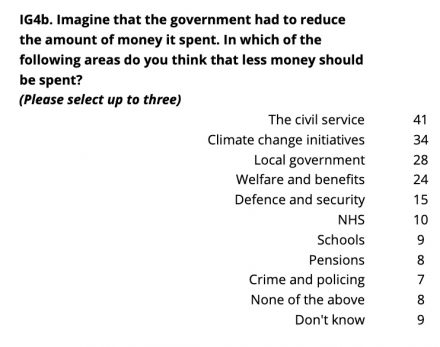
Labour voters would choose cuts to climate change initiatives and welfare over cuts to policing or pensions, a new poll reveals ahead of the Treasury’s looming spending review.

The findings will come as a relief to many in government in the same week that ministers have made the case for 5% spending cuts in government departments, unveiled a crackdown on welfare fraud and dropped hints they will back airport expansion to support growth. The seeming direction of travel in all three areas has sparked unease among campaigners, and is likely to prove highly controversial with parts of the party.

The survey by Deltapoll, commissioned by the Institute for Government, found that 39% of Labour voters at the last election would want to see less money spent on the civil service – if the government had to reduce spending. The second most popular – or least unpopular – of the nine options Labour supporters were pressed to choose from was climate change initiatives (30%).

Local government was next in line (27%) despite heavy cuts it has already faced since 2010, followed by ‘welfare and benefits’ (21%). Defence and security ranked next highest, in the middle of the rankings, on 19%.

The four areas Labour supporters least wanted cut were the NHS (12%), schools (10%), pensions (10%) and crime and policing (8%).

The electorate as a whole provided a similar ranking of their priorities to Labour voters.

Asked their preferences more broadly however, more Labour voters backed increasing taxes and spending more (39%) or keeping tax-and-spend levels the same (37%) to cutting taxes and spending less (12%).

It comes ahead of the government’s Spending Review in the spring, with Chief Secretary to the Treasury Darren Jones warning on Tuesday that government departments will not receive any cash for new projects unless they meet the Treasury’s target of a five percent reduction in spending.

READ MORE: Climate groups urge PM to challenge Trump and warn over airport expansion

Joe Twyman, director of Deltapoll, told the Institute for Government conference while presenting the findings on Tuesday: “This is a reflection of that dissatisfaction with the political process generally. 

“When you break it [support for cuts to the civil service] down, it is not the case it is driven overwhelmingly by those on the right. The big difference is with Baby Boomers compared to Gen Z. Nearly two-thirds of Baby Boomers select the civil service in their top three, compared to under a quarter for Gen Z.

Deltapoll

“Among party supporters, it’s not the case this is a particular bugbear for one group or another.”

The findings come as the government unveils plans to chase repayments from convicted benefits cheats, with powers to force banks to hand over account information to target investigations and driving bans for those who fail to pay back the taxpayer.

When asked about potential cuts to the civil service in the upcoming Spending Review, Darren Jones said: “I don’t think there is an either or, because just taking that action doesn’t solve all the problems we’re trying to fix.

“The idea of the zero-based review and the Office for Value for Money is we are looking at everything for the first time in 17 years and making sure where there is duplication or waste that we’re being ruthless in taking that out of the system.”

Building a fighting left in 2025 – The ‘Red Weekly’ Column

“Whatever framework is offered in the discourse of leading political figures and media pundits, neither smug liberalism nor reactionary conservatism will lead us to anywhere but disaster.”

Ben Hayes writes the first of our new Red Weekly columns

Even before reports of Rachel Reeves planning a new round of spending cuts emerged, 2025 looked set to be yet another year of political volatility in Britain. Last summer saw a depleted Conservative government finally come to an end, years after various scandals and the record-quick implosion of Liz Truss’ leadership had rendered it a laughing stock. Its replacement, under the leadership of Keir Starmer, has already hit the rocks, with YouGov polling putting Number 10’s current net approval at a brutal -47%.

There is no denying that the left is operating in a hugely challenging situation. The defeat of Labour in the 2019 general election, and subsequent marginalisation of those representing even fairly modest social democratic traditions inside the party, has led to a period rife with demoralisation, disengagement, and fragmentation.

In Parliament itself, the seven MPs who voted to support scrapping the two-child benefit cap were suspended from the PLP – another chapter in what is surely the most politically narrow and anti-democratic leadership in Labour’s history. Those who supported them against this outrageous measure were quite right to do so, and they should continue to do so this year, including by backing the initiatives some of those MPs are taking for an alternative economic strategy.

Whilst some MPs with a range of affiliations have made positive interventions on various issues in the first 6 months of this Parliament, those representatives seriously pushing for the change we need are clearly very much in the minority at Westminster. Any good news in the foreseeable future is therefore going to be the result of popular pressure rather than bold progressive thinking from those in charge, although the level of disquiet across society and the labour movement as more unpopular measures are proposed may well at some point lead to new divisions and battles.

Recent months have also highlighted the limitations of an approach which has made some headway in sections of the labour movement in recent years, which using the correct assertion that meaningful gains are won not merely through the House of Commons but by building strong industrial organisations and mass mobilisations, has then advocated a strategy which all too often means effectively turning away from campaigning around pressing matters of government policy and power.

Bearing this in mind, a reality which we all now need to face is that leaving a void has simply opened the door for various reactionary alternatives to grow – with Reform having consistently polled at 20% or more for the past 3 months, and the Tories continually drifting further right. And while those attracted to explicit fascist politics remain a relatively small minority, the violent street mobilisations last year showed what the consequences of their message being boosted can be.

Nonetheless, whilst having a realistic assessment of the current context, it remains vital not to slump into defeatism.  The result of the last general election, for all that can be criticised about the Parliament it has created, was reflective of a strong mood in favour of change and a rejection of the legacy left by 14 years of Tory-led governments.

This desire for an economic policy which addresses the damage caused by austerity and invests into services and communities can also be seen in responses to the agenda of the new government – with polling showing that scrapping the universal Winter Fuel Allowance payments in favour of means testing (a continuation of austerity politics) has been the most damaging policy in terms of public opinion, and the minimum wage increase proving to be the most popular one.

There remains a strong social base for an intervention from the left on Britain’s economic direction – seen even in the response to the latest Wallace and Gromit special’s emphasis on ensuring technological advances are used for the common good!

Building on Arise’s significant monthly events programme on economic alternatives in partnership with organisations such as the GFTU, Trade Union Co-Ordinating Group, Keep our NHS Public and We Own It, plus the significant support for individual issue campaigns such as in favour of wealth taxes, for public ownership of water and stopping the Winter Fuel cut, this area must be a priority for us in 2025.

It was also notable last year that, despite the notion promoted in some quarters of questions around internationalism and liberation being ‘fringe issues’, the most significant and widely-supported mobilisations were those in solidarity with the Palestinian people and defending our communities against extreme-right mobs, the latter turning the tide after numerous violent attacks.

These campaigns will be key once again over the next 12 months. On Palestine, the increasing breadth and impact of the coalition that has been put together is testament to the tireless work of those helping to build public pressure and engagement. The ongoing scenes of human and societal destruction have been kept in the public eye, and the role of Britain’s state and arms industry has been exposed. This has also led to growing layers to consider the links between struggles for progress at home and the fight for a better, more peaceful Earth.

And, as Trump prepares to return to office by ramping up his rhetoric not only in relation to the Middle East but an ever-growing list of places around the world, it is also worth noting that last month marked a year of the hard-right Milei administration in Argentina. The situation there should not only prompt solidarity with unions and social movements but serve as a warning of what these politics deliver in practice.

With a combination of attacks on trade union rights, vicious austerity policies, backward steps on the environment, and plans for an increase to a 12 hour working day (without overtime, naturally), it is little surprise that his agenda has been met with two thumbs up from Elon Musk – whilst a majority of the population have been pushed into poverty.

A final thought. This year should absolutely involve working with those from different political traditions – as well as those new to political activism. There is no contradiction between this and marking out a distinct socialist analysis and proposals to address the seriousness of the situation around us. Whatever framework is offered in the discourse of leading political figures and media pundits, neither smug liberalism nor reactionary conservatism will lead us to anywhere but disaster.

Anyone on the left expecting 2025 to see unanimous agreement on building their preferred organisation and programme is likely to be disappointed. But in terms of a New Year’s Resolution, we could do a lot worse than working to build links in whatever way we can to support all those fighting for positive change politically, industrially and internationally, and ensure we have an opportunity to set the agenda to the greatest possible extent.


The Fight for Peace and Disarmament

Featured image: No US Nukes in Britain, Campaign for Nuclear Disarmament banner. 
Photo credit: CND

(Nuclear) weapons are not about deterrence. They exist for the purpose of imperial projection, and imperial war.”

By Gary Lefley

The basic case in support of Britain’s nuclear weapons has barely changed in the past 72 years: it pleads Defence via Deterrence. The bogey man comes and goes. New ones are invented. For four decades the rationale was supposedly to deter the so-called Soviet threat. The USSR has been and gone. The Warsaw Pact has been and gone. But NATO, nuclear weapons and other weapons of mass destruction have not. Britain continues to spend multi-billions of pounds on military forces and nuclear weapons in the name of ‘defence’ and ‘deterrence’.

There is a yawning disconnect between the premise and the conclusion for Britain’s possession of nuclear weapons. The conclusion is always the same – “We must have a nuclear deterrent”. But the premise – exactly who it is we are supposed to be deterring – changes periodically, to fit the latest targets of US and British imperialism. We had to deter Stalin, we had to deter Brezhnev, we ‘can do business with Gorbachev’, said Reagan – and they did – resulting in the large-scale privatisation of the Soviet economy, wage cuts, price inflation, mass unemployment and poverty. We didn’t have to deter Yeltsin, we didn’t have to deter Putin – but no, on second thoughts, now we do have to deter Putin.

Not about self-defence

While Britain and the US turn the meaning of self-defence on its head with regard to Israel, a glance at the deployment of global forces reveals the depth of deceit. The US has 750 military bases in over 80 countries. That equates to around 80% of all the world’s foreign military bases. Britain, with 145 bases in 41 countries, has the second biggest number. According to the esteemed Stockholm International Peace Research Institute (SIPRI), Russia is estimated to have between 12-36 and China, 5-8, depending on how you define a military base. Again according to SIPRI, the United States military budget is greater than the next 9 biggest spenders added together. Of the 193 nation state members of the UN, 175 have a smaller annual GDP than the United States spends every year on ‘defence’! That is 9/10ths of the countries of the world.

If we step away from the relentless messaging of the pro-NATO establishment, is it not absurd to suggest that the US and UK’s global military footprint has anything to do with deterrence? They have 895 overseas military bases – more than four bases for every country in the world and gargantuan levels of military spending. And NATO military strategies are based on the doctrines of power projection and forward force projection – that is deploying and sustaining armed forces and military power outside NATO territory. In other words, they have military dominance throughout the globe). Even with the most blinkered will in the world, this is not about defence. Indeed, does not the rest of the world perceive it as the opposite: an imperial threat of existential proportions?

A cursory look at US invasions and covert regime-change operations over the past 70 years makes it clear that its military and special forces are not purposed for self-defence – unless you think a myriad of states were planning to invade America, including Korea, Vietnam, Cambodia, Laos, Cuba, Chile, Grenada, Nicaragua, Bolivia, Venezuela, Libya, Iraq, Syria, Afghanistan, Iran, Indonesia Yugoslavia, the USSR, and more.

As for Britain, are we so insular, so ignorant of how the world has experienced Britain’s savage colonial and continuing neo-colonial occupations, so imbued with the sub-conscious ideology of supremacy, as to believe that the UK’s overseas military bases, across six continents, are somehow about defending Britain? When the Royal Navy cruised through the South China Sea in 2021, with the largest attack force assembled by Britain in over 30 years, did anyone seriously think it was there to defend Plymouth? How do we think the people of Beijing and Shanghai received that deployment? And how might the people of Britain respond to a deployment in kind – with an attack fleet sailing through the English Channel and the North Sea in ‘self-defence’ of China?

Yet Britain repeats a similar exercise – albeit surreptitiously – all year round. Its four Trident nuclear submarines can each deploy up to 192 independently targetable nuclear warheads. Each warhead is eight times as destructive as that which obliterated Hiroshima in 1945. Other than in some Dr Strangelove dystopia, who believes that silently traversing the world’s ocean beds with enough nuclear warheads to destroy virtually every major city on the planet is motivated by self-defence?

Preparing for war

These weapons are not about deterrence. They exist for the purpose of imperial projection, and imperial war. Recent statements from leading political and military figures underline this reality. Grant Shapps, the then Defence Minister, said in January this year: “In five years’ time we could be looking at multiple theatres including Russia, China, Iran and North Korea… We have moved from a post-war to a pre-war world”. (Curiously, those ‘theatres’ do not include Britain. Or western Europe. Or the USA. As if the targeted countries would not retaliate. General Sir Roly Walker has stated that Britain must be ready within 3 years for a war against the “Axis of Upheaval” – again, Russia, China, Iran and North Korea. US Air Force 4 Star General Mike Minihan is predicting war with China in 2025.

Germany, France and Japan are all in the process of increasing their military spending by between 50% and 100%. The UK currently spends 2.32% of GDP on defence – £64.6 billion. Starmer has said that will rise to 2.5% – £87.1bn – “as soon as resources allow”. The Ministry of Defence Equipment Plan for 2021-2031 states: “The [defence] department has an equipment plan which balances cost and budget. Over the 10 years from 2021-22 we plan to spend £238 billion on equipment procurement and support (…) Spending on nuclear programmes across the whole Defence Equipment Plan over the next ten years (2023 to 2033) is forecast at £117.8 billion”. If this is anywhere near accurate, it suggests that in the region of 49.5% of the UK’s military equipment budget for the next decade will be spent on replacing Trident nuclear submarines with the new Dreadnought class boats and upgraded nuclear weapons. Even these colossal sums, from the horse’s mouth, are still way less than CND’s estimate of £205 billion, which includes in-service costs for the duration of the Dreadnought programme.

The threat is allegedly coming from Russia, China, Iran and North Korea. Yet nobody is seriously projecting a scenario under which any of these states actually initiates war against Britain. The US and NATO are surrounding these countries, by land and by sea, with nuclear-armed military bases and submarines. There are no equivalent deployments by any of the four targeted states. The cold-war-to-hot-war allegations against them are conspicuously devoid of any evidence, or any raison d’être.

The real threat to the British Isles is if Britain implicates itself as an aggressor in a war against them. In other words, the real threat to Britain comes from our self-inflicted relationship with the US and our self-inflicted membership of NATO. Any nuclear threat derives from our self-inflicted possession of nuclear weapons.

Alongside US-NATO-UK warmongering there resides a familiar narrative: McCarthyism, Islamophobia, Russophobia, Sinophobia; the demonising of leaders like Gaddafi; and plain lies, such as Iraq’s non-existent nuclear bomb.

The US has for over a century been the world’s dominant, imperialist power and has proven repeatedly that it will use the terror of war. It remains the only country ever to drop nuclear bombs on people, killing more than 300,000 civilians in Hiroshima and Nagasaki. It is hardly surprising that Russia and China today choose not to, unilaterally, be rid of their nuclear weapons while the US has them deployed on every continent, in every ocean.

The concept of self-defence is a viable principle for international relations if its application is consistent, universal and upheld in conjunction with multilateral commitments to peaceful coexistence and cooperation. But the perversion of this principle becomes apparent the moment the West applies its validity selectively. Manifestly, the US, UK and NATO do not extend the right of self-defence to their chosen victims. Today the peoples of Palestine, Lebanon, Syria, and now Iran, are not afforded this right. Netanyahu, in pursuit of annexation and expansion, under the pretence of self-defence, is given the go ahead and the weapons to displace a nation, destroy a civilisation, and exterminate a people. Those who dare to resist – those who are acting in self-defence – are labelled terrorists.

The British peace movement

Today there is a heavy burden on the British peace movement. The establishment media, and the Labour Party under Blair, did a job in marginalising the objectives of nuclear disarmament and withdrawal from NATO. Yet since 2010, under the leadership of Kate Hudson, CND has made impressive strides forward in developing a world view that has a broader appreciation of global developments and Britain’s role within them. CND began to campaign for Britain to leave NATO, and for US and NATO forces to be expelled from the UK.

From CNDs recent briefing, No To NATO, and from Sophie Bolt’s excellent inaugural speech as Hudson’s successor it is clear that CND is developing a world view that is incompatible with the interests of imperialism and militarism.

While Britain has nuclear weapons, and remains allied to the US, the threat of mutually assured destruction is as real as it ever was. The development of tactical/battlefield weapons has lowered the threshold for initiating nuclear war. But they have done nothing to prevent – and everything to incite – the escalation of war to the nuclear-strategic level. And as recent warfare has demonstrated, there are no ‘Iron Domes’.

If nuclear disarmament had slipped down the pecking order of priorities for the British Left, then that is being reversed, and not by demoting the profile of campaigning for a free Palestine, or a sustainable planet, or for a ceasefire and a negotiated peace in the Donbas. Rather, nuclear disarmament is now a key component of a positive alternative strategy for Britain as a nuclear weapon-free state, out of NATO. As Sophie Bolt said recently: “a peaceful, just, sustainable and nuclear-free world” necessitates “overcoming the major obstacle, which is US global dominance (…) Our efforts for an independent foreign policy, to secure Britain’s progressive role in the world and break with the US military project, are absolutely critical”.

The peaceful alternative

We may want to make British membership of the Non-Aligned Movement integral to that independent foreign policy. No to nuclear weapons, US bases and NATO, becomes a less isolationist, more attractive proposition when we add the positive vision of joining up with the 120 member states of the Non-Aligned Movement (NAM). And at some point, BRICS – already representing nearly half of the global population. The positives of being a non-nuclear weapons state and a member of NAM are not only about enhancing Britain’s security.

The multi-billion-pound construction and operational costs of the Dreadnought programme represents a huge potential peace dividend. The past 15 plus years of enduring economic crisis is reflected in Britain’s crumbling social and economic infrastructure. An increasingly needy and indebted British public may now be a little more susceptible to claiming that peace dividend, scrapping four submarines and 770 warheads, and joining the global non-nuclear mainstream.

It’s a win-win-win:

  • Give up threatening other countries with nuclear annihilation and stop being a target for nuclear retaliation
  • Resign from the swaggering nuclear weapons club of 9 countries (conceivably encouraging others to do likewise) and join the 184 nations that defend their independence without stockpiling nuclear weapons
  • Release multi-billions of pounds to invest in the people of Britain.

Scrapping Britain’s nuclear weapons, leaving NATO and joining NAM increases Britain’s security, enhances the country’s legitimacy, status and opportunities within the global community and affords a multi-billion-pound peace dividend. With Britain now contributing to missile attacks deep within Russia, we are directly provocative of, and susceptible to, a nuclear conflagration. To sidestep the issue of British nuclear disarmament is perilous.  A fundamental re-alignment of foreign and domestic policy is required urgently.


  • This article was originally published by The Socialist Correspondent– you can find out more and subscribe to them here.
  • The Labour Outlook Editorial Team may not always agree with all of the content we reproduce but are committed to giving left voices a platform to develop, debate, discuss and occasionally disagree