It’s possible that I shall make an ass of myself. But in that case one can always get out of it with a little dialectic. I have, of course, so worded my proposition as to be right either way (K.Marx, Letter to F.Engels on the Indian Mutiny)
Tuesday, February 11, 2025
'Everyone is really scared': Farmer speaks out as Trump puts livelihood in jeopardy
Maryland flower farmer Laura Beth Resnick spoke out on CNN Tuesday morning after President Donald Trump's across-the-board freeze on federal spending blocked a grant to help her upgrade her farm to clean energy — which would put her on the hook for over $36,000 the federal government had promised to pay, and jeopardize the economic viability of her business.
"We signed our contract with the government about a year ago to put solar panels on our barn, and about a year later the project was complete and we were supposed to get our funding the week that the funding freeze was announced," Resnick told anchor Sara Sidner. "We still haven't seen the money. And when we asked the government representative where it was and what we should do, they informed us that our funding request had been rejected due to the funding freeze."
She added that no one in the administration is explaining what's going on, despite federal judges ordering Trump to stop the freeze, and "it's a very stressful time."
"Do you think this is part of the design of all of this is that they're saying, look, the freeze is no longer in place, but in fact, it is still in place, just more quietly?" asked Sidner.
"I don't know," said Resnick. "I mean, I'm just a farmer trying to do my work." What she does know, she added, is that "the profit margins are so slim. These government programs are just so important for helping new farmers and farmers who don't have, you know, independent wealth to get going. So in the past, there's been no problem with these government grants and loans. But this is the first time I've ever had anything like this."
"Is this happening to your fellow farmers?" asked Sidner. "Are you hearing this from anyone else in your world?"
"Yes, absolutely," said Resnick. "Everyone is really scared. People have reached out to me all over the country sharing similar stories. There's two other farms in Maryland who were in the middle of receiving their grant contracts for their solar panels as well. So there's at least two other people who are in the exact same position as me. And then there's also other government grants, not even this one, but ones for building high tunnels, and putting a well on your property, and putting up fencing for livestock. And all of those are frozen. So everyone is kind of in limbo and just feeling very nervous."
The Justice Department has asked a judge to stop or amend another judge’s order, issued Saturday, that blocks Elon Musk from accessing the Treasury Department’s payment systems. The DOJ’s move came after Donald Trump’s allies openly questioned the constitutional authority of independent judges.
“If a judge tried to tell a general how to conduct a military operation, that would be illegal. If a judge tried to command the attorney general in how to use her discretion as a prosecutor, that’s also illegal. Judges aren’t allowed to control the executive’s legitimate power,” Vance said.
Vance is lying, but lying is beside the point.
The point is that the Trump administration appears to be preparing to defy the courts, thus triggering what US Senator Chris Murphy called “the most serious constitutional crisis the country has faced, certainly since Watergate.” He went on: “The president is attempting to seize control of power, and for corrupt purposes … he’s trying to crush his opposition … this is a red alert moment … our democracy is at risk.”
With due respect to my senator, I think we’re passed that. Trump is already defying the courts, and as a result, we are already beyond “a constitutional crisis” and in some other stage of decline and fall.
According to a motion filed Friday by 23 state attorneys general, all Democrats, the Trump administration has not complied with an order to stop a federal funding freeze that was implemented last month.
Two weeks ago, the White House Office of Management and Budget issued a memo that froze as much as $3 trillion, including Medicaid.
States sued. Some federal judges handed down injunctions, pending litigation. In response, the White House said it withdrew the memo, but according to these state AGs, the federal funding freeze didn’t stop.
In their motion, AGs allege that “despite the court’s order, defendants have failed to resume disbursing federal funds in multiple respects.” They ask that the administration be ordered “to immediately restore funds and desist from the federal funding pause until the preliminary injunction motion can be heard and decided, a process which is proceeding expeditiously in separate proceedings before this court.”
According to journalist Jennifer Shutt, the AGs allege that: the Trump administration hasn’t begun distributing billions of dollars in funding that Congress approved in the Inflation Reduction Act or the bipartisan infrastructure law. the NIH “abruptly cancelled an advisory committee review meeting with Brown University’s School of Public Health for a $71 million grant on dementia care research, saying ‘all federal advisory committee meetings had been cancelled.’” Head Start programs were unable to access funds. The CDC “renewed stop work orders to a University of Washington program doing global HIV prevention work.”
Connecticut AG William Tong said in a statement that “President Trump is not complying with the court order and continues to defund states. Let’s be clear about what Donald Trump wants to do — Donald Trump wants to defund Connecticut schools. He wants to defund the police. He wants to defund Connecticut highways. He is defunding energy assistance right now in defiance of a court order when so many Connecticut families are desperate for relief. He is defunding Connecticut efforts to reduce our reliance on foreign oil and fossil fuels. He is defying the rule of law and daring courts to stop him.”
US Senator Patty Murray, of Washington, released a briefing on areas in which the administration continues to illegally withhold funding. “President Trump is continuing to block hundreds of billions of dollars in funding from making its way out to families and communities across America who are counting on investments that have been signed into law. While he withdrew his blanket funding freeze — the disastrous [Office of Management and Budget] memo — in the face of nationwide backlash, Trump has so far refused to withdraw the various executive orders he has signed that are illegally freezing enacted funding.”
Murphy said: “the president wants to be able to decide how and where money is spent so that he can reward his political friends and he can punish his political enemies. That is the evisceration of democracy. You stand that with the wholesale endorsement of political violence, with the pardons given to every single Jan. 6 rioter, including the most violent, who beat police officers over the head with baseball bats, and you can see what he’s trying to do here. He’s trying to crush his opposition by making them afraid of losing federal funding, by making them afraid of physical violence. So yes, this is a red-alert moment.”
Donald Trump has already robbed the first branch of government of its constitutional authority – “the power of the purse.” Now he’s begun robbing the third branch, too. He isn’t leading “a constitutional crisis.”
Just four weeks in, we’re well beyond that.
An agency tried to regulate SpaceX — now Musk could control its fate
ProPublica February 11, 2025 A 3D-printed miniature model of Elon Musk and the X logo are seen in this illustration taken January 23, 2025. REUTERS/Dado Ruvic/Illustration/File Photo/File Photo
ProPublica is a Pulitzer Prize-winning investigative newsroom.
When SpaceX’s Starship exploded in January, raining debris over the Caribbean, the Federal Aviation Administration temporarily grounded the rocket program and ordered an investigation. The move was the latest in a series of actions taken by the agency against the world’s leading commercial space company.
“Safety drives everything we do at the FAA,” the agency’s chief counsel said in September, after proposing $633,000 in fines for alleged violations related to two previous launches. “Failure of a company to comply with the safety requirements will result in consequences.”
SpaceX CEO Elon Musk’s response was swift and caustic. He accused the agency of engaging in “lawfare” and threatened to sue it for “regulatory overreach.” “The fundamental problem is that humanity will forever be confined to Earth unless there is radical reform at the FAA!” Musk wrote on X.
Today, Musk is in a unique position to deliver that change. As one of President Donald Trump’s closest advisers and head of the newly created Department of Government Efficiency, he’s presiding over the administration’s effort to cut costs and slash regulation.
While it’s unclear what changes his panel has in store for the FAA, current and former employees are bracing for Musk to focus on the little-known part of the agency that regulates his rocket company: the Office of Commercial Space Transportation, known as AST. “People are nervous,” said a former employee who did not want to be quoted by name talking about Musk.
The tech titan and his company have been critical of the office, which is responsible for licensing commercial rocket launches and ensuring public safety around them. After the fines in September, SpaceX sent a letter to Congress blasting AST for being too slow to keep up with the booming space industry. That same month, Musk called on FAA chief Mike Whitaker to resign and told attendees at a conference in Los Angeles, “It really should not be possible to build a giant rocket faster than paper can move from one desk to another.”
FAA leadership seems to have heard him. The day of Trump’s inauguration, Whitaker stepped down — a full four years before the end of his term. And experts said the pressure is almost certain to grow this year as Musk pursues an aggressive launch schedule for Starship, the most powerful rocket ever built.
Whitaker did not respond to requests for comment.
Part of the problem for AST, experts say, is bandwidth.
The office has seen a sixfold increase in launches in the past six years, from 26 in 2019 to 157 last year — with SpaceX leading the pack. At the same time, AST’s staffing and budget have not kept pace. The agency has roughly 160 people to oversee regular flights by private rocket companies — sometimes more than one a day — bringing satellites to orbit, giving rides to astronauts, assisting with national security surveillance efforts and carrying tourists to the edge of space.
Launch traffic “has increased exponentially,” said George Nield, who led the office from 2008 to 2018. “No signs that that’s turning around or even leveling off.”
For each launch, AST’s staff calculate the risk that “uninvolved” members of the public, or their property, will be harmed. They also consider whether the launch will cause environmental damage or interfere with other airspace activities like commercial flight, as well as make sure a rocket’s payload received the proper approvals. The office licenses space vehicle reentries, too, though, as yet, there are far fewer of them.
The process, on average, takes five months. “It takes a certain amount of time to do the work to protect the public, and you do want to do that right,” Nield said. The consequences of shrinking the office or eliminating it altogether could be devastating, he said. “If a rocket goes off course, and nobody’s double-checked it, and so you have a major catastrophic event, that’s going to result in a huge backlash.”
But Musk has criticized AST for focusing on “nonsense that doesn’t affect safety.” He’s also emphasized that his company moves quickly and must have failures to learn and improve. Within SpaceX, this approach is known as “rapid iterative development.” And it is not without risk. Last month, when Starship blew up shortly after liftoff, dozens of airplanes scrambled to avoid falling debris. Residents of the Caribbean islands of Turks and Caicos reported finding pieces of the craft on beaches and roads, and the FAA said a car sustained minor damage.
SpaceX has said it was reviewing data to determine the cause, pledging to “conduct a thorough investigation, in coordination with the FAA, and implement corrective actions to make improvements on future Starship flight tests.”
Musk, however, downplayed the explosion as “barely a bump in the road.” Moreover, he seemed to brush off safety concerns, posting a video of the flaming debris field with the caption, “Success is uncertain, but entertainment is guaranteed!” He also said nothing suggested the accident would push plans to launch the next Starship this month — even though the FAA investigation was still pending.
Moriba Jah, a professor of aerospace engineering at the University of Texas, said that Musk’s response was “recklessness … at a minimum,” given that people were alarmed by the falling rocket debris, which streaked fire and smoke across the sky before landing in and around the islands.
“That he now gets to provide government oversight over the things that he is trying to get permission to do is one of the most significant conflicts of interest I’ve seen in my career, and it’s inexplicable to me,” said Jah, who served on a federal advisory committee for AST.
The White House did not answer questions from ProPublica about DOGE’s plans for AST. Officials referred to comments by Trump, who said last week that if a conflict arises for Musk between one of his businesses and his government work, “we won’t let him go near it.” Karoline Leavitt, Trump’s press secretary, also said Musk “will excuse himself from those contracts” if needed.
Musk and SpaceX did not respond to questions.
Jah said Musk and others advocating for less regulation have what he called a “launch, baby, launch mentality” that could push the FAA office in the wrong direction.
Industry representatives and members of Congress have accused the FAA of being more risk averse than necessary, stifling innovation.
“With nations like China seeking to leapfrog our accomplishments in space, it is even more imperative that we streamline our processes, issue timely approvals, minimize regulatory burdens and advance innovative space concepts,” said Rep. Brian Babin, a Republican from Texas and the incoming chairman of the House Science, Space and Technology Committee, at a hearing in September. He said he was concerned the FAA’s regulations could result in the mission to return astronauts to the moon being “unnecessarily delayed.”
Babin did not respond to a request for an interview about AST.
Sean Duffy, Trump’s new transportation secretary, has already indicated his department will take a more business-friendly approach.
Last month during his confirmation hearing, when Sen. Ted Cruz of Texas criticized the FAA’s enforcement action against SpaceX and asked Duffy whether he would “commit to reviewing these penalties and more broadly to curtailing bureaucratic overreach and accelerating launch approvals,” Duffy said he would. “I commit to doing a review and working with you, and following up on the space launches and what’s been happening at the FAA with regard to the launches.”
Duffy has since said he’s spoken to Musk about airspace reform and is looking to DOGE to “help upgrade our aviation system” — a move that drew a quick rebuke from Sen. Maria Cantwell of Washington last week. She called Musk’s involvement in FAA matters a conflict of interest.
The Department of Transportation did not make Duffy available for an interview, and the FAA did not answer written questions provided by ProPublica, despite multiple requests for comment.
Rep. Zoe Lofgren of California, the top Democrat of the Science committee, said streamlining the regulation of commercial space launches has bipartisan support.
Still, she said, the safety of crews and launchpads’ neighbors, as well as noise and pollution, need to be managed. “There needs to be a traffic cop here,” she said, especially given increased launches and issues such as space debris. “This can’t just be the Wild West, right?”
The $42 million allocated annually to AST is less than 1% of the FAA’s budget.
Astrophysicist Jonathan McDowell, who tracks space launches at the Smithsonian Astrophysical Observatory, said the office needs the resources and authority to hold companies accountable as the industry grows and has more impact. “Government will need to play a role,” he said, “and they’re going to have to sort it out.”
Last year, a government advisory committee recommended the AST move out of the FAA and become a standalone agency within the Department of Transportation.
Proponents argue the move would help AST get more attention, and potentially resources. Industry supporters also say the FAA’s culture of allowing no failures — a bedrock of its oversight of the commercial airline industry — is culturally a bad fit for what AST does, given how young the space industry is.
AST does not require that each mission succeed in the conventional sense, said Caryn Schenewerk, an industry consultant who sat on the advisory committee. “They can’t,” she said. Launching rockets is still so new, the office’s goal is to make sure failures don’t hurt anyone — not to prevent them altogether, she said.
As launches have become more common, though, so too have problems like the Starship explosion. A report from the Government Accountability Office found that in the three years before its 2023 review, commercial space launches experienced roughly two dozen mishaps, the industry’s term for “catastrophic explosions and other failures.”
While the report noted that none of those incidents resulted in fatalities, serious injuries or significant property damage to the public, there have been other impacts. Starship’s first launch in April 2023, for example, blew a cloud of dust and grime that stretched miles across Texas. Debris like concrete and shrapnel rained down on an environmentally sensitive migratory bird habitat near the company’s Boca Chica launchpad. Residents have complained, Jah said, but “citizens of that community aren’t feeling that they’re being heard.” A report in The New York Times noted egg yolk staining the ground near a bird’s nest.
In response, Musk wrote on X: “To make up for this heinous crime, I will refrain from having omelette for a week.”
SpaceX’s plans to launch the next Starship this month are part of the accelerated schedule the company has been pushing AST to approve. The company launched four of the vehicles in 2024, and officials said it wants to launch 25 this year.
'God bless this Pope': Critics cheer Vatican's new admonishment of Trump and Vance
FILE PHOTO: Pope Francis leads the Angelus prayer from his window at the Vatican, January 6, 2025. REUTERS/Guglielmo Mangiapane//File Photo
Pope Francis harshly criticized the Trump administration for its mass deportation of migrants in a public letter to U.S. bishops published Tuesday. In it he argues that the administration's treatment of migrants goes against church social doctrine and says that a policy built on force “will end badly.”
“The act of deporting people who in many cases have left their own land for reasons of extreme poverty, insecurity, exploitation, persecution or serious deterioration of the environment, damages the dignity of many men and women, and of entire families, and places them in a state of particular vulnerability and defenselessness,” the Pope writes.
The letter comes after Vice President JD Vance, a Catholic convert, called on theology to legitimize a crackdown on migrants. “You love your family, and then you love your neighbor, and then you love your community, and then you love your fellow citizens in your own country,” Vance said on Fox News. “Then after that, you can focus and prioritize the rest of the world.”
READ MORE: Whether Christians should prioritize care for migrants as much as for fellow citizens has been debated for centuries “Christian love is not a concentric expansion of interests that little by little extend to other persons and groups,” the first Latin American Pope writes. “The true ordo amoris that must be promoted is that which we discover by meditating constantly on the parable of the ‘Good Samaritan,’ that is, by meditating on the love that builds a fraternity open to all, without exception.”
“God bless this Pope,” Mehdi Hasan, editor in chief of Zeteo, posted on X.
“When you get your Catholic teaching so wrong the Pope himself has to issue a correction,” Mollie Wilson O’Reilly, editor at large for Commonweal Magazine, posted on Bluesky. She added: “I'm being glib, but this is truly beautiful,and clarifying.”
“The Pope's letter today takes aim at every single absurd theological claim by JD Vance and his allies in conservative Catholicism (and the Catholic electorate) but he also defends the chief target of Trumpism -- the rule of law -- in a way few seem able to articulate,” David Gibson, director of the center for religion and culture at Fordham University, posted on X.
Gibson pointed to a portion of the letter: “This is not a minor issue: an authentic rule of law is verified precisely in the dignified treatment that all people deserve, especially the poorest and most marginalized,” the Pope writes.
“The true common good is promoted when society and government, with creativity and strict respect for the rights of all — as I have affirmed on numerous occasions — welcomes, protects, promotes and integrates the most fragile, unprotected and vulnerable. This does not impede the development of a policy that regulates orderly and legal migration. However, this development cannot come about through the privilege of some and the sacrifice of others. What is built on the basis of force, and not on the truth about the equal dignity of every human being, begins badly and will end badly” he adds.
The Pope also references Pope Pius XII, who wrote what Pope Francis calls the “Magna Carta” of how the Church thinks of immigration. “The family of Nazareth in exile, Jesus, Mary and Joseph, emigrants in Egypt and refugees there to escape the wrath of an ungodly king, are the model, the example and the consolation of emigrants and pilgrims of every age and country, of all refugees of every condition who, beset by persecution or necessity, are forced to leave their homeland, beloved family and dear friends for foreign lands,” Pope Pius XII writes.
“This is the Pope also directly countering misinformation about the Catholic faith that is being expounded by the Catholic vice president,” Gibson told The Associated Press. “And it is the Pope supporting the Bishops as well."
'Will end badly': Pope Francis gives a major warning to Trump
Pope Francis speaks during the weekly general audience, in Paul VI hall at the Vatican, December 18, 2024. REUTERS/Guglielmo Mangiapane
Pope Francis on Tuesday took a direct shot at the Trump administration in a new letter in which he criticized the president's immigration policies as being un-Christian.
In the letter, Pope Francis described Trump's push for mass deportations in the United States as a "major crisis" and outlined why it goes against the teachings of Jesus Christ.
"The act of deporting people who in many cases have left their own land for reasons of extreme poverty, insecurity, exploitation, persecution or serious deterioration of the environment, damages the dignity of many men and women, and of entire families, and places them in a state of particular vulnerability and defenselessness," wrote the pope. "This is not a minor issue: an authentic rule of law is verified precisely in the dignified treatment that all people deserve, especially the poorest and most marginalized."
The pope also took issue with Vice President J.D. Vance invoking the Catholic concept of ordo amoris, or "order of love," to justify mass deportations from the United States.
"The human person is a subject with dignity who, through the constitutive relationship with all, especially with the poorest, can gradually mature in his identity and vocation," wrote the pope. "The true ordo amoris that must be promoted is that which we discover by meditating constantly on the parable of the “Good Samaritan," that is, by meditating on the love that builds a fraternity open to all, without exception."
The pope also warned Trump that any policy that is "built on the basis of force, and not on the truth about the equal dignity of every human being, begins badly and will end badly."
Photography
Dennis Morris: the iconic lens behind Bob Marley and punk rock takes centre stage in Paris
The Maison Européenne de la Photographie in Paris is presenting the first major retrospective of Dennis Morris’s work, showcasing his photography from 1960s and 1970s London. Celebrated as a ‘living legend’ in Japan, Morris is best known for his iconic images of Bob Marley, as well as his striking portraits of punk and rock figures, including the Sex Pistols, Marianne Faithfull, and French bands such as The Rita Mitsouko.
The Parisian exhibition, titled Dennis Morris – Music + Life, offers a glimpse into Morris’s black-and-white photographs, capturing the Jamaican and Sikh communities in London’s Hackney during the 1970s, as well as the white working-class, "The Happy Breed".
Morris’s passion for photography began at an early age - his first photograph was published on the front page of the Daily Mirror when he was just 11. He met Bob Marley in the early 1970s at the age of 16 and went on to capture some of the most iconic images of the reggae legend, both on and off stage.
The photographer who describes himself as always "sharp, stylish and cool" didn’t just capture images, he worked as a stylist for various Jamaican musicians and played a role in transforming Johnny Rotten of the Sex Pistols into John Lydon for his next venture, Public Image Limited (PiL).
More recently, Morris worked with the band Oasis, drawing comparisons to the Sex Pistols, describing it as "absolute chaos".
03:49
RFI: You had an exhibition at La Fab in Paris last year, and now at the Maison Européenne de la Photographie. What is your connection to Paris?
Dennis Morris: I've been and worked in Paris many times. I used to do a lot of work for Rock&folk magazine and I have many connections here. I've worked with quite a few French bands such as The Rita Mitsouko, Telephone, FFF.
Paris is a very creative place. It's a place where I think artists can come to find themselves. You know, sometimes artists reach a point in their career where they are looking for something, a new direction or they feel stagnated.
Artists will come to Paris to find themselves and then to recreate themselves in that sense.
And Paris is a beautiful city, architecturally, spiritually in that way.
RFI: At the MEP, there is a dedicated space showcasing your photographs of Bob Marley, both on and off stage. When did you first meet him?
Dennis Morris: The first time I met Bob Marley, it was my last year at school and I was very much into photography and music.
I had read in one of the music papers that he was coming over to do his first tour of England. I decided I wanted to meet him and take some photos of him.
So I went to the first venue he was to play on the tour in London, a place called the Speakeasy Club.
I didn't go to school that day and went to the club, maybe at 10am in the morning. I didn't know anything really about the music, how bands operated. I was there at 10am and they didn't turn up till around 3 or 4pm to do their sound check.
I just waited and waited and eventually he arrived, and I walked up to him and said: "Can I take your picture? He said: "Yeah man, come in." I went into the club with him, and while they were doing their sound check when they had a break, he was asking me what it was like to be a young black kid in England. And I was asking him about Jamaica.
He really liked me and said: "Would I like to come on the tour?" And I said, yes. So the next day I packed my bag as if I was doing sports and went to the hotel.
In those days, there wasn't a tour bus. It was a van. And the very famous picture, one of my most iconic images of Bob. I was sitting in the row of seats behind, and he turned round and said: “You ready, Dennis?” And I said, yeah. And took the shot.
Dennis Morris: Yes, I had a stage in my career as a photographer where I decided I wanted to make my own music. A band was formed with Basement Five.
I was the lead vocalist and very funny story was basically we were like a black punk band. But it was basically my influences from photography was punk and reggae, and I sort of fused the two together.
It was very difficult for us because no one really understood us… Because we were black, people expected us to play reggae or to play funk or soul, and we weren't like that at all.
And so what was really strange about it was at the time our support was U2, we went on to bigger things. But we had a very big following, but we had very bad management. U2 had a brilliant manager.
RFI: You’ve mentioned overcoming significant challenges in your life to become a photographer.How important is this achievement for you?
Dennis Morris: My ambition as a photographer was to be seen or recognised as one of the great photographers. If I have achieved that, I'm not sure. That's not for me to say. That's for the public to say.
I'm also very grateful for what photography has given me in terms of it's opened many doors for me. I've travelled the world through my photography and my work is recognised worldwide.
For instance, in Japan, they call me "living legend". Dennis Morris is a living legend, you know... So I am very proud of what I've been able to achieve.
RFI: What does ‘punk’ mean for you? Are you a punk?
Dennis Morris: I am a punk. Punk is a state of mind, a way of thinking. It's not really about the way you dress.
What punk really means is the ability, the desire to achieve what you want against all the odds, to go against the grain in that sense.
Working with Bob Marley…I learned how to be positive within myself, to recognise myself as a as a black man, as being equal to anyone. I learned my history. And more importantly, it gave me a sense to ground myself.
With punk, I learned how to kick down the door to take what I want. And through Bob Marley, I learned how to ground myself through spirituality in that sense and positivity.
► The exhibition Dennis Morris – Music + Life runs until 18 May, 2025 at the Maison Européenne de la Photographie in Paris.
Generative AI models are known to amplify prejudice – can they be fixed?
Analysis
Artificial intelligence (AI) tools are known to reproduce and amplify human prejudice about race or gender, but correcting such discriminatory bias has proved challenging. US President Donald Trump’s return to power appears to have nipped in the bud any hopes of progress – unless Europe can stand up to the deregulatory wave.
Dilapidated buildings, streets littered with trash, and cheerless residents sporting dirty clothes with holes in them. That’s how the AI-powered image creator Midjourney portrayed France's suburbs, the banlieues, in 2023, peddling negative stereotypes about the suburban neighbourhoods surrounding French cities.
The disparaging portrayal of French suburbs was the subject of a viral campaign by ride-hailing app Heetch, which invited residents to send postcards to Midjourney’s developers urging them to remove banlieue bias from their AI model.
As the campaign showed, searches for “banlieue school” or “banlieue wedding” revealed startling prejudice, contrasting sharply with images representing non-suburban France.
A discriminatory bias is equally present in AI chatbots, particularly regarding coloured people, women and those with disabilities, says journalist Rémy Demichelis, who has written a book on bias in artificial intelligence systems (“L’Intelligence artificielle, ses biais et les nôtres”).
Such automated discrimination has its roots in the data used by AI systems, which are themselves imbued with stereotypes and therefore biased.
Research into wedding photo databases, for instance, has shown that almost half the pictures come from just two countries: the US and the UK.
“AI feeds off databases that draw largely from Western content and have a specific cultural context,” Demichelis explains. That’s why AI systems might identify costumes from a Pakistani wedding as “folk attire”, because most of the background photos in their databases feature brides in white gowns.
Growing awareness
There is no such thing as a neutral algorithm, stresses Demichelis, noting that “algorithms not only reproduce bias inherent in society but also reinforce it”.
Recognition of this structural bias does not exempt the industry and decision-makers from striving to correct it, argues Jean Cattan, head of France's Conseil national du numérique, an independent advisory body tasked with exploring the complex relationship between digital technology and society.
“We're seeing growing awareness of the problem and burying our heads in the sand is not an option,” he says.
Cattan spoke of “concrete improvements” in the better known chatbots, though cautioning that the recent proliferation of AI systems means not all are moderated or subject to the same standards.
“There is now an abundance of conversational assistants that carry the same biases as in the past, or even more serious biases, with relatively little scrutiny of the databases they are trained on,” he warned.
'Masculine energy’
Databases are not the only reason generative artificial intelligence can produce skewed results, with experts highlighting the role played by engineers who design AI algorithms and models.
“Obviously, if you have only white people, and men in particular, designing these tools, they’ll be less likely to take discriminatory biases into account,” says Demichelis.
The Algorithmic Justice League, a US-based advocacy group, has long warned about unchecked and unregulated AI systems that amplify racism, sexism and other forms of discrimination. It advocates the use of “algorithmic audits” to ensure accountability and mitigate bias.
While such audits are increasingly popular, they remain “poorly defined” and difficult to verify, the group warns. Its recommendations include “directly involving the stakeholders most likely to be harmed by AI systems in the algorithmic audit process”.
US President Donald Trump’s return to power, however, coupled with the tech giants’ pandering to his rhetoric, do not bode well for efforts to tackle discrimination and the lack of accountability in AI.
“When you hear Mark Zuckerberg lament the lack of masculine energy in the tech world, you wonder whether we can expect any positive developments in the industry,” says Demichelis. “All the battles waged in recent years are being called into question, and there’s a risk that discrimination will actually increase.”
Google’s AI debacle
There have been attempts in the industry to correct inherent prejudice – some ending in embarrassment.
Google’s AI tool Gemini was lambasted last year when an ill-designed attempt to correct bias resulted in the chatbot generating images of Asian women in Nazi uniform and a black-skinned US Founding Father.
Viral posts of Gemini’s historically inaccurate images quickly became cannon fodder in a wider cultural war over political correctness, forcing Google to apologise and “pause” the tool.
Elon Musk typically stepped into the fray, branding Gemini “woke” and “racist” even as he promoted his own AI assistant.
Such incidents highlight the difficulty of training AI models to offset centuries of human bias without creating other problems.
“Technically, it’s extremely difficult for designers to pinpoint exactly where the prejudice occurs,” says Demichelis, noting that some form of bias is inevitable. Europe’s regulatory push
Cattan says improving chatbots will depend largely on user feedback and ensuring companies are required to report on the complaints and other feedback they receive.
The head of the Conseil national du numérique recommends using tools that compare different AI models, such as the Compar:ia platform developed by France’s culture ministry.
He hopes the European Union’s new AI Act, which will come into force in stages over the next three years, will protect users and mark a milestone in regulating the technology.
The Act, parts of which came into effect earlier this month, notably bans “biometric categorisation” systems that sift people based on biometric data to infer their race, sexual orientation, political opinions or religious beliefs.
The world’s first regulatory framework of its kind, the AI Act has been heavily criticised by US tech giants. Facebook’s parent company Meta has already said it will not release an advanced version of its Llama AI model in the EU, blaming the decision on the “unpredictable” behaviour of regulators.
“It remains unclear whether the EU can hold the line” in the face of the deregulatory wave pushed by Trump and Musk, adds Demichelis.
Analysts have warned that Europe is lagging behind the US and China in the global AI race. Its ability to stand up to tech giants may yet shape the future of AI regulation. This article has been translated from the original in French.
Creation must remain ‘fundamentally human’, says expert ahead of Paris AI summit Ahead of the Artificial Intelligence Action Summit in Paris next week, the French Culture Ministry is holding a public event this weekend, hoping to spark interest in AI, as the country aims to keep up with the competition in the sector from the United States and China.
Issued on: 08/02/2025 -
"Chim(ai) ra / Avatars in the Era of Artificial Intelligence", an installation by Justine Emard, is part of a group exhibition at the Conciergerie in Paris on 9 February.
France is hoping the summit, to be attended by world leaders as well as tech experts, will reinforce its leading European position, in a battle that is for now largely being played out between the US and China.
The country also hopes to stoke public interest in real-world uses of artificial intelligence (AI). The French Cultural Ministry has put together a weekend programme of events in Paris, ahead of the summit, for the public to learn about the use of AI in various arenas such as art, cinema, history and music.
For law professor Alexandra Bensamoun, it’s vital for France to keep abreast of the latest developments in AI, regardless of the sector. “I believe that we must get on the AI train, we must not stand on the platform and watch it go by," she said.
Bensamoun is among the guest speakers at a discussion being held at the National Library of France, focusing on AI's place in the cultural domain. She is part of a special task force informing the government on a legal framework for AI, at both a French and a European level.
One of the biggest challenges artists face in the age of AI is having their work re-used or copied by AI tools and applications, without being properly credited – or indeed paid.
As an advisory member of a national committee set up by the Culture Ministry (CSPLA), she is dedicated to finding a suitable legal framework to protect intellectual property in creative fields.
Her role is to “reconcile” the growth potential of AI while remaining “consistent with European values". 'Fundamentally human'
For Bensamoun, AI is an important tool, but it should be viewed as just that: a tool, to be used by humans, rather than something that replaces human endeavour.
Artistic and literary creation is “fundamentally human and it is important to recognise the uniqueness of human creation and to protect it,” she said. “The objective is not to ban AI, the objective is to allow the deployment of AI in an ethical environment, in an environment that respects everyone."
To reach this goal, Bensamoun says two measures related to protecting copyright in cultural fields were included in the European Union's AI act – published in 2024.
The first states that suppliers of AI programmes must respect author copyright and so-called “neighbouring rights”, which regulate the republication of certain content.
The second measure stipulates that AI suppliers must provide the public with “a sufficiently detailed summary of the content which was used for training artificial intelligence models”.
Such transparency at each step of the process, Bensamoun says, is only possible if all players in the AI field sit down and negotiate fair rules from the outset, rather than play catch-up via expensive legal action after the fact.
However, she adds that there are still unchartered waters moving forward, as copyright issues are necessarily inter-connected with other laws covering competition, image rights and the treatment of personal data.
Sylvester Stallone promoting the film "Rambo V: Last Blood" at the Cannes Film Festival in May 2019. REUTERS/Eric Gaillard
Exploitation and education
Aside from legal questions, the use of AI raises philosophical and ethical debate.
One recent example that garnered media attention was the case of the late actor Alain Dorval, the French “voice” of American action hero Sylvester Stallone.
While Dorval passed away in February of 2024, a company called ElevenLabs used artificial intelligence to recreate his voice in order to dub Stallone’s voice for the trailer of the film Armor, due for a French release in March 2025.
However, as Bensamoun explains, Dorval’s family had only given their consent for simple tests to be done using the actor's voice, and not for its use for media exploitation. In the end, another actor was hired to dub the full film.
In the report Bensamoun and other experts submitted to President Emmanuel Macron in 2024, one key recommendation was the importance of education on the use of AI, particularly in times of social and economic upheaval.
“We need to raise awareness, educate about AI. Not everyone is going to use AI, but everyone needs to understand what it is about," she said.
Macron’s special envoy for AI, Anne Bouverot, with whom Bensamoun collaborated, believes "science can help us think through this revolution" and "understand the societal impacts of AI".
“AI must not be the source of new divisions,” Bensamoun added.
One thing experts including Bensamoun and Bouverot agree on is that France and Europe will need to invest if they want to remain credible contenders in the AI race.
Recent events "show us that the field is still very open in terms of global competition," Bouverot told a packed lecture theatre at the Polytechnique engineering school in Paris on Thursday.
Hot on the heels of a US plan for a $500 billion AI investment scheme, France has also announced major investments running into the billions, including for new data centres on its territory.
ICC Condemns Trump Sanctions as UN Human Rights Office Demands Reversal
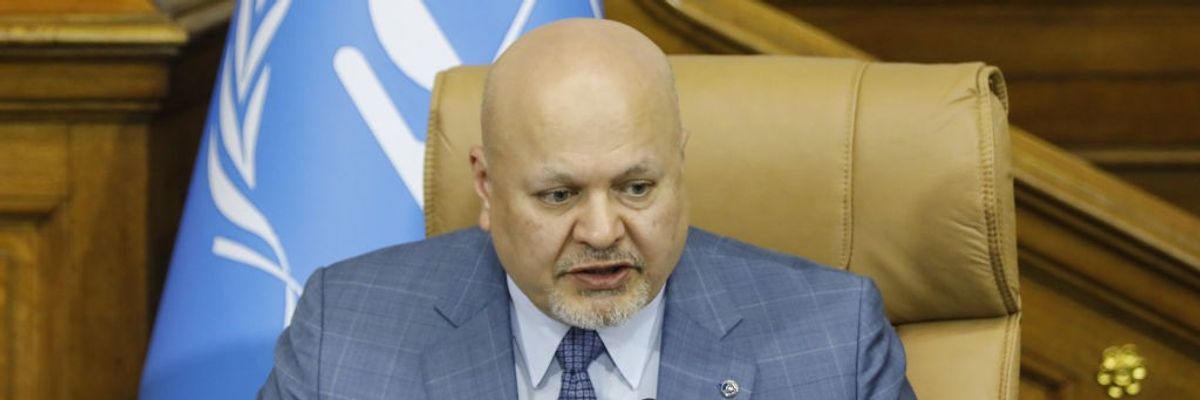
"The rule of law remains essential to our collective peace and security," said a United Nations spokesperson. International Criminal Court Prosecutor Karim Khan delivers an address before Venezuela's National Assembly in Caracas on April 22, 2024. (Photo: Pedro Rances Mattey/Anadolu via Getty Images)
The International Criminal Court on Friday denounced U.S. President Donald Trump's executive order sanctioning the ICC in response to arrest warrants issued for Israeli leaders over their devastating 15-month military assault on the Gaza Strip.
"The ICC condemns the issuance by the U.S. of an executive order seeking to impose sanctions on its officials and harm its independent and impartial judicial work," the tribunal said in a statement. "The court stands firmly by its personnel and pledges to continue providing justice and hope to millions of innocent victims of atrocities across the world, in all situations before it."
"We call on our 125 states parties, civil society, and all nations of the world to stand united for justice and fundamental human rights," added the Hague-based ICC, which was established by a global treaty known as the Rome Statute to prosecute individuals for genocide, war crimes, crimes against humanity, and the crime of aggression.
A spokesperson for the United Nations' Office of the High Commissioner for Human Rights (OHCHR), Ravina Shamdasani, also slammed Trump's order targeting the ICC, which she called "a central institution of the international criminal justice system and fundamental to ensuring justice and achieving accountability for the most serious crimes."
"We fully support the independent work of the court—across all situations within its jurisdiction," Shamdasani said Friday. "We deeply regret the individual sanctions announced yesterday against court personnel, and call for this measure to be reversed."
"The court should be fully able to undertake its independent work—where a state is unwilling or unable genuinely to carry out the investigation or prosecution, as stated in the Rome Statute. The court is an essential part of the human rights infrastructure," she added. "The rule of law remains essential to our collective peace and security. Seeking accountability globally makes the world a safer place for everyone."
Since Trump signed the order—which specifically cites the court's November warrants for Israeli Prime Minister Benjamin Netanyahu and his former defense minister, Yoav Gallant—civil society groups around the world have also spoken out against the U.S. president, who previously targeted ICC officials with sanctions during his first term.
"This reckless action sends the message that Israel is above the law and the universal principles of international justice. It suggests that President Trump endorses the Israeli government's crimes and is embracing impunity," saidAmnesty International secretary general Agnès Callamard, a former U.N. special rapporteur, in a statement.
The "aggressive" and "vindictive" order, she continued, "is a brutal step that seeks to undermine and destroy what the international community has painstakingly constructed over decades, if not centuries: global rules that are applicable to everyone and aim to deliver justice for all. The sanctions constitute another betrayal of our common humanity."
"At an historic moment when we are witnessing a genocide against Palestinians in Gaza, Russia's aggression against Ukraine, and the global rule of law coming under threat from multiple fronts," she argued, "institutions like the court are needed more than ever to advance human rights protections, prevent future atrocities and secure justice for victims."
Trump's sanctions will not only "embolden perpetrators," Callamard warned, "they will negatively impact the interests of all victims globally and those who look to the court for justice in all the countries where it's conducting investigations, including Darfur, Libya, the Philippines, Palestine, Ukraine, and Venezuela."
"The sanctions are also an affront to 125 member states who have collectively resolved that the court must be able to effectively pursue justice—which means it must be able to undertake independent judicial functions, such as issuing arrest warrants, for example, against Benjamin Netanyahu or Vladimir Putin," said added, referring to the Russian president.
"Governments around the world and regional organizations must do everything in their power to mitigate and block the effect of President Trump's sanctions," Callamard concluded. "Through collective and concerted actions, ICC member states can protect the court and its staff. Urgent action is needed, like never before."
While some governments, such as Hungary, have backed Trump's move, others have joined the chorus of condemnation and reiterated support for the ICC.
"We reaffirm our continued and unwavering support for the independence, impartiality, and integrity of the ICC," 79 nations—including France, Germany, and the United Kingdom—said in a joint statement reported by Reuters. "The court serves as a vital pillar of the international justice system by ensuring accountability for the most serious international crimes, and justice for victims."
Bowdoin College Students Launch First Gaza Solidarity Encampment of Trump Era
"As Israeli aggression obliterates Palestinian homes and guns down children in Jenin, as unspeakable suffering continues in Gaza, and as America descends further into fascism, we ask—what type of institution does Bowdoin want to be?"
Bowdoin College students try to enter Smith Union, where Students for Justice in Palestine activists set up an encampment in Brunswick, Maine on February 7, 2025. (Photo: @thestustustudio/X/screen grab)
Activists at Bowdoin College in Brunswick, Maine have launched what is believed to be the first Palestine solidarity encampment since President Donald Trump took office, occupying the first floor of the liberal arts school's student union to protest the U.S. leader's proposal to take over the Gaza Strip and expel its native Palestinian population.
Bowdoin Students for Justice in Palestine (SJP) occupied the first floor of Smith Union on Thursday night and erected tents there, The Bowdoin Orientreported. They named the encampment after Sha'ban al-Dalou, a 19-year-old computer engineering student at al-Azhar University in Gaza who burned alive in a refugee tent encampment bombed by Israel last October.
The protesters—who reportedly number around 50—acted in response to Trump's Tuesday press conference with fugitive Israeli Prime Minister Benjamin Netanyahu, during which the president floated U.S. ownership of Gaza, the ethnic cleansing of its Palestinian population, and the construction of the "Riviera of the Middle East" there following 15 months of Israel's genocidal war on the coastal enclave.
Demonstrators also condemned Israel's ongoing assault on the illegally occupied West Bank, where the killing and injury of thousands of Palestinians since October 2023 has been overshadowed by the annihilation of Gaza.
"As Israeli aggression obliterates Palestinian homes and guns down children in Jenin, as unspeakable suffering continues in Gaza, and as America descends further into fascism, we ask—what type of institution does Bowdoin want to be?" Bowdoin SJP said in a statement Thursday. "One that cowers to authoritarianism, that chooses cowardice in the face of injustice? The choice is Bowdoin's."
The Orient reported that a Bowdoin College security official began asking student protesters to identify themselves around 1:00 am on Friday morning while Dean of Students Michael Pulju informed students about the disciplinary repercussions of their action, including the possibility of expulsion.
On Friday morning, more Bowdoin students showed up outside the student union to protest and try to enter the building, chanting, "Open Smith!"
According to the Orient:
The encampment... comes nearly a year after Bowdoin students voted in favor of the SJP-organized Bowdoin Solidarity Referendum, a resolution demanding that the college take an institutional stand against the scholasticide and stop future investments in defense-focused funds. At the beginning of the fall semester, the college established its Ad Hoc Committee on Investments and Responsibility in response to the referendum but has yet to alter its investment practices or offer an institutional statement.
Lead SJP organizer Olivia Kenney told the Orient that the protesters plan to occupy Smith Union "until the demands of the Bowdoin Solidarity Referendum are met" by the school's Board of Trustees.
Staff and students at Birzeit University in the occupied West Bank recorded a message of solidarity with the "beautiful and wonderful" Bowdoin encampment.
"We woke up this morning to... the news of your encampment, and we've been following the news of the solidarity encampment at Bowdoin and Students for Justice in Palestine," they said in the message, which was posted on Instagram. "We see you, we love you."
"Thank you, from occupied Palestine in the West Bank, where students and faculty and employees alike can barely if at all get to campus because of the checkpoints and roadblocks," the message continued. "From all of Palestine, from the river to the sea, all of the universities that were actively destroyed in 471 days of genocide. Universities throughout the occupied West Bank, which are being surrounded and isolated."
"We are in this together," the message added. "We see you and thank you for raising your voices and screaming loudly that the space of a university is our space. It is a space where knowledge is exchanged. It is the space where we imagine and work to achieve the world that we want to live in, not the world that has been thrust upon us."
NAKBA 2.0
100+ Groups 'Decry and Oppose' Trump Push to Ethnically Cleanse Gaza
"Palestine is not just an idea—it is a place. It is a homeland to the Palestinian people," the coalition wrote.
Displaced Palestinian children sit on a sand mound overlooking tents set up amid destroyed buildings in Jabalia in the northern Gaza Strip on February 6, 2025. (Photo: Bashar Taleb/AFP via Getty Images)
A coalition of over 100 organizations on Monday forcefully denounced U.S. President Donald Trump's plan to ethnically cleanse the Gaza Strip of Palestinians and take over the coastal enclave recently decimated by an Israeli military campaign conducted with American weapons.
Led by A New Policy—a group founded by Biden administration officials who resigned in protest—and the Quaker organization Friends Committee on National Legislation, the coalition said that "we are deeply alarmed by President Trump's recent statements, tracing them back to January 25, just days after the Republican returned to power.
"We, the undersigned organizations, decry and oppose any effort or initiative, and any calls for, the forcible displacement of Palestinians from Gaza, and support the joint statement of Egypt, Jordan, Saudi Arabia, the United Arab Emirates, Qatar, the Palestinian Authority, and the Arab League that similarly rejected any such steps, the coalition wrote, citing the Fourth Geneva Convention.
The letter highlights the ethnic cleansing of Palestine in the 1940s during the formation of the modern state of Israel, which Palestinians call the Nakba, Arabic for catastrophe; that since 2006, Gaza "has been in a state of siege," with residents enduring repeated bombardment and restrictions on necessities; and that since the Hamas-led October 7, 2023 attack on Israel, they have faced what various experts have found to be a plausible case of genocide, with over 48,000 people killed.
"Through this all, the Palestinians in Gaza have stood with remarkable dignity and perseverance, insisting throughout the immense suffering and loss that they will never abandon their homeland," the letter continues, echoing recent remarks from residents. "We are deeply concerned by clear statements of intent from Israeli government officials over the past year concerning the creation of new Israeli settlements within the Gaza Strip, which further reinforce the intent of ethnic cleansing."
"The United States has no right to dictate to the Palestinian people in Gaza to leave, and direct other countries to participate in their displacement. We are also aware that even a temporary external displacement could be used by Israel to enact permanent exile," the letter says. "While we agree that the short and medium-term humanitarian needs of the people of Gaza may be difficult to meet given the nearly complete destruction that Israel has wrought, if the necessary services cannot be provided in Gaza, the people of Gaza must be able to access them elsewhere within the historic borders of Palestine and must be able to return."
The coalition also expressed alarm over "an uptick in settler violence" and deadly Israel Defense Forces operations in the illegally occupied West Bank, writing that "these actions are part and parcel of a strategy that seeks to make not just Gaza, but all Palestinian areas across historic Palestine, unlivable for the Palestinian people, and are thus contributory to a process of ethnic cleansing."
"Palestine is not just an idea—it is a place. It is a homeland to the Palestinian people," the groups stressed. "To participate in, facilitate, or endorse their removal from it would violate every precept of international law, devastate the rules-based international order that protects us all, do irreversible harm to America's global influence, and be an act of unconscionable immorality."
The letter concludes with a poem from Palestinian Mahmoud Darwish, who wrote: My country is not a suitcase I am not a traveler I am the lover and the land is the beloved. The archaeologist is busy analyzing stones. In the rubble of legends he searches for his own eyes to show that I am a sightless vagrant on the road with not one letter in civilization's alphabet. Meanwhile in my own time I plant my trees. I sing of my love.
In addition to the coalition leaders, signatories to the letter include ActionAid USA, CodePink, Democracy for the Arab World Now, Demand Progress Education Fund, Democratic Socialists of America, IfNotNow Movement, Just Foreign Policy, Madre, National Iranian American Council, Oil Change International, Peace Action, Progressive Democrats of America, and September 11 Families for Peaceful Tomorrows, and U.S. Campaign for Palestinian Rights.
The letter came amid a fresh wave of alarm over Trump's latest comments about Gaza and Palestinians, which aired Monday morning on "Fox & Friends." He said: "We'll build safe communities a little bit away from where they are, where all of this danger is. In the meantime, I would own this—think of it as a real estate development for the future. It would be a beautiful piece of land."
Asked by Fox News' Bret Baier whether Palestinians would have the right to return to Gaza, the president said, "No, they wouldn't.
The letter also came as Hamas on Monday suspended its next planned release of hostages taken in October 2023, citing Israel's deadly violations of a fragile cease-fire deal that took effect last month.
Trump: Palestinians have no right of return under Gaza plan
Last year, Trump described Gaza as being “like Monaco,” while his son-in-law Jared Kushner suggested that Israel could clear Gaza of civilians to unlock “waterfront property.”
US President Donald Trump first unveiled his Gaza plan last week
- Copyright AFP
ROBERTO SCHMIDT Danny KEMP
President Donald Trump said Palestinians would have no right of return to Gaza under his US takeover plan, describing his proposal in excerpts of an interview released Monday as a “real estate development for the future.”
Trump told Fox News Channel’s Bret Baier that “I would own it” and that there could be as many as six different sites for Palestinians to live outside Gaza under the plan, which the Arab world and others in the international community have rejected.
“No, they wouldn’t, because they’re going to have much better housing,” Trump said when Baier asked if the Palestinians would have the right to return to the enclave, most of which has been reduced to rubble by Israel’s military since October 2023.
“In other words, I’m talking about building a permanent place for them because if they have to return now, it’ll be years before you could ever — it’s not habitable.”
Trump first revealed the shock Gaza plan during a joint news conference with visiting Israeli Prime Minister Benjamin Netanyahu on Tuesday, drawing outrage from Palestinians.
The US president pressed his case for Palestinians to be moved out of Gaza, devastated by the Israel-Hamas war, and for Egypt and Jordan to take them.
In the Fox interview — which will be broadcast Monday after the first half was screened a day earlier — Trump said he would build “beautiful communities” for the more than two million Palestinians who live in Gaza.
“Could be five, six, could be two. But we’ll build safe communities, a little bit away from where they are, where all of this danger is,” added Trump.
“In the meantime, I would own this. Think of it as a real estate development for the future. It would be a beautiful piece of land. No big money spent.”
– ‘Unacceptable’ –
Trump stunned the world when he announced out of the blue last week that the United States would “take over the Gaza Strip,” remove rubble and unexploded bombs and turn it into the “Riviera of the Middle East.”
But while he initially said that Palestinians could be among the “world people” allowed to live there, he has since appeared to harden his position to suggest that they could not.
Netanyahu on Sunday praised Trump’s proposal as “revolutionary”, striking a triumphant tone in a statement to his cabinet following his return from Washington.
“President Trump came with a completely different, much better vision for Israel,” said Netanyahu, who was reportedly only briefed on the plan shortly before Trump’s announcement.
The reaction from much of the rest of the world has been one of outrage, with Egypt, Jordan, other Arab nations and the Palestinians all rejecting it out of hand.
The criticism was not limited to the Arab world, with German Chancellor Olaf Scholz on Sunday labeling the plan “a scandal,” adding that the forced relocation of Palestinians would be “unacceptable and against international law.”
Trump’s plan has also threatened to disrupt the fragile six-week ceasefire between Israel and Hamas in Gaza, and the chances of it progressing to a second, more permanent phase.
Trump, however, repeated his insistence that he could persuade Egypt and Jordan, both major recipients of US military aid, to come around.
“I think I could make a deal with Jordan. I think I could make a deal with Egypt. You know, we give them billions and billions of dollars a year,” he told Fox.
Last year, Trump described Gaza as being “like Monaco,” while his son-in-law Jared Kushner suggested that Israel could clear Gaza of civilians to unlock “waterfront property.”