Tuesday, February 11, 2025

'Panic': Trump’s paused tariffs are already inflicting 'long-lasting damage' — here's why


A fake $2020 bill featuring former President Donald Trump. Photo illustration: Christopher Sciacca/Shutterstock

Donald Trump has unclaimed property and abandoned money in at least 16 states
February 08, 2025
ALTERNET

Many economists, both left and right, cringed when President Donald Trump ordered 25 percent tariffs on all goods being imported into the United States from Canada and Mexico. And the outcry was vehement from neighboring officials north and south of the United States.

Former Canadian Deputy Prime Minister Chrystia Freeland slammed the tariffs as "a betrayal of America's closest friend," and Mexican President Claudia Sheinbaum vowed to impose tariffs on U.S. goods in response.

Trump later agreed to delay the tariffs on Canada and Mexico by 30 days, and many economists are hoping he won't go through with them at all. But The Atlantic's Lora Kelley, in an article published on February 7, argues that the mere threat of tariffs is already inflicting damage economically.

Trump, Kelley notes, "caused a panic in the stock market," adding that "the residue of this week's blink-and-you-missed-it trade war will stick."

Ernie Tedeschi of the Yale Budget Lab told The Atlantic that "uncertainty about tariffs poses a strong risk of fueling inflation, even if tariffs don't end up going into effect" —adding that "one of the cornerstone findings of economics over the past 50 years is the importance of expectations."

"Consumers, nervous about inflation, may change their behavior — shifting their spending, trying to find higher-paying jobs, or asking for more raises — which can ultimately push up prices in what Tedeschi calls a 'self-fulfilling prophecy,'" Kelley explains. "The drama of recent days may also make foreign companies balk at the idea of entering the American market. During Trump's first term, domestic industrial production decreased after tariffs were imposed."

Similarly, Felix Tintelnot, who teaches economics professor at Duke University, warns that the threat of tariffs — even if they don't go through — can promote inflation.

Tintelnot told The Atlantic, "Uncertainty by itself is discouraging to investments that incur big one-time costs."

'Will make the economy worse': Confidence free falls as voters blame Trump for market 'chaos'

"The Trump bump in consumer confidence is already over,"
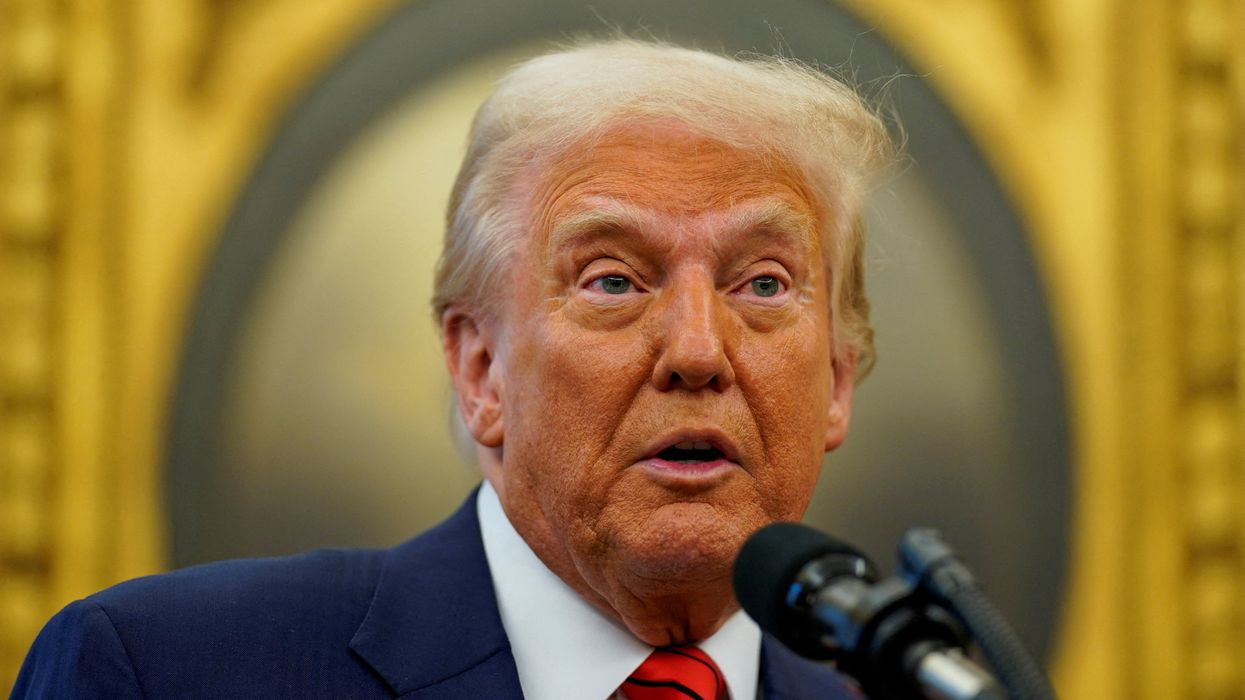

REUTERS/Kent Nishimura/File Photo/File Photo
FILE PHOTO: U.S. President Donald Trump speaks at the White House in Washington, U.S., February 5, 2025.

February 08, 2025
ALTERNET


During the 2024 presidential race, Donald Trump repeatedly claimed that the U.S. economy was terrible under then-President Joe Biden and then-Vice President Kamala Harris. But according to U.S. Bureau of Labor Statistics (BLS) figures, unemployment stayed under 4.0 percent from February 2022 through April 2024. And U.S. unemployment was 4.1 percent in December 2024, Biden's last full month in office.

Nonetheless, voter frustration over inflation worked to Trump's advantage, and he narrowly defeated Harris by roughly 1.5 percent (according to the Cook Political Report) on Election Day.

Wall Street Journal reporters Rachel Wolfe and Joe Pinsker examine consumer confidence in an article published on February 7, laying out some reasons why it appears to be declining during Trump's second presidency.

"The Trump bump in consumer confidence is already over," Wolfe and Pinsker report.

 "Tariff threats, stock market swings and rapidly reversing executive orders are causing Americans across the political spectrum to feel considerably more pessimistic about the economy than they did before President Trump took office. Consumer sentiment fell about 5 percent in the University of Michigan's preliminary February survey of consumers to its lowest reading since July 2024. "

The WSJ reporters continue, "Expectations of inflation in the year ahead jumped from 3.3 percent in January to 4.3 percent, the second month in a row of large increases and highest reading since November 2023…. Morning Consult's recent index of consumer confidence, too, fell between January 25 and February 3, driven primarily by concern over the country's economic future."

Wolfe and Pinsker cite 58-year-old Paul Bisson as an example of someone who voted for Trump in 2024 but now has reservations about his economic policies, including tariffs.
Bisson told WSJ, "I don't like the turbulence. I don't like the chaos in the market…. That will make the economy worse, and that's not what we signed up for. We've already cut back. There's no more cutting back to do."

Nicholas Schuch, a 38-year-old Durham, North Carolina resident who voted for Harris, also views the economy as chaotic during Trump's second presidency. And he is thinking of moving to a country he believes has a better monetary policy.

Schuch told WSJ, "I was thinking Switzerland, potentially…. I just expect things will be chaotic, and that that is what life is now."


'Irritating domestic manufacturers': How Trump tariffs create 'inflationary environment' for consumers
February 10, 2025
ALTERNET

After agreeing to delay, for 30 days, 25 percent tariffs on all goods being imported into the United States from Canada and Mexico, President Donald Trump unveiled a new idea for tariffs on Sunday, February 9: a 25 percent tariff on all imported steel and aluminum.

Trump didn't specify any particular counties. He was talking about steel and aluminum imports in general, telling reporters, "Any steel coming into the United States is going to have a 25 percent tariff. Aluminum too."

Trump argues that tariffs on steel and aluminum imports will give domestic steel and aluminum manufacturers an advantage. But during a Monday, February 10 appearance on CNN, Roben Farzad — a business reporter for National Republic Radio (NPR) — warned that the tariffs Trump is proposing will be bad for the U.S. economically.

Farzad argued, "I think, for starters, this is about punching China in the nose. The great big panda. If you look at what China has done over the past 30 or 40 years in terms of ramping up steel production, where the United States was dominant in the middle of the 20th Century, and big steel and Pittsburgh and all the various things that came out of that, including Detroit and the various industries that could take that for granted. That industry has been in kind of an inexorable decline for a long time."

The NPR reporter added, "China, meanwhile, has been able to bring on all sorts of steel mills, all sorts of more modern steel mills, that could take inputs. It can recycle scrap, and it is now a behemoth…. You see dumping all across the global trade balance, and that's ending up in the United States and irritating domestic manufacturers."

Asked if tariffs on imported steel and aluminum would make them more expensive in the U.S., Farzad quickly replied, "Yes, yes."

"Look, the market for steel — which again, used to be dominated by Pittsburgh, it's no longer that. It's very fluid and fungible. We have the Koreans, the Mexicans, the Canadians, the Vietnamese, all along the value chain, passing this stuff along. And if there's any shiver in the system, any idea that, wow, a big price hike is going through — already, car prices are at a record high…. This is something that you really don't want in an inflationary environment."

Watch the full video below or at this link.


The US tried high tariffs and ‘America first’ policies in the 1930s. Here's what happened next.


 U.S. National Archives and Records Administration, Public Domain, https://commons.wikimedia.org/w/index.php?curid=17057587
Unemployed people lined up outside a soup kitchen opened in Chicago by Al Capone during the Great Depression in February 1931
February 09, 2025

Donald Trump has hit the 30-day pause button on imposing 25% tariffs on Canada and Mexico, but is proceeding with slapping 10% tariffs on Chinese imports, and tariffs on the EU are still on his agenda.


Trump has declared that “tariff” is “the most beautiful word in the dictionary”. Yet as the president weighs up the sweeping consequences of his tariff fixation, he may want to throw out the dictionary and pick up a history book.

The magnitude and scale of the proposed tariffs hark back to the US Smoot-Hawley Tariff Act enacted in 1930.

For example, Nobel Laureate economist Paul Krugman told Bloomberg that “we’re really talking about tariffs on a scale that we … have not seen,” adding that “we’re talking about a reversal of really 90 years of US policy”.

The Smoot-Hawley tariffs were initially intended to provide support to the deeply indebted US agricultural sector at the end of the 1920s, and protect them from foreign competition – all familiar themes to the anti-free-trade rhetoric peddled by Trumpists today.

The advent of the Great Depression had generated widespread, albeit not universal, demands for protection from imports, and Smoot-Hawley increased already significant tariffs on overseas goods. Members of Congress were eager to provide protection, trading votes in exchange for support for their constituents’ industries.

Although at the time more than 1,000 economists implored President Herbert Hoover to veto Smoot-Hawley, the bill was signed into law. The resulting tariff act led to taxes averaging nearly 40% on 20,000 or so different types of imported goods.The history of trade tariffs in the US.

The culmination led to a dramatic decline in US trade with other countries, particularly among those that retaliated, and is widely acknowledge as severely worsening the Great Depression. According to one estimate, the sum of US imports plummeted by nearly half.

What’s more, the impacts were felt globally. Protectionist policies are believed to have accounted for about half of the 25% decline in world trade, and indirectly helped create economic factors that led to the second world war.

The blowback against Capitol Hill was immense as well: the optics of vote trading over the tariff act resulted in Congress delegating control over trade policy to the president just four years later because the behaviour was regarded as so reckless.

All of this came against the backdrop of diplomatic American isolationism in the 1930s, which were not unlike many of Trump’s current efforts to retreat from – or even attack – multilateral institutions.

Despite President Woodrow Wilson winning the Nobel Peace Prize in 1919 for his work initiating the League of Nations (a forerunner of the United Nations), for example, the US never became a member. The term “America first” was also used widely in this period to refer to a focus on domestic policy and high tariffs.
Fast forward to present day

Trump has said that his tariffs will cause “some pain” but are “worth the price that must be paid.” Based on recent estimates from the non-partisan Peterson Institute for International Economics, Trump’s tariffs could drive up costs for the average US household more than US$1,200 (£963) per year.

Whether US voters will still stand behind Trump when actual prices begin to rise is still to be determined.

However, many Republicans on Capitol Hill have rushed to Trump’s defence. Congresswoman Claudia Tenney of New York told Fox News that she’s glad the US is “projecting strength for once on the world stage”. Senator Eric Schmitt of Missouri insisted that tariffs were “not a surprise,” emphasising that Trump had relentlessly campaigned on “improving our standing in the world.”

Perhaps the sharpest Republican rebuke came from Sen. Mitch McConnell of Kentucky, who labelled the tariffs simply a “bad idea”.

Public opinion data show that tariffs are hotly contested, with partisanship shaping both general views toward tariffs and views on specific national targets.

According to a January 2025 Harvard CAPS/Harris poll, 52% of Americans overall approve of placing new tariffs on China, with 74% of Republicans in favour, but just 34% of Democrats.

Support is more modest for imposing tariffs on America’s neighbours. Only 40% of voters think tariffs on Canada and Mexico are a good idea, including 59% of Republicans and 24% of Democrats.

Tariffs rank low on a list of national priorities. A mere 3% of Americans think tariffs on Canada and Mexico should be a top priority for Trump in his first 100 days, while just 11% rank tariffs on China as a top priority.
Prospect of a broader trade war

What seems clear is that Trump’s proposed tariffs against Canada, Mexico, and China could be just the opening salvos in a broader tit-for-tat that may extend to Europe, and beyond.

At home, the political challenge for Trump is to keep intact what increasingly looks like a fragile coalition – balancing the interests of hardline Maga supporters who reject free trade and tech titans who see tariffs as disrupting vital supply chains, especially to Asia.

After Trump’s election, former adviser and populist nationalist Steve Bannon warned that America would no longer be “abused” by “unbalanced trade deals.” “Yes, tariffs are coming,” he said. “You will have to pay to have access to the US market. It is no longer free, the free market is over.”

Meanwhile, Silicon Valley has been mostly silent on the tariffs. While tech moguls are doubtlessly trying to curry favour for tariff exemptions or the reduction of tariffs altogether, it’s possible that they have been assured that the tariffs are about leverage and will be gone soon enough.

Regardless, Trump is showing that tariffs are a crucial part of his “America first” foreign policy, a kind of belligerent unilateralism that treats allies and adversaries alike as pieces to be moved around a chessboard.

Under Trump, the “art of the deal” means throwing America’s weight around as the world’s economic superpower, and waiting for the leaders of other nations to fold. Whether American voters will endure the economic costs necessary for his plans could determine his resolve.

Trump may think that tariff is a beautiful word now. But if even a glimmer of the 1930s repeats itself, its economic shadow could soon look grim.

Thomas Gift, Associate Professor and Director of the Centre on US Politics, UCL and Michael Plouffe, Lecturer in International Political Economy, UCL

This article is republished from The Conversation under a Creative Commons license. Read the original article.


General slams Pentagon’s 'racist' decision to drop key Black engineers recruitment event


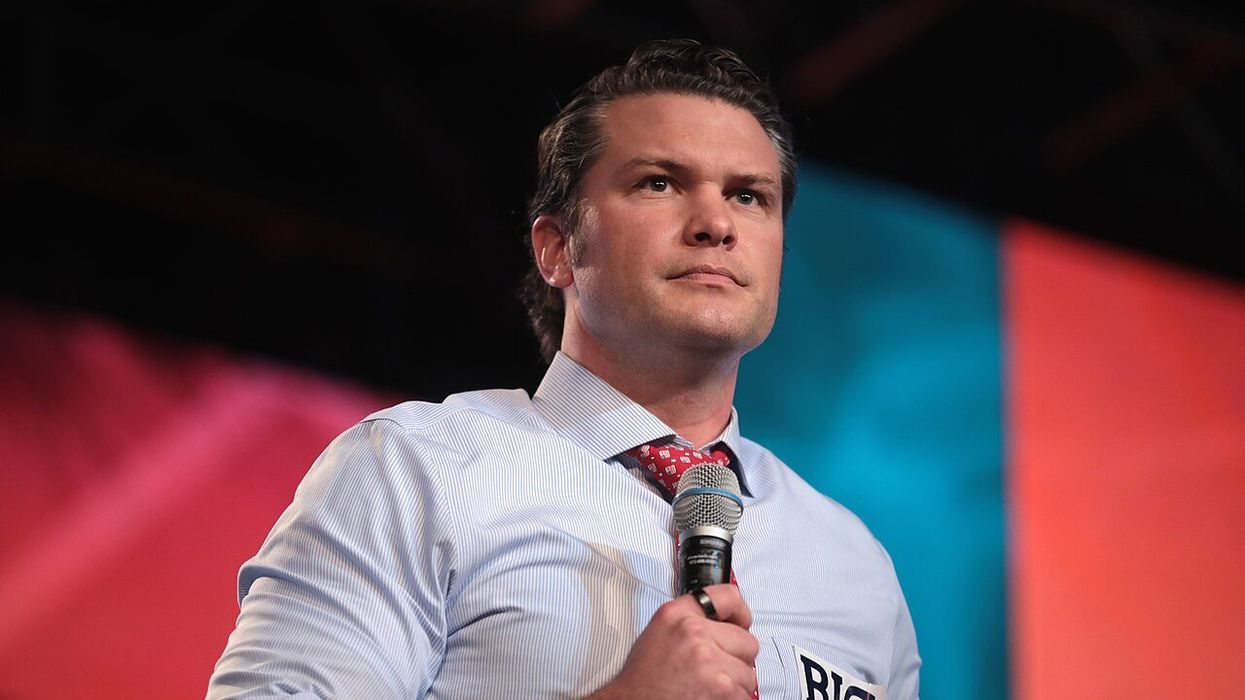
Pete Hegseth on December 19, 2018 (Gage Skidmore)
NEW CIVIL RIGHTS MOVEMENT
February 11, 2025
ALTERNET

In 1976, during America’s bicentennial, President Gerald Ford became the first president to recognize February as Black History Month. Ten years later, after a joint resolution of Congress decreed it, President Ronald Reagan signed a proclamation observing the event. Every president since Reagan has issued proclamations observing Black History Month.

President Trump’s Secretary of Defense, Pete Hegseth, has scrapped recognition of all “identity” events, including Black History Month, Pride Month, Hispanic Heritage Month, Women’s History Month, and National Disability Employment Awareness Month — declaring them all “Dead,” via a memo, according to USA Today.

“Our unity and purpose are instrumental to meeting the Department’s warfighting mission,” Hegseth’s memo, titled, “Identity Months Dead at DoD,” reads. “Efforts to divide the force – to put one group ahead of another – erode camaraderie and threaten mission execution.”

Standing on a stage last week at a Pentagon town hall (video below), Secretary Hegseth elaborated.

“I think the single dumbest phrase in military history is ‘our diversity is our strength.’ I think our strength is our unity. Our strength is our shared purpose. Regardless of our background, regardless of how we grew up, regardless of our gender, regardless of our race, in this department, we will treat everyone equally. We will treat everyone with fairness. We will treat everyone with respect, and we will judge you as an individual by your merit and by your commitment to the team and the mission. That’s how it has been. That’s how it will be.”

Last week, Reuters noted that “Hegseth has criticized diversity, equity and inclusion initiatives in the military, and, in his latest book, asked whether the top U.S. general has the job because he is Black. Reuters has previously reported about the possibility of mass firing among top brass, something Hegseth repeatedly refused to rule out during his confirmation process.”

Journalist Errol Louis, who has degrees from Harvard, Yale, and Brooklyn Law, last week commented on Hegseth’s remarks: “In 5 years, most recruitable adults will be people of color. The military’s current recruitment crisis is likely to worsen under Hegseth.”

On Monday, Military.com reported that at least four of the five Military service branches — Army, Navy, Air Force, and Space Force — have pulled out of a top recruiting opportunity, “a prestigious Black engineering event,” and by doing so they are “turning down access to a key pool of highly qualified potential applicants amid President Donald Trump’s purge of diversity initiatives in the military.”

“Until this week, Army Recruiting Command had a long-standing public partnership with the Black Engineer of the Year Awards, or BEYA, an annual conference that draws students, academics and professionals in science, technology, engineering and math, also known as STEM,” Military.com reported. “The event, which takes place in Baltimore, has historically been a key venue for the Pentagon to recruit talent, including awarding Reserve Officers’ Training Corps scholarships and pitching military service to rising engineers. Past BEYA events have included the Army chief of staff and the defense secretary.”

Three years ago, DOD News, part of the U.S. Department of Defense, reported, “The Defense Department is likely the largest employer of engineers in the United States, and the department will need even more to continue to protect the nation, said Barbara McQuiston, who now performs the duties of the deputy undersecretary of defense for research and engineering.”

“The DOD has over 100,000 engineers, and they are incredibly important to us,” McQuiston also said, DOD News added. “You can imagine the range of capabilities and personnel that we have working on the hardest problems — from civil engineers and software engineers to material engineers and chemical engineers — just a whole range of engineers looking at some of the toughest problems for DOD. We couldn’t function without them. They touch everything that we do.”

READ MORE: ‘Stomach Turning’: Trump Defends His J6 Pardons as ‘Great for Humanity’

It appears some Army recruiters and officers are not pleased with the decision to pull out of the Black Engineer of the Year Awards conference.

“This is one of the most talent-dense events we do,” an unnamed Army recruiter told Military.com. “Our footprint there has always been significant. We need the talent.”


“It’s f—ing racist,” an unnamed active-duty Army general told Military.com. “For the Army now, it’s ‘Blacks need not apply’ and it breaks my heart.”

But the Pentagon’s involvement in some other recruiting events has not been scrapped.

“Last week, the same Army recruiting unit that would have attended BEYA instead participated in a National Rifle Association-sponsored event in Harrisburg, Pennsylvania, a predominantly white gathering that recruiters acknowledge is less likely to yield high-quality applicants,” Military.com noted.

Military.com spoke with five recruiters who “saw the move as a significant and problematic escalation in the Pentagon’s rejection of diversity initiatives, which have been widely interpreted as programs that recognize women and troops with minority backgrounds, as well as gay and lesbian troops.”

On Monday, Secretary Hegseth announced a “pause” for all medical treatments of transgender service members, and a pause on accepting any new transgender service members into the U.S. Military. During his first term, Trump tried to throw out every transgender service member, but his efforts were stymied in the courts.

Also on Monday, President Trump continued his efforts to entirely reshape the culture of America’s Armed Forces, starting at the very beginning of the pipeline.

“Our Service Academies have been infiltrated by Woke Leftist Ideologues over the last four years. I have ordered the immediate dismissal of the Board of Visitors for the Army, Air Force, Navy, and Coast Guard,” the Commander-in-Chief announced Monday afternoon. The Boards ensure accountability and civilian oversight at institutions like West Point. “We will have the strongest Military in History, and that begins by appointing new individuals to these Boards. We must make the Military Academies GREAT AGAIN!”

Watch the video below or at this link.
Apocalypse Now: Extreme interpretation of Christian nationalism now guides Pentagon policy


Amy Goodman
January 28, 2025

The Senate has confirmed former Fox News host Pete Hegseth as Trump’s defense secretary by just one vote. Hegseth has “very clear” ties to extreme Christian nationalism, as well as a history of alleged sexual assault and abuse. Logan Davis, a reporter in Denver, Colorado, who grew up in the same classical Christian educational movement that Hegseth is raising his family in, explains the problematic ideology that shapes it. Hegseth has endorsed leaders in the community and their beliefs that the church possesses supremacy over worldly affairs, antebellum slavery was a “beneficent American institution” and the U.S.'s global war on terror is a modern-day iteration of the medieval Crusades. Davis says Hegseth's lack of qualifications for his new role means he will likely be “leaning on these controversial faith leaders in his life more than someone with adequate experience” would be — bringing this extremist Christian nationalism into the mainstream.


This is a rush transcript. Copy may not be in its final form.

AMY GOODMAN: This is Democracy Now!, democracynow.org, The War and Peace Report. I’m Amy Goodman.

We end today’s show with the Senate confirmation of Pete Hegseth as defense secretary by one vote on Friday night and Hegseth’s embrace of extreme Christian nationalism. Vice President JD Vance cast a rare tie-breaking vote to confirm the former Fox News host and combat veteran, who faced accusations of rape, spousal abuse, repeated public drunkenness, and financial mismanagement of veterans organizations. Three Republican senators joined Democrats opposing. That’s the former Senate Majority Leader Mitch McConnell, Alaska Senator Lisa Murkowski and Maine Senator Susan Collins.

We go now to Denver, Colorado, where we’re joined by Logan Davis, a longtime political consultant and columnist for the Colorado Times Recorder, where his recent piece is headlined “Pete Hegseth & I Know the Same Christian Nationalists.”


Logan, welcome to Democracy Now! Explain his record and what you mean by “extreme Christian nationalism.”

LOGAN DAVIS: Thanks so much for having me.

Important thing to understand about Pete Hegseth is that he’s been very clear about what he believes and what faith communities he sees himself as being a part of. He’s written books. He’s appeared on podcasts. In Hegseth’s case, he is affiliated with a conservative sect of Calvinists who have been driving the classical Christian education movement for a long time, which he is also associated with, embrace things like sphere sovereignty, and have been at really —


AMY GOODMAN: Sphere sovereignty?

LOGAN DAVIS: Yes. So, sphere sovereignty is the extreme interpretation of Christian nationalism, referenced in The Guardian this most recent week, in which there is an understanding of different authorities being given to the church, the state, the family, etc. And ultimately, the church is above all of those. So, Hegseth is a member of a faith community that believes in the supremacy of the church over earthly affairs and has pursued that. And I think there’s reason for concern as to which of those beliefs he will bring to the Pentagon.

AMY GOODMAN: So, if you can talk about, for example, his views of women, whether he’s talking about getting women out of combat military, what that means, how that fits into his Christian nationalist beliefs?

LOGAN DAVIS: So, Christian nationalism, of course, has some variety towards it — to it. In Hegseth’s case, he’s a member of a community that very much is led by a man named Doug Wilson, based out of Moscow, Idaho. Wilson has been a lightning rod for controversy over the last few decades for his positions on things like slavery and the separation of church and state and, in this case, whether or not women should have the right to vote. He has said that that was bad for the family. In this community, there is a certain chauvinism.


And I think it is interesting that Hegseth is stepping into this role shortly after we’ve had conversations about women in combat roles, about greater egalitarianism in the military. I would expect that he’s going to see some of that rolled back. And I think that his spiritual leaders and folks like Doug Wilson would be pleased to see that.

AMY GOODMAN: So, talk more about the glorification of the Confederacy as a godly cause within Reformed Calvinist circles and their views of slavery, particularly what Pete Hegseth has said.

LOGAN DAVIS: So, we know that Hegseth has strongly endorsed Wilson’s take on this. Doug Wilson has made the Confederacy a pretty popular trope in Reformed and classical Christian education circles, which has always been interesting to me, given that he is not even a Southerner. Going back several decades, Wilson has really embraced a neo-Confederate strain. Two decades ago, he wrote a pamphlet entitled Southern Slavery as It Was with a guy named Steve Wilkins, who was the head of the League of the South, which is listed by Southern Poverty Law Center as a hate group. Wilson and Wilkins toured with this pamphlet, which essentially argued that antebellum slavery in the American South was a beneficent institution that kept families together and helped expose Black families to the gospel. So he really argued full-throated that the institution of American slavery was a beneficent American institution.

And we know that Hegseth has studied at this man’s feet. He talks on virtually every podcast he has been on about the most recent thing he has read from Doug Wilson. He seems to have consumed all of his books. He talks about him on podcasts constantly. Most people in American public life do not have a track record of having defended antebellum American slavery. The fact that the incoming secretary of defense firmly sides with a man on the other side of that divide is probably not a great sign.


AMY GOODMAN: I wanted to talk about your background and Pete Hegseth’s background, the community of the Reformed Calvinists, the Hegseth family, and what you were a part of. For example, you grew up in a Reformed Calvinist church that was similar to Hegseth’s, one of his children attending the high school that Hegseth’s child attends?

LOGAN DAVIS: So, I did. I grew up in the Reformed community in and around Nashville, Tennessee. My father is actually a pastor. To his credit and ours, when the Doug Wilson faction, the Community of Reformed Evangelical Churches, splintered off, we did not go with it. However, a lot of the folks in our school, which was a classical Christian school very much affiliated with our church, did. And that’s kind of a whole package, the church and classical school thing.

So, I do know many of the same people as Hegseth. The classical school that he moved to Nashville to send his children to is kind of a bookend to the one that I grew up in. They are on either end of the Nashville area. Several alumni from my school have taught his children. I’m very familiar with the doctrine and the curriculum that they share, because I was taught much of it as a child, less so on the doctrine side as things got a little bit later. We were never, for instance, on the slavery-defending end of things. The curriculum, however, at the classical Christian schools, nearly identical. And I think there’s a lot of reason for concern in there, as well, because there are, for instance, those tropes about the Confederacy or the Crusades and how those things are portrayed. I think that it’s a risky thing to be teaching young children.

AMY GOODMAN: And talk about the tattoos on his body, not just artwork, but the political and religious significance, that go back to the Crusades, Logan.


LOGAN DAVIS: Absolutely. The Crusades are a popular historical trope in this community. During the first couple decades of this century especially, we saw the Crusades kind of resurge in popularity in curriculum and discussion, for the obvious reason that it was being used to impose a kind of clash of civilizations frame on the “global war on terror,” conflicts in the Middle East, and it was being done in such a way as to cast Christian America as the sword of the Lord in that context. With Hegseth’s service and what we know he has said about that, it is pretty clear that his Crusader tattoos are a reference to his service in the “war on terror.”

AMY GOODMAN: So, in this last minute we have, if you can respond to him becoming head of this 3 million-person organization, the charges against him of spousal abuse, of rape, but there were nondisclosure agreements, nondisparagement agreements, repeatedly of public drunkenness and driving two veterans organizations — well, of financial irregularity in running these two organizations?

LOGAN DAVIS: This is the thing about Hegseth — right? — is we can talk about his faith. We can talk about his community. The biggest problems with Hegseth — I mean, his beliefs are troubling, but he is wildly unqualified for this role. He also has a long track record of demonstrating a fairly serious moral unfitness to be in polite society. My biggest concern with that is a man holding these fairly intense, far outside of mainstream beliefs, finding himself in a position well beyond anything he is qualified for or has experience in, I think that that puts us in a position where he is likely going to be leaning on these controversial faith leaders in his life more than somebody with adequate experience for the job might. So I think we do need to be concerned about what —

AMY GOODMAN: Logan, we’re going to have to leave it there. Thank you so much. But we’ll link to your article in the Colorado Times Recorder, Logan Davis. I’m Amy Goodman. Thanks so much for joining us.
'Worse than I feared': Pastor unleashes plan to fight 'heretical Christian nationalism'


REUTERS/Brendan McDermid
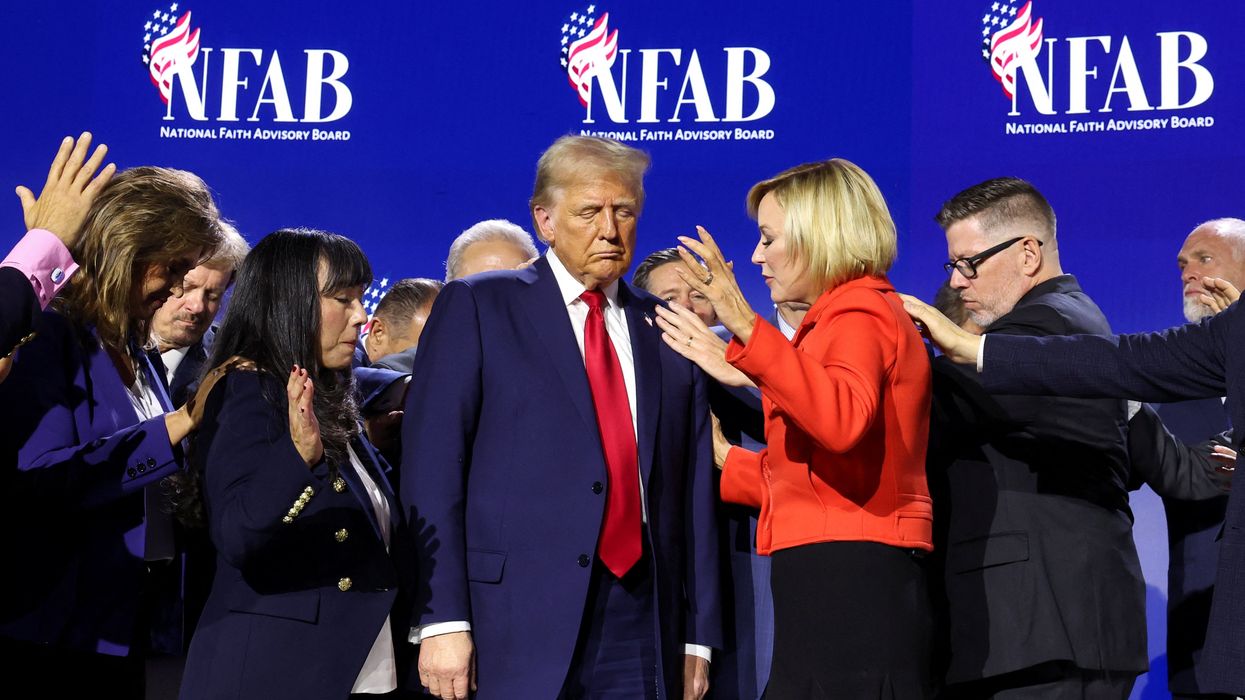
People stretch their hands towards Donald Trump as they pray, on the day Trump participates in in a moderated Q&A with Pastor Paula White, at the National Faith Advisory Summit, in Powder Springs, Georgia, U.S., October 28, 2024.

February 11, 2025
ALTERNET

Founded in the 1970s, the Sojourners movement has a long history of making a Christian case for liberal/progressive politics — and has vehement disagreements with the Religious Right and far-right white evangelicals.

Christianity, as Sojourners see it, is more compatible with the left than with the right. And while President Donald Trump is quite popular with the Religious Right — which aggressively supported him in 2016, 2020 and 2024 — Sojourners are blistering critics of Trump and the MAGA movement

In an interview with Salon's Chauncy DeVega, the Rev. Adam Russell Taylor (president of Sojourners) outlined the role that Christianity and other "faith traditions" can play in combating the second Trump Administration.

Taylor told DeVega that Trump's second president is turning out to be even "worse than I had feared or expected."

"I knew that President Trump would reverse the executive orders from the Biden Administration and would seek to push the limits of his power and authority," Taylor argued. "However, the unaccountable power of Elon Musk is a new and increasingly dangerous element, as is the degree of carelessness and callousness of many of the policies they have pushed forward, including trying to end birthright citizenship, pardoning practically all of the January 6 insurrectionists…. seeking to freeze federal grants that directly impact people's daily lives…. and giving inordinate power to Elon Musk and DOGE (the Department of Government Efficiency) to run freelance and roughshod across our federal government to illegally cripple and shut down agencies such as USAID (the United States Agency for International Development) are alarming and represent a real abuse of power."

Taylor stressed that religion that played a prominent role in liberal/progressive politics during the civil rights movement of the 1950s and 1960s and can do so again.

The Sojourners president told DeVega, "I believe that the faith community needs to be careful about mirroring some of the 'us versus them' framing and hyper-partisan and fear and grievance-driven tactics of the Religious Right/Christian nationalist movement….. We also need to weaken and counteract the rising appeal of the heretical ideology that is Christian nationalism…. I often refer to a quote by Dr. (Martin Luther) King that 'The church at its best is not called to be the master or the servant of the state, but to be the conscience of the state.'"

Taylor continued, "We want and need faith leaders and organizations to show up and serve as the conscience of the state right now, including by making a faith-rooted and moral argument around defending our democracy and protecting the most vulnerable, so ultimately, we can transform our democracy into becoming a truly just, inclusive multiracial one."

Read Chauncey DeVega's full Salon interview with the Rev. Adam Russell Taylor at this link.
Why would a 'Christian' destroy the world's largest relief agency?


SAUL LOEB/Pool via REUTERS
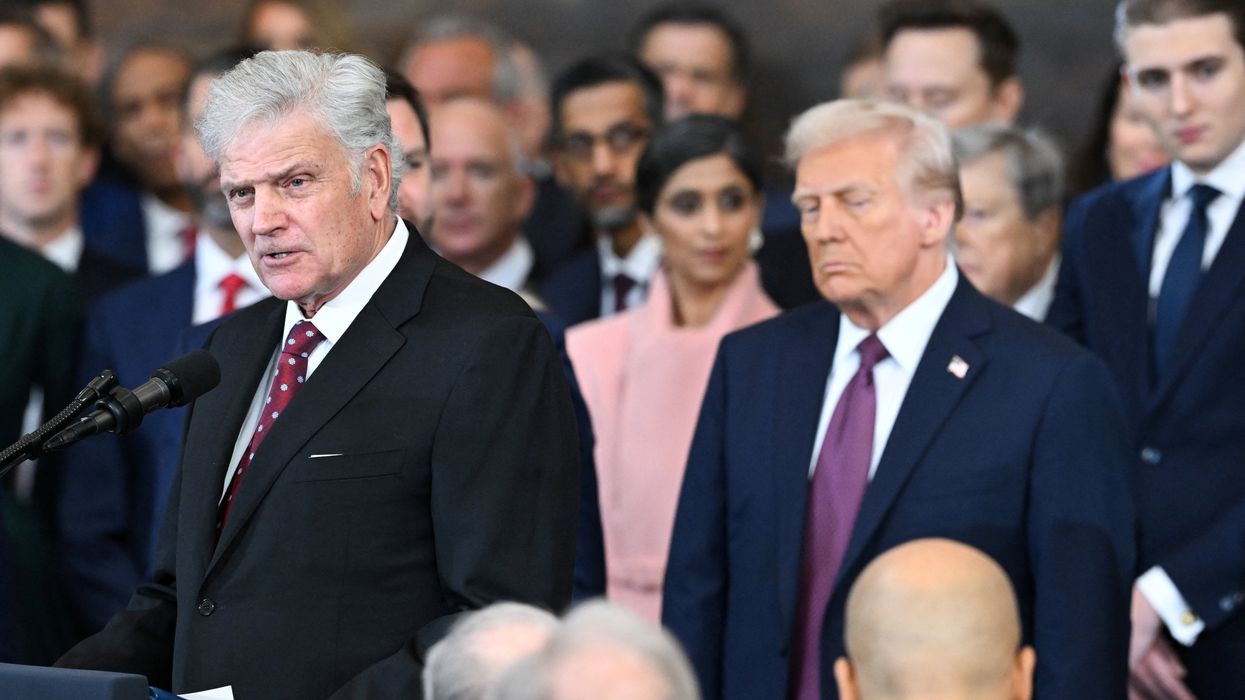
US President-elect Donald Trump (C) looks on as evangelist president of Samaritan's Purse Franklin Graham (L) devliers an invocation during the inauguration ceremony before Trump is sworn in as the 47th US President in the US Capitol Rotunda in Washington, DC, on January 20, 2025.
February 08, 2025
ALTERNET

For Christians here and across the world, the ongoing confrontation over the fate of USAID dramatically illustrates the moral degeneration of the politicians who most fervently profess their piety. While Donald Trump wraps himself in the mantle of the Almighty, his assault on the world’s largest relief agency is a modern passion play, with scheming malefactors of great wealth sadistically persecuting sincere people of faith who seek to serve the poor.

Not everyone who works for USAID, a government agency that employs hundreds of private contractors, is motivated by charity or religious conviction. While many are nonprofits, others are profitable companies. But the agency’s single largest contractor is Catholic Relief Services, which has provided billions of dollars in assistance to impoverished communities on every continent.

Nearly every denomination is represented among the recipients of USAID funding, including major evangelical and conservative organizations such as Samaritan’s Purse, the global charity operated by Franklin Graham -- who happens to be among Donald Trump’s most sycophantic admirers. Graham's reputation as a "humanitarian" has surely benefited from his organization's association with US relief efforts, not to mention $90 million in taxpayer support. And he knows that Musk and Trump are lying about USAID.As Christianity Today reported on February 4:

Most of USAID’s budget goes to grants for specific development projects, including at Samaritan’s Purse, World Vision, World Relief, Catholic Relief Services, and many other faith-based groups. It supports local Christian health clinics in Malawi and groups providing orphan care.

In Kenya, PCEA Chogoria Hospital, a historic mission hospital now run by Kenyan churches, provides comprehensive health care to HIV patients through support from USAID. On January 24 the hospital received a stop-work order for that care and has had no indication of a return of funding despite [Secretary of State Marco] Rubio’s promises that life-saving HIV care could continue. The hospital has 3,162 HIV patients in that USAID-funded program, and 42 staff members caring for those patients…“It is exceptionally painful to watch all this,” said Kent Hill, a former top official at USAID who also worked at World Vision and in Christian higher education as the president of Eastern Nazarene College. If USAID has specific problems, shutting the whole agency down instead of addressing the problems is a “tremendous overreaction” and “inhumane,” he said.

“Few American investments, if any, bring such a remarkable return,” Hill said. “To talk about shutting USAID down is callous and represents a tremendous a lapse in judgment which ought to call forth bipartisan condemnation.”

What do Rev. Graham and other evangelical leaders on the right think when they hear Elon Musk accuse USAID of corruption, with zero evidence, and denounce it as a “criminal” organization that must “die"?” The foreign-born billionaire boasted about putting the agency “in the wood chipper,” as if the deprivation and suffering that would ensue among the ill and hungry is a funny fratboy joke.

What seems truly amusing, by contrast, is the notion of Donald Trump as a follower of Christ, specially anointed by the Lord. From the beginning of his political career, the former casino owner has cultivated the tawdriest characters in Christianity, from the pants-dropping Jerry Falwell Jr. to TV evangelists Paula White, Kenneth Copeland, and other exponents the “prosperity gospel.” Like Trump, these are individuals whose unbridled avarice leaves little space for good works of any kind. It isn't hard to imagine them mocking the actual Christians who minister to the poor instead of swindling them.

Perhaps to promote sales of Trump-branded Bibles, he played the devout Christian at the National Prayer Breakfast on February 6. “Well, we wanna bring religion back stronger, bigger, better than ever before. It’s very important,” the president declared. “We have to have religion and it suffered greatly over the last few years, but it’s coming back.”

As for Musk, once lionized by libertarians for his atheism, the world’s richest man has taken to proclaiming his belief in “the teachings of Jesus Christ,” notably to “love thy neighbor.” In a late 2022 tweet, he wrote: "Jesus taught love, kindness and forgiveness. I used to think that turning the other cheek was weak and foolish, but I was the fool for not appreciating its profound wisdom." This alleged attraction to Christian principles accompanied Musk’s turn toward the far right, with its hostility toward racial minorities, immigrants, and all of the destitute and oppressed.

In short, Musk now qualifies as that most MAGA brand of Christian -- a hypocrite who exploits religion to amplify his own power and wealth, with a heavenly license to bully the weak. Somehow ruining the lives of people who depend on USAID for their very sustenance seems much more like the devil’s work.

Joe Conason is founder and editor-in-chief of The National Memo. He is also editor-at-large of Type Investigations, a nonprofit investigative reporting organization formerly known as The Investigative Fund. His latest book is The Longest Con: How Grifters, Swindlers and Frauds Hijacked American Conservatism.


'Would turn the Constitution into a warrant': Experts rip far-right theory Trump is pushing


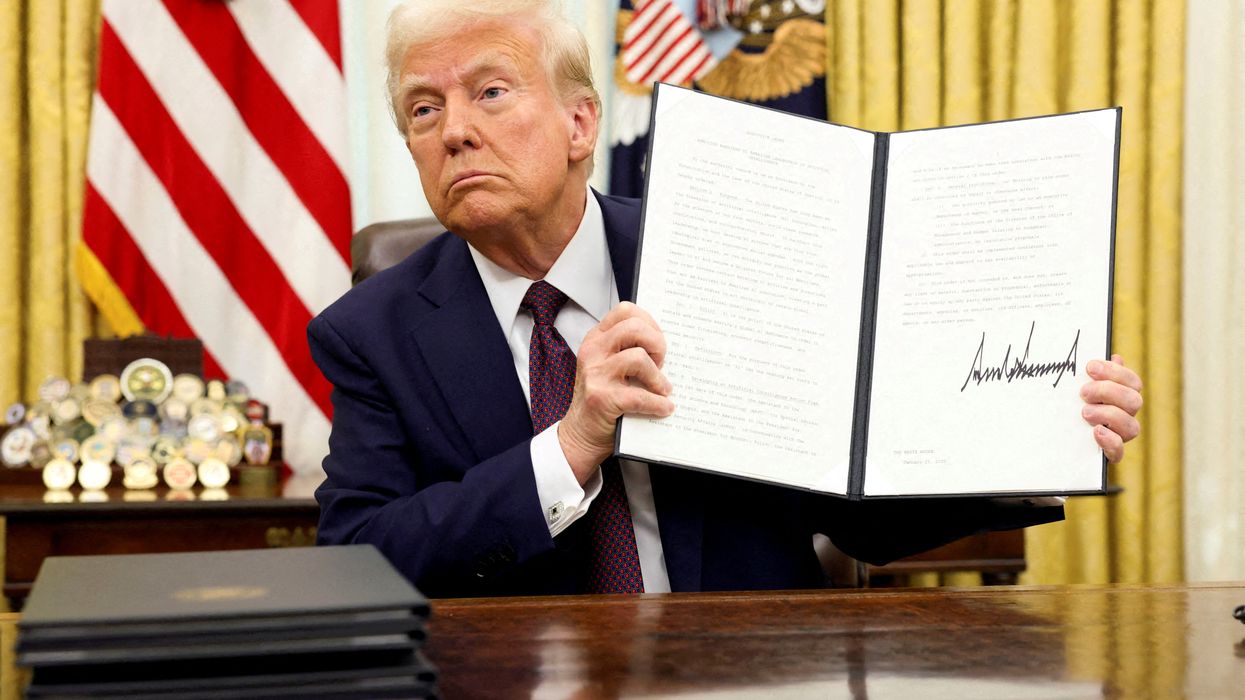
U.S. President Donald Trump holds a signed executive order on AI, in the Oval Office of the White House, in Washington, U.S., January 23, 2025.
February 08, 2025
ALTERNET

President Donald Trump made numerous executive orders after returning to the White House on January 20, some of which are which are being aggressively challenged in court — from firing more than a dozen inspectors general to an order calling for an end to birthright citizenship (which, Trump's critics say, is flat-out illegal because birthright citizenship is protected by the U.S. Constitution's 14th Amendment).

But Trump and some of his MAGA defenders are pushing a far-right idea known as the "unitary executive theory," which claims that a president has sole authority over the federal government's executive branch.

In an article published by Salon on February 8, three political science scholars — John A. Dearborn of Vanderbilt University in Nashville, Desmond King of Oxford University in England, and Stephen Skowronek of Yale University in New Haven, Connecticut — lay out some flaws with the "unitary executive theory."

READ MORE: Americans' 'legally protected' info now 'exposed' as Trump budget chief gets new powers: union

Trump, according to the scholars, is determined to "test the boundaries of existing law."

"For example, the Office of Personnel Management sent a 'Fork in the Road' e-mail to federal employees designed to incentivize mass resignations," Dearborn, King and Skowronek explain. "Employees at the Department of Justice who had worked on special counsel Jack Smith's investigations were fired, despite their career status and protections from at-will removal. The president also fired several inspectors general, declining to provide the congressionally mandated 30-day notice and detailed reasons for their dismissal."

The scholars continue, "Such rapid-fire actions are already setting up court cases that will determine how much control the president can exercise over the civil service and whether any kind of restrictions on the president's removal power are constitutional."

Dearborn, King and Skowronek note that the "unitary executive theory" is promoted in Project 2025, the Heritage Foundation's 922-page blueprint for a second Trump presidency.

"Cultivated by the conservative legal movement and now widely shared within it," the scholars write, "this 'theory of the unitary executive' deploys the 'Vesting Clause' of Article II of the Constitution to declare that 'all of the executive power' belongs to the president alone…. No doubt the conservative legal movement believes that in advancing the unitary executive theory, it is espousing the true meaning of the Constitution. In fact, it boasts that it has rediscovered the original meaning. But we should be under no illusions that adopting such decisions would restore Americans' faith in the Constitution."

Dearborn, King and Skowronek continue, "Instead, judicial approval for the president’s actions would fatally undercut the Constitution's power-sharing design. It would turn the Constitution into a warrant for one group of participants to impose its will unilaterally on the rest."

Read the full Salon article at this link


Sep 3, 2022 ... The Nazi legal theorist Carl Schmitt opposed liberalism in favor of an authoritarian politics based on singling out the enemies of the state ...

Aug 13, 2024 ... An early 20th century reactionary, German political theorist by the name of Carl Schmitt maintained such instability would haunt democracies ...


AMERIKA


‘A violent act in every case’: One judge’s impossible quest for a humane execution


Photo by Scott Kelston for the Arizona Mirror
Retired federal magistrate judge David Duncan was hired by Gov. Katie Hobbs to examine Arizona’s death penalty procedures and make recommendations to improve them.
February 10, 2025

Is there a humane way to execute murderers? Does anyone care?

In Medieval times, agony and humiliation were the norm. Men and women were publicly beheaded, drawn and quartered, dragged behind horses and burned at the stake for far lesser crimes than murder.

Public hangings persisted in this country well into the 20th century. And just hours into his new administration, President Donald Trump signed an executive order stating that the death penalty is a deterrent to crime.

In recent history, government leaders have worried more whether execution is presentable to the witnesses who are supposed to see how humane it is. And nothing looks more humane than death by lethal injection. If it’s done right, it looks as if the condemned person just went to sleep.

Looks like.

If it’s done right.

In Arizona, history shows that both of those conditions are questionable.

Over the last 10 years, there have been problems with the drugs used, problems securing drugs in the first place, problems with getting catheter lines into arms and legs to deliver the killing drugs, problems finding qualified personnel to insert them. More recently, there have been concerns that the primary drug used in executions is not as painless as was thought.

Poorly executed: How Arizona has failed at carrying out the death penalty

Some states have even started reconsidering the firing squad, while Arizona looked for a time to resume using its gas chamber, which hasn’t been used since 1999.

Shortly after she took office in 2023, Gov. Katie Hobbs asked retired federal magistrate judge David Duncan to do an analysis of the state’s protocols for lethal injection and the gas chamber and make suggestions for improving them in the future.

Duncan has a reputation as the consummate legal nerd, “driven by fairness and justice,” as U.S. District Court Judge Douglas Rayes said, “a serious person who understands the gravity of his job and the gravity of the cases in front of him.”


He is oblivious to opposition.

“David has emotional armor like nobody’s business,” says his wife, Sally Duncan, herself a retired Maricopa County Superior Court judge.

He is precise.

“I thought he was probably the best person to take on the responsibility,” said Dale Baich, a former federal public defender and legal expert on the death penalty. “He believes in the process, he believes in the system, and he is meticulous about following the rules.”

The irony of the job was not lost on Duncan. Can execution be humane?

“(T)he ending of a life and overcoming that person’s will and biological command to live is by nature a violent act in every case,” he wrote in a preliminary report to Hobbs, “even lethal injection.”

He took the job anyway, but he was determined to forgo opining about the bigger question of whether the state should be in the execution business at all.

“Some states had blue ribbon commissions asking, ‘Should we have a death penalty at all?’ that concluded it should be abandoned,” he told the Arizona Mirror. “And, in all but one, the conclusion was ignored.”

This was an inquiry more limited in scope. It was not a judgment on the death penalty, just a review of how the state carried it out. It was doable, he thought. Perhaps someone would pay attention to his conclusions.

He pored through tens of thousands of documents, did dozens of interviews with lawyers and jailers and medical personnel who had performed executions in the past. He traveled to other states to comb university collections.

Hobbs asked Duncan for an update on his work, and he submitted his summary.

“Lethal injection, while theoretically achievable,” he wrote, “is in actual practice, fundamentally unreliable, unworkable and unacceptably prone to errors.”

Even a return to the firing squad was more reliable, he wrote, despite being jarring to potential witnesses.

“So, look away,” he told the Mirror of those who didn’t want to see it.

Hobbs fired him.

At the end of November, Hobbs wrote a letter to Duncan, noting that firing squad was not permitted under the state constitution and she no longer had confidence in Duncan because he had gone beyond the scope of his assignment.

Political battles were brewing. Trump had just been elected and was extolling his belief in the death penalty. An Arizona Death Row prisoner was demanding to be executed, and a county attorney was helping make his argument, even attempting to force a death warrant herself, though that was hitherto assumed to be beyond her jurisdiction.

However, the Arizona Supreme Court was willing to listen to her argument. Hobbs won’t answer questions on the matter. Pundits offer analysis off the record: Rather than risk losing a case that could open the door for county attorneys to cross other jurisdictional lines, it was perhaps more expedient for Hobbs to fire Duncan, hold her nose and execute a man who wants to die anyway. Execution, after all, is the law of the land in Arizona.

Then the best hope would be to pray the Supreme Court refuses to issue a warrant. If not, fingers crossed, hope the execution goes well.
The ‘consummate public servant’ and the impossible task

David Duncan, 67, is a larger man than he appears in photos. A solid six-footer, he moves around his house without betraying the fact that his vision is seriously impaired, due to a condition that forced him to retire from the federal bench.

In photos, he is invariably dressed with an old-fashioned formality, favoring suits and bow ties. At home, his hair is uncombed and he wears jeans, but the formality is still there in his speech and his bearing.

He came to Arizona with his family at age two, and has been here since, except for two years when he attended Brown University in Rhode Island. He had to take medical leave because of an inherited disease and came home to Tucson. His father suffered from the same malady and died during that time. So, Duncan continued his studies at the University of Arizona.

There, he met his wife, Sally, who had also come home from college in another state because her dad was ill.

“He was going to be my summer fling,” she says. A friend of Duncan’s was interested in dating Sally’s twin sister. “David was her Cyrano,” in connecting the sister to the friend, she said, referring to the Edmond Rostand play about a long-nosed chevalier who helps a friend find the right words to woo a woman that Cyrano himself loves.

Or call it “When David met Sally.” They’ve been together for 42 years.

Both graduated from UofA law school. David clerked for a federal judge in Tucson, worked for the prominent law firm of Osborn Maledon and was appointed an assistant U.S. attorney in 1996. Then, in 2001, he was appointed a magistrate judge in the U.S. District Court for Phoenix.

Federal magistrate judges might be compared to commissioners in the Arizona Superior Court, in that they don’t have the full range of duties that judges have. They handle preliminary matters in criminal cases but do not take them to trial. They also handle settlement conferences, and if both parties consent, they can try civil cases.

“He is a very fine lawyer and he was a fine judge,” said U.S. District Court Judge Roslyn Silver, who supervised Duncan as the court’s chief judge. “His ethics are as high as he can imagine.”

Silver became chief judge after the death of John Roll, who was killed in the same supermarket shooting that seriously wounded former U.S. Rep. Gabrielle Giffords. Silver says that Duncan was “an enormous resource” to her in those days after her sudden appointment.

“I always went to David first,” she said.

Andrew Hurwitz is a judge on the 9th U.S. Circuit Court of Appeals and a former Arizona Supreme Court justice. He has known Duncan since before Duncan was an attorney.

Hurwitz recalls the care with which Duncan would treat defendants during initial court appearances, making sure they and their families understood the proceedings against them. After Duncan conducted citizenship ceremonies for immigrants, Hurwitz said, “He stood at the door and shook everyone’s hand on the way out.”

Perhaps Duncan’s biggest trial was Parsons v. Ryan, a long-running dispute between the Arizona Department of Corrections, Rehabilitation & Reentry and its prisoners over health care. But in 2018, with his eyesight failing, he felt compelled to retire and turn the case over to Silver.

Hobbs tapped him to be an independent commissioner to analyze the state’s lethal injection protocol in 2023.

“Arizona has a history of mismanaged executions that have resulted in serious concerns about ADCRR’s execution protocols and lack of transparency,” she said in a press release at the time. “That changes now under my administration and Director (Ryan) Thornell. A comprehensive and independent review must be conducted to ensure these problems are not repeated in future executions. I’m more than confident that Judge Duncan has the expertise and ability to take on this crucial role.”

Duncan had not handled capital cases over his legal career. He did not even ask advice from his wife, who had presided over capital cases, so that his findings could be his own. He felt he could apply his analytical skills to the task. Not everyone thought it was a dream assignment.

“I didn’t understand why he took it,” Hurwitz said. “But his undertaking this job is consistent with everything I know about him. He’s the consummate public servant. He’s a Boy Scout.”
A litany of problems and failings

It was no surprise when Hobbs and newly elected Attorney General Kris Mayes took office that they declared a moratorium on executions. It’s a party-lines thing. President Joe Biden declared a moratorium on federal executions when he came into office in 2021; President Donald Trump rescinded it just last week with a memorandum from his Department of Justice.

Nobody in Arizona comes right out and says that Democrats don’t do executions, but the numbers don’t lie.

Arizona has executed 40 men since 1992, and all but one of them was executed during Republican administrations. And before that? Capital punishment was temporarily banned by the U.S. Supreme Court in 1972, but came back online in 1976. Still, between 1976 and 1992, there were no executions at all in Arizona, to some extent because of litigation and because many death row prisoners had not exhausted their appeals. And maybe it’s a coincidence, but during that time, hard as it may be to believe, all but one of Arizona’s governors were Democrats. The sole Republican, Evan Mecham, only lasted one year, and his most significant accomplishment was getting impeached.

There had been booms and busts along the way, periods when executions were not performed because of pending federal or state litigation, and periods when the death house was in demand. Over a three-year span, 1998 to 2000, Arizona executed 14 prisoners. Between 2014 and 2022, Arizona executed no one, largely because of a badly botched 2014 execution that set off more litigation. Then, in 2022, the state executed three prisoners, and had a fourth on deck when Hobbs took office. She let the death warrant run out as Duncan began his work.

“What the executive order boiled down to was essentially three questions,” Duncan says. “What went wrong in the past? Identify what went wrong, then see if it can be done properly. Are there steps that can be taken so that lethal injection can work in a way that people envision it should work? That’s how it works when you go to the vet and the vet puts the dog down; it’s seamless every time. Why doesn’t it work for people? And the third question is how to increase transparency.”

To be sure, there had been problems, even if they were not always visible to the execution witnesses, victims’ families, state officials and journalists. The state switched from gas to lethal injection in 1992 because gas was so horrible to watch, though it is still in state statutes as an option for prisoners convicted before 1992. (It was only used once again, in 1999.)

Under Doug Ducey’s administration, the state purchased cyanide to have it on hand in case another prisoner opted for it. Duncan would have nothing to do with it.

“I made it clear to them that, as a Jew, I was not going to ever countenance anything that was associated to dropping cyanide into water and gassing people to death,” Duncan said.

So, on to lethal injection. Arizona has had its mishaps and scandals.

In 2010, when one of the drugs used in executions became unavailable domestically, the Corrections Department illegally imported it in from Europe. The department even shared some of it with the state of California. And though no one was ever charged or prosecuted for the transgression, the Drug Enforcement Agency eventually ordered that the remaining quantities of the drug be destroyed. ADCRR tried to import it again in 2015, but the feds intercepted that shipment at Sky Harbor Airport.

Subsequent drugs also became unavailable for use in executions, resulting in the department using a questionable cocktail of chemicals that left a man gasping on the execution gurney for nearly two hours in 2014. Then-Corrections Director Charles Ryan ordered the executioner to push 15 additional doses of the combo into the prisoner before he died.

That was a problem for Duncan.

“Somebody who is not a medical person should not be making those decisions,” Duncan said. “But it’s a quasi-military operation, the Department of Corrections, so the power and responsibility is vested in the director and his subordinates. The chain of command does not include the medical doctor to make the key decisions. In a strange way, everything is done to divorce the process from medical proximity.”

Duncan questioned the department’s current supply of pentobarbital salt, the active pharmaceutical ingredient for the barbiturate pentobarbital. Pento, in short-hand, is unavailable to prisons because pharmaceutical manufacturers will not allow it to be used for executions. So, in 2020, Arizona, other states and the federal government found a supplier of the active ingredients, which then have to be transformed to an injectable form by a compounding pharmacy.

Duncan was shocked to learn that the pentobarbital salts had been delivered to a private residence, and now sit in eight unmarked glass jars in a locked refrigerator, with little to no documentation as to its origins or potency. (Mayes’ office recently released a heavily redacted report that supposedly speaks to tests performed in January, supposedly by the Arizona Department of Public Safety.) An attorney at the department told Duncan she had destroyed the relevant documents, which he found peculiar.

And historically, there had been consistent problems setting the catheters to administer the drugs in the prisoners’ arms, often resulting in the doctor-executioners performing a surgical cut-down in a prisoner’s groin to set a line in the femoral vein.

Duncan interviewed members of the medical teams that had carried out the 2022 executions. One of the staffers told him, “With each passing minute, the tension was rising in that room” because of the inability to set lines. One of the prisoners even suggested a vein that might — and did — work when the medical team was ready to give up and do a cut down.

Duncan also cited the lack of communication with prison staff in other states that perform executions.

“It’s not just the absence of qualified personnel and the absence of good drugs, it’s the absence of information exchange,” he said. “The secrecy that enshrouds every state’s procedure with respect to executions precludes best practices from emerging. So, if someone learns a lesson in one state, it’s never shared with another.”

He asked if there were tax records of payments to the medical teams. There were not.

The final impasse was when he asked to watch a rehearsal by the newly hired execution team.

“I believed that was critical to my process,” he said, “because I had learned a great deal about lethal injection. These people who had been hired by the state to do the upcoming executions have never done it before. And I have studied it for two years. I’m not a doctor, but it’s possible that I could have brought something to the table.”

The answer was a hard no.

“They said I could do written interrogatories, and I said, ‘No, I need to sit across from them, I need to look in their eyes,’ and they said, ‘You cannot do that because they will not make themselves available for hire if you do that, because they are worried that you will reveal their identities.’ I said, ‘It’s against the law to reveal their identities.’

“To sit across from a federal judge and suggest that the retired federal judge is going to violate the law is a ridiculous notion. And I said, I can’t accept that. Then they said I could not watch a dry run for the same reason: that I would create a risk.”

He had seen records of earlier rehearsals, practicing how to handle crowds and parking and seating in the execution chamber, but “Never practicing what actually goes wrong, and that is the setting of the lines, the administration of the drugs.”

He was asked to summarize his findings, even though his report was not finished.

“…lethal injection is not a viable method of execution in actual practice,” he wrote.
Everyone wants to execute Aaron Gunches, including Aaron Gunches

The governor has declined multiple requests from the Arizona Mirror for comment on David Duncan and the death penalty. But the death penalty is written into Arizona law. Political circumstances are more easily changed than the law. And for Katie Hobbs, there was the problem of Aaron Gunches.

In 2002, Gunches killed his girlfriend’s ex-husband, Ted Price, by shooting him in the back of the head on the Beeline Highway. He tried to go on the lam, but didn’t make it across the state line before he got into a shootout with police. He shot and wounded an officer and was arrested.

He was charged in Maricopa County Superior Court and pleaded guilty to first-degree murder. But prosecutors wanted the death penalty, so he still needed to go to trial. He represented himself, but didn’t offer any mitigation, that is, any reason why he shouldn’t be sentenced to death. The jury sent him to death row.

Arizona death sentences automatically get reviewed by the state Supreme Court, and the court threw out the sentence because the prosecutor alleged as an aggravator that the crime was cruel and heinous. But the court objected, saying that killing someone instantly from behind, without that person knowing what was coming, did not meet the definition of cruel.

Gunches went back to trial. This time, prosecutors alleged a new aggravator and a new jury sent him back to death row. During his next step in the appeal process, known as post-conviction relief, he fired his court-appointed attorney, dropped the appeal and has not filed one since.

In 2022, he sent handwritten notes to the court asking to be executed. Then-Attorney General Mark Brnovich was willing to oblige him, and the Supreme Court issued the necessary death warrant.

Then Brnovich left office before the scheduled execution date. Hobbs and Mayes came into office and let the death warrant expire. Hobbs declared a moratorium on executions and hired Duncan to do his investigation.

Gunches did not give up his death wish. And Maricopa County Attorney Rachel Mitchell picked up the cause on his behalf and on behalf of the victim’s survivors, and asked why she couldn’t request a new warrant.

On June 5, 2024, she issued a public statement.

“For nearly two years, we’ve seen delay after delay from the governor and the attorney general,” it read. “The commissioner’s report was expected at the end of 2023, but it never arrived. In a letter received by my office three weeks ago, I’m now told the report might be complete in early 2025. For almost 22 years, Ted Price’s family has been waiting for justice and closure. They’re not willing to wait any longer and neither am I.”

It continued, “The motion filed today specifically asks the Arizona Supreme Court to set a briefing schedule in anticipation of a request by the Maricopa County Attorney’s Office for a new warrant of execution. While it is unusual for a county attorney to seek a death warrant, it is also true that each county represents the state in felony prosecutions that occur in Arizona.”

“I believe that as an attorney who acts on behalf of the state, I also can appropriately ask the Supreme Court for a death warrant,” added Mitchell. “The victims have asserted their rights to finality and seek this office’s assistance in protecting their constitutional rights to a prompt and final conclusion to this case.”

Right before Thanksgiving, Hobbs sent a letter to Duncan.

“Your review has, unfortunately, faced repeated challenges, and I no longer have confidence that you will accomplish the purpose and goals of the Executive Order that I issued nearly two years ago. The early drafts of your work have called into question your understanding of the Executive Order and the actual scope of work you were hired to perform. … I therefore write today to inform you that your continued service to the state is no longer necessary.”

Thornell, she told him, had done his own review of his agency’s procedures and said they were set to execute Gunches. Hobbs said she found that assessment more acceptable than Duncan’s.

In a letter a few days earlier, Thornell detailed the examination he had conducted, including talking to other states and reviewing files. He had instituted new training and found new medical team members.

“As is evident by the scope of these review efforts across the last 20 months, and the extent of the procedural changes implemented, we have systematically reviewed, addressed, and improved the necessary protocols related to the Department’s execution process,” Thornell wrote. “I am confident in the methodology I used in leading this effort and am satisfied with the outcome. As such, I write to inform you that the Department is operationally prepared to proceed with an execution.”

On Feb. 11, the Arizona Supreme Court will decide whether to issue a new death warrant for Aaron Gunches. If it does, Gunches will be scheduled for execution 35 days later, on March 18.

It is not without controversy. Days before he left office in January, U.S. Attorney General Merrick Garland issued an order to discontinue use of the drug pentobarbital in executions because of mounting evidence that it causes a painful and terrifying death that resembles drowning. The Feb. 5 memorandum from Trump’s DOJ even says that, before resuming executions, a “review should focus on whether the use of pentobarbital as a single-drug lethal injection comports with the Eighth Amendment.” Friend of the court briefs have been filed in Gunches’ case to that effect. Other briefs filed allege that the state’s drug supply violates state and federal laws.


Gunches is apparently unmoved. So are Hobbs and Mayes — at least they are not commenting except to say that they are moving full speed ahead.

Duncan plans to finish his report, even if the person who commissioned it won’t read it. The Corrections Department took away his access to the documents he consulted as he worked on it, so he is unable to properly cite them. He will do what he can from memory.

Sally Duncan said, “The family motto is, ‘Go where the truth leads.’ And if you’re not willing, don’t do the job.”


Arizona Mirror is part of States Newsroom, a nonprofit news network supported by grants and a coalition of donors as a 501c(3) public charity. Arizona Mirror maintains editorial independence. Contact Editor Jim Small for questions: info@azmirror.com.