Monday, February 17, 2025

HIGH SEAS MONOPOLY CAPITALI$M 

Powerhouse: OSM Thome

The 2023 merger of OSM Maritime and the Thome Group created a ship management powerhouse. That was just the beginning.
Courtesy OSM Thome

Published Feb 16, 2025 2:39 PM by Tony Munoz


(Article originally published in Nov/Dec 2024 edition.)

It’s been a good – no, an exceptional year – for OSM Thome, marked by significant growth, strategic achievements and new opportunities in the maritime and offshore sectors. It all began with the merger of OSM Maritime and the Thome Group a year earlier.

“The merger between OSM Maritime and the Thome Group has been a success,” says Finn Amund Norbye, CEO of OSM Thome. “It was driven by a strategy to create a company of scale capable of meeting the increasing demands of the maritime industry. By combining resources, expertise and a global presence, we’ve strengthened our ability to serve clients across a diverse range of vessels and operations.”

It also positioned OSM Thome to lead in key areas such as sustainability, digitalization and regulatory compliance.

With shared Norwegian roots and 96 years of combined experience between the two merged companies, OSM Thome today ranks as the third largest ship management company in fleet size and the leading ship management, crew management and marine services company.

But it’s more than that. By uniting OSM’s innovation and operational excellence with Thome’s deep commitment to quality, sustainability and strong client relationships, OSM Thome stands as a leader in navigating the complexities of today’s maritime landscape and shaping the industry’s future.

That leadership is embodied in the company’s logo – a two-colored arrowhead pointing upward and symbolizing the company’s forward-looking approach and cutting-edge technology. The two colors – blue and red – are taken from the Norwegian flag. They symbolize two equal partners joining forces to create an even stronger ship management powerhouse with a clear strategy of promoting a sustainable future in maritime.

“The new branding is a physical representation of our commitment to providing the highest standards of safety, quality and reliability to our clients,” says Norbye.

It extends to the company’s culture as well. Following the merger, the company co-created its Vision, Mission and Values to reflect its unified identity and ambitious future. The Vision, "Leading Excellence at Sea," speaks to its drive to set new benchmarks in maritime management and operations. Its Mission is to be a trusted industry powerhouse – one that clients rely on, communities respect and employees proudly call home.

At the heart of OSM Thome are its Values: Safety, Transparency, Relationships and Innovation. These values guide every decision, fostering trust, embracing teamwork, advancing sustainability and putting people at the forefront. Together, they form the foundation for a shared purpose, inspiring passion and excellence in everything OSM Thome does.

Services

The company offers a broad range of services, and its clients represent a diverse range of sectors within the industry – from tankers and bulkers to chemical carriers, shuttle and offshore vessels. It consciously selects markets where its expertise can deliver the most value, focusing on segments that demand specialized skills and high-quality management.

Services are divided into three main business units – Technical Management/Ship Management, Crew Management and Marine Services. The Marine Services unit encompasses a variety of offerings and subsidiaries including OSERV Maritime Catering, Axia Maritime Procurement and Energia Global Travel.

Offshore wind is an increasingly important area of focus.

As the global transition to renewable energy accelerates, OSM Thome is leveraging its extensive experience in offshore operations to support this growing sector. Services include managing vessels specifically designed for offshore wind projects like service operation vessels (SOVs) and wind turbine installation vessels (WTIVs). The company’s expertise in technical and crew management, combined with its commitment to sustainability, positions it as a trusted partner in advancing clean energy initiatives.

And despite its significant size, it prioritizes a personalized approach for each client. Its decentralized structure empowers local teams to make decisions that align with the specific requirements and cultural nuances of the regions they serve, ensuring customized solutions that uphold the highest standards of quality and efficiency.

By serving a broad spectrum of shipping and offshore industries, OSM Thome remains adaptable to shifting market dynamics while playing an active role in shaping the future of maritime and offshore energy.

Seafarers

Seafarers are a critical component of the company’s success.

“At OSM Thome,” says Norbye, “we recognize that our crew is our most valuable asset, and we are committed to sourcing and training seafarers who embody our values.”

The company has recruitment offices in more than 20 countries, ensuring good access and close interaction with seafarers and enabling it to connect with a diverse pool of talent across more than 70 nationalities. An extensive digital platform with over 150,000 registered seafarer profiles provides additional opportunity to efficiently match qualified candidates with specific vessel requirements.

When it comes to training and development, the OSM Thome Maritime Leaders Academy (MLA) in the Philippines serves as a central pillar, focusing on the training and development of competent seafarers. MLA’s programs are regularly updated to comply with new legislation, onboard technologies and best practices, ensuring crew personnel are well-prepared to operate vessels safely and efficiently.

Going beyond training, the company strives to create an inclusive and supportive work environment, emphasizing the well-being and professional growth of its seafarers. “Our commitment to safety, transparency and fostering strong relationships reflects our dedication to being a ‘preferred employer’ in the maritime industry,” Norbye states.

It’s a well-known fact that the global maritime industry faces a significant shortfall of trained seafarers in the next few years. To help mitigate this challenge, OSM Thome is actively enhancing its recruitment and training initiatives to promote gender diversity and attract new talent to the industry.

By investing heavily in its crew and maintaining high standards, OSM Thome aims to ensure a sustainable and competent workforce for the future.

Growth Through Consolidation

Building on its steady growth, in October OSM Thome acquired Norwegian-based Klaveness Ship Management. The move adds to its expanding portfolio of offerings and reaffirmed its commitment to a strategy of growth through consolidation.

“The recent acquisition of Klaveness Ship Management reflects our strategic approach to growth through consolidation,” explains Norbye, “allowing us to enhance our capabilities and expand into a new and interesting shipping segment of environmentally efficient combination vessels. It aligns with our commitment to providing comprehensive and innovative solutions to our clients.”

The ship management industry is undergoing significant transformation, driven by key trends like digitalization, sustainability and increased collaboration.

Digital technologies are revolutionizing operations, enabling real-time monitoring, predictive maintenance and data-driven decision-making. Sustainability has become a central focus with the industry striving to reduce emissions and adopt environmentally friendly practices in response to global environmental concerns. Collaboration among industry stakeholders is also on the rise, fostering shared knowledge and resources to address complex challenges.

“At OSM Thome, we’re committed to leading these trends,” Norbye says. “We’re investing in advanced digital tools to optimize vessel performance and operational efficiency. Our sustainability initiatives aim to minimize environmental impact and promote green shipping practices. Additionally, we actively seek partnerships and collaborative opportunities to drive innovation and set new industry standards.”

By embracing these developments, the company aims to not only adapt to the evolving landscape but also to shape the future of ship management, ensuring it continues to meet the needs of clients and the industry at large.

The Road Ahead

Looking ahead to 2025, OSM Thome is optimistic about maintaining the current momentum.

“Our clients’ trust and our team’s dedication are the cornerstone of our success,” Norbye says.

The company will continue to identify strategic partnerships and potential acquisitions that will drive future growth and innovation and create value for clients. It will focus on expanding service offerings, enhancing operational efficiency and deepening the commitment to sustainability by exploring new technologies and investing in talent development.

“I’m a strong believer in our business, and we are excited to lead the industry into the future.”

Tony Munoz is Founder, Publisher & Editor-in-Chief of The Maritime Executive.

The opinions expressed herein are the author's and not necessarily those of The Maritime Executive.

 

Op-Ed: Economic Coercion is On the Rise

Port
iStock

Published Feb 16, 2025 8:04 PM by The Strategist


[By David Uren]

The rising use of economic coercion is a symptom of an increasingly unstable world that is struggling to contain rise of China and is no longer bound by the institutions established in the wake of World War II.

US President Donald Trump’s scattergun threats of punitive tariffs are a continuation of this trend. The Biden administration redoubled use of export controls to slow the spread of US technology to China. The West coordinated sanctions on Russia over its invasion of Ukraine, including the appropriation of its foreign exchange reserves. And China has repeatedly used boycotts and regulatory punishments targeting businesses of nations that have displeased it.

US legal firm Gibson Dunn, which tracks the use of economic coercion, says the Biden administration pursued "the most aggressive and far-reaching use of international trade tools of any US administration in history." The number of individual designations under the US economic sanctions regime more than doubled to 16,400 in the past four years, with 3300 names added just last year.

The United States intensified its financial squeeze on Russia last year, imposing secondary sanctions on financial institutions of third countries that facilitated transactions with Russia’s military or industry, even if they had no knowledge of the prohibited activity.

The Biden administration also expanded the use of export controls on technology sales to China to cover artificial intelligence, quantum computing and chip-making equipment. A new development was a restriction on outbound investment in Chinese advanced technology businesses.

It is early days, but the Trump administration shows signs of further intensifying economic coercion. In its first three weeks, it issued direct threats of punitive tariffs on Canada and Mexico, demanding tighter border control on migration and fentanyl, and on Colombia, demanding it abandon its rejection of military deportation flights. Canada, Mexico and Colombia all took steps to appease the US.

Trump has also threatened punitive tariffs on Denmark and Panama, if they fail to hand over Greenland and the Panama Canal respectively. He has directed similar threats towards Egypt and Jordan if they fail to accept relocation of the Palestinian population.

The new administration is yet to spell out its policy towards Russia. However, Trump threatened ‘high-level taxes, tariffs, and sanctions’ if it refused to negotiate over Ukraine.

The administration has also reinstated strict sanctions on Iran, including secondary sanctions on foreign organizations facilitating Iranian trade. It is unclear whether this will extend to Chinese banks, which the Biden administration was reluctant to attack. Furthermore, Trump has rescinded a deal negotiated by the Vatican under which the US would relax sanctions on Cuba and remove its designation as a sponsor of terrorism in return for the release of political prisoners.

China is ramping up export controls on critical minerals. Last December it banned the export of germanium and gallium, used for microchips, and antimony, used for ammunition, to the US. This month it added a requirement for government approval on the export of five further metals, including tungsten.

China is also restricting the export of critical minerals processing technology, which could affect planned rare earths and lithium processing plants in Australia.

Economic coercion has been accelerating alongside globalization since the mid-1980s. As trade rose from 15 percent to 25 percent of global GDP, it became an attractive target. According to the historian Nicholas Mulder, sanctions were used twice as much in the 1990s and the 2000s as in the period from 1950 to 1985. Their use had doubled again by 2010. It has likely more than doubled once more since Russia’s attacks on Ukraine.

International trade agreements matter little when powerful nations use economic coercion. China ignored its 2015 trade agreement with Australia when it imposed bans on Australian exports. The US’s latest tariffs on aluminium and steel which have been justified on national security grounds, ignore both its trade agreement with Mexico and Canada and World Trade Organisation (WTO) standards.

China has foreshadowed a complaint to the WTO over the US’s 10 percent tariff on Chinese exports. However, the US has effectively shut down the organization’s appeal panel as presidents, starting with Barack Obama, have refused to approve new members. The US contends that the WTO has facilitated the rise of China at the expense of US manufacturing.

During the first Trump administration, legislation was drafted to withdraw from the WTO. Now, an executive order that establishes a review of US participation in all multilateral organizations will likely confirm US withdrawal. The governor of the Bank of England, Andrew Bailey, has expressed concern that the review may also lead US to pull out of the International Monetary Fund and the World Bank.

Those organizations and the General Agreement on Tariffs and Trade, the predecessor of the WTO, were established in 1944 to avert the sort of breakdown in international economic relations that created the conditions for WWII. Seventy years on, they are proving to be inadequate brakes on the rise of economic hostility.

David Uren is an ASPI senior fellow. This article appears courtesy of The Strategist and may be found in its original form here.

The opinions expressed herein are the author's and not necessarily those of The Maritime Executive.
 

Why the IMO Must Tighten Rules On Shipping’s Carbon Emissions

Vessel
iStock

Published Feb 16, 2025 4:02 PM by John Maggs


The International shipping sector provides an outsized and growing contribution to the climate crisis. Slower, more efficient ships can help slash climate emissions, but this will not happen without ambitious regulation.

Fortunately, the International Maritime Organization’s (IMO) current revision of the rules around its Carbon Intensity Indicator, a metric for measuring and regulating ships’ carbon emissions provides such an opportunity. Governments are consulting and reviewing evidence on barriers to efficiency and potential solutions, with a final decision on improving the indicator due by January 1, 2026. 

If properly designed, these new rules could address almost half of shipping’s climate impacts and deliver massive ocean health co-benefits. But the outcome is far from certain.

The scope of the problem

The vast majority of internationally traded goods travel by ship, and these massive ships burn a lot of fuel. As a result, the shipping industry generates around three per cent of all climate emissions globally—a contribution equivalent to that of the whole economy of a country like Germany or Japan. 

Ships also undermine ocean health. I am not just talking about the environmental harm caused by oil spills when a tanker runs aground or sinks. As we have seen recently in the Black Sea this remains a very serious problem, but ships are also responsible for a myriad of other routine yet damaging operational practices—some legal, some not—that threaten ocean wildlife: oil and chemical discharges, toxic paint coatings, underwater noise pollution, sewage and grey water discharges, and the dumping of plastics, to name just a few.

Human health is also threatened, with an estimated 250,000 deaths and millions of childhood asthma cases annually caused by toxic air pollution from fossil-fuel powered shipping.

In all these areas, regulation has failed to keep up with the growth of the industry. Sporadic and weak measures mean the problem keeps getting worse.

Turning the page?

The Carbon Intensity Indicator revision provides the IMO with an important opportunity to address both the climate and ocean health impacts of global shipping and turn the tide on some of these problems.

By far the most effective way to reduce ship climate impacts is to slow ships down. A ten per cent speed reduction can lower the emissions of an individual ship’s journey by almost 20% per cent. Even though this will mean, in some cases, using additional ships, there are still large net emission reduction benefits. What’s more, slowing ships down can happen immediately—we don’t need new technology just to take our foot off the gas pedal. 

We must also look at wind power. In a case of “back to the future,” new high-tech sails can dramatically reduce fuel burn (and thus emissions) on existing ships, and can go even further when new ships are designed from scratch to use wind as their primary means of propulsion. No other transport mode can harness wind power directly in this way - it is shipping’s climate crisis superpower. 

Most underwater noise pollution is caused by ship propellers, compromising the ability of whales and other marine life to forage and reproduce. Using sails and slowing ships down has a dramatic effect on noise levels, and slower ships are also less likely to strike and kill whales and other marine wildlife. 

Any action that reduces the amount of fuel burned not only reduces climate emissions, but also cuts emissions of everything connected to burning fuel, including the particulates that are harmful to human health. The oily sludge that ship fuels generate, which sadly still often ends up being discharged illegally at sea, is also reduced. 

Reducing fuel burn also decreases the volume of toxic waste produced by the exhaust gas cleaning systems, known as scrubbers, that shipowners are installing to avoid using cleaner fuels. This shocking new waste stream is largely unregulated and dwarfs other shipping pollution in terms of volume.

An outsider looking in could easily assume that ship owners would operate their vessels more efficiently purely out of self interest and a desire to minimise costs, but there are a number of factors working against this.

For instance, there’s industry’s “split incentive” - whereby the entity responsible for the technical efficiency of a ship and its equipment isn’t always the one paying for the fuel. 

Inefficient ship operation is also often written into long-established conventions and contractual arrangements—the most famous one being the instruction in charter agreements to travel at "utmost dispatch” (quickly) and then wait at the destination if you get there too early. Slowing down and arriving on time would make more sense, and have a massive impact on climate emissions, but would also be a breach of the agreement.

And in a booming market when few ships are without work, an individual owner acting from a business perspective might prefer to speed up and squeeze in an extra trip. Unfortunately, this is the worst approach from a climate, environment and ocean health point of view.

It is rare that a single measure or regulation holds the potential to have such wide-ranging positive impacts on the climate and environmental footprint of an industry. The revision of the IMO’s Carbon Intensity Indicator truly holds the possibility to set the shipping industry on a much more sustainable course. 

This week’s IMO meeting, which is set to discuss the shipping sector’s impact on the global climate (Intersessional Working Group on Reduction of Greenhouse Gas Emissions from Ships - ISWG-GHG 18) must agree on an ambitious set of new climate measures, including a global zero- and near-zero GHG fuel standard, along with a levy on ship emissions to drive emission reductions and ensure a just climate transition for international shipping. 

However, to keep the cost of the shipping energy transition down and see to it that emission cuts happen quickly enough to meet the IMO GHG strategy’s 2030 and 2040 goals, these measures must be aligned with an ambitious, transparent and enforceable energy efficiency measure. To build a more ocean-friendly shipping industry, governments must close their ears to “special pleading” from industry and make sure both the fuel standard and levy align with the concurrent IMO’s Carbon Intensity Indicator revision, ahead of April’s Intersessional Working Group on Air Pollution and Energy Efficiency.

John Maggs is a board member of the Clean Shipping Coalition and is the coalition’s accredited representative at the International Maritime Organization.

The opinions expressed herein are the author's and not necessarily those of The Maritime Executive.
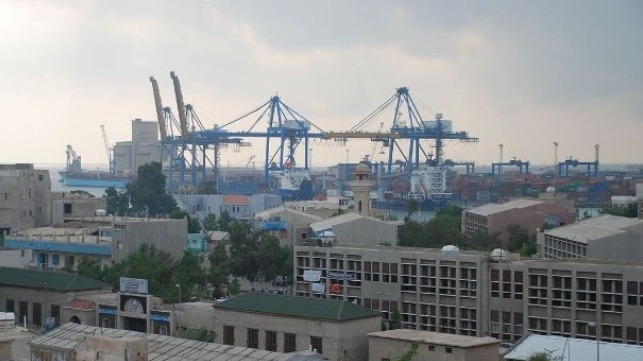
 

Sudanese Foreign Minister: No Obstacles for Russian Base in Port Sudan

Port Sudan
Port Sudan (file image)

Published Feb 16, 2025 2:57 PM by The Maritime Executive


With Russia’s footprint in the Mediterranean facing uncertainty, the deal for a naval base in Sudan has reached a new milestone. Last week, Sudanese Armed Forces (SAF) foreign minister Ali Youssef Ahmed al-Sharif was in Moscow, where he met his Russian counterpart Sergei Lavrov. Although the negotiations for the base were not part of the meeting, Ali Sharif said there was no disagreement on the deal, assuming that the SAF can win or reach a stalemate in its two-year civil war against the breakaway Rapid Support Forces (RSF).

“There was a deal which was signed and there are no obstacles. We are in complete agreement,” said Sharif.

Russia signed an agreement with the government of Sudan for the naval base under the regime of former dictator Omar al- Bashir, who was ousted in a coup by his former generals back in 2019, leading eventually to the SAF’s rule over most of the country. In 2021, SAF leaders said that the government would review the deal to align with the country’s interests.

The ongoing civil war in Sudan since 2023 has stalled progress on the base deal. A logistical base for Russia is Sudan - the first in Africa - could provide Moscow with desperately-needed access to a regional basing arrangement. Russia’s 50-year foothold in the Mediterranean at the port of Tartus, Syria, is endangered and may already be lost. The setbacks facing the Russian Mediterranean flotilla has likely sent Moscow on an overdrive for an alternative base. It remains to be seen if Eastern Libyan warlord Khalifa Haftar or the government of Algeria might offer a base to the Russian Mediterranean fleet, or if such a basing arrangement could be a suitable replacement for Tartus.

Either way, the willingness of Sudan to offer Russia a base is still good news for Moscow. As a logistics support point for the Russian navy, the Port of Sudan could easily accommodate four warships, including nuclear-powered ones. Some analysts believe that the base would restore Russia’s permanent presence in the Indian Ocean. Russia lost this privilege at the end of the Cold War: the Soviet-era naval base in Berbera, Somalia closed in 1997, and the Nokra base in Eritrea (then part of Ethiopia) closed in 1991.

But given its location, the Port of Sudan base would have serious limitations as an alternative launch pad for reconstituting Russia’s Mediterranean Flotilla.

“The logistical constraints of negotiating Suez Canal, particularly in cases of requiring emergency maintenance, are significant. Operationally, canal transits also clearly signpost ship movements to adversaries,” argue naval experts Edward Black and Sidharth Kaushal.  


Iran's "Drone Carrier" May Join Exercise With Russia and China

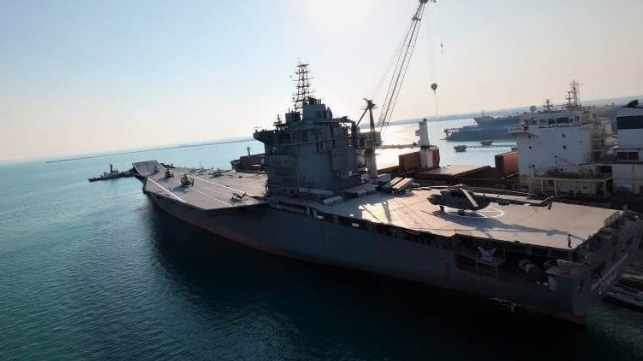
Converted boxship Shahid Bagheri, Iran's "drone carrier" (Sepah News / CC BY 4.0)

Published Feb 16, 2025 1:44 PM by The Maritime Executive


The annual Iranian-Chinese and Russian naval codenamed Exercise Maritime Security Belt normally takes place in mid-March, in a pattern established over a number of years. 

Maritime Security Belt 2025 is likely to feature the outgoing Chinese Navy Group, which is nearing the completion of its six month forward deployment to the PLA Navy’s Project 141 Overseas Support Base at Doraleh, in Djibouti. The departing 46th Naval Escort Group consists of the Type 052D destroyer Jiaozuo (D163), Type-054A frigate Xuchang (F536) and the Type 903A logistics vessel Honghu (K963). 

The Maritime Security Belt 2025 exercise will be the first of a number that they will carry out with cooperating navies on their way back to their homeport of Zhanjiang in Guangdong, headquarters of the PLA Navy’s South Sea Fleet. 

The Chinese Navy’s Project 141 Overseas Support Base at Doraleh, in Djibouti (Google Earth)

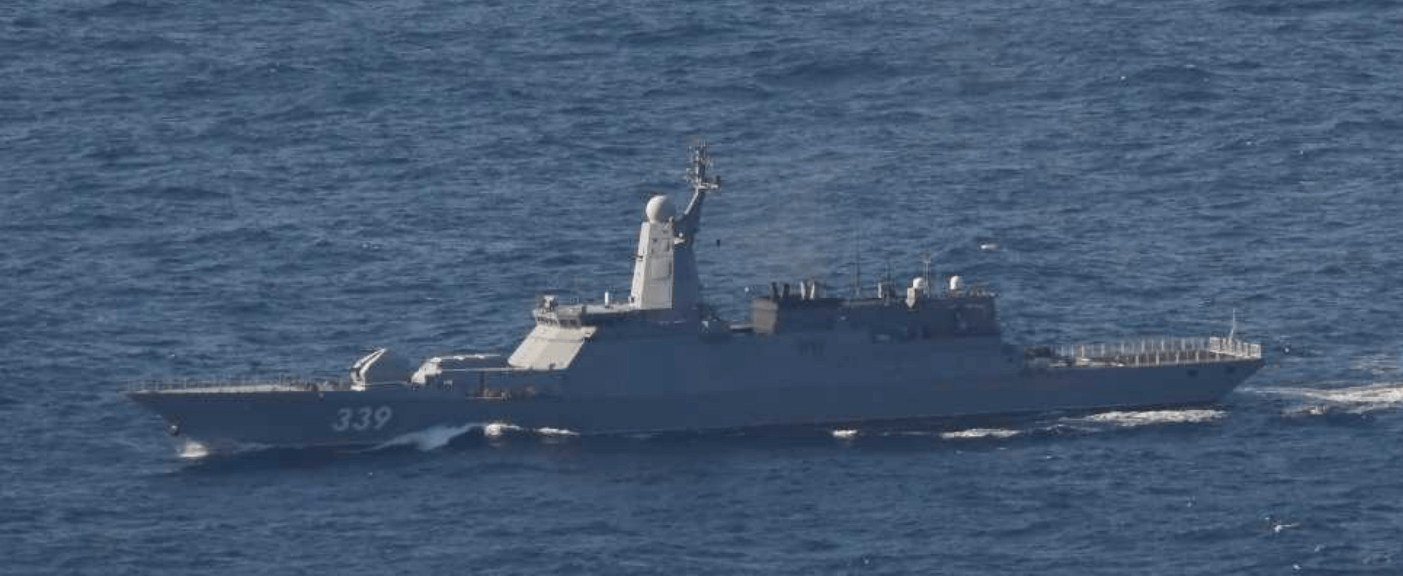
The Russian participants are likely to be Steregushchiy Class Project 20380 missile corvettes Hero of the Russian Federation Aldar Tsydenzhapov (F339) and Rezkiy (F343) and the oiler Pechenga (IMO 7710977). The Press Office of the Pacific Fleet via Izvestia reported their departure from Vladivostok on February 3 for "tasks in the Asia Pacific Region." While transiting the Sea of Japan the flotilla conducted air defence training to counter drones and drills ‘to repel attacks of uncrewed boats’, which could be useful if any of Iran’s Houthi allies operating in the Red Sea and Gulf of Aden mistakes the Russian ships for unfriendly vessels.

The Pechenga is sailing without its AIS automatic identification system switched on, but the flotilla en route is known to have arrived off Bali on February 15 to take part with the Indonesian Navy in Exercise Komodo-2025.

Hero of the Russian Federation Aldar Tsydenzhapov (F339) (Japan Ministry of Defense, 2021)

The Iranian naval representation in the exercise, from the both the IRGC (Nedsa) and regular Navy (Nedaja) will become apparent closer to the time and will be dependent on ship serviceability, always an issue in the aging Iranian fleet. However, the exercise is likely to feature drone and missile firings, which is the Iranian preoccupation at present.

It may also present the Nedsa an opportunity to demonstrate that their new drone carrier Shahid Bagheri (C110-4), last seen in its normal anchorage off Bandar Abbas on a cloudless February 1,  is operationally viable.  Some press reports greeted the Nedsa’s promotional video of a small jet-powered one-way attack drone, akin to a model aircraft, taking off from the Shahid Bagheri as representing a radical shift in the balance of power at sea which would concern Israel. 

Whilst one-way drone launches may be viable, the ship can launch missiles, helicopters and fast attack boats, as any frigate could. But there is no indication yet that a fixed-wing air vehicle could recover to the Shahid Bagheri’s 180-meter flight deck, overcoming the pitch and roll characteristics of the off-center flight deck and air turbulence created by the ship’s towering sterncastle. 

Except in conditions of stable peacetime, the survivability of this 20-year-old converted tanker in wartime, or even in times of increased tension, would probably be measured in hours rather than days. Notwithstanding its sturdy Korean construction, a ship surveyor would probably have consigned the Perarin to the scrap heap rather than allow it to be converted into the Shahid Bagheri, pride of the Nedsa fleet.

Top image: Converted boxship Shahid Bagheri, Iran's "drone carrier" (Sepah News / CC BY 4.0)

The opinions expressed herein are the author's and not necessarily those of The Maritime Executive.
Royal Navy Escorts Russian Evacuation Flotilla Through English Channel

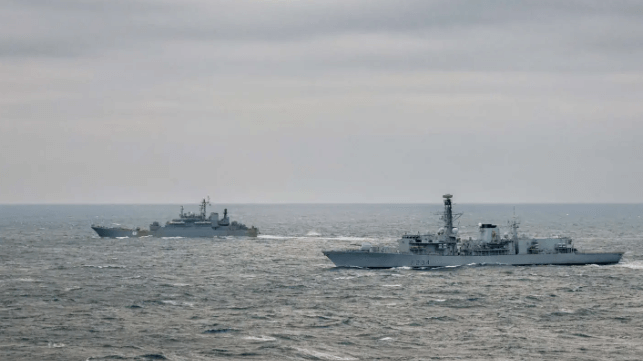
HMS Iron Duke (right) with the Russian amphib Alexander Otrakovsky (Royal Navy)

Published Feb 16, 2025 12:37 PM by Royal Navy News

Royal Navy warships and aircraft shadowed a Russian task group in the English Channel in a concentrated operation last week.

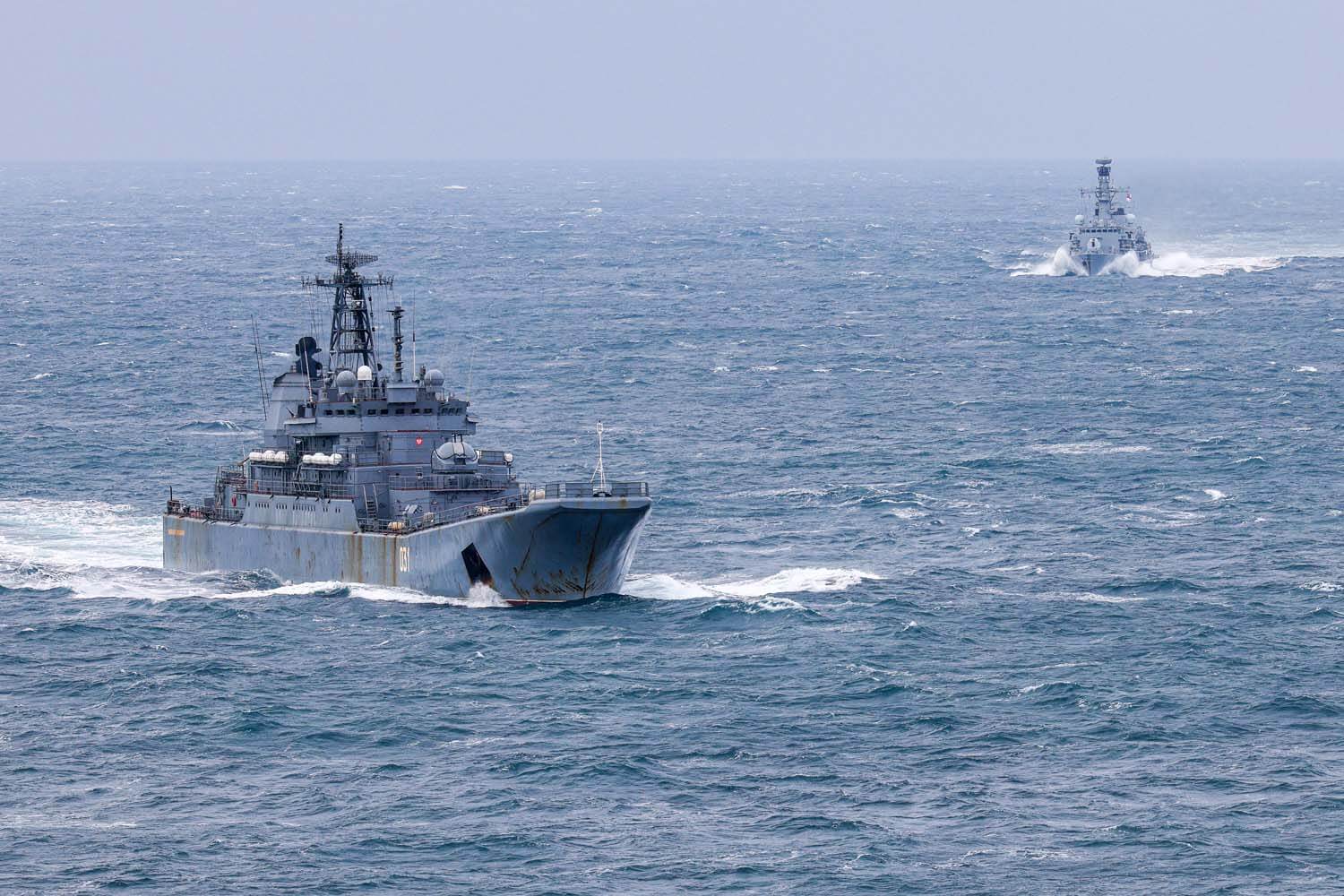
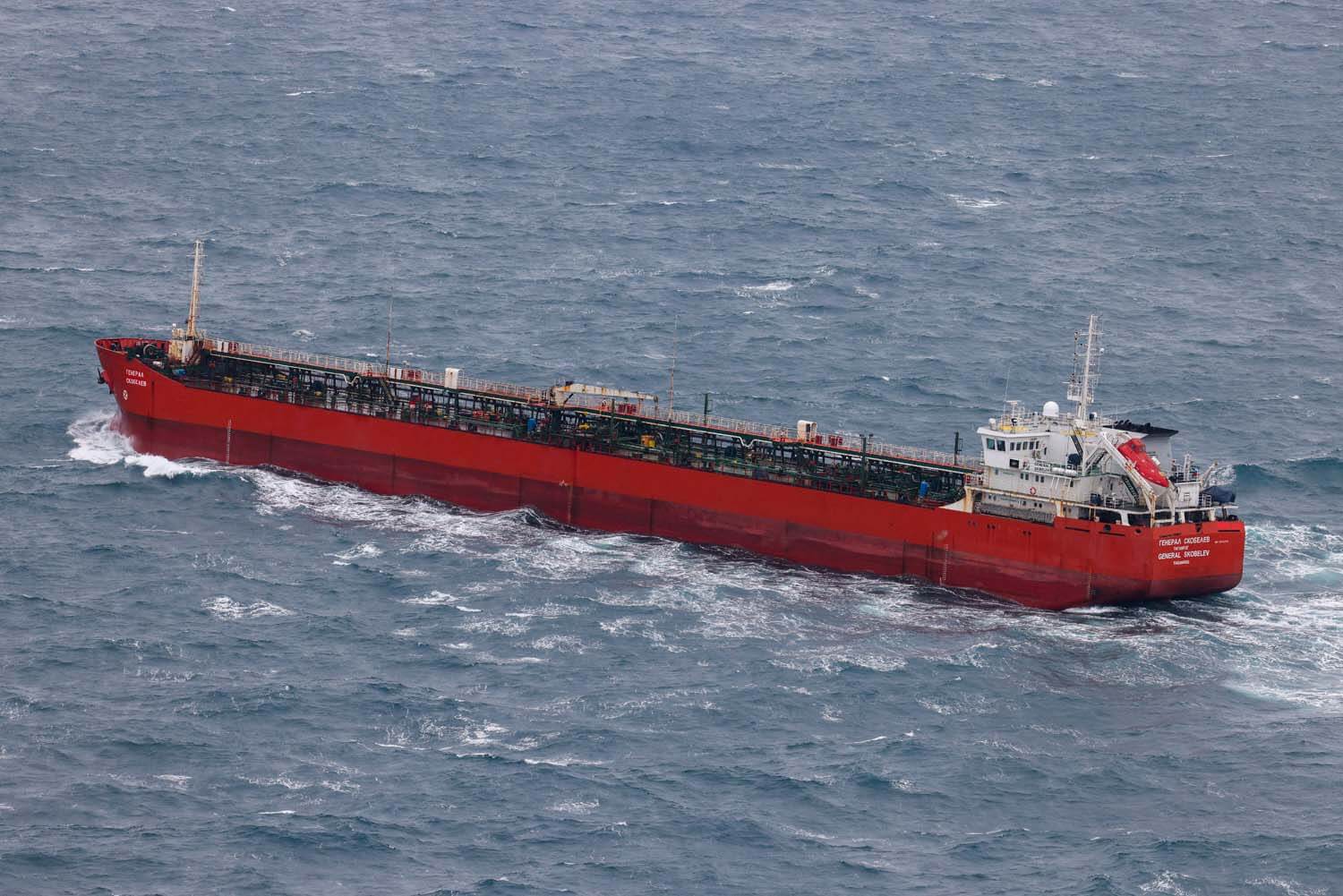
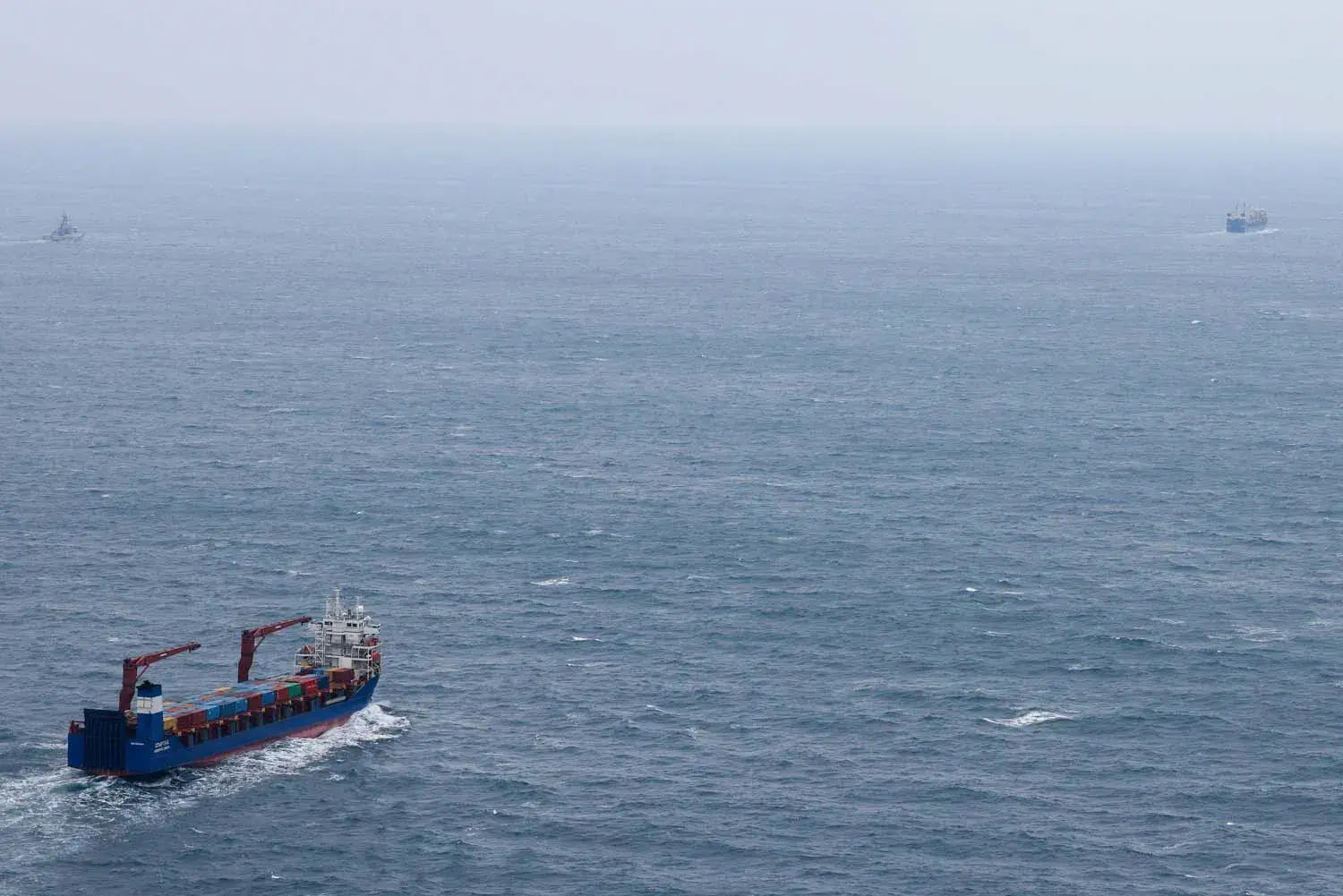
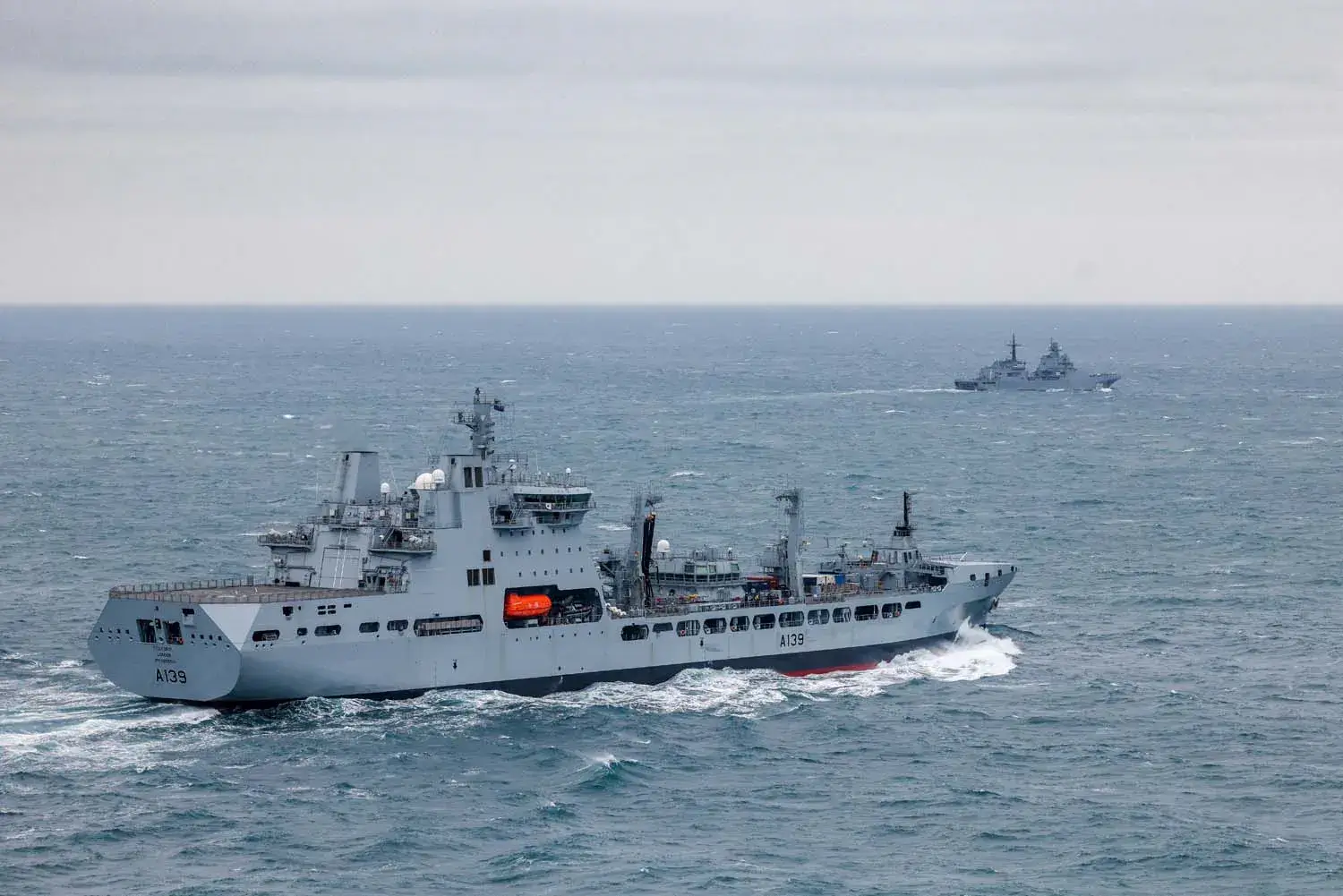
HMS Iron Duke, HMS Tyne, a Wildcat helicopter from 815 Naval Air Squadron and RFA Tideforce reported on every move of landing ships, RFS Aleksandr Otrakovskiy and RFS Ivan Gren, and merchant vessels Sparta, Sparta II and General Skobelev and oiler Yelnya.

The group of six Russian vessels departed the Mediterranean recently, sailing through the busy international shipping lane in the English Channel as they sailed towards a Russian Baltic port.

"Whilst this particular Russian task group was not assessed to pose a specific threat to the UK, this closely coordinated operation demonstrates our steadfast determination to protect our nation’s territorial seas and Critical National Infrastructure; on which our economic prosperity depends," said Commander David Armstrong, CO of Iron Duke. "It is not enough to hope passing non-allied warships will not threaten our maritime security – we will be there to make sure they can’t."


Ropucha-class amphib Alexander Otrakovsky (Royal Navy)

Russian tanker General Skobelev, sanctioned (Royal Navy)


The Tartus evacuation flotilla: Sparta and Sparta II, both sanctioned (Royal Navy)

The fleet oiler RFA Tideforce escorts the Russian Navy frigate Ivan Gren (Royal Navy)

The Royal Navy maintained constant watch on the Russian task group, utilizing a range of sensors and cutting-edge technology to ensure accurate reporting of the transit.

Plymouth-based frigate Iron Duke – the Royal Navy’s Fleet Ready Escort – was activated to meet tanker Tideforce and patrol ship Tyne as the Russians entered the Channel.

While this is routine for the navy, it is still a skilled and complex operation, requiring close coordination and seamless cooperation with European allies, which deployed their own naval and air force assets.

Tideforce was the first UK ship to escort the task group, just west of Brest on the French coast.

The Russian group broke off into two groups in the Channel, with the Wildcat from 815 Naval Air Squadron and RAF P8 Maritime Patrol Aircraft providing critical information on movements from the air.

This latest operation follows the shadowing of a suspected Russian spy ship by HMS Somerset and HMS Tyne last month. The Yantar was tracked through the Channel and Strait of Dover.

This article appears courtesy of the Royal Navy and may be found in its original form here.

The opinions expressed herein are the author's and not necessarily those of The Maritime Executive.
 

Restricted in the West, Russia Expands Trade Links in Southeast Asia

FESCO
Courtesy FESCO

Published Feb 16, 2025 2:26 PM by The Maritime Executive


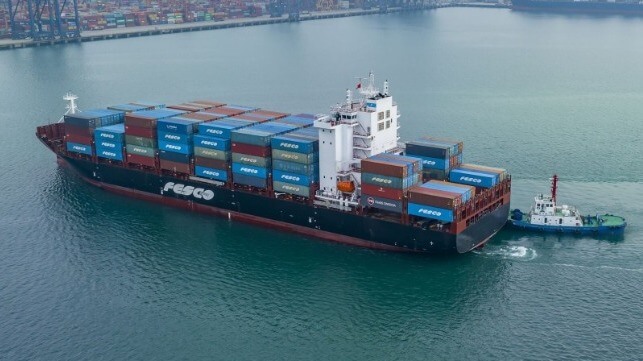
The Russian container line FESCO is further expanding its Intra-Asia service to include a new port call in Pasir Gudang, Malaysia. This becomes the second port of call for FESCO in Malaysia.

FESCO entered the Malaysian shipping scene almost six months ago, with a service at Port Klang connecting to the Vietnamese port of Ho Chi Minh City. The route is served once a week, with a transit time of three days between the ports.

The addition of Pasir Gudang will expand the geography of the FESCO Intra Asia Service (FIAS) between Malaysia and Vietnam, according to the company. The service is served by a 400 TEU containership from the FESCO fleet. The first departure from Pasir Gudang took place on February 8.

“Pasir Gudang is one of the largest ports in Malaysia, which is literally next door to Singapore. Our team did a great job for FESCO to receive permission for cabotage transportation from the Malaysian authorities. On the very first voyage, we sent cargo not only from Pasir Gudang to Russia via our hub in Ho Chi Minh City, but also carried out domestic transportation between Malaysian ports,” said German Maslov, Vice President of FESCO’s Liner Logistics Division.

Maslov added that FESCO is planning to expand FIAS to Thailand and also studying the possibility of adding a second vessel to the service. FESCO wants to develop FIAS as an Asian feeder line to deliver additional cargo volumes to Russia from markets such as Malaysia, Sri Lanka, Singapore, Indonesia, Bangladesh, India and Thailand.

The ramp-up of FESCO’s service in Southeast Asian countries follows the launch of a subsidiary enterprise, DBF Logistics Vietnam, back in December. Besides FIAS, the new company will ensure smooth operation of the FESCO Vietnam Direct Line, which connects Russia’s Far East Port of Vladivostok and Vietnam’s Haiphong and Ho Chi Minh City.

“The container transportation market is actively developing between Russia and Vietnamese ports. We transported 25,700 TEU last year. Therefore, we essentially grew several times over in three years,” said FESCO’s Group President, Pyotr Ivanov.

Meanwhile, as the West tightens economic sanctions against Russia, there is a noticeable drop in the amount of liquid cargo handled at Russian ports. Last week, the Russian Commercial Seaports Association reported that cargo handling in major ports fell by 1.6 percent year-on-year to 71.6 million tons in January. Liquid cargo transshipment fell 6.1 percent to 37.3 million tons, including 8.5 percent to 21.2 million tons of crude oil and 5.1 percent to 11.6 million tons of oil products. However, handling of liquefied natural gas (LNG) rose 4.4 percent to 3.4 million tons.


After Collision, Carrier USS Harry S. Truman Pulls Into Souda Bay

USN
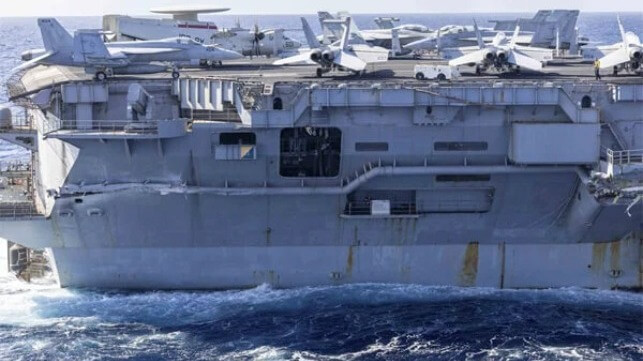
Minor damage on the starboard quarter: hull damage above the waterline, center left, and a damaged sponson, center right (USN)

Published Feb 16, 2025 7:04 PM by The Maritime Executive


The carrier USS Harry S. Truman has arrived in Souda Bay, Crete for emergency repairs after a collision damaged her starboard quarter on Wednesday night. The impact caused minor damage to the hull and several exterior structures, but the impact was comparatively limited. 

“While the ship is fully mission capable and the ship conducted flight operations following the collision, pulling into port for emergent repairs will enable the ship to continue deployment as scheduled,” said Capt. Dave Snowden, Harry S. Truman’s commanding officer.

The hull damage - all above the waterline - includes the exterior bulkheads of two storage rooms and a maintenance space. Externally, the impact damaged a line handling space, a part of the fantail, and the platform above a storage space. Luckily, the aircraft elevator located in the same area sustained no damage, and the command says that it is fully operational. 

Forward-deployed maintenance units in Souda Bay are carrying out an assessment and repair process to fix the damage. 

“The Harry S. Truman Carrier Strike Group (HSTCSG) units remain operational across geographic regions in support of their component commanders,” said Rear Adm. Sean Bailey, commander of HSTCSG. “Our mission has not changed and we remain committed to responding to any challenge in this dynamic and global security environment.”

The Navy has not yet released the details of Truman's collision with the bulker Besiktas M, which occurred off Port Said at about 2345 hours local time on Wednesday night. From images of the damage aboard Besiktas M, the merchant ship's starboard bow appears to have made contact underneath the deck overhang on Truman's starboard quarter, tearing a mooring winch free of the bulker's forecastle. 


MAIB: Open Drain Caused Deadly Capsizing in North Sea

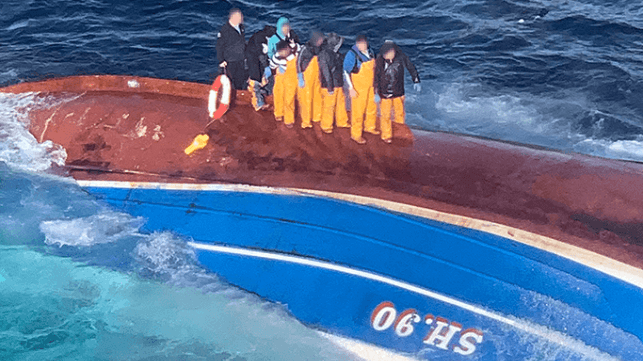
The crew of the Njord, moments before the vessel sank (MAIB)

Published Feb 16, 2025 11:08 PM by The Maritime Executive


MAIB has published its final accident investigation report into the capsizing and foundering of stern trawler Njord, which went down about 50 nautical miles north-east of Peterhead, Scotland in 2022. MAIB found that post-construction modifications had reduced the vessel's initial stability, and that a large haul of fish was enough to capsize the vessel. 

On March 5, 2022, the 27-meter Njord departed Peterhead to fish in the Norwegian sector of the North Sea, with a crew of eight on board. In the early hours of the following morning, Njord arrived at a position about 130 nautical miles north-east of Peterhead and put out its fishing net over a gas pipeline from the Sleipner A gas platform. The vessel towed its net along the pipeline until 1100, when the net was hauled in. The catch was the largest the crew had ever seen, the equivalent of roughly 30 tonnes of fish. 

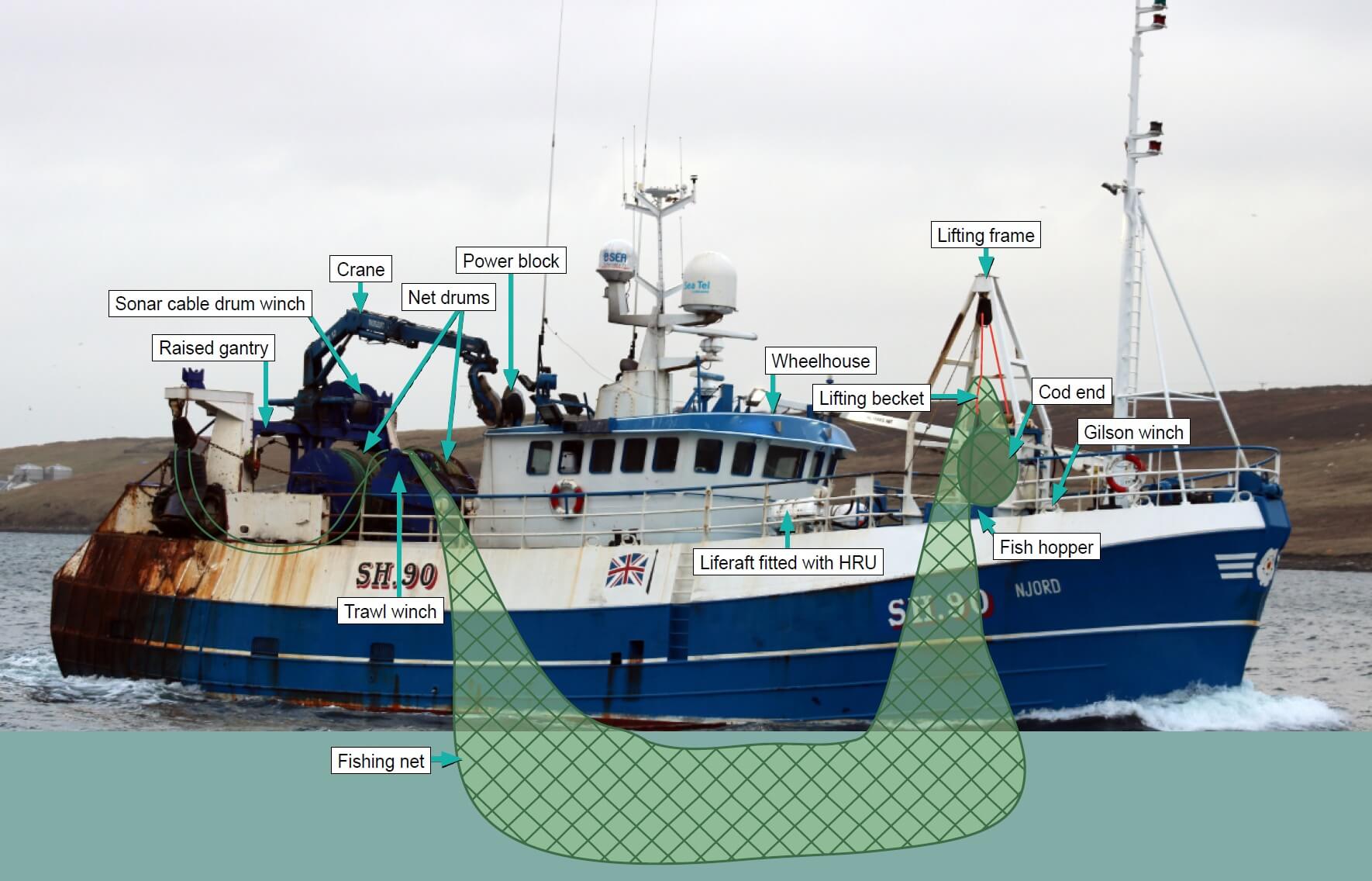
Njord was a 1992-built trawler with a setup not commonly found in high-seas fisheries. Her net reels were at the stern, but recovery of the catch occurred on the starboard bow. The cod end had to be hauled up over the starboard rail using a winch and lifting frame, and then the fish were fed into a hatch in the foredeck for processing. 

Courtesy MAIB

This time around, the catch was 30 times as abundant as usual. The crew towed the cod end around to the starboard side using a power block, then used a loop of line and a winch to haul up about one tonne of fish at a time into the hopper on the foredeck. After about ten lifts and ten tonnes in the hopper, the Njord had a list of about 10-15 degrees. The crew went below to start processing the catch. 

Within an hour, they had only processed and stowed about three tonnes of the fish, and the skipper wanted to move more quickly. He ordered them to haul up more of the catch and fill the hopper again. Two more lifts went well enough, but on the third lift, the vessel took on a heavy list from the weight of the fish hanging from the net reel and the winch on the bow. 

As the list increased, the Njord began to downflood, and the situation changed very rapidly. Despite efforts to cut loose the net, the Njord slowly rolled over to starboard, and the crew escaped by climbing out onto the port side of the hull and walking up onto the upturned keel. For floatation, they had only one life ring for eight people, and no immersion suits. None of the life rafts popped to the surface; it is likely that they were all caught in the vessel's rigging and deck gear. 

The vessel's EPIRB self-activated at about 1340, and the Norwegian Coast Guard launched a response. A SAR helicopter dispatched from the Johan Sverdrup oil platform arrived on scene at about 1416 and stood by as the OSV Olympic Challenger approached to conduct a surface rescue. As the Challenger prepared to launch its fast rescue boat, the Njord suddenly began to sink from beneath the survivors' feet. Within moments, all eight fishermen were in the water: six who were hanging on to one lifering, and two who were attempting to swim to stay afloat. 

The SAR helicopter crew deployed their rescue swimmer to try to save the two men who had nothing to hang onto. The first fisherman to be hoisted up was retrieved alive, though he was briefly unconscious and had ingested water and diesel. The second was pulled up six minutes later. By the time the rescue swimmer got to him, he had sunk below the surface, and he was retrieved in an unresponsive state. Despite medical attention he did not recover. 

The SAR helicopter recovered one more survivor from the life ring group, then headed for shore; the Olympic Challenger's fast rescue boat saved the last five survivors. 

In 2021, before the casualty voyage, the Njord had been modified with the addition of two prawn net reels and an icemaker towards the stern, but no evaluation was made of the effect on stability. MAIB reconstructed the vessel's stability based on the best available figures, and found that the vessel may have failed the test on one of seven standard loading conditions (though the findings were not definitive). 

Additionally, MAIB found that progressive flooding began rapidly through an unapproved and undocumented drain pipe that had been installed through a watertight bulkhead on the starboard side. Assuming that the valve on the drain had been left open, modeling suggested that the passageway probably began flooding through the drain at about 17 degrees of inclination, and a load of about 4 to 7.5 tonnes on the net would have been enough to start the process. 

"It is likely that Njord would not have capsized had the valve on the drain been closed, as it should have been, while the vessel was at sea," MAIB concluded. 

That reduced downflooding angle, combined with the extreme luck of a 30-tonne catch, may have been enough to sink the ship - and the crew may have been willing to overlook the danger signs, especially in flat-calm surface conditions. 

"It is likely that the new experience of such a large catch led the crew to perceive Njord’s heavy listing as normal under the circumstances. A large catch meant significant remuneration for all of the crew as share fishermen, and their delight might have influenced their judgment of and consideration towards safety," wrote MAIB. "Had the net been cut away immediately, and the additional fish not been added to the hopper, the vessel might have been saved."

MAIB noted that the crew were incredibly lucky that the EPIRB had floated free. The captain did not manage to get off a VHF distress call before the capsizing, and if the EPIRB had not activated itself and reached the surface, it is likely that the entire crew would have perished in the cold water. 


Crew Rescued After MSC Containership Grounds in Storm off Newfoundland

containership aground
MSC Baltic III blacked out and was driven ashore on Newfoundland, Canada (Canadian Coast Guard)

Published Feb 15, 2025 3:25 PM by The Maritime Executive


Multiple teams from Canada responded Saturday morning after an MSC containership issued a mayday call during a strong winter storm. A helicopter from the Canadian SAR team was able to rescue the 20 crewmembers despite the severe conditions.

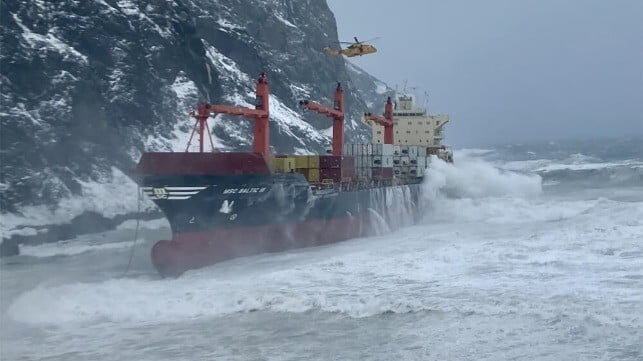
The MSC Baltic III (33,767 dwt) reported that it lost power and was unable to anchor due to the strong storm. Winds were up to 75 mph and seas were running at up to 6 meters (20 feet) along the west coast of Newfoundland. The vessel was scheduled to be in Corner Brook, Newfoundland departing for Saint John and then Freeport in the Bahamas.


The containership was about 12 nautical miles outside the entrance to the Bay of Islands when the ship blacked out. It was driven ashore in Wild Cove west of Lark Harbor on the western coast of Newfoundland along the Gulf of St. Lawrence. 

"The vessel’s propulsion fuel is marine diesel, and the vessel is sitting on rocks on the shoreline. So we’re concerned that it may breach the hull, but at this point in time in time there’s no breach and no oil on the water,” Canadian Coast Guard response officer Bruce English told the Canadian Press on Sunday. 

Built in 2003, the vessel is registered in Liberia and has a capacity of 2,478 TEU. It is owned by NordBaltic operating since 2021 for MSC Mediterranean Shipping Company. The ship is 679 feet in length.

The Canadian Coast Guard vessel Henry Larsen was in the area supporting the SAR team and the Cormorant helicopter which was able to rescue the crew. Local emergency and fire teams also responded to the calls for assistance. The Coast Guard reports the Henry Larsen remains in the area. A mobilization of crews and equipment is also underway to reach the stranded vessel.