Monday, February 17, 2025

Russia-US meeting on Ukraine in Saudi Arabia set for Feb.18 without Kyiv’s participation: Media reports

Russian media outlet claims Russian Foreign Minister Lavrov to head Russian delegation, while his counterpart Rubio to head US negotiation team

Elena Teslova |17.02.2025 - TRT/AA/AP


MOSCOW

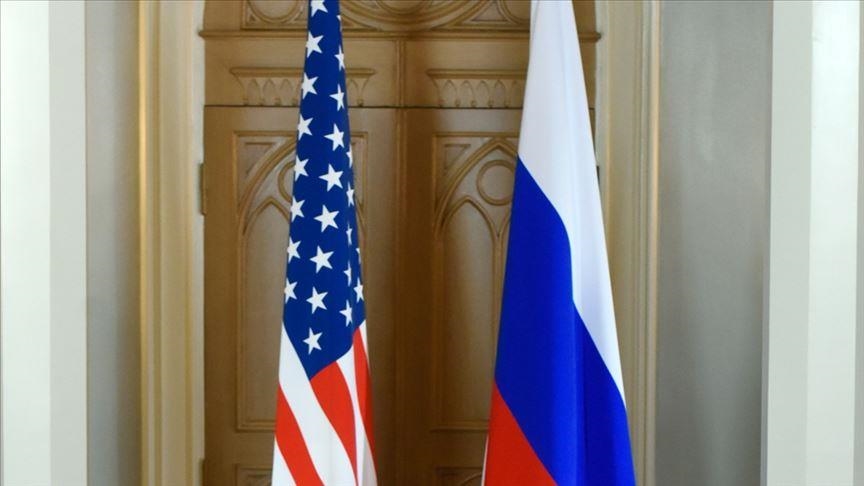
A Russian daily has claimed that the Russia-US meeting on Ukraine will take place on Tuesday in Saudi Arabia, while American media reported that Kyiv was not invited to take part in the gathering.

The Russian daily Kommersant claimed on Sunday with a link to its sources in the Kremlin that the Russian official delegation will be headed by Foreign Minister Sergey Lavrov and the US negotiation team by Secretary of State Marco Rubio.

The US team will also reportedly include National Security Adviser Mike Waltz and Special Envoy for the Middle East Steve Witkoff.

Meanwhile, American media reported that the Ukrainian authorities were either not invited or unwilling to take part in the meeting.

Last Wednesday, Russian President Vladimir Putin and his US counterpart Donald Trump agreed in a phone talk to organize contacts on the Ukrainian settlement as soon as possible.

Trump made ending the ongoing Moscow-Kyiv war a part of his presidential election campaign.


Europe out of Ukraine ceasefire talks

Europe out of Ukraine ceasefire talks
Head of the Ukrainian Presidential Office Andriy Yermak met with US Special Representative Kellogg to discuss continued support for Ukraine on February 14. / bne IntelliNewsFacebook
By Ben Aris in Berlin February 16, 2025

When asked if Europe will be at the table in the upcoming US-Russia negotiations to end the conflict in Ukraine, US special envoy to Ukraine retired Lieutenant General Keith Kellogg said “no.”

Asked at the Munich Security Conference (MSC) on February 15: “Can you assure this audience that Ukrainians will be at the table and Europeans will be at the table?”, his response was: “the answer to that last question is no.”

In a follow up question, he was asked to confirm the fact that Europe would not be invited to the talks and replied: “So the Europeans… you don't think you should be at the table directly? I’m from the school of realism, I think that’s not going to happen.”

The Kremlin is delighted with the chaos that emerged from the MSC summit. Moscow and Washington will from now on “focus on peace not war,” Kremlin Spokesman Dmitry Peskov said in an interview with television host Pavel Zarubin on February 16.

"They send a powerful message that from now on we will try to solve problems through dialogue. And from now on we will talk about peace, not war," he said.

According to Peskov, Trump’s views should appeal to any sound-minded person. He said Russia completely lacked communication with the previous US administration, TASS reported. 

Zelenskiy’s worst fears have been confirmed with the weekend’s comments at the MSC. During his conversation with US President Donald Trump last week, he pushed for reassurances of US support and got none.

“A few days ago, President Trump told me about his conversation with Putin. Not once did he mention that America needs Europe at that table. That says a lot. The old days are over – when America supported Europe just because it always had,” Zelenskiy said at the MSC conference.

A rapidly expanding chasm is opening up in trans-Atlantic ties, and Kellogg said he understood that barring Europe from the talks might be “like fingers on a chalkboard, may grate a little bit but I'm telling you something that's really quite honest.”

Kellogg’s remarks follow on from a controversial speech by US Vice President JD Vance who lambasted the EU for falling down on freedom of speech values and accused it of undermining democracy. He added insult to injury by meeting with the far-right AfD (Alternative für Deutschland) leader Alive Weidel while in Germany provoking German Chancellor Olaf Scholz into accusing the US of interfering in Germany’s elections; Germans go to the polls on February 23 and Scholz’s SPD is trailing in the polls with 15%, while AfD is in second place with 21% and will likely get a boost from the US’ de facto endorsement. The Christian Democratic Union is currently leading with 31% and its leader (CDU) Friedrich Merz, who is almost certain to become the new chancellor, is downbeat on supporting Ukraine. 

Europeans are in shock and scrambling to form a united response to the US position as it will attempt to barge its way into the talks. The official line throughout the last three years has been that only Kyiv can decide to bring the war to an end and must not only participate in talks but lead them to get terms that are acceptable to Bankova (Ukraine’s equivalent of the Kremlin) for a “just” and long-lasting peace.

French President Emmanuel Macron has called for an emergency EU summit in Paris on February 17. Germany, Italy, and Poland are to meet in Paris together with Nato General Secretary Mark Rutte.

Europe is clearly torn over Trump’s decision to ignore it in the upcoming negotiation, with some EU members demanding the solution to the Ukraine crisis is a problem that can only be solved by the international community in cooperation with Kyiv, while others remain focused on maintaining good relations with the US and the security umbrella it has provided since the end of WWII.

German Foreign Minister Annalena Baerbock described the situation as a "moment of truth" for Europe, urging European leaders to unite and take decisive action.

“This is an existential moment. It’s a moment where Europe has to stand up,” she said in a speech at the MSC. “There won’t be any lasting peace, if it’s not a European-agreed peace.”

UK Prime Minister Keir Starmer on the other hand said that his primary goal in the Paris summit meeting would be, “to ensure we keep the US and Europe together. We cannot allow any divisions in the alliance to distract from the external enemies we face.”

A visibly stressed Zelenskiy lashed out at the US proposal: “Ukraine will never accept deals made behind our back without our involvement, and the same rule should apply to all of Europe,” he said in his MSC speech.

He called for a creation of an “armed forces of Europe” because the US can “no longer be counted on to support the Continent,” after Rutte made it clear that Ukraine was “never promised Nato membership” during his comments at the MSC.

“I really believe that time has come,” Zelenskiy told the MSC delegates. “The armed forces of Europe must be created.”

Washington sent out a questionnaire last week asking what they would be willing to do to keep the peace in Ukraine after a ceasefire. It includes six questions including a request for an indication of how many troops they would be willing to contribute to a peacekeeping force, sources told Reuters.

“The Americans have provided Europeans with the questionnaire on what would be possible,” Finnish President Alexander Stubb said. “This will force Europeans to think, then it’s up to the Europeans to decide whether they actually answer the questionnaire, or whether they answer it together.”

Sending peacekeepers to enforce a ceasefire and police a demilitarised zone (DMZ) is one of the options that the Western allies are looking at in lieu of full Nato Article 5-like security guarantees. Some have proposed a force of 40,000 peacekeepers, but Zelenskiy has called for 200,000. However, the Kremlin is likely to reject the idea of any Nato-backed forces on Ukraine’s territory out of hand.

In his victory plan circulated in December, Zelenskiy pushed for accelerated Nato membership as Europe’s “cheapest” option for providing the  security deals Ukraine needs for any ceasefire deal to work that remain elusive. But those hopes have been dashed. It is now clear Ukraine will not be admitted to Nato for at least 25 years, according to US Secretary for Defence Pete Hegseth, ending the rhetoric of Ukraine’s “irreversible path” to Nato membership.

Zelenskiy responded that Ukraine will have to “build our own Nato” by expanding the Armed Forces of Ukraine (AFU) to at least 1.5mn men and boost its own domestic defence industry at a time when the war is going increasingly badly for Ukraine.

Zelenskiy also told The Associated Press on February 15 that he “didn’t let” his ministers sign off on an agreement with the US to exploit Ukraine’s considerable mineral resources, because “it is not ready to protect us, our interest.”

Crown Prince Mohammed bin Salman (MbS), who is emerging as a key player in the Middle East peace process, has also called an emergency summit for the five leading Arab states to work out a response to Trump’s proposal to “take over” Gaza and expel around 2mn Palestinians that live there to build a “Riviera of the Middle East.” As bne IntelliNews reported, the chances of the Ukraine conflict being linked to Palestine are increasing.

Russia’s Foreign Ministry and the US State Department said that Russian Foreign Minister Sergey Lavrov and US Secretary of State Marco Rubio spoke on February 15 by phone. Rubio reaffirmed Trump’s “commitment to finding an end to the conflict in Ukraine. In addition, they discussed the opportunity to potentially work together on a number of other bilateral issues,” US State Department spokesperson Tammy Bruce said, reports AP.

Rubio is currently on tour in the Middle East ahead of the Ukraine ceasefire talks that will be held in Riyadh to sound out Arab leaders ahead of the negotiations with Russia.

Shut up and pay

Kellogg also made it clear that even if Europe was part of the negotiations, the White House still expects Brussels to abide by the deal and moreover continue to provide Ukraine with both military and financial aid. Trump has previously said that Europe “must pay and do more” for Ukraine because of its geographical proximity to the war.

“You have to understand, when you sign up for these security guarantees, that is an obligation and the reason I say that and I challenge many people that are out there, right now, 2014 Wales declaration, all the Nato allies, 2% of GDP, 20% of that was modernisation, there are still eight nations who've not even gotten to that number, okay? So, when we get to it make sure you check your six as they say that the obligation is upon YOU when WE make these commitments,” Kellogg said.

European leaders are in crisis mode as it becomes increasingly clear that Trump’s plan is that “Europe should stay out of negotiations that will fundamentally affect their security architecture - yet bear the primary responsibility and cost for the negotiations' outcome,” political commentator Arnaud Bertrand said in a social media post. Moreover, it is also clear that Trump is looking to take control of Ukraine’s rare earth mineral deposits as payment for US support. “As Greek historian Thucydides wrote 2,500 years ago, “the strong do what they can and the weak suffer what they must”," Bertrand added.

"If the United States is going to monetise its support for the defence of Kyiv, then why not dozens of other countries that helped? And if that happens, there will be nothing left of the country but bones," Bloomberg commentator and former editor of the Moscow Times said in a recent opinion piece.

The US support for Ukraine already petered off in 2023 when it ran out of money for Ukraine at the start of the year before finally putting a $61bn aid package in place on April 20. However, earlier this month Zelenskiy complained that Ukraine has received less than half of the support the US promised and some $100bn from a total of $177bn pledged has failed to appear in Kyiv as Ukraine’s relations with the newly installed Trump administration got off to a rocky start thanks to missing money, delayed arms deliveries and demand for mining deals.

The split of support between Europe and the West for Ukraine is already at 60/40, according to the Kiel Institute that tracks support, and US support is expected to fall off further and quickly under Trump’s leadership.

“Over the past three years of war, donor countries have provided a low but continuous flow of support to Ukraine, with a value of about €80bn per year. European donors have been the main source of aid to Ukraine since 2022, especially when it comes to financial and humanitarian aid,” the Kiel Institute says on its website. “In total, approximately €267bn in aid has been allocated to Ukraine over the past three years, amounting to more than €80bn per year. Of the total around €130bn (49%) was allocated in military assistance, €118bn (44%) in financial support, and €19bn (7%) in humanitarian aid.”

Germany remains Ukraine’s biggest donor, but facing its own budget crisis, Germany has also run out of money for Ukraine and France is in similar fiscal dire straits and also reduced its commitments in October.

Zelenskiy faced the grim realities of his worsening position at Munich, saying that it will be “very difficult” for Ukraine to continue its military campaign without continued US support.

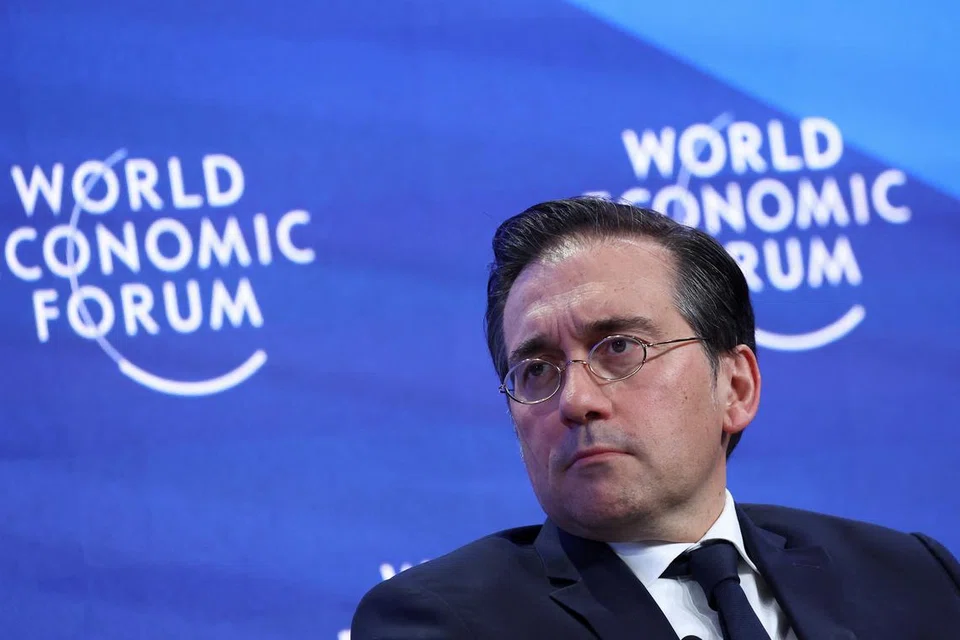
European leaders seek to prevent rewarding Russian aggression, Spain says


 Spain's Foreign Minister Jose Manuel Albares looks on as he attends the 55th annual meeting of the World Economic Forum (WEF) in Davos, Switzerland, January 21, 2025.
REUTERS/Yves Herman/File Photo

UPDATED Feb 17, 2025

MADRID - Spanish Foreign Minister Jose Manuel Albares said European leaders will discuss in Paris on Monday how to prevent a peace negotiation on Ukraine ending up rewarding Russian aggression.

"A war of aggression cannot be rewarded, we cannot encourage others to launch wars of aggression," he said in an interview with radio station Onda Cero.

"Today I'm convinced Putin will keep attacking and bombing Ukraine. So I do not see peace on the horizon at the moment," he added.

Albares spoke ahead of an emergency summit of European leaders, including Britain's Prime Minister Keir Starmer, hosted by French President Emmanuel Macron on the Ukraine war. The summit was convened after U.S. officials suggested Europe would have no role in any talks on ending the conflict.

U.S. President Donald Trump stunned European NATO allies and Ukraine last week when he announced he had held a call with Russian President Vladimir Putin without consulting with them and would start a peace process.

U.S. Secretary of State Marco Rubio arrived in Saudi Arabia on Monday ahead of expected talks with Russian officials aimed at ending Moscow's nearly three-year war in Ukraine.

 REUTERS

Poland to play key role in EU Paris meeting to counter Trump’s Ukraine talks exclusion


Polish Prime Minister Donald Tusk will travel to Paris to meeting other key EU leaders to work on a response to US President Donald Trump’s decision to exclude the EU from upcoming Ukraine ceasefire talks with Russia. / bne IntelliNews
By Ben Aris in Berlin February 16, 2025

Poland was the poor second cousin to its EU peers when it first joined the EU two decades ago. But a flourishing economy, its frontline position and growing military might means it’s been promoted to the top table as the leaders of the most powerful countries in Europe meet in Paris on February 17 to respond to US President Donald Trump’s decision to exclude Europe from the upcoming Ukraine ceasefire talks.

The Paris summit is expected to discuss the US decision, following comments made by special envoy to Ukraine retired Lieutenant General Keith Kellogg at the Munich Security Conference (MSC) at the weekend.

Speaking at the Munich Security Conference, Polish Foreign Minister Radoslaw Sikorski, said he was “very glad that President Macron has called our leaders to Paris” to discuss “in a very serious fashion” the challenges posed by Trump.

“President Trump has a method of operating which the Russians call razvedka boyem – reconnaissance through battle: you push and you see what happens, and then you change your position ... and we need to respond,” the Polish minister said speaking in Munich at the weekend.

Sikorski said the current situation was both “a crisis and a result” of Europe having consumed a “peace dividend” for too long, adding on February 15 that he was not too concerned that Europe had not been consulted ahead of Trump’s phone call with Putin last week.

European countries will not create one unified army in response to threats from Russia, said Sikorski in an interview with state TV broadcast on February 15, responding to Zelenskiy calls for the creation of an “armed forces of Europe,’ but he added that he was a supporter of boosting Europe’s defences.

He went on to say that the Trump-Putin “call was a mistake because it vindicates President Putin and lowers morale in Ukraine” but asserted that, sooner or later, Europe would have to be involved in talks on Ukraine’s future security.

“But when President Trump says that as part of a deal there will have to be European troops [safeguarding a deal] then it will be up to us to supply them, so sooner or later we will have to be involved,” he said.

Sending peacekeepers to Ukraine to police a proposed demilitarised zone (DMZ), one of the options on the table for ending the war, has been championed by French President Emmanuel Macron, who called the meeting.

The White House is also interested in the idea, and Trump has already made it clear that no US troops will be sent to Ukraine. Washington sent out a questionnaire last week asking what EU countries are willing to do to keep the peace in Ukraine after a ceasefire. It includes six questions including a request for an indication of how many troops they would be willing to contribute to a peacekeeping force, sources told Reuters.

Tusk said in December in a meeting with Macron that currently Poland has no plans to send peacekeepers to Ukraine. But has said at the same meeting that Europe expected to be able to “work closely” with the new Trump administration, rather than be completely excluded from the discussions on the future of Europe’s security. Poignantly at that meeting, both Tusk and Macron emphasised that no solution affecting Ukraine will be made without Kyiv and any agreement to end the fighting will be negotiated by Ukraine and with the aim of securing Ukraine’s interests.

Trump said that Europe needs to “do more” for its own security and has threatened to not honour US’ Nato obligations for any country that has not spent the mandated 2% of GDP on defence. More recently he called for Nato members to spend 5% of GDP on arms, a call which most EU countries have rejected.

Part of Ukraine’s problem has been that while the EU has thrown vocal support behind Kyiv in its conflict with Russia, it has not matched the words with actions. As bne IntelliNews has been reporting for two years, Europe was extremely slow to sign off on military procurement contracts with privately-owned arms producers that would allow them to ramp up production. An EU promise to provide Ukraine with a million artillery shells by March 2023 was missed and only fulfilled nine months later.

Moreover, as the US wound down deliveries from its own stockpiles to Ukraine last year, the burden has shifted to Europe, which provides most of Ukraine’s imported military hardware and has drastically deleted its own stocks. Germany in particular, which has both the largest standing army and defence sector, will take decades to rebuild it to 2004 levels, according to the government. The report from former Italian Prime Minister and ex-European Central Bank boss Mario Draghi released at the end of last year also highlighted the sorry state of Europe’s defence sector after decades of underinvestment and called for massive investments of €800bn per year to bring Europe’s production up to speed.

Against this, Russian President Vladimir Putin rapidly put Russia’s economy on a war footing in the first year of the war and is currently outproducing all of Europe combined in production. Ukrainian President Volodymyr Zelenskiy admitted during his MSC speech that it will be “very difficult” to continue the war without US support.

Poland, however, has increased its defence spending in its 2025 budget to 4.7% of GDP – the highest level in Europe – and plans to triple the size of its military and create the largest conventional army in Europe.

At the same time, Poland has emerged as Europe’s growth leader and with its increasing economic clout it has also been promoted to the top tier of European politics. It is notable that Poland, currently holding the EU rotating presidency, was invited to Paris along with the UK, Italy and Germany after it has emerged as a major military power in Europe.

Several items are on the table in Paris, including the position Europe should adopt on Ukraine’s future membership of Nato, sending European peacekeepers to Ukraine should a deal be struck and what security guarantees Europe can offer Ukraine – a key demand of Zelenskiy - either through Nato or some European force.

After Ukraine’s hopes for rapid accession to Nato, the central demand in Zelenskiy’s victory plan, were dashed by Nato General Secretary Mark Rutte who said Ukraine was “never promised Nato membership” he called on Europe to create an “armed forces of Europe” at the weekend, saying Ukraine could play a key role as it already has a million men under arms.

Macron has also favoured moving Europe out from under the US security umbrella and taking more responsibility for its own defence. The French president also did a volte-face on providing Ukraine with strong security guarantees last year, but the rest of the EU has dithered on promising military support should Ukraine be attacked again.

The 2023 initiative, devised by France, also seeks to weaken Europe’s dependence on the US security umbrella – another one of Marcon’s initiatives that did not prove popular. Macron’s security deal proposal has encountered opposition from several "neutral" EU member states, including Austria, Ireland, Cyprus and Malta, the Financial Times reported. Macron argued that Europe was overly dependent on the US security umbrella and said that the EU should become “the third superpower” – a call that looks prescient now that the US looks like it is preparing to throw Ukraine under the bus without consulting the EU on an issue that is fundamental to the Continent’s security.

The Polish prime minister, Donald Tusk, who will travel to Paris on February 17, seems to agree and said in a social media post: “Europe urgently needs its own plan of action concerning Ukraine and our security, or else other global players will decide about our future. Not necessarily in line with our own interest … This plan must be prepared now. There’s no time to lose.”

Tusk will play a key role in the meeting and remains an ardent supporter of the Ukrainian cause, while UK Prime Minister Keir Starmer, on the other hand, said ahead of the summit that his primary goal is, “to ensure we keep the US and Europe together. We cannot allow any divisions in the alliance to distract from the external enemies we face.”

German Chancellor Olaf Scholz is somewhere in the middle; Germany has been the most generous of all the EU members with its financial aid to Ukraine, but extremely cautious with military supplies, afraid of provoking Russia into a direct conflict with Nato. Berlin has come under heavy criticism for not providing Ukraine with its powerful Tartus cruise missiles, while both France and the UK have supplied Kyiv with their highly effective Storm Shadow missiles.

Polish military

Poland meanwhile is in a strong position to support Ukraine militarily and Tusk pledged to put the Ukraine crisis at the top of his agenda as EU president.

Under the Homeland Defence Act, Poland has significantly boosted its defence budget, allocating PLN187bn zlotys ($48.7bn) for 2025, aiming to reach 4.7% of its GDP. The country plans to enlarge its military personnel to 300,000 by 2035, up from the current 207,500, making it Nato's third-largest army as well as adding plans to introduce a voluntary basic military service.

Poland has also been a close ally of the US, purchasing much of its equipment there - including orders for 250 M1A2 Abrams tanks - as well another 1,000 K2 Black Panther tanks from South Korea.

In addition, Poland hosts a rotating force of 10,000 US troops on its territory, with the government covering the cost of its maintenance and infrastructure investments. Warsaw has been pushing Trump to make the force permanent, but the White House has so far resisted, leaving the option of withdrawing the troops open.

As a frontline state in the rising tensions with Russia in Europe, Poland’s "East Shield" initiative aims to fortify Poland's eastern borders with Belarus and Russia's Kaliningrad region.

Military analysts have long assumed that if Russia were to launch a full-scale military invasion of Europe, a large force would come through the so-called Suwalki Gap that would only take five days to cut the Baltic states off from Nato support, overrunning the Baltic Sea coast making the Polish border the frontline in a European war. Warsaw has already invested PLN10bn into physical barriers, advanced surveillance systems, and infrastructure development, to bolster its defences.

News wires with the Armed Forces of Ukraine (AFU) positions on the frontline report that the Ukrainian troops were very disconcerted by the Putin-Trump call and are afraid that it will undermine US support for their three-year struggle against the invading Russian forces.


Argentina’s Milei faces impeachment calls over alleged massive crypto scam


The Argentine president deleted his $LIBRA endorsement post on X after several hours, stating he "was not aware of the details of the project" and had "no connection whatsoever" with the controversial initiative. / WEFFacebook
By bne IntelliNews February 16, 2025

Argentina's President Javier Milei could be subjected to impeachment proceedings after facing widespread criticism for promoting a cryptocurrency that spectacularly crashed hours after his endorsement, wiping billions from its value.

The libertarian president posted a message on X on February 14 evening, endorsing a novel "private project" called $LIBRA, which purported to stimulate Argentina's economy by financing small businesses. The token's value surged to nearly $5,000 per coin, reaching a market capitalisation of $4.6bn – comparable to a major Argentine bank – before plummeting to under $1 within hours.

Argentina's fintech chamber has acknowledged the possibility that the incident represents a "rug pull" – a fraud scheme where token creators attract investors before rapidly cashing out. According to crypto intelligence firm Lookonchain, insider wallets linked to the project extracted more than $107mn in liquidity, including 57.6mn USD Coin and 249,671 Solana tokens worth $49.7mn, Cointelegraph reported.

Javier Smaldone, a crypto influencer known for uncovering pyramid schemes, confirmed these estimates and dubbed the short-lived operation a "global scam” in an X post.

"So far, it has been discovered that the profit made is around $107mn, maybe more," he told AFP.

Blockchain analysts had warned about the project's murky structure even before the meltdown. Analysis firm Bubblemaps, cited by Cointelegraph, revealed that 82 per cent of the supply was unlocked and sellable from the start, with two accounts controlling 70 per cent of the token's total supply – a red flag for potential price manipulation.

Before backtracking, the self-described “anarcho-libertarian” leader lashed out at his critics slamming them as "filthy rats of the political caste" seeking to take advantage of the situation.

Milei deleted his $LIBRA endorsement post on X after several hours, stating he "was not aware of the details of the project" and had "no connection whatsoever" with the private enterprise. His personal lawyer, Francisco Onato, defended him, arguing his actions did not constitute a crime due to “lack of criminal intent.”

After the backlash, the presidential office announced on February 15 that Milei had requested the Anti-Corruption Office to investigate potential misconduct by any government official, including himself. The office’s statement confirmed the president had met with representatives of KIP Protocol, the platform behind $LIBRA, in October 2024, and with crypto entrepreneur Hayden Davis in January at Casa Rosada, but denied the latter’s direct involvement with Milei.

"All the information gathered in the investigation will be handed over to the courts to determine whether any of the companies or individuals linked to KIP Protocol’s project committed a crime," the statement said

In response, Davis released a statement on February 16 claiming that Milei and his team had reneged on previous agreements by withdrawing their support and deleting their social media endorsement.

The saga deepened after Charles Hoskinson, co-founder of cryptocurrency Ethereum, alleged that organisers of a tech forum where Milei met KIP Protocol representatives had solicited payments in exchange for access to the president, La Nacion reported. Hoskinson claimed he rejected the request as it would violate US foreign corrupt practices law.

"I think there are some people in that circle around Milei who took advantage of his lack of knowledge of our industry," Hoskinson said while defending the president's intentions. "They used the President of Argentina to basically make a bunch of money."

Embittered opposition lawmakers are now moving to launch impeachment proceedings. "This scandal, which embarrasses us on an international scale, requires us to launch an impeachment request against the president," said opposition lawmaker Leandro Santoro, as quoted by Reuters. Former Peronist president Cristina Kirchner, meanwhile, branded Milei a "crypto-scammer".

This is not the first time Milei has come under scrutiny over crypto mishaps. Opposition leader Martín Lousteau noted that in 2021, while serving as a national deputy, Milei promoted the CoinX platform, which is now under investigation for alleged fraud.

The episode comes as Milei's government struggles to attract foreign investment despite implementing business-friendly reforms and wide-reaching cost-cutting programmes, which have been praised by the IMF.

“We recognise the enormous progress that Argentina has made in reducing inflation, stabilising the economy, returning to the path of growth and with poverty finally beginning to decline,” IMF Spokesperson Julie Kozack recently said while announcing “good progress” on talks over a much-needed new loan programme.

The country, still plagued by currency controls set to be lifted next year, faces additional headwinds from blanket tariffs being imposed by the Trump administration despite Milei’s close relationship with the US president.

Milei’s $LIBRA controversy follows a recent surge in politically-linked cryptocurrency launches, most notably the Official Trump ($TRUMP) memecoin, which returning US President Donald Trump launched in January on the Solana network ahead of his inauguration, followed by First Lady Melania Trump's Melania Meme (MELANIA) own token.


INTERVIEW: UNIFIL's Deputy Spokesperson in Lebanon, Kandice Ardiel

INTERVIEW: UNIFIL's Deputy Spokesperson in Lebanon, Kandice ArdielTensions Escalate in Lebanon Following UN Convoy Attack / bne IntelliNews
TwitterLinkedInTelegramFlipboard\FeedlyBy Josiane Hajj Moussa for bne Beirut bureau February 17, 2025A series of interconnected events has heightened tensions in Lebanon this weekend, beginning with a violent attack on United Nations peacekeepers that has drawn international condemnation.The UN Interim Force in Lebanon (UNIFIL) reported that their deputy force commander sustained injuries when their convoy was "violently attacked" while en route to Beirut airport on February 14 evening. Lebanese authorities detained more than 25 individuals from Hezbollah in connection with the incident, which potentially dragged the country back into strife following a denial of landing rights of an Iranian airliner.

\


State Department officials claimed Hezbollah supporters orchestrated the attack, an allegation the Iran-backed organisation staunchly denied in a statement issued two days later. However, video from the night showed people waving Hezbollah flags.

"We express our firm rejection of any targeting of UNIFIL forces," the group declared, distancing itself from the assault.

In an interview with bnm IntelliNews, UNIFIL's Deputy Spokesperson in Lebanon, Kandice Ardiel, discussed the convoy attack and its implications for the peacekeeping mission.

The attack on a UNIFIL convoy last week was both shocking and unacceptable. Ardiel stated that what should have been a routine administrative movement transporting personnel to the airport escalated into a violent assault that left the force commander injured.

This incident represents a severe violation of UN Resolution 1701 and directly undermines the peacekeeping mission, which has played a vital role in regional stability since 2006. She added that UNIFIL has launched a thorough investigation to determine who is responsible and hold them accountable.

In response to the attack, UNIFIL is intensifying efforts to ensure justice is served. Any attack on peacekeepers directly challenges international peace efforts and the principles the mission upholds.

Despite this aggression, Ardiel stated that UNIFIL remains committed to its mandate in South Lebanon, maintaining a significant presence to support stability and security. The organisation will not be deterred from its mission and will continue to operate with resilience and determination.

Since its deployment in 2006, UNIFIL has worked closely with local communities, providing essential support and assistance. The mission's primary goal remains to stabilise South Lebanon, ensuring peaceful conditions for residents on both sides of the border.

This work is fundamental to maintaining regional security, and the dedication of peacekeepers to this cause remains unwavering.

Operating in such a volatile environment presents inherent risks. Given the nature of peacekeeping, military personnel are deployed with the expectation of encountering security challenges. UNIFIL continually assesses and adapts its security measures and protocols to address evolving threats.

Ardiel said that the safety of peacekeepers is paramount, as their protection is essential to fulfilling the mission’s broader objective of sustaining peace and stability in the region.

UNIFIL has strongly condemned the attack, stressing that any violence against peacekeepers is an attack on peace itself. Ardiel stated that the mission’s presence in the region benefits all communities, and such incidents only serve to jeopardise collective efforts toward stability.

Despite these challenges, she concluded that UNIFIL remains steadfast in its commitment to peace, with the unwavering support of the international community in condemning acts of violence against those dedicated to preserving stability.


Britain rejects resettlement requests from 2,000 former Afghan commandos: Report

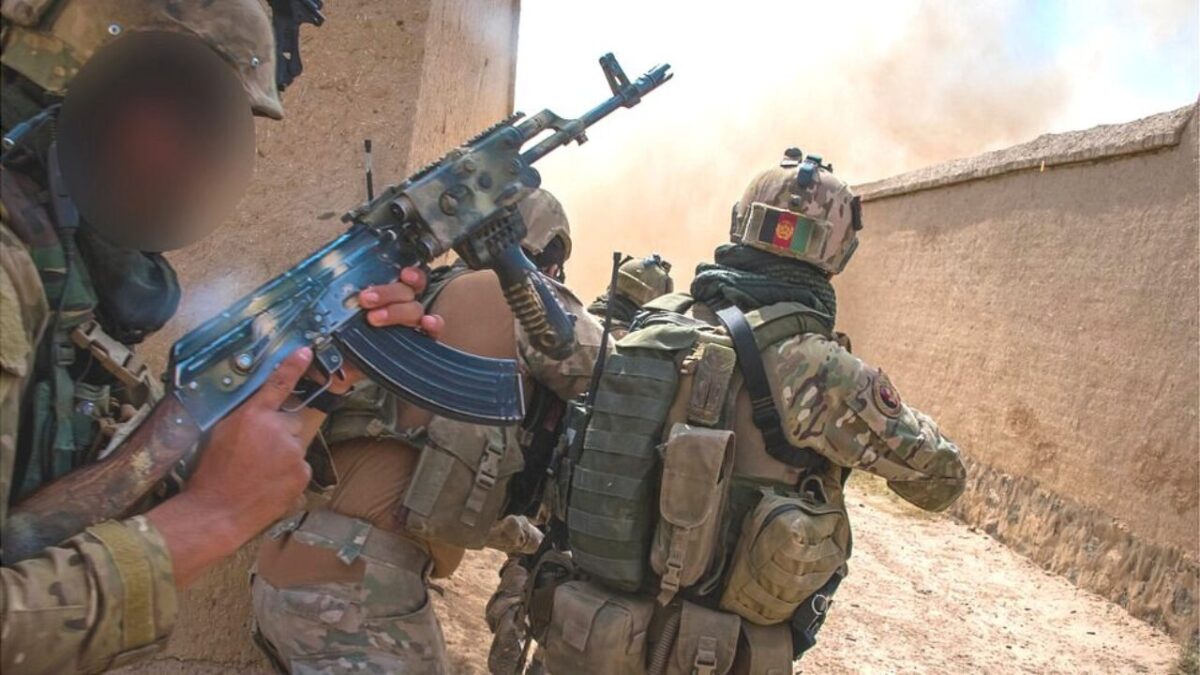
The British Ministry of Defense (MoD) has confirmed that it denied resettlement requests from more than 2,000 former Afghan commandos, despite credible evidence of their service in British-backed units in Afghanistan, the BBC reported.

According to the report, these forces were trained, funded, or directly supported by British troops before the Taliban takeover in 2021.

The revelation contradicts previous MoD claims that Afghan nationals who served alongside British forces were eligible for relocation under the U.K.’s resettlement policies.

Mike Martin, a British MP and member of the Defense Select Committee, called the decision “deeply concerning.”

“It appears that British special forces have blocked Afghan special forces’ applications because they may have witnessed alleged war crimes committed by the U.K.,” Martin told the BBC, referring to an ongoing investigation into Britain’s military conduct in Afghanistan.

He added that if the MoD fails to provide a clear explanation, the matter should be formally investigated.

The MoD’s rejection of more than 2,000 resettlement cases surfaced during a recent court hearing, as part of a legal challenge filed by a former member of British special forces earlier this month.

The American Fog and Iranian Year


Ghassan Charbel
Editor-in-Chief of Asharq Al-Awsat newspaper


Monday - 17 February 2025The diplomat is familiar with Washington and its hallways where decisions are made. He used to visit at the beginning of presidential terms and return with as many answers and expectations as possible to report to his superiors.

This time, however, he found himself confronted with a difficult task. He came across a Washington that was shrouded in heavy fog and with the world focused on the return of the “strongman” to the White House. Fog covered the whole of the United States and the diplomat came back with more questions than answers.

There is a feeling at the White House that the country is at a major turning point. Donald Trump will not make do with changing the furniture at the White House, but he is dreaming of changing the country’s political and economic features.

The diplomat said that the new American compass is so shaky that it has confused allies and enemies alike. Going along with Trump is like driving on a bumpy road in an almost impenetrable fog. He returned with the impression that he wanted to end the Russia-Ukraine war, not only because he has his sights set on the Nobel Peace Prize, but to reserve a place for himself in the history books. He seems to be relying on his old friendship with Vladimir Putin to achieve that goal as it appears that the war had not soured ties between them.

The diplomat also sensed that Washington was insistent on firmly tackling the Iranian file on the basis of preventing Tehran from developing a nuclear bomb and from mobilizing its “parallel armies” to destabilize the region. It doesn’t take a lot to realize that Trump wants to make peace in the Middle East. The diplomat paused, however, at Benjamin Netanyahu’s success in securing a close and influential alliance with the Trump administration.

Ever since he returned to the White House, Trump bombarded the world with a series of statements and posts that have created confusion across the world. He is on the brink of launching a trade war, is tackling the Ukraine file by recognizing the reality on the ground imposed by the Russian war, and created disarray by outrageously suggesting that Gaza’s residents be removed from the enclave so that it can be transformed in a beautiful riviera.

This confusion and fog appear to be absent when it comes to the Iranian nuclear file, where the Trump administration is not backing down from its positions.

Fog enveloped Europe when JD Vance, speaking from Munich, rebuked European countries for their alleged “stifling of freedoms”, criticizing them for their approach towards the far-right. Europe seemed to panic at the possibility of the Ukraine war being decided without it and President Volodymyr Zelenskiy. Vance seemed to echo Trump’s past remarks that the US will not forever continue to pay the price of protecting Europe.

Trump had made that statement back in 1987 when he was real estate developer far removed from the world of politics. That year, he visited Moscow and admired the opportunities available there. He declared that Europe can cover the costs of defending itself.

As the Europeans become preoccupied with the fate of the war in Ukraine, the people of the Middle East will be preoccupied with not only peace, but with what will happen with Iran. This is unquestionably Iran’s year. Trump had categorically declared that Iran will not be allowed to possess a nuclear bomb. US Secretary of State Marco Rubio reiterated that position from Israel on Sunday after meeting Netanyahu, who shared his stance.

The prevailing impression is that there can be no new deal with Iran that does not cover its rocket arsenal and destabilizing role in the region. The question is: Will the Iranian supreme leader agree to make such huge concessions over Iran’s role, especially in wake of its losses in Syria and Lebanon?

Important deadlines are approaching in the Palestinian territories, Iran and Ukraine amid the dense American fog. Syria, Lebanon and Iraq are also concerned with the fog and the choices America will make. A deep and detailed dialogue is necessary with the Trump administration because protesting is not a form of policy and does not protect stability and rights. An Arab vision for peace based on the two-state solution is necessary. This is the only way to end this chronic conflict.

With its political and economic weight, Saudi Arabia is the leading Arab and Islamic country capable of playing a role to that end. Its hosting of American-Russian meetings ahead of a summit is a testament to that role. It is also recognition by Washington and Moscow of Saudi Arabia’s Arab, Islamic and international standing. The current consultations to prepare an alternative plan to Trump’s Gaza proposal reflect this standing. Moreover, Saudi Arabia can benefit from the strong ties it has forged with heavyweights China and India, as well as the European Union.

We must be prepared for the Iranian year. An American-Iranian agreement will mark a major turning point in the region. Israel’s destruction of Iran’s nuclear facilities - with American support - will be another major and dangerous development that we must prepare for. The heavy fog should not be an obstacle to safe navigation if countries are prepared, use their strengths and hold dialogue with the Trump administration based on mutual interests, the benefits of stability and revenues from investments and prosperity.

'Whoops!' Trump mocked after report he 'accidentally fired people in charge of nukes'


David McAfee
February 16, 2025

Donald Trump (ALLISON ROBBERT/Pool via REUTERS/File Photo)

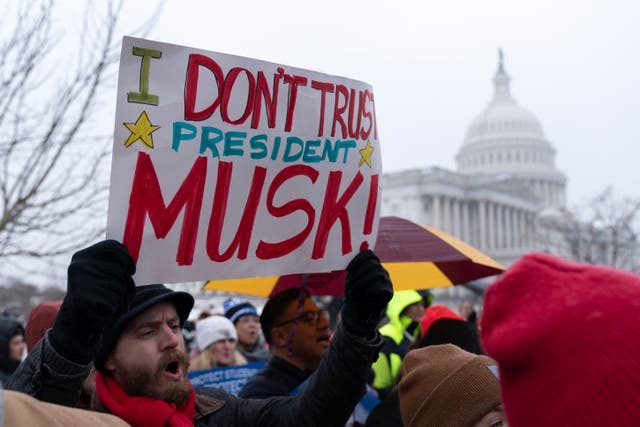
Donald Trump is being ridiculed after an Associated Press report that the President "has reversed the firings of all but 28 of the nuclear weapons workers that" Elon Musk's team "blindly cut."

Tara Copp, Pentagon Correspondent at Associated Press, which is currently embroiled in its own dispute with Trump over White House access and the Gulf of Mexico, dropped the report Sunday.

"One of the hardest hit plants was Pantex -- near Amarillo, Texas -- where 30 percent of the cuts took place," Copp wrote on X. "The nuclear weapons role of those workers and the feds who oversee it is one of the most sensitive missions in the US."

Columnist and political analyst Molly Jong-Fast said, "Accidentally firing the people in charge of the nukes! Whoops!"

The writer then added, "Probably fine thou!"

Defend Our Constitution, a self-described Army veteran, said, "Trump and Musk are making America weaker not stronger."

"I never seen an incompetent team in the Oval Office like this. It’s embarrassing to be an American in front of the whole world," they added.

Political humorist Jesus Freakin Congress said, "The Trump administration fired 300-400 nuclear employees since they didn’t know what their job was… and now they are scrambling to get them to come back."

"So, if anyone was questioning if our enemies are infiltrating our government from the inside, the answer is yes… since they would be jumping on this if not," the user added.

Trump administration tries to bring back sacked nuclear weapons workers


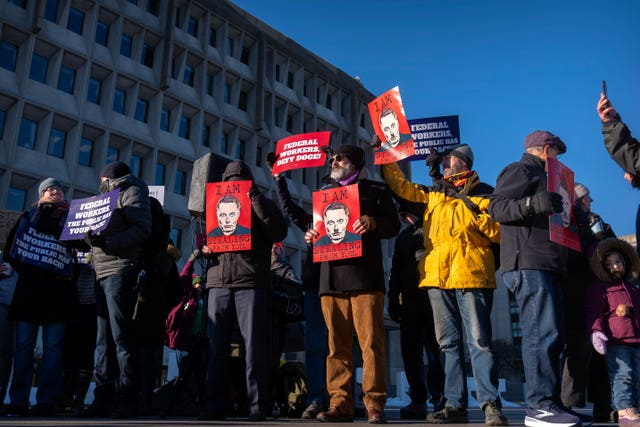
The Trump administration has halted the sackings of hundreds of US federal employees who worked on America’s nuclear weapons programmes.

The U-turn has left workers confused and led experts to warn that blind cost-cutting by the Department of Government Efficiency (DOGE) will put American communities at risk.

US officials said up to 350 employees at the National Nuclear Security Administration (NNSA) were abruptly laid off late on Thursday, with some losing access to email before they learned they had been dismissed. Some tried to enter their offices on Friday morning, only to find they were locked out.

One of the hardest hit offices was the Pantex Plant near Amarillo, Texas, which saw about 30% of the cuts.

Those employees work on reassembling warheads, one of the most sensitive jobs across the nuclear weapons enterprise, with the highest levels of clearance.

The move has sparked protests (AP)

The hundreds let go at NNSA were part of a DOGE purge across the Department of Energy that targeted about 2,000 employees.

Daryl Kimball, executive director of the Arms Control Association, referencing Elon Musk’s Department of Government Efficiency team, said: “The DOGE people are coming in with absolutely no knowledge of what these departments are responsible for.

“They don’t seem to realise that it’s actually the department of nuclear weapons more than it is the Department of Energy.”

By late on Friday night, the agency’s acting director, Teresa Robbins, issued a memo rescinding the firings for all but 28 of those hundreds of fired staff members.

“This letter serves as formal notification that the termination decision issued to you on February 13 2025 has been rescinded, effective immediately,” said the memo, which was obtained by the AP.

The accounts from the three officials contradict an official statement from the Department of Energy, which said fewer than 50 National Nuclear Security Administration staffers were let go, calling them “probationary employees” who “held primarily administrative and clerical roles”.

Many workers were reinstated after being dismissed (AP)

But that was not the case. The firings prompted one NNSA senior staffer to post a warning and call to action.

Deputy division director Rob Plonski posted to LinkedIn: “This is a pivotal moment. We must decide whether we are truly committed to leading on the world stage or if we are content with undermining the very systems that secure our nation’s future.

“Cutting the federal workforce responsible for these functions may be seen as reckless at best and adversarily opportunistic at worst.”

While some of the Energy Department employees who were fired dealt with energy efficiency and the effects of climate change, issues not seen as priorities by the Trump administration, many others dealt with nuclear issues, even if they did not directly work on weapons programmes.

This included managing massive radioactive waste sites and ensuring the material there does not further contaminate nearby communities.

That incudes the Savannah River National Laboratory in Jackson, South Carolina; the Hanford Nuclear Site in Washington state, where workers secure 177 high-level waste tanks from the site’s previous work producing plutonium for the atomic bomb; and the Oak Ridge Reservation in Tennessee, a Superfund contamination site where much of the early work on the Manhattan Project was done, among others.

US representative Marcy Kaptur of Ohio and US senator Patty Murray of Washington, both Democrats, called the firings last week “utterly callous and dangerous”.

The NNSA staff who had been reinstated could not all be reached after they were fired, and some were reconsidering whether to return to work, given the uncertainty created by DOGE.

Many federal employees who had worked on the nation’s nuclear programmes had spent their entire careers there, and there was a wave of retirements in recent years that cost the agency years of institutional knowledge.

It is now in the midst of a major 750 billion dollar (£595 billion) nuclear weapons modernisation effort – including new land-based intercontinental ballistic missiles, new stealth bombers and new submarine-launched warheads. In response, the labs have aggressively hired over the past few years. In 2023, 60% of the workforce had been there five years or less.

Edwin Lyman, director of nuclear power safety at the Union of Concerned Scientists, said the firings could disrupt the day-to-day workings of the agency and create a sense of instability over the nuclear program both at home and abroad.

He said: “I think the signal to US adversaries is pretty clear: throw a monkey wrench in the whole national security apparatus and cause disarray.

White House says some employees
who accepted buyout offer fired by mistake: Report

'Some employees who responded to the buyout offer ahead of the deadline last week may have received termination notices by mistake,' official says


Muhammed Enes Çallı
17.02.2025 -
 TRT/AA

ISTANBUL

The White House said some government employees who accepted the buyout offer were fired by mistake, according to a report on Monday.

"President Donald Trump's administration acknowledged on Sunday night that some federal government employees who took the 'Fork in the Road' buyout offer were also, subsequently, fired or let go — and that this was an error," ABC News reported.

"An Office of Personnel Management official told ABC News that some employees who responded to the buyout offer ahead of the deadline last week may have received termination notices by mistake but, for those personnel, the buyouts agreements would be honored," it added.

Nick Detter told ABC News that he is one of the workers affected.

Detter, a natural resource specialist with the US Department of Agriculture, said he was fired on Thursday, despite having already accepted the administration's buyout offer, which should have ensured he was paid through September.

Despite the OPM's explanation, Detter claims he has not received any direct guidance. He added that his supervisors in Kansas, where he is based, told him they had no information.

"I frankly find it pretty insulting and chaotic and disorganized," Detter told ABC News.