It’s possible that I shall make an ass of myself. But in that case one can always get out of it with a little dialectic. I have, of course, so worded my proposition as to be right either way (K.Marx, Letter to F.Engels on the Indian Mutiny)
Monday, February 17, 2025
Bezos’s Blue Origin rocket firm to cut 10% of workforce
By AFP February 13, 2025 Blue Origin, whose rockets include New Shepard, seen in March 2022, has been attempting to land large government contracts - Copyright AFP Patrick T. FALLON
Jeff Bezos’s rocket company Blue Origin is laying off around 10 percent of its workforce following a period of rapid expansion, the firm’s chief executive told staff on Thursday.
“We grew and hired incredibly fast in the last few years,” CEO Dave Limp wrote in an email — a copy of which was obtained by AFP — explaining the company’s “tough” decision.
“With that growth came more bureaucracy and less focus than we needed,” he continued, adding that the makeup of the company “must change.”
“Sadly, this resulted in eliminating some positions in engineering, R&D, and program/project management and thinning out our layers of management,” he said.
The decision will affect more than 1,000 people given the firm’s roughly 11,000 employees, according to a recent PitchBook estimate of staffing levels.
Blue Origin is one of the United States’ largest private space companies, and has in recent years been attempting to win lucrative government contracts in an industry still largely dominated by Elon Musk’s SpaceX.
Its massive New Glenn rocket recently reached orbital space for the first time, marking a potential turning point in the commercial space race
Ecuador’s wild west shows limits of Noboa’s ‘iron fist’
Members of the Ecuadoran armed forces patrol the Jambeli Archipelago in the province of El Oro - Copyright AFP ANDREW CABALLERO-REYNOLDS
Andrew BEATTY
On Ecuador’s lawless southwest coast, drug gangs operate with impunity and terrified residents ask if their president’s “iron fist” security policies are just words.
In a darkened military command center near the Peruvian border, eight Ecuadoran marines armed with rusting M4 rifles prepare for a patrol.
For their safety, all are heavily masked. Name tags and rank insignia are removed.
They are about to enter cartel country, where the state has no monopoly on the use of force.
Like much of once-tranquil Ecuador, Puerto Bolivar has become a battleground for rival cartels fighting to bring record amounts of cocaine from Colombia and Peru to Europe, North America and Asia.
Last year, the marines found about 30 bodies in waters near the port, some decapitated, others otherwise mutilated.
A recent bomb targeting a local gang leader killed two people and levelled several homes.
“There is no security,” said one resident who asked not to be named for fear of being killed. “The country has been completely abandoned.”
The marines tear away from the quay in two boats, racing through a mud-brown maze of canals and estuaries flanked by mangroves, docks and fishing villages.
Most of their four-hour patrol is unremarkable. They search a few fishing boats and find nothing.
But when they enter Huayala — an estuary stuffed with ramshackle docks and cinder block buildings — the unit snaps into position, their rifles cocked and raised.
The marines nervously scan the jumble of boats and buildings, where hundreds of eyes peer back from the shadows.
“It’s not a good idea to stay here long,” confides one of the marines. “Someone could take a shot.”
– Paying for ‘vaccines’ –
Puerto Bolivar is one of the world’s most important banana-exporting ports and a key seafood trading post — strategically vital for Ecuador’s economy.
But today, the container cranes appear idle and the deepwater docks are mostly empty.
The boom businesses are extortion, kidnapping, assassination, illegal fishing, money laundering and cocaine trafficking.
Most locals are too scared to talk. “They might go as far as killing me or my family” said one old man, before his wife pulled him away.
But a handful of residents are angry enough to speak out and risk their lives.
One of them is a local fisherman who agreed to speak to AFP on condition of anonymity.
He arrives at a secure meeting point wearing a facemask and cap and determined to tell the world what is happening to his community, and to his country.
He admits paying a “vacuna” or vaccine, to the gangs — a monthly fee, plus 20 percent of his catch in return for his safety.
“If we ignore them, they sink our boats or steal our engines. Some fishermen have simply disappeared,” he said.
Others happily work for the cartels because they pay more.
The fisherman described the myriad ways the gangs make money, from gold mining to smuggling fuel into Peru.
Some schemes are simple — banana shipments loaded with cocaine and sent to Europe. Others are complex, involving the purchase of non-existent fish to launder money.
The names of the gangs and their leaders are well known to everyone — Los Lobos (The Wolves), Los Lobos Box and Los Choneros.
“Some of them I have known since they were kids running around without shoes,” said the fisherman.
Criminal influence is out in the open.
One of the area’s numerous brothels is called “Napoles,” in homage to the notorious Colombian drug lord Pablo Escobar’s opulent estate of the same name.
The military admits that ranking figures in Mexico’s Jalisco New Generation Cartel are deeply engrained in the area. They visit and do business out in the open.
– ‘The judges don’t judge’ –
President Daniel Noboa has responded to Ecuador’s security crisis by declaring a state of emergency, making high-profile arrests and sending the military onto the streets and into gang-controlled prisons.
But in Puerto Bolivar locals see little impact.
Noboa lost the province by five points to his leftist rival in Sunday’s election and may not fare any better in April’s second-round runoff.
Evan Ellis, a Latin America security expert and former State Department advisor, said Noboa’s deployments have “caused (gangs) to ‘lay low’ to some degree”.
But they “did not address the fundamental problems of the flow of drugs through the country and the associated battles for control over routes.”
The deployments may also have left the military shorthanded and in a difficult position.
Navy Captain Carlos Carrera admits “the Armed Forces are not designed to combat organized crime or to directly provide internal security. We can help the police.”
But according to the fisherman from Puerto Bolivar, the police don’t always police, “the prosecutors don’t prosecute and the judges don’t judge.”
One official recalled a woman who approached the police for help escaping her gang member partner.
She was betrayed, loaded onto a boat in plain sight and taken to an island, where she was allegedly beaten, raped and murdered.
“There is no one in charge here,” said one resident of Pitahaya, a nearby fishing village.
“We live in fear that we will lose everything over some little thing”.
OpenAI’s board chairman on Friday said it has unanimously rejected an Elon Musk-led offer to buy the hot artificial intelligence company for $97.4 billion.
“OpenAI is not for sale, and the board has unanimously rejected Mr. Musk’s latest attempt to disrupt his competition,” chairman of the board Bret Taylor said in a statement posted by the company on Musk-owned X, formerly Twitter.
“Any potential reorganization of OpenAI will strengthen our nonprofit and its mission to ensure AGI (artificial general intelligence) benefits all of humanity,” the statement continued.
Musk filed court documents on Wednesday saying that he would withdraw the offer to buy OpenAI if its board returns the artificial intelligence pioneer to a non-profit “charity” model.
OpenAI currently operates a hybrid structure, as a non-profit with a money-making subsidiary.
The change to a for-profit model — one that Altman considers crucial for the company’s development — had exacerbated ongoing tensions with Musk.
Tension between super wealthy Elon Musk (l) and OpenAI chief Sam Altman has escalated with Musk’s rejected offer to buy the artificial intelligence firm – Copyright AFP/File JIM WATSON, JOEL SAGET
Musk and Altman were among the 11-person team that founded OpenAI in 2015, with the former providing initial funding of $45 million.
Three years later, Musk departed the company, with OpenAI citing “a potential future conflict for Elon… as Tesla continues to become more focused on AI.”
Musk established his own artificial intelligence company called xAI early in 2023 after OpenAI ignited global fervor over the technology.
The massive costs of designing, training, and deploying AI models have compelled OpenAI to seek a new corporate structure that would give investors equity and provide more stable governance.
The transition to a traditional for-profit company requires approval from California and Delaware authorities, who will scrutinize how the non-profit arm of OpenAI is valued when it becomes a shareholder in the new company.
Current investors prefer a lower valuation to maximize their share of the new company.
Musk’s bid, valuing the OpenAI non-profit at $97.4 billion — approximately $30 billion above the level in current negotiations, according to The Information — appears designed to disrupt the company’s fundraising efforts.
OpenAI’s Chief Global Affairs Officer Chris Lehane has said Musk’s offer came from a competitor “who has struggled to keep up with the technology and compete with us in the marketplace”.
Facebook, TikTok harden EU commitment to tackle disinformation — but not X
Digital titans including Facebook and TikTok formally pledged to ramp up the fight against disinformation in the EU, Brussels said on Thursday, just days after the new US administration condemned the bloc’s online content rules.
Missing from the list of 42 platforms — including those owned by Google, Meta and Microsoft — who committed to a strengthened code of conduct was tech billionaire Elon Musk’s social media platform X.
Musk withdrew his platform — then known as Twitter — from the original code in May 2023 and he has repeatedly railed against the European Union’s content moderation rules known as the Digital Services Act (DSA).
The DSA forces all digital firms to police content online and tackle the spread of mis- and disinformation. The EU has been probing X under the DSA since December 2023, including its efforts to combat disinformation on the platform.
The law is at the centre of growing tensions between American big tech and the new US administration on one side, and the EU on the other.
US Vice President JD Vance slammed the DSA during his speech on Tuesday at the AI summit in Paris, saying it was not up to national capitals to “prevent a grown man or woman from accessing an opinion that the government thinks is misinformation”.
The EU has refused to comment on Vance’s remarks.
But announcing the formalisation of the code of conduct under the DSA, EU tech chief Henna Virkkunen said “Europeans deserve a safe online space where they can navigate without being manipulated”.
This “is an important milestone in stepping up the EU’s regulatory framework in the fight against disinformation. I will engage with the signatories to ensure there are effective efforts to protect democratic processes”, she added in a statement.
The code will serve as a “meaningful benchmark for determining DSA compliance” when it applies from July, the European Commission said.
For example, the EU believes fact-checking is an effective form of content moderation and it is included in the code, but it does not force companies to do it.
Meta remains part of the code despite its CEO Mark Zuckerberg aligning himself with the new White House and slamming EU rules as “censorship” in January as he announced a halt to US fact-checking operations for its Facebook and Instagram platforms.
An EU official admitted that if Meta wanted to withdraw from its commitments under the code, “we cannot force them to stay”.
The official stressed that simply signing the code did not amount to a “presumption of innocence” and that platforms had to implement effective measures to fight disinformation.
The code was also signed by Adobe, LinkedIn, Twitch, Vimeo and YouTube.
Trump eyes summit with Xi-Putin, shaking up world order
US President Donald Trump has cast himself in his second term as a global peacemaker - Copyright AFP ANDREW CABALLERO-REYNOLDS
Danny KEMP
Donald Trump unveiled an extraordinary vision of a shake-up to the world order Thursday, eyeing a three-way summit with the Russian and Chinese leaders just a day after saying he had agreed with Vladimir Putin to start Ukraine peace talks.
With Kyiv and European capitals still stunned by Trump’s surprise call with Putin, the US president also said he would “love” to have Russia back in the G7, from which it was suspended in 2014 after Moscow annexed Ukraine’s Crimea peninsula.
“I think it was a mistake to throw him out,” Trump told reporters in the Oval Office, referring to Putin.
Trump — who has cast himself in his second term as a global peacemaker — also said he would consider a summit with Putin and China’s Xi Jinping “when things calm down.”
“When we straighten it all out, then I want one of the first meetings I have is with President Xi of China, President Putin of Russia. And I want to say, let’s cut our military budget in half.”
The US president, who was hosting India’s Prime Minister Nahendra Modi at the White House later Thursday, also called for the three powers to start cutting their nuclear arsenals.
“There’s no reason for us to be building brand-new nuclear weapons,” he added.
Trump meanwhile insisted the Russian leader wanted a ceasefire with Kyiv, despite President Volodymyr Zelensky on Thursday warning against trusting the Kremlin leader.
“I think he wants peace. I think he would tell me if he didn’t,” Trump said.
Trump made his comments after inking plans for sweeping “reciprocal tariffs” that could hit both allies and competitors.
– Seismic shift –
His remarks on Russia and China mark a seismic shift after more than a decade of US policy which had increasingly cast Moscow into the cold and largely viewed both it and Beijing as adversaries.
They will also be viewed with consternation by Ukraine and European allies, who will fear that if they are not at the table of international diplomacy, they could end up on the menu.
Trump’s overtures to Putin in particular have caused alarm in Europe, which has viewed its huge neighbor Russia as a major threat since the invasion of Ukraine.
Trump revealed Wednesday he expected to meet Putin separately in Saudi Arabia for Ukraine peace talks, in a sudden thaw in relations.
In their first confirmed contact since Trump’s return to the White House, the US president said he had held a “highly productive” conversation with his Russian counterpart who ordered the bloody 2022 invasion of Ukraine.
Several European nations have questioned Trump’s strategy and warned Washington not to hatch a deal without them.
The Trump administration’s talking points on Ukraine have also at times echoed Moscow’s, particularly when it comes to Kyiv’s dream of NATO membership to protect it from Russia.
“I believe that’s the reason the war started, because (predecessor president Joe) Biden went out and said that they could join NATO,” said Trump of Russia’s February 2022 invasion.
In 2014, Russia was suspended from what was then the G8 after it annexed Crimea and sanctions were imposed on Moscow.
In his first term, Trump also called for Russia to be readmitted, but he found little support among other Western countries.
Trump pushes Romanian government to ease up on accused MAGA-loving sex traffickers: report
Bucharest, Romania. 21st June, 2023: Andrew Tate and his brother Tristan Tate, surrounded by bodyguards, leave the Bucharest Court/ (LCV - Shutterstock)
President Donald Trump's administration has been urging the Romanian government to ease travel restrictions on Andrew and Tristan Tate, two brothers who have been indicted on sex trafficking and other charges in that country.
The Financial Times reports that "the Tates’ case was first brought up by US officials in a phone call with the Romanian government last week and then followed up by Trump’s special envoy Richard Grenell when he met the Romanian foreign minister at the Munich Security Conference."
Andrew Tate, a self-described misogynist influencer, has long been supportive of Trump and his MAGA movement.
Sanders Urges Europe to 'Stand Tall' Against Far-Right Boosted by Trump and Musk
"European friends: Do not accept lectures on democracy and freedom of speech from an administration that denies the 2020 election results and is now suing and intimidating news outlets whose reporting they don't like," said U.S. Sen. Bernie Sanders. Tens of thousands protest the Germany far-right on February 16, 2025 in Berlin. (Photo: Guy Smallman/Getty Images)
U.S. Sen. Bernie Sanders urged Europeans on Saturday to "stand tall against right-wing extremism" after the American vice president scolded the continent's leaders for not accommodating parties like the neo-Nazi Alternative for Germany, which appears poised for a strong performance in the approaching general election.
"European friends: Do not accept lectures on democracy and freedom of speech from an administration that denies the 2020 election results and is now suing and intimidating news outlets whose reporting they don't like," Sanders (I-Vt.) wrote in a social media post after U.S. Vice President JD Vance used his address at the Munich Security Conference to blast Germany's "firewall" against Alternative for Germany, also known as AfD.
Vance's speech was praised by AfD leader Alice Weidel—with whom the vice president met on Friday—and U.S. President Donald Trump, who called his second-in-command's remarks "very brilliant" as they sparked revulsion and open condemnation from European leaders.
The Guardian's Patrick Wintour characterized Vance's speech as "a call to arms for the populist right to be able to seize power in Europe, and a promise that the 'new sheriff in town' would help them to do so."
"Right-wing extremism is not just an American phenomenon. It's worldwide."
On Sunday, around 30,000 people took to the streets of Berlin to condemn Germany's far-right and specifically AfD, which has also been embraced by U.S. billionaire Elon Musk. AFPreported that "many carried placards with slogans denouncing" AfD, "which is expected to become the second-biggest party in next Sunday's vote."
One demonstrator, identified as 71-year-old Hannelore Reiner, told AFP that in the current moment she sees "a lot of parallels to 1933, to the time before the war when Hitler's fascism came to power."
"I'm afraid history will repeat itself," she said.
Sunday's protests came a week after hundreds of thousands of people took to the streets of Munich to protest the far-right—and a week ahead of Germany's closely watched general election on February 23.
The Associated Pressnoted Friday that AfD's rise in Germany "has coincided with that of far-right parties in many other European countries, including Austria's Freedom Party and the National Rally in France, with which it has plenty of common ground."
"Weidel was in Budapest to visit Hungarian Prime Minister Viktor Orbán on Wednesday," the AP added.
Following last weekend's demonstrations in Munich, Sanders emphasized that "right-wing extremism is not just an American phenomenon."
"It's worldwide," the senator wrote. "We're in solidarity with our friends in Germany who are standing tall against oligarchy, authoritarianism, and racism—and the AfD, the Musk-supported party."
‘United States of Extortion’: New Trump Ukraine ‘Shakedown’ Called ‘Cheap Mafia’ Move
Just weeks into his second term, President Donald Trump’s administration is not only grappling with a growing colossus of self-inflicted crises, but is now igniting international tensions as well. The administration is pressuring Ukraine to relinquish rights to half of its valuable precious metals—just as Trump and Russian President Vladimir Putin prepare to begin negotiations to end Russia’s illegal war against Ukraine.
“Multiple lawmakers here in Munich told me the U.S. Congressional delegation presented Zelensky with a piece of paper they wanted him to sign which would grant the U.S. rights to 50% of Ukraine’s future mineral reserves,” Washington Post foreign policy and national security columnist Josh Rogin reported Friday afternoon from the Munich Security Conference.
“Zelensky politely declined to sign it,” he added.
Trump has made it clear he expects Ukraine to hand over the rights to its rare earth minerals, which are extremely valuable.
“Rare earths are a group of 17 metals used to make magnets that turn power into motion for electric vehicles, cell phones, missile systems, and other electronics. There are no viable substitutes,” Reuters reported. The news outlet also noted that Trump “said on Monday he wants Ukraine to supply the United States with rare earth minerals as a form of payment for financially supporting the country’s war efforts against Russia.”
“We’re telling Ukraine they have very valuable rare earths,” Trump said. “We’re looking to do a deal with Ukraine where they’re going to secure what we’re giving them with their rare earths and other things.”
Trump’s expected haul: “close to $300 billion,” or more.
“We are going to have all this money in there, and I say I want it back. And I told them that I want the equivalent, like $500 billion worth of rare earth,” Trump said Monday, CBS News reported. “They have essentially agreed to do that, so at least we don’t feel stupid.”
The New York Times on Wednesday suggested Kyiv may be willing to play ball with the billionaire businessman.
“President Trump says he wants to make a deal for minerals from Ukraine in exchange for aid. That followed a long effort by Ukrainian officials to appeal to Mr. Trump’s transactional nature.”
Earlier this week Bloomberg reported on Trump’s call with Putin, saying, “European leaders, who were broadly aligned with Washington under Biden, were stunned to learn of the call and some said it appeared to signal that Trump was selling out Ukraine.”
“Trump is skeptical of providing more aid,” Bloomberg continued, “and if he does then he wants the US to be compensated – perhaps in the form of access to Ukraine’s mineral wealth. Treasury Secretary Scott Bessent was in Kyiv today to work on that part of the deal.”
Garry Kasparov, the internationally famous Russian chess grandmaster and now vice president of the World Liberty Congress, likened Trump’s demand to that of a Mafia don.
“Trump wants to give Russia something for nothing and expects Ukraine to give America something for nothing. Cheap mafia behavior,” he charged.
Olga Lautman, a non-resident Senior Fellow at the Center for European Policy Analysis (CEPA) and researcher of organized crime and intelligence operations in Russia and Ukraine, deemed the move “extortion.”
“This extortion by the [Trump] regime is outrageous. Europe needs to step up asap and help Ukraine,” she urged.
Professor Roland Paris, director of the Graduate School of Public and International Affairs at the University of Ottawa, doubly mocked the administration: “The United States of Extortion. (Can Google update its maps with this new name?)”
The Atlantic’s David Frum, a Bush 43 speechwriter, declared it, “Gangsterism.”
Jay Nordlinger, a senior editor for the right wing National Review, blasted the administration:
“The United States ought to back Ukraine because it is the right thing to do, morally, and, above all, because it is in the hard U.S. interest to do so. To shake down a country that is struggling for its very existence is, to my sense, repulsive.”
Russia-US meeting on Ukraine in Saudi Arabia set for Feb.18 without Kyiv’s participation: Media reports
Russian media outlet claims Russian Foreign Minister Lavrov to head Russian delegation, while his counterpart Rubio to head US negotiation team
Elena Teslova |17.02.2025 - TRT/AA/AP
MOSCOW
A Russian daily has claimed that the Russia-US meeting on Ukraine will take place on Tuesday in Saudi Arabia, while American media reported that Kyiv was not invited to take part in the gathering.
The Russian daily Kommersant claimed on Sunday with a link to its sources in the Kremlin that the Russian official delegation will be headed by Foreign Minister Sergey Lavrov and the US negotiation team by Secretary of State Marco Rubio.
The US team will also reportedly include National Security Adviser Mike Waltz and Special Envoy for the Middle East Steve Witkoff.
Meanwhile, American media reported that the Ukrainian authorities were either not invited or unwilling to take part in the meeting.
Last Wednesday, Russian President Vladimir Putin and his US counterpart Donald Trump agreed in a phone talk to organize contacts on the Ukrainian settlement as soon as possible.
Trump made ending the ongoing Moscow-Kyiv war a part of his presidential election campaign.
Europe out of Ukraine ceasefire talks
Head of the Ukrainian Presidential Office Andriy Yermak met with US Special Representative Kellogg to discuss continued support for Ukraine on February 14. / bne IntelliNewsFacebook
When asked if Europe will be at the table in the upcoming US-Russia negotiations to end the conflict in Ukraine, US special envoy to Ukraine retired Lieutenant General Keith Kellogg said “no.”
Asked at the Munich Security Conference (MSC) on February 15: “Can you assure this audience that Ukrainians will be at the table and Europeans will be at the table?”, his response was: “the answer to that last question is no.”
In a follow up question, he was asked to confirm the fact that Europe would not be invited to the talks and replied: “So the Europeans… you don't think you should be at the table directly? I’m from the school of realism, I think that’s not going to happen.”
The Kremlin is delighted with the chaos that emerged from the MSC summit. Moscow and Washington will from now on “focus on peace not war,” Kremlin Spokesman Dmitry Peskov said in an interview with television host Pavel Zarubin on February 16.
"They send a powerful message that from now on we will try to solve problems through dialogue. And from now on we will talk about peace, not war," he said.
According to Peskov, Trump’s views should appeal to any sound-minded person. He said Russia completely lacked communication with the previous US administration, TASS reported.
Zelenskiy’s worst fears have been confirmed with the weekend’s comments at the MSC. During his conversation with US President Donald Trump last week, he pushed for reassurances of US support and got none.
“A few days ago, President Trump told me about his conversation with Putin. Not once did he mention that America needs Europe at that table. That says a lot. The old days are over – when America supported Europe just because it always had,” Zelenskiy said at the MSC conference.
A rapidly expanding chasm is opening up in trans-Atlantic ties, and Kellogg said he understood that barring Europe from the talks might be “like fingers on a chalkboard, may grate a little bit but I'm telling you something that's really quite honest.”
Kellogg’s remarks follow on from a controversial speech by US Vice President JD Vance who lambasted the EU for falling down on freedom of speech values and accused it of undermining democracy. He added insult to injury by meeting with the far-right AfD (Alternative für Deutschland) leader Alive Weidel while in Germany provoking German Chancellor Olaf Scholz into accusing the US of interfering in Germany’s elections; Germans go to the polls on February 23 and Scholz’s SPD is trailing in the polls with 15%, while AfD is in second place with 21% and will likely get a boost from the US’ de facto endorsement. The Christian Democratic Union is currently leading with 31% and its leader (CDU) Friedrich Merz, who is almost certain to become the new chancellor, is downbeat on supporting Ukraine.
Europeans are in shock and scrambling to form a united response to the US position as it will attempt to barge its way into the talks. The official line throughout the last three years has been that only Kyiv can decide to bring the war to an end and must not only participate in talks but lead them to get terms that are acceptable to Bankova (Ukraine’s equivalent of the Kremlin) for a “just” and long-lasting peace.
French President Emmanuel Macron has called for an emergency EU summit in Paris on February 17. Germany, Italy, and Poland are to meet in Paris together with Nato General Secretary Mark Rutte.
Europe is clearly torn over Trump’s decision to ignore it in the upcoming negotiation, with some EU members demanding the solution to the Ukraine crisis is a problem that can only be solved by the international community in cooperation with Kyiv, while others remain focused on maintaining good relations with the US and the security umbrella it has provided since the end of WWII.
German Foreign Minister Annalena Baerbock described the situation as a "moment of truth" for Europe, urging European leaders to unite and take decisive action.
“This is an existential moment. It’s a moment where Europe has to stand up,” she said in a speech at the MSC. “There won’t be any lasting peace, if it’s not a European-agreed peace.”
UK Prime Minister Keir Starmer on the other hand said that his primary goal in the Paris summit meeting would be, “to ensure we keep the US and Europe together. We cannot allow any divisions in the alliance to distract from the external enemies we face.”
A visibly stressed Zelenskiy lashed out at the US proposal: “Ukraine will never accept deals made behind our back without our involvement, and the same rule should apply to all of Europe,” he said in his MSC speech.
He called for a creation of an “armed forces of Europe” because the US can “no longer be counted on to support the Continent,” after Rutte made it clear that Ukraine was “never promised Nato membership” during his comments at the MSC.
“I really believe that time has come,” Zelenskiy told the MSC delegates. “The armed forces of Europe must be created.”
Washington sent out a questionnaire last week asking what they would be willing to do to keep the peace in Ukraine after a ceasefire. It includes six questions including a request for an indication of how many troops they would be willing to contribute to a peacekeeping force, sources told Reuters.
“The Americans have provided Europeans with the questionnaire on what would be possible,” Finnish President Alexander Stubb said. “This will force Europeans to think, then it’s up to the Europeans to decide whether they actually answer the questionnaire, or whether they answer it together.”
Sending peacekeepers to enforce a ceasefire and police a demilitarised zone (DMZ) is one of the options that the Western allies are looking at in lieu of full Nato Article 5-like security guarantees. Some have proposed a force of 40,000 peacekeepers, but Zelenskiy has called for 200,000. However, the Kremlin is likely to reject the idea of any Nato-backed forces on Ukraine’s territory out of hand.
In his victory plan circulated in December, Zelenskiy pushed for accelerated Nato membership as Europe’s “cheapest” option for providing the security deals Ukraine needs for any ceasefire deal to work that remain elusive. But those hopes have been dashed. It is now clear Ukraine will not be admitted to Nato for at least 25 years, according to US Secretary for Defence Pete Hegseth, ending the rhetoric of Ukraine’s “irreversible path” to Nato membership.
Zelenskiy responded that Ukraine will have to “build our own Nato” by expanding the Armed Forces of Ukraine (AFU) to at least 1.5mn men and boost its own domestic defence industry at a time when the war is going increasingly badly for Ukraine.
Zelenskiy also told The Associated Press on February 15 that he “didn’t let” his ministers sign off on an agreement with the US to exploit Ukraine’s considerable mineral resources, because “it is not ready to protect us, our interest.”
Crown Prince Mohammed bin Salman (MbS), who is emerging as a key player in the Middle East peace process, has also called an emergency summit for the five leading Arab states to work out a response to Trump’s proposal to “take over” Gaza and expel around 2mn Palestinians that live there to build a “Riviera of the Middle East.” As bne IntelliNews reported, the chances of the Ukraine conflict being linked to Palestine are increasing.
Russia’s Foreign Ministry and the US State Department said that Russian Foreign Minister Sergey Lavrov and US Secretary of State Marco Rubio spoke on February 15 by phone. Rubio reaffirmed Trump’s “commitment to finding an end to the conflict in Ukraine. In addition, they discussed the opportunity to potentially work together on a number of other bilateral issues,” US State Department spokesperson Tammy Bruce said, reports AP.
Rubio is currently on tour in the Middle East ahead of the Ukraine ceasefire talks that will be held in Riyadh to sound out Arab leaders ahead of the negotiations with Russia.
Shut up and pay
Kellogg also made it clear that even if Europe was part of the negotiations, the White House still expects Brussels to abide by the deal and moreover continue to provide Ukraine with both military and financial aid. Trump has previously said that Europe “must pay and do more” for Ukraine because of its geographical proximity to the war.
“You have to understand, when you sign up for these security guarantees, that is an obligation and the reason I say that and I challenge many people that are out there, right now, 2014 Wales declaration, all the Nato allies, 2% of GDP, 20% of that was modernisation, there are still eight nations who've not even gotten to that number, okay? So, when we get to it make sure you check your six as they say that the obligation is upon YOU when WE make these commitments,” Kellogg said.
European leaders are in crisis mode as it becomes increasingly clear that Trump’s plan is that “Europe should stay out of negotiations that will fundamentally affect their security architecture - yet bear the primary responsibility and cost for the negotiations' outcome,” political commentator Arnaud Bertrand said in a social media post. Moreover, it is also clear that Trump is looking to take control of Ukraine’s rare earth mineral deposits as payment for US support. “As Greek historian Thucydides wrote 2,500 years ago, “the strong do what they can and the weak suffer what they must”," Bertrand added.
"If the United States is going to monetise its support for the defence of Kyiv, then why not dozens of other countries that helped? And if that happens, there will be nothing left of the country but bones," Bloomberg commentator and former editor of the Moscow Times said in a recent opinion piece.
The US support for Ukraine already petered off in 2023 when it ran out of money for Ukraine at the start of the year before finally putting a $61bn aid package in place on April 20. However, earlier this month Zelenskiy complained that Ukraine has received less than half of the support the US promised and some $100bn from a total of $177bn pledged has failed to appear in Kyiv as Ukraine’s relations with the newly installed Trump administration got off to a rocky start thanks to missing money, delayed arms deliveries and demand for mining deals.
The split of support between Europe and the West for Ukraine is already at 60/40, according to the Kiel Institute that tracks support, and US support is expected to fall off further and quickly under Trump’s leadership.
“Over the past three years of war, donor countries have provided a low but continuous flow of support to Ukraine, with a value of about €80bn per year. European donors have been the main source of aid to Ukraine since 2022, especially when it comes to financial and humanitarian aid,” the Kiel Institute says on its website. “In total, approximately €267bn in aid has been allocated to Ukraine over the past three years, amounting to more than €80bn per year. Of the total around €130bn (49%) was allocated in military assistance, €118bn (44%) in financial support, and €19bn (7%) in humanitarian aid.”
Zelenskiy faced the grim realities of his worsening position at Munich, saying that it will be “very difficult” for Ukraine to continue its military campaign without continued US support.
European leaders seek to prevent rewarding Russian aggression, Spain says
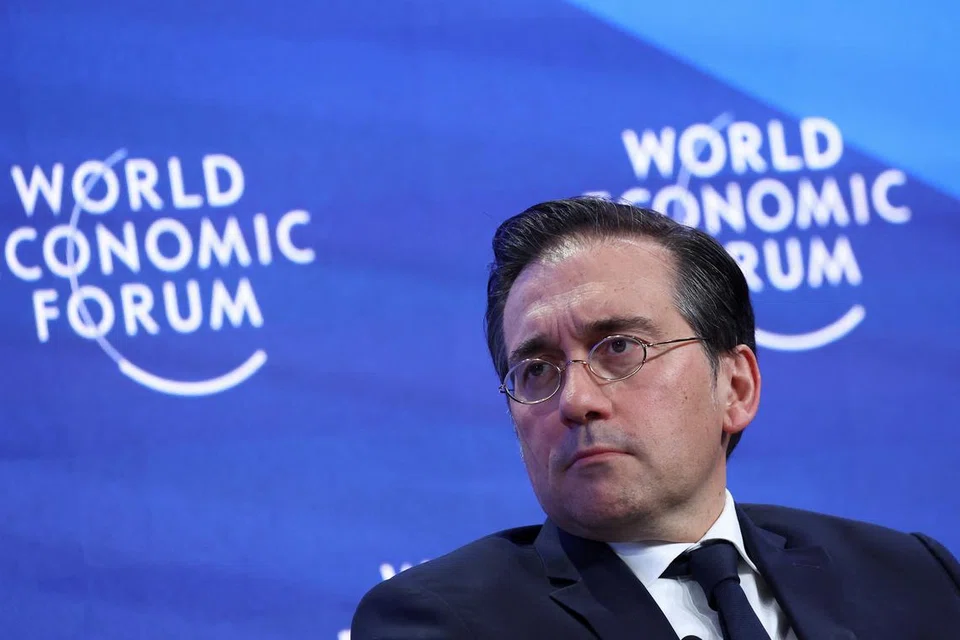
Spain's Foreign Minister Jose Manuel Albares looks on as he attends the 55th annual meeting of the World Economic Forum (WEF) in Davos, Switzerland, January 21, 2025.
REUTERS/Yves Herman/File Photo
UPDATED Feb 17, 2025
MADRID - Spanish Foreign Minister Jose Manuel Albares said European leaders will discuss in Paris on Monday how to prevent a peace negotiation on Ukraine ending up rewarding Russian aggression.
"A war of aggression cannot be rewarded, we cannot encourage others to launch wars of aggression," he said in an interview with radio station Onda Cero.
"Today I'm convinced Putin will keep attacking and bombing Ukraine. So I do not see peace on the horizon at the moment," he added.
Albares spoke ahead of an emergency summit of European leaders, including Britain's Prime Minister Keir Starmer, hosted by French President Emmanuel Macron on the Ukraine war. The summit was convened after U.S. officials suggested Europe would have no role in any talks on ending the conflict.
U.S. President Donald Trump stunned European NATO allies and Ukraine last week when he announced he had held a call with Russian President Vladimir Putin without consulting with them and would start a peace process.
U.S. Secretary of State Marco Rubio arrived in Saudi Arabia on Monday ahead of expected talks with Russian officials aimed at ending Moscow's nearly three-year war in Ukraine.
REUTERS
Poland to play key role in EU Paris meeting to counter Trump’s Ukraine talks exclusion
Polish Prime Minister Donald Tusk will travel to Paris to meeting other key EU leaders to work on a response to US President Donald Trump’s decision to exclude the EU from upcoming Ukraine ceasefire talks with Russia. / bne IntelliNews
Poland was the poor second cousin to its EU peers when it first joined the EU two decades ago. But a flourishing economy, its frontline position and growing military might means it’s been promoted to the top table as the leaders of the most powerful countries in Europe meet in Paris on February 17 to respond to US President Donald Trump’s decision to exclude Europe from the upcoming Ukraine ceasefire talks.
The Paris summit is expected to discuss the US decision, following comments made by special envoy to Ukraine retired Lieutenant General Keith Kellogg at the Munich Security Conference (MSC) at the weekend.
Speaking at the Munich Security Conference, Polish Foreign Minister Radoslaw Sikorski, said he was “very glad that President Macron has called our leaders to Paris” to discuss “in a very serious fashion” the challenges posed by Trump.
“President Trump has a method of operating which the Russians call razvedka boyem – reconnaissance through battle: you push and you see what happens, and then you change your position ... and we need to respond,” the Polish minister said speaking in Munich at the weekend.
Sikorski said the current situation was both “a crisis and a result” of Europe having consumed a “peace dividend” for too long, adding on February 15 that he was not too concerned that Europe had not been consulted ahead of Trump’s phone call with Putin last week.
European countries will not create one unified army in response to threats from Russia, said Sikorski in an interview with state TV broadcast on February 15, responding to Zelenskiy calls for the creation of an “armed forces of Europe,’ but he added that he was a supporter of boosting Europe’s defences.
He went on to say that the Trump-Putin “call was a mistake because it vindicates President Putin and lowers morale in Ukraine” but asserted that, sooner or later, Europe would have to be involved in talks on Ukraine’s future security.
“But when President Trump says that as part of a deal there will have to be European troops [safeguarding a deal] then it will be up to us to supply them, so sooner or later we will have to be involved,” he said.
Sending peacekeepers to Ukraine to police a proposed demilitarised zone (DMZ), one of the options on the table for ending the war, has been championed by French President Emmanuel Macron, who called the meeting.
The White House is also interested in the idea, and Trump has already made it clear that no US troops will be sent to Ukraine. Washington sent out a questionnaire last week asking what EU countries are willing to do to keep the peace in Ukraine after a ceasefire. It includes six questions including a request for an indication of how many troops they would be willing to contribute to a peacekeeping force, sources told Reuters.
Tusk said in December in a meeting with Macron that currently Poland has no plans to send peacekeepers to Ukraine. But has said at the same meeting that Europe expected to be able to “work closely” with the new Trump administration, rather than be completely excluded from the discussions on the future of Europe’s security. Poignantly at that meeting, both Tusk and Macron emphasised that no solution affecting Ukraine will be made without Kyiv and any agreement to end the fighting will be negotiated by Ukraine and with the aim of securing Ukraine’s interests.
Trump said that Europe needs to “do more” for its own security and has threatened to not honour US’ Nato obligations for any country that has not spent the mandated 2% of GDP on defence. More recently he called for Nato members to spend 5% of GDP on arms, a call which most EU countries have rejected.
Part of Ukraine’s problem has been that while the EU has thrown vocal support behind Kyiv in its conflict with Russia, it has not matched the words with actions. As bne IntelliNews has been reporting for two years, Europe was extremely slow to sign off on military procurement contracts with privately-owned arms producers that would allow them to ramp up production. An EU promise to provide Ukraine with a million artillery shells by March 2023 was missed and only fulfilled nine months later.
Moreover, as the US wound down deliveries from its own stockpiles to Ukraine last year, the burden has shifted to Europe, which provides most of Ukraine’s imported military hardware and has drastically deleted its own stocks. Germany in particular, which has both the largest standing army and defence sector, will take decades to rebuild it to 2004 levels, according to the government. The report from former Italian Prime Minister and ex-European Central Bank boss Mario Draghi released at the end of last year also highlighted the sorry state of Europe’s defence sector after decades of underinvestment and called for massive investments of €800bn per year to bring Europe’s production up to speed.
Against this, Russian President Vladimir Putin rapidly put Russia’s economy on a war footing in the first year of the war and is currently outproducing all of Europe combined in production. Ukrainian President Volodymyr Zelenskiy admitted during his MSC speech that it will be “very difficult” to continue the war without US support.
Poland, however, has increased its defence spending in its 2025 budget to 4.7% of GDP – the highest level in Europe – and plans to triple the size of its military and create the largest conventional army in Europe.
At the same time, Poland has emerged as Europe’s growth leader and with its increasing economic clout it has also been promoted to the top tier of European politics. It is notable that Poland, currently holding the EU rotating presidency, was invited to Paris along with the UK, Italy and Germany after it has emerged as a major military power in Europe.
Several items are on the table in Paris, including the position Europe should adopt on Ukraine’s future membership of Nato, sending European peacekeepers to Ukraine should a deal be struck and what security guarantees Europe can offer Ukraine – a key demand of Zelenskiy - either through Nato or some European force.
After Ukraine’s hopes for rapid accession to Nato, the central demand in Zelenskiy’s victory plan, were dashed by Nato General Secretary Mark Rutte who said Ukraine was “never promised Nato membership” he called on Europe to create an “armed forces of Europe” at the weekend, saying Ukraine could play a key role as it already has a million men under arms.
Macron has also favoured moving Europe out from under the US security umbrella and taking more responsibility for its own defence. The French president also did a volte-face on providing Ukraine with strong security guarantees last year, but the rest of the EU has dithered on promising military support should Ukraine be attacked again.
The 2023 initiative, devised by France, also seeks to weaken Europe’s dependence on the US security umbrella – another one of Marcon’s initiatives that did not prove popular. Macron’s security deal proposal has encountered opposition from several "neutral" EU member states, including Austria, Ireland, Cyprus and Malta, the Financial Times reported. Macron argued that Europe was overly dependent on the US security umbrella and said that the EU should become “the third superpower” – a call that looks prescient now that the US looks like it is preparing to throw Ukraine under the bus without consulting the EU on an issue that is fundamental to the Continent’s security.
The Polish prime minister, Donald Tusk, who will travel to Paris on February 17, seems to agree and said in a social media post: “Europe urgently needs its own plan of action concerning Ukraine and our security, or else other global players will decide about our future. Not necessarily in line with our own interest … This plan must be prepared now. There’s no time to lose.”
Tusk will play a key role in the meeting and remains an ardent supporter of the Ukrainian cause, while UK Prime Minister Keir Starmer, on the other hand, said ahead of the summit that his primary goal is, “to ensure we keep the US and Europe together. We cannot allow any divisions in the alliance to distract from the external enemies we face.”
German Chancellor Olaf Scholz is somewhere in the middle; Germany has been the most generous of all the EU members with its financial aid to Ukraine, but extremely cautious with military supplies, afraid of provoking Russia into a direct conflict with Nato. Berlin has come under heavy criticism for not providing Ukraine with its powerful Tartus cruise missiles, while both France and the UK have supplied Kyiv with their highly effective Storm Shadow missiles.
Polish military
Poland meanwhile is in a strong position to support Ukraine militarily and Tusk pledged to put the Ukraine crisis at the top of his agenda as EU president.
Under the Homeland Defence Act, Poland has significantly boosted its defence budget, allocating PLN187bn zlotys ($48.7bn) for 2025, aiming to reach 4.7% of its GDP. The country plans to enlarge its military personnel to 300,000 by 2035, up from the current 207,500, making it Nato's third-largest army as well as adding plans to introduce a voluntary basic military service.
Poland has also been a close ally of the US, purchasing much of its equipment there - including orders for 250 M1A2 Abrams tanks - as well another 1,000 K2 Black Panther tanks from South Korea.
In addition, Poland hosts a rotating force of 10,000 US troops on its territory, with the government covering the cost of its maintenance and infrastructure investments. Warsaw has been pushing Trump to make the force permanent, but the White House has so far resisted, leaving the option of withdrawing the troops open.
As a frontline state in the rising tensions with Russia in Europe, Poland’s "East Shield" initiative aims to fortify Poland's eastern borders with Belarus and Russia's Kaliningrad region.
Military analysts have long assumed that if Russia were to launch a full-scale military invasion of Europe, a large force would come through the so-called Suwalki Gap that would only take five days to cut the Baltic states off from Nato support, overrunning the Baltic Sea coast making the Polish border the frontline in a European war. Warsaw has already invested PLN10bn into physical barriers, advanced surveillance systems, and infrastructure development, to bolster its defences.
News wires with the Armed Forces of Ukraine (AFU) positions on the frontline report that the Ukrainian troops were very disconcerted by the Putin-Trump call and are afraid that it will undermine US support for their three-year struggle against the invading Russian forces.