Saturday, March 15, 2025

View from Bucha: ‘Peace’ for Russia is when there are no more Ukrainians left alive


Copyright AP Photo

By Sasha Vakulina
Published on 11/03/2025 - 

Exactly three years ago, in early March 2022, satellite images showed the first mass grave of civilians in Bucha, a town in the Kyiv region. It was on the grounds of the Church of St Andrew, where now there is the Wall of Remembrance for the civilians killed by Russian troops during the occupation.

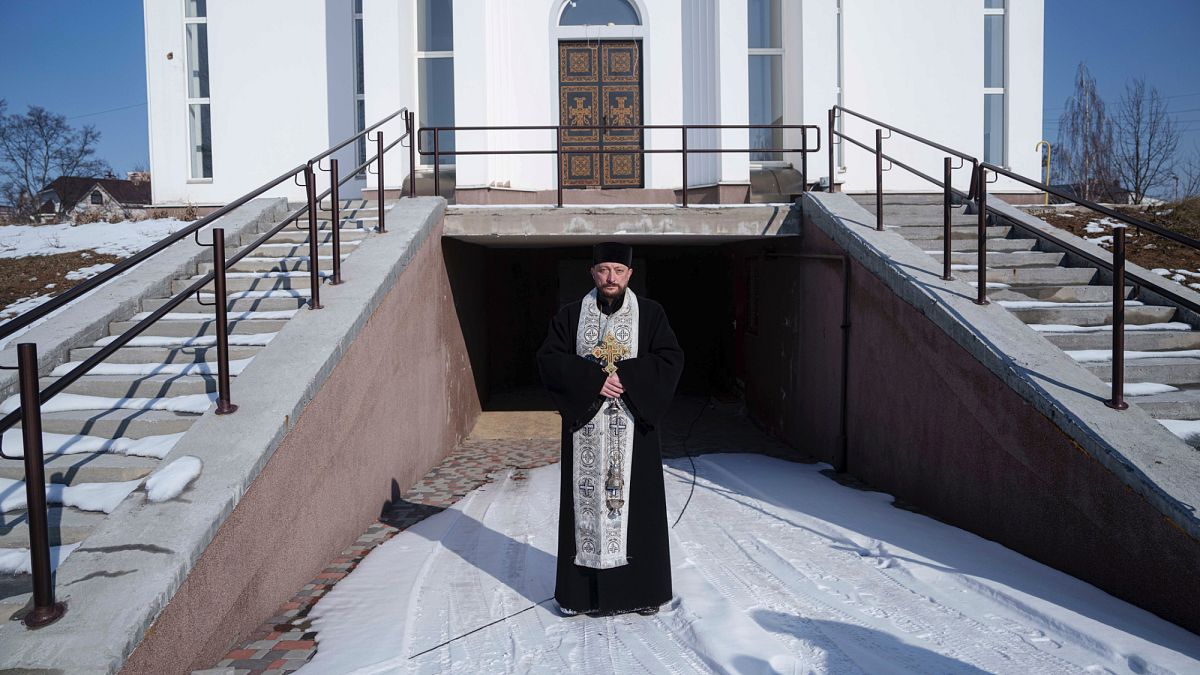
The priest at the Church of St Andrew, Father Andriy Halavin, is still in Bucha, three years since Russia started its brutal invasion of Ukraine.

The region of Kyiv and its towns like Bucha, Hostomel and Irpin were the first to face — and stop — Russian forces in their all-out war in early 2022.

Showing Bucha's Wall of Remembrance, Father Andriy says it will be replaced with a permanent memorial.

He told Euronews the wall, replete with metal plaques for each person killed in the town after Russian troops occupied it, should be a place where people could come with their children, for it to be also a place of strength.

“The liberation of our country started with the liberation of Bucha," Father Andriy explained.
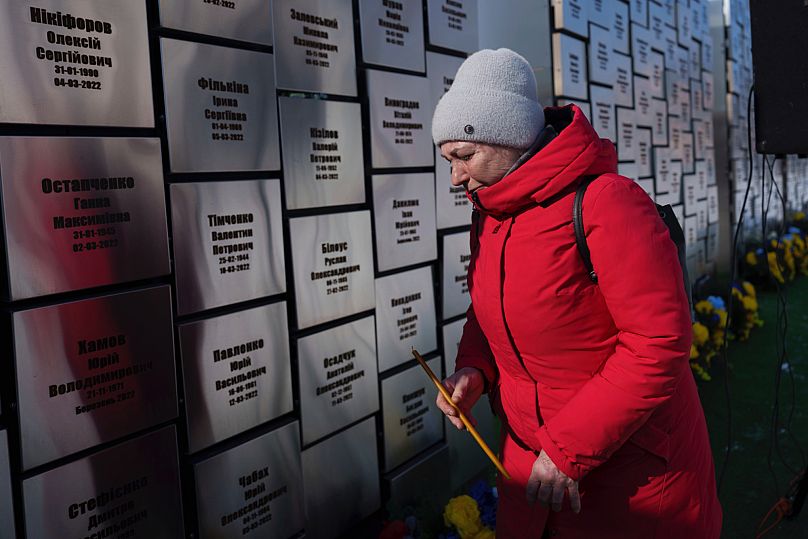
A woman attends a memorial ceremony for killed civilians to mark the third anniversary of the Russian invasion of Ukraine, in Bucha, Ukraine, Feb. 24, 2025. AP Photo
Painful memories of 2022

Father Andriy knows every corner of Bucha and probably every resident. As he shows the memorial, he points at the house facing the church.

The family who lived there escaped Russia’s war once in the past, when Moscow forces invaded the Donbas. But the Kremlin and its war chased them all the way to Bucha.


On 5 March — several days into the occupation — the family tried to evacuate.

"Russian forces opened fire at them, at the entire family, just like this, in the streets of Bucha," Father Andriy recalled.

Only the father survived, having lost his leg. The names of the two children — nine and four years old — and their mother are engraved on the memorial at the church, right across the road from their house. The man still lives in Bucha, Father Andriy says.

He knows the names and stories of almost everyone whose name is on the memorial. Many families got killed while trying to evacuate, he explained.


“We have surveillance cameras at the exit from Bucha, the roundabout towards Hostomel and Irpin. On the second day of the full-scale war, the Russians fired at any moving car, and many people died there," he said.
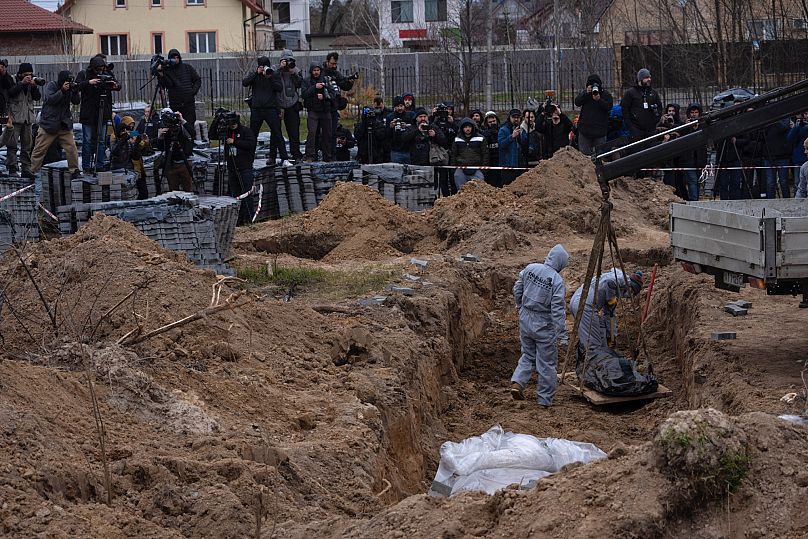
Cemetery worker exhume the corpse of a civilian killed in Bucha from a mass grave, in the outskirts of Kyiv, Ukraine, Wednesday, April 13, 2022.AP Photo

Many civilians also got killed while staying in Bucha under occupation. “When Russians came into people’s houses, they would open fire at anyone inside,” Father Andriy explained.

Residents had no choice but to leave and try to find food, water and medicine. Russian soldiers told the locals to put white bands on their arms, and they’d be safe.

“A father and a son went to a city hall to get medicine, both got shot. The son, thirteen years old, survived because the bullet got through the hood of his vest. He stayed on the ground, next to the body of his father, pretending to be dead until it was safer to run home,” the priest recalled.
Bucha, three years later

The Vokzal'na Street in Bucha, where a column of Russian armored vehicles was destroyed by a Ukrainian army, famous for a photo that shocked the world, look totally different now.

There's no sign of battle and almost no sign of destroyed houses. The street has been rebuilt, and it now looks just like any other road in any quiet European town with modern cookie-cutter houses and tidy fences.

Cafes and shops have been rebuilt and reopened, and people are back. But although one can spot the scars of Russian brutality only on some residential buildings in the facades pockmarked by shrapnel from the shelling signs on the facade — just like on the Church of St Andrew — the emotional wounds have not healed.

There are 509 names of the civilians killed during the occupation of Bucha on the Wall of Remembrance, Father Andriy says, adding, "509 civilians died here not as a result of combat, but during the occupation. And we have not yet talked about rape, robbery, abduction of children."
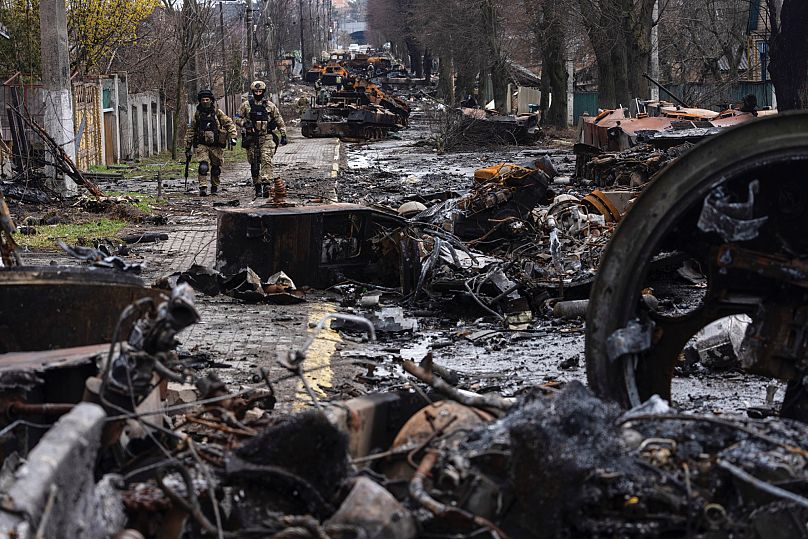
Soldiers walk amid destroyed Russian tanks in Bucha, on the outskirts of Kyiv, Ukraine, April 3, 2022.AP Photo


Talks with Russia: View from Bucha


Among many statements regarding Ukraine by US President Donald Trump, there was one that really stood out, crossing red lines for the Ukrainians: when Trump said that Ukraine should not have started the war.

Father Andriy says for the Russians, negotiations are not a way to find peace, but "a way to achieve what you cannot achieve with weapons."

“The Russians wanted to take Kyiv in three days, and they failed. With the help of Trump, negotiations, and so on, they are trying to occupy Ukraine in some other way," he explained.

"This is a matter of justice. What is worrying is that when they say ‘negotiations’, no one talks about crimes. No one talks about responsibility.”

He says he fully understands why those on the outside might be unable to comprehend it, explaining it as simple as "human psychology".

“When planes were already flying over our heads, Russian helicopters were flying overhead and everything was blasting away and exploding, you understand that there is war," Father Andriy said.

"But mentally it was it impossible to admit that it can be real in the 21st century.”

Many people in Europe feel the same way, that the war is impossible, Father Andriy points out.

"They are not ready to accept it. They have a calm, comfortable life," he said, adding that now Europeans are in a state where they are beginning to understand, but they are not ready to give up what they had or accept things as they are.

“If this continues, there is a danger that they will have to learn Russian. Because if Ukraine falls, Poland and the Baltic states will be next.”

He believes that when it comes to any talks with Russia, the crucial issue is the understanding of what "peace" essentially means, which is very different in Ukraine and Russia. Even if the conditions and terms of the agreement are fair, the question is, will this make Russia's Vladimir Putin and his forces stop shooting?

“Ukrainians understand the word ‘peace’ when they are not killed, when there is justice, when criminals are held accountable for their crimes — this is peace," Father Andriy said.

"From Putin's point of view, I think, ‘peace’ is something like when they don't shoot anymore because there are no more survivors left on our side, no one alive, only territories left," he concluded.


RAGOZIN: What did we die for?

RAGOZIN: What did we die for?
Volodymyr Zelensky’s chief of staff, Andriy Yermak, met with US Secretary of State Marco Rubio in Jeddah. He went in talking tough, but came out with a very thin agreement indeed. / bne IntelliNewsFacebook
By Leonid Ragozin in Riga March 13, 2025

In the morning on March 11, the Guardian ran an article by Ukrainian president Volodymyr Zelensky’s chief of staff, Andriy Yermak. It stated that a ceasefire in the Russo-Ukrainian war would be meaningless without security guarantees for Kyiv, more sanctions against Russia and transferring frozen Russian assets to Ukraine.

In the evening on the same day, after eight hours of negotiations with state secretary Marco Rubio and national security advisor Michael Waltz in Saudi Arabia, the same Ukrainian official agreed to endorse the American proposal which envisaged a 30-day comprehensive ceasefire without any mention of the said conditions.

Yermak also walked away from Ukraine joint initiative with the UK and France which suggested that the ceasefire should be limited to airspace and sea. As he left the meeting, Rubio said that the ball was now in the Russian court.

Russia’s reaction came two days later and it was initially ambivalent. Putin’s foreign policy aide Yury Ushakov said that ceasefire would only give a respite to Ukrainian forces, while Russia wants a comprehensive settlement rather temporary freezing of the conflict. But he didn’t reject the American proposal out of hand saying that it needed to be adjusted taking into account Russian interests.

A few hours later Putin appeared before cameras to say that he was endorsing the ceasefire plan but he listed various caveats making it certain that ceasefire talks will be difficult and protracted.

The proverbial ball is thus in the American court and it is up to Trump’s administration to decide whether it wants to adjust the proposal as per Russian suggestion.

What did we die for?

The moment Jeddah talks finished and the ceasefire proposal was announced Hungarian foreign minister Peter Szijarto felt vindicated. “For three years, we have been urging a ceasefire and peace talks in Ukraine - only to be insulted for our stance”, he said. “Now, after three years, ceasefire and negotiations are finally being discussed. Perhaps if there had been less condemnation, hundreds of thousands fewer would have died, millions fewer would have been displaced, and the damage would be far less”.

Ever since Ukraine’s failed counter-offensive in 2023, it was only a matter of basic intellectual decency to realise that the longer this war continues, the worse the final outcome for Ukraine will be. But pro-war lobby made both Zelensky’s administration and numerous governments in the West too invested in delusional expectations, which is what is making damage control particularly tricky at the moment.

Sadly for Western liberalism, it is now left to far-right governments of Victor Urban and Donald Trump to deliver the bitter truth. That’s because they have never been invested in the risky enterprise of challenging a major nuclear power to what Western politicians, like Marco Rubio and former British prime-minister Boris Johnson are now openly calling a proxy war.

What politicians and lobbyists who helped to derail Istanbul agreements in the spring of 2022 (and Minsk agreements before that) can’t possibly admit, is that Ukraine’s terrible sacrifice was in vain.

Hence the attempts to make the war last for another year or two - in the hope that some miraculous black swan event, be it a sudden economic crisis or military uprising along the lines of Wagner founder Yevgeny Prigozhin putsch in 2023, will bring Russia on its knees. None of that seems conceivable as things stand now.

The benchmark for what Ukraine would see as a success or failure in the full-out war was spelled out in March 2022 by Oleksiy Arestovych who was Yermak’s aide and one of Ukraine’s top spokesman on all things related to war. Anything worse than the conditions of Minsk agreements, which ended the hot phase of the conflict in 2015, would be deemed as Ukraine’s defeat, he said a few weeks into the full-out war and at the time when Istanbul talks were in full swing. Minsk agreements is what Kyiv effectively rejected in the run-up to full-out invasion, perhaps believing that it was calling Putin’s bluff or that the invasion was doomed to failure.

Ukraine is further away from achieving these goals today than any time during the three years of the full-out conflict. That creates a major headache for war enthusiasts who spent three years promoting delusional expectations in order to make Ukrainians fight a losing battle - effectively for nothing. The bitter pill Ukraine and Europe will have to take will need to be explained to the voters. More than a few political careers will unravel as the blame game ensues.

For Russia, on the other hand, it is the moment when its skilful diplomats, led by foreign policy veteran Sergey Lavrov and the above-mentioned Ushakov, may help it seal what has been achieved on the battlefield over the last three years.

Dancing around ceasefire

On the face of it, ceasefire is disadvantageous for the Russians who have been slowly advancing all along the frontline since the end of 2023, with the notable exception of the debacle in Kursk region where the Ukrainians managed to seize a chunk of rural territory. By the time Jeddah talks happened, however, this area had been all but liberated with remaining Ukrainian troops either trapped without supplies in Russian territory or fleeing across the border.

But the 30-day limit on ceasefire, negotiated by Yermak and Trump’s envoy, may provide an opening for Putin. This term is short enough for any major changes with regards to military capability on either side. There is not much Moscow is losing by agreeing to ceasefire while signalling its willingness to cooperate with Trump. If nothing is achieved, it can resume the offensive. At the same time, it will incentivise Trump to exert more pressure on Ukraine and extract more concessions.

Besides, agreeing to talk about a ceasefire is not the same as agreeing to ceasefire per se. Ceasefire talks will be difficult and highly technical - the separation of troops and effective monitoring of ceasefire violations proved a major sticking point already when Minsk agreements were still alive. Both sides may eventually pull out blaming each other for failing to achieve a result. Ceasefire talks may drag on for months while the Russian army will continue advancing along the frontline. Most crucially, Moscow will be able to bring up any kind of conditions in the meantime steering the conversation towards its desired format of long-term settlement.

Over many months, the Kremlin repeatedly said that it is interested in a comprehensive peace treaty not just with Ukraine but also with the West - not in a ceasefire that could result in the Korean-style freezing of the conflict.

That suggests that it will try to at least agree upon the general framework of the future peace negotiations before committing to the end hostilities. Russia insists on reviving the Istanbul framework which envisaged Ukraine’s neutrality and limiting the size of its armed forces. In addition, Moscow insists on keeping the territory it has occupied so far or even on the Ukrainian withdrawal from the rest of the four regions Russia has formally annexed after sham referendums in 2022. The latter demand shouldn’t be taken too seriously - it is the reaction to similarly unrealistic demands by the Ukrainian/Western side, like deployment of NATO “peacekeepers”.

Peace according to Putin

Territory is not what Putin is fighting for in Ukraine - it is a tool of punishment for intransigence and a bargaining chip in negotiations. What Moscow is going to be focused on in the talks both prior and after the prospected ceasefire is a new security architecture in Europe that will set a red line for NATO’s eastward expansion for decades to come.

As for Ukraine, multiple statements and leaks suggest that Moscow will be satisfied with it attaining the status similar to Finland’s and Austria’s after the World War II. That will effectively mean a return to the status quo prior to Maidan revolution in 2014 when Ukraine was geopolitically equidistant from Russia and the West. Incidentally, it was also more democratic and inclusive.

But Moscow will insist on the removal of all kinds of NATO infrastructure, specifically the CIA listening stations which emerged along the Russian border after 2015, as per reports by the mainstream American media. It will also insist on the de-Americanisation of Ukrainian security agencies, the SBU and the HUR, parts of which are all but run by the CIA, according to investigative reports by Washington Post and New York Times.

This might be the toughest bargain of all for the West because the withdrawal of both the CIA and the MI6 from Ukraine will be the West’s most tangible defeat in its confrontation with Putin’s Russia over Ukraine.

Moscow will also likely to insist on the decriminalisation of political forces representing Russian-speakers as well as on ending the ban on the formerly Moscow-affiliated Ukrainian Orthodox Church. It is also hard to imagine Putin agreeing to peace that doesn’t envisage the end of the culture war on Russian language and all vestiges of Russian culture currently under way in Ukraine.

But this is also something that will be fairly easy for Kyiv to agree with and get a sympathetic response from the public. As the Ukrainian leadership very well understands, rather than harming Ukraine, ditching ethnonationalist policies is what will help make Ukraine genuinely democratic, inclusive and compatible with EU standards. Xenophobia and discrimination will make little sense once the conflict is properly over.

Will Ukraine and the West agree to all of that? Not immediately for sure. But what we saw over the last several months was them slowly backtracking on key issues with regards to the future settlement, starting with the de-facto acceptance of Ukraine’s territorial losses.

Trump administration may try and pressure Putin into accepting what he doesn’t want to accept. Whether that strategy will succeed depends on how Putin sees the prospect of Russia sustaining the war effort for another few years in the face of potentially increasing Western sanctions. All signals so far have indicated that Moscow is ready to engage in fighting for much longer than the West. Unlike the latter, it is genuinely seeing this war as existential.

But for Trump, pressuring Putin too much means getting invested in a project he is not invested in at the moment and the one which by all means looks doomed to failure, even putting aside the moral qualms associated with the idea of “fighting to the last Ukrainian”.

What we are seeing now is likely to be the beginning of a long negotiations process in which the performative aspect will be more prominent than any other. Western and Ukrainian leaders will need to produce a lot of “tough talk” while gradually backtracking on key issues and carefully selling these concessions to domestic audiences which was being sold delusional expectations over the last three years.

Some goodwill gestures by the Kremlin are not inconceivable since ultimately it wants to restore good relations with the West - on its terms. These terms, however, appear to be largely non-negotiable and Putin appears to be dead certain that time is on his side.


900-year-old Vatican doomsday prophecy resurfaces amid Pope Francis’ illness


Copyright AP Photo
By David Mouriquand
Published on 14/03/2025 - 
This article was originally published in Turkish

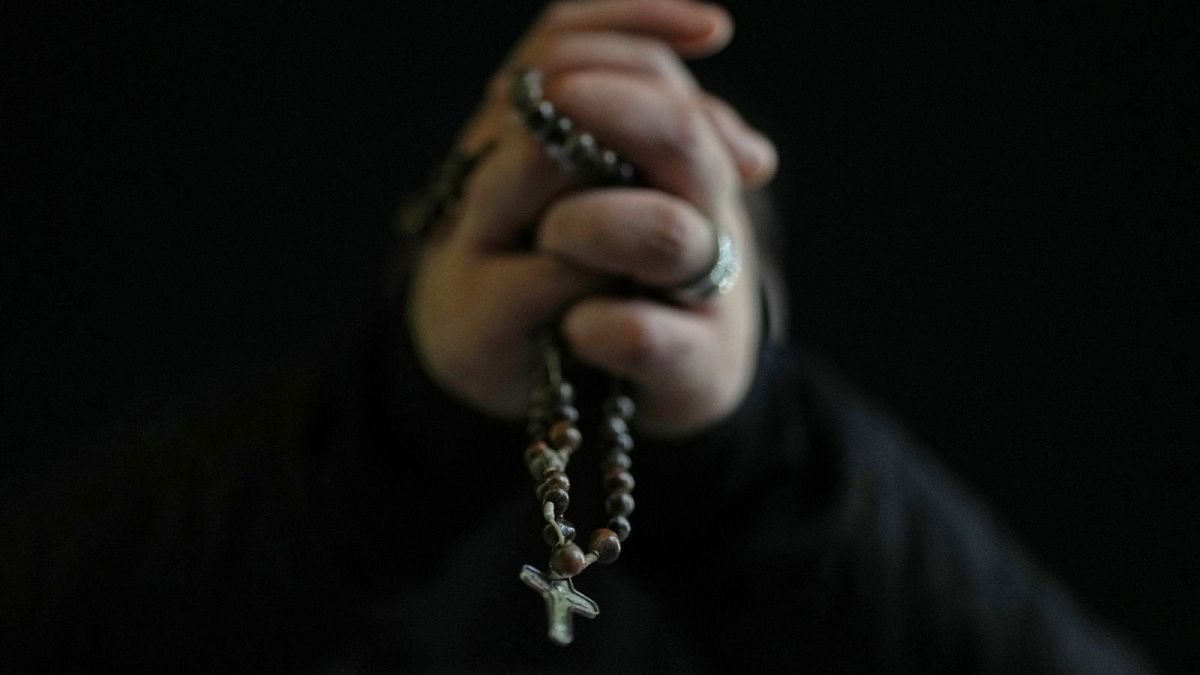
According to a 900-year-old book in the Vatican, 'Judgement Day' may be upon us soon, and Pope Francis might be the last leader of the Church.


The health of Pope Francis has led to renewed interest in a 900-year-old book known as "The Prophecy of the Popes" (“Prophetia Sancti Malachiae Archiepiscopi, de Summis Pontificibus” - or "Prophecy of Saint-Archbishop Malachy, concerning the Supreme Pontiffs"), which claims to predict the year of Judgement Day.

For those of you who need brushing up on your scripture, Judgement Day – also known as “The Final Judgement” or “the second coming of Jesus Christ” - is the day that Jesus returns to Earth to judge humanity and destroy Earth and Heaven.

Essentially, the day we find out who will be saved and who will be damned.

According to the 12th-century book credited to Irish bishop Saint Malachy, it’s going to take place in 2027.

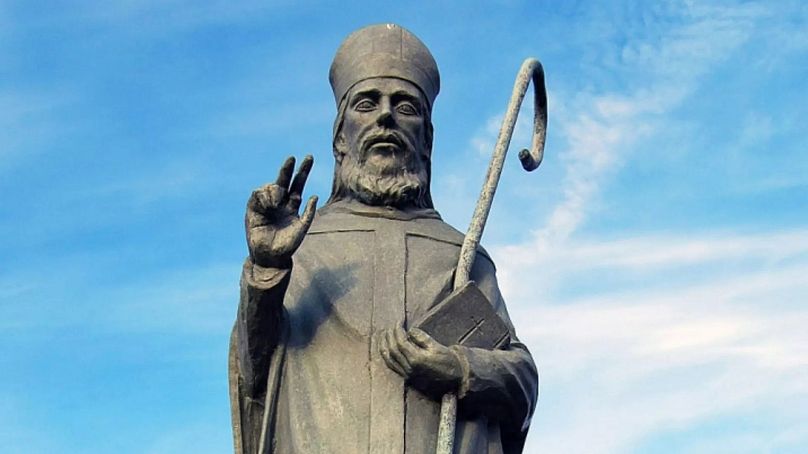
A statue depicting Saint Malachy
Wikimedia Commons

Located in the Vatican’s Secret Archives and discovered in 1590 by Benedictine monk Arnold Wion, "The Prophecy of the Popes" is making headlines due to a prophecy that ties with Pope Francis’ health.

The 88-year-old pontiff has been treated fordouble pneumonia and today marks his one month in hospital.

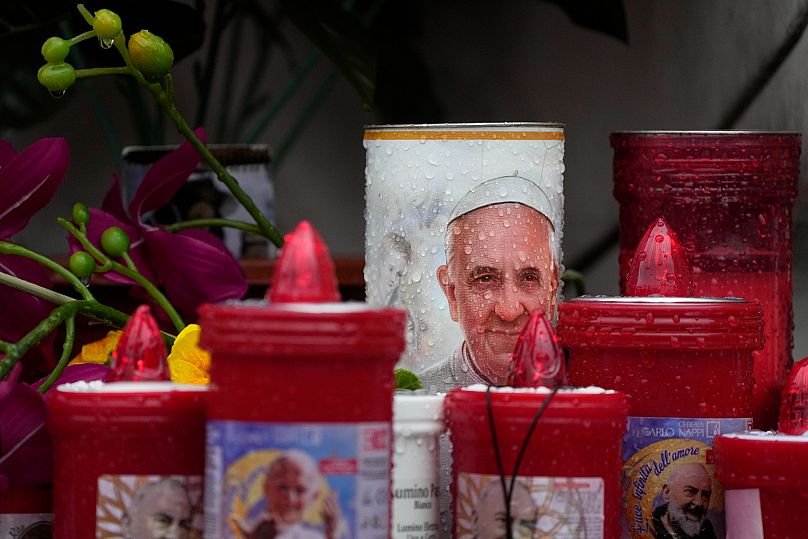
Rain falls on the auspicious candles with images of Pope Francis left outside the Agostino Gemelli Polyclinic, where he is being treated for bilateral pneumonia in Rome
AP Photo

The book contains a series of Latin phrases in 112 mysterious sections which purport to predict the Catholic popes, beginning with Celestine II up to the Church's current leader.


One passage, attributed to Pope Sixtus V, reads: “Axle in the midst of a sign”.

Pope Sixtus’ tenure began 442 years after the first Pope’s rule, and the passage suggests he is in the ‘middle’ of the papal lineage - thus indicating the end of the world would come 442 years later, in 2027.

The last passage of the book reads: "In the final persecution of the Holy Roman Church there will reign Peter the Roman, who will feed his flock amid many tribulations, after which the seven-hilled city will be destroyed, and the dreadful Judge will judge the people. The End."

The “seven-hilled city” refers to Rome and some interpret the last passage as Peter taking over as the Pope from Francis due to the latter's chronic lung disease, making Francis the last Pope.

Final part of the propheciesLyon Public Library - public domain

It all sounds very Dan Brown, and "The Prophecy of the Popes" has appeared in popular fiction, including Steve Berry’s 2005 novel "The Third Secret" and in James Rollins’ 2009 novel "The Doomsday Key".

It’s worth noting that modern scholars have disputed the origins of the text, saying that the book is simply cryptic forgery created for partisan political reasons.

Others also refer back to the Bible, which specifically warns against predicting the date of the second coming.

Matthew 24:36 reads: "But of that day and hour no one knows, not even the angels of heaven, nor the Son, but the Father alone."

So maybe don’t get out your calendars just yet.


Rearming Europe is the EU's next folly, Yanis Varoufakis tells Euronews

Copyright Markus Schreiber/AP
By Amandine Hess
Updated 
This article was originally published in French

Economist, politician and the former Greek finance minister welcomed the easing of the German debt brake but believes that defence spending will not generate growth where it is needed.

At a time when Europe is trying to regain control of its defence in the face of Russia's war on its soil and the US' apparent withdrawal, some dissenting voices are speaking out against the continent's further armament.

Visiting Brussels, Yanis Varoufakis refuses to mince his words yet again. "The rearmament of Europe is the next great folly of the European Union," declared the co-founder of the pan-European leftist DiEM25 movement in an interview with Euronews.

"It's going to make us less safe. It will make life nastier, more brutish, shorter in Europe," he added.

The left-wing economist believes expanding Europe's military would "dissolve the social fabric" without guaranteeing security. "It's a way of weakening Europe in the name of making it stronger," Varoufakis explained..

Opposed to an agreement between Moscow and Kyiv proposed by US President Donald Trump, Varoufakis instead calls on Europe to put its own peace plan on the table.

"We should reject Trump's plan. But we need to have our own. The first step will be to immediately and without a second doubt reject Donald Trump's land grab, his attempt to grab the underground riches of a part of Europe," he stressed.

"We need to counter-propose our own peace plan. Rearming Europe, buying more weaponry from British Aerospace, from Dallas, from Rheinmetall, this is not going to make any difference to Ukraine. Ukraine needs a peace plan from Europe now".

In his view, this agreement should guarantee Ukraine's sovereignty and its connection to Europe while keeping it "outside the two blocs, the Russian bloc and the NATO bloc, and allows us, as Europeans to come to their assistance, to rebuild their economy and society."

According to Varoufakis, if Europe wants to play a role on the international stage during this period of major geopolitical tensions, it needs first and foremost a "political union" to gain "legitimacy", not an army.

'Buying shells and putting them on a shelf is not productive'

Faced with the United States' withdrawal, the 27 EU member states are taking their security back into their own hands, giving the green light to a plan to rearm Europe, including a budget of €800 billion.

The European Commission has also proposed that member states derogate from the EU's orthodox budgetary rules to finance their defence spending.

In Germany, Chancellor-in-waiting Friedrich Merz has opened the door to relaxing the debt brake to allow investment in the country's infrastructure and defence.

This is a 180 turnaround for the otherwise prudent country, which favoured strict fiscal rules for Greece during the financial crisis.

As the former Greek finance minister who opposed Europe's austerity policy, Varoufakis positively greeted this paradigm shift — albeit with some reservations.

"Of course, I welcome the end of the debt brake," Varoufakis said, however noting that Merz "wants to indulge in military Keynesianism."

"Instead of investing in life, he is investing mostly in death. And if you look at it from a realistic macroeconomic point of view, this is not going to generate growth where it is necessary," Varoufakis explained. "When you buy ammunition, when you buy shells and put them on a shelf, this is not a productive investment."

Asked whether pacifism might be tantamount to giving Russian President Vladimir Putin carte blanche to pursue his imperialist ambitions and invade other countries, Varoufakis concluded, "Pacifism is never a good response to invasion, but opting for endless war is not rational either."

Watch Euronews' interview with Yanis Varoufakis 

EU Governments agree to ease regulation of new-generation GMOs

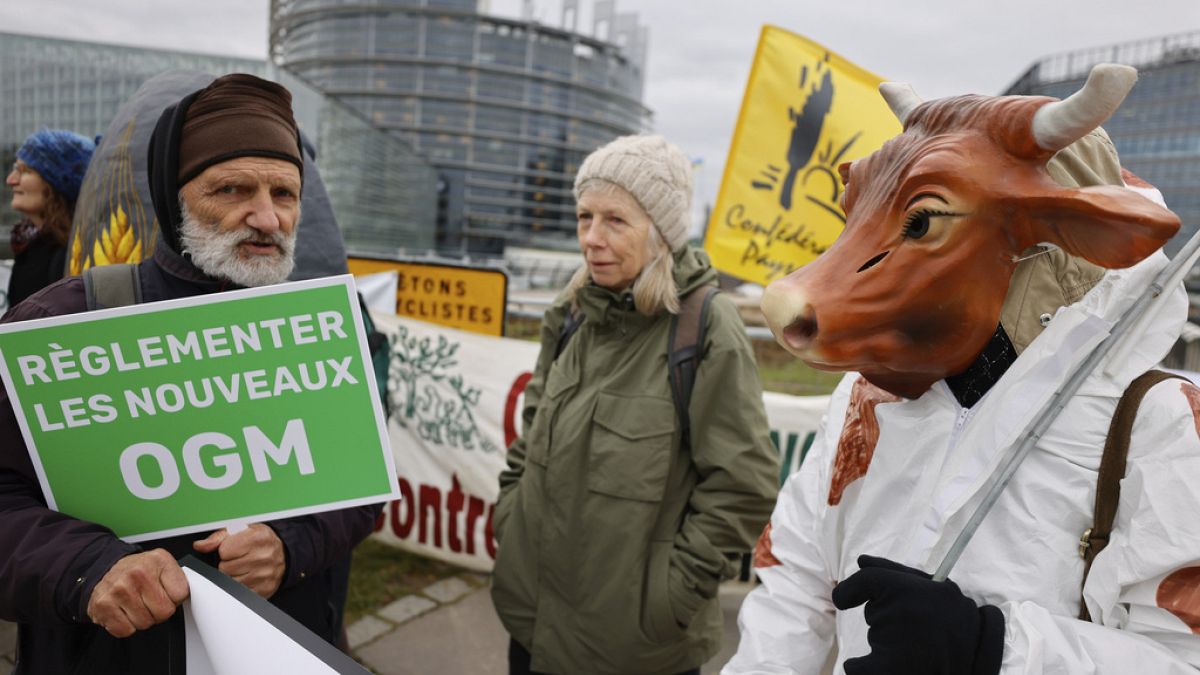
Farmers gather outside the European Parliament for a protest, in Strasbourg, eastern France, Tuesday, Feb. 6, 2024.
Copyright Jean-Francois Badias/Copyright 2023 The AP. All rights reserved
By Robert Hodgson
Published on 

The EU is to set to release a new class of genetically modified crops from strict regulation that dates back over 20 years, but MEPs and governments are divided over whether biotech firms should be allowed to patent them.

The EU has moved a step closer to lifting controls on some genetically modified crops after diplomats in Brussels gave the green light on Friday for final talks with the European Parliament, which has already backed a proposal to split them into two categories.

Laboratory techniques developed since the EU put in place its current GMO regulations two decades ago mean new properties can now be conferred by precisely editing a plant's genome, rather than inserting whole genes from another species.

Under the incoming rules, the products of new genomic techniques like the Nobel Prize-winning CRISPR-Cas9 ‘genetic scissors’ will be placed in a lower ‘category 1’ and exempted from strict risk assessment and labelling requirements.

They would also be removed from an opt-out that has allowed most EU governments to ban – often with broad public support – the commercial cultivation of all GM crops in their countries.

Governments have agreed that products of the more modern genetic engineering techniques should not have to be marked as such on supermarket shelves, although seeds would still have to be labelled to allow organic farmers to avoid them.

‘Innovation friendly’

Backers of GM crops, notably powerful agricultural technology and chemicals companies and the intensive farming lobby, argue that such targeted mutations could occur spontaneously or through conventional breeding, so there is no need for any special treatment.

Euroseeds, a trade association whose members include European agro-tech giants like Bayer, Syngenta and Cortiva, welcomed the EU Council’s agreement and called on MEPs and governments to agree an “innovation friendly” legal text in upcoming final talks.

“This means treating conventional-like NGT plants and products similar to conventional breeding without discriminatory labelling or traceability requirements,” secretary general Garlich von Essen said.

But opponents of the deregulatory move argue that even small tweaks to a plant’s genetic code could create unpredictable risks that would be all but impossible to contain once the new breed is in the wild.

‘A dark day’

Mute Schimpf, who leads food campaigning at Friends of the Earth Europe said the intergovernmental deal marked “a dark day for consumers, farmers and the environment”.

“EU governments have voted on the side of a handful of big corporations’ profits, instead of protecting farmers and consumers’ right to transparency and safety,” Schimpf said.

The German GMO watchdog Testbiotech pointed out that as well as waiving risk assessment and traceability, governments in the EU Council had also agreed to allow the patenting of all GM plants, even those derived from most wild species.

“New developments such as the use of artificial intelligence (AI) and new possibilities for more risky changes of plant characteristics are not taken into account,” the NGO added.

The new regulation will now be discussed behind closed doors by MEPs, government delegates and the European Commission. A likely sticking point is the parliament’s call, in a negotiating mandate adopted a year ago, for a total ban on patenting of new-generation GMOs in order to avoid large farms creating monopolies.


Euronews

Over 100,000 people gather in Belgrade over Novi Sad's canopy collapse which killed 15


Our Euronews Correspondent Dušan Ilic brings us the latest from Belgrade's massive protest over nationwide government corruption, which gathered over 100,000 people.


At least 100,000 people gathered in Belgrade at the call of students on Saturday for a massive rally against government corruption, marking the peak of months-long protests against Serbia's populist President Aleksandar Vučić and his government.

Near-daily demonstrations since November last year, sparked by tragedy, have challenged Vučić's firm grip on power in Serbia like never before in his 13 years in office.

Since then, students have been blocking their faculties, demanding justice for the victims of the canopy collapse at the Novi Sad railway station, where 15 people died and two were seriously injured. Many in Serbia blamed the incident on widespread government corruption, negligence, and disregard for construction safety regulations, demanding accountability.
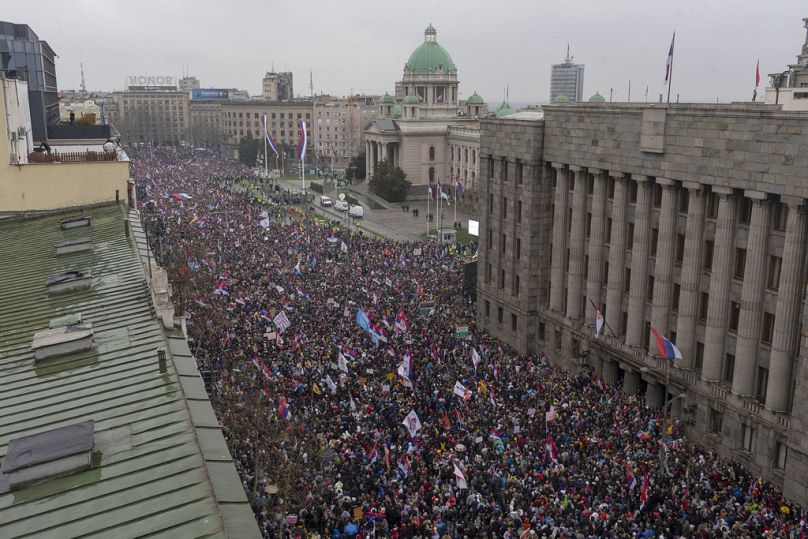
Tens of thousands gather in front of the Serbian parliament during a major anti-corruption rally led by university students in Belgrade, Serbia, Saturday, March 15, 2025. Marko Drobnjakovic/Copyright 2025 The AP. All rights reserved

Students argue that their demands have still not been met, even after four months.

They are demanding that all documentation related to the reconstruction be published and that those responsible be punished.

Saturday's rally, called “15 for 15,” referenced both the protest date and the number of people killed in Novi Sad on November 1, 2024. In the evening, the crowd observed a one-minute silence to honor the victims.

Ahead of the demonstration, Vučić repeatedly warned of supposed plans for unrest, threatening arrests and severe sentences for any incidents.

One protester, Dejan Simić, is rallying for a more democratic Serbia, while another said, "This is just the beginning of the end, a process that I hope will conclude soon."

The protests led to the fall of the government in late January, but the students believe that their demands have still not been met, which is why they are not giving up on blocking their faculties. The student rebellion has put the entire academic year in Serbia in question.

University students have been a driving force in the anti-corruption movement, demanding justice. Their determination has resonated with citizens disillusioned by politicians and who have lost faith in state institutions.

Mass protest in Belgrade against President Vucic's government


The rally — which is probably the biggest anti-government protest ever held in Serbia — comes after more than four months of anti-corruption demonstrations.

Tens of thousands of people descended on Belgrade on Saturday for a mass rally seen as a culmination of months-long protests against Serbia's populist President Aleksandar Vucic's government.

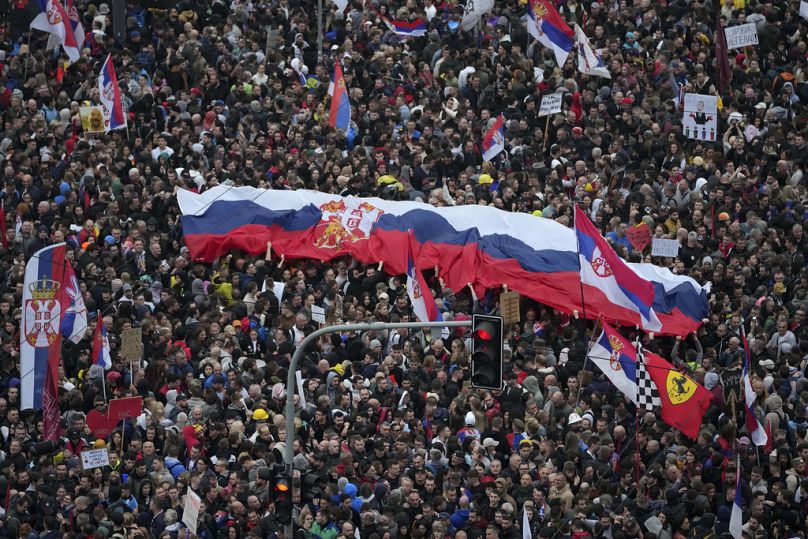
Large crowds of flag-waving protesters clogged the downtown area of the capital despite occasional rain, with people hardly able to move and many stuck hundreds of meters away from the planned protest venue.

Protesters converged after meeting up at several agreed-on protest venues in various parts of the city, which was placed on high alert. All public transport was cancelled.

Ahead of the demonstration, Vucic repeatedly warned of alleged plans for unrest while threatening arrests and harsh sentences for any incidents.

A deafening sound of whistles, drums and vuvuzelas filled the air on Saturday. Some protesters carried banners that read, “He’s Finished!” Crowds chanted “Pump it Up,” a slogan adopted during past four months of student-led protests.

”I expect that this will shake his authority and that Vucic will realise that people are no longer for him,” Milenko Kovacevic, a protester, said.

The rally — which is probably the biggest anti-government protest ever held in the Balkan country — comes after more than four months of anti-corruption demonstrations that have posed the biggest challenge to Vucic's grip on power after 13 years in charge.

Protesters march during a major rally against populist President Aleksandar Vucic and his government, in downtown Belgrade, Serbia, Saturday, March 15, 2025.Darko Vojinovic/Copyright 2025 The AP. All rights reserved

The massive rally is not the endgame in a struggle for a more democratic Serbia, Dejan Simic, a protester, said. "This is just the beginning of the end, a process which I hope will end soon,” he said.

Protesting university students have led the nationwide anti-graft movement, which started after a concrete canopy collapsed at a train station and killed 15 people in Serbia’s north on Nov. 1. Many in Serbia blamed the crash on rampant government corruption, negligence and disrespect of construction safety regulations.

With their call for justice for the victims, students have struck a chord among the citizens who are disillusioned with politicians and have lost faith in the state institutions.
Hundreds of riot police deployed in Belgrade

On Friday evening, tens of thousands of people staged a joyous welcome for the students who have been walking or cycling for days from across Serbia toward Belgrade.


Interior Minister Ivica Dacic told state RTS broadcaster that 13 people were detained overnight. He said police detained six opposition activists for allegedly plotting to stage a coup and stir unrest.

By Saturday morning people were assembling in various parts of the city as they marched toward the centre. The entire downtown zone was flooded with people hours before the scheduled start of the gathering.

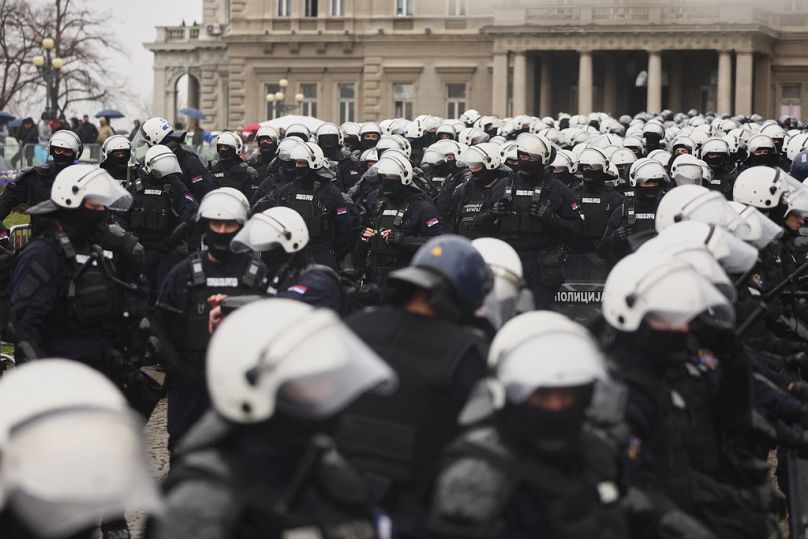
Reflecting the tensions, police said they arrested a man who rammed his car into protesters in a Belgrade suburb, injuring three people. Hundreds of police officers were deployed inside and around government buildings and in front of the presidential palace.
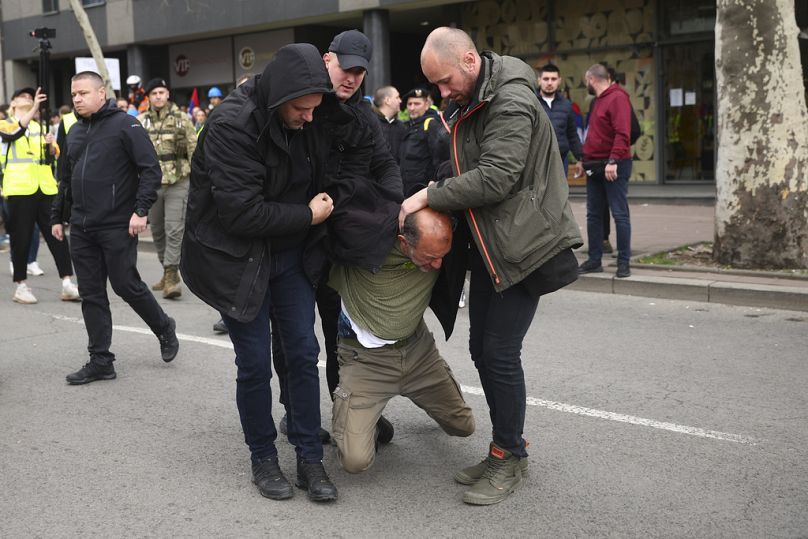
A man who allegedly claimed he was armed with bombs is detained by plain-clothed police at anti-goverrnment rally in Belgrade, Serbia March 15th 2025Armin Durgut/Copyright 2025 The AP. All rights reserved

The Belgrade authorities cancelled all public transport, including intercity railway and bus links, in an apparent effort to prevent people from attending the rally. The transport company said the cancellation was made “for security reasons.”

Several reporters from neighboring Croatia as well as Slovenia have been turned back from Serbia's border and were told that their presence at the rally “represents a security risk.”


Anti-riot police cordons off the area near the Parliament building in downtown Belgrade, Serbia, Saturday, March 15, 2025. Armin Durgut/Copyright 2025 The AP. All rights reserved

Vucic claims West is backing protests

Vucic has rejected earlier proposals for a transitional government that would prepare an early election. Fuelling fears of clashes, Vucic's supporters have been camping in central Belgrade in front of his headquarters. They include ex-members of a dreaded paramilitary unit involved in the assassination in 2003 of Serbia's first democratic Prime Minister Zoran Djindjic, as well as soccer hooligans who are known for causing violence.

Former paramilitary fighters loyal to President Aleksandar Vucic camp outside the presidency building prior to major anti-corruption rally in Belgrade, Serbia, March 15th 2025Darko Vojinovic/Copyright 2025 The AP. All rights reserved

Private N1 television on Saturday broadcast footage of dozens of young men with baseball caps going into the pro-Vucic camp.

Vucic has been claiming that Western intelligence services were behind almost daily student-led protests aiming to oust him from power. He has presented no evidence for the claims.

Previous student-led rallies in other Serbian cities have been peaceful while drawing huge crowds.


Serbia braces for largest protest in years as students march on capital

Serbia braces for largest protest in years as students march on capital
A previous mass protest in the city of Novi Sad in February. / Tatyana Kekic


By Tatyana Kekic in Belgrade March 14, 2025

As Serbia braces for what could be the largest protest in years, tensions are rising in the capital ahead of the planned March 15 demonstration. Students, who have been at the forefront of anti-government protests for over three months, will gather at 4 pm on March 15, in front of the Serbian National Assembly, in what could become a defining moment for both the students and the government.

The students, who have been blocking universities across Serbia for several months, have been joined by citizens from all walks of life — including educators, farmers and cultural workers. They are calling for justice following the deaths of 15 people in a canopy roof collapse at Novi Sad railway station in November 2024, and for political and criminal accountability. Their movement, which has gained widespread support, aims to challenge alleged government corruption and the long-standing rule of President Aleksandar Vucic.

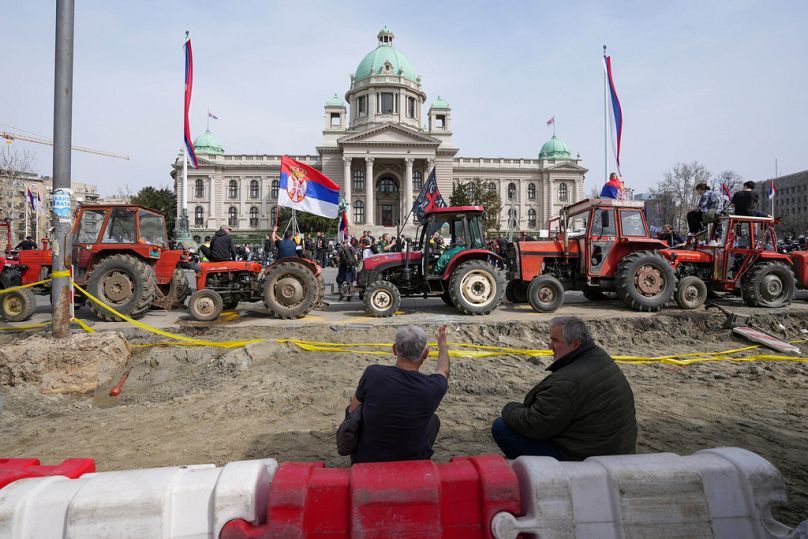
The protest, which has been meticulously planned, will see students arriving on foot and by bicycle from cities across Serbia, including Kragujevac, Niš, Trstenik, Kraljevo and Užice. Many have been walking for days to reach Belgrade, while a “tractor camp” is forming in Pionirski Park, with protesters planning to sleep there in solidarity. In preparation for the influx of protesters, traffic in central Belgrade has already been blocked off, with the National Assembly cordoning off its building until March 17 to minimise disruptions and potential incursions.

The government is preparing for significant unrest. Serbian police have warned of possible large crowds, traffic jams and potential interruptions to basic services, including emergency medical assistance. There are also concerns about possible phone network disruptions. In a stark warning, the government has indicated that they are prepared for potential violence, though the previous mass protests have occurred largely without incident. Serbian President Aleksandar Vucic has accused some opposition groups of planning violent tactics, citing a video shared by state media on March 13, in which a group of people can be heard plotting an attack on the parliament.

Despite these fears, the student-led blockades have maintained a consistent message of peaceful protest, reiterating that all previous demonstrations have been non-violent. However, with accusations flying, the possibility of clashes remains high. Tensions could also escalate between protesters and a growing faction of citizens who are frustrated by the months-long instability caused by the demonstrations. Some citizens are demanding an end to the protests and a return to normalcy, with some students even camping out in front of the presidential palace, desperate to resume their education.

In response to these growing tensions, the United Nations has called for calm. "We urge both the Serbian authorities and protesters to ensure that the demonstration remains peaceful and to respect the right to free expression," said a spokesperson for the UN Office for Human Rights.

Meanwhile, the European Union has expressed concern over the situation, with a spokesperson stating that Brussels is “closely monitoring” the situation. The EU has called on Serbian authorities to allow the protest to take place without interference. The US embassy in Belgrade also issued a security warning to its citizens, advising them to avoid large crowds and mass gatherings.

The statements from foreign embassies and international organisations highlight the levels of anticipation for the March 15 event, a culmination of months of anti-government protests and bubbling discontent. But what happens next? While the protest is unlikely to force Vucic to step down, it is certainly a blow to his government’s authority and he will be feeling the pressure as the crowds gather. With the resignation of top ministers already under the belt of the protesters, the government has scrambled to launch a purge of corrupt officials — but it has done little to quell the growing discontent.

Some speculate that the protest could mark a new chapter in Serbia's turbulent political history, reminiscent of the 2000 protests that led to the downfall of former president Slobodan Milošević. "Will this be the next fifth of October?" the opposition is asking. While this is an unlikely outcome, the atmosphere in Belgrade is undeniably charged, and the global community is watching closely to see how the government is going to react.

COMMENT: Meeting protesters’ demands would improve Serbia’s investment climate

COMMENT: Meeting protesters’ demands would improve Serbia’s investment climate
Protests have been ongoing for months since the deadly collapse of the canopy at Novi Sad railway station. / Tatyana KekicFacebook
By Nina Miholjčić Ivković in Belgrade March 15, 2025

After several months of protests, Serbian President Aleksandar Vucic and other officials have criticised student protesters for damaging the country’s economy. Yet meeting the demands for more efficient institutions and a stronger judiciary would actually improve the country’s investment climate in the long-term. 

Widespread protests sparked by the November 2024 collapse of a canopy roof in Novi Sad railway station, which killed 15 people, have already resulted in the resignation of Prime Minister Vučević and the collapse of his government. 

This prompted a recent claim by Vučić that the protests were ruining the economy. Jorgovanka Tabakovic, governor of the National Bank of Serbia, has also stressed the importance of political stability in Serbia’s efforts to become a high-income economy. 

While the protests have drawn international attention, the protesters are not seeking to overthrow the government but demanding reforms such as adherence to the rule of law, more efficient institutions and a stronger judiciary, while protesting in a peaceful manner.

Reviewing the current protests' impact on investment in the country, Dušan Šoškić, a professor at the Faculty of Economics, University of Belgrade, told bne IntelliNews that, “protests demanding respect for the constitution, the law, strengthening of institutions, better education, rule of law, and the fight against corruption can only encourage credible investors to invest more and better in Serbia in the future, with better results for the real well-being of the country.” 

He added: “the fulfilment of the demands of the protesters [who demand more effective institutions] in Serbia should be a good sign for the future of investments and economic development in Serbia.”

Statistics office data from January also contradicts Vucic’s claim. The tourism and industrial production sectors continued to show positive growth. According to data released by the country's statistics office on February 28, Serbia recorded a 16% increase in foreign tourist numbers in January 2025 compared to the same month last year. The same data also showed that industrial production in January was 0.4% higher than in January of last year.

Despite the ongoing political instability in Serbia, Šoškić looks at the long-term picture. “Advocacy for the fight against corruption, for better functioning of state institutions, and for respecting the law can only be beneficial for the country’s economy. This is especially true if the country is at the bottom of the European continent in the Transparency International corruption perception index,” said Šoškić.

Serbia dropped to 105th place on the latest index, meaning it is below all but a handful of European countries such as Belarus, Bosnia & Herzegovina, Russia and Ukraine. 

Economist Saša Đogović, speaking to Danas, made a similar point to Šoškić, saying that the current student blockades and protests do not have any significant negative effect on the country's economy. Regarding investments, Đogović pointed out that even if foreign direct investments show a negative trends, they are certainly not caused by the protests "but rather [are] a consequence of the lack of effective institutions, which are exactly what these protests are addressing."

The political instability caused by student-led protests is only one of the challenges to investment in Serbia. Other issues include bureaucratic delays and corruption, loss-making state-owned enterprises, a large informal economy, an inefficient judiciary. Despite all these, the majority of analysts believe investment will continue to grow in Serbia. 

According to the US 2024 Investment Climate Statements for Serbia, steps taken already on macroeconomic reforms, financial stability, fiscal discipline, and the government's prioritisation of foreign investment have enabled the country to maintain a relatively stable investment sector. 

Shortly before the protests started, in October 2024 Serbia achieved its first-ever investment-grade credit rating when international credit rating agency Standard & Poor's (S&P) Global Ratings upgraded the country's long-standing BB+ rating to BBB-. Serbia thus became the first Western Balkans state and EU candidate to obtain investment-grade status. 

Since then, another major credit rating agency, Fitch, has raised concerns about the ongoing political instability in Serbia, saying this could delay reforms and project implementation. However, its latest report indicates that the impact of the current political situation on the country's policy mix will be minimal.

Fitch estimates that Serbia will experience robust investment-led economic growth, underpinned by the Leap into the Future — Serbia Expo 2027 plan, which includes €18bn of investment. While €1.2bn will be specifically allocated to the Expo itself, likely for event-related infrastructure, facilities and operations, the remaining investment will be directed to road and rail, industrialisation, and other infrastructure projects, which could lead to increased interest among investors.

Commenting on Serbia's reputation among investors during the current wave of protests, Šoškić believes that while some investors who have spoken with the current political establishment in Serbia may view the public uprising as an added uncertainty in their investment decisions, this should not be a concern for credible and long-term investments. This is particularly true since such investments should not be tied to the existing group of politicians, as the turnover of politicians is a normal occurrence in democratic countries.

Nina Miholjčić Ivković is a researcher based in Serbia with a background in political science and international relations.


Hungary's Russia-friendly prime minister attacks the EU in nationalist speech

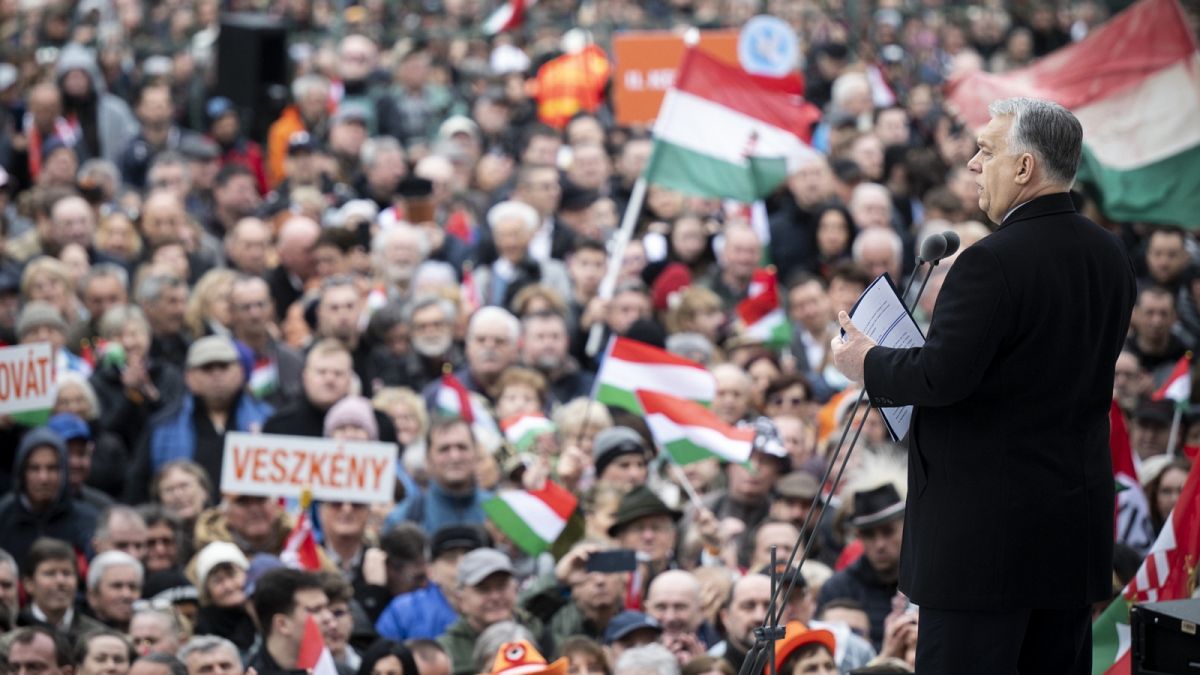
Prime Minister Viktor Orbán to give a speech in the Museum Garden
Copyright MTI/Miniszterelnöki Sajtóiroda/Fischer Zoltán
By euronews
Published on 
This article was originally published in Hungarian

"There is always an empire that is trying to take away the freedom of the Hungarians, and right now it is the one in Brussels," Viktor Orban claimed.

Hungary's populist prime minister on Saturday vowed to rid his country of those he claims work for the interests of foreign powers, saying his right-wing government will eliminate a global “shadow army” serving the European Union and a “liberal American empire.”

In a conspiracy theory-laden address, which coincided with a national holiday commemorating Hungary’s 1848 revolution against Habsburg rule, Viktor Orbán told a group of several thousand select supporters that Hungary in the coming weeks will uproot media outlets and other organisations that have received funding from abroad, comparing such groups to insects.

“After today’s festive gathering comes the Easter cleaning. The bugs have overwintered," Orbán said. “We will dismantle the financial machine that has used corrupt dollars to buy politicians, judges, journalists, pseudo-NGOs and political activists. We will eliminate the entire shadow army.”

Orbán, in power since 2010, has used the March 15 celebration in recent years as a podium from which to launch increasingly hostile harangues against the EU.

"There is always an empire that is trying to take away the freedom of the Hungarians, and right now it is the one in Brussels. Brussels is abusing its power, just as Vienna did in the past. They want to rule over us, just as the governors of the Viennese court did in the past," he claimed.

Hungary and Austria were the two states that formed the Habsburg empire which ruled much of central Europe between 1867 and 1918.

Orbán said that one task remained, to defend Hungary against Brussels' attacks. "Brussels" has, he claimed, "jumped headlong into the Russian-Ukrainian war".

"We did not jump into the war with Brussels, the Empire does not want to help, but to colonise, the means of this is war, it will cost what it costs, and then Ukraine will gain EU membership."

Viktor Orbán, said there was only one answer: "Union, but without Ukraine."

Orban cracks down on the media and civil society

Now, after the inauguration of U.S. President Donald Trump, the Hungarian leader has accelerated his longstanding efforts to crack down on critics such as media outlets, civil rights and anti-corruption groups, which he says have undermined Hungary's sovereignty by receiving financial assistance from international donors.

Orbán, a Trump ally, has applauded the U.S. administration’s actions to dismantle the US Agency for International Development, claiming, with no evidence, that it was used to fund liberal causes in Hungary aimed at toppling his government.

He has promised that groups that have benefited from funding by USAID would be eliminated in Hungary and face “legal consequences.”

This week, Orbán's Fidesz party proposed amendments to Hungary's constitution that would allow for Hungarian dual citizens to have their citizenship suspended and be deported from the country if they are deemed to threaten Hungary’s sovereignty or national security.

Another amendment appeared to target the LGBTQ+ community. Orbán's party has said the annual Budapest Pride carnival would be banned in public starting this year.

On Saturday, Orbán, a firm opponent of immigration, also echoed the conspiratorial “great replacement theory,” which suggests there is a global plot to diminish the influence of white people.

"The battle today is actually being fought for the soul of the Western world," Orbán said. “The empire wants to mix and then replace the indigenous people of Europe with invading masses arriving from foreign civilizations.”

He also claimed “the empire” that has provided economic and military assistance to Ukraine as it fights off Russia's invasion seeks to “colonise” the embattled country.

And he repeated his call for the EU to abandon the process of eventually bringing Ukraine into the bloc, and said he would issue a poll for Hungarians on decide whether they think Kyiv should gain EU membership.

 SCI-FI-TEK 70YRS IN THE MAKING

Laser-based fusion plant planned for Biblis site


Friday, 14 March 2025

A memorandum of understanding has been signed by representatives from politics, business and science aimed at establishing a laser-based nuclear fusion power plant at the former Biblis nuclear power plant in the German state of Hesse by 2035.

Laser-based fusion plant planned for Biblis site
(Image: Hessian State Chancellery)

The MoU was signed on 13 March by the Hessian state government under the leadership of Minister-President Boris Rhein, Minister of Economic Affairs Kaweh Mansoori, Minister of Research Timon Gremmels, the fusion company Focused Energy, the Technical University of Darmstadt, the GSI Helmholtz Centre as well as Schott and other industrial companies. It was signed during the first Round Table on Nuclear Fusion, held at the Biblis plant.

In the MoU, the signatories commit to pursuing the path to commercial fusion energy for Hesse and establishing the state as a leading location for cutting-edge research and the development of laser-based nuclear fusion. To this end, a demonstration plant and, later, a power plant will be funded at the Biblis site. The two-unit plant was shut down in March 2011 in response to the accident at Japan's Fukushima Daiichi plant.

The declaration also aims to establish a state-of-the-art fusion technology centre in Hesse, which will promote research, development and commercial applications.

"We need an energy mix that is open to all technologies, because the sun doesn't always shine, and the wind doesn't always blow," Minister-President Rhein said. "Only if energy is available at all times and remains affordable for everyone can we secure our prosperity. Nuclear fusion can be the game changer and bring about the decisive breakthrough."

He added: "It is a very good signal that the future federal government intends to promote fusion research more strongly and is pursuing the goal of building the world's first fusion reactor in Germany ... I am firmly convinced that we can make nuclear fusion the energy supplier of the future. Biblis should become a nucleus for energy supply 'made in Hesse' - and Hesse should thus become the number one location for nuclear fusion. The state government is providing up to EUR20 million (USD21.8 million) this year for nuclear fusion research."

In addition to state investments, the government also intends to use private funds and funding from federal and EU programmes.

"With companies like Focused Energy in Darmstadt and the excellent local scientific institutions, we have players who are setting standards in international fusion research," said State Minister of Economic Affairs  Kaweh Mansoori. "This offers Hesse a historic opportunity not only to develop a key technology, but also to produce it competitively. This is a crucial step towards strengthening our innovative strength and independence at a time when international supply chains and energy imports are becoming increasingly uncertain."

Markus Roth, co-founder of Focused Energy and Professor of Laser and Plasma Physics at TU Darmstadt said: "Germany now has a historic opportunity to become a leader in the industrialisation of fusion energy. With TU Darmstadt and Focused Energy, Hesse is already a world leader in laser fusion research and has everything in its hands to take the lead in the construction and operation of fusion power plants."

"We are currently investing very heavily in German innovation in Biblis and Darmstadt," added Thomas Forner, also co-founder and President of Focused Energy. "Fusion energy is indispensable for the economy and society of the future and can become a game changer in energy generation for Germany."

Focused Energy was founded in 2021 as a technology spin-off of TU Darmstadt and National Energetics to commercialise fusion and is based in German and the USA. Its approach to creating nuclear fusion power uses a focused proton beam to ignite millimetre-scale sphere deuterium/tritium fuel targets to create fusion reactions, which it says builds on the work achieved by the National Ignition Facility laser at the Lawrence Livermore National Laboratory.

Last year, Focused Energy received funding of EUR2.5 million, of which EUR500,000 came from state funds and EUR2 million from the European Regional Development Fund.

In March 2024, a new funding programme for nuclear fusion research was announced by Germany's Federal Research Minister Bettina Stark-Watzinger aimed at paving the way for the first fusion power plant to be constructed in Germany by 2040.