Sunday, March 30, 2025

ALT. FUELS

Model Testing Advances Hurtigruten’s Design for Sustainable Cruise Ship
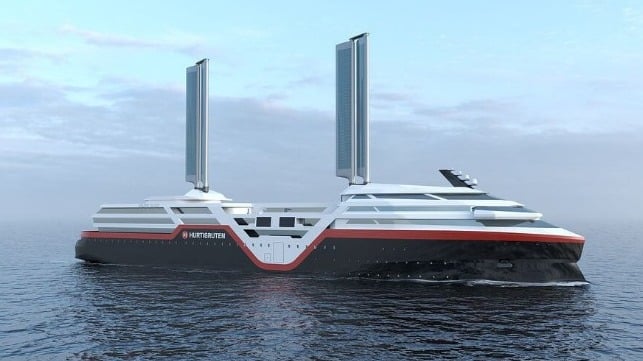
zero emission cruise ship concept
Revised design uses two sails, has a longer hull, and lower height to improve stability (Hurtigruten)

Published Mar 26, 2025 5:23 PM by The Maritime Executive


Two years after previewing the Sea Zero project to develop the world’s most energy-efficient cruise ship, Hurtigruten and its partners report the design has been refined through a series of model tests. Hurtigruten wants to design a ship that can sail without emissions in normal operation on the Norwegian coast from around 2030.

The project reports it completed a new phase of rigorous testing using digital simulations and physical trials in Trondheim, at the Norwegian research institute SINTEF Ocean’s facilities. In addition, Vard Design, DNV, Brunvoll, Plug, Corvus Enegery, and others are also participating in the project. Involving the partners, the recent testing worked to evaluate large battery packs, retractable sails, air lubrication systems, contra-rotating propellers, and an energy-optimized hull.

“We are learning a lot from these tests, and we now see that many of the ambitious goals in this project can also be implemented in practice,” said Gerry Larsson-Fedde, Chief Operating Officer at Hurtigruten.

Following months of design work and testing, they report the ship design has been further refined. The ship is now eight meters longer (143.5 meters/471 feet total) and slightly wider than earlier versions of the concept. The height has also been reduced by one deck to among other things provide better stability. The design has been reduced from three to two retractable solar sails.
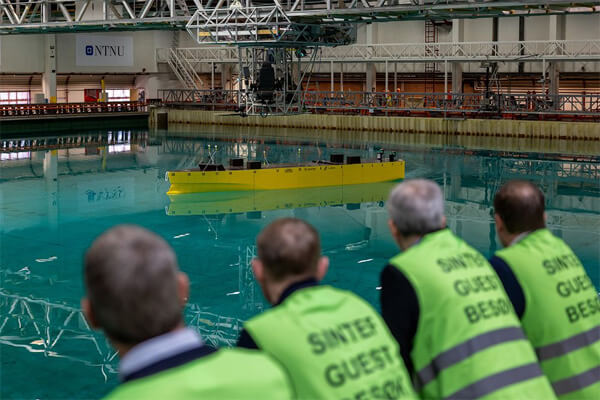
 

Model testing is helping to refine the design (Hurtigruten)


The Sea Zero concept aims to cut energy between 40-50 percent compared to today’s ships. The companies report that the sails alone could reduce energy consumption by 10 to 15 percent. With that reduction, they report that batteries charged with shore power connectivity in key ports could make emission-free operations possible.
 
"With the reduction in energy use we’re aiming for, it’s realistic to fit a battery system with enough energy to allow the ship to sail between charging ports under normal weather conditions," said Trond Johnsen, Project Manager for Sea Zero.

Committed to setting a higher standard for more sustainable travel initiatives, Hurtigruten highlights that its fleet currently includes four battery-hybrid powered ships, while it also prioritizes energy efficiency and responsible waste management. Through the ambitious Sea Zero project, Hurtigruten aims to develop its first ship that can sail emissions-free in normal operations on the Norwegian coast and in response to Norway’s tightening regulations for shipping emissions. 

Norway’s Parliament last year finalized rules setting a phased-in schedule to move coastal shipping and vessels operating in the fjords to zero emissions. Cruise ships and ferries under 10,000 gross tons will have to operate with zero emissions by January 1, 2026. For the large ships, the implementation is scheduled for January 1, 2032.


First Ammonia-Fueled Tug Completes Three Months Demonstrating GHG Reduction
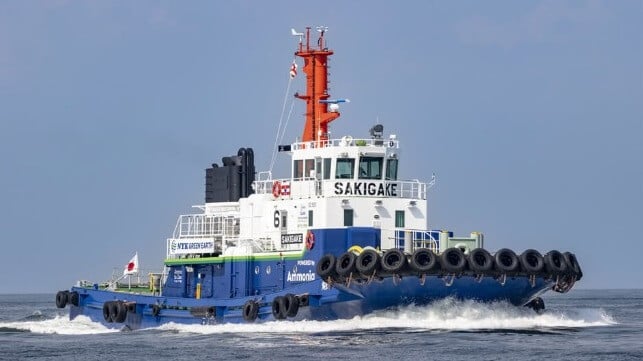
ammonia-fueled tugboat
Three month demonstration results confirmed a nearly total reduction in GHG emissions for the ammonia-fueled tugboat (NYK)

Published Mar 28, 2025 6:04 PM by The Maritime Executive


The world’s first commercial-use ammonia-fueled vessel, Sakigake, completed a three-month demonstration voyage. Engaged in tugboat operations in Tokyo Bay, NYK which owns the vessel reports it achieved a GHG-emission reduction of up to approximately 95 percent. They believe it illustrates the potential of ammonia as a maritime fuel.

The 272-ton tug Sakigake, which was built in 2015 as Japan’s first LNG-fueled tug, was selected for the pioneering project. When it was introduced a decade ago, the tug which is 122 feet (37 meters) in length was viewed as a proof of concept for alternative fuel operations in the class. It is again taking that role for ammonia-fueled propulsion.

The conversion program for the vessel was completed by Nippon Yusen Kabushiki Kaisha (NYK) and IHI Power Systems Co. on August 23, 2024. They worked in cooperation with Nippon Kaiji Kyokai (ClassNK) as part of a Green Innovation Fund Project sponsored by Japan’s New Energy and Industrial Technology Development Organization (NEDO).

The development project of this vessel started in October 2021 as part of NEDO’s Green Innovation Fund Project which provided for the “development of vessels equipped with domestically produced ammonia-fueled engines.” The companies worked together to develop the designs and ultimately removed the LNG-fueled propulsion system to replace it with the new ammonia-fueled propulsion. Sakigake became the world’s first commercial-use ammonia-fueled vessel following Fortescue which converted an offshore support vessel and completed certification for its ammonia system earlier in 2024.

NYK Group company Shin-Nippon Kaiyosha operated Sakigake in a three-month demonstration voyage while conducting tugboat operations in Tokyo Bay. NYK and IPS analyzed the ammonia co-firing and GHG-reduction rates during vessel operations and confirmed it consistently exceeded 90 percent. Depending on engine load rates, they were also able to achieve a 95 percent reduction in GHG emissions.

After having completed this first demonstration, the vessel will continue to be used for tugboat operations in Tokyo Bay. NYK reports it will continue to accumulate knowledge related to the development and operation of ammonia-fueled vessels.

NYK, Japan Engine Corporation, IPS, and Nippon Shipyard Co. are working together to develop an ammonia-fueled ammonia gas carrier, which is scheduled to be delivered in November 2026. This project is also sponsored by NEDO’s Green Innovation Fund Project and is part of NYK’s efforts to develop and introduce next-generation fueled vessels.

 

Rejuvenation of Brooklyn Marine Terminal Proceeds with $18M Investment

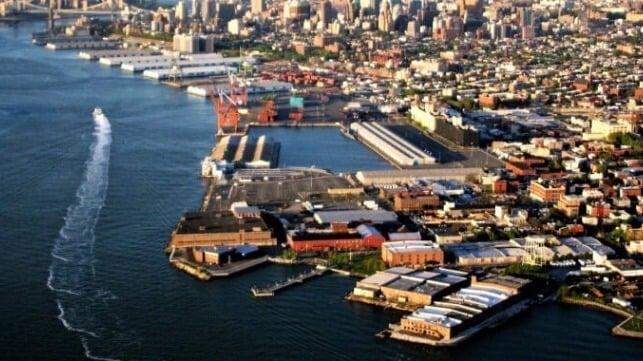
Brooklyn New York waterfront
Once a vibrant part of the commercial port, New York looks to revitalize the Brooklyn waterfront with new commercial terminals (NYCEDC)

Published Mar 26, 2025 5:55 PM by The Maritime Executive


The New York City Economic Development Corporation (NYCEDC) has executed three maritime infrastructure-related contracts valued at $18 million as part of the plan to upgrade port operations at the Brooklyn Marine Terminal. It is part of a larger vision for the “Harbor of the Future” announced in 2024 that calls for increasing capacity in the Port of New York and creating a new “blue highway” for freight and commerce in the city.

NYCEDC reports it is committed to redeveloping the terminal and container port. As a first step, it signed contracts for the removal of four out-of-service cranes across Piers 9A and 10, and the purchase of a new electric Ship-to-Shore (STS) crane to serve the Red Hook Container Terminal at Pier 10. Additionally, Pier 10 will receive crucial fender repairs to protect the pier from future vessel damage.

“After decades of disinvestment and inaction, now the real work begins with an initial $18 million investment bringing this maritime port into the 21st century,” said New York City Mayor Eric Adams. “This is a significant step forward for this 122-acre site and represents early signs of what’s to come as we reimagine the Brooklyn Marine Terminal to its full potential.”

In May 2024, the mayor along with New York Governor Kathy Hochul mapped the future vision including an initial $95 million investment by the state and city. NYCEDC now is spending an initial $18 million. This includes $15 million for a new electric STS crane, $2 million for fender repairs to Pier 10, and $1 million for the demolition and removal of four out-of-service cranes. 

Demolition and removal of the four out-of-service cranes will take place from April to August 2025 by Atlantic Coast Dismantling (ACD). The two cranes on Pier 9A are diesel-operated, over 50 years old, and are inaccessible due to the unstable condition of Pier 9A. The two cranes on Pier 10 that will be removed were damaged during superstorm Sandy, a near hurricane-force storm that hit the area in October 2012. The removal of these cranes will provide space for a new electric crane and the 3,000 tons of steel from the four removed cranes will be recycled by ACD.

Liebherr USA has been contracted to deliver the new all-electric ship-to-shore crane to serve the Red Hook Container Terminal at Pier 10. The crane will be designed, manufactured, and delivered from Irish-based Liebherr Container Cranes, taking approximately two years, making the new crane operational in Spring 2027. Pier 10 is also receiving a fender, fender pile, and chock and wale repairs and replacement to ensure the longevity of Pier 10 and protect the physical integrity of the pier from berthing ships and barges, repairs are anticipated to go from May to September 2025.

“After decades of decay and disinvestment at the Brooklyn Marine Terminal, these contracts are a small but meaningful step toward delivering a modern, all-electric, maritime port that activates our Blue Highway network and advances New York City's Harbor of the Future,” said NYCEDC President & CEO Andrew Kimball. 

NYCEDC reports that over the past eight months, it has regularly engaged with the task force, advisory groups, and the community to build a shared vision for this site. 

“In the last nine months, NYCEDC has done more for this port than has been done for the last several decades,” said Red Hook Container Terminal President Mike Stamatis. 

In the coming weeks, the Brooklyn Marine Terminal Task Force will vote on a Vision Plan outlining the future of the site, which will include reinvestment for a modernized maritime port and a vibrant mixed-use community to serve Red Hook and Columbia Street Waterfront District.


Fish use sharks as shields to ambush prey, study reveals


Scientists have revealed for the first time that some fish sneak up on their prey by hiding behind sharks


University of Edinburgh

Shadowing behavior displayed by blue runner fish hiding below a sandbar shark before attacking prey. Lampione island, Central Mediterranean sea. Credit: Rocco Canella 

image: 

Shadowing behavior displayed by blue runner fish hiding below a sandbar shark before attacking prey. Lampione island, Central Mediterranean sea, 11 July 2022. Credit: Rocco Canella.

view more 

Credit: Rocco Canella.


Scientists have revealed for the first time that some fish sneak up on their prey by hiding behind sharks.

The previously unknown behaviour was discovered by a team of researchers, including scientists from the University of Edinburgh, studying sandbar sharks in the Mediterranean Sea.

Underwater video footage captured by divers and remotely operated vehicles shows a type of small predatory fish – called blue runners – using the sharks for cover while they hunt.

Previous research has shown that some fish shadow sharks to remove parasites and hide from predators. However, they have never before been seen hiding behind sharks to ambush their prey.

Videos captured off the coast of Italy’s Lampione Island revealed 34 examples of blue runners using this hunting strategy. On each occasion, a single fish shadowed a shark for around 30 seconds before breaking off to launch high-speed attacks on smaller types of fish, such as damselfish.

Analysis of the footage suggests that the fish – which usually hunt in small groups – are more likely to catch their prey off guard by shadowing sharks, increasing their chances of success, the team says.

When hiding behind a shark, prey only noticed a blue runner’s approach around 10 per cent of the time. In contrast, when the fish hunted in packs their prey spotted them almost every time – more than 95 per cent of attacks – and got into a defensive schooling formation.

As well as improving their chances of a successful hunt, the shadowing behaviour may protect blue runners from their own predators and help them conserve energy by swimming in sharks’ slipstream, the team says.

The research is based on multi-year observations around Lampione Island, where a rare clustering – known as an aggregation – of sandbar sharks occurs every summer.

The study, published in the journal Ecology, was supported by the Blue Marine Foundation and National Geographic Society. It also involved researchers from Stazione Zoologica Anton Dohrn, the National Biodiversity Future Center, CNR-IAS and the University of Palermo.

Professor Fabio Badalamenti, of the University of Edinburgh and CNR-IAS Palermo, said: “The study highlights how interactions between species can drive alternative hunting tactics in marine ecosystems. Understanding these dynamics enriches our knowledge of marine biodiversity and underscores the importance of conserving high-level predators, like sharks.”

Dr Carlo Cattano, of the Stazione Zoologica Anton Dohrn, said: “This unique interaction emphasises the ecological importance of the few remaining shark aggregations, which can influence the structure and function of ecosystems. Lampione Island is one of only two known aggregation areas for the sandbar shark in the Mediterranean Sea. The ongoing decline in large shark populations due to overfishing could jeopardise associations like these, which could have knock-on effects on other species.”


The UMA will coordinate an international consortium that will hasten the use of cement as a carbon sink


With a funding allocation of more than 4 million euros, this is the first time that the University of Malaga will lead a project selected by the European Innovation Council (EIC), under the Pathfinder Challenges programme


University of Malaga

The UMA will coordinate an international consortium that will hasten the use of cement as a carbon sink 

image: 

Led by professor of inorganic chemistry at the University of Malaga, Miguel Ángel García Aranda - who also received the prestigious ERC Advanced Grant from the European Research Council last year – the project will benefit from a financial boost of more than 4 million euros for its development over 4 years.

view more 

Credit: University of Malaga


The University of Malaga has been selected for the first time ever to coordinate an innovation project under the Horizon Europe - European Innovation Council (EIC), `Pathfinder Challenges’ programme, which promotes initiatives that "open new scientific frontiers and revolutionise technology." In total, 31 of the 415 proposals submitted from 48 countries, will be funded. Eight have been granted in Spain.

'X-SeeO2' an international consortium, in addition comprising, the universities of Bath and Manchester (United Kingdom), and the European Synchrotron Radiation Facility (ESRF, France) intends to hasten the use of cements as carbon dioxide 'sinks', in order to reduce emissions of this pollutant, whilst maintaining the properties of concrete and without affecting the durability of the resulting infrastructures.

Led by professor of inorganic chemistry at the UMA, Miguel Ángel García Aranda - who also received the prestigious ERC Advanced Grant from the European Research Council last year – the project will benefit from a financial boost of more than 4 million euros for its development over 4 years.

In the "Cement as Carbon Sinks" challenge of the latest Horizon Europe call, only six projects out of a total of 80 submitted, are eventually to be funded. "The success rate for this call was 7.5 percent, which reflects the scientific and technical rigour demanded," notes the University of Malaga scientist.

Global leaders

This is a new challenge that, as García Aranda states, firmly sets the UMA Cement Sciences Group “as global leaders in research into concrete curing mechanisms with both water (H2O) and carbon dioxide (CO2)”.


'Real-time X-ray diffraction and microstructure imaging, accelerating the transformation of cementitious materials into CO₂ sinks, will provide unique tools for cement decarbonization and smart concrete carbonation.

Enabling technology

'X-SeeO2' has been selected as an 'enabling technology', meaning that the advanced analytical techniques that have already made the UMA a benchmark in X-ray powder diffraction (PD), synchrotron and laboratory techniques, and micro-computed tomography (mCT) will be used to accelerate and improve the products and technologies of the other innovation projects that have been selected within this same challenge in this latest EIC Horizon Europe call.

“The knowledge generated by X-SeeO2 will be fundamental to the other proposals of our ‘challenge’ and to the advancement of the science and engineering of construction materials,” explains García Aranda, who also adds that the top priority is research aimed at reducing CO₂ emissions and promoting the circular economy by upclying waste.


To another of its researchers, UMA professor María de los Ángeles Gómez de la Torre, “this project will enable an unprecedented collaboration model to be established, where the consortium's knowledge will be shared with the other projects selected by the EIC under the same challenge, with all the synergies that this implies”.


Revolutionary technology

To date, within the current Horizon Europe framework, the University of Malaga is involved in two other projects from this same program: 'Zeus' and 'BioRobot-MiniHeart'. Another proposal was also granted in the previous H2020 program: 'SONICOM'. In these three instances, the UMA acts as a partner in each international consortium.

With 'X-SeeO2', the University of Malaga will, for the first time, take on the role of coordinator of the European consortium, leading the scientific team, which will include "the world's leading experts" in cement science and synchrotron techniques.

The ‘Horizon EIC Pathfinder Challenges’ programme awards grants to those projects exploring new technological areas, particularly "deeptech" – those based on a scientific discovery or significant engineering innovation  which have the potential to become radically innovative technologies in the future and generate new market opportunities. The overarching goal is to nurture the innovation market with revolutionary technologies and bring them to the proof-of-concept stage.

Miguel Ángel García Aranda has been a professor of inorganic chemistry at the University of Malaga since 2011. He graduated in chemistry in 1988 from the UMA and obtained his doctorate in the same specialty in 1992, also awarded by the Malagan institution.

His line of R&D is based on the study of cement curing (hydration/carbonation) to improve its performance. His research focuses on developing cements with a carbon footprint of at least 50 percent lower, replacing part of the Portland cement with other, much less polluting materials.

As Scientific Director of the ALBA synchrotron, on secondment from the UMA (2013/01-2019/02), he coordinated the user assistance program, as well as the future scientific use of the facility, in addition to supervising a group of more than 75 scientists and technologists of 15 nationalities.

He was also Chairman of the Council of the ESRF (European Synchrotron Radiation Facility), the European synchrotron in Grenoble . This synchrotron is funded by a collaboration of 21 nations (13 Member States and 8 Associated States) and has a staff of over 800 people.

María de los Ángeles Gómez de la Torre has been a professor of inorganic chemistry at the University of Málaga since July 2022 and has an outstanding career in cement research.

A chemistry graduate from the UMA in 1999 and PhD in 2003, she has focused her scientific work on the study and development of cementitious materials. Initially, she worked on the quality control of these materials using X-ray powder diffraction. Subsequently, she focused her research on the study and development of techniques to understand and control cement hydration, with the aim of reducing their carbon footprint and contributing to climate change mitigation.

He has directed four national research projects and another four funded by the Andalusian Regional Government, in addition to leading contracts with companies in the sector, including the American company CTS - Cement Manufacturing Corporation. Since 2024, she has been a member of the scientific evaluation panel for the ALBA synchrotron in Barcelona.

Led by professor of inorganic chemistry at the UMA, Miguel Ángel García Aranda - who also received the prestigious ERC Advanced Grant from the European Research Council last year – the project will benefit from a financial boost of more than 4 million euros for its development over 4 years.

Credit

University of Malaga


Este proyecto ha sido seleccionado a través del Programa de Investigación e Innovación de la Unión Europea, Horizonte Europa, con Grant Agreement 101161465, que está en preparación


“Artificial intelligence is the future of peer review”


Boston University School of Medicine


(Boston)—It is expected that in 2025, approximately three million articles will be indexed in Scopus and the Web of Science. If each undergoes peer review by two experts, and an additional 2 million articles undergo peer review, but are rejected—approximately 10 million peer reviews will be conducted this year—a staggering number that is likely to grow as the biomedical enterprise, and the number of peer-review journals increase.


According to an editorial in the journal Critical Care Medicine, in the coming years, artificial intelligence (AI) should be part of the future of peer review.


“Peer review at biomedical journals has been essentially unchanged for many decades. Although compensating peer reviewers would likely help to receive timely reviews, it is probably not feasible on a wide scale. In addition, peer review has well-known limitations,” said Howard Bauchner, MD, professor of pediatrics at Boston University Chobanian & Avedisian School of Medicine. “We believe peer review should include some form of initial review by AI, assisting editors in decisions on which articles to send out for external peer review,” adds Bauchner, who also is former editor-in-chief of the Journal of the American Medical Association.


Bauchner outlines the limitations of peer review and defines the various types: double-blind, single-blind and open review. He describes one of the largest trials ever conducted comparing double-blind to single-blind review. “When reviewers were aware of the authors’ identity (single-blind), they gave a more favorable rating from countries with higher English proficiency and higher income. These findings are consistent with what has been known for years: peer reviewers can be biased. While Bauchner agrees that AI could also be biased, he questions whether it is more biased - than a human peer reviewer. He believes models could be taught to disregard who the authors are and where they come from.


Bauchner also stresses that several independent groups which already offer AI review of articles, largely as a service for authors prior to submission of articles, have already experienced good results. He cites one particular study, where the authors found feedback from GPT-4 review to be more helpful than feedback from some peer reviewers.


Additionally, he believes that AI will be good at evaluating whether an article follows the appropriate reporting guideline, which is often noted by authors as requested by journals, but with no evidence that peer reviewers actually check adherence to these guidelines. Furthermore, Bauchner feels AI may be able to detect fraudulent research more effectively than peer reviewers.


“As it continues to improve,” he said. “It is time to embrace a different approach, an approach that is likely to be more efficient and more effective—review by AI.”


New approach makes one type of clean fuel production 66% more efficient


Energizing waste carbon enhances liquid methanol generation


Ohio State University


COLUMBUS, Ohio – Researchers have uncovered a more efficient way to turn carbon dioxide into methanol, a type of alcohol that can serve as a cleaner alternative fuel. 

In the lab, synthesizing methanol can be extremely difficult, due to the extremely complex reaction pathway needed to select for it. Previous attempts by the same team to manufacture this valuable liquid fuel from carbon dioxide have used a combination of cobalt phthalocyanine (CoPc) molecules and electricity, but this method is inefficient as only about 30% of the carbon dioxide is converted to methanol. 

To better scale up methanol production, the team in this study added a second material, nickel tetramethoxyphthalocyanine (NiPc-OCH3), to the nanotube catalyst where the reaction takes place. They discovered that adding this second molecule can catapult methanol production efficiency up to 50%, about 66% better than any other known process. 

“This catalyst system is one of the very few that can produce methanol at such high selectivity,” said Robert Baker, co-author of the study and a professor in chemistry and biochemistry at The Ohio State University.

Enhancing methanol production would not only allow scientists to make the liquid faster and more cheaply but also help them limit the amount of unwanted waste products. More importantly, having steady access to such a flexible renewable resource could transform many aspects of daily life, including the transportation sector, said Baker. 

“Methanol is a really desirable product for CO2 reduction because it has such a high energy density,” he said. “It’s a great molecule – of all the possible products of CO2 reduction, methanol is an excellent candidate for use as an alternative fuel.” 

The study was recently published in Nature Nanotechnology.

To confirm their findings, scientists used a technique called sum-frequency generation vibrational spectroscopy to analyze where carbon dioxide molecules were binding and how they were moving during their reaction. 

When carbon dioxide is introduced to NiPc-OCH3, researchers can see that it becomes carbon monoxide before the catalytic reaction turns it into methanol.  

In this case, the team saw that the carbon nanotubes, which held the two catalysts in place and helped electricity flow more smoothly through the reaction, influenced the carbon dioxide molecules’ movements. These tubes essentially act as a highway that ferries the reaction intermediates from one catalyst site to the next during this process.

“The dual nature of the nanotube catalysts causes the process to work extremely efficiently,” said Baker. 

Since this new process of methanol generation does require a large quantity of carbon dioxide, efforts to scale it up for commercial use would likely have to be used in tandem with carbon capture technologies that can remove harmful greenhouse gases from the atmosphere and sequester them elsewhere. “Capturing and converting carbon directly to a fuel would be one of humanity’s best possible options,” said Baker. 

What’s more, the understanding gained in this study about how creating dual catalysts from nanoscale building blocks can likely pave the way for other types of sustainable technologies, including opportunities for researchers to engineer brand new types of catalysts and chemical processes, said Baker. 

“Now we have the tools to understand how when you put different nanoscale components together in the right architectures, you can create new, more efficient systems,” he said. “It’s a really exciting time for this kind of research.”

The study was supported by the National Science Foundation and the Yale Center for Natural Carbon Capture. Co-authors include Quansong Zhu from Ohio State; Alvin Chang and Zhenxing Feng from Oregon State University; Huan Li, Zhan Jiang and Yongye Liang from the Southern University of Science and Technology; and Jing Li, Seonjeong Cheon, Yuanzuo Gao, Bo Shang, Conor L. Rooney, Longtao Ren, Shize Yang and Hailiang Wang, all from Yale University. 

#

Contact: Robert Baker, Baker.2364@osu.edu

Written by: Tatyana Woodall, Woodall.52@osu.edu