Sunday, March 30, 2025

In Manila, U.S. Defense Secretary Commits to Protecting Philippines


FOR HOW MUCH $$$$$$$ ?!

Philippine President Ferdinand Marcos Jr. meets with U.S. Defense Secretary Pete Hegseth, March 28 (Pentagon)

Published Mar 27, 2025 11:09 PM by The Maritime Executive


In a press conference in Manila on Thursday, U.S. Secretary of Defense Pete Hegseth sought to reassure Philippine partners that the U.S. is committed to their sovereignty in the South China Sea, and he pushed back on China's claims that America abandons its foreign allies.

The Philippines is one of America's oldest treaty allies in East Asia, and the U.S. has had a hand in its defense since the colonial era. Its territorial integrity is under pressure in its western exclusive economic zone, where Chinese forces are gradually expanding their hold over reefs and waterways in the Spratly Islands. China claims most of the South China Sea under its historical "nine-dash line" policy, and has used increasing levels of force to pursue its claims - including obstructing navigation, ramming, water-cannoning and (on one isolated occasion) hand-to-hand combat

In the run-up to Hegseth's trip, Chinese officials repeatedly tarred the U.S. as an unreliable partner. "Those who willingly serve as chess pieces [of the U.S.] will be deserted in the end," Chinese Foreign Ministry spokesman Guo Jiakun warned the Philippines on Tuesday. Chinese Defense Ministry spokesman Wu Qian was more direct, and claimed that America has an "astonishing record of breaking its promises and abandoning its allies."

U.S. officials and policy experts are well aware of this narrative, and some have advised investing more heavily in the Philippines' defense to restore deterrence and prevent China's territorial ambitions from becoming reality. 

"China . . . believes it can be combative without a credible response due to limited Philippine capabilities and a lack of U.S. commitment to come to the aid of their treaty ally," cautioned former Trump administration defense official Joseph Felter, writing for The Hill. "The U.S. and the Philippines must not squander this opportunity to strengthen the credibility of their alliance."

In Manila, Hegseth emphasized that President Donald Trump is committed to the alliance with the Philippines. "He and I both want to express the ironclad commitment we have to the Mutual Defense Treaty and to the partnership, economically, militarily, which our staffs have worked on diligently for weeks and weeks and months," Hegseth told Philippine President Ferdinand Marcos, Jr. "Friends need to stand shoulder to shoulder to deter conflict to ensure that there's free navigation, whether you call it the South China Sea or the West Philippine Sea, we recognize that your country has stand very firm in that location and in defense of your nation."

 

NTSB: Crane Barge Hit an STS Crane Because Mate Didn't Perceive Hazard

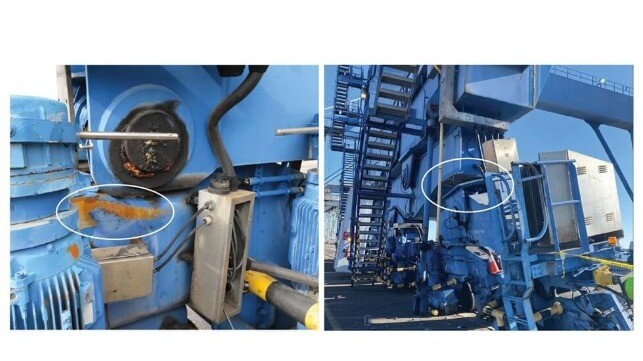
Damage to the structure of the STS crane from the impact (NTSB)

Published Mar 26, 2025 4:08 PM by The Maritime Executiv


The National Transportation Safety Board has determined the cause of an STS crane allision at North Charleston Terminal last year. A towboat mate failed to consider the horizontal extent of the STS crane when he made passing arrangements with a dredge in the channel, and his chosen course put his tow - a tall crane barge - in contact with the STS crane's lowered boom.

On the afternoon of January 4, 2024, the towboat Royal Engineer and the crane barge Stevens 1471 got under way from a terminal on the Cooper River for a berth at the Pierside Docks, a short three-hour trip downriver on the other side of the North Charleston Terminal. The crane was lowered, but its upper mast extended about 145 feet above deck level. 

As Royal Engineer approached North Charleston Terminal, its passage was blocked by the dredger Brunswick, which was working on dredging out the bottom just a few hundred feet off the terminal's pier. The dredge's floating discharge pipeline extended all the way across to the opposite side of the river, and was temporarily blocking all of the navigation channel. The only options for safe passage were to ask the dredge crew to stop work and move their floating pipeline so that traffic could get by, or to go through a narrow slot between the dredger and the pier, where the terminal's cranes were working cargo. 

Royal Engineer's mate had the watch, and he contacted Brunswick about an hour out to make timely passing arrangements. He planned to ask the dredger crew to move their pipeline and wanted to give them enough advance notice. The Brunswick did not respond to two calls. 

At 1605, Royal Engineer approached Brunswick's work area. A large boxship was moored at the terminal and an STS crane boom was lowered to move containers. The boom extended about 200 feet out over the channel, 100 feet beyond the beam of the boxship. 

At this point, Royal Engineer's mate was able to reach Brunswick's captain over VHF, and he asked him to move the pipeline. The dredger's captain declined because his crew was busy and he already had his crew on a task and would "have to stop them to go do something else." Instead, he suggested that Royal Engineer could safely go through the 300-foot slot between Brunswick and the pier, and he offered to turn the dredger to make this possible.  

Royal Engineer's mate accepted this arrangement. Considering the narrowness of the gap, he posted a deckhand to watch for obstructions. He did not consider the barge's air draft and the STS crane's reach out into the channel until he began to pass Brunswick. The deckhand thought it would clear, but he was mistaken. The mate reversed engines too late to avoid contact.

The STS crane operator was in his control booth aloft and was in harm's way. He saw the hazard coming and sounded his warning horn moments before impact, then braced himself. Immediately after, he fled the operator's cabin and ran down a ladderway to the pier. 

The STS crane stayed upright, and even had enough strength to stop Royal Engineer/Stevens 1471's forward momentum. Royal Engineer's mate reversed away from the crane; the Brunswick disconnected its dredge line and left the area in case the STS crane were to collapse; and the boxship got under way, headed away from the terminal. 

The STS crane was badly damaged, and was determined to be structurally unstable. Torqued like a screw by impact at the far end of its boom, the STS crane's vertical frame was twisted, the gantry assemblies were "wrecked," and the base was rotated off its rails. Remarkably, it was repairable, and it was restored within a year and put back into service. The overall cost of the repair came to just $4.5 million, and was the only significant charge; the crane on Stevens 1471 was virtually undamaged. 

NTSB concluded that the root cause was the towboat mate's failure to identify the STS crane as an overhead hazard. 

"Ship-to-shore cranes, when conducting cargo operations on a vessel and in the lowered position, may extend considerably beyond the side of the vessel and become a hazard to vessels with high air drafts transiting nearby. Mariners should always consider their vessel and tow’s air draft when identifying hazards to navigation," NTSB advised. 


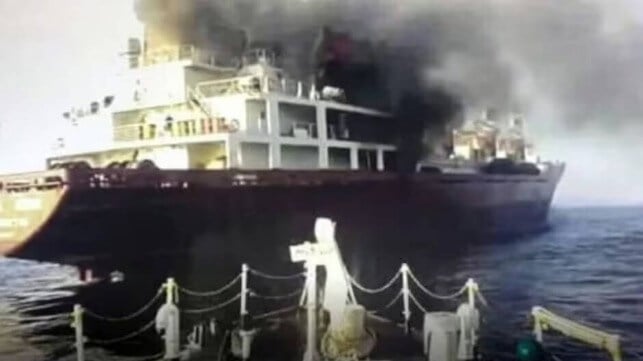
Six Injured as Russian Cargo Ship Catches Fire Departing South Korea

cargo ship fire
Six seafarers were injured in the fire on the Russian cargo ship (Korean Coast Guard)

Published Mar 27, 2025 3:20 PM by The Maritime Executive


Korean officials report they organized the rescue of the crew from a Russian-flagged cargo ship which caught fire shortly after it departed Busan on March 26. Initial reports said three crewmembers were injured but it was later revised to a total of six, with two badly burned and the other four with more minor injuries.

The ship, Crystal Asia, is a refrigerated cargo ship built in 1993 and operating under the Russian flag since 2016. The ship is 8,000 dwt and operates from Vladivostok.

The Korean Coast Guard reports the vessel departed Busan with ballast at around 0700 local time. Shortly after, while it was approximately 5 miles from the port, smoke was seen billowing from the vessel. The Coast Guard said it was a presumed engine failure but it was working to determine if it was a smoke condition or a fire burning on the ship. Multiple rescue boats were dispatched.

Crewmembers later told the Coast Guard that the smoke was coming from an engine failure. However, the Coast Guard said its initial inspection showed traces of an explosion inside the ship.

The rescue teams assisted with the firefighting. They removed the 23 crewmembers from the vessel and transported them to shore.

A tug was later able to secure the vessel and moved it back to Busan Port where it is now docked.


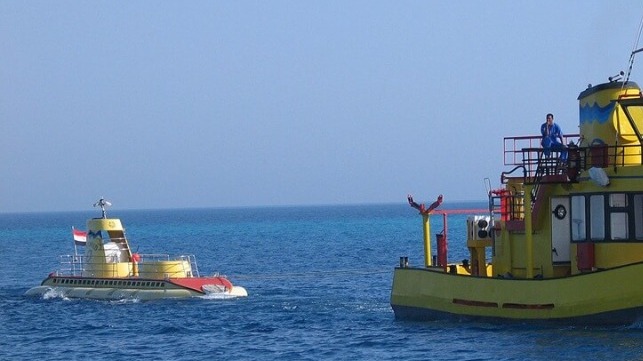
Six Killed in Tourist Submarine Sinking off Egypt

A Sindbad submarine under tow, 2004 (file image courtesy Digr / CC BY SA 3.0)

Published Mar 27, 2025 4:17 PM by The Maritime Executive


On Thursday, six tourists were killed when a recreational submarine went down near Hurghada, a resort town on Egypt's Red Sea coast. 

The viewing sub had 45 passengers and five crewmembers aboard at the time of the casualty, according to Red Sea Governorate's Maj. Gen. Amr Hanafy. The tourists included Swedish, Norwegian, Indian and Russian nationals, along with five Egyptian crewmembers. 

All crewmembers and all the rest of the passengers were rescued, though four surviving tourists were left in critical condition. They were evacuated to nearby hospital ICUs and remain in critical condition. 

Hurghada's Russian consulate reported that the sub was on a routine trip to a nearby coral reef when it "crashed." An investigation by the local authorities is under way.

The operator of the vessel, Sindbad Submarines, has two subs in its fleet. They were "engineered in Finland," according to the company, and typically operated at depths of about 80 feet on 40-minute excursions. 

It is the latest in a series of tragic accidents in Egypt's Red Sea tour-boat industry. The UK government counts 16 serious accidents involving Egyptian dive boats within the last five years. The most recent fatal casualty, a sinking in November, killed 16 people. Another brand new Egyptian dive yacht caught fire and burned before its maiden voyage last month. 

Top image: a Sindbad submarine under tow, 2004 (file image courtesy Digr / CC BY SA 3.0)


Tensions Rise in the Northern Indian Ocean as Iran Stages Display

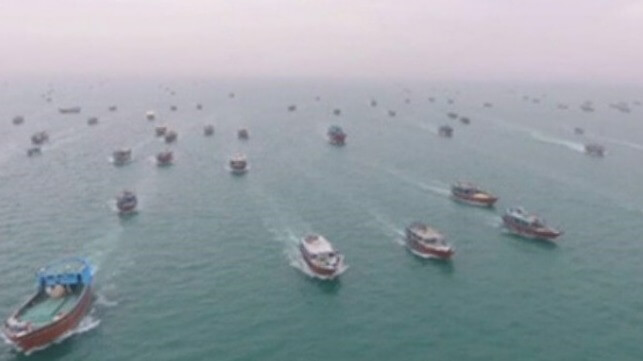
Iran dhow parade
March 27 dhow parade (Press TV)

Published Mar 28, 2025 2:18 PM by The Maritime Executive


While US forces continue to pummel Houthi targets in Yemen, primarily using aircraft launched from the USS Harry S. Truman Carrier Strike Group located in the Red Sea, tensions at sea are also rising in the Northern Indian Ocean. Signs of increased military readiness are evident both on the part of Iran and of the United States.

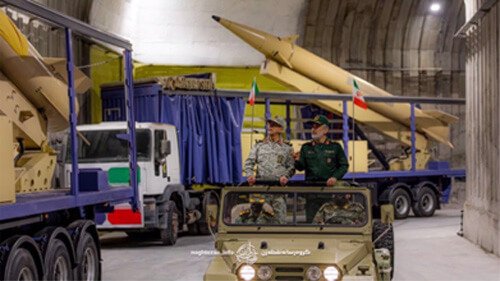
In comparison with the normal level of anti-American rhetoric seen on a daily basis in the Iranian online press, which is dominated by government-controlled websites, recent days have seen a dramatic increase in stories that imply that the Iranians feel they are under imminent threat. These stories are normally pitched as warnings to both America and Israel not to attack, brandishing Iran’s ability to counter-attack using its drone and ballistic missile forces. At times of tension, Iran often manufactures a display of some new missile capability, and in recent days has shown off what it claims is a new underground tunnel complex; in this instance, the story may be true, as similar tunneling, albeit with the normal complement of missiles on mobile launchers, has not been seen before. 


Major General Mohammad Bagheri and Brigadier Amir Ali Hajizadeh tour the new ‘missile megacity’, March 25 (Press TV) 


In an underwhelming display on March 27, the IRGC Navy (Nedsa) mounted a parade of old and unarmed dhows along the length of its coastline, which it said included vessels from Lebanon, Iraq, and Yemen. A number of the trading vessels are likely to have been contracted by Nedsa’s Unit 190 in recent years to smuggle weapons to the Houthis and others. This somewhat pointless review, which was probably the ‘3000 boat event' originally planned for January 27, was led by the converted oil tanker Shahid Bagheri (C110-4) and the Shahid Soleimani Class missile corvette Shahid Rais Ali Delvari (FS313-04).

The Regular Iranian Navy (Nedaja) is adopting a slightly more relaxed posture during the Ramadan season. On March 28, satellite imagery of the main naval base at Bandar Abbas showed four Alvand/Moudge and one Bayandor frigates alongside. There was no sign in the harbor of the intelligence collection frigate IRINS Zagros (H313). A Kilo Class submarine was at its berth on the east side of the harbor, with a second Kilo seen in dry dock. The long-range logistic vessel IRINS Makran (K441) was at its normal pier in the outer harbor. The three operational Hengham Class amphibious ships were alongside, together implying that there are no long-range flotillas out of home waters at present, as these vessels normally provide logistic support for such deployments. It is not clear at present even if the Nedaja remains in the Red Sea and Gulf of Aden area, a station which it has been maintaining continuously since 2008; if present, what would be the 101st Flotilla is maintaining an extremely low profile.

With the U.S. negotiating position outlined to Iran in a letter passed by President Trump through intermediaries to Supreme Leader Ali Khamenei, the Iranians understand they have limited room for maneuver and are under increasing pressure. At the same time, both the European Union and the United States have significantly tightened sanctions on the dark tanker fleet running sanctioned Iranian oil exports, which will have immediate detrimental effects on an Iranian economy already under very significant strains. On March 13, the US Treasury sanctioned an additional 30 tankers, in the third round of such sanctions. The EU’s 16th sanctions package listed an additional 73 Russian and Iranian tankers.

On the other side of the balance sheet, the United States is significantly reinforcing its strike capability in both the Red Sea and Northern Indian Ocean areas. 


Imagery of Diego Garcia on March 25, sourced from @IndoPacWatch but reposted by @MenchOsint who is often sympathetic to Iran


Recent satellite imagery shows at least seven B-2 Sprint strategic bombers on the British base at Diego Garcia. Nine KC-135 refueling aircraft are also visible on the southern-most ramp, with slots B1 and B2 on the ramp closed to other visiting military aircraft until the end of April. The KC-135 refuellers provide a significant payload and range boost, as they can refuel both the B-2 Sprints, the F-18 strike aircraft launching from the USS Harry S. Truman Carrier Strike Group, but also those from the USS Carl Vinson Carrier Strike Group which is tracking west, and due to arrive in the area shortly.

Early on March 28, the MV Jairan, the second of two sanctioned Islamic Republic of Iran Shipping Lines (IRISL) carrying sodium perchlorate from China, arrived in the Bandar Abbas anchorage. It can be expected to now move into the inner harbor and unload its cargo, to be processed into ammonium perchlorate which is the basis of the solid fuel which powers most of Iran’s medium-range ballistic missiles.


New U.S. Strikes Reported in Houthi-Controlled Sanaa

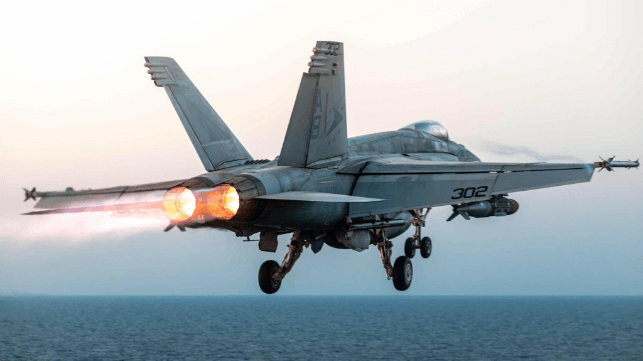
An F/A-18 fighter takes off from the deck of USS Harry S. Truman carrying a bomb loadout, March 26 (USN)
An F/A-18 fighter takes off from the deck of USS Harry S. Truman in the Red Sea March 26 (USN)

Published Mar 27, 2025 9:36 PM by The Maritime Executive


Airstrikes have been reported for another night in Sanaa, Yemen, as U.S. forces continue to hit the Houthi rebel militia. Earlier in the day, the group launched two more ballistic missiles at targets in Israel, demonstrating that it retains the capacity for long-range attacks. 

Local reports indicate that the latest American airstrikes hit the airport in Sanaa, as well as the Houthi military headquarters in the city center. 

The strikes are more sustained than the campaign carried out by the previous administration last year, and more intense as well, according to a review by the AP. Satellite imaging and radio traffic also reveal a buildup of bomber forces at Diego Garcia, the strategic base that the U.S. leases from Britain in the Indian Ocean. The rare deployment of seven B-2 stealth bombers at this remote airfield - a third of the entire inventory - has raised speculation about possible escalation against Houthi targets, or even against their sponsors in Iran. The B-2 has many capabilities, including one that could be particularly relevant: it is the only U.S. aircraft certified to carry the 30,000-pound Massive Ordnance Pentetrator (MOP, or GBU-57/B). This is the largest U.S. bunker-buster bomb, and would provide more capability for hitting hardened tunnels and command posts. 

If the Houthis are hit hard by U.S. strikes, it would not be the first time: a U.S.-supplied force tried to defeat them on the ground for the better part of a decade, but despite billions spent, the Houthis expanded their reach and dug in. 

"The Houthi leadership has been taken out in history in the past, and they are resilient," Vice Adm. Kevin Donegan (USN, ret'd) told AP. "They came back and they grew stronger. So this isn’t something that is a one-and-done."


Hulk of Containership Solong Arrives in Scotland

burnt-out containership
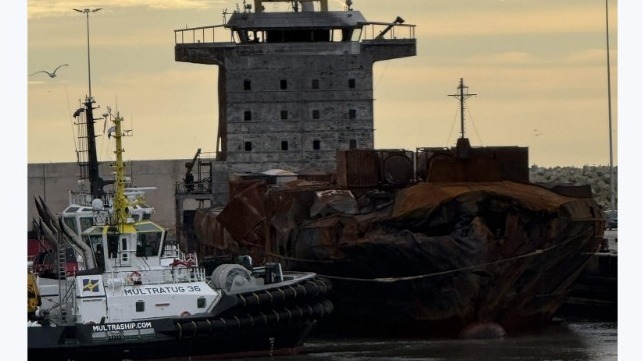
Solong being docked in Aberdeen, Scotland (Terry Charleton / X)

Published Mar 28, 2025 11:15 AM by The Maritime Executive


The burnt-out remains of the containership Solong which collided with the Stena Immaculate on March 10 arrived in Scotland this morning, March 28. The hulk of the vessel was tied to a dock in Aberdeen, Scotland with HM Coastguard reporting that concluded a key step with it now becoming a commercial salvage operation.

The tow arrived in Scotland and entered the harbor around 7:15 a.m. local time with a tug pulling the Solong. It was flanked by two additional tugs and a vessel with pollution control material was following the tow. The hulk was positioned in the South Harbor next to a laid-up oil rig and port officials said it would not be interfering with port operations.

A spokesperson for the owners of the containership, Ernst Russ, said the ship would be “fully assessed by specialist marine assessors and insurers” in Aberdeen. 


HM Coastguard also reports that the salvage of the Stena Immaculate “continues to be progressed.” The tanker has remained at its anchorage while it was inspected. The Coastguard reports “the transfer of its cargo to another vessel that may begin as early as this weekend.”

U.S. ship operator Crowley previously reported that a survey showed that only one of the tanker's cargo tanks had been damaged and it highlighted that the crew before evacuating activated fire systems which helped to preserve the other tanks. Crowley reported that there were 220,000 barrels of jet fuel aboard the tanker and that 17,515 barrels were lost due to the impact and subsequent fire.

The Coastguard also noted that it continues to assist the local authorities which are leading the coastline cleanup. They have been dealing with small plastic beads, nurdles, that were released during the fire and began washing ashore a week after the containership hit the tanker.

TRADE WAR TOO

Report: Under Pressure from China Hutchison Will Delay Panama Terminal Sale

Balboa Panama port
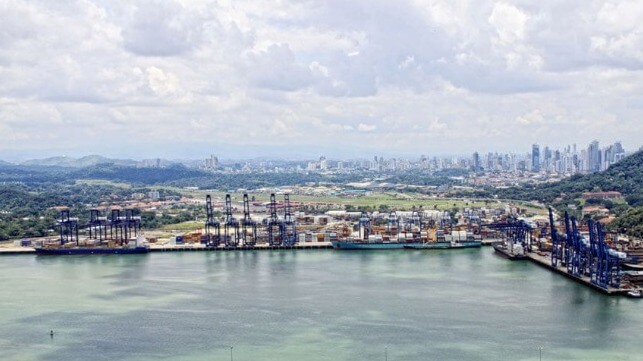
Reports are that Hutchison will delay the signing of the definitive sale agreement for the terminals in Panama (Hutchison file photo)

Published Mar 28, 2025 12:33 PM by The Maritime Executive


The controversial deal by CK Hutchison to sell its two port operations in Panama is reportedly going to be delayed. The South China Morning Post and Chinese-controlled newspapers are reporting that the target date of April 2 for the signing of definitive documentation will not proceed but also said this does not mean the deal is canceled.

Chinese officials later confirmed that the State Administration for Market Regulation would be reviewing the transaction. The South China Morning Post reports that the officials said the review was to “ensure fair competition in the market and safeguard the public interests.” Bloomberg adds that the review will be looking for potential security or antitrust violations.

Hutchison on March 4 announced that it had reached principal agreements with a consortium of U.S.-led BlackRock and MSC Mediterranean Shipping Company’s TiL group which owns and operates terminals. The total deal valued at $23 billion is for the sale of 80 percent interest in terminals in 43 ports in 23 countries outside China operated by CK Hutchison. In a parallel agreement, Hutchison said it would sell 90 percent interest in the Panama company that operates the terminals in Balboa and Cristobal, Panama at each terminus of the Panama Canal.

Hutchison said that “fundamental and essential terms” of the two transactions had been agreed in principle, subject to definitive documentation. It reported that the definitive documentation for the Panama portion of the transaction was expected to be signed on or before April 2. It also entered into exclusive negotiation and non-disclosure arrangements with the BlackRock-TiL consortium.

Chinese officials reacted negatively to the news of the sale as they saw it as U.S. intervention and worried about threats to Chinese shipping and trade. According to the media reports, China has been increasing the pressure on CK Hutchison including reports this week that the government had ordered that there be no new deals with Li Ka-shing, the Hong Kong billionaire who controls Hutchison, and his family.

Panama which has also been under pressure from the United States announced that it would be reviewing the transaction. Previously Panama had moved to review the contract with Hutchison and the Panama government filed notice that it was withdrawing from China’s Belt & Road initiative.

Media reports in Asia suggested that behind-the-scenes talks were happening between the company and government officials in Hong Kong. Hutchison has declined to make public comments and also canceled a planned briefing with investors after its year-end financial report.

Trump has hailed the deal for the Panama terminals and took credit with BlackRock for making it happen. MSC has remained quiet about the deal letting BlackRock be the center of attention in the media reporting on the transaction.

TRADE WAR 

OMSA Proposes a Daily Fee on Chinese-Made Offshore Vessels in US Waters

WTIV Cadeler
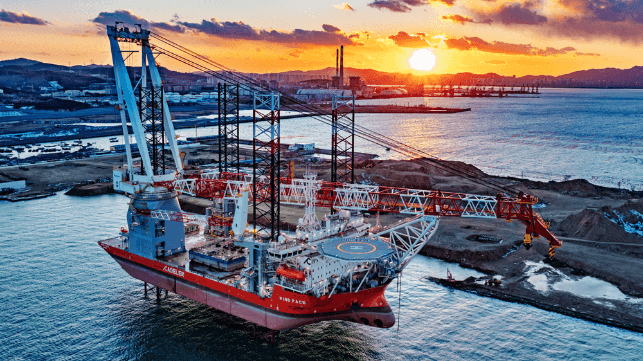
The high-spec WTIV Wind Pace was delivered on Wednesday at a Chinese yard, and will head directly to the U.S. East Coast for its first charter (Cadeler)

Published Mar 26, 2025 7:43 PM by The Maritime Executive


America's offshore vessel operators are pleased with the White House's proposal for steep fees on Chinese ships, and they would like the administration to go one step further - with a daily tax on Chinese-built vessels operating in U.S. waters. 

Despite the protections of the Jones Act for American shipping, the offshore vessel services industry is still exposed to low-cost foreign competition for certain tasks. Depending on the specifics of the work, a foreign offshore service vessel may not be covered by the Jones Act in U.S. waters. Crane ships, offshore wind turbine installation vessels, survey ships and other specialty service vessels can often compete for work on the U.S. continental shelf, so long as they do not move cargo between U.S. points. The definitions of "move," "cargo" and "U.S. points" are often disputed, but foreign operators still regularly win charters for work in U.S. waters. 

Last month, the Office of the U.S. Trade Representative (USTR) announced a plan to impose steep multimillion-dollar charges on Chinese-owned and Chinese-built vessels for calls at American seaports - but the fees are only assessed once per visit, and only in port. Under USTR's fee structure, a Chinese-made offshore vessel could still work in U.S. waters without paying anything, so long as it avoided American port calls. 

To offset the cost advantages of these foreign-built, foreign-crewed vessels, the Offshore Marine Services Association (OMSA) has asked USTR to include offshore work in its proposed schedule of fees for Chinese-built vessels. 

"OMSA respectfully requests that the proposed actions be amended so that the service fees accrue on a daily basis for Chinese-built vessels working in U.S. sovereign waters on U.S. offshore energy projects. This clarification to the USTR proposed remedies will adequately ensure that the actions fully account for the harm that is being promulgated by Chinese-built vessels to U.S. shipyards, vessel owners, mariners, and other workers that engage or attempt to engage in U.S. offshore energy projects," said OMSA President and CEO Aaron Smith. 

Smith suggested that Chinese-built offshore vessels could easily be assessed a daily fee based on AIS data records showing their time in U.S. waters, or on their Coast Guard notice of arrival and departure paperwork. This would affect at least 10 foreign ships that have worked in the U.S. offshore wind industry, representing some the largest and most important foreign-flag competitors that U.S. service providers face in the sector. 

"These vessels are coming into U.S. waters and staying—sometimes for years at a time—all the while taking opportunities from U.S. ships and shipyards," testified Smith. 

He singled out one particular vessel as an example: Cadeler's brand new WTIV Wind Pace. The 20 MW-capable vessel formally delivered on Wednesday at COSCO Shipping Heavy Industry in Qidong, and will soon get under way for its maiden voyage to the U.S. East Coast. Wind Pace is a cutting-edge ship and is expected to outcompete previous generations of WTIVs on capacity, transit speed and efficiency, according to Cadeler. On arrival in U.S. waters, it will begin a long-term installation contract worth about $70-80 million - revenue that U.S. shipowners will not get. 

The low, subsidized price of Chinese ships hurts American domestic competitors, but the sub-$100-per-day pay scale for foreign seafarers can be even more of a challenge, Smith said. 

"U.S. offshore energy vessel owners can simply not compete with their foreign competitors because current U.S. law requires U.S.-owned companies to hire only U.S. citizens and permanent residents as mariners when its vessels work on U.S. offshore energy projects," said Smith. "Conversely, U.S. law allows foreign-owned vessels to employ foreign mariners when conducting the same work. As foreign mariners command significantly less pay than their U.S. counterparts this gives foreign-crewed vessels a significant cost advantage."


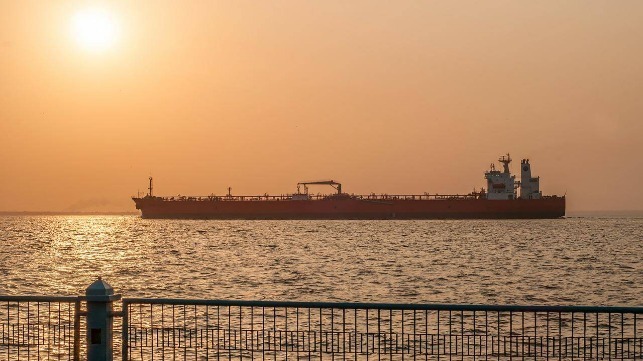
Report: India Turned Away Shadow Fleet Tanker Laden with Russian Oil

tanker at sea
India reportedly turned away a shadow fleet tanker (file photo)

Published Mar 28, 2025 1:37 PM by The Maritime Executive


While remaining the largest customer for Russian oil, India has had a spotty relationship with the shadow fleet and several times cracked down or responded to Western sanctions. In the latest effort, however, India reportedly turned away a shadow fleet tanker over improper documentation. 

The crude oil tanker Andaman Skies (111,000 dwt) is currently loitering in the Arabian Sea between India and Oman after being turned away from the oil terminal at Vadinar reports Reuters. In its reporting, it said the vessel which was due to arrive on Thursday, March 27, laden with approximately 100,000 metric tons of Russian crude would be turned away.

Built in 2004, the vessel has now completed 20 years of service which is an important threshold under Indian regulations. Both Reuters and Bloomberg are reporting the vessel which is managed from India was turned away because it lacked seaworthiness certificates from a recognized source. India requires additional documentation from the older vessels.

The vessel was sold by Delta Tankers of Greece in 2023 with the ownership registered in India. The tanker had last called at an Indian port in December according to Bloomberg. Typical of a shadow fleet vessel, the Equasis database reports it was registered in 2023 in the Cook Islands but switched flags again in 2024. Equasis and Bloomberg report the ship is operating under the flag of Honduras while Reuters and Marine Traffic say it is now under the flag of Tanzania. 

Bloomberg reports the tanker has P&I insurance from a Russian company, Soglasie, while Equasis lists its last surveys done in late 2024 by the China Classification Society but class was withdrawn in February 2025 for other reasons. Both news outlets report that Indian sources said the vessel is now being certified by the Dakar Class, which is not recognized in India.

Andaman Skies has been targeted by the West for its involvement in the Russian trade. Both the UK and EU have listed the vessel in their sanctions. However, the U.S. and the UN have not designated the vessel creating another loophole. India has promised not to import oil on sanctioned tankers but only recognizes the UN designations.

Reports indicate that as much as 35 percent of India’s overall crude oil imports came from Russia in 2024.