Sunday, May 18, 2025

National Security is often Local Insecurity: TriValley CAREs and Lawrence Livermore National Laboratory 


 May 16, 2025
Facebook

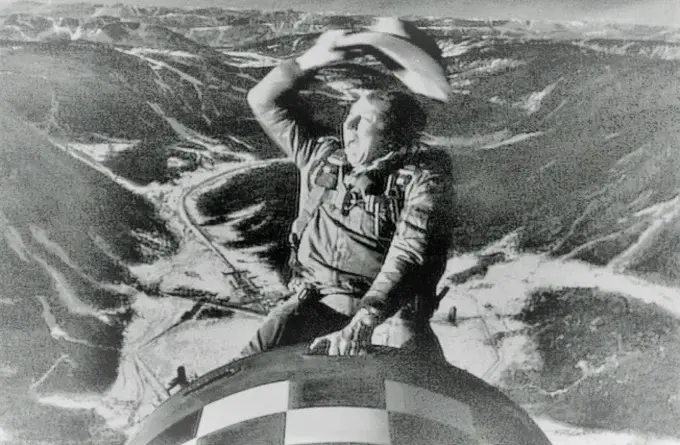
Slim Pickens (Louis Burton Lindley Jr.) in “Doctor Strangelove.” Pickens was a San Joaquin Valley native, born in Kingsburg, 1919, died of a brain tumor in Modesto, 1983.

I had just come back from a demonstration against a uranium mine near the rim of the Grand Canyon and talking to Native people from several tribes whose water, air and land would probably be polluted by the mine, the trucking, and the mill. Their struggle to protect their homes reminded me of my hometown, Modesto, only 50 miles from Lawrence Livermore National Laboratory and 35 miles from LLNL’s Site 300 High Explosives Testing Range.  

None of us knew the dangers on the Colorado Plateau or in the north San Joaquin Valley or in the valleys around Livermore. In the 1950s, in the San Joaquin Valley we were using smudge pots to fight frost in the peaches and almonds. We had a bad polio epidemic in 1953 just before the Salk Vaccine came out and ended polio here. Rachel Carson’s Silent Spring didn’t come out until 1962, and DDT was the best pesticide ever made: “It kills everything for 28 days,” the farmers said. Many of us got Valley Fever (Coccidioidomycosis) and still have to explain the lung scar to physicians far from agricultural areas. Occasionally the newspaper would announce a new case of Bubonic Plague in the Sierra Foothills. And, from the middle of WWII until the 1990s, we had our own (conventional) arms-manufacturing and storage facility 5 miles east of Modesto called Norris-Thermador, which employed up to 3,500 people when in operation but was best known for its long layoffs. 

We had no idea that during those years over on the Colorado Plateau Navajo miners were working in unventilated uranium mines during the great uranium boom of the 1950s and the Navajo Nation still suffers from radioactive mine litter, waste and dust.  

We knew nuclear bombs were being tested in Nevada near Las Vegas and on islands far away in the Pacific Ocean. We had no idea in high school in the middle of the Cold War that the bombs were being designed and developed 50 miles away from us. LLNL was shrouded in secrecy in those years. But after Sputnik at the start of my sophomore year, a lot of us were subjected to the awkward attempts of our excellent chemistry teacher to teach us physics.  Nevertheless, we were nearly completely ignorant of the greatest environmental threat in our vicinity. But a few years later we learned an ominous new term describing several nearby locations: cancer clusters. 

Analysis contained in an Environmental Impact Statement in accordance with the National Environmental Protection Act states that the effects of an accident at LLNL would spread 50 miles, as far north as Marin County, through San Francisco, the Peninsula, as far south as San Jose, and as far east as Tracy, Stockton, and Modesto. As many as 7 million people would be affected by plumes of either radioactive or chemically toxic particles. From an environmental safety standpoint it doesn’t make any sense for 90,000 people to live in Livermore, but many work at the lab, which has grown to completely fill its one square mile campus, and the Silicon Valley “high-tech/bio-tech engine for growth” employs many more.  Tens of thousands of other workers commute daily across the 10-lane Altamont Pass (I-580) from cities in the northern San Joaquin Valley to jobs in the lab and other high-tech industries. Median home price in Tracy, at the eastern foot of the Altamont was $680,000 last month; in Livermore, on the western side of the pass, median price is $1.1 million.  

All the energy, ambition, and traffic generated by high tech and nuclear weapons remind me of lines from Mandeville’s “The Grumbling Hive,” 1705: 

A Spacious Hive well stock’d with Bees,
That lived in Luxury and Ease;
And yet as fam’d for Laws and Arms,
As yielding large and early Swarms;
Was counted the great Nursery
Of Sciences and Industry.  

The National Nuclear Security Administration, a division of the Department of Energy, has stated that LLNL, because of special circumstances, cannot be made safe. One glaring special circumstance is that LLNL is only one square mile in size and surrounded by suburban housing. By contrast, Los Alamos National Laboratory is 40 square miles, Hanford Site is 586 square miles, the Savannah River Site is 310 square miles, and LLNL’s Site 300 is 11 square miles.  

In the early 2000s, LLNL in collaboration with Russian nuclear scientists, created Livermorium, a highly radioactive element, Lv, 116 on the Periodic Table. The City of Livermore changed its seal so that the graphic of an atom erases large parts of a cowboy on a bronc and a vineyard. And it created Livermorium Plaza with a large round statue of Lv at its center.  

I found the best way to begin to get an idea of what TriValleyCAREs is and does is to compare its mission statements with the statements of Lawrence Livermore National Laboratory. 

Lawrence Livermore National Laboratory: 

For over 70 years, Lawrence Livermore National Laboratory (LLNL) has applied science and technology to make the world a safer place. 

The Lab’s mission is to enable U.S. security and global stability and resilience by empowering multidisciplinary teams to pursue bold and innovative science and technology. 

Mission Areas 

Enhancing and expanding our mission in the broad national security space. 

By splitting our broad and evolving mission into four areas relevant to the current and future stability of our world, we’re better able to address issues of nuclear deterrence, threat preparedness and response, climate and energy security and multi-domain deterrence. We count on our talented workforce to think bigger in all four areas of our central mission. With exceptional work in preeminent areas of science and operations, the Lab’s influence doesn’t stop at our country’s borders — our innovations make the world a better place to live…

This statement brought to my mind former Secretary of Interior Stewart Udall’s comment: 

Although many disclosures did not surprise me, I concluded that the Cold War had been an incubator of deceitful practices and harmful illusions, and that if one was to gain a clear picture of this period of our history, it was essential to distinguish myths from truths.”

– Stewart Udall, The Myths of August, p. 21, 1994. (Udall spent much of his post-government years trying to get justice for miners and down-wind residents from the harm to health and livelihood from uranium poisoning and nuclear tests on the Nevada desert.) 

TVC’s mission statement struck me as a vision of peace more important for us to hear today than it was 40 years ago, when the Union of Concerned Scientists’ Doomsday Clock registered four minutes instead of this year’s prediction of 98 seconds: 

Tri-Valley CAREs’ overarching mission is to promote peace, justice and a healthy environment by pursuing the following five interrelated goals: 

1. Convert Livermore Lab from nuclear weapons development and testing to socially beneficial, environmentally sound research. 

2. End all nuclear weapons development and testing in the United States. 

3. Abolish nuclear weapons worldwide, and achieve an equitable, successful non-proliferation regime. 

4. Promote forthright communication and democratic decision-making in public policy on nuclear weapons and related environmental issues, locally, nationally and globally. 

5. Clean up the radioactive and toxic pollution emanating from the Livermore Lab and reduce the Lab’s environmental and health hazards… 

Tri-Valley CAREs was founded in 1983 in Livermore, California by concerned neighbors living around the Lawrence Livermore National Laboratory, one of two locations where all US nuclear weapons are designed. Tri-Valley CAREs monitors nuclear weapons and environmental clean-up activities throughout the US nuclear weapons complex, with a special focus on Livermore Lab and the surrounding communities. 

This statement has the clarity of Annie Jacobsen’s comment in her 2024 best-seller, Nuclear War: A Scenario: “It was the nuclear weapons that were the enemy of all of us. All along.” 

And it is as simple as what Albert Camus wrote two days after the US dropped the atomic bomb on Hiroshima: 

…mechanistic civilization has come to its final phase of savagery. A choice must be made, in the fairly near future, between collective suicide or the intelligent use of scientific conquests… (Combat, Aug. 8, 1945. )

Sitting at the edge of Silicon Valley, the latest manifestation of “mechanistic civilization,” LLNL represents the apex of Western technology:  the design and development of nuclear weapons. Palo Alto based Hewlett-Packard’s “El Capitan,” the world’s most powerful computer, is lodged at LLNL, to advance nuclear weapon science. A private/public partnership of University of California, Bechtel, BWX Technologies, Amentum, and Battelle Memorial Institute affiliated with Texas A&M University, called Livermore National Security, LLC, manages LLNL. 

Camus’s suicide comment is not an existential anachronism: according to the Union of Concerned Scientists we are closer than we have ever been to nuclear apocalypse.  

Driving into Livermore Valley to meet TVCs staff,  I couldn’t help remembering one stormy day when I was 10 or 11 years old and across the freeway from LLNL was entirely green pasture and I saw several black and bay horses, manes and tails flying as they played in the wind. But we aren’t horses and neither science nor technology offer us guidance about what to do about nuclear weapons.  

Scott Yundt, TVCs director, met me in the lobby of a plain, two-story office in downtown Livermore and took me up to a lovely office – lovely because it had no pretense or décor, just the slightly untidy air of a place where a lot of good work had been done for a long  time—some posters from past actions on the walls, computers on several desks, enough chairs and long tables for meeting purposes, racks for documents and cabinets along the walls.  And that was about as far as I ever got on my idea of doing a profile on TVC because Yundt immediately directed my attention to the Lab and kept me focused for the entire interview. He left to doubt that for him legal action was what to do about nuclear weapons. 

“We are entering a new nuclear arms race,” he told me. “It’s visible in LLNL’s new 15-year plan, which calls for tearing down old buildings and replacing them with 70 new ones, mainly devoted to nuclear work,” he said. “And in the last two years, employees have increased from 7,000 to 9,500.” LLNL announced in 2015-16 a 10-fold increase in the number of test explosions. It was rushed through NEPA.  

Yundt was working for an Oakland environmental law firm on TVC cases and decided to go full time with TVC in 2009  as its staff attorney drafting federal Freedom of Information and state Public Records Act requests, writing environmental statement comment letters, representing workers exposed to radiation considered “an externality of nuclear weapons program,” he said. The federal government has a program, the Energy Employees Occupational Illness Compensation Program (EEOICP), just for people employed at 115 Department of Energy sites: Hanford, Los Alamos, LLNL, Rocky Flats, plus little contractors. The programs are both for uranium radiation and toxic chemical exposure. More than LLNL 3,000 employees have made claims plus 81,000 nationwide, minus military personnel who have handled radioactive material. “The government has spent billions,” Yundt said. 

The federal Environmental Protection Agency has found that LLNL is a toxic Superfund site, but Yundt said that EPA figures “it would take between 70 years and infinity,” for cleaning it up. Some of the pollution, he added,  was generated by a WWII U.S. Naval Air Station located on the LLNL site, which contaminated the area with jet fuel and solvents.  

Since the 1960s, TVC has found through data searches that Livermore Lab has released 1 million curies of radiation into the environment, approximately equal to the amount of radiation deposited by the US bombing of Hiroshima. Approximately three-quarters of a million curies have been tritium, Yundt explained. 

LLNL opened Site 300 in 1955 as a “high explosives testing area” on seasonal pastureland. It is located on Corral Hollow Road just beyond the western limits of the City of Tracy, in the San Joaquin Valley. LLNL tests its proprietary nuclear warhead triggers on the site. Instead of plutonium in the experimental warheads, LLNL uses depleted uranium in its tests of different mixtures of explosive triggers. This is an air-quality issue for the people and livestock in the northern San Joaquin Valley. This program adds PM 2.5 particulates to the San Joaquin Valley’s air pollution, but this particulate “is a real special dust,” Yundt said.  TVC went to state/fed air-quality-board hearings with 80 people. The local air pollution control district issued a letter instead of rubber stamping the LLNL program. But LLNL management never replied — one more example in this region of how “national security” equals local insecurity. 

The Tracy city limits did not expand west of I-580 until persuaded by the developers of Tracy Hills, AKT Development, founded by Angelo Tsakopoulos and managed at the time by his daughter, now California Lt. Gov. Eleni Kounalakis. Yundt said Tracy Hills, now operated by partial owners, Lennar Homes, was planning a senior facility on the fence line between its property and LLNL’s Site 300. I thought that plan showed a remarkable capacity for denial, even for California developers.  

LLNL is building up – new buildings, more employees, more explosive tests – because the Department of Energy/National Nuclear Security Administration, and the Department of Defense are funding design and development of two new warheads using plutonium pits, the terrestrial warhead called the W87-1 and a submarine warhead to be called the W93. 

There is a Level 3 Biowarfare Laboratory at the LLNL main site in Livermore. A level 3 lab typically contains “microbes that are either indigenous or exotic and can cause serious or potentially lethal disease through inhalation” like Anthrax, COVID-19, Hantavirus, Malaria, Mycobacterium tuberculosis, Rift Valley fever, Rockey Mountain spotted fever, West Nile virus, and Yellow fever.   

TVC sued the LLNL because the environmental impact statement included no analysis for terrorism. Yundt said that the LLNL reply was inadequate because it didn’t deal with intentional acts, replying only that the probability of a successful attack was low because LLNL was a “high security site.” 

But the issues of management and “high security” at LLNL are closely connected and have had quite a history  in recent years, which will be treated at the top of the second installment on the history of the relationship of TVC and LLNL.  


Bill Hatch lives in the Central Valley in California. He is a member of the Revolutionary Poets Brigade of San Francisco. He can be reached at: billhatch@hotmail.com.

Who’s on the List of Radical Left Thugs that Live Like Vermin?


May 16, 2025
Facebook

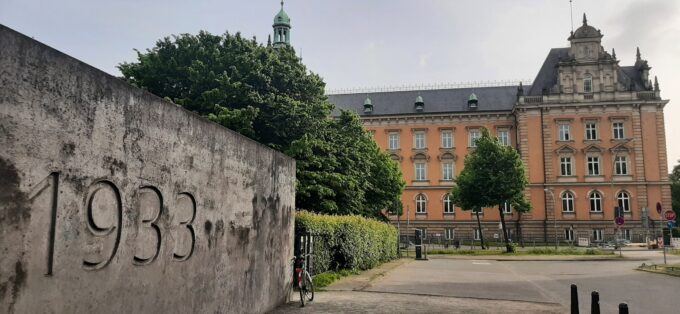
A stark monument in Hamburg’s courthouse square, near the infamous Dammtor prison. Photo by the author.

I’m married to a German citizen who’s a life-long resident here in Hamburg, and I spent most of the winter and spring in this city of two-million — a far cry from my rural Wisconsin homestead outside a town of 2,000. Not far from our flat is Hamburg’s federal, state and municipal courthouse square, which has a billboard-sized concrete cuboid monument with a blunt, stark, and grim reminder. It reads simply: 1933. The monument is also the site of Dammtor prison where during the terror the Nazi regime conducted 468 executions using the guillotine.

It’s frightening to follow news of repression in the United States, and people here ask why I intend to fly back this month. The short answer is my connection to the rest of my family and friends, my work colleagues, personal identity, the national park system, and the intentional community farmstead that a group of us built with our own hands over the last 36 years.

The prevalence and unpredictable expansion of political persecution is what my friends here and at home are afraid of. They know even high-ranking Republican Party stalwarts like Alaska’s U.S. Senator Lisa Murkowski have said publicly, “We are all afraid. I’m oftentimes very anxious about using my voice because retaliation is real.”

This trepidation in high places prompted Sally Quinn to write in the New York Times on May 10, “Washington is …., “Washington is physically, emotionally, psychologically and spirituality permeated with an invisible poison. The emotion all around … is fear. Nobody feels safe.” Perhaps nobody should. Trump said Nov. 17, 2023 in New Hampshire, “We will root out the communists, Marxists, fascists, and the radical left thugs that live like vermin within the confines of our country.” I wonder if Sally Quinn and I qualify for the “vermin thug” list.

It’s hard to say, since Trump himself could hardly be more thuggish. On his first day in office he demonstrated that his magical thinking can’t find thugs among his radical right storm troopers. He released from prison 1,500 January 6 rioters led by far-right militias, many of whom had been convicted of violently assaulting police officers, injuring 140.

Speaking of thugs with the rightwing website National Pulse, Trump said that immigration was “poisoning the blood of our country” — his Hitlerian dog whistle heard around the world which he would repeat. At an Ohio rally March 16, 2024, he said about immigrants, “I don’t know if you call them people. In some cases, they’re not people, in my opinion.” Using his best words, Trump added, “I’ve seen the humanity, and these humanity, these are bad, these are animals, okay?”

Dehumanization and vengeful cruelty

Robert Jones, of the Public Religion Research Institute, told National Public Radio in 2023 that “dehumanization of political opponents are the bricks that pave the road to political violence.” In view of Charlottesville, January 6, and the pardons of unrepentant paramilitary rioters, that road’s been paved, resurfaced, and upgraded to a speedway.

Rümeysa Öztürk, a Tufts Univ. graduate student from Turkey was grabbed March 25 in Somerville, Mass. by masked secret agents, shipped off to a Louisiana jail, and held there 7 weeks for signing an opinion piece in the college paper. Mahmoud Khalil, a green card holder married to a U.S. citizen, was abducted without a warrant from his Columbia University housing in New York City by ICE agents March 8 and shipped to jail in Louisiana, although he’s not charged with a crime. Kilmar Armando Abrego Garcia, a Maryland sheet metal worker with no criminal record, was mistakenly shipped to El Salvador’s notorious “Center for Terrorism Confinement” or Cecot maximum security mega-prison, in violation of a federal immigration judge’s 2019 order prohibiting the U.S. from returning him to El Salvador, where gangs could “pose a threat to his life.” Garcia is still there.

The Kafkaesque nightmare nature of Trump’s martial law dreams is that neither the U.S. State Department nor the government of El Salvador have even identified the 260 prisoners sent to the giant maximum-security prison, and neither state has provided evidence of the men’s alleged crimes or gang membership. A federal judge’s order forbade the White House from invoking an antique wartime law to justify the deportations, but the flights had already left. The imprisoned men have effectively vanished indefinitely inside a Salvadoran dictator’s police state nihilism, without recourse.

And immigrants aren’t Trump’s only targets. Lydia Polgreen reported May 8 in the New York Times that the president “muses about ejecting U.S. citizens too,” and enacting “the fantasy of expelling every person he deems undesirable.” In January, Trump talked about sending U.S. citizens who are “repeat offenders” to El Salvador’s gulag-for-hire. Repeatedly belaboring his repetitive repetition again and again, Trump said January 27 in Miami, “If they’ve been arrested many, many times, they’re repeat offenders by many numbers.”

He added, “We’re going to get approval, hopefully, to get them the hell out of our country, along with others,” NBC News reported. The next day Trump said in the Oval Office he wanted U.S. citizens convicted of crimes sent to foreign prisons “to get these animals out” of the United States. “If we could get them out of our country, we have other countries that would take them.” In February, El Salvador offered to jail violent U.S. citizen convicts in the “most severe cases,” in addition to the 260 men flown there earlier from the U.S. without due process.

On May 9, White House adviser Stephen Miller said for the cameras, “The Constitution is clear — and that, of course, is the supreme law of the land — that the privilege of the writ of habeas corpus can be suspended in a time of invasion. So, it’s an option we’re actively looking at.” Miller mis-quotes the U.S. Constitution to suit his Apartheid agenda. Article VI says, “This Constitution, and the laws of the United States which shall be made in pursuance thereof; and all treaties made, or which shall be made, under the authority of the United States, shall be the supreme law of the land; and the judges in every state shall be bound thereby.”

Habeas corpus is the right to challenge your detention in court and threats of its suspension moved Sen. Chris Murphy of Connecticut to warn, “The slope to despotism can be slippery and quick.” And this is where Trump’s deliberately irrational, secret and rogue police actions, designed to keep opponents off balance, can look and feel like terror. In my work against nuclear weapons and the war system over 4 decades, I’ve been convicted of dozens of nonviolent misdemeanor charges for sit-ins, blockades, and non-payment of fines, and have been sent to 20 county jails and four federal prison camps — including one here in Germany. Within our bands of “repeat offenders,” we call ourselves “nuclear resisters,” but the peace movement’s resistance has never garnered much more than a “pffff” from the police, the masters of war, or the courts that protect them. That’s why I’ll likely be left alone at passport control when I return.

But in view of warrantless, secret police snatching and detention of nonviolent immigrants and students without due process and even in violation of court orders, Sally Quinn’s withering warning gives pause. “The hallmark of this administration is cruelty and sadism, vengefulness carried out with glee.” As if to prove the point, Trump’s richest friend, the Afrikaner Elon Musk, has declared: “The fundamental weakness of Western civilization is empathy.” Ja voll, Herr Musk! Que the stiff-arm salute. #


John LaForge is a Co-director of Nukewatch, a peace and environmental justice group in Wisconsin, and edits its newsletter.

A Deceptive Joy in Geneva over U.S. China Trade Talks

 May 16, 2025
Facebook

Photograph Source: Dan Scavino – Public Domain

There is joy in diplomatic Geneva. The neutral, good offices convenor of Reagan-Gorbachev and Putin–Biden summits is back in the headlines with trade talks between China and the United States. “China–U.S. tariff talks place Swiss diplomacy on centre stage” boasted a local website. But wait, isn’t the trade war between the United States and China a clear violation of international norms codified at the World Trade Organization (WTO)? Is the euphoria over the possibility of averting a global trade war and recession actually undermining internationally accepted principles and institutions of multilateralism such as the WTO based in Geneva?

In a highly anticipated meeting, representatives of the world’s two largest economies met over the May 10 weekend in Geneva to try to avert a global economic slowdown caused by President Trump’s imposition of a minimum 145 percent tariff on all Chinese imports and China’s countermeasure 125 percent import tax on all American imports. U.S. Treasury Secretary Scott Bessent, U.S. Trade Representative Jamieson Greer and Chinese Vice Premier He Lifeng led the high-level delegations.

No official statement followed the first day of talks, but Trump was optimistic; “A very good meeting today with China, in Switzerland. Many things discussed, much agreed to. A total reset negotiated in a friendly, but constructive, manner,” he posted on Truth Social after Saturday’s seven hour session. Trump added: “We want to see, for the good of both China and the U.S., an opening up of China to American business. GREAT PROGRESS MADE!!!”

The final agreement after Sunday’s meeting said that starting May 14, the U.S. will drop its 145 per cent tariff rate for Chinese imports to 30 per cent, while China agreed to lower its rate from 125 per cent to 10 per cent. Both reductions caused global economic and political relief. In addition, the two sides agreed to set up a joint mechanism focused on “regular and irregular communications related to trade and commercial issues,” China’s international trade representative Li Chenggang said.

But what is this joint mechanism? Where is the WTO? From the Chinese perspective, according to Frederic Koller in a local Geneva newspaper, “China is indeed trying to position itself as the defender of international trade rules and its guarantor, the WTO.” As proof of Chinese support for the WTO, the Chinese delegation invited the head of the WTO, Ngozi Okonjo-Iweala, to a debriefing late Sunday at the Chinese embassy after the bilateral negotiations ended.

The U.S., on the other hand, has been very critical of the WTO. The WTO appeals organ, the Appellate Body, has been blocked since 2016 by the U.S’s refusal to fill remaining vacancies. And the U.S. Trade Representative Greer continued to downplay the multilateral trade institution, saying, “This organization is detached from reality.”

There is no question that Trump’s Liberation Day announcement of tariff increases has caused global economic disruption and political anxiety. U.S. Federal Reserve Chair Jerome Powell warned about the negative effects of substantial increased tariffs at a recent press briefing; “If the large increases in tariffs that have been announced are sustained, they are likely to generate a rise in inflation, a slowdown in economic growth, and an increase in unemployment,” Powell said.

But in addition to causing economic hardship, Trump’s tariff announcements are a direct violation of the WTO’s fundamental principles. Although the head of the WTO found the talks encouraging – the discussions are “a positive and constructive step towards de-escalation” Ngozi Okonjo-Iweala said on the eve of the negotiations – she did not comment on the larger questions of the Trump administration following WTO norms.

The United States has undermined the effectiveness of the 166 member organization by challenging WTO rules. Article II of the General Agreement on Tariffs and Trade (GATT, the precursor of the WTO) requires “that each member gives effects to its commitments to treat imports no less favourably than its GATT Schedule provides.” If a member country imposes a tariff higher than its bound commitment, it violates Article II. That is exactly what the United States has done.

The first step to resolve a dispute are bilateral consultations. If consultations fail, the complainant country may be allowed to impose retaliatory tariffs or other trade countermeasures after receiving approval from the WTO. That has not been done. Trump announced the tariffs unilaterally. There was no WTO approval. To be noted; The United States, under Trump 1.0, had introduced additional tariffs of 25 per cent on steel and 10 per cent on aluminium products on grounds of ‘national security.’ The WTO ruled against this in multiple cases.

The WTO dispute panel decided that national security exceptions cannot be used arbitrarily and must be linked to real security concerns such as during war or emergencies. The U.S. has appealed this and the result is still pending.

So while there is joy in Geneva because the trade talks are taking place here, the larger question of Trump undermining multilateralism cannot be avoided. The two sides agreed to establish a mechanism for consultation on economic and commercial issues in China, the United States or elsewhere. But that is exactly what the WTO is supposed to do. No final decision about where the consultations will take place has been made.

An American anti-WTO argument was sent to me by Joost Pauwelyn, a former legal adviser to the WTO Secretariat: “The U.S. would argue that they tried to reform the WTO, address unfair trade from China for decades, but the WTO process is hopelessly blocked. The U.S. would say that they had no other choice but to take things in their own hands the way they did in the late 1980s/early 1990s, with U.S. aggressive unilateralism and NAFTA actually pressuring other countries to agree to the WTO’s creation.”

As for a positive WTO role in the future, Pauwelyn, now a professor at the Geneva Graduate Institute, optimistically wrote in the International Economic Law and Policy Blog; “The WTO leadership has a key role to play….a revitalized WTO following a positive outcome on reciprocal tariffs would create the conditions for better international cooperation on these matters too. If this could materialize, instead of chaos for global trade and the death knell of the WTO, Trump’s reciprocal tariff plan could be a boost for WTO reform and the creation of a new, fairer balance in global trade.”

All of the above discussion of tariffs, the role of the WTO and multilateralism is in many ways a tribute to Joseph Nye, who passed away on May 6 at 88. Former professor at Harvard and Dean of the JFK School, Nye was a senior member of the Carter and Clinton administrations. He is best known for coining the phrase “soft power,” the idea that power and influence can come from sources other than military might.

Multilateralism and soft power go hand in hand. Trump’s attacks on USAID, USIP and other American peaceful global outreaches are examples of his disregard for soft power. Unilateral tariff increases are hard power. Bilateral trade negotiations are hard power. Multilateral negotiations within a collective organization such as the WTO are soft power, a necessity in a complex interdependent world, another phrase often used by Professor Nye.

Whether the WTO will come out stronger from Trump’s tariff declarations, as Pauwelyn hopes, remains to be seen. But Trump’s Liberation Day announcements and other unilateral measures remain traumatic shocks to the multilateral system and a determined rejection of Nye’s soft power. Geneva’s joy at hosting the U.S. China trade talks cannot hide that reality.

Daniel Warner is the author of An Ethic of Responsibility in International Relations. (Lynne Rienner). He lives in Geneva.