Sunday, May 18, 2025

The World According to Donald Trump

 May 16, 2025
Facebook

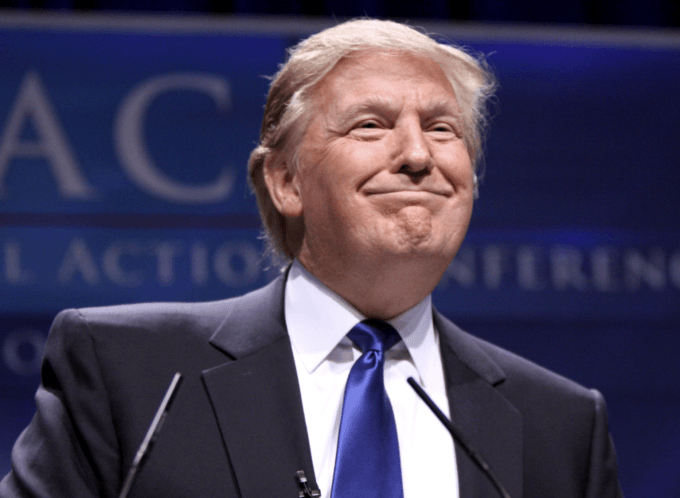
Image by Gage Skidmore.

I remember the phrase from my boyhood, listening to baseball games on the old wooden radio by my bed. A major hitter would be up and — bang! — he’d connect with the ball in a big-time fashion. The announcer in a rising voice would then say dramatically: “It’s going, going, gone!” It was a phrase connected to success of the first order. It was Duke Snider or Mickey Mantle hitting a homer. It was a winner all the way around the bases.

Today, though no one may say it anymore, somewhere deep inside my mind I can still hear it. But now, at least for me, it’s connected to another kind of hitter entirely and another kind of reality as well. I’m thinking, of course, about the president of these (increasingly dis-)United States of America, Donald J. Trump, and how, these days, his version of a going-going-gone homer is simply the going-going-gone part of it.

But no one reading this piece should be surprised by that. After all, in my own fashion, for the last 24 years here at TomDispatch, I’ve been recording the going-going-gone version of both this country and, as time has gone on, this planet.

And of course, I’ve lived through it all as well. I mean, imagine: I was born on July 20, 1944, less than 13 months before World War II ended in all-American success with the ominous use of two atomic bombs to obliterate the Japanese cities of Hiroshima and Nagasaki. (Going, going, gone!) And I grew up in the 1950s, years when the president of the United States, Dwight D. Eisenhower, had previously been nothing less than the Supreme Commander of the Allied Expeditionary Force in Europe in World War II and a five-star Army general. And it would be under his presidency that this country would end its military action in Korea with an armistice that left that land split in two. And that unsatisfying conclusion would prove to be but the first of what, over the decades to come, would be an almost endless series of unwinnable wars in countries ranging from Vietnam, Cambodia, and Laos, to Afghanistan, Iraq, and in the era of the Global War on Terror, an unnerving percentage of the rest of this planet. (Going, going gone!)

We’re talking about the military that, in those same years, would establish an unparalleled 750 or more military bases across significant parts of planet Earth and would, while it was at it, create what was functionally a global navy and air force.

In those same decades, as literally millions of people died in all-American wars, we would, in response, pour ever more money into the institution that was all too inaptly — or do I mean ineptly? — called the Department of Defense. Of course, the question of whether it should actually have been called the Department of Offense simply never came up. And yet, despite three-quarters of a century of remarkable lack of success in its conflicts, in the years to come, the Pentagon, under Donald J. Trump, is likely to break quite a different kind of record when it comes to success.  No, not in fighting wars, but in being funded by the American taxpayer in what, if any sort of perspective were available, would be seen as a staggeringly unbelievable fashion.  After all, President Trump is now aiming for a 2026 “defense” budget that, with a rise of 13%, would break the trillion-dollar mark. And mind you, that sum wouldn’t even include the $175 billion he hopes to invest in “securing” our border with Mexico, or the funding for the rest of the national security bureaucracy.

And to set the stage for all of this, he even all too (in)appropriately launched a new American conflict, an air war on Yemen, a country that, I would bet, most Americans didn’t even know existed and certainly couldn’t locate on a global map. And given the American record on such matters since 1945, it was perhaps strangely on target of him recently to suddenly halt that bombing campaign, since you can count on one thing without even having access to the future: there was no way it would have proven successful and victory there would never have been at hand.

And consider it strange as well that, even in the decades of this country’s imperial success, when it helped form and support the North Atlantic Treaty Organization in Europe, when it developed a vast network of military bases and military allies across the Pacific littoral from Japan to Australia and beyond, when it faced off against the Soviet Union on this planet (and did indeed, in the end, leave that imperial power in the dust of history), it was still, in war-fighting terms, a military disaster zone. In short, since its victory in World War II soon after my birth, this country has never again come close to winning a war.

And yet, here’s the strange thing, historically speaking: those years of disastrous wars were also the years of American imperial greatness. Who, today, can even truly remember the moment that the Soviet Union collapsed in 1991, its empire dissolving, while it fell into utter disarray, leaving this country, in imperial terms, standing distinctly alone on planet Earth, not an enemy or even a true opponent in sight? (Communist China was then still a modest power, though on the rise.)

Going Down the Trumpian Toilet

Thirty-four years later, how things have changed! (Yes, given those years, it seems to me that an exclamation point is anything but inappropriate!) And if you want to take in the true nature of that change, you have to look no further than one Donald J. Trump. How extraordinary that he has become the Dwight D. Eisenhower or John F. Kennedy of this strange moment of ours.

I think that someday, looking back, hard as that act may be even to imagine right now, Donald Trump will be seen as a — or perhaps the — symbol of the decline and fall of just about everything. Or looked at another way, what’s left of imperial America appears to be going down Trump’s toilet, while this country itself threatens to come apart at the seams. Meanwhile, America’s first billionaire president, who has surrounded himself with a bevy of other billionaires, continues to have the urge to profit personally from this increasingly strange world of ours. Of course, that should hardly be shocking on a planet where, in 2024, even before his second term in office, the cumulative wealth of billionaires was estimated to have grown by $2 trillion, or $5.7 billion a day, with the creation of an average of four new billionaires a week. And according to Oxfam, “In the U.S. alone, billionaire wealth increased by $1.4 trillion — or $3.9 billion per day — in 2024, and 74 more people became billionaires.”

And mind you, all of that was true even before (yes, that word should indeed be italicized!) billionaire Donald Trump reentered the Oval Office, while his sons continued to wildly circle the globe trying to make yet more money for themselves and him. And who wouldn’t agree that, in these last months, the second time around, he’s been a distinctly tarrific president? (Don’t you dare disagree or I’ll put a 10%, — “the new zero” — if not a 145% tariff on you personally!)

Oh, and the man who rode into office on a promise to save the American middle class has promisingly staffed his administration with at least 12 other billionaires. And oh (again!), I haven’t even mentioned the richest man on planet Earth yet, have I? Yes, Elon Musk has lent a distinctive hand — and what a hand! — to dismantling significant aspects of the U.S. government (but not, of course, the Pentagon!), throwing tens of thousands of people out of work, while ensuring that parts of the government that actually helped Americans and others on this planet of ours would no longer be functional. No less impressively, he did so at a genuine cost to himself. The fall in value of the stock of his increasingly unpopular car company, Tesla, has been little short of stunning, leaving him with a mere $300 billion or so (no, that is not a misprint!), which represents a loss of about $131 billion so far in 2025 alone.

The President from Hell

But what makes Donald Trump’s and Elon Musk’s moment and movement so different from any other moment or movement in our history is another reality (and it is a reality) entirely: This isn’t simply a moment of imperial decline, something all too common in the long story of humanity, but of a marked planetary decline as well.

Yes, the Earth itself is, it seems, going down that same imperial toilet. And unlike the decline of great powers, the decline of Planet Earth is likely to be devastating indeed for the rest of humanity. It’s hard even to believe, in fact, that Americans elected (twice, no less!) a man who has insisted that climate change is a “giant hoax” and, once in office, has seemed intently focused on increasing the levels of drilling for and the burning of oil and natural gas, even though it’s hardly news anymore that such acts will, over the years to come, help devastate this already overheating planet of ours — the last 10 years having already been the hottest on record — and everyone on it.

Storms, floods, and fires of a historic — or do I mean post-historic? — sort clearly lie in our future in a fashion that we humans have never experienced before. And it’s perfectly obvious that 78-year-old Donald Trump simply couldn’t give less of a damn. After all, he certainly won’t be here to experience the worst of it. He is, in short, not just a tariffic president but, in some futuristic sense, all too literally the president from hell.

And all of this should have been obvious enough from his first round in the Oval Office, so consider all too many of us Americans, if not us humans, to have some version of a Trumpian-style death wish, even if not for ourselves but for our children and grandchildren. In so many ways, in retrospect, the reelection of Donald Trump seems to represent — explain it as you will — the enactment of a human death wish on a scale almost beyond imagining.

And with that in mind, let me return to the threesome I began this piece with. Those three words may no longer be a baseball line at all — I wouldn’t know since I haven’t listened to a baseball game in years — but they still have a certain grim futuristic significance on our planet. So let me repeat them again as a kind of warning about where, if we’re not far more careful in our political choices, all too much of humanity is heading — thank you, Donald J. Trump!

Going, going, gone!

(Let’s truly hope not!)

Tom Engelhardt is a co-founder of the American Empire Project and the author of The United States of Fear as well as a history of the Cold War, The End of Victory Culture. He is a fellow of the Nation Institute and runs TomDispatch.com. His latest book is Shadow Government: Surveillance, Secret Wars, and a Global Security State in a Single-Superpower World.

Fear of Protesting Trump Policies Spreads in US


 May 15, 2025
Facebook

Image by Teemu Paananen.

Cambridge, England. I just returned to this medieval English university town last week after a three-and-a-half week visit to the US where my harpsichordist spouse performed four concerts in Philadelphia and Portland, Oregon, and I must say that the feeling of coming “home” was much stronger when I began hearing British accents around me than when, after spending the last seven months in the UK, I had initially landed in Newark Liberty International Airport.

I’ve been following, and writing about, the dizzying wrecking-ball assault on democratic governance by the second-term Presidency off Donald Trump, watching in horror as my graduate school alma mater Columbia University prostrated itself to Trump and the Republican hyenas in Senate and House, left courageous student protesters against Israeli genocide to the not-so-tender mercies of New York’s Finest Tactical Thugs, and even helped the more brutal thugs of the federal Department of Homeland Security, on private university grounds and without court orders, arrest, detain and attempt to deport students who are Palestinian.

That outrage—which included summarily and without due process suspending foreign student activists for exercising their 1st Amendment rights and thus losing their student visas —ws reminiscent of the post-WWI Red Scare era and the post-WWII HUAC-McCarthyite nightmare combined was awful. But my horror was amplified when I tried to get my Columbia Journalism Class of 1975 classmates, many of whom had gathered at Columbia to celebrate our 50th anniversary reunion, to sign a letter composed and circulated by the Journalism class of 1969 (some of them veterans of the 1968 student takeover of several campus buildings). Addressed to J-School and University administrations and condemning their sell-out of the First Amendment so fundamental to our work as journalists, I could only find six classmates willing to add their names to it!

Later in my US stay, both in my home community in a suburb just north of Philadelphia, and during a cross-country side trip for another harpsichord concert engagement in Portland, Oregon, I was dismayed to find myself picking up a weird sense of almost enforced normalcy or fearful passivity among my fellow Americans. Given the endless evidence of a fascist regime in the process of consolidation in Washington, I had hoped and expected to see signs of resistance and rebellion—cars sporting outraged bumperstickers, demonstrators outside of Social Security buildings, threatened Post Offices, Congressional constituent-services offices, Tesla dealerships, etc. — but I saw nothing. Even during a jog across the sylvan campus of Reed College, a hotbed of anti-war protest during the days of America’s war on Indochina in the 1960s-70s, I saw students on their exam study week lolling on the lawns, but there were no protest signs in evidence, no anti-Trump T-shirts, or chalk graffiti denouncing White House predations, or even denunciations of his predatory attack on higher education.

I can’t say for certain, but I got the clear sense that there is a wide-spread fear among Americans these days of openly expressing opposition to the aspiring orange tyrant in the White House. Putting an anti-Trump bumper sticker on a car could lead to vandalizing of the vehicle, saying something critical of Trump could mean losing friend, a job, or ruining a family gathering. I even heard that one of my J-School alums didn’t want to sign the Class of ‘69 protest letter or even to have a copy of it sent to his email address, explaining to a mutual friend that “I still have a journalism job” and thus even being associated with such a document!

A common comment I heard from people when I expressed my outrage at Trump’s executive orders like the blocking of already-awarded federal research grants, the revoking of already-approved Green Cards and student visas for foreign students, the deportation of children who are US citizens, and the president’s ignoring of judicial and even Supreme Court orders, has been a dismissive and resigned “Yeah, that’s the new normal now.”

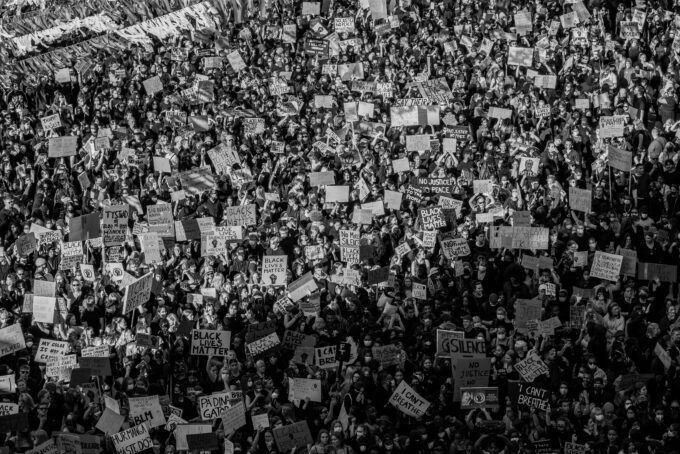
I cannot recall observing that sort of defeatism and fear during the dark years of American atrocities in Indochina. When we learned of massacres of civilians in Vietnam by US troops, or of the carpet bombing by B-52s of North Vietnam and later of Cambodia, the news fueled mass marches across the country and in the nation’s capital.

Even knowing that there could be arrests for such protests, and attacks by police or, during the Nixon administration, by organized thugs from right wing labor unions, like construction workers, people would come out onto the streets to make their outrage known.

Now I know that there are groups—climate activists, defenders of Social Security, Medicare and Medicaid, protesters against the IDF’s genocidal war on Palestinians in Gaza and in the west Bank, including my own chosen organization Radical Elders,—which have organized many courageous people, but the numbers of protesters remain small compared to the scale of the Trumpist attacks.

None of this is to say that things are great politically herein the UK. The Labour government last July delivered thumping defeat to the governing Conservative Party, virtually decimating it and paving the way for the right-wing anti-immigrant Reform Party to become the main opposition party. Even though Labour has a solid majority of parliamentary seats that should virtually guarantee the Labour Party another five years to control Parliament, PRIME minister Keir Starmer just this week appallingly cribbed lines from the notorious Tory Party anti-immigrant racist Enoch Powell, who notoriously in the 1950s gave a “River of Blood” speech condemning the immigration of brown-skinned citizens from Commonwealth nations in Asia, Africa and the Caribbean.

In criticizing the Conservative Party’s record of allowing immigration to rise from 224,0000 in 2019 to 906,000 in 2023, Starmer used such Powell phrases as the Island country becoming a “nation of strangers” who are “pulling our nation apart,” and even vowing to take back control of the borders to put an end a “squalid chapter” of rising immigration.

Such deliberate racist rhetoric, which drew immediate condemnation from leftist Labour Party members in Parliament, was drawn directly from Powell’s speeches, a point that some were quick to point out.

At this rate it will become difficult to distinguish between Labour and Reform, which sadly must be Starmer’s objective.

Still, at least at this point, there is nothing going on with immigration in the UK that is remotely like the terror being visited in the US upon politically active immigrants and even simply against immigrant mothers with babies or brown-skinned citizens picked up for being in the wrong place at the wrong time during an immigrant raid. People with no criminal records are being grabbed off the street, off the job, or even out of seemingly routine meetings at ICE offices deliberately set up to lure victims in for capture and deportation. Such captures are typically perpetrated by unnamed, masked Immigration and Customs Enforcement (ICE) personnel to enhance the sense of fear among immigrants.

My feeling, based upon my short visit back to the US is that a pervasive sense of fear has infected US citizens too, no just immigrants. I’m not the only one who feels it either. As I was composing this article, I stumbled on a May 12 piece by former NY Times correspondent David Shipler, who in his blog, The Shipler Report, wrote yesterday of a “new divide” which he says is, “Plaguing America: sharp disagreements over how to resist the authoritarian juggernaut in Washington. Speak and fight forcefully? Thread your way between principle and pragmatism? Capitulate to the rising autocracy? Or keep your head down to present less of a target?”

I understand the fear. Back in 2019 I found myself suddenly included on the FBI’s Terrorist Watch List, which meant I was subjected to intensive searches when I would try to fly internationally. At first I thought it was a foolish threat designed to punish me with harassment by the Pentagon, which was angered by a cover story I had published in the Nation magazine a month earlier, but then I learned it was no joking matter: that list was from the start and remains instantly available to any cop with a computer, meaning that a simple traffic stop for failure to signal a turn or even a broken tail light could quickly become a brutal arrest or worse.

Since the FBI doesn’t say whether one is on the list or not (that is only revealed by how one is treated on trying to obtain a boarding pass on-line the day before a flight (you can’’t do it if you’re on the list), and how one is treated when trying to fly back into the US.

So, after arriving in the UK on Oct, and after Trump won a second term, knowing I would be returning briefly to the US briefly in May, my wife and I wondered how I would be treated when I tried to re-enter the US. After all, this Trump administration is far more draconian than the one in power in 2019-2020 when I knew I was on that list. I even found myself wondering about certain highly critical and derogatory articles I was writing about Trump while in the UK. But I decided I was not going to self-censor my journalism out of fear.

This is the only way to stop what Shipler and I are noticing: a withdrawal from protest. That cannot be allowed to happen. As Shipler writes, “History is still in the hands of the people, for a time. Whether this enters American history as a passing phase or a fundamental turning point will depend on whether Americans mobilize. To make courage contagious. ‘In a free society,’ said Abraham Joshua Heschel during the civil rights movement, ‘some are guilty, but all are responsible.”

Right on!

This article by Dave Lindorff appeared originally in ThisCantBeHappening! on its new Substack platform at https://thiscantbehappening.substack.com/. Please check out the new site and consider signing up for a cut-rate subscription that will be available until the end of the month.