A Challenge
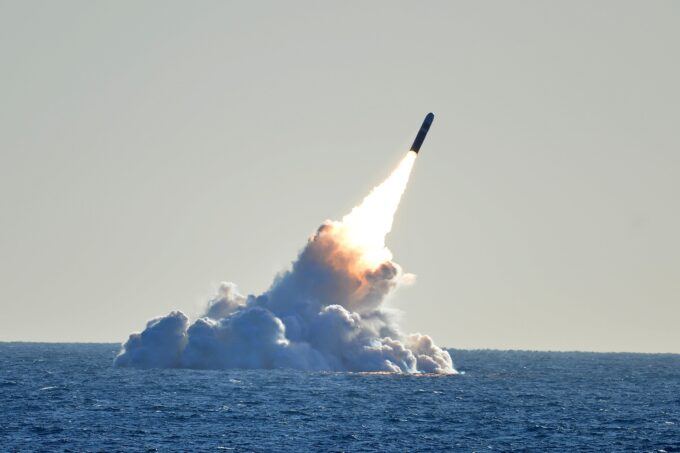
Trident II D5 missile launch test off the coast of California. U.S. Navy photo by Mass Communication Specialist 1st Class Ronald Gutridge/Released.
This article is intended as an outright challenge to any who may not have heard or read of the following, or who have avoided it like me. I DARE you to read Nuclear War: A Scenario by well-known author Annie Jacobsen. There is no better or extensive documentation of the many factors leading to the growing potential for nuclear war. The author fully strives to awaken dread for that reason in her readers and begins with a quote from a former commander of the U.S. Strategic Command: “The world could end in the next couple of hours.” She excavates detailed proof in interviews with 47 insiders, including two former Secretaries of Defense, exposing the long-term planning that “Since the end of World War II the U.S. Government has been preparing for, and rehearsing, a secret plan, a first strike, for A General Nuclear War.” The many withdrawals from nuclear reduction treaties since the collapse of the Soviet Union makes such a scenario ever more likely
Later, she takes us on a ghastly journey, the semi-final scenario of a precipitous nuclear strike in California and no one in American government knows which nuclear “enemy” is responsible, Russia, China, or North Korea. They cannot ignore the strike and they have only six minutes to decide how and where to respond in kind. There is no escape from the longstanding planned requirement to retaliate. The end of human evolution is at hand.
A 1-megaton thermonuclear weapon, relatively small, creates a temperature of 180 million degrees Fahrenheit in an initial fireball that expands and consumes everything for great distances. Since Washington would be a primary target all 27,000 employees at the Pentagon would instantly perish. More than a million people in D.C. would be dead in two minutes. Twelve miles out uncountable numbers will have ruptured lungs and blindness. As the astrophysicist Carl Sagan warned, a nuclear bomb produces a “witches brew of radioactive particles,” and radiation sickness will follow for those who survive the initial blast for which there will be no medical treatments. No worry, according to General Leslie Groves, the Military Commander of the Manhattan Project, radiation poisoning “is a very pleasant way to die.” Meanwhile the electromagnetic pulse will wipeout all communications leaving survivors to realize that no help will ever be on the way. More than one nuclear bomb will fall on Washington as well as every major city in the United States, not to forget that the U.S. and its “allies” will be targeting the enemy, all three of its long-prevailing antagonists, especially Russia. As Soviet premier Khrushchev declared after the Cuban Missile Crisis of 1962, proclaiming that humankind must never again allow itself to fall into such an existential jeopardy: “Those who survive will envy the dead.”
The vast majority of American citizens are completely out of the loop when it comes to matters of warfare and nuclear conflict plans which are the most secret of all. A tiny minority will decide whether to use nukes and the president is supposed to be the final actor in such a decision. How many Americans know that the vice president also is assigned a nuclear “football” whereby such an existential terror will be addressed.
At the age of seven I and my classmates were regularly ushered into the basement of our school as nearby sirens screeched drill warnings of impending nuclear attack. At age eight the photos of Hiroshima and Nagasaki filled me with dread. Since my fifteenth year, as a result of the Cuban Missile Crisis, I have KNOWN that as long as nuclear weapons exist sooner or later they will be used…SOONER or LATER. I have avowed the same to all my students for four decades. As the Doomsday Clock admonishes, every human being on earth lives ensnared today in the most precarious moments in human history. Will they be our last?
I had avoided the book because I knew it would send me into extreme anxiety and even panic attack, primarily because I perceive that few of my fellow citizens comprehend or repress awareness of our perilous tenure on Gaia and that the stark opposite of measures to derail the looming calamity is occurring at the level of military planning and “national security preparedness.” That and the ignorance and passivity of the population actively encouraged by a kept media that rarely dares openly to challenge the insanity arising after World II and ensuring that the Third was manifestly in the works.
For many years I have preached about the extreme peril of nuclear war and often encounter the naïve faith that “our government is charged with our protection and so will take care of us and never be so stupid as to self-destruct.” Others voice cynical responses: “why upset yourself there isn’t anything we can do about it.” I know a professor at UCal Berkeley who told me simply with a shrug “If it happens, it happens.” Worse, too many adhere to the creed that nukes are essential for protection from enemies and “adversaries,” since only they would plan such treachery! The theory of MAD, or “Mutually Assured Destruction,” became a catchword averring that no nation would be foolish enough to risk annihilation, while definite steps to assure such an outcome were obviously ongoing. “Deterrence” became the refrain used to rationalize the ever-burgeoning number of nukes. How does the possession of thousands of thermonuclear bombs, by nine nations, many always at the ready, ensure that they will not be used? Once upon a time various agreements and treaties were signed all around which gave some a dream of nuclear weapons abolition. Only one of those agreements exists today but no one believes it is in force. And it expires on January 1 next year.
We ignore the salient fact that it was the U.S. that employed the first atomic bombs, though extensive evidence demonstrates that these were not necessary to defeat Japan as we have long been indoctrinated. Rather, the Soviet “ally” had overrun parts of China and Korea and was gaining position to invade Japan, thus creating the same problem for Washington of co-occupation as in Nazi Germany. The U.S. suffered zero war devastation, as was not the case for all other combatants, especially the Soviet Union, which lost at least 27 million people. So, the U.S. emerged in 1945 as the most powerful nation ever to exist and since that time the overarching goal of U.S. Foreign Policy has been to promote American hegemony: militarily, economically and politically, throughout the world. Though the USSR was undeniably the essential force that defeated Germany its very existence, along with communism, socialism and the nationalism of the so-called Third World, was hyped as the threat to the U.S.’s crackpot and dangerous ambition of global domination. In 1945 the USSR was in a shambles and all but broken yet incessant American propaganda insisted that the Soviet’s ultimate goal was to expand into Western Europe. This false propaganda continues to this day.
So, the Cold War was on and the Pentagon soon requested numerous nuclear bombs as its estimate of the number required to destroy the USSR grew. The Soviets knew that the American nuclear arsenal was increasing rapidly and that these horrific weapons had become the menace to the world order envisioned in the corridors of power in D.C., Wall Street, and arms manufacturers. The newly birthed United Nations convened immediately after World War II. Yet Washington made it absolutely clear that it intended to be the new global imperator despite the U.N.’s. proclaimed goal to maintain international peace and security, protect human rights, deliver humanitarian aid, support sustainable development, and uphold international law. We all see how that has worked out. Within four years would-be American hegemons were at war again in Korea, later in Vietnam, while the newly minted Central Intelligence Agency began its dismal chronicle of overthrowing governments it saw as detrimental to the overarching goal of world domination.
In 1948 the U.S. positioned B-29s in Europe, the aircraft that had delivered the A-Bombs on Hiroshima and Nagasaki, as an overt threat to the Soviets during the Berlin Crisis and Blockade. Research later showed that some of these planes were armed with A-bombs. Meanwhile, Soviet espionage had revealed the American Atomic program during WWII,and they immediately initiated their own. The following year Moscow announced its first successful test of an A-Bomb. In 1952 the U.S. wiped a small Pacific Marshall Island off the face of the earth with the new H-bomb. The USSR soon followed. The A-Bomb killed tens of thousands: a single thermo-nuke can kill millions.
In a not inconceivable circumstance Jacobsen posits a crisis leading North Korea to launch a successful nuclear attack on the West Coast, using an undetectable submarine. Now Washington must determine which nation conducted the strike. Both the U.S. and Russia have only minutes to respond. With no valid evidence the U.S. launches against Russia. Russian early-warning satellites are known to be flawed but they believe that Washington has been struck and see hundreds of war heads moving from America to the east. In short order the “Doomsday scenario” so often postulated has arrived and there is no escape.
Thousands of cities across Mother Earth are on fire. Everything burns: cities, suburbs, towns, forests. In no time the atmosphere is full of deadly smog filled with pyrotoxins embedded in the industrial environments, extremely poisonous and hot enough to kill. Water is extremely contaminated and as darkness and in days extreme cold sets in and then rapidly freezes. Nuclear Winter is arriving. In the absence of sun plants die and soon there will be no agriculture. Whatever uncontaminated foods exist they are viciously and murderously fought over and “only the ruthless survive.” Meanwhile, radioactive substances are spreading widely and gruesome radiation sicknesses proliferate.
Whether the human species becomes extinct after a global nuclear war has been debated. In her final scenario Jacobsen advances an examination of of what planet earth will doubtlessly look like in the aftermath of nuclear war. Personally, I would rather be at Ground Zero and be atomized instantly with my family and loved ones, than even attempt to endure in the aftermath of a self- induced nuclear holocaust. Much of the United States will be below freezing for six to 10 years. Survivors will be faced with radiation illnesses and almost universal chromosome damage. If any produce offspring they are likely to be born with hideous defects and malformations. In my mind the species homo sapiens sapiens will cease to exist and if survivors do procreate their genetics will almost certainly result in a new genus.
As a youngster I was taught that human beings are the most intelligent, really the only intelligent species. We all know the story of the sudden annihilation and disappearance of the dinosaurs and many other species sixty-five million years ago. They, however, did not bring about the circumstances for their own extinction.
Since 1945 we humans have long passively looked on as the numbers of weapons of mass death proliferated, and the extreme irony is that the vast majority are not even needed to bring about the holocaust described herein. They exist in such superfuous numbers only because they are seen as massive sources of profit for “Defense contractors” Lockheed, Raytheon (RTX), Northrop-Grumman, Boeing et al. William Hartung, former career army colonel, tags former Senator Jon Kyl , now on the payroll of Northrop-Grumman, as “Senator Strangelove” for his management of the U.S withdrawal from the Comprehensive Test Ban Treaty, then George W”s from the Anti- Ballistic Missile Treaty, followed in 2019 by the Intermediate Nuclear Forces Treaty. In his first term Donald Trump said he would withdraw from the Strategic Arms Limitations Treaty, which then was answered by Vladimir Putin. The Treaty will expire in seven months. I often wonder how many of my fellow citizens have ever heard of the Bulletin of Concerned Scientists and their “Doomsday clock,” now set at 89 seconds before what may yet become our collective endtime horror-scape.
