Monday, May 19, 2025

Strathcona Resources aims to join oilsands ‘doppelgangers’ with MEG takeover bid


By The Canadian Press
Updated: May 16, 2025 

MEG Energy

The executive chairman of Strathcona Resources Ltd. says his company aims to join two complementary oilsands players with its unsolicited takeover bid for MEG Energy Corp., but one analyst calls the $5.9 billion being offered an “affront” to shareholders.

“I am actually not aware of two businesses of any scale in North America that share this level of complementary nature,” Adam Waterous told analysts on a conference call Friday.

“These are doppelgangers, brothers from another mother ... identical twins.”

Strathcona and MEG both extract bitumen using steam-driven techniques in eastern Alberta and don’t have fuel refining or retail businesses like some bigger oilsands players.

Earlier this week, Strathcona signalled its plans to become a pure-play heavy oil company when it announced the sale of its Alberta shale natural gas operations in three separate deals with a total of $2.84 billion.

It also said it has bought the Hardisty crude-by-rail rail terminal in Alberta for about $45 million.

A takeover of MEG would further that strategic shift, Waterous said.

“If someone’s interested in a lower-risk, long-life, low-decline, high-free-cash-flow oil business of scale in North America, we think that this is going to be the business to own.”

A combination with MEG would create Canada’s fifth-largest oil producer, Strathcona said.

Strathcona, which disclosed late Thursday it owns about a 9.2 per cent stake in MEG, said it sent a takeover offer to the MEG board of directors in April, but was rejected earlier this week.

“Strathcona respects the MEG board’s right to dismiss any offer made for MEG, and it has no reason to believe that its decision to dismiss Strathcona’s proposal was not made in good faith,” the company said in a late Thursday news release.

But it said MEG shareholders should have the chance to decide for themselves.

MEG said Friday that its board of directors will consider and the Strathcona offer once it has been received and urged shareholders to take no action until it has made a recommendation.

Strathcona is offering 0.62 of a Strathcona share and $4.10 in cash per MEG share in the proposal worth $23.27 per MEG share based on the closing price of its shares on Thursday.

MEG shares shot higher Friday, topping the implied value of the takeover offer and suggesting investors believed a higher bid might be possible.

MEG shares closed up $3.99 or almost 19 per cent at $25.29 on the Toronto Stock Exchange.


Desjardins Securities analyst Chris MacCulloch said Strathcona is offering a “modest” 9.3 per cent premium and competing offers are likely to come from bigger oilsands players like Canadian Natural Resources Ltd., Cenovus Energy Inc., Suncor Energy Inc., Imperial Oil Ltd. or ConocoPhillips.

“Although we are naturally supportive of further consolidation of the Canadian oilsands to create a stronger and more resilient sector, we view the (Strathcona) takeover offer as an affront to MEG shareholders and highly unlikely to be accepted,” he wrote in a note to clients.

Enverus senior analyst Michael Berger said the offer price seems “a little bit light” given what MEG has going for it.

“They operate some of the highest quality acreage in the oilsands today,” he said.

“Do I think all the major operators in the oilsands are going back to sharpen their pencils on what MEG would look like in their portfolios? Absolutely.”

Strathcona has identified $175 million in annual synergy opportunities, including $50 million in overhead reduction costs, if the deal goes ahead.

Berger said there are signs of accelerating merger and acquisition activity among Canadian oil and gas producers. Between the first and third quarters of 2024, there was US$2.5 billion worth of transactions, he said. Contrast that with the US$19.1 billion in deals announced between the fourth quarter of last year and now, with western Canadian shale an oilsands the focus.

MEG is a solid operator that can hold its own as a stand-alone company, Berger said. But broadly, oilsands players recognize that scaling up can mean better efficiency and costs.

“I think that consolidation is likely to continue.”

The MEG takeover offer comes on the same week Whitecap Resources Inc. closed its friendly $15-billion deal to join up with Veren Inc., creating Canada’s seventh-largest oil and gas producer with a hefty footprint in Alberta and B.C. shales and Saskatchewan oilfields.

In the refining and fuel retail space, Texas-based Sunoco struck a friendly deal last week to buy Calgary-based Parkland Corp. for US$9.1 billion.

Strathcona made its offer after it reported a first-quarter profit of $205.3 million or 96 cents per diluted share, up from $100.6 million or 47 cents per diluted share a year earlier.

Oil and natural gas revenue totalled $1.33 billion, up from $1.17 billion in the first quarter of 2024.

This report by The Canadian Press was first published May 16, 2025.
Full transcript: PM Mark Carney’s exclusive Canadian interview with CTV News

By Spencer Van Dyk
Published: May 18, 2025 

LONG READ


In an exclusive Canadian broadcast interview, Prime Minister Mark Carney sat down with CTV News chief political correspondent Vassy Kapelos to discuss his mandate for change, Canada’s “investment era,” becoming an “energy superpower,” and U.S. President Donald Trump.

He also answered some rapid-fire questions about the start of a new session of Parliament, whether he’s seeking out floor-crossers, whether he plans to renegotiate the Canada-U.S.-Mexico free trade agreement.

Here’s a full transcript of that conversation, it has been edited for grammar and clarity.


Vassy Kapelos: I wanted to start off on your cabinet selections, and in particular, who you selected for your front bench. I think a lot of Canadians physically would have looked at that front bench today and said it looked remarkably like the previous government. Is that not the opposite of what they elected you to do?

Mark Carney: Well, there’s a number of things that are different in that front bench. For example, François-Philippe Champagne is the minister of finance. He became the minister of finance when I became prime minister for that brief period following winning the leadership election. Lots of experience, but not the minister of finance. Now he’s going to have a real run at being minister of finance.


Melanie Joly moving from foreign affairs to becoming minister of industry. This is a government that has a huge focus on the economy, and specifically cost of living, but really growing wages and jobs for Canadians. So, she has a crucial role, but it’s a new role for her.

Dominic LeBlanc as the minister of intergovernmental affairs. I need experience in that role that Dominic has. He’s got great relations with a number of the premiers. We are going to focus on building one Canadian economy, changing how we’re doing big projects, all in the course of the next several months. Plus, he’s been one of the main, if not the main, interlocutors with the level of the U.S. government below President (Donald) Trump.

So, I don’t want to switch everybody out in that circumstance. And then, you know, you look at Anita Anand, who’s moving into foreign affairs. It’s a big change into those jobs.

So, there’s some similarities. There’s experience, experience being deployed in different ways. I’m a new prime minister, and let’s look at the cabinet as a whole, because I’m not quite sure I make the distinction between the “front bench” and the cabinet as a whole.

We only have 28 cabinet ministers. That’s down from the mid-, upper-40s of some previous governments. Half of those ministers are new, never been cabinet ministers before. In many cases, they’re new to Parliament as a whole. So, we’re bringing in a lot of fresh energy, fresh ideas, fresh perspectives, alongside with experience. And that’s a good team, that’s a good management team. In my judgment, obviously, I spent a lot of time trying to construct it that way.

Kapelos: And I do take the point on the fresh faces, but even when you point to the experience of those who are in the biggest roles, the reason why I highlight them is because they were at the forefront of the decisions that the previous government made.

Carney: I disagree with that.

Kapelos: They were. I mean, Melanie Joly, François-Philippe Champagne, he led the industrial policy now he’ll be in charge of finance. Dominic LeBlanc led a lot of those files as well. We are used to hearing from them, justifying and explaining the decision that Justin Trudeau made. And now we’re going to hear from them again.

Carney: Well, first off, now you’re hearing from me. I’m a new prime minister. I’m the 24th prime minister of Canada. I’ve got a very clear set of objectives, which I laid out in the course of my initial government from that cabinet table: cancel the carbon tax, right there, in fact, just to our right, my first act. But developing this focus on one Canadian economy, getting rid of internal trade barriers, we’ll do our job by Canada Day. That means the federal government, we’re working with the provinces so that they can move out of the way. Some of them are moving really fast, Nova Scotia, Ontario, others moving fast. We’re trying to get all of them, plus unlocking these major projects that are going to build this economy for the next generations, not just growth today, but growth for generations. That’s a focus that is an entirely new focus of this government.

At the same time, we’re working on this economic security partnership with the Americans and diversifying our trade partnership. Different focus, different people. There were so many differences, as I say, half of the cabinet is different. Big change in terms of priorities, big change in terms of speed. This is one of the fastest swearing-in, in Canadian history. It will be one of the fastest returns to Parliament in Canadian history, where you’ll see with the Speech from the Throne, which the King will deliver in whatever it is, 12 days’ time, 13 days’ time, and in that Speech from the Throne, are going to enumerate some priorities, including success by Canada Day. So, we’re going to go hard.

Kapelos: So how do you articulate, because you conceded today, you did through the campaign, that the mandate you have is one for change. It’s against that backdrop that I’m asking those questions about those big faces for your cabinet. How would you articulate to Canadians what that change will actually look like? Is it just you?


Carney: No. Okay, if I may, you are going into process and personnel. I’m going to results. I’m talking about one Canadian economy. I’m talking about getting rid of all the federal barriers.

Kapelos: But those personnel…

Carney: No, no, no, no, no. Please. Let me answer the question. Those are real results that will happen or not. We will either pass that legislation or not. First point. Secondly, in terms of working with the provinces, working with Indigenous peoples, working with the territories, identifying the nation-building process, a process that has already begun, I helped start it during my first few days as prime minister in the previous mandate, now going to accelerate through. Already talking with (Alberta) Premier (Danielle) Smith, (Saskatchewan) Premier (Scott) Moe, (Ontario) Premier (Doug) Ford, (Quebec) Premier (François) Legault, all the premiers, (Manitoba) Premier (Wab) Kinew. Sorry, now I’m going to offend somebody because I haven’t mentioned them all, but they’re all working on this. And, working towards our Saskatoon First Ministers’ Meeting June 2.

Again, that’s a tangible thing. You’ll see where we’re coming together on specific projects.

What’s the federal government doing to support those? What are we doing with respect to our relationship with the United States? So these are all real things, and to reduce it, to person, faces, personnel, and then, by the way, to ignore half of the cabinet, which is brand new, literally never been in cabinet before, and now they’re in, in very senior roles at core priorities for the government.

Kapelos: It’s definitely not to reduce the new people that I ask. It’s because, to be fair, I covered that government extensively. Those are the ministers who told me time and time again, the carbon tax was the only way to address climate change, who told me time and time again, the only way to be fiscally responsible was to bring in capital gains tax changes. Yes, you came in and you changed that. But these are the people for 10 years who defended what you say you have a mandate to change.

Carney: Okay, let’s be clear about mandates. We just had an election, you might have noticed, I think you covered it, right? Nineteen million Canadians voted. More Canadians voted for a political party, the Liberal Party, than ever before. We have more votes than anyone else. We have majorities in seven of the 10 provinces. We have the most seats in Parliament. And we ran on a very clear platform of change. More Canadians chose that platform of change than anybody else’s. So, we have a clear mandate.

I come and all the deputies in Parliament, come with a responsibility to deliver that change. That’s what Canadians, they put their trust in us. They expect us to deliver. And I’m going to put together the cabinet, the legislative agenda, and work with the provinces, work with Indigenous people, work with the territories, in order to deliver for Canadians. And Canadians will judge the change that they receive, that’s the right thing. And I’ll do what’s necessary with the people I have around the table in order to deliver that.

Kapelos: I wanted to ask about what that change looks like. You got a question (Tuesday) about, for example, tangibly, how will Canadians know that their life is better? More specifically, you made some very specific promises during the campaign about what would happen to our economy, the biggest transformation since the end of the Second World War, it would become the most prosperous economy in the G7. How, and by when?

Carney: Well, first off, what we’re looking to do is unlock an investment era in this country. So, investment in conventional energy, oil and gas, investment in clean energy, getting up to doubling the rate of home-building over several years, so that the rate of new home construction in this country is twice as much as it was previously. Those are very tangible things. We have to make big changes, some in federal legislation, some in terms of how we work with the provinces, some in terms of how we finance certain activities, all of which we’re prepared to do.

Canadians will see that change as we deliver that change. But there are more immediate things that we can do for Canadians, and we intend to do them. So, for example, we, as I said a few hours ago, just before I sat down with you, we will deliver that middle class tax cut by Canada Day. So, we’re going to go to Parliament, and we are going to table a motion for that middle-class tax cut, up to $825 for a two-earning family in Canada. That would be in place by Canada Day. That’s an example. Also, cutting the GST on new homes.

So, there are tangible things in the near-term, but then the transformation, which you rightly talk about, the transformation of the economy, those are big structural changes which we need to do big things in order to get them going. And we are going to do them. You’re going to hear a lot about them. You’re going to hear a lot about them from different people. Let me give you an example, talking about change. Gregor Robertson. Gregor Robertson is the minister of housing and infrastructure. Gregor Robertson has never been a federal MP, he’s got one of the most important areas. Let’s talk about change. Tim Hodgson, brand new, never been an MP. He is minister of Natural Resources Canada, so think critical minerals, think conventional oil and gas, think electricity, think trade corridors. He needs to help deliver that. We’re bringing in external expertise that Canadians validated. These people, of course, were elected in their ridings. They’re coming straight into cabinet. Huge mandate for change. We’re going to work together in order to deliver it.

Kapelos: And I have some specific questions about those files. But on the bigger picture, for Canadians, are their incomes going to go up? Is GDP per capita going to go up? How am I going to know tangibly that you have accomplished what you said you’re going to do, which is probably the largest in scope promise we’ve heard from a politician in Canada?

Carney: Okay, let’s take a step back. I do think it’s worthwhile reminding ourselves that we are in a crisis. We are in, in my judgment, the biggest crisis that we have faced in generations, because of the American tariffs, but also because the global economy, the way it’s structured, the way it’s working, is fundamentally changing, and that’s an economy that we have relied on in Canada. Others have as well, but we’ve relied on it, and we need to adapt, and we need to get ahead of that. So, we need to make big changes.

Now, in the end, when you look at affordability, I’d like to talk about it in terms of Canadians getting ahead, people have a sense of getting ahead. And you know, as year goes after year, do I have more money in my pocket after paying the rent, paying for groceries, paying for cell phone bills, or do I feel like I’m falling behind? In periods of big inflation, you can be falling behind, but you can also have periods of relatively low inflation, but you just said it, your wages aren’t growing fast enough. So yes, ultimately, you’ve got to get to — if we want to talk like economists, I’m very happy to, but it’s probably not the way Canadians think — yes, you want to see GDP per capita increasing, we would need to see productivity increasing. Fundamentally, there is not a button marked ‘productivity’ around that cabinet table that you push and it instantly changes.

So, we have to do a variety of things in order for that to happen. Some of them relate to those big projects. A big element is going to be if we actually do get this one Canadian economy, that’s going to drive through. Something that wasn’t talked about a lot during the election campaign, but will be incredibly important to making people more productive themselves, and therefore getting higher wages themselves, not replacing their jobs, but making them more productive, will be (artificial intelligence) AI and the digital economy. How well we’re going to implement that? And so, we have a new ministry, new minister of digital and AI, Evan Solomon, new to Parliament, coming in clear mandate, clear resources, in order to drive that.

Kapelos: I want to talk about something a bit more conventional when you talk about big projects, and that is around energy. And in particular, when you said during the campaign, you want to make Canada an energy superpower. Do you mean you want Canada to export more oil and gas?

Carney: That is an element of it, but it’s not the element of it. So, there are multiple elements when you’re a superpower. Let’s look at America. America is a superpower. It is a superpower because it has a strong economy. It is a superpower because it has a strong military. Arguably, it is also a superpower because it has soft power — it’s cultural — the American influence is multiple, and all of those aspects contribute to it. So, when I talk about being an energy superpower, I always say in both clean and conventional energies. So, what does that mean? Yes, it does mean oil and gas. It means using our oil and gas here in Canada to displace imports wherever possible, particularly from the United States. It makes no sense to be sending that money south of the border or across the ocean. But yes, it also means more exports, without question. But it doesn’t stop there. That in and of itself doesn’t make us an energy superpower.

We can be an energy superpower, and we have all the components in nuclear, in hydro, potentially in carbon capture and storage, which is going to be one of the determinants of competitiveness and productivity in a number of sectors. So, what are we doing to build out all those aspects in our economy? What are we doing today? And look, if I were — I shouldn’t classify myself, but a conventional politician might say — what we should be judged by is whether or not we approve one pipeline, right? And that’s going to make us an energy superpower. And that is a type of objective that you can define and you can point to that is progress, but it doesn’t accomplish the bigger goals, and it’s not at the level of what Canada is capable of. We need to do multiple things at the same time in order to build this base, so that we are creating wealth and competitiveness, better lives for Canadians for generations.

So, we’re going to be very ambitious across a range. That’s why we’re not asking for one nation-building project, we’re asking for nation-building projects, and we are going to move as rapidly as possible on as many of them as possible.

Kapelos: If I’m accurately representing the point of view from people whose livelihood depends on the conventional energy sector, it’s not that they’re asking you “that’s it, that’s the be all, end all.” It’s that they want to know where conventional energy fits into your ambitions. And it’s not just because of the record of the previous government, it’s because of you yourself. In your book “Values,” for example, which extensively talks about a reorientation of the market around the climate imperative. Canadians had been asking throughout the campaign and now “is this Prime Minister Mark Carney of ‘Values,’ or is it the prime minister of the campaign?” Are you going to build that pipeline if the consensus exists?

Carney: It’s both. First off, I’ve said repeatedly, yes. First point. Secondly — because I understand the need for that consensus — I’m a prime minister who can help create that consensus. You can’t create a consensus on your own, but you have to drive processes that bring provinces along, bring the private sector in. Remember, I’ve got extensive experience. This is not just a concept to me. I have been involved in major energy projects for over three decades in the private sector, so I’ve got that experience bringing the provinces, working with Indigenous partners, putting it in place — as we have billions of dollars of financing for those Indigenous partners — bringing in somebody like Tim Hodgson, who, when he was CEO of Hydro One, was one of the only major corporations to have a major Indigenous partnership program that actually worked. So, we’re bringing the components in. We have to deliver.

Let me make another point, because I appreciate that you’ve read my book very carefully. At the core of the way I talk about the energy transition is the future of — including about Canada being an energy superpower — is the future is low risk. Canada’s low risk as a business investment place. Low cost. We’re getting cost down, including the oil sands, the marginal production of is low cost. And, low carbon. All three of those come together. We have the ingredients of all that. Let’s get together and move on it. And it takes more than just one pipeline in order to accomplish that.

Kapelos: I do understand that point, but I think, in your book, on multiple occasions, for example, you talk about the merits of a carbon tax, and now we have a different Prime Minister Mark Carney, who says, ‘the first thing I did in this very room was get rid of the carbon tax.’

Carney: I got rid of the consumer carbon tax, which is different than...

Kapelos: … the industrial side, but it’s still a portion of the carbon tax.

Carney: And how much of the emission reduction did that consumer carbon tax…

Kapelos: Nine per cent.

Carney: Well, it’s actually six, but you’ve extrapolated out to 2030, it’s nine per cent. … It’s not nothing, it’s not much. It’s not much. And we can do much better with different approaches, including collaborative approaches, which is what I’m looking to do.

And look, okay, if you want a simple answer on, will I support building a pipeline? Yes. That simple answer, I’ve given that multiple times, but I don’t stop at that. For example, if you want a simple answer on, how do I make homes more affordable? I could just say we’re going to cut GST on homes, but that doesn’t solve the problem. Don’t get me wrong, it’s good. That’s a positive thing and working collaboratively in order to happen. But it’s not enough. It’s not enough to make Canada an energy superpower. It’s not enough to build our full potential. It’s not enough to truly get incomes growing across the country. We can do much more. We are going to be very, very ambitious. Build big, build bold build now.

Kapelos: It does speak, though, to what people in Alberta and Saskatchewan, who didn’t vote for your party, are worried about, right? They are worried that it is the Mark Carney of “Values,” that it is the (former prime minister) Justin Trudeau government. And the reason I ask about that, is against that backdrop. You are still saying you’re going to keep (Bill) C-69 in place. You’re going to keep the emissions cap in place. They view that as evidence of something that runs counter to what you’re saying.

Carney: I’ve said very clearly, look, I am a pragmatist. I go over and over on this, and I really am. I’m interested in results. So, the point of building a pipeline, the point of building out carbon capture, is to get the results, to get those barrels to the market, to get carbon down. You can do both. We have the capability to do more. We have the capabilities financially, from a technological perspective, in terms of the companies, the federal government can play a role, the province of Alberta, obviously, other provinces, Indigenous people have to come along for almost all of these projects in order for them to actually work.

And what I’m putting on the table is, okay, let’s go. Let’s not talk about this. Let’s roll up our sleeves. Let’s focus in on specific projects, and let’s work on them together. Now I’ve had constructive conversations with Premier Moe in this vein, also with Premier Smith in this vein. So, the next stage of that is to sit down across premiers and other groups and start to refine that list and move forward. And we will change things at the federal level that need to be changed in order for projects to move forward.

Kapelos: Does that include C-69 and the emissions cap?

Carney: It could include both. Absolutely, it could include both. But I’m not going to do it conceptually. I’m going to do it on specifics. Do it for moving forward. And that’s the point. Canadians deserve results, not rhetoric and not talking past each other. And one of the things that I feel very strongly about and understand, I think, from both being in the private sector and working across government over the years, is you can’t get results unless you work across partners. So, it’s the federal government, it’s the provinces, it’s the companies, it’s Indigenous peoples. You can’t get result if you just say: ‘we’re not going to have environmental assessment.’ The (former prime minister Stephen) Harper government effectively tried that approach. It doesn’t work. You get tied up in court. So, what you have to do is to work together for an efficient and effective environmental assessment process.

What we have clearly signalled, and we’ve been absolutely clear, I’ve been very clear about this, is we will rely on provincial environmental assessments as appropriate. That is a huge shift in approach that potentially unlocks a series of projects. You have to do other things at the same time, again, roll up our sleeves, sit down, map out what needs to be done, we’ve got the team here, and we have the will to do it.

Kapelos: I have just, I’m already getting the wrap sign, and I apologize, I know your time is very limited. I wonder if I can ask very briefly on how Parliament will work on what you just mentioned. Have you spoken to (Conservative Leader) Pierre Poilievre about seeking support from the Conservatives in advancing parts of that agenda?

Carney: Mr. Poilievre and I spoke immediately after the election. He congratulated me, and I signalled to him that if he was, as he is, seeking a by-election, I would call it as soon as I’m allowed to do that. So that’s the conversation that we’ve had. He’s not the leader of the Opposition, as you know, at the moment, so any conversations, obviously, at least in the near term, would be with Mr. (Andrew) Scheer.

Kapelos: Have you explicitly had any conversations with anyone from any party about crossing over to help form a majority?

Carney: No.

Kapelos: When you called Donald Trump ‘transformative’ did you mean transformative in a good or bad way?

Carney: Yin and Yang. There’s both.

Kapelos: There’s both?

Carney: Look, what I say is, what matters for Canadians is that the relationship with the U.S. has changed. I’ve been clear about that. Clear about that for months. I think others were very slow to recognize that. I think it’s now increasingly understood. Secondly, that it has bigger ramifications than just the U.S. The way the global economy is working is changing. We need to change. Working with President Trump, working with his team as possible, sovereign nation to sovereign nation, that’s what I’m pursuing.

Kapelos: Do you plan to renegotiate the Canada-U.S-Mexico free trade agreement, USMCA? Can you trust him as a partner?

Carney: We’ll see about the sequencing. I think the revealed preference of the U.S. is working on some of these sectoral aspects before broader trade deals. It is an advantage to us that USMCA exists. It is not right that it’s being violated, but it is still an advantage that it exists, and we intend to make the most of our advantages in these negotiations.

Kapelos: Do you trust him?

Carney: I will work with him and negotiate with him, yeah.

Kapelos: Do you trust him?

Carney: Look, my answer is my answer.

Kapelos: Okay, I’ll leave it on that note, prime minister, I appreciate it very much. Thank you for all your time.

Carney: Thank you. Thanks.

Writer & Producer, Ottawa News Bureau, CTV News
How everything from law schools to men’s underwear can signal a coming recession

By Charlie Buckley
Published: May 18, 2025 

Bank towers are shown from Bay Street in Toronto's financial district, on Wednesday, June 16, 2010. THE CANADIAN PRESS/Adrien Veczan (Adrien Veczan/THE CANADIAN PRESS)

As a global trade war marches on, economic uncertainty has sparked fears of a recession on the horizon, bringing layoffs, bankruptcies and deepening affordability challenges with it.

But for as long as there have been hard times, there have been a mountain of strategies to try and see them coming. And while economists routinely track hard data like GDP, unemployment and inflation, analysis can fold in all kinds of indicators -- including some that seem obscure, or strangely specific.

From cardboard boxes, lipstick and men’s undergarments to law school entrance exams, here are some supposed signs the economy might be on track to contract:
Could there be a recession?

As defined by the C.D. Howe Institute, an economic recession is a "pronounced, persistent, and pervasive decline in aggregate economic activity," and while it isn’t always the case, a market is typically considered in recession if it’s gone through at least two consecutive quarters with a decreasing gross domestic product (GDP).

Economists rely on a variety of financial data to predict recessions, including GDP performance, total sales of goods, unemployment rates and the yield curve, or the difference in interest rates on shorter versus longer-term bonds.

The path ahead for Canada’s economy is unclear, as predictions differ as to whether the country is headed for a recession in the next two years. RBC’s May update shows slowing growth heading into 2026, but TD Bank’s and Deloitte’s spring outlooks forecast back-to-back quarters of contraction in the near future.

“The trade conflict has made the outlook for the Canadian economy highly uncertain‚" reads a recent Bank of Canada report that found that the economy could be facing a yearlong recession, should the trade war’s impacts linger.

Uncertainty clouds predictions of the future for an economy already in trouble before the trade war, says University of Ottawa economics professor and Canada research chair Isabelle Salle.

“Tariff(s) and this uncertainty shock just added to existing problems, at the worst time possible,” she told CTVNews.ca in an interview Thursday. “(With) uncertainty, you cannot easily put probabilities attached to the different scenarios. You really have to operate with just options.”

Salle says that unlike the financial crisis of the late 2000s, which had a more identifiable impact and response, not only do we not know how bad things could get in the coming months, it’s also hard to know the solution.

“We don’t know exactly what is going to be the size of the shock, how long it’s going to last, but we’re also not sure what is this shock … Is it a supply shock? Is it a demand shock? Is it a bit of the two?” she said.

“This is a little bit more complicated, I would say, than the 2007 crisis.”
Economic anxiety

Aside from the recent hard data, also key are forward-looking indicators like consumer confidence surveys, where large numbers of people are asked how they feel about the economy’s health and future.

At last tally, the Bloomberg-Nanos Canadian Confidence Index showed a positive rebound, following notable declines amid the recent height of trade tensions. Rated at 48.59 as of May 9, the index has nearly returned to the 50-point benchmark, which signifies a net-neutral opinion among consumers.

“After a consistently negative trajectory since the election of U.S. President Trump, consumer confidence is improving in the period following the election of the Mark Carney government,” said data scientist Nik Nanos, in a release.

Walid Hejazi, a professor of economic analysis and policy at the University of Toronto, notes that in hard economic times, consumer confidence can add fuel to the fire.

If consumers fear a recession is coming, he explains, they may reduce their spending to prepare, but reduced consumer spending makes the economy slow down even more.

“That, in and of itself, makes a recession more likely,” he said in a Thursday interview with CTVNews.ca. “That’s where that self-fulfilling (prophecy) comes in.”
Lipstick, underwear, cardboard boxes

But recession indicators don’t stop at broad aggregates of business performance and public opinion. Some economic signals can be far more niche, and even bizarre.

Among modern economics’ oldest indicators is "hemline theory," which holds that the market shifts toward shorter skirts in times of plenty (think: the Roaring 20s) and longer ones amid economic downturns (the Great Depression).

While some academic research has debated on the statistical significance between skirt length and overall economic health, the idea of working backwards from consumer trends has caught on.

It’s often said that as the economy recedes, shoppers cut back on big-ticket luxuries like cars or gadgets, but spend more on small nonessentials, a form of retail therapy commonly known as the "lipstick effect."

Conversely, former U.S. central banker Alan Greenspan popularized the "men’s underwear index“: a recession indicator based on the idea that, when money is tight, men delay purchases of the one item of clothing seen least often in daily life.

Hejazi says phenomena like these can help illustrate correlation versus causation, but they can also be instructive examples of how the economy impacts not just our total spending, but also where it’s concentrated.

“There seems to have been some fundamental change in people’s spending patterns, and many people think it’s probably because of the huge crisis we have in affordability,” he said.

Salle notes that Canada’s economy is particularly reliant on consumer forces.

“Household consumption is a big, big, big deal of the GDP,” Salle said. “We know that if you are going to cut on your budget, or postpone your consumption because you think it’s going to be hard, and you better save, you are not going to cut, necessarily, on your food first.”

But it’s not just about purchases; some behaviours understood to be market-driven can run deeper. A recent spike in applications for law-school entrance exams, for example, may signal to some that young professionals are seeking recession-proof careers, or at least a few years of school to wait it out.

According to economist Andrew Lawrence’s “skyscraper index,” the completion of a new world’s tallest building is often followed by financial crisis, as such huge projects “seem to mark a very large economic boom that typically ends in large recession,” he told the Council on Tall Buildings and Urban Habitat in a 2012 interview.

Jeffrey Kleintop, a strategist at financial services firm Charles Schwab, has examined sales of cardboard boxes as an indicator for the health of global manufacturing. All of those goods need to be shipped in something, after all; a drop in sales for packing materials may connote coming trouble for goods of all kinds.

While many indicators are based on logical, or at least linear market trends, others track phenomena completely divorced from dollars and cents, such as whether this Lunar New Year sparked a year of the dragon, who won the Super Bowl or even whether Groundhog Day predicted six more weeks of winter.

In a blog post early last year, Kleintop wrote that the popularity of "market folklore" makes for a “testament to the very human desire for an easy answer,” despite its dubious relationship with accuracy.

U of T’s Hejazi notes that even some of the most trusted indicators can be misleading, and often disagree with one another.

“Leading indicators are not determinative,” he said. “They predict, but they don’t always get it right.”


Charlie Buckley

CTVNews.ca National Digital Producer
CANADA
Economists expect end of consumer carbon price pulled down April inflation to 1.6%

By The Canadian Press
Published: May 18, 2025 

A gas station north of Newcastle, Ont. display its gasoline per-litre prices as a customer finishes pumping gas on Tuesday, April 1, 2025. THE CANADIAN PRESS/Doug Ives

OTTAWA — Canadian motorists were paying less at the pump in April after the Liberals nixed the consumer carbon price — a move economists expect will help keep inflation around the Bank of Canada’s two per cent target as tariff woes percolate.

Statistics Canada is set to release its consumer price index figures for April on Tuesday, roughly two weeks before the central bank’s next interest rate decision scheduled for June 4.

As of Friday afternoon, economists expected April inflation cooled to 1.6 per cent, according to LSEG Data & Analytics.

The consumer carbon price amounted to around 18 cents per litre of gas when it was eliminated at the start of April, one of the first actions from Prime Minister Mark Carney after he took office.

The shock of removing the consumer carbon price is expected to drop headline inflation by 0.7 percentage points in April, according to calculations from the Bank of Canada’s latest monetary policy report.


The central bank expects the end of the carbon price will lower the overall inflation figures by roughly that amount each month for the coming year, after which the removal of the levy will fall out of the annual comparison.

RBC expects the annual inflation figure will drop to 1.6 per cent in April, down from 2.3 per cent in March.

RBC economists Nathan Janzen and Abbey Xu said in a note to clients Friday that Canadian inflation data continues to be “distorted” by tax changes, with the carbon price removal coming after the two-month federal tax break on a variety of goods ended in mid-February.

Tu Nguyen, economist with RSM Canada, said motorists were also benefitting from a drop in global oil prices in April.

“We’re expecting a slower economy in the world overall this year, and OPEC countries increased production, so that led to lower oil prices,” she said.

Nguyen expects April inflation to come in “fairly close” to the Bank of Canada’s two per cent target as slowdowns in shelter inflation tied to lower rents also take some steam out of the headline number.

But hopes that cheaper transportation costs would feed through supply chains might fall flat, she said, as April marked the first full month of Canada’s tariff dispute with the United States.

The U.S. has imposed tariffs on Canadian steel and aluminum, with some carveouts for goods such as autos. Canada’s counter-tariffs targetting billions of dollars in goods from south of the border also have some exemptions.

Nguyen argued any relief businesses got from cheaper gas costs might end up “cancelled out” by trade uncertainty as companies reorient their supply chains to either steer away from the U.S. or absorb the hit from tariffs — in either case, pushing their costs higher.

She said the trade dispute will primarily show up in the prices Canadians pay for new vehicles or certain auto parts, but she doesn’t think those forces are enough to pump up the April inflation figure.

The U.S. consumer price index figures released last week showed little evidence that tariffs were pushing up prices south of the border, Nguyen added, so they’re unlikely to have a drastic effect in the Canadian data.


“Because retaliation is still quite limited right now, and we do have various pauses, trade talks seem to be happening, I don’t think ... the headline number would be dramatically too different,” she said.

The Bank of Canada held its benchmark interest rate steady in April following seven consecutive cuts.

Governor Tiff Macklem made clear then that the central bank opted for a rate hold as it awaited more data on how the trade dispute will impact the Canadian economy.

Nguyen said signs of weakness in the labour market — Canada’s unemployment rate ticked up to 6.9 per cent last month as trade-sensitive sectors such as manufacturing shed jobs — could be enough to push the Bank of Canada off the sidelines and toward additional cuts in June.

TD Bank economist Marc Ercolao said in a note to clients Friday that incoming data is “increasingly painting a picture of a slowing Canadian economy.”

“From our lens, the current situation gives the BoC room to deliver another quarter-point cut to the policy rate at the June announcement,” he said.

As of Friday afternoon, money markets placed odds over 64 per cent for a quarter-point cut from the Bank of Canada next month, according to LSEG Data & Analytics.

Nguyen said she expects two additional quarter-point rate cuts this year, bringing the central bank’s policy rate down to 2.25 per cent.

She said she doesn’t think those cuts will be back-to-back, however, as the Bank of Canada sticks to its wait-and-see approach as the trade war plays out.

This report by The Canadian Press was first published May 18, 2025.
Craig Lord, The Canadian Press


Italian Project Displays Small Fission Nuclear Reactor Concept for Ships

fission nuclear reactor
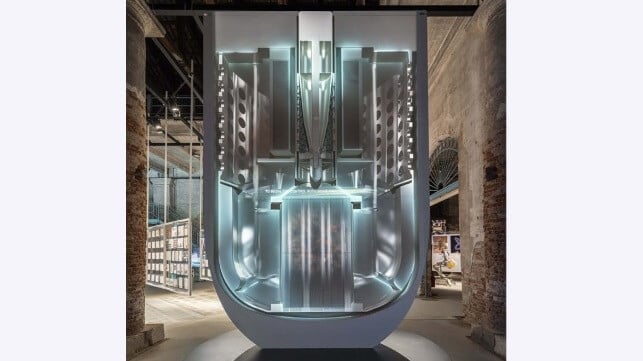
The display shows a cutaway to familiarize viewers with nuclear fission technology (Newcleo)

Published May 16, 2025 12:30 PM by The Maritime Executive


An Italian start-up, Newcleo, working with Italian shipbuilder Fincantieri and design firm Pininfarina, has unveiled its concepts for a new generation of small, fission power plants that could provide the future power for shipping and other applications. A full-scale representation of the fourth-generation nuclear reactor was placed on display at a prestigious Italian design fair with the companies saying the aim was to redefine the social image of nuclear power.

Newcleo, which was launched in September 2021, with more than €537 million (more than $600 million) of private funding, is working on concepts for small modular lead-cooled fast reactors. The company calls its concepts “the next step in the evolution of fission power plants.”

“We believe the lead-cooled Fast Reactors technology is the most promising. In fact, lead characteristics enable design simplification (which in turn has economic benefits) and a high degree of inherent safety,” says Newcleo.

The fourth-generation small modular reactor, the company says, represents a revolutionary approach to the decarbonization challenge by offering the answer to the perceived problems of traditional nuclear power. The lead cooling system introduces passive safety systems that avoid the risk of nuclear accidents through the physical laws governing reactor operation. In addition, the reactor would be able to eliminate nuclear waste generated by conventional nuclear power plants through a virtuous multi-cycle system that allows it to be burned, generating clean, cheap, and virtually inexhaustible energy.

Newcleo points out that much of the nuclear industry is focused on large-scale applications while it has a concept of an ultracompact and transportable 200 MWe module with improvements in energy density compared to other technologies. In the event of an accident, with Newcleo’s design, the liquid lead inside the reactor would solidify as it cools after coming in contact with the cold water, enclosing the reactor core in a solid casing and containing all radiation due to the shielding properties of lead.

Fincantieri, Italian classification society RINA, and Newcleo have been collaborating since 2023 to study applications for ship propulsion of Newcleo's technology. When they launched the project, they articulated a vision for placing a closed mini reactor on vessels as a small nuclear battery producing a 30MW electric output. The company said the concept would require infrequent refueling (only once every 10 to 15 years), very limited maintenance, and easy replacement at the end of life, with the whole unit simply being removed and replaced with a new one on the ship, and the spent unit taken away for decommissioning and reprocessing.


Concept for the compact reactor was displayed at an Italian design fair (Newcleo)


Pininfarina oversaw the creative vision of the project. It reports that it infused sustainable design into the technological solutions, and brought for the first time to the nuclear industry a creative vision that mixes technical and aesthetic elements to promote their understanding to a wide audience.

The collaboration presented its vision at the prestigious 19th International Architecture Exhibition of the Venice Biennale. They put on display a full-scale representation using a vase shape and standing 18 feet, with an outer shell made of fiberglass. A portion of the reactor is open so that visitors can get a sense of how the technology would work.

The unveiling they said is a unique opportunity to show the world an innovative, unprecedented, and futuristic vision of nuclear energy, far from the narratives of the past and capable of inspiring a near future where this inexhaustible source of clean energy. Newcleo also states that it is actively pursuing a targeted acquisition strategy, incorporating key companies with strong capabilities in nuclear engineering, manufacturing, and waste management as it moves toward its goal of commercializing fission reactors.


Is understanding propaganda a necessary skill for modern democracy?


Taylor & Francis Group


Propaganda is not simply a tool of manipulation, and in fact a professor of communication suggests it may even be a necessary skill for any citizen to address global challenges.

After carrying out extensive research examining the role of mass persuasion in an era of viral videos, social media campaigns, and global messaging, Professor Nathan Crick says propaganda has become an inescapable part of modern life.

In Propaganda: The Basics, Professor Crick suggests propaganda is not merely a tool of deception and instead should be understood as a fundamental aspect of mass communication in a technological society.

Redefining propaganda for the digital age

For many, propaganda carries negative connotations, suggesting hate speech, coercion, and manipulation. Crick argues it is time to return the word closer to its original meaning, “to propagate,” which is a technique of modern, mass persuasion.

“We must come to terms with the larger implication that in the digital age, all of us consume and often produce propaganda on a daily basis, sometimes unwittingly, but more often deliberately and eagerly,” he advises. “Much of what we willingly consume is propaganda, and what makes it propaganda is not necessarily the fact that it is exploitative and full of disinformation (although it very well might be), but because it makes use of a repertoire of persuasive techniques adapted to a mass audience.”

For Crick, propaganda is unavoidable in modern society, affecting even those who actively try to avoid it. Traditional definitions focusing solely on lies and manipulation prove inadequate for understanding modern propaganda's complexity and reach.

Instead, he suggests that understanding propaganda techniques has become essential for democratic participation. In fact, citizens can learn to use these techniques ethically to promote positive social change

“Only when we accept propaganda as part of our lives can we begin to actively criticize and resist manipulation, push back against the tide of disinformation, and master the arts of persuasion on our own to make society more democratic and more just,” he explains.

The psychology of propaganda

People need to understand the motivations behind believing propaganda, and the tactics employed, because until we can understand the basic propaganda tactics and persuasive appeals, we will neither be able to resist nor improve it.

Research shows that the reason why propaganda is so effective lies in our human behaviour. Different messages can tap into people’s innate need to belong, or to be successful, or to keep themselves safe, while at the same time offering only simple solutions that promote snap judgments.

Propaganda is achieved by bypassing the central route pathway that employs reasoning and investigation to reach a decision. Instead, propaganda takes the peripheral route. This peripheral route is akin to reflex, and propaganda stimulates a reflexive action in mass audiences.

Some of the foundations of human motivation used by propaganda to alter beliefs and behavior include: compensatory substitutes, which involves tapping into a impulses and desires; group mind, which involves raising our status in the eyes of others; and cognitive dissonance, in which propaganda makes the person aware of tensions within ourselves to create discomfort and then provide an easy and manageable way to resolve them.

Propaganda uses simple cues to ensure a reflexive response. This means providing vivid examples of situations that demonstrate complex concepts and encourage certain paths of action. Propaganda is also most influential when it addresses individuals in a mass context, when they are hurried, distracted, and immersed in a crowd.

These aspects of human nature, combined with technology such as data-driven psychological insights and instant access to huge audiences via social media, make propaganda a powerful tool in modern times.

Call to Action

As global challenges require collective action, understanding propaganda becomes increasingly crucial, and instead of attempting to eliminate propaganda, Crick believes society should strive to understand its techniques, be on guard against its abuses, and harness it for constructive purposes.

Propaganda: The Basics aims to help equip people with the tools to analyze propaganda messages critically, recognize persuasion techniques, and use propaganda effectively for positive social change.

“In a message-dense, interconnected digital environment that crosses national borders, one of the primary means of expressing social, economic, and political power is through propaganda. I believe that democratic society benefits when more people, not less, master the arts of persuasion and use it as a vehicle for exerting influence in their world,” he says.

"The future is not one free of propaganda," concludes Crick. "It is a future in which we have all mastered the techniques of propaganda so that they no longer have the power to master us."

For example, propaganda may be crucial in addressing global challenges like climate change, where collective action and behavior modification are essential.

Crick warns that although many place their hopes in social media and other digital technologies to connect people and advance social progress, in fact they carry their own risks. For example, it is well-documented that social media algorithms can entrench biases.

“The inevitable results of such a system include polarization, the stifling of innovation, and the creation of master neurosis and paranoia.

“That said, if we wish to enliven democratic life, propaganda must still be part of the solution for the simple reason that it will never go away. But it must be a propaganda in which everyone participates as both producer and consumer. To be an active citizen and a modern technological society is to be actively engaged in the diverse propagandas of our time.”

 Robots learning without us? New study cuts humans from early testing


University of Surrey


Humans no longer have exclusive control over training social robots to interact effectively, thanks to a new study from the University of Surrey and the University of Hamburg.  

The study, which will be presented at this year’s IEEE International Conference on Robotics and Automation (ICRA), introduces a new simulation method that lets researchers test their social robots without needing human participants, making research faster and scalable.  

Using a humanoid robot, the research team developed a dynamic scanpath prediction model to help the robot predict where a person would look in a social setting. The model was tested using two publicly available datasets, and the researchers demonstrated that humanoid robots were capable of mimicking human-like eye movements. 

Dr Di Fu, co-lead of the study and lecturer in Cognitive Neuroscience at the University of Surrey: 

"Our method allows us to test whether a robot is paying attention to the right things – just as a human would – without needing real-time human supervision. What’s exciting is that the model remains accurate even in noisy, unpredictable environments, making it a promising tool for real-world applications like education, healthcare, and customer service." 

Social robots are designed to interact with people using speech, gestures, and expressions, making them useful in education, healthcare, and customer service. Examples of social robots also include Pepper, a retail assistant, and Paro, a therapeutic robot for dementia patients.  

The research team matched how their model worked in the real world to that of a simulated one, projecting human gaze priority maps onto a screen to compare the robot's predicted attention focus with real-world data. This allowed for direct evaluation of social attention models in realistic conditions, reducing the need for large-scale human-robot interaction studies in the early phases of research. 

Dr Fu comments:  

"Using robotic simulations instead of early-stage human trials is a major step forward for social robotics. It means we can test and refine social interaction models at scale, making robots better at understanding and responding to people. Next, we want to apply this approach to areas like social awareness in robot embodiment and explore how it can work in more complex social settings and different types of robots." 

[ENDS] 


  • The full paper is available at upon request, strictly under embargo. 

  • An image of Dr Di Fu is available upon request. 


WAIT,WHAT?!

National Poll: Some parents say they waited too long to stop pacifier use or thumb-sucking in children


About half of children have used a pacifier; strategies to reduce pacifier use or thumb-sucking range from hiding pacifier to using deterrents like hot sauce


Michigan Medicine - University of Michigan

National Poll on pacifier use and thumb-sucking 

image: 

Parents report a variety of strategies to break the habits.

view more 

Credit: Sara Schultz, University of Michigan Health C.S. Mott Children's Hospital National Poll on Children's Health,


Pacifiers and thumb-sucking can help soothe babies and ease them to sleep but some parents struggle with knowing when and how to stop these habits, a new national poll suggests.

About half of parents say their child currently or previously used a pacifier while a quarter say their child sucked their thumb or fingers, according to the University of Michigan Health C.S. Mott Children’s Hospital National Poll on Children’s Health.

Experts point to many benefits of pacifier use and thumb-sucking, with the American Academy of Pediatrics recommending offering pacifiers during sleep to help reduce the risk of sudden infant death syndrome, or SIDS.

But some parents polled feel they waited too long to stop the behaviors.

“For newborns, sucking is a natural reflex that they use for feeding and can help them calm themselves as they adjust to stressors in their environment,” said Susan Woolford, M.D., a pediatrician at U-M Health C.S. Mott Children's Hospital and co-director of the Mott Poll.

“Pacifiers and thumb-sucking can be lifesaving by reducing the risk of SIDS but their use should be short-lived, as the benefits of these self-soothing techniques decrease as babies get older. Prolonged thumb-sucking or pacifier use may impact dental health and possibly speech development.”

To reduce potential long-term effects—such as misalignment of teeth or changes to the shape of the mouth—some experts recommend phasing out these habits as early as six months of age.

When and how to end pacifier use or thumb-sucking

Parents say their children most commonly turned to pacifiers or thumb-sucking at bedtime, naptime, or when stressed or fussy. Yet the habits extended into other moments as well: one in 10 pacifier users and nearly a quarter of thumb-suckers relied on the habit while watching TV or videos. About 18% of parents say their child used the pacifier almost constantly.

“These self-soothing behaviors are a natural part of early development,” Woolford said. “But when they persist beyond the toddler years or start interfering with daily routines, it can signal a child is seeking comfort in the absence of other coping tools.”

More than half of parents believe the ideal age to stop thumb-sucking or pacifier use is before two years old. While many children quit these behaviors on their own, parents may sometimes need to intervene, Woolford says.

Parents report a variety of strategies to break the habits. Common methods to reduce pacifier use include limiting it to bedtime, hiding or “losing” the pacifier, telling the child they’re too old for one, or removing it when the child is distracted. One in 10 parents say they even cut a hole in the pacifier’s nipple to make it less appealing.

Among parents of thumb-suckers, 18% gave their child a stuffed animal to hold instead while one in 11 applied deterrents like hot sauce, Vaseline, or mittens to discourage the behavior.

Woolford recommends parents adjust strategies to stop pacifier use or thumb-sucking based on the child’s age, temperament, and how and when they use the pacifier. Some children can be convinced that they are getting too big for the pacifier, perhaps by reading a book or watching a video about the topic, she says, while other children may be motivated by stickers or other small rewards.

She adds that some children may need to be phased out of pacifiers, starting with limiting use to certain situations. But others may be able to make a clean break, perhaps by having the “pacifier fairy” take it away, so the child knows it’s no longer there.

Substituting a stuffed animal or soft doll may also provide an alternate self-soothing option for the child, she says.

“As children get older, parents should encourage them to rely less on pacifiers and thumb-sucking for comfort and develop other strategies to self soothe,” Woolford said.

“Parents should recognize that this may be an emotional transition for their child, and approach it with kindness and patience.”