It’s possible that I shall make an ass of myself. But in that case one can always get out of it with a little dialectic. I have, of course, so worded my proposition as to be right either way (K.Marx, Letter to F.Engels on the Indian Mutiny)
Monday, May 19, 2025
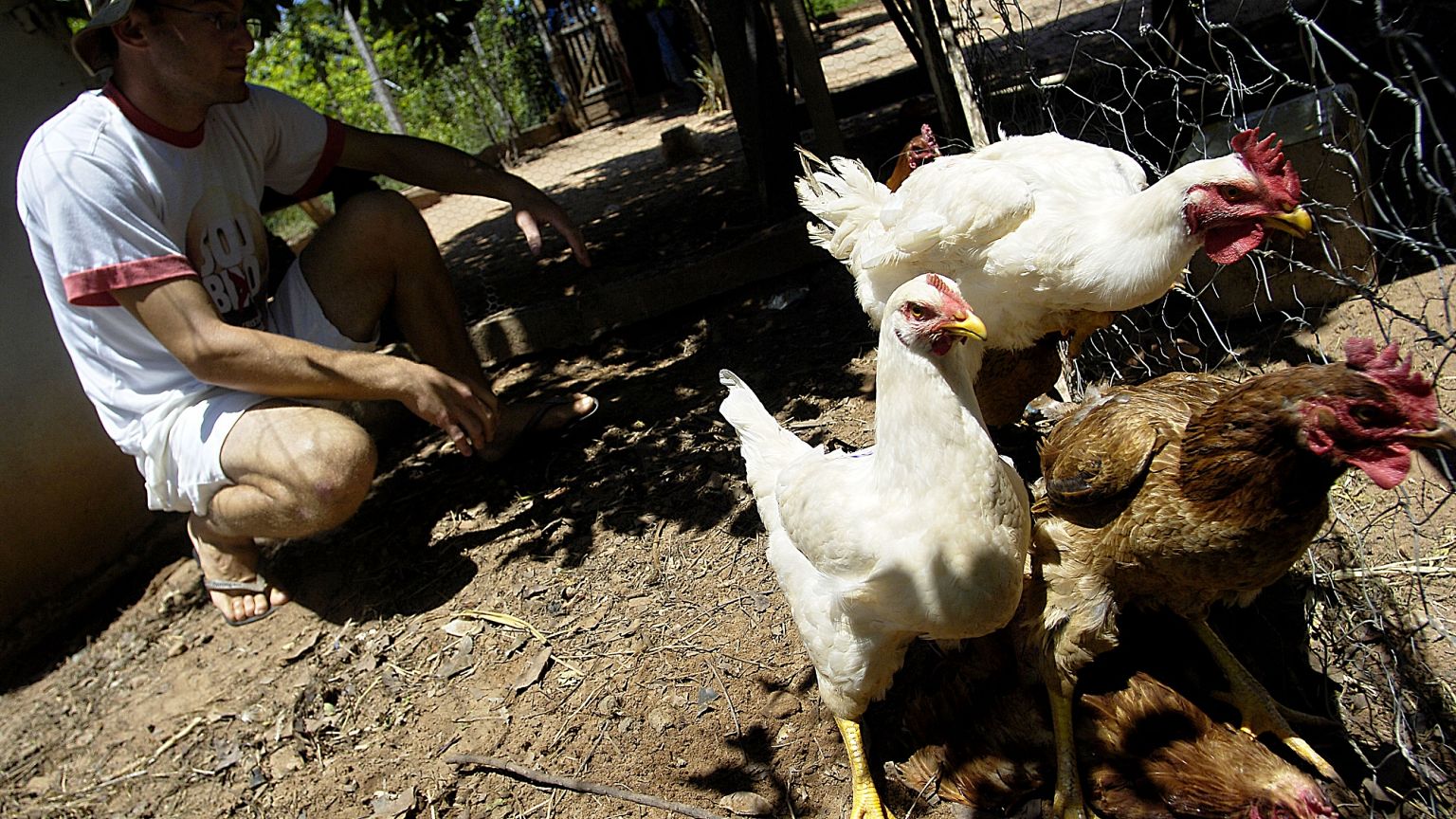
Bird flu outbreak halts Brazilian poultry exports to the EU
Brazil can no longer issue the required export certificates for poultry meat destined for the EU due to a avian flu outbreak.
Brazil has halted all poultry exports to the EU, the European Commission confirmed on Monday, after the country notified the World Organisation for Animal Health (WOAH) of a bird flu outbreak.
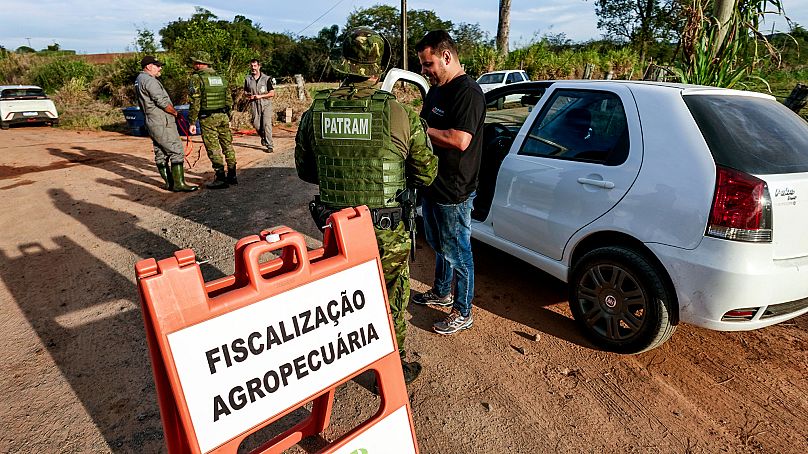
Brazil notified WOAH that it suspended its status ‘free of Highly Pathogenic Avian Influenza (HPAI)’ after bird flu was detected on a commercial farm in Montenegro, in the state of Rio Grande do Sul.
The notification rendered imports from any region of Brazil of poultry and poultry products ineligible under EU rules that stipulate countries must maintain an HPAI-free status to export poultry products, meaning the EU need not impose a ban on Brazilian poultry.
Without this status, Brazilian authorities are unable to sign the animal health certificates required for exports to the EU.
Although the EU is not Brazil’s largest poultry market (only about 4.4% of Brazilian poultry exports were sent to the EU last year) the Latin American country remains a key poultry supplier to the bloc, accounting for 32% of the EU’s poultry imports in 2024, according to official EU data.
Brazilian outbreakCopyright 2025 The Associated Press. All rights reserved.
"The European Commission remains in contact with the Brazilian authorities and relies on them to ensure no EU export certificates are being signed," a Commission spokesperson told Euronews.
As part of containment measures, approximately 1.7 million eggs - equivalent to 450 metric tons - have been destroyed in Rio Grande do Sul, according to the state's department of agriculture.
Brazil is the world's largest poultry exporter, supplying to major international markets. China remains its top customer, followed by the United Arab Emirates, Japan, Saudi Arabia, and South Africa.
Health experts are increasingly concerned as bird flu cases continue to rise among wild birds worldwide, particularly in the US, where an outbreak among poultry and dairy cows has resulted in 67 confirmed human cases and one death.
Can glaciers regrow if global warming is reversed? Not in our lifetimes, scientists warn
Copyright Dr Lilian Schuster
By Euronews Green
Published on
“The longer we delay emissions cuts, the more we burden future generations with irreversible change”.
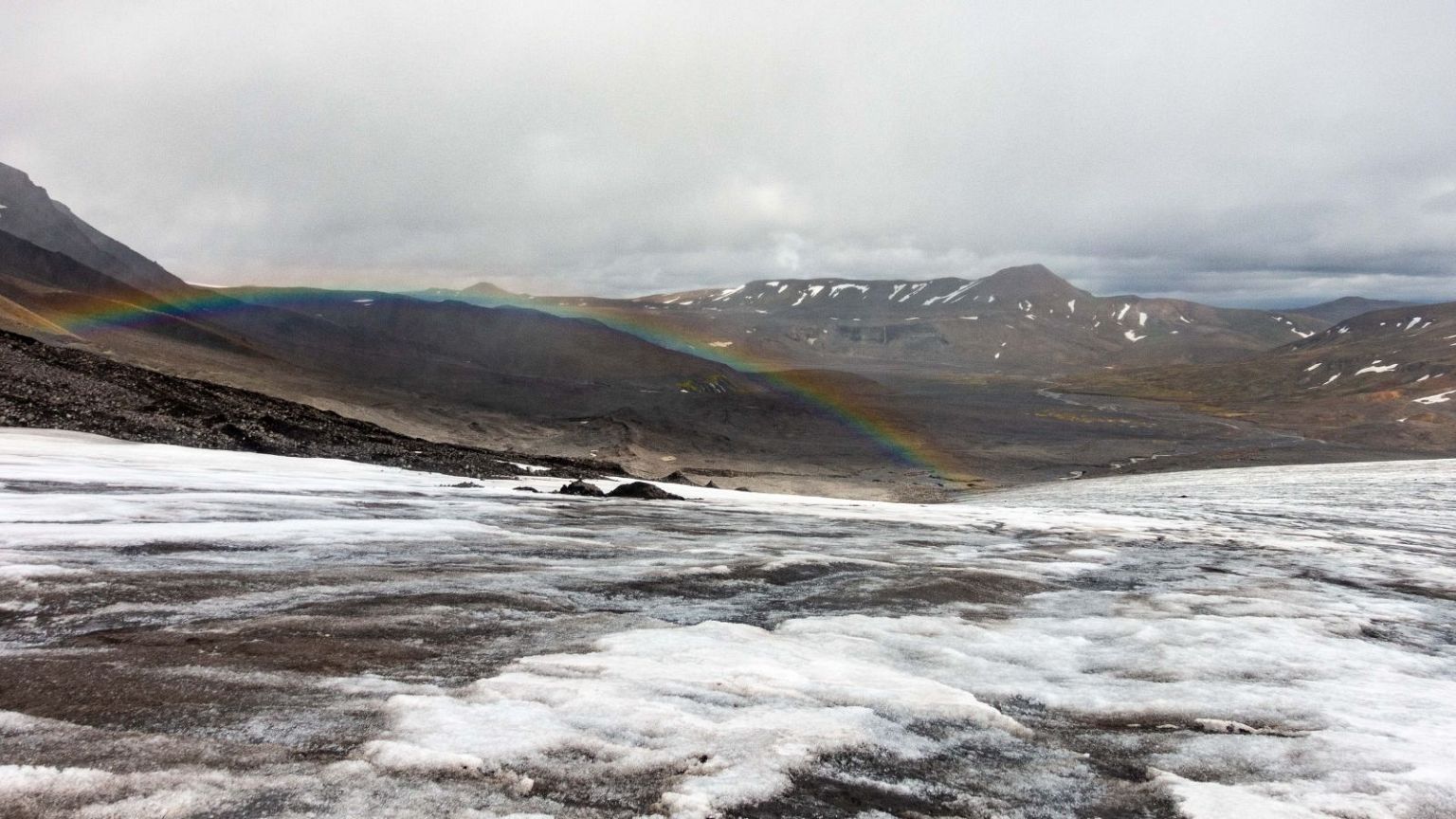
Mountain glaciers won’t recover for centuries if the world temporarily exceeds 1.5°C of global heating, new research shows.
It is the first study to simulate glacier change up to 2500 under ‘overshoot scenarios’ - where the planet surpasses the 1.5°C limit up to 3°C before cooling back down.
Since current climate policies put Earth on track for closer to 3°C of warming, the research led by the UK’s University of Bristol and Austria’s University of Innsbruck provides a timely glimpse into a possible future. And presents another urgent plea to correct the course we are on.
“It’s clear that such a world is far worse for glaciers than one where the 1.5°C limit is held,” says corresponding author Dr Fabien Maussion, Associate Professor in Polar Environmental Change at the University of Bristol
“We aimed to discover whether glaciers can recover if the planet cools again. It’s a question many people ask - will glaciers regrow in our lifetime, or that of our children? Our findings indicate sadly not.”
Why 1.5°C makes a big difference for glaciers
2024 was the hottest year on record and the first calendar year to exceed the 1.5°C limit.
The Paris Agreement target of limiting global warming to 1.5°C above pre-industrial levels - beyond which climate disasters will escalate - is based on long-term averages, so we haven’t crossed the line just yet.
But it’s looking increasingly likely, with the UN weather agency warning last year that there is a near 50 per cent chance that average global temperatures between 2024-2028 could top 1.5°C.
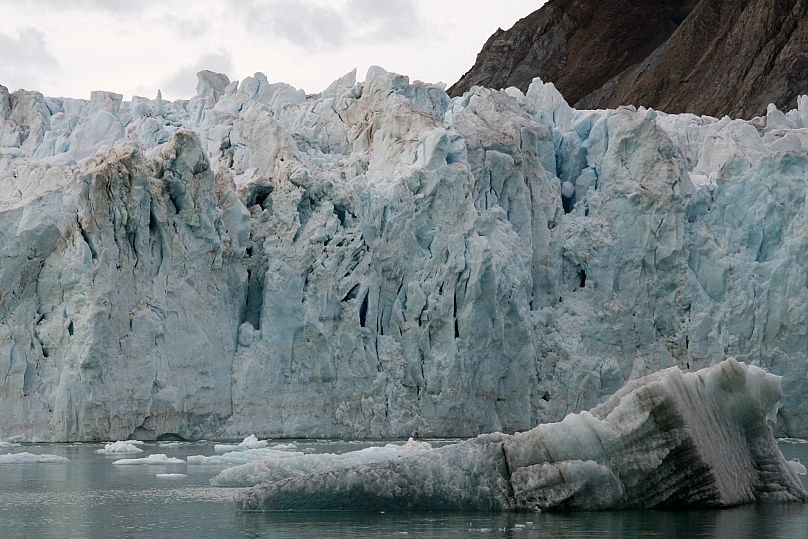
A calving glacier in Svalbard, Norway.Dr Fabien Maussion
To confront what this means for the world’s frozen rivers of ice, scientists simulated a strong overshoot scenario in which global warming continues rising to 3°C by around 2150, before falling back to 1.5°C by 2300 and stabilising.
Under these conditions, glaciers could lose up to 16 per cent more of their mass by 2200, compared to a world that never crosses the 1.5°C threshold, and 11 per cent more by 2500.
That’s on top of the 35 per centalready committed to melting even at 1.5°C.
The thawing of glacial ice since 2000 has already raised sea levels by almost 2 centimetres, making glacier melt the second biggest contributor to sea level rise after the expansion of water due to warming oceans.
Glaciers in the Alps would not recover until around 2500
“Our models show it would take many centuries, if not millennia, for the large polar glaciers to recover from a 3°C overshoot,” says Dr Lilian Schuster, lead author of the study published today in the journal Nature Climate Change, and a researcher at the University of Innsbruck.
The research excludes the world’s two polar ice sheets.
“For smaller glaciers such as those in the Alps, the Himalaya and the Tropical Andes, recovery won’t be seen by the next generations but is possible by 2500.”
The fluctuations of glacier meltwater in these mountain regions have a huge impact on downstream communities.
In basins where glaciers regrow after peak temperatures, glacier runoff reduces further than if they stabilise, a phenomenon the scientists call ‘trough water’.
Related
“We found that roughly half of the basins we studied will experience some form of trough water beyond 2100,” explains Dr Lilian Schuster.
“It’s too early to say how much impact this will have, but our study is a first step toward understanding the many and complex consequences of climate overshoots for glacier-fed water systems and sea-level rise.”
“Overshooting 1.5°C, even temporarily, locks in glacier loss for centuries. Our study shows that much of this damage cannot simply be undone - even if temperatures later return to safer levels,” concludes Dr Maussion.
“The longer we delay emissions cuts, the more we burden future generations with irreversible change.”
Dragon’s blood trees grow in one place on Earth. Climate change and goats threaten their survival
Copyright AP Photo/Annika Hammerschlag
By Annika Hammerschlag with AP
Published on
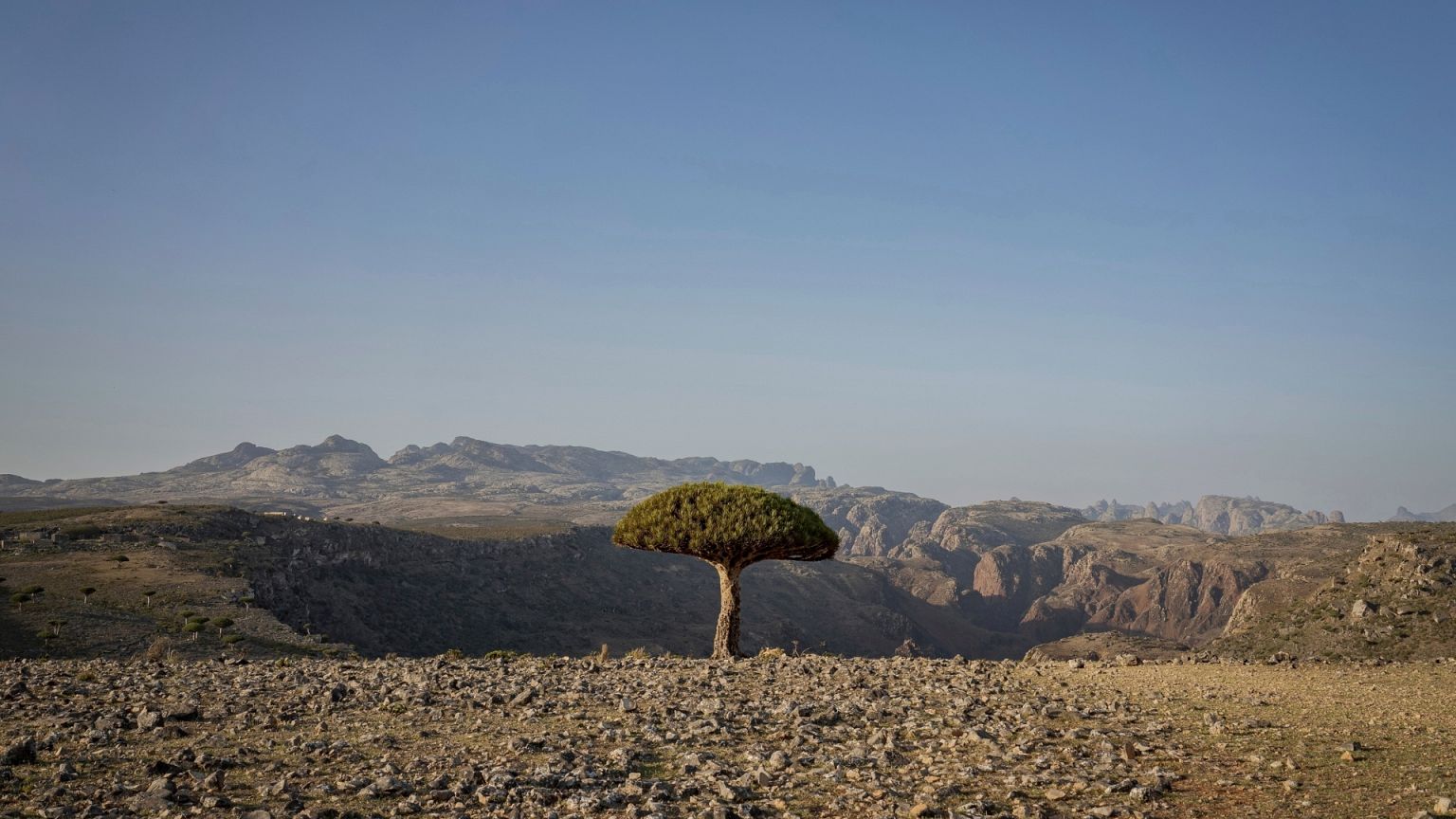
Known for their mushroom-shaped canopies and the blood-red sap that courses through their wood, the trees once stood in great numbers.
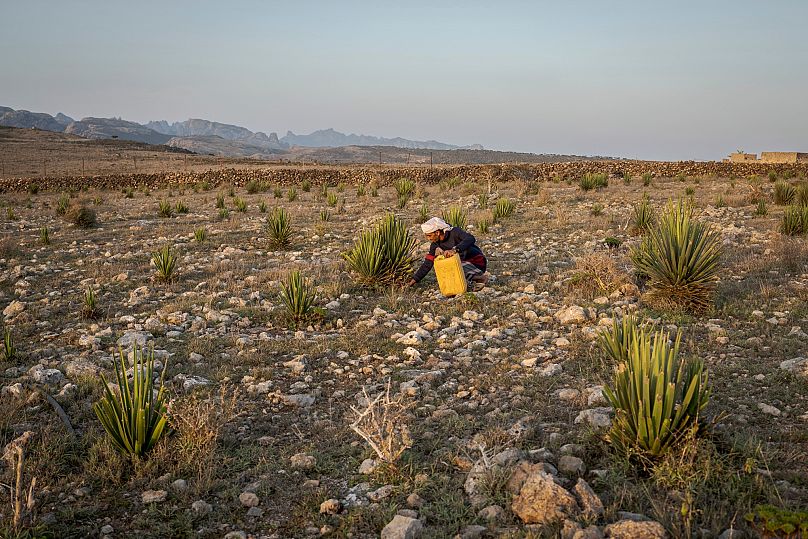
On a windswept plateau high above the Arabian Sea, Sena Keybani cradles a sapling that barely reaches her ankle.
The young plant, protected by a makeshift fence of wood and wire, is a kind of dragon’s blood tree - a species found only on the Yemeni island of Socotra that is now struggling to survive intensifying threats from climate change.
“Seeing the trees die, it’s like losing one of your babies,” said Keybani, whose family runs a nursery dedicated to preserving the species.
Known for their mushroom-shaped canopies and the blood-red sap that courses through their wood, the trees once stood in great numbers.
But increasingly severe cyclones, grazing by invasive goats, and persistent turmoil in Yemen, which is one of the world’s poorest countries and beset by a decade-long civil war, have pushed the species, and the unique ecosystem it supports, toward collapse.
An island of dragon’s blood forests
Often compared to the Galapagos Islands, Socotra floats in splendid isolation some 240 kilometres off the Horn of Africa.
Its biological riches - including 825 plant species, of which more than a third exist nowhere else on Earth - have earned it UNESCO World Heritage status. Among them are bottle trees, whose swollen trunks jut from rock like sculptures, and frankincense, their gnarled limbs twisting skywards.
But it’s the dragon’s blood tree that has long captured imaginations, its otherworldly form seeming to belong more to the pages of Dr Seuss than to any terrestrial forest. The island receives about 5,000 tourists annually, many drawn by the surreal sight of the dragon’s blood forests.
Visitors are required to hire local guides and stay in campsites run by Socotran families to ensure tourism income is distributed locally. If the trees were to disappear, the industry that sustains many islanders could vanish with them.
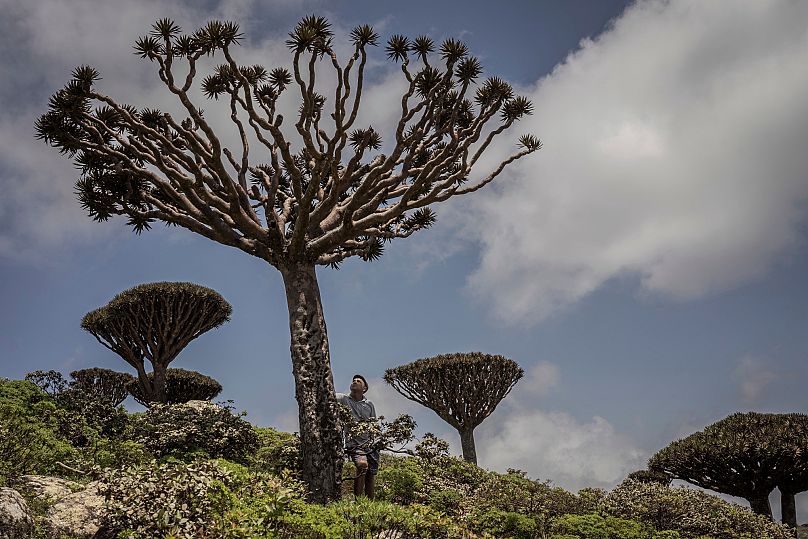
Ecotourism guide Sami Mubarak poses for a portrait beneath an ailing dragon's blood tree on the Yemeni island of Socotra.AP Photo/Annika Hammerschlag
“With the income we receive from tourism, we live better than those on the mainland,” said Mubarak Kopi, Socotra’s head of tourism.
But the tree is more than a botanical curiosity: It’s a pillar of Socotra’s ecosystem. The umbrella-like canopies capture fog and rain, which they channel into the soil below, allowing neighbouring plants to thrive in the arid climate.
“When you lose the trees, you lose everything - the soil, the water, the entire ecosystem,” said Kay Van Damme, a Belgian conservation biologist who has worked on Socotra since 1999.
Without intervention, scientists like Van Damme warn these trees could disappear within a few centuries, and with them many other species.
“We’ve succeeded, as humans, to destroy huge amounts of nature on most of the world’s islands,” he said. “Socotra is a place where we can actually really do something. But if we don’t, this one is on us.”
Increasingly intense cyclones uproot trees
Across the rugged expanse of Socotra’s Firmihin plateau, the largest remaining dragon’s blood forest unfolds against the backdrop of jagged mountains.
Thousands of wide canopies balance atop slender trunks. Socotra starlings dart among the dense crowns while Egyptian vultures bank against the relentless gusts. Below, goats weave through the rocky undergrowth.
The frequency of severe cyclones has increased dramatically across the Arabian Sea in recent decades, according to a 2017 study in the journal Nature Climate Change, and Socotra’s dragon’s blood trees are paying the price.
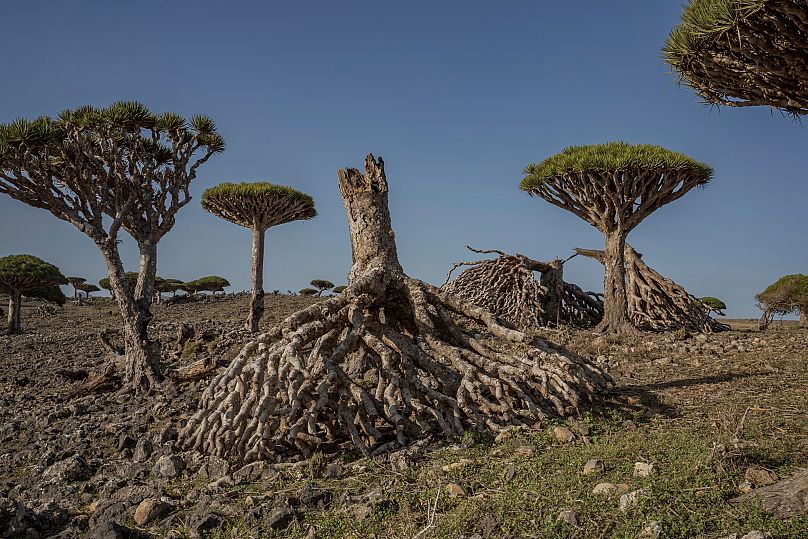
Toppled dragon's blood trees are strewn on the ground on the Yemeni island of Socotra.AP Photo/Annika Hammerschlag
In 2015, a devastating one-two punch of cyclones, unprecedented in their intensity, tore across the island. Centuries-old specimens, some over 500 years old, which had weathered countless previous storms, were uprooted by the thousands. The destruction continued in 2018 with yet another cyclone.
As greenhouse gas emissions continue to rise, so too will the intensity of the storms, warned Hiroyuki Murakami, a climate scientist at the National Oceanic and Atmospheric Administration and the study’s lead author.
But storms aren’t the only threat. Unlike pine or oak trees, which grow 60 to 90 centimetres per year, dragon’s blood trees creep along at just 2 to 3 centimetres annually. By the time they reach maturity, many have already succumbed to an insidious danger: goats.
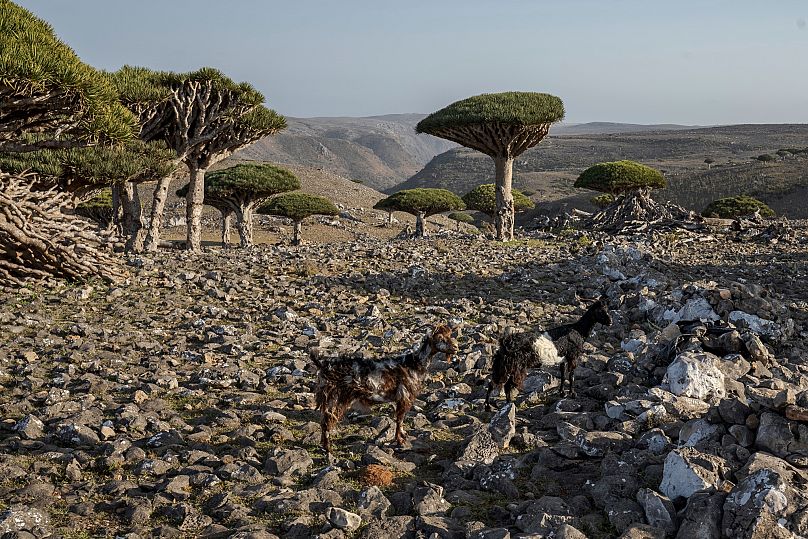
An invasive species on Socotra, free-roaming goats devour saplings before they have a chance to grow. Outside of hard-to-reach cliffs, the only place young dragon’s blood trees can survive is within protected nurseries.
Goats roam amidst dragon's blood trees on the Yemeni island of Socotra.AP Photo/Annika Hammerschlag
“The majority of forests that have been surveyed are what we call over-mature - there are no young trees, there are no seedlings,” said Alan Forrest, a biodiversity scientist at the Royal Botanic Garden Edinburgh’s Centre for Middle Eastern Plants.
“So you’ve got old trees coming down and dying, and there’s not a lot of regeneration going on.”
Keybani’s family's nursery is one of several critical enclosures that keep out goats and allow saplings to grow undisturbed.
“Within those nurseries and enclosures, the reproduction and age structure of the vegetation is much better,” Forrest said. “And therefore, it will be more resilient to climate change.”
As the Saudi Arabia-backed, internationally recognised government battles Houthi rebels - a Shiite group backed by Iran - the conflict has spilt beyond the country’s borders. Houthi attacks on Israel and commercial shipping in the Red Sea have drawn retaliation from Israeli and Western forces, further destabilising the region.
“The Yemeni government has 99 problems right now,” said Abdulrahman Al-Eryani, an advisor with Gulf State Analytics, a Washington-based risk consulting firm. “Policymakers are focused on stabilising the country and ensuring essential services like electricity and water remain functional. Addressing climate issues would be a luxury.”
Mohammed Abdullah tends to dragon's blood tree saplings at the Keybani family nursery on the Yemeni island of Socotra.AP Photo/Annika Hammerschlag
With little national support, conservation efforts are left largely up to Socotrans. But local resources are scarce, said Sami Mubarak, an ecotourism guide on the island.
Mubarak gestures toward the Keybani family nursery's slanting fence posts, strung together with flimsy wire. The enclosures only last a few years before the wind and rain break them down. Funding for sturdier nurseries with cement fence posts would go a long way, he said.
“Right now, there are only a few small environmental projects - it’s not enough,” he said. “We need the local authority and national government of Yemen to make conservation a priority.”
France to build high-security jail in Amazon to isolate drug traffickers from gangs
The country's Justice Minister Gérald Darmanin announced the €400-million scheme during a visit to French Guiana on Sunday.
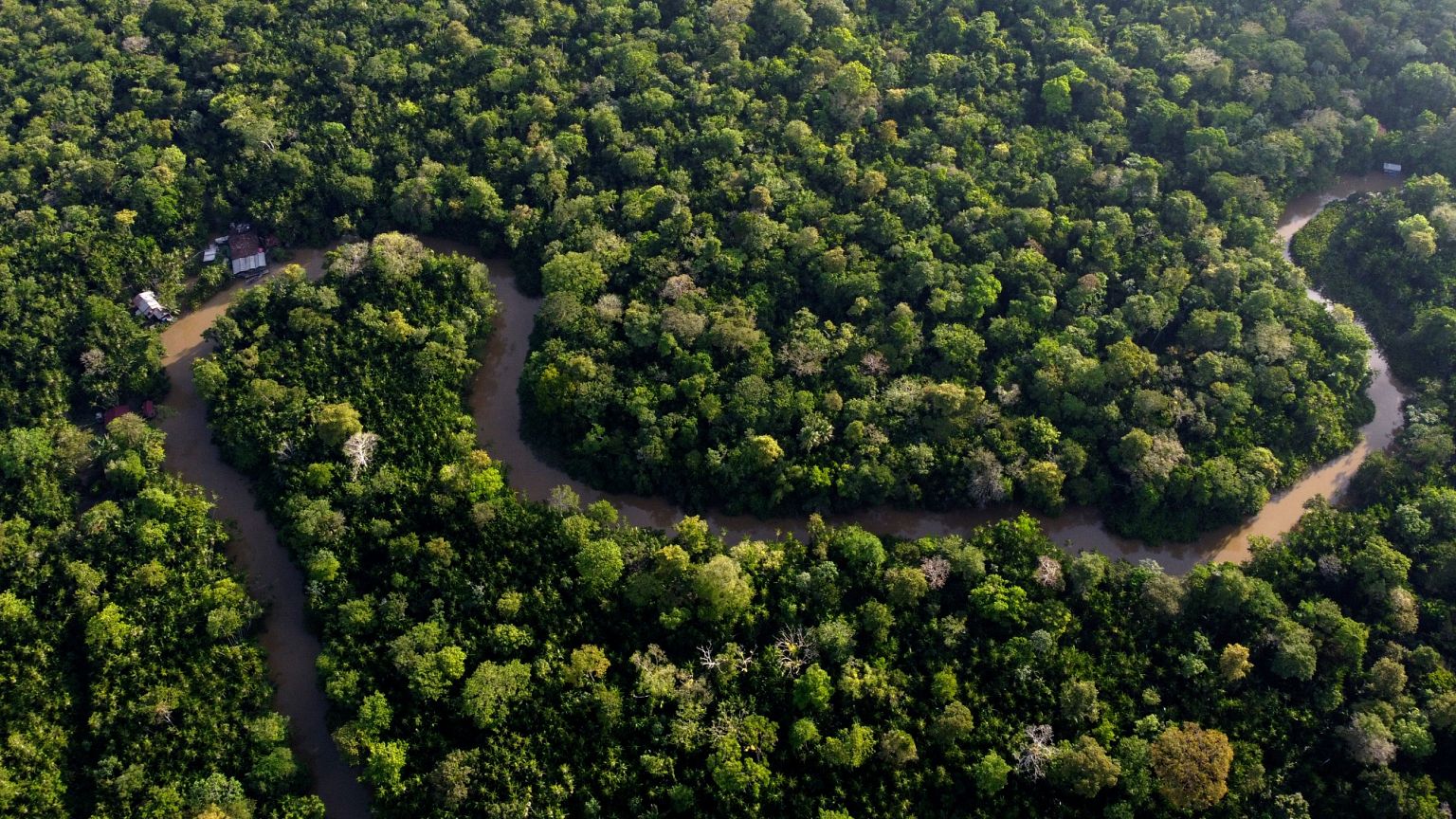
France plans to build a high-security prison in the Amazon as part of its crackdown on serious drug offenders.
Justice Minister Gérald Darmanin announced the proposal during a visit to French Guiana — an overseas territory in South America which borders Brazil and Suriname — at the weekend.
The scheme would see a 500-bed prison built in Saint-Laurent-du-Maroni, an area of French Guiana, with space to house 60 high-level drug criminals and 15 terrorists, Darmanin said.
A courthouse will also be built at the Ministry of Justice site, which could open as early as 2028 and which is due to cost €400 million, he explained.
The facility will be constructed close to a notorious penal colony known as the Devil's Island that France operated until the 1950s.
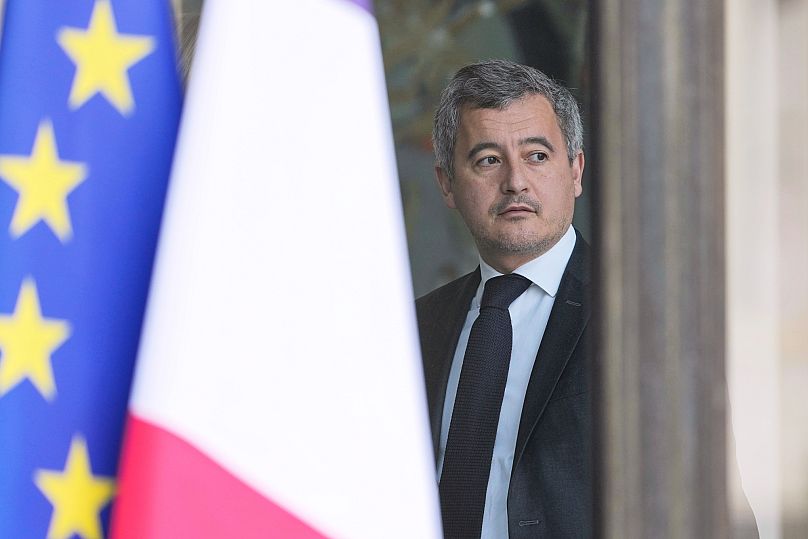
France's Justice minister Gérald Darmanin leaves a weekly cabinet meeting in Paris, 19 February, 2025 AP Photo
The penal colony, which was renowned for its short life expectancy, was used as the setting for the novel "Papillon", which later became a Hollywood film starring Dustin Hoffman and Steve McQueen.
The minister told the French newspaper Le Journal du Dimanche (JDD) that the purpose of the prison is "to put the most dangerous drug traffickers out of action."
As well as targeting the drug trade in the territory, Darmanin also said that it would help to ease prison overcrowding.
Darmanin has made the fight against drug trafficking one of his highest priorities. By this summer, he wants to isolate his country’s top 100 drug traffickers from their criminal networks.
Under this plan, prisoners will be transferred to two high-security prisons at Vendin-le-Vieil (Pas-de-Calais) and Condé-sur-Sarthe (Orne) in mainland France.
Speaking to the French newspaper Le Monde in January, Darmanin explained his reasoning.
"What is unbearable is that prisons are no longer obstacles for most narco-traffickers to continue their trafficking, or to assassinate or to threaten magistrates, prison officers, journalists or lawyers," he said.
The third high-security prison in his anti-drugs plan will be the one in French Guiana.
Scientists use special ‘squeezing’ and electrical probes to collect sperm from endangered kākāpō
Copyright Canva
By Euronews Green
Published on
The kākāpō was the first wild bird to be successfully artificially inseminated in 2009, but it’s taken years to repeat the feat.
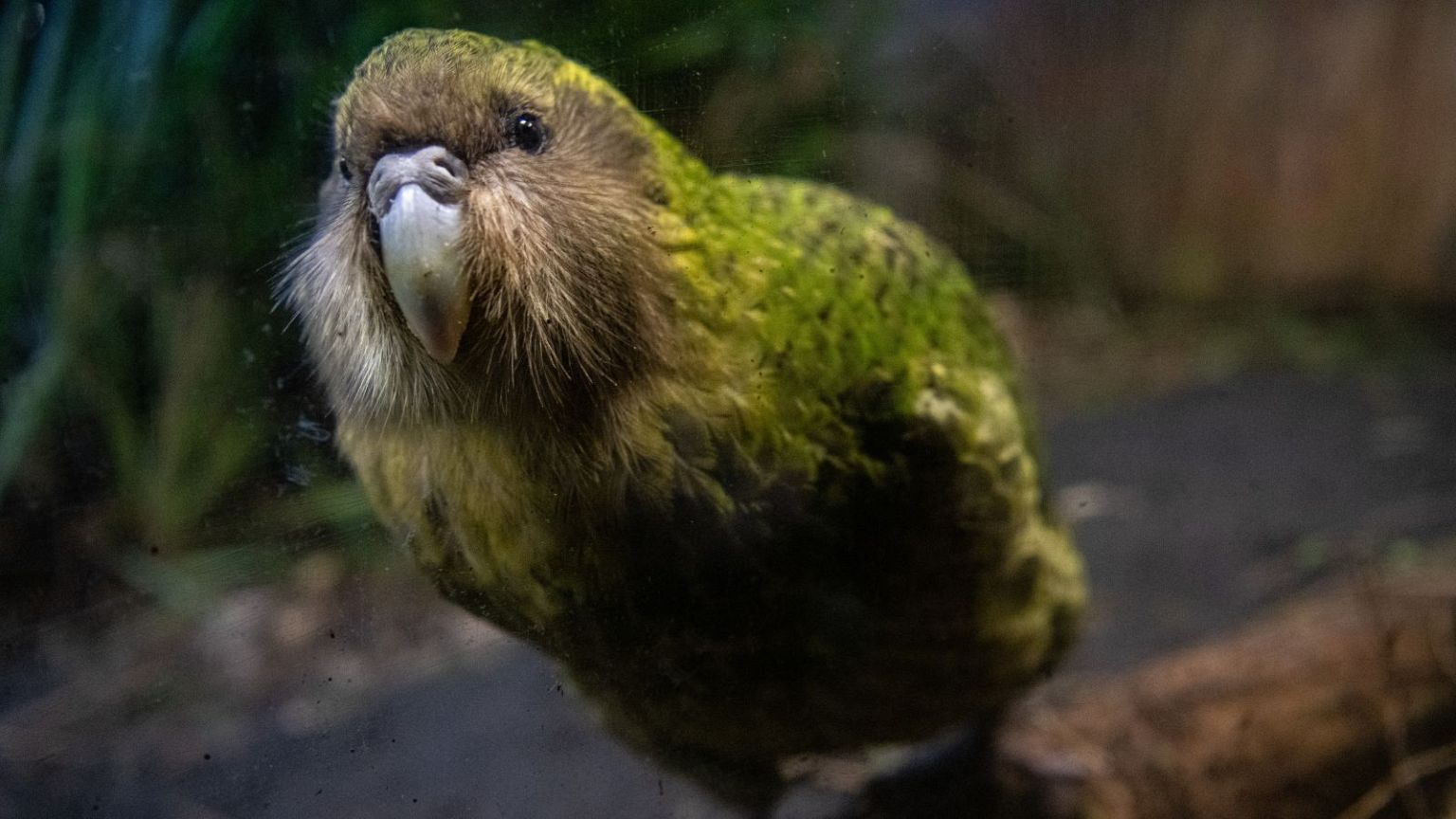
New Zealand's beloved kākāpō is a highly unusual bird. Sometimes called the ‘owl-parrot’ or ‘owl-faced parrot’ because of its facial disc, the yellow-green plumed bird is the world’s heaviest parrot - and the only one that can’t fly.
Unfortunately, it also has abnormally unproductive breeding habits. One in five males don’t father any offspring and only around two in five eggs hatch.
This has made it hard for the kākāpō to bounce back from vanishingly low numbers in the 1990s, brought down by hunting, habitat loss and the arrival of invasive ground predators such as cats, rats and ferrets on its island havens.
A 2019 count found only 142 of the species left, putting it in the ‘critically endangered’ camp according to the IUCN. So conservationists have been devising ways to help the iconic kākāpō get back on track.
Artificial insemination to the rescue
During the 1970s to 1990s, all surviving kākāpō were transferred from the two last natural populations in Fiordland and on Rakiura/Stewart Island to three predator-free islands.
But the nocturnal bird has struggled to reproduce even in this relative safety. Breeding, which depends on the episodic fruiting of trees like the rimu, is hampered by low productivity and high levels of genetic inbreeding.
“Artificial insemination is an important tool to tackle these issues, since it helps improve fertility and enables preservation of important genetic diversity from individuals which don’t mate naturally,” explains Dr Andrew Digby, Science Advisor Kākāpō/Takahē, at the Department of Conservation, and co-author of a new study on the method.
Artificial insemination comes with its own challenges, however. Although the Kākāpō Team were first successful in 2009 - a world first for a wild bird species - it has taken another ten years to repeat the feat.
After no luck for the next decade, New Zealand's Department of Conservation called in a team of parrot insemination experts from Germany to help in 2019.
Related
How does artifical insemination of kākāpō work?
Six years ago, the team used artificial insemination to produce four chicks from three females.
These included offspring from two males which had previously not produced, including one with rare and valuable “Fiordland” genes.
It’s far less glamorous than the kākāpō’s natural ways. Unlike other parrots, the species has a polygynous ‘lek’ mating system: males gather for a courtship ritual which involves making booming noises throughout the night at their exclusive sites to attract females.
To collect kākāpō semen, the researchers restrained the male bird by covering its head and wings with a towel and placing its top half into the top half of a cut open water bottle.
Rhythmic movements of the thumb and fingers in a “squeezing” fashion on the abdomen of the bird induced ejaculation in some cases. While electric simulation using a ‘multipolar probe’ (patent pending in Germany) did the trick for others.
The male was rewarded with a nut and released, while the researchers tested the semen sample they collected from the bird’s cloaca straightway. If deemed viable, it was used to artificially inseminate females.
Following on from further successful attempts in 2022, the Kākāpō Team will again use artificial insemination in the upcoming 2026 breeding season.
They hope this will help improve fertility and preserve genetic diversity from founder kākāpō (carrying the only remaining genetics from Fiordland), which are poorly represented in the population, explains Dr Digby.
Trump’s South African Refugee Policy Exposes Racial Double Standard
Afrikaners enroute to America last Monday, May 12, 2025.
(Photo/Donald Trump for President Facebook page)
By Levi Rickert
May 19, 2025 Indian Country
Opinion. The Washington Post headline from last Monday—“White South Africans arrive at Dulles as refugees under Trump order”—immediately caught my attention. The article reported that approximately 50 White South Africans, known as Afrikaners, were admitted to the United States as refugees under a humanitarian designation made possible by an executive order signed by President Donald Trump in February.
What stood out to me was the contrast in how this group, many of whom are farmers, was granted entry under humanitarian grounds, while refugees from countries such as Afghanistan, the Democratic Republic of Congo, and Sudan fleeing persecution or war have often been denied entry.
Let’s not forget: Donald Trump instituted a travel ban affecting Muslim countries, slashed refugee admissions to historic lows, caged asylum-seeking children at the southern border, and called majority-Black and brown nations “sh*thole countries.”
During his first administration, Trump consistently used scare tactics about caravans from Central America to drum up political support. He separated families under a zero-tolerance policy, and his immigration agenda became a rallying cry for white nationalists. But now, when White South Africans express fear about land reform or rural crime, suddenly the door swings open.
For years, Trump has painted refugees as invaders—unless, of course, they fit a certain mold. When the narrative shifts from fear to welcome, the distinction is telling.
It is nothing short of hypocrisy.
Trump’s executive order claimed that minority Afrikaners were facing unfair treatment in South Africa. Trump and Elon Musk, an immigrant from South Africa, have even suggested the South African farmers were victims of genocide.
The term “genocide” carries deep weight, particularly for Native Americans, whose ancestors suffered through genocide marked by war, starvation, rampant disease, and the forced assimilation of Indian boarding schools.
Calling what's happening in South Africa a "White genocide" is inaccurate, inflammatory, and dangerous. It diverts attention from real issues—like rural safety, economic inequality, and land reform—and turns them into weapons of racial fear.
What makes this even more cynical is the invocation of “farmer killings” in South Africa—a complex issue distorted into a race-based narrative by far-right outlets. Trump echoed this in 2018, tweeting about the “large-scale killing of farmers,” parroting conspiracy theories with no basis in reality. His focus was never justice; it was grievance politics.
The claim that White South African farmers are being subjected to genocide has been widely debunked by experts, human rights organizations, and crime analysts.
While South Africa does face high levels of violent crime, these issues impact all communities. In fact, most murder victims in the country are Black, not White.
If the Trump administration is truly concerned about violence in South Africa, the conversation should focus on shared safety, equitable development, and historical justice for all communities.
U.S. Deputy Secretary of State Christopher Lu attempted to justify Trump’s move to bring in the Afrikaners into our country by saying they “could be assimilated easily into our country.”
This isn’t about protecting farmers. It’s about protecting whiteness.
This justification statement for allowing Afrikaners into our country exposes the hollow core of Donald Trump’s so-called "America First" rhetoric. While humanitarianism should never be selective, Trump’s sudden interest in refugee protection isn’t rooted in compassion—it’s rooted in ideology.
The hypocrisy couldn’t be more glaring. Refugees of color fleeing political violence, climate collapse, and narco-state terror are criminalized. But White South Africans, facing vastly different circumstances and not meeting the traditional criteria of “persecution,” are offered sanctuary under the guise of shared values and civilization.
For Native people in this country, the irony runs even deeper. The descendants of settlers who seized Indigenous land are now being extended the protection of a system that has historically marginalized and exterminated others in the name of expansion and racial hierarchy.
True justice means consistent compassion. It means protecting all vulnerable people, not just those who reinforce a supremacist narrative. If Trump truly cared about refugees, he would welcome those fleeing war in Sudan, political oppression in Nicaragua, or climate disaster in the Pacific Islands. But he doesn’t.
He cares about building a nation that looks the way he wants it to look—white, nostalgic, and obedient. His selective empathy isn’t a policy. It’s a projection of power.
And for those of us who know what it’s like to be on the receiving end of systemic erasure, that’s a truth we won’t forget.
Thayék gde nwéndëmen - We are all related.
Who Gets to Legally Name It?
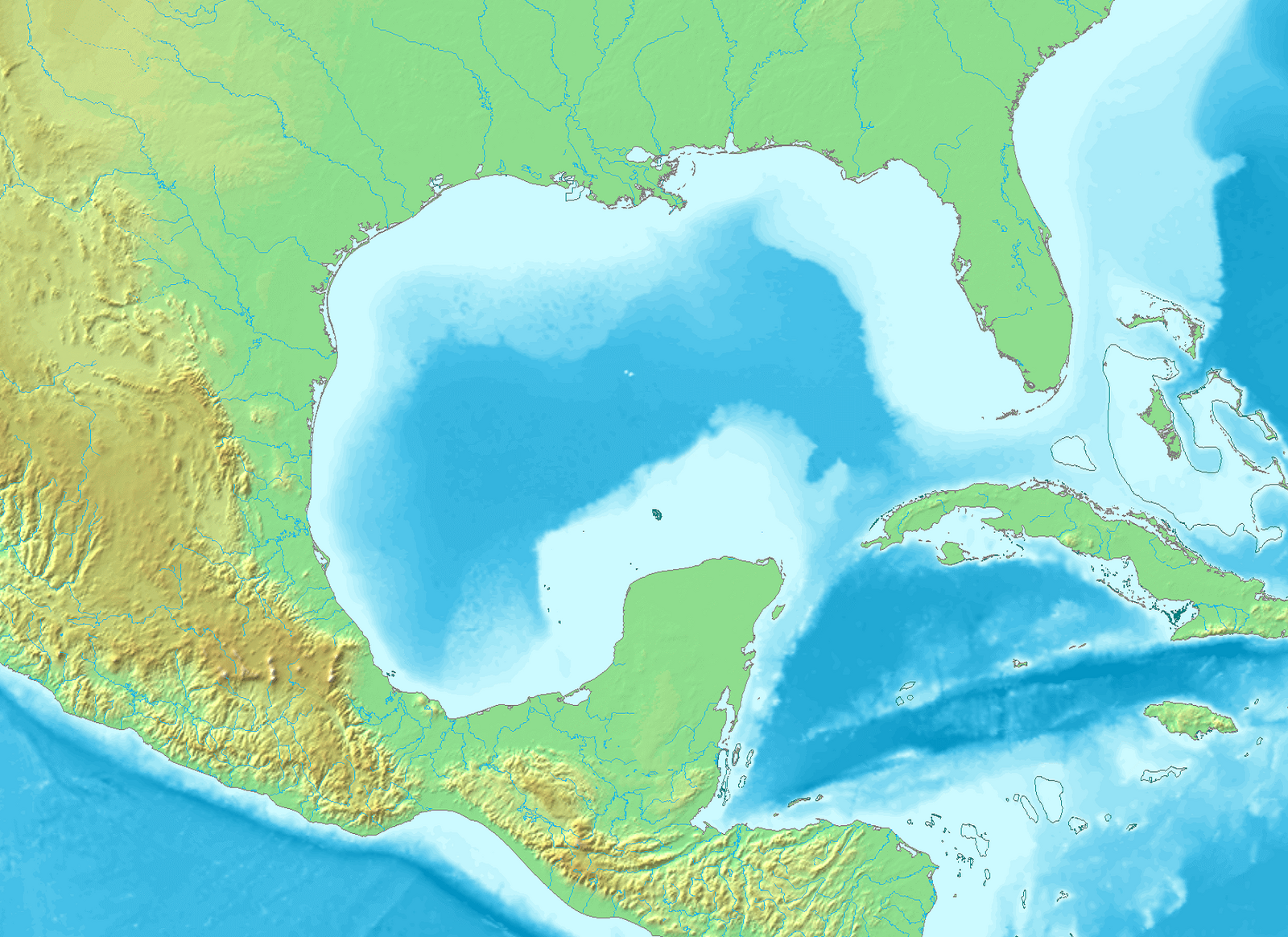
Gulf of Mexico or Gulf of America? (Photo/WikiCommons)
By Professor Victoria Sutton
Guest Opinion. On January 20, 2025, President Trump signed Executive Order 14172, “Restoring Names That Honor American Greatness”, that
. . . required the Secretary of the Interior, acting pursuant to 43 U.S.C. 364 through 364f, to “take all appropriate actions to rename as the ‘Gulf of America’ the U.S. Continental Shelf area bounded on the northeast, north, and northwest by the State of Texas, Louisiana, Mississippi, Alabama and Florida and extending to the seaward boundary with Mexico and Cuba in the area formerly named as the Gulf of Mexico.”
This directive requires the Secretary of the Interior to officially change the name of the body of water now called the Gulf of Mexico to the Gulf of America on the U.S. list of official place names, by the U.S. Board on Geographic Names, for use by the United States. It does not change it for the rest of the world.
On February 9, 2025, President Trump commemorated his first visit to the Gulf of America with an Executive Order, declaring “Gulf of America Day.”
It is the right of a sovereign to name things—buildings, natural features and other objects within its geographical jurisdiction. But with shared bodies of water, when that sovereignty is divided as in the illustrated map of maritime boundaries above, it can lead to usually “light” conflict.
The “Gulf of Mexico” name is firmly grounded in tradition, if not official naming. The first year a document shows the “Gulf of Mexico” as the name of this body of water is 1524. This document is a map sent by Hernan Cortes to King Charles the V of Spain, and now appears in a special exhibit in Tampa, Florida. Namings such as this were often intended to signify the claiming of territory, and indeed that is what Hernan Cortes was intending to do. Despite its colorful history, it goes unmentioned in Pres. Trump’s Executive Order that states that this renaming is part of the Administration’s policy to restore pride in America’s greatness, specifically, the executive order directs that “ . . . in recognition of this flourishing economic resource and its critical importance to our Nation's economy and its people, I am directing that it officially be renamed the Gulf of America.”
In March, Mexico filed a lawsuit in Mexico against Google for changing the name of the Gulf of Mexico for U.S. users of Google, which goes too far in asserting Mexican sovereignty. Mexico Google users still see the entire body name of the “Gulf of Mexico”.
Is there an International Naming Authority?
The International Hydrographic Organization (IHO) focuses on charting marine boundaries; however, they have no formal international agreement or protocol for naming maritime areas, despite their historical statement: “The International Hydrographic Organization has had an interest in geographical place names from the very beginning of its existence in 1921.” It is not associated with the United Nations, but is a stand alone organization that was formed before the UN. Representation in the IHO is organized where “States are represented within the IHO by the national authority responsible for the provision of hydrographic and nautical charting services in each Member State. A Secretary General and two Directors are elected by Member States and administer the work of the Organization.” While they have no protocol for naming maritime areas, they are mainly concerned with mapping the floor of the oceans, with its ridges, seamounts and other natural features.
United Nations involvement?
The mission of the United Nations (established in 1945, after the IHO, formed in 1921), is to prevent the “scourge of war”; and thus, makes conflict resolution a priority. While there are several controversies over the naming of commonly bordered bodies of water, like the Persian Gulf vs. the Arabian Gulf, the United Nations has not chosen to enter that fray as mediator. But the United Nations has within its Economic and Social Council division (1945 UN Charter, Art. 61), nine expert units, one of which is a unit called the Group of Experts on Geographical Names (UNGEGN). Their work is to set standards and meet with the representatives of each nations’ geographical naming authority. The United Nations is strictly an intragovernmental organization that has no authority other than what its member nations agree to allow it to exercise through treaties and agreements. So if there is any mediating it would likely take place within this UNGEGN among the geographical naming authorities.
International Law and Naming
While there is no international protocol or law to officially name a body of water, each sovereign is left to name their own boundary waters within their jurisdictions. The Law of the Sea is the international legal instrument that we would first look to for determining where that jurisdiction lies.
However, as in the Gulf of Mexico, aka Gulf of America, there are three sovereign nations with jurisdictions over parts of this body of water. One group of scholars has determined that through “unilateral acts” provided for in the Law of the Sea, one nation could name a body of water beyond their jurisdiction, but to what extent this accrues any rights is more of a matter of international diplomacy, than perhaps a customary law. An analysis in 2010 concluded:
The silence of the 1982 Convention [The Law of the Sea] does not rule out the possibility for a state to create a new right to impose its chosen nomenclature of a particular maritime feature on the international community. The technique that could give birth to such an entitlement is the unilateral act. Indeed, the legal nature of such acts has been acknowledged (Eastern Greenland 1933, 69; Nuclear Tests 1974, 268) and recent years have seen a sharp rise in their usage: “(…) unilateral acts have become the most frequent tool of State interaction. They weave, so to speak, the daily web of international relations” (Zemanek 1998, 210).
The Law of the Sea allows filing exceptions while still signing the Convention if there is a disagreement over an “historic . . title.” This means these disagreements do not prevent the larger treaty from being signed or becoming effective. It is really an agreement to disagree.
The Law of the Sea also provides for maritime bilateral (between two nations) and multilateral (between many nations) agreements between nations. Indeed, there is a maritime treaty between Mexico and the United States: US/Mexico Maritime Boundary Treaty, 1978; which was not effective until 1997 and enrolled with the United Nations in 2001. It speaks strictly to boundaries and jurisdictions with no other authorities regarding naming.
In summary
Every nation has the sovereign power to name the body of water contiguous with its shore, and to use that name within their jurisdiction. The name can be adopted by any or all of the international organizations that record names. However, naming a body of water or a sea or a gulf could be done with a “unilateral” act under the Law of the Sea.
Did I mention, the United States often relies on the United Nations Convention on the Law of the Sea, but has not ratified the treaty (Senate approval), nor is it even a signatory (Executive Branch signing of the treaty)?
So we may be relying on international law that we have not agreed to be bound by, but then that is not out of the ordinary for the United States. Thus, we hereby rename the entire Gulf and rely on international law and diplomacy to make it customary.
Professor Victoria Sutton (Lumbee) is a law professor on the faculty of Texas Tech University. In 2005, Sutton became a founding member of the National Congress of American Indians, Policy Advisory Board to the NCAI Policy Center, positioning the Native American community to act and lead on policy issues affecting Indigenous communities in the United States.