Thursday, June 12, 2025


Why another world is possible: Comments at a socialist rally in Berlin

Another world is possible sticker

The following remarks by Paul Le Blanc kicked off the final session, on June 1, 2025, at the four-day das Marx is' Muss Kongress 2025, held in Berlin, organized by marx21, a left-wing current in Die Linke (the Left Party), and which drew 1200 activists. These remarks are now first appearing in digital form, with the author’s authorization, simultaneously on LINKS and Communis. Both sites previously published the text of Paul Le Blanc’s contribution to the event.

Here is the question I have been asked to address: “What makes us socialists believe that another world is possible?”

Two things frame the answer to this question: (1) the problems and crises of capitalism, and (2) essential qualities inherent in humanity. After elaborating on these, I will conclude with a few remarks on the relevance of Lenin and how we must, as Lenin urged, organize ourselves.

For the first key element in the answer about the possibility of revolutionary change, I want to offer a summary report from my homeland — the United States of America, which throughout my lifetime has been the center of global capitalism, “the belly of the beast,” as some put it. That system is increasingly in trouble, which means that more and more of us are in trouble. We all should know what is happening, because it is all over the news, day after day, at least in the US. 

First there is something which is always in the background of daily life, but more and more it is coming to the foreground: the weather. We have been experiencing increasingly odd weather. In various places, it is warmer than usual, colder than usual, rainier than usual, dryer than usual. This increasingly visible climate change now seems to be unfolding fast, furiously, extensively, with an unusual proliferation of floods, droughts, wildfires, high winds and tornados where generally such things have not been expected. We are told that this is worse in other parts of the world, but it is impacting more and more on the US people.

In our own lives and experience, we know that there have always been both grotesque inequality and visible corruption. But I do not think we have ever seen the kind of soaring inequality that has been increasing in recent times, accelerating to unimagined proportions. And corruption is becoming blatant in the very highest circles of power. Those who benefit from such things, with all their immense power, have contempt for us. They tell us lies, they disregard us, they laugh at us, they set us against each other while pretending to be our best friend.

Impacting all of us, however, even on those at the top, has been a growing economic instability. Those of us among the bottom 80% of US people are especially slammed by rising prices, the erosion of living standards, the increasing shakiness of employment, growing problems of housing and health care, the erosion of all things public — education, libraries, parks, transportation and more. This is generating an expansive anxiety, which is sharpening as we face declining social services and the dramatic slashing of programs that many depend on.

Such developments are now intimately related to the recent extraordinary shifts in “politics-as-usual”. The dominant faction of the US ruling class — stretching from liberal Democrats to old-line conservatives among the Republicans — is largely discredited in the eyes of many. Both of these factions have made glowing promises for years but failed to provide genuine solutions to the growing plight of our people. Effectively trashing these losers and promising drastic action to improve the lives of people in the US (while also playing on widespread biases and illusions), an erratic, ego-centric, powerful huckster named Donald Trump has now taken charge.

Trump claims he won the US presidency by a landslide, but in truth it was a very narrow and unstable margin, less than a majority. Through the new regime we are now being treated to an expanding and deepening authoritarianism. The Trump faction of the ruling class is, quite obviously, inclined to give up on the pretense of democracy and constitutional government. It is overseeing the dismantling of long-standing institutions, policies, norms. Along with this, it is elevating and expanding new layers of governmental strata that seem to be afflicted by an ideological narrowness blended with a breathtaking shallowness, ineptness, and rigidity.

Not surprisingly, there is declining public confidence in the viability of the status quo, and in the ability of any faction of our rulers to deal with the increasingly overwhelming problems that we face. This has contributed to a rise in unofficial violence — including traditional “criminal” activity but especially involving new increases of bullying, vigilante activity, mass shootings, and sometimes targeted assassinations.

Yet the social and political crises are also accompanied by the ominous rise in official violence — ranging from political repression to outright killing — for those deemed to be “problematical”. But this inward-directed violence is consistent with the dynamics of US foreign policy, with its increasing impacts of imperialism and militarism, support for genocide perpetrated by certain allies, and the growing threat of war.

There is certainly much more to be said — especially in regard to the unfolding of such dynamics across the face of our planet. But the bottom line is what Bertolt Brecht once told us: “Because things are as they are, they cannot stay as they are.” 

We now come to a second key element in the answer to the question we are wrestling with. It is the title of Carl Sandburg’s great poem of the 1930s, The People, Yes. Speaking of the laboring majority of humanity that has been long oppressed by a succession of exploiters, Sandburg says: “This old anvil laughs at many broken hammers.” He adds: “Time is a great teacher. / Who can live without hope?” 

Also from the experience of the 1930s is John Steinbeck’s novel The Grapes of Wrath, which was made into a wonderful motion picture in 1940. In it, a key character, Ma Joad, reflects in comments to her husband: “Rich fellas come up an' they die, an' their kids ain't no good an' they die out. But we keep a'comin'. We're the people that live. They can't wipe us out; they can't lick us. We'll go on forever … 'cause we're the people.”

Three decades earlier, in backward Russia, a novelist named Maxim Gorky, in his revolutionary novel Mother, put similar thoughts in what his characters had to say: 

The time will come when people will wonder at their own beauty, when each will be like a star to all the others… The earth will be peopled with those who are free, great in their freedom… 

Everything for all — all for everyone! That is how I see it. In very truth we are all comrades, all kindred spirits, all children of one mother, who is truth!

Of course, all of us have the many problems and limitations that people have, but in each human being we also find essential qualities for our survival. In the early 1840s, the young Karl Marx referred to these qualities as our “species-being,” involving an elemental striving for freedom, creative labor, and genuine community. Rosa Luxemburg — from her prison cell amid the catastrophe of the First World War — commented on this dynamic blend: “The psyche of the masses, like … the eternal sea, always bears within it every latent possibility: deathly stillness and raging storm, the basest cowardice and the wildest heroism. The masses … are always on the verge of becoming something totally different from what they seem to be.”

Within ourselves, among people we know, and among the vast number of people we do not know, we can find qualities of insightfulness, creativity, humor, collaborative inclinations, generosity, caring, heroism — a vibrant blend of individualism and collectivism. Out of this, there is hope for the future. This hope is grounded in thousands of years of human experience. It can be found in a variety of human traditions. We can find essential qualities in the best of our spiritual traditions — the best that is in Christianity, in Judaism, in Islam, in Buddhism, and more. I am, of course, speaking here not of the authoritarian and superstitious dogmas, but of the vibrant insight and energy animating these belief systems. 

It is very much present in the centuries of what have been called humanism and the scientific spirit. It permeates the many social movements and struggles engaged in the elemental quest for popular democracy and human rights. Such things have been absorbed into the heart of socialism and permeate the Marxist orientation that inspires some of us. Not the authoritarian and superstitious dogmas passing for Marxism in some circles, but that which is alive, creative, critical-minded, and free. Such qualities animate Lenin’s outlook. 

I have explored this in my recent book-length biographical account Lenin: Responding to Catastrophe, Forging Revolution. Lenin represents a way of understanding reality that is inseparable from an essential activist commitment, and inseparable from the kinds of sensibilities outlined here. His approach to the remarkable orientation developed by Marx is permeated by what he called revolutionary dialectics — which includes the interplay of complex and contradictory realities, and also (in Lenin’s words), “development by leaps, catastrophes, and revolutions.” This relates to the question of why and how we need to organize ourselves to bring about the changes we desire.

To put it simply, we need to organize ourselves because the terrible problems and people’s hopeful aspirations will not automatically result in positive outcomes. Mindful and activist elements of the population must, within that population, function as a leaven to enable the exploited, oppressed majority to rise and bring a revolutionary outcome. 

For this, we need coherent and outward-reaching democratic collectives — involving the key concept of cadre (the German word is Kader). Cadres are the activists who have learned how to size up a situation, how to write a leaflet that can be effective, how to organize a meeting in a way that effective decisions come out of it, how to help ensure that the decisions are carried out. They are the activists who know how to organize rallies, demonstrations, strikes and other actions. Not everyone can do this — but cadres can. Such cadres also help more and more people develop the same skills and abilities. 

This involves going beyond simple protests and self-expression around various discontents. It means the development and implementation of strategy and tactics — a program of step-by-step activity that can take us from the current situation to the goal we desire. We must help build and strengthen such a movement within the multi-faceted working class of our own time, pushing against all forms of oppression, and helping to bring a transition from capitalism to a society of the free and the equal.

 

Philippines as a Warring Nation

Not a day goes by in the Philippines without reports about new friction and arms sales. Elevated military spending is now undermining economic development, while fostering economic uncertainty and political volatility.

 Posted on

Last week, Philippine and US Marines demonstrated “lethal firepower in two separate live fire exercises” the Philippine Marine Corps portrayed as “defense partnership.” It went hand in hand with high-profile, high-cost military deals.

These follow Manila’s flirting with US Army Typhon missile systems. The deployment is part of US military’s strategic repositioning in the Pacific and a money-maker to the world’s largest weapons manufacturer, Lockheed Martin. In April, US also approved the potential sale of 20 F-16 fighter jets to the Philippines in a $5.6 billion deal.

The Marcos Jr government has also been busy negotiating a variety of military access deals not just with the US, but with Japan and European powers.

To defense contractors, Manila is now a prime weapons theater in Southeast Asia.

Deals heralding the showdown

In parallel, the Marcos Jr government, which is still licking its wounds after its weak performance in the recent mid-term elections, signed a $700-million contract with Korea Aerospace Industries (KAI) to acquire an additional batch of 12 FA-50PH light combat aircraft.

Days before, the government inked a $460-million deal with French shipbuilder OCEA for 40 fast patrol boats for the Philippine Coast Guard. In mid-2020, at the eve of the proxy war in Ukraine, the French OCEA also signed a $186 million deal with Ukraine to provide 20 fast patrol boats. It’s great business to France, which is today the world’s second-largest arms exporter.

Manila purchased four similar FPB-72 gun-boats already in 2018, quickly renamed as Boracay-class patrol vessels. In the past few years, these have played a key role in the Philippine-China incidents in South China Sea, thanks to Project Myoushu, a derivative of the US Naval Institute’s Maritime Counterinsurgency Project, and an initiative by a Stanford University think-tank.

Ever since President Marcos Jr agreed to a number of new rotating military bases for the US in the Philippines, Manila has become a model of militarization in the region – as verified by military spending and arms transfers.

Philippines as ASEAN’s fastest rising military spender   

The ASEAN community features 10 nations. Today, only three of them are included in the Top-40 list of military spenders: Singapore, Indonesia and the Philippines. Unlike the first two that have fallen in rank, the Philippines is on the rise and made the list for the first time in 2025. It is right behind Iraq.

Source: SIPRI

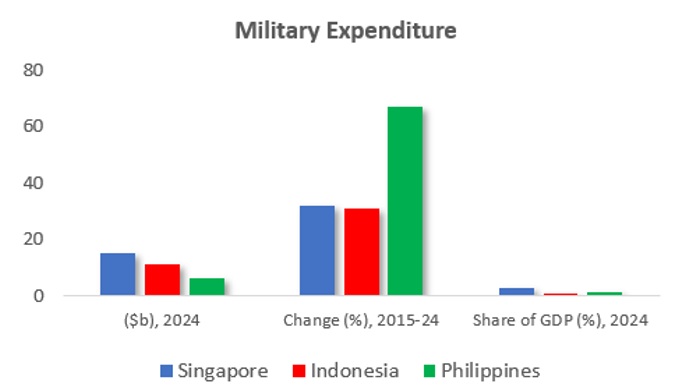
The Philippines is investing increasingly in military spending. On per capita basis, it spends more in arms than Indonesia, which has a population of over 280 million as opposed to 115 million Filipinos.

Furthermore, the Philippines increase of military spending is on average twice as fast in comparison to Singapore and Indonesia. In the tiny city state, the share of military spending of GDP is 2.8%; and in Indonesia, 0.8%. But in the Philippines, it is 1.3% – in relative terms more than 50 percentage points higher than in Indonesia.

In the Duterte era, the Philippines was an aspiring BRIC-like economy. Today, it is an assertive military spender that is cannibalizing its economic futures.

Philippines as a major global arms importer            

The Philippines is one of the world’s largest importer of arms. In a gross mis-allocation of resources, Manila is boosting its arms imports faster than any other major ASEAN arms importer.

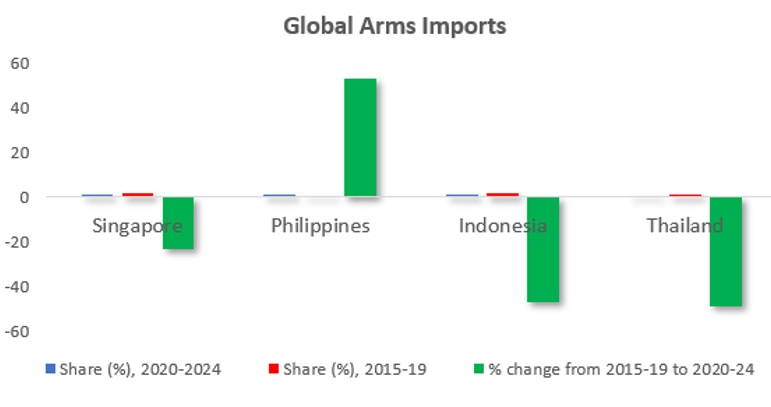
In the global top-40 list of the world’s largest arms importers, there are just four ASEAN countries: Singapore, the Philippines, Indonesia and Thailand. Although the tiny city-state has the largest share of global arms imports, the Philippines is second, ahead of both Indonesia and Thailand.

Source: SIPRI

In the past half a decade, these other ASEAN states have cut their arms imports by 20% (Singapore) to almost 50% (Indonesia, Thailand). They have tried to prepare for the economic headwinds that now drastically penalize global economic prospects. Unlike them, the Philippines has dramatically increased its share of global arms imports by more than 50 percentage points.

The ongoing militarization is dragging the Philippines into twisted alignments, which are undermining its foreign policy and diplomacy.

Atrocious alignments                  

Manila imports more than 80% of its arms from just three countries: South Korea (33%), Israel (27%) and the US (20%), which is also Ukraine’s main supplier (45%) and provides most arms imports to South Korea (86%) and Taiwan (98%).

The Philippines’ military suppliers are arms exporters cashing on mass atrocities. Gaza is the prime example. After 1.5 years of abject obliteration, some Western countries are stopping arming Israel. By contrast, South Korea raked in $6 million in arms exports to Israel in eight months of 2024 alone.

Despite some chill in bilateral ties, Manila has been a big client of the Israeli military exports (over 8% of Israel’s total exports), including Spyder air defense systems from Rafael, Sabra 2 light tanks from Elbit Systems, Shaldag boats from Israel Shipyards, and Hermes-type drones. As Israel’s largest weapons manufacturer, Elbit produces killer drones for Gaza, while its MPR 500 multi-purpose bombs contain 26,000 controlled fragments for “high kill probability.”

In the Philippines, Shaldag patrol gunboats are known as Nestor Acero-class. Off the coast of Gaza, they ensure nobody can escape the living hell in Gaza, while keeping aid flotillas away.

The failing economic promise

In the Philippines, self-rated poverty exceeds 55% of the population while 30% see themselves in the borderline of abject poverty. Militarization represents a massive misallocation of resources away from desperately-needed social spending.

Not so long ago, the Marcos Jr government boldly projected the country had potential for 7% economic growth in annual terms. Thanks to costly militarization, misallocated spending and the consequent political divides and volatility, the real growth rate in 2025 is likely to be slightly above 5.0%.

But when and if these weapons replace diplomacy in Southeast Asia, the worst is still ahead.

Dr. Dan Steinbock is an internationally recognized strategist of the multipolar world and the founder of Difference Group. He has served at the India, China and America Institute (USA), Shanghai Institutes for International Studies (China) and the EU Center (Singapore). For more, see https://www.differencegroup.net


Golden Dome Idiocy

Reprinted from Bracing Views with the author’s permission.

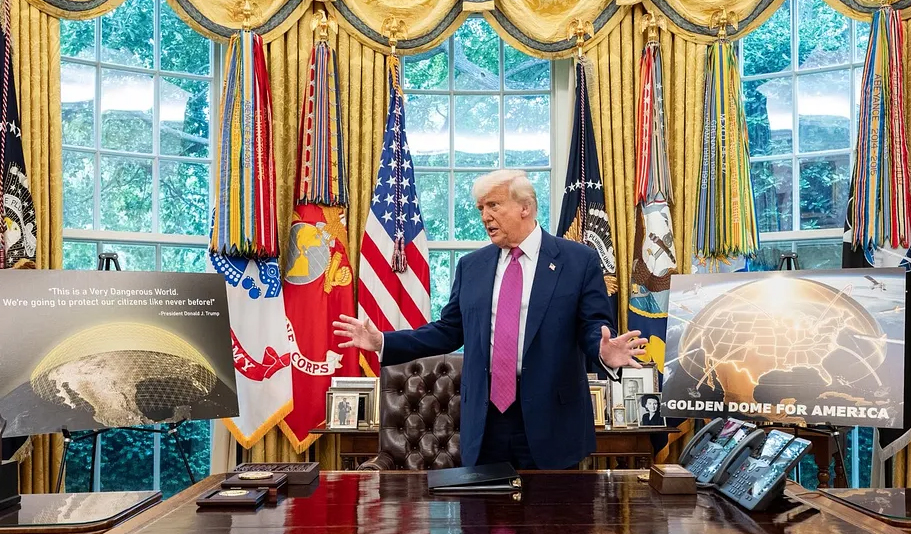
Donald Trump has a dream: a “golden dome” over America to defend the country against nuclear missiles. It’s a repeat of Ronald Reagan’s dream, the Strategic Defense Initiative, nicknamed “Star Wars” after the movie. The problem is that the dream represents a nightmare.

How so? Golden Dome would be dangerously escalatory, wildly expensive, and unlikely to work as a “shield” to America. It is worse than a mistake: it is a crime. It represents a massive theft from those who hunger and suffer in America. As Republican President Dwight D. Eisenhower said in 1953, wasting enormous resources on weapons systems is no way of life at all. It is humanity crucifying itself on a cross of iron. Crucifixion is not made more pleasant when the cross is golden.

Put differently, the Golden Dome is a golden idol, a false god, one that by making a massive nuclear strike more likely endangers all of us and God’s creation.

Golden Dome is a grotesque example of makework militarism and warfare as welfare for weapons makers. Though it’s unlikely to work, if it did (partially) it would make a massive nuclear strike more likely, not less, endangering the world with the ecocidal terror of nuclear winter.

Golden Dome and the so-called investment in America’s nuclear triad are both examples of socio-technological madness – America’s leaders are like the mutants in “Beneath the Planet of the Apes,” worshipping the bombs that twisted them and which can only destroy what’s left of civilization.

Some Christians today await the apocalypse when Christ is supposed to return – but the most likely apocalypse features not the second coming of a God-man but a third world war featuring bomb-gods of thermonuclear destruction.

As Daniel Ellsberg once noted, U.S. nuclear attack plans in the early 1960s envisioned 600 million killed, or 100 Holocausts (before we knew such an attack would lead to nuclear winter). We’re lucky this insanity never came to pass. The only sane policy is to cancel Golden Dome and end “investment” in a new nuclear triad. Disarmament, not rearmament, is what’s needed.

The Global Network Against Weapons & Nuclear Power in Space has released a statement against Golden Dome that you can read here. You can add your name to the statement, as I have. Here are some bullet points released along with the statement:

  • Golden Dome is financially reckless and unsustainable. Early cost estimates range from $550 billion to several trillion dollars over two decades. This dwarfs even the Pentagon’s annual budget and adds to the US’s $37 trillion national debt – a price tag that makes the project fiscally indefensible.
  • Experts overwhelmingly agree that 100% effective missile interception is a fantasy, especially against complex attacks involving decoys, hypersonic missiles, and maneuverable warheads. Even Israel’s Iron Dome has been bypassed by more rudimentary drone and missile attacks.
  • Golden Dome includes space-based interceptors – effectively weaponizing the Earth’s orbit and triggering an arms race. This violates the spirit of the Outer Space Treaty and pushes nations like China and Russia to accelerate space weapons development.
  • By giving the illusion of first-strike survivability, it runs counter to the Mutually Assured Destruction (MAD) doctrine that has prevented so far a nuclear holocaust and incentivizes other powers to retain or expand their nuclear arsenals, blocking disarmament efforts permanently.
  • Thousands of rocket launches for satellite interceptors would further damage the ozone layer, could generate dangerous orbital debris (Kessler Syndrome), and will harm our already fragile space environment.
  • The only guaranteed winners of Golden Dome are weapons giants like Lockheed Martin, Raytheon, and Palantir, which stand to profit enormously regardless of the system’s effectiveness or risks.
  • The trillions funneled into Golden Dome could be used for urgent domestic priorities – such as healthcare, infrastructure, climate action, and education, directly benefiting millions of Americans.

In short, Golden Dome is a massive, dangerous, and futile vanity project, cloaked in patriotism but driven by profit, politics, and illusion.

William J. Astore is a retired lieutenant colonel (USAF). He taught history for fifteen years at military and civilian schools. He writes at Bracing Views.

Czech president appoints a new justice minister amid a bitcoin scandal

By The Associated Press
 June 10, 2025 

Czech Republic's President Petr Pavel, right, appoints Eva Decroix, left, as new Justice Minister at the Prague Castle in Prague, Czech Republic, Tuesday, June 10, 2025. (AP Photo/Petr David Josek)

PRAGUE — Czech President Petr Pavel swore in a new justice minister on Tuesday, another step in a political crisis caused by a bitcoin-related scandal.

Pavel appointed Eva Decroix after her predecessor Pavel Blažek resigned from the post on May 30. He was under fire from the opposition because his ministry accepted a donation of bitcoins and sold them for almost 1 billion Czech koruna (US$46 million) earlier this year.

Blažek said that he wasn’t aware of any wrongdoing, but didn’t want the four-party coalition government led by Prime Minister Petr Fiala to be harmed by the scandal. Fiala said that he appreciated his resignation and believed that Blažek acted with goodwill.

Blažek was a close ally of Fiala in the government and also in his conservative Civic Democratic Party. The new minister is from the same party.

Decroix said she will order an independent probe into the ministry’s activities in the case.

“The public trust in the institutions and the state is at stake,” Pavel said.

The issue focused on the fact that the bitcoins were donated to the ministry by a person who was previously convicted of drug dealing and other crimes while it was not clear why he did it.

The opposition has accused Blažek of possible money laundering, because it wasn’t clear where the bitcoins originated.

The opposition parties demand the resignation of the entire government and are planning to request a parliamentary no-confidence vote. It could take place later in June.

The issue has been investigated by the national police’s organized crime unit.

The scandal is taking place just months before the Oct 3-4 parliamentary election. The main opposition ANO (YES) party led by former populist Prime Minister Andrej Babiš is predicted to win the vote.

The Associated Press
Space and defense tech firm Voyager raises US$382.8M in U.S. IPO

By Reuters
 June 11, 2025 

Voyager Technologies raised $382.8 million in its U.S. initial public offering, the space and defense tech company said on Tuesday, amid a global rush to amp up military spending.

The company, which provides mission-critical space and defense technology solutions, along with some investors sold roughly 12.35 million shares at $31 per share, above its marketed range of $26 to $29.

The offering is the latest in recent weeks as the U.S. IPO market regained its footing after being restricted by tariff-driven volatility.

The Denver, Colorado–based company’s IPO comes as President Donald Trump’s administration looks to sharply increase spending on defense and space projects.

Trump last month selected a design for his $175 billion Golden Dome project, a next-generation U.S. missile defense shield.

The stock will trade on the New York Stock Exchange on Wednesday under the symbol “VOYG.”

Morgan Stanley and J.P. Morgan are the lead underwriters on the listing.

(Reporting by Ateev Bhandari and Manya Saini in Bengaluru; Editing by Sriraj Kalluvila)
U.S. importers turn to brokers to navigate Trump-era tariffs, at a cost

By Reuters
 June 11, 2025

A truck drives by shipping containers at the port of the port of New York & New Jersey in Elizabeth, N.J., Monday May 12, 2025. (AP Photo/Matt Rourke) (Matt Rourke/AP)

NEW YORK — U.S. importers are increasingly relying on customs brokers to keep up with President Donald Trump’s ever-changing trade policies. But booming demand for help in processing foreign goods has made these services more expensive, adding another cost to the tariff burden, industry players told Reuters.

Customs brokerages, until recently an anonymous branch of the import ecosystem, handle the paperwork needed to process shipments and calculate tariff bills. Mom-and-pop brokers interviewed by Reuters say they are raising fees, while major logistics firms like Memphis, Tennessee-based FedEx FDX.N and Germany-based DHL DHLn.DE are also adding staff to their customs compliance teams.

Market research firms ballpark customs brokering as a roughly $5 billion industry in the United States. Hiring a broker is optional, but the increasing complexities of U.S. tariffs and customs regulations are leading more importers to shell out the cash.

Independent brokers like Laredo, Texas-based JD Gonzalez are fielding dozens of questions daily from concerned clients struggling to understand what they may owe to U.S. Customs and Border Protection, and whether to go ahead with shipments or hold off.

Brokers are also spending more time and labor on customs forms than ever, and have in some cases implemented new IT systems.


“With all the new information we have to process, some of the automation we’ve used has been thrown out, so there’s more work to do,” said JD Gonzalez, who is also president of custom brokerage trade group NCBFAA.

The trend is part of a broader wave of corporate efforts to bolster trade compliance operations. Major companies, from Nike NKE.Nto AmazonAMZN.Oto Lowe’s LOW.N, had published job postings as of Wednesday for trade and customs professionals.

Nike was seeking a “lead” for trade and customs, who would “play a pivotal role in shaping the future of our trade compliance framework,” according to the post on Nike’s careers website. Amazon, meanwhile, had at least 10 U.S. customs brokerage jobs listed on its careers website. Lowe’s had three.

Nike, Amazon and Lowe’s did not respond to requests for comment.
HIGHER FEES

Independent brokers often base their fees on the number of codes they must enter to classify the contents of a given shipment. Known as harmonized tariff schedule codes, these line items help border officials distinguish car parts from children’s toys, and determine proper tariff rates.

Prior to Trump’s frenetic tariff policies, fees ranged from around $4 to $7 per code. But Gonzalez said the extra costs brokers have incurred as they ramp up systems to handle the tariff changes have led some to increase fees by $1 to $5 per code.

Gonzalez said he has raised fees “nominally,” while Steve Bozicevic, CEO of A&A Customs Brokers headquartered in Seattle and Vancouver, said his company added $3 per product type being imported into the U.S. because of merchandise facing “tariff stacking,” a phrase used when an item faces multiple tariffs.

“We raised the rates for the U.S. because of the new and added complexity,” Bozicevic said. The company has not raised rates for imports into Canada because there’s “no new complexity,” he said.

United Parcel Service UPS.N raised brokerage rates in December between $3.75 and $50 per import entry, depending on the country of origin. The move was part of general rate increases and unrelated to changes in tariffs, a UPS spokesperson told Reuters. FedEx’s logistics arm increased its base customs brokerage rates by 4 per cent in January, according to a company spokesperson.

These bigger logistics companies, which include brokerage services in their broader shipping offerings, are also beefing up staff. DHL has upped headcount on its U.S. customs entry team by 30 per cent since February, according to a spokesperson for the company’s DHL Express shipping unit.


FedEx had more than 40 open job postings on its customs and trade teams as of Tuesday, mainly based in the U.S., according to its LinkedIn jobs page. UPS had 10 similar U.S. positions open, according to its jobs website.

FedEx is “adjusting our network to meet demand” in an evolving tariff landscape, which “includes hiring additional customs brokerage roles,” the spokesperson said. UPS declined to comment on the job postings.

Historically, tariff changes have been less frequent, say brokers, trade lawyers and other trade professionals, and they have come with weeks of lead time, allowing brokers to prepare for the change and provide logistical feedback to CBP.

Compare that to last week’s doubling of steel and aluminum tariffs to 50 per cent, which Trump announced abruptly, forcing the U.S. customs department to quickly publish official guidance just hours ahead of a midnight change.

“Many brokers clear shipments ahead of time, so then you have to come back and retroactively redo it and fix it,” said Miami-based customs broker Ralph De La Rosa, whose company, Imperial Freight Brokers, was founded by his father 54 years ago.

Even brokers who have not raised fees said their services have become inherently more expensive as the number of HTS codes has spiked.

Importers slowed shipments into the United States after Trump’s massive tariff announcement on April 2, after having frontloaded purchases earlier in the year to get ahead of an expected rise in duties.

Imports of consumer goods, which include cell phones and other household items, decreased $68.9 billion to $277.9 billion in April from a month before, according to the U.S. Bureau of Economic Analysis. Trump announced additional tariffs on steel and aluminum in June and in May threatened to impose 50 per cent tariffs on the European Union.

Adding to the uncertainty, a federal appellate court on Tuesday ruled that sweeping tariffs may remain in effect while appeals proceed, after a trade court ruled that the U.S. president overstepped his executive powers and blocked the duties. The appellate scheduled arguments for July 31.

(Reporting by Arriana McLymore and Nicholas Brown in New York, Editing by Lisa Jucca, David Gaffen and Andrea Ricci)
Luxembourg opens Ottawa embassy as Canada shifts its attention to Europe

By The Canadian Press
June 11, 2025 

Luxembourg City's old town skyline is seen from across the deep gorge that runs through the city in July, 1996. (AP Photo/Paul Ames)

OTTAWA — The federal government says its “best friends” are Europeans amid a drift with the United States, as Luxembourg opens an Ottawa embassy aimed at boosting a knowledge-based economy.

“This moment in time is witness to a changing and stressed geostrategic environment,” Foreign Affairs Minister Anita Anand said Wednesday.

“Issues relating to defence and security -- not to mention economic survival and affordability -- are at the very top of mind for us all,” she said at an event where her Luxembourg colleague Xavier Bettel officially opened a new embassy in Ottawa.

Anand’s parliamentary secretary Rob Oliphant said her presence at the event showed “the absolute importance that we are placing on Europe” in the coming weeks and years.

“Canada is depending more and more on Europe as our best friends in the world. The European Union, and other European countries, are absolutely critically important to Canada’s success and Canada’s future,” he said.


Luxembourg is a major financial hub and Statistics Canada ranks it as the eighth largest source of foreign direct investment in Canada, which does not include other countries’ indirect funding through Luxembourg.

Bettel told reporters near Parliament Hill that the embassy that has been operating since last December was decided on before the return of Donald Trump to the White House.

“It’s a win-win situation and it’s not against (the) U.S.A.; it’s not against someone,” he said. “It’s not America First and the others behind; it has to be a win-win situation for all the partners.”

Bettel said he chose to place an embassy in Canada because it’s a “trusted partner” with shared values who hosted the country’s head of state, Grand Duchess Charlotte, in Montreal during the Second World War.

He said Canada is the only G7 country without an embassy in Luxembourg, and hopes Ottawa opens a diplomatic mission instead of following his country from neighbouring Belgium.

With just 680,000 people, Luxembourg is one of Europe’s most sparsely populated nations, even with the 200,000 workers who commute from neighbouring countries.

But the country has outsized clout in financial markets, according to Robert Harmsen, an Edmonton native and a political scientist at the University of Luxembourg.

“It’s a gateway to Europe that it is not only a major financial centre, it’s also a logistics hub; it’s also a very good place if you’re looking for a European base, or to expand into Europe,” he said.

Likewise, “Canada potentially is a North American gateway” for Luxembourg, he said.

For decades, Luxembourg was a major steel producer, and it was among six countries who formed a continental steel and aluminum agreement in 1951 that later morphed into the European Union.

Harmsen said the country became an innovator in financial services and found ways to package investments to lower tax bills, thus earning a reputation as a tax haven. It hosts the European court that deals with most commercial and regulatory cases.


More recently, he said, the country has tried to become a knowledge economy with a focus on cybersecurity, outer-space technology and systems biomedicine.

Harmsen was part of Luxembourg’s trade mission to Canada in 2022, where he said there was a focus on partnering with aerospace and pharmaceutical companies, particularly in Quebec as most people in Luxembourg speak French.

The country launched another trade mission in 2024 and decided to open an embassy, ahead of Prime Minister Mark Carney being elected on a pledge to seek deeper trade ties with Europe.

Canada signed a trade agreement with the European Union that came into force in 2017, and Harmsen noted that Canadian exports to the continent have not gone up nearly as much as European exports to Canada.

“I’ve lost count of the number of times that Canada was going to turn to Europe, and that there was going to be a big initiative to actually strengthen relationships, economic, political, cultural, and otherwise,” he said.

“If there is going to be the kind of diversification that Carney’s been talking about and the Canadian government’s been talking about, this is the sort of thing that needs seriously to be looked at,” Harmsen said.

Bettel said both Luxembourg and Canada have learned the importance of having “a strong economy” that doesn’t rely on one partner, whether it’s Russian gas, Chinese microchips or American trade opportunities.

“As a European continent, we were always dependent on someone else,” he said. “This is what we learned, from the lessons of the last 10 years.”

This report by The Canadian Press was first published June 11, 2025.

Wednesday, June 11, 2025

Barrick Mining removes Mali gold complex from 2025 output forecast, sources say

By Reuters
 June 11, 2025

This undated file photo shows Barrick Goldstrike Mines' Betze-Post open pit near Carlin, Nev. (Adella Harding/The Daily Free Press via AP, File)

TORONTO/DAKAR — Barrick Mining has removed its Mali gold complex from its overall output forecast for 2025, four sources told Reuters, adding to fallout from a two-year dispute over new mining legislation aimed at boosting the West African country’s revenue.

Operations at the Loulo-Gounkoto gold complex, one of the Canadian miner’s largest gold assets in Africa, have been suspended since January after the military-led government blocked gold exports by the world’s third-largest miner of the precious metal, detained staff and seized three metric tons of stock during separate negotiations over a new mining contract with Barrick.

At stake for both sides is the opportunity to realize revenues worth at least US$1 billion this year due to record high gold prices. Mali risks repelling potential investors, while Barrick shares have lagged those of its peers.

The sources spoke on condition of anonymity as they were not authorized to speak publicly.

Spokespersons for Barrick did not immediately respond to a request for comment, nor did a spokesperson for Mali’s Mines Ministry.

Barrick has not made its Mali output forecast public, but Morningstar analysts had predicted Mali would contribute around 250,000 ounces in 2025.

Mali’s government, a shareholder in the complex, asked a domestic court in May to appoint a provisional administrator to reopen the complex, which would effectively see Barrick lose control over the mines that accounted for 14 per cent of its total output, according to Jefferies.

A court hearing on the matter is scheduled for Thursday.

Negotiations are ongoing in parallel with the court case. In a significant concession, Mali has agreed to allow Barrick to repatriate 20 per cent of its earnings into an international bank account, an exception that was not made for any other foreign miners who recently renegotiated contracts with the state, two people familiar with the matter said.

However, one remaining point of contention between Barrick and Mali is that authorities would like all future disputes to be handled in domestic courts. Barrick said any new mining contract should be covered under an international treaty and, in case of future disputes, be settled through international arbitration, according to one of the people and another source familiar with the matter.

While strong gold prices have supported Barrick’s global revenue, the threat of a provisional administration worries investors, one of the sources said, noting that even if the miner later regains control of the complex, it could be left with depleted gold reserves.

In December, Barrick launched international arbitration proceedings against Mali. In May, it asked the World Bank’s arbitration court to halt court proceedings in Bamako over provisional administration. According to two people aware of the development, the tribunal rejected that request.

The president of the arbitration tribunal for the case declined to comment.

In the first nine months of 2024, production in Mali contributed us$949 million to Barrick’s revenue. Jefferies, in an analyst report last December, estimated that if the Mali complex remains idle, Barrick would lose 11 per cent of its expected 2025 earnings before interest, taxes, depreciation, and amortization.

Mali is Africa’s third-largest gold-producing country.

Malian authorities, which seized power in coups in 2020 and 2021, say their current agreement with Barrick is unfair.


The state has negotiated new agreements with other multinational miners. The chief executive of Australian miner Resolute was detained for more than a week amid negotiations last year.

---

Reporting by Divya Rajagopal in Toronto and Portia Crowe in Dakar; Editing by Veronica Brown and Rod Nickel.
Ottawa’s GST rebate on new homes would save typical first-time buyer $27K: PBO

THE ACTUAL MINIMUM DOWNPAYMENT REQUIRED


By The Canadian Press
June 11, 2025

Houses for sale in a new subdivision in Airdrie, Alta.
 THE CANADIAN PRESS/Jeff McIntosh

OTTAWA — An eligible first-time homebuyer could save an average of $26,832 in sales tax on the price of a newly built home under Ottawa’s latest housing proposal, the parliamentary budget officer said in a new report on Wednesday.

But the PBO’s estimate of the plan’s total cost is substantially lower than the federal government’s estimate, and ministers responsible for the file have not offered an explanation for the gap.

In a new analysis released Wednesday, the federal fiscal watchdog predicts that 71,711 new builds would qualify for GST relief over the lifetime of the program.

The proposal would see the federal portion of the sales tax eliminated on a new home worth up to $1 million if it’s bought by a qualifying first-time homebuyer.

The GST rebate would be phased down as the price of the home approaches $1.5 million.

Homes bought from May 27 through to 2031 can qualify for the rebate, as long as construction starts before 2031 and finishes by 2036.

With some exceptions, Canadians who have owned a home already are not eligible for the GST relief. Neither are investors.

The PBO forecasts the program will cost $1.9 billion over six years, about $100 million lower than the estimate it presented during the spring federal election campaign. It attributes that gap to a later implementation date and a different definition used for first-time homebuyers.

The federal government, meanwhile, estimated the “tax savings” for Canadians at $3.9 billion over five years when the legislation was tabled on May 27. The Liberals’ spring election platform costed the GST rebate at around $1.6 billion over four years.

A PBO spokesperson said in an email that any difference in figures is likely due to assumptions about the share of homes ultimately bought by first-time buyers, but deferred to Finance Canada for questions about the government’s figures.

Finance Minister François-Philippe Champagne did not stop for questions about the cost discrepancy on his way out of the Liberal caucus meeting Wednesday. His office did not respond to a request for clarification.

Housing Minister Gregor Robertson also did not comment about the PBO report when asked Wednesday. He told reporters he would answer questions “tomorrow.”

A Desjardins Economics analysis of the proposal released Monday offered one explanation for the discrepancy between the PBO’s cost estimate and the government’s figure: Ottawa might think its program will be more popular than the PBO does.

A higher cost estimate suggests more first-time homebuyers purchasing qualifying new builds, in other words.

The GST rebate, which is not yet law, was included in the Liberals’ spring election platform as a way to help Canadians break into the housing market.

A home priced at $1 million would receive the maximum rebate of $50,000. Homes priced below that amount would still get the full rebate — but since the sales tax is a taken off a lower overall cost, the size of the rebate would be reduced accordingly.

The rebate also would be lower than $50,000 for homes sold above $1 million because the rebate gradually ramps down until it zeros out at a purchase price of $1.5 million.

The Desjardins report by economist Kari Norman said that if the program proves popular with first-time buyers, it could spur additional housing construction to meet higher demand.

The PBO said it does not include possible behavioural responses to the program in its analysis.

Norman noted in her report that it’s also possible increased demand from homebuyers will push up home prices in the near-term.

She estimated that 85 per cent of new homes built in Canada over the program time frame will be eligible for the full GST break of up to $50,000.

In cases where the GST portion of a new home sale is rolled into the mortgage principal, the typical owner could expect to save $240 per month on mortgage payments, she said. The savings are more direct when a developer charges the GST upfront.

The measure is packaged in legislation that also includes the Liberals’ promised income tax cut, which is set to take effect July 1.

---

Craig Lord, The Canadian Press

This report by The Canadian Press was first published June 11, 2025.
Dollarama earns $273.8M Q1 profit, up from $215.8M a year ago, sales up 8.2 per cent


By The Canadian Press
June 11, 2025 


A person cycles past a Dollarama store in Montreal
THE CANADIAN PRESS/Christinne Muschi


MONTREAL — Tariff tensions don’t appear to be weighing on Dollarama Inc. sales yet, but executives at the discount goods retailer are bracing for that to potentially change because consumers are “fragile.”

Market chart of DOL:CT
DOL:CT
$192.99+17.23+9.80%
As of:June 12, 2025 at 3:45 AM


The Montreal-based business reported Wednesday that its first-quarter sales increased by 8.2 per cent to $1.52 billion. Its profit during the period ended May 4 soared by 27 per cent to $273.8 million, up from $215.8 million a year earlier.

Dollarama chief financial officer Patrick Bui framed the increases as a sign that shoppers still see his retailer as providing value, even while they’re more generally cutting back on discretionary purchases.

But given the “unpredictable trade environment”, he is taking nothing for granted.

“When you go back to February and March, we all saw the data on consumer confidence and it was at an all-time low,” he said on an earnings call with analysts.

“As we moved through the quarter, we did see a resilient consumer in the back half ... but we do sense the consumer being fragile and with all the uncertainty in the market, it’s very hard to see how that will evolve.”


Bui’s remarks came roughly a week after the U.S. doubled Canadian steel and aluminum tariffs to 50 per cent. This week saw officials from the U.S. and China to London to try to reach some semblance of a truce after the world’s two biggest economies spent recent months volleying eye-popping duties at one another before reaching a 90-day détente.

Dollarama, which sources goods from all over the world, has previously said it sees the tariffs as being “manageable” for its business but “consumer confidence will be a major challenge.”

It stuck with that messaging Wednesday, when it indicated it has been “working extremely hard” to boost consumer confidence by holding its prices for as long as possible.

“Price adjustments are always a last resort for us,” CEO Neil Rossy said on the same call as Bui, while pledging to maintain Dollarama’s existing price point range.

As part of those efforts Dollarama executives visited China in April, when tariffs between the country and the U.S. were intensifying.

At first, Dollarama was able to use the drama to negotiate some advantages with FOB — a shipping term that’s short for Free on Board and refers to agreements between buyers and sellers dictating, when the ownership and liabilities of goods transfer between them.

However, “the vendors were reticent to pass on any discounts or to sell any of the goods that were being held for their American customers,” Rossy said.

“They were waiting to see what would happen and possibly change with U.S. policies and they were right to do so because U.S. policies changed,” he said referring to the 90-day reprieve. “In the end they shipped their goods, and it was pretty much back to business as usual.”

His comments were made a few hours after the retailer released its latest financial results, showing its first-quarter profit amounted to 98 cents per diluted share, up from 77 cents per diluted share a year earlier.

Excluding an unrealized gain from a derivative on equity-accounted investment, Dollarama said it would have earned 95 cents per diluted share in its most recent quarter.


The increase came as comparable store sales for the quarter increased by 4.9 per cent, including a 3.7 per cent increase in the number of transactions and a 1.2 per cent increase in average transaction size.

The quarter covered a period when it announced Dollarama announced it will buy Australian discount retailer, the Reject Shop.

The deal valued at $233 million is expected to see Dollarama expand the Australian acquisition’s footprint to about 700 stores by 2034.

Rossy expects the transaction to close by the end of July, assuming it lands necessary Australian approvals.

---

Tara Deschamps, The Canadian Press

This report by The Canadian Press was first published June 11, 2025.