Thursday, June 12, 2025

U.S. to review AUKUS as part of Trump’s ‘America First’ agenda


U.S. Defense Secretary Pete Hegseth meets with Australian Defence Minister Richard Marles at the Pentagon in Washington in February. | REUTERS

By Gabriel Dominguez
STAFF WRITER

The future of the AUKUS security partnership between Australia, Britain and the U.S. — and with it Canberra’s plans to acquire American nuclear-powered submarines — could be at stake as Washington reviews the initiative to ensure it aligns with U.S. President Donald Trump’s “America first” agenda.

Announced late Wednesday by a Pentagon spokesperson, the decision, likely to raise eyebrows among U.S. allies and partners, was swiftly criticized by congressional Democrats but downplayed by Canberra.

“The Department is reviewing AUKUS as part of ensuring that this initiative of the previous (Joe Biden) administration is aligned with the president’s America First agenda,” the spokesperson told The Japan Times in an emailed statement.

“This means ensuring the highest readiness of our servicemembers, that allies step up fully to do their part for collective defense, and that the defense-industrial base is meeting our needs,” the official added.

The remarks suggest that Washington is not only concerned about meeting its own submarine needs as it doubles down on deterring China, but also that it might want to use the review to increase pressure on Canberra to hike defense spending to 3.5% of its gross domestic product "as soon as possible."

Asked about the review and whether he still thinks Canberra will get submarines out of AUKUS, Australian Defence Minister Richard Marles said, “I'm very confident this is going to happen,” calling the deal a “treaty-level agreement” between the three countries.

“I think the review that's been announced is not a surprise,” Marles told ABC Melbourne Radio. “We welcome it. It's something which is perfectly natural for an incoming administration to do,” he said, pointing out that Britain recently conducted its own defense review in which AUKUS was “very” positively assessed.

In terms of whether Canberra should consider a Plan B, Marles said that “chopping and changing” would guarantee that Australia “will never have the capability.”

“You just need to look at the map to understand that Australia absolutely needs to have a long‑range submarine capability,” he added. “So, there is a plan here, we are sticking to it and we're going to deliver it.”

The review will be led by Elbridge Colby, the Pentagon’s undersecretary of defense for policy.

While Colby has described AUKUS as a “model” of the cooperation type Washington needs to meet 21st-century challenges, he has expressed skepticism over the benefits of the submarine sales element of the initiative, arguing before the U.S. Senate’s Armed Service Committee in March that his country wasn’t producing enough submarines to meet its own requirements in the Indo-Pacific region.

“It would be crazy” to have fewer U.S. nuclear-powered submarines in the right place and time, he tweeted last year, when referring to a potential conflict with China over democratic Taiwan.

But Colby also said during his confirmation hearing in March that it “should be the policy of the United States government to do everything we can to make this (AUKUS) work."

Launched in 2021, AUKUS is Australia's biggest-ever defense project and arguably also its most geopolitically consequential.

Canberra wants to acquire up to eight nuclear-powered submarines, including three Virginia-class subs from the United States from 2032, with the potential to acquire up to two more if needed. The remaining boats for the Royal Australian Navy, called “SSN-AUKUS,” would then incorporate Australian, British and U.S. technologies.

Regarded as a key element of the Biden administration’s “integrated deterrence strategy” against China, the trilateral program, which includes the establishment of a rotational presence of British and U.S. submarines at an Australian naval base near Perth, is forecast to cost between $268 billion and $368 billion Australian dollars ($174 billion to $239 billion) between now and the mid 2050s.

But AUKUS is not merely a submarine program.

Under the initiative’s second pillar, the partners also want to step up research cooperation in advanced areas, such as quantum computing, artificial intelligence, electronic warfare and hypersonic missile capabilities. For these projects, the members have said they would be open to cooperating with close partners such as Japan, South Korea, Canada and New Zealand.

The review comes as Australian Prime Minister Anthony Albanese is set to meet Trump next week on the sidelines of the Group of Seven meeting in Canada, where the two sides are expected to discuss U.S. tariffs as well as Washington’s demand that Canberra boost military spending to 3.5%.

Albanese has said Canberra would not be dictated to by its ally, noting that the country is already planning to pour a significant amount of cash into defense coffers. Australia aims to increase its defense budget to about AU$67.4 billion in 2027-28 and AU$100 billion by 2033-34, putting it at 2.3% of GDP.

The review also triggered a swift response from Democrats, with Virginia Sen. Tim Kaine calling on the president to “work expeditiously” with Canberra and London to strengthen the agreement and further boost the U.S. submarine industrial base if he is “serious about countering the threat from China.”

Anything less, Kaine warned, “would play directly into China’s hand.”

Analysts such as John Blaxland, from the Australian National University’s Strategic and Defence Studies Centre, argue that while Trump may try and use the review to strike a deal — potentially on a slower submarine delivery schedule or Canberra hiking military spending — he is unlikely to spike AUKUS entirely.

Writing in an analysis after the announcement, Blaxland noted several reasons why Trump might not scrap it. AUKUS is already several years in and over 100 Australian sailors are already operating in the U.S. system, he said. Perhaps more crucially, he also pointed to Canberra’s potential contribution to the United States’ submarine production line and the strategic value of the sub base near Perth, which is widely viewed as key in pushing back against Chinese military assertiveness in the region.
US Federal judge orders Mahmoud Khalil to be released by Friday on $1 bond

Khalil was the first leader of last year’s pro-Palestinian student protests to be arrested under the Trump administration’s push to deport non-citizens who they said fueled antisemitism on campuses.

Demonstrators gather outside the Federal Courthouse in New York City to show support for Palestinian activist Mahmoud Khalil and to demand his release from ICE detention on March 12, 2025.(photo credit: Mostafa Bassim/Anadolu via Getty Images)ByPHILISSA CRAMER/JTAJUNE 12, 2025 03:52

A federal judge has decreed that Mahmoud Khalil, the Palestinian Columbia University protest leader, cannot be detained or deported and set the stage for him to go free as early as Friday.

Khalil was the first leader of last year’s pro-Palestinian student protests to be arrested under the Trump administration’s push to deport non-citizens who they said fueled antisemitism on campuses.

Others have already been released on court orders after multiple federal judges ruled that the administration had violated the students’ rights by detaining them despite not accusing them of crimes.

Judge says Khalil's deportation was likely unconstitutional Last month, Judge Michael Farbiarz of the Federal District Court in New Jersey ruled that the law that the State Department cited in justifying Khalil’s deportation — a little-used provision that says the United States can seek to eject non-citizens whose actions undermine US policy — was likely unconstitutional.

On Wednesday, he additionally ruled that Khalil had shown that he was being irreparably harmed by being detained while the government seeks to deport him. Khalil’s son was born in New York since his arrest.

Muslim protesters pray outside the main campus of Columbia University during a demonstration to denounce the immigration arrest of Mahmoud Khalil, a pro-Palestinian activist who helped lead protests against Israel at the university, in New York City, US, March 14, 2025. (credit: REUTERS/David Dee Delgado)

Farbiarz left a small window of opportunity for the Trump administration to press for Khalil’s continued detention, saying that they could argue by 9:30 am Friday that Khalil had lied about his affiliations when seeking a student visa. But he indicated that he was unlikely to be swayed by such an argument and said Khalil could otherwise go free after posting a $1 bond.
Trump both booed and cheered attending Les Misérables at Kennedy Center


‘We want to bring it back, and we want to bring it back better than ever,’ Trump said about the Kennedy Center

Andrea Cavallier
in New York
Thursday 12 June 2025 
THE INDEPENDENT

Trump to attend 'Les Mis' open as Kennedy Center faces revenue decline

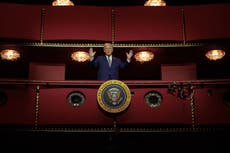
President Donald Trump was greeted with boos, as well as cheers, and chants of “USA!” as he took his seat for the opening night of Les Misérables at the Kennedy Center on Wednesday.

It’s the first time Trump has attended a show at the venue since he fired the Kennedy Center’s leadership, putting MAGA loyalist Richard Grenell in charge of the famed performing arts institution and naming himself chairman of the board.

He promised to scrap “woke” programming that aligned with what he called leftist ideology, which includes drag shows and “anti-American propaganda,” the president wrote on Truth Social.

The move upset some of the center’s patrons and performers, and it was reported that several cast members planned to skip the show in protest of his attendance on Wednesday.

RECOMMENDED
Les Miserables actors drop out because Trump is attending show

When one group of ticket holders found out that Trump, Vance and their wives, Melania and Usha, would be in attendance, they donated their tickets to a group of drag performers, according to Qommittee, as reported by Houston Public Media.

Videos posted on social media show the drag performers being cheered before Trump arrived. Other videos showed the president taking his seat to a combination of boos and cheers from the audience.

When Trump walked the red carpet with first lady Melania Trump ahead of the show, he said he was not bothered by the reported boycott.

“I couldn’t care less, honestly, I couldn’t,” Trump said.

“All I do is run the country well. The economic numbers you saw them today, they’re setting records. We took $88 billion in tariffs in two months, far beyond what anybody expected. There’s no inflation. People are happy. People are wealthy. The country is getting back to strength again. That’s what I care about.”

Trump also spoke about his plans for the Kennedy Center, whose board he replaced with loyalists, some of whom were in attendance Wednesday, including Usha Vance, Attorney General Pam Bondi and White House Chief of Staff Susie Wiles.

“We want to bring it back, and we want to bring it back better than ever,” Trump said from the red carpet. “As you know it needs a little help from the standpoint of age and fitness, but it’s going to be fantastic.”


open image in gallery(Getty Images)

Trump has previously proclaimed his love for Les Misérables, telling Fox News: “I love the songs; I love the play. I think it’s great.”

He has played the musical’s rebellion anthem, “Do You Here the People Sing?” at past events and rallies. The story revolves around revolution in France, and has been a massive smash for decades.

Trump also suggested that “we may extend” the show’s run. Currently, Les Misérables is slated to run at the Kennedy Center through July 13.

The political drama at the center comes just two months after audience members booed the Vances and they took their upper-level seats at the National Symphony Orchestra.

Back in 2016, incoming vice president Mike Pence was booed when he attended a production of Hamilton with his family.

Pence acknowledged that he heard “a few boos" and "some cheers" and told his kids at the time, “that’s what freedom sounds like.”

The ethnically diverse cast of the popular and sold-out musical, which tells the story of America’s Founding Fathers, asked Pence not to leave the venue before he listened to what they wanted to say – which was that people were worried that Trump would “not protect them.”

While Trump demanded an apology from the cast at the time and called the show "overrated", Pence told Fox News at the time that he, his daughter and cousins "really enjoyed the show".


Indian agent had NDP leader Jagmeet Singh under close surveillance

By Stewart Bell & Mercedes Stephenson Global News
Published June 12, 2025


A suspected Indian government agent had Jagmeet Singh under close surveillance, prompting the RCMP to place the New Democratic Party leader in police protection 18 months ago, sources have told Global News.

The agent, who is allegedly tied to activities directed by the Indian government, had access to intimate knowledge of Singh’s daily routines, travel and family, according to the sources familiar with the matter.

He was also described by the sources as associated with the Lawrence Bishnoi gang, which the Indian government has been accused of using to commit violence in Canada.

Police notified Singh about a credible risk to his life in late 2023 and put tight security around him and his homes. Singh revealed during the 2025 federal election that he had been under police protection.

But no details of the investigation have been publicly disclosed until now, and Singh has said the RCMP never told him who was behind the threat, although “the implication was a foreign government.”

Police responded to the threat at the time and Singh is no longer considered to be in imminent danger. Singh lost his seat in the 2025 federal election and has stepped down as NDP leader.

The allegation that a suspected Indian agent was gathering information about the day-to-day movements of a federal party leader will likely raise new questions about foreign interference.

NDP Leader Jagmeet Singh steps off campaign plane as member of his RCMP security detail stands by in Winnipeg, April 23, 2025. THE CANADIAN PRESS/Darryl Dyck.

Singh did not respond to requests for comment through an intermediary. Global News is not identifying the multiple sources with knowledge of the investigation who spoke on condition they would not be named.

The Indian High Commission in Ottawa has not responded to questions about the allegations. The RCMP said it does not discuss “protective measures, nor confirm individuals who may be designated to receive protection.”

“The security environment in which public figures operate is constantly evolving, and the RCMP takes all threats against public officials seriously,” spokesperson Marie-Eve Breton said on Wednesday.

The reasons police became concerned about Singh’s safety a year-and-a-half ago have emerged as Prime Minister Narendra Modi is scheduled to visit Canada on the weekend.

With President Donald Trump in the White House, Prime Minister Mark Carney has said he wants to diversify Canada’s trading relationships and has invited Modi to the G7 summit in Kananaskis, Alta.

But the decision has faced criticism because New Delhi is still not cooperating with RCMP investigations into India’s suspected involvement in the 2023 killing of Hardeep Singh Nijjar, among other violent crimes.

RCMP Commissioner Mike Duheme held a news conference last October to announce that investigators had found evidence linking “agents of the government of India to homicides and violent acts” across the country.

Police said India was collecting information on potential victims in Canada and using the Lawrence Bishnoi crime group, and similar drug and extortion outfits, to target them.

They also said “well over a dozen credible and imminent threats to life” had led them to issue warnings to members of the South Asian community, specifically those active in the pro-Khalistan movement.

Singh told reporters in April that police had advised him in the winter of 2023 that his life could be in danger. They did not tell him who was behind the threat but he said the implication was that it was a foreign government.

He said he stayed in his basement, avoided windows and considered quitting politics over fears about his family’s safety. He decided to carry on but was forced to lead the NDP for a period under police protection.

A lawyer who became federal NDP leader in 2017, Singh has angered India by pressing the Canadian government to take a harder line against Modi’s government over its problematic human rights record.

Indian press reports have wrongly labelled Singh a supporter of anti-India “terrorists” and reported that the intelligence agency that works for Modi’s office had prepared dossiers on him.


Under Modi, New Delhi has amped up its claims that Canada has not done enough to counter the Khalistan movement that seeks independence for India’s Sikh-majority Punjab.

It has also meddled in all levels of Canadian politics and now ranks as the “second most active country engaging in electoral foreign interference in Canada,” according to the Hogue Commission.

With the murder of Nijjar, however, India has allegedly taken its grievances against Canada to another level. A Sikh temple leader, Nijjar was leading a referendum campaign on Khalistan independence when he was gunned down.

Then-prime minister Justin Trudeau told the House of Commons in September 2023 that investigators were probing the involvement of Indian government agents.

Police believe India used gang members to carry out the killing. Sources have told Global News that Modi’s right-hand man Amit Shah allegedly approved the operation. India has denied that.

Canada later expelled six Indian diplomats and consular officials for allegedly collecting information on Canadians of Indian descent that was fed back to intelligence officers in New Delhi and used to direct attacks.

NDP Leader Jagmeet Singh speaks at campaign rally in Winnipeg, April 23, 2025.
 THE CANADIAN PRESS/Darryl Dyck.

The alleged surveillance of Singh is not unprecedented. Before Nijjar was killed, he told a close friend that a tracking device had been found on his pickup truck when he was having it serviced.

“He told me this personally,” said Moninder Singh, the spokesperson for the Sikh Federation who is also among those police have warned about threats to their lives.

Nijjar was shot dead inside the same vehicle outside Surrey’s Guru Nanak Sikh Temple. Moninder Singh said he did not know whether agents had followed him too.

“I’ve had multiple warnings but have never been told or known if I was under surveillance, but I would think I would be and do live my life as though I am,” he said.

“There’s no other way.”

As someone living under threat, he said Modi’s visit to Canada had added “insult to injury.”

After Modi said he would attend the G7, Liberal MP Sukh Dhaliwal said his constituents had told him that inviting the Indian prime minster was sending the wrong message.

Carney has said that Modi agreed to “continued law enforcement dialogue and discussions addressing security concerns” and that countering foreign interference was high on the summit agenda.


2:24
Carney lays out G7 priorities, faces criticism over Modi invite


But a Canadian Sikh coalition wrote to MPs this week to voice their “anger and sense of betrayal” over Carney’s decision to extend an invitation to the leader of a government that has not yet been held to account for Nijjar’s killing.

“His death was not an isolated act but part of a coordinated campaign of transnational repression that continues to violate Canadian sovereignty to this day,” the four Sikh organizations wrote.

“To extend an invitation to the architect of these policies who proudly boasts that India ‘enters the homes of its enemies and kills them,’ without any public commitment to justice or accountability, undermines the very principles Canada claims to uphold.”

The letter was signed by the leaders of the World Sikh Organization of Canada, Sikh Federation of B.C., Ontario Gurdwara’s Committee and Quebec Sikh Council. The groups are holding a news conference on Parliament Hill on Thursday.

Stewart.Bell@globalnews.ca

Zionism is as Corrupt as Christian Nationalism


 June 12, 2025

Image by Shalev Cohen.

As the political and religious left continues to attack Christian nationalism, as a progressive Christian, I find myself increasingly uneasy. It is not that I believe Christian nationalism exists, or that it is dangerous to a pluralistic society with religious diversity and perspective, but the ire and critique is not applied across the board to other forms of ethnoreligious nationalism. There is a glaring absence on the political left and in the peace and justice movement to condemn Zionism with equal weight as is applied to Christian nationalism. Among nationalistic expressions of religion, expressions of narrow particularism, and obsessive focus on the justification of one religious/ethnic group over others Zionism escapes the condemnation for some reason that Christian nationalism is confronted with.

Christian nationalism asserts that a particular country is founded on “Christian” principles. Its founders or framers were divinely inspired, and therefore the impetus is to draw those countries back into line with the original framework intended by the founders of that nation. Christian nationalism is a worldwide phenomenon, with proponents in Europe, and particularly evident in the United States. The political/religious framework offered in the United States is that the founders of the country, and all of its original documents were divinely inspired through white men who authored them. You cannot escape the fact that the founders of the United States were white men who were landowners, and therefore an undercurrent exists where Christian nationalism is built upon white privilege and supremacy. This is true whether it is in the United States or Europe. The belief is that the malaise that exist in national boundaries is due to the straying or abandonment of those Christian principles, and the antidote for the national demise is to return to religious inception initiating all the blessings that will flow as a result of doing so. Hence, we have witnessed the push to place the Ten Commandments in schools, the turning back of the clock on Roe v. Wade, the continued push to publicly fund religious schools, attacks upon the LGBTQIA communities, and the demonizing of diversity, equity, and inclusion initiatives. It is presented as if all the problems and the failings of a nation is a result of eschewing “Christian” principles, affirming religious and ethnic pluralism, and because we have removed all the trappings, strictures, and images of so-called Christianity from public life. As a progressive Christian I unapologetically stand in opposition to Christian nationalism and all its forms of expression.

Zionism is akin to Christian nationalism. A difference in Zionism is that it existed originally as political/religious thought among a diverse population spread across national borders in Europe that identified religiously and culturally as an ethnoreligious group. Originally the argument of Jews pursuing a homeland in Palestine was met with skepticism as a political/religious philosophy and existed on the margins. However, the various European pogroms against Jews began to coalesce larger swarths of Jews to strategically reconsider Zionism.

Zionism emerged in the 19th century as an ethnocultural ideology. It sought to establish a national home for the Jewish people that they controlled and therefore were free from the ethnic cleansing that arose periodically in Europe. World War II and the atrocities carried out against Jews other groups in Europe became a major factor for the intellectual and emotional acceptability of the Zionist framework that would result in the colonialization of Palestine. As the acceptability of Zionism arose as a solution for Jewish security among larger segments of the Jewish population its political and religious tenets became more wedded to Judaism. This conflation of Zionism with Judaism has become problematic in terms of having any sober political discussions on the realities and consequences of Israel and the implications of Zionism without being accused of being antisemitic.

Zionism claimed that Palestine is the historical land of the Jews and therefore the Jewish right to the land outweighed anything that was Arab. The concept of “transfer”, or what we today would call “ethnic cleansing” is inherent to Zionism, believing that the security of Jews had to be based upon their majority, and to lessen any potential of uprisings in response to Jewish occupation. The idea of removing non-Jewish populations and affording non-Jews less rights than Jews evidently gained widespread support across a array of Zionist groups. The religious roots of Zionism focused upon the land of Palestine being promised by God to the Jewish people into perpetuity with the conquest and subjugation of non-Jewish people resulting. There are enough biblical narratives that justifies the subjugation, conquest, and killing of non-Jewish people. The political roots of Zionism are based upon what is presented as practical strategies of protection, security, and historical rights to the land. The religious justifications of Zionism are questionable given that Jews largely have appropriated and identified with the biblical narratives as stories of identity and belonging, just as Black people largely reinterpreted the biblical stories as our own identification with God and divine purpose. The political justification of Zionism is flawed in that it affirms the European colonialization and conquest of non-white lands, and the subjugation of non-white peoples. Zionism, though ethnic in character, is a nationalistic European expression of the stealing and conquest of the land of others and the extension of white supremacy in form and practice.

I am offering a brief summation of Christian and Jewish nationalism. I am also raising the ideological and political deficiencies of the left where it condemns Christian nationalism but fail in offering the same kinds of condemnation and critique of Jewish nationalism. One has to ask the question, why? Each form of religious nationalism is an apostasy to the spiritual and political concepts of Christianity and Judaism. Each nationalism avoids the declarations of justice, right treatment of neighbor, and welcoming the stranger as if it is foreign to the scriptural text. Instead, they turn to scriptures that seem to affirm their narrow and myopic points of view, conquest, and divine justification for subjugation and genocide. Each form of nationalism deserves and needs to be condemned. Peace and justice organizations on the left, liberal religious groups, and political secular groups need to apply their criticism of religious and political nationalism across the board and in a principled way. I am offering that all forms of nationalism are inherently evil because it strips non-conforming groups of their dignity, security, and freedom of expression. Zionism emerged because of nation-state nationalism, but the irony is that they formed another expression of nationalism to combat nationalism. This simply illustrates how one evil leads to another. Christian nationalism has been the backbone of all kinds of evils from enslavement to the Christianization and genocide of indigenous peoples. It must be condemned in all of its forms from the past to the present, and into any future expression. Zionism must also be subjected to the same types of criticism and analysis, and if we fail to apply the same standard of criticism across the board, in reference to Christianity, Judaism, and even Islam then we have certainly failed in being any moral voice at all.

Left fails to win its referendums in Italy

Wednesday 11 June 2025, by Dave Kellaway


These referendums were promoted by the main trade union confederation and the official left of centre opposition parties to limit some of the more repressive anti-trade union laws and to improve the citizenship process for immigrants

Results

ReferendumYesNo
Stopping sacking without justifiable cause89.0611.94
Legal compensation for workers in workplaces with less that 15 workers87.6013.40
Making short term contracts more difficult to impose89.0411.96
On subcontracting/Health and safety87.3512.65
On halving 10 year process for citizenship65.4934.51

Turnout: 14.07 million (registered electorate is 45.99 million) 30.59%

All five referendums were lost because none reached the quorum of 50% of the electorate. Around 88-89% who voted supported the progressive changes to the labour laws but this went down by 33 percentage points for the change to the citizenship process for immigrants.

Over the last thirty years only one out of nine referendums reached the quorum – in 2011 to defend water as a public good. Even then the government maneuvered to not implement the change demanded by the broad left and a vast grassroots campaign. As a democratic mechanism for change it worked effectively to legalise divorce and abortion rights in the seventies and eighties when Italy was a different country with a turnout of over ninety percent for many elections.
A more individualized country

I remember how different civil society was even in a town of 60,000 in the South near Naples. The local branch offices of the Italian Communist Party (PCI) were a hub not just for party members but anyone on the left. Then the piazza still was politically vibrant and the big well-organised factories more prevalent. The gains of the seventies had not been rolled back and neoliberal austerity was still ahead of us. Today, everything is more individualized and commodified.

Local fetes of the PCI (or of anybody) hardly happen now. Culture no longer has much of a budget from public bodies and is just a consumer spectacle controlled by big business. Walking around looking for a photo of referendum campaign posters for this article, I could not even easily find any. Voting in all elections has declined massively. People do not join political parties, unions or even civil society associations like they used to. The disconnect with the political process has helped the rise of hard right populist politics exemplified by the present government.

Meloni’s government coalition revels in the defeat of the referendums. The anti-working class labour laws implemented by a previous left of centre government (led by Matteo Renzi) will continue. The post-fascist premier and her ally Salvini are particularly exultant on the much smaller number of people who voted to support immigrants gaining citizenship faster. It will encourage them to reinforce their racist anti-migrant policies. Representatives of capital are happy their freedom to exploit working people continues without added restrictions.
The bosses are happy

Watching the post results TV coverage one comment from a so-called independent journalist stood out. He said this result shows you that all that old-style confrontation in the workplace the CGIL wants to stir up again with this referendum is over, we need to move on, focus on wages and productivity rather than all that stuff that is historically finished. This is the narrative the government and bosses want. Keep politics out of the workplace, let us discuss it as a technical matter, the people have shown they are not interested in resurrecting outdated talk about class struggle.

The government actively encouraged people to go to the seaside or for a walk in the mountains rather than to participate in the democratic process. Meloni herself was shown on the media going to a polling station and refusing to take a ballot paper. Legally it is a legitimate tactic and governments with different politics have done the same thing when the right wing have organised referendums. Still it reflects a refusal to engage in any discussion about these big workplace issues. One minister when questioned on TV could not even accurately say what the referendums were about.

The government denounced these referendums as a manoeuvre to challenge it and as an internal faction fight within the PD. The left of centre opposition were accused of being led by the main trade union confederation, the CGIL, which has strong links with the main opposition party, the social liberal, PD (Partito Democratico, Democratic Party).

Landini, CGIL leader,was the main promoter of the referendum. He mobilized the union structures to get the half million signatures and then crisscrossed Italy in the last months to get out the vote. The government and rightwing forces are falling over themselves in using these results to discredit him. Even though he has failed to really lead national strike action to defend workers living standards, they want to neutralize even the small possibility he will lead the unions in any confrontation with the government over the wage contracts in dispute.
Internal conflict in PD

Elly Schlein, the PD leader, beat the more moderate leadership challenger and the right wing of the party to secure her position two years ago. She has been keen to disown the worst anti-working class policies of a previous PD leader and prime minister, Matteo Renzi. He had proposed and implemented the Jobs Act, a so-called modernizing piece of legislation which was a sweetheart deal with neoliberal capital. It removed some of the progressive labour laws which allowed for limited protection, although in practice the bosses were not particularly restrained.

The rifromisti – the PD right wing minority who still support Renzi’s position, opposed the party line of 5 yes votes with 3 no votes on the Jobs Act changes. Although a smallish minority among the membership the riformisti has important elected respresentatives. For example Picerino, vice president of the European parliament, openly campaigned for three No’s. So on one level it is true the referendum were also part of an internal debate within the PD. For the PD this sort of institutional campaign, which the whole left supports, is the priority for political action. There was little of the mass campaigning the local committees organised for the 2011 water referendum. Schlein has not changed the overall social liberal policies of the PD and certainly not mobilized working people against the hard right Meloni government.

I was surprised that even before the referendum was over Schlein was already expectation managing saying that 30% would be a good result. In any sort of sporting contest – let alone a political one – it is hard to mobilize your people if you accept defeat in advance. Landini, to his credit, did not adopt this line. Her target figure of 30% was decided on because she wanted to say that if the referendums had more that 12.5 million voters it would be more than elected the Meloni government. The government opposed the referendums but more people voted in them than for her government so this would be a defeat for Meloni and Salvini. Nobody is buying this line.

Depending on how you add things up there may be about the same number of Yes voters as voted for Meloni. But you cannot toss in all the no votes or ignore the vote on citizenship (only 9 million Yes, and the centrist parties supported this) which is a main plank of the government’s programme. On citizenship the Yes vote was certainly less than those who elected Meloni. Migration will be a theme of any future election campaign much more than the Labour laws. Schlein will be facing angry reactions from the right of the party who are saying her referendum strategy and alliance with Landini has had a boomerang effect or gifted Meloni a victory.
Has much changed as a consequence of the votes?

The big question is whether the opposition or the government has gained or lost from the referendums. Clearly these numbers do not give the left of centre parties much hope that they will defeat the right wing coalition any time soon in an election. You cannot translate these results simply into general election, but voting intentions and the citizenship question spells bad news for the opposition.

It is true the campaign to get the referendums and the electoral process has put these issues on the table as Landini has argued since the defeat. However, it shows the limits of the left of centres parties’ implantation in the country and ability to mobilize a majority. It also exposed the divisions within the opposition compared to the government’s compact unity. Conte leads the Five Star Movement (M5S) and although he personally said he would vote Yes on the citizenship question there was no official party position. As for any broader electoral unity with the centrist parties like Renzi’s Italia Viva or Calanda’s Azione, both voted Nos except on citizenship.

Conte’s M5S has a lot of electoral support in the South but this is where the turnout was worse (low twenties), whereas in the PD fiefdoms in the North/Centre the turnout was above average (36-9%). As might be expected turnout was best in the big towns and urban areas. Working class areas turned out more for the votes on contracts while the more middle class historic centres voted most for the citizenship change. Small towns with less union structures and smaller influence of the left of centre parties turned out a great deal less than the larger urban areas. Women voted more than men.
landini, cgil trade union leader in press conference

Are referendums any use any more?

After the results there has been some discussion of the usefulness of the abrogative referendum system. It did bring some positive historic changes like on abortion and the left has generally supported using the process since, as with water one, you can use it to build a big campaign and even win. However with only one quorum since 1997 some people are arguing for reducing the quorum to encourage more participation. On the right there is talk of making it more difficult to hold a referendum by increasing the number of signatures needed.

These votes have reflected the relationship of class forces in Italy which is still very unfavourable to the working class. The struggle to defend workers rights and living standards will continue through the building of militant currents in the unions and workplaces. This continues through the rank and file unions and inside the CGIL.

10 June 2025

Source: [Anti*Capitalist Resistance: https://anticapitalistresistance.org/italy-left-fails-to-win-its-referendums/


Attached documentsleft-fails-to-win-its-referendums-in-italy_a9040.pdf (PDF - 918.1 KiB)
Extraction PDF [->article9040]


Dave Kellaway is a Socialist Resistance and Fourth International supporter within Anti*Capitalist Resistance.


International Viewpoint is published under the responsibility of the Bureau of the Fourth International. Signed articles do not necessarily reflect editorial policy. Articles can be reprinted with acknowledgement, and a live link if possible.


In support of ‘synchronized global disarmament’


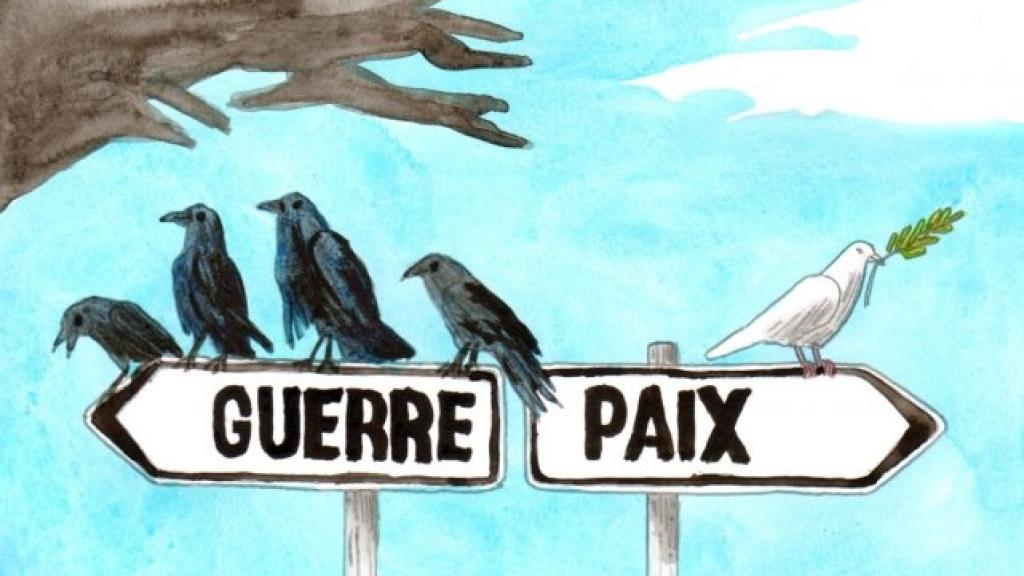
war or peace?

First published in French at CQFD. Translated into English by International Viewpoint.

At a time when everything is spiralling out of control in the East, when alliances as evil as the Donald Trump and Vladimir Putin duo are being forged, and when our leaders are advocating rearmament, we wanted to take some time to think about it. With Gilbert Achcar, a specialist in international relations and professor at the University of London, we discussed ways of supporting Ukraine while rejecting a generalized war.

The United States, under President Trump, is threatening to withdraw from the Old Continent. Russia has no shortage of imperialist ambitions. The war in Ukraine has been going on for over three years. And Europeans are under pressure. How do you analyse the situation?

Indeed, it’s a major upheaval. The Russian invasion of Ukraine in 2022 had initially given NATO a new lease of life. But this revival can now be interpreted as the swan song of an organization that has been in decline for a decade. It does, however, cruelly underline dependence on the United States in this conflict. And this concerns Europeans and Ukrainians alike.

On Russia’s side, for the past three years, this immense country with its considerable military resources inherited from the Soviet Union  the only area where the USSR really rivalled the West  has still not managed to seize all the territories annexed in Ukraine. This is not a defeat, as Russian troops continue to advance at a snail’s pace, but it is clearly not a victory.

As for the Russian threat to Europe, let’s just remember that the European Union (EU) has more than three times the population, more than ten times the economy and three times the military spending (including the UK)  despite the fact that Russia is directly engaged in a large-scale war, and therefore at full capacity, unlike Europe. Under these conditions, it would be absurd to seriously consider a Russian invasion of Europe.

And yet, according to Emmanuel Macron, there is an “existential Russian threat”.

Emmanuel Macron’s idea is more a political manoeuvre aimed at positioning France as the strategic leader and exclusive protector of Europe. This positioning flatters his presidential role while directly benefiting the French military industry. But this rhetoric is dangerous, as it brings us closer to precisely the perils it claims to prevent.

But it’s true that Putin’s authoritarian Russia is multiplying its interference: cyber-attacks, attempts to influence the elections of European states... And on the other side of Europe, the Baltic states fear for their borders.

Moscow is waging psychological warfare and a disinformation campaign. But the best option would be a symmetric riposte: a campaign to set the record straight, aimed at the Russian population. As an imperialist power, Russia certainly has ambitions for the Baltic states. But Putin got his fingers burnt in Ukraine. Even in the event of US disengagement, he knows that he does not have sufficient means to confront Europe on the ground.

Another argument put forward to justify European rearmament is that it would reduce our dependence on the United States.

That’s true. And when you put it that way, it sounds positive. All the more so as the US administration is taking an increasingly worrying political turn, multiplying its interference by openly supporting Europe’s far right.

But the argument is hypocritical. Firstly, because those who talk most about relocating production to Europe are the countries that already have an advanced arms industry, like France. For them, this is a godsend! Secondly, the investments announced will not replace US weapons with European equipment. In reality, it takes more than a snap of the fingers to do without US components. These funds will therefore be used primarily to increase production!

Finally, the term “rearmament” is itself problematic. It falsely suggests that Europe is disarmed, which is far from the case: each country already spends an average of 2% of its GDP on defence  Poland and the Baltic States quite more.

A truly progressive approach would be to work towards synchronized global disarmament, as advocated by some fifty Nobel Prize winners in the natural sciences1, in order to invest in the fight against global warming and poverty.

Is Europe crossing a red line that could lead to a more direct confrontation with Russia?

Rhetorical escalation and the arms race increase tensions and the risk of incidents at one border or another. A missile trajectory error or an accidental airspace violation could quickly escalate.

But, more than an invasion, it’s the possibility of a nuclear confrontation that worries me. Faced with his difficulties in Ukraine, Putin has already threatened several times to use his nuclear arsenal. He knows that his country is the world’s leading nuclear power. On the other hand, Europe’s nuclear power is limited to the arsenals of France and Great Britain. No match for him. Putin could use tactical nuclear weapons (with more limited impact), believing that none of his adversaries would dare a strategic riposte (capable of destroying huge areas). When it comes to nuclear deterrence, it’s Russia that does the deterring!

You have called for a referendum in the annexed Ukrainian territories so that the people can decide their own destiny. Can you tell us more?

International law prohibits the acquisition of territory by force, which Russia nevertheless did in Crimea in 2014 and in eastern Ukraine in 2022. But on the ground, the situation is complex. In these regions, Russian speakers and Russians sometimes have a stronger sense of belonging to Russia than to Ukraine. In Crimea, for example, there was no significant popular resistance to the entry of Russian forces. To avoid further bloodshed, I am therefore in favour of a referendum on self-determination, organized under the aegis of the United Nations, with guarantees and based on the electoral register of the populations present before the invasion.

In concrete terms, Russian troops would have to withdraw to their barracks for the duration of the process, to be replaced by UN troops. It would be unrealistic to demand their prior return to the borders prior to 2022 or 2014: such a scenario would be unacceptable to Russia and would prevent a long-term political settlement of the conflict. Finally, the deployment of international observers would guarantee the transparency of the ballot. In my view, this is the only way to avoid the rancour that can lead to long-term irredentism. This approach is democratic and complies with international law.

How can we maintain a critical stance towards NATO while at the same time showing active solidarity with Ukrainian victims of the bombardments?

I think the first step is to recognize and support the legitimacy of the Ukrainians in defending their country. Recognize and support their right to arm themselves. Not oppose the delivery of defensive weapons. And I stress the word “defensive”: this means all “anti” weapons  anti-missile, anti-tank, anti-aircraft. Finally, to engage in international pressure for the organization of a referendum on self-determination for the regions of Eastern Ukraine and Crimea.

I would add that it’s time to stop ignoring the elephant in the room: China. China was quick to express its support for Ukraine’s sovereignty and territorial integrity. But Washington preferred to ignore this outstretched hand and immediately accuse China of being in league with Russia. Today, negotiations are taking place in Saudi Arabia between Russia, the United States and Ukraine. Volodymyr Zelensky is isolated, under pressure to accept far worse peace terms than those I have mentioned. But China, as a major importer of hydrocarbons, has no interest in seeing this conflict prolonged, and could be a major ally in encouraging the players to return to the UN table.