Thursday, June 19, 2025

US to screen social media of foreign students for anti-American content


By AFP
June 19, 2025


The State Department will require student visa applicants to make public their social media profiles to be vetted for anti-American views - Copyright AFP/File -

Foreigners seeking to study in the United States will be required to make public their social media profiles to allow screening for anti-American content under new State Department guidelines released Wednesday.

The State Department had temporarily paused issuing visas for foreign students at the end of May while it came up with the new social media guidance and it will now resume taking appointments.

“The enhanced social media vetting will ensure we are properly screening every single person attempting to visit our country,” a senior State Department official said.

US consular officers will conduct a conduct a “comprehensive and thorough vetting of all student and exchange visitor applicants,” the official said.

To facilitate the screening, student visa applicants will be asked to adjust the privacy settings on all their social media profiles to “public,” the official said.

In an executive order on his first day as president, Donald Trump called for increased vetting of persons entering the United States to ensure they “do not bear hostile attitudes toward its citizens, culture, government, institutions, or founding principles.”

Student visas are one of a series of battles waged over higher education by the Trump administration, which has rescinded thousands of visas and sought to ban Harvard University from accepting international students.

Secretary of State Marco Rubio has revoked visas in large part of students who led demonstrations critical of Israel’s offensive in Gaza, as he uses an obscure law that allows the removal of people deemed to go against US foreign policy interests.

In April, the Department of Homeland Security said the social media of foreign student applicants would be examined for “antisemitic activity” that could result in visa denial.

The US government has been vetting the social media of persons seeking to immigrate to the United States or obtain a green card for more than a decade.


Op-Ed: Australian writer barred from entry into the US because of his opinions


By Paul Wallis
June 16, 2025
DIGITAL JOURNAL


An American Airlines plane flies past a cellular tower disguised as a palm tree as it lands at Los Angeles International Airport (LAX) in California in January 2022 - Copyright POOL/AFP/File Patrick Pleul

An Australian writer was barred from entry into the US because of his online commentaries. The writer, a guy called Alastair Kitchen, said that he was interrogated about his online views and then sent back to Australia.

His views included commentary on the Gaza war and college protests. According to Kitchen, who studied at Columbia, they said, “We know why you’re here”. They also found evidence on his phone of “drug use”, which is legal in most of the US.

This is true banana republic stuff.

The whole story is pretty grim. A flight attendant, not a US government official, was given charge of Mr Kitchen’s phone and passport and said he could have them back when he arrived back in Australia.

Let’s just say that only authorized people are supposed to handle ID and personal information.

There are so many ongoing stories about foreigners being refused entry to the US on what are effectively purely political grounds. The level of “forensic insanity” in this case is a bit unusual, though.

The airport interrogations are notorious. Complaints are made almost daily about brutal or arbitrary treatment of travellers. You have to wonder exactly what this chaotic approach to foreigners is supposed to achieve, except a total boycott on travel to the US.

Travel warnings against going to the US are now pretty much universal, ironically, except for Australia, which describes US entry requirements as “strict”.

Let’s clarify:

Any country can refuse entry for any reason related to the applicable laws of that country.

What laws did Mr Kitchen breach?

He arrived documented with a valid passport.

Look at it from a consumer perspective. You pay money to go all the way over there, and your money is forfeited simply because somebody feels like doing that.

You have no recourse at all in this environment.

The Australian consulate attempted to help, but not much resulted.

None of the issues raised regarding Mr Kitchen’s entry seem to have related to US laws of any kind. There are no applicable laws about foreign citizens expressing their opinions, for example.

This was a purely political process.

This sort of thing also happened in the previous Trump administration.

A statement from Australian acting prime minister Marles included the inexcusably insipid remark about our “profoundly important relationship with the United States”, strategic relationship, etc.

That’s nice.

There are other relationships that are much more important.

These include friends, relatives, and business relationships. People relationships.

Relationships that mean something.

Real Americans, the non-goosestepping variety, don’t act like cartoon dictators.

The message for travellers is DO NOT GO TO AMERICA. Boycott the place until it’s sane again.

__________________________________________________
Disclaimer
The opinions expressed in this Op-Ed are those of the author. They do not purport to reflect the opinions or views of the Digital Journal or its members.
Rise in ‘harmful content’ since Meta policy rollbacks: survey


By AFP
June 16, 2025


Meta ditched third-party fact-checking in the United States in January - Copyright AFP Brendan SMIALOWSKI
Anuj CHOPRA

Harmful content including hate speech has surged across Meta’s platforms since the company ended third-party fact-checking in the United States and eased moderation policies, a survey showed Monday.

The survey of around 7,000 active users on Instagram, Facebook and Threads comes after the Palo Alto company ditched US fact-checkers in January and turned over the task of debunking falsehoods to ordinary users under a model known as “Community Notes,” popularized by X.

The decision was widely seen as an attempt to appease President Donald Trump’s new administration, whose conservative support base has long complained that fact-checking on tech platforms was a way to curtail free speech and censor right-wing content.

Meta also rolled back restrictions around topics such as gender and sexual identity. The tech giant’s updated community guidelines said its platforms would permit users to accuse people of “mental illness” or “abnormality” based on their gender or sexual orientation.

“These policy shifts signified a dramatic reversal of content moderation standards the company had built over nearly a decade,” said the survey published by digital and human rights groups including UltraViolet, GLAAD, and All Out.

“Among our survey population of approximately 7,000 active users, we found stark evidence of increased harmful content, decreased freedom of expression, and increased self-censorship.”

One in six respondents in the survey reported being the victim of some form of gender-based or sexual violence on Meta platforms, while 66 percent said they had witnessed harmful content such as hateful or violent material.

Ninety-two percent of surveyed users said they were concerned about increasing harmful content and felt “less protected from being exposed to or targeted by” such material on Meta’s platforms.

Seventy-seven percent of respondents described feeling “less safe” expressing themselves freely.

The company declined to comment on the survey.

In its most recent quarterly report, published in May, Meta insisted that the changes in January had left a minimal impact.

“Following the changes announced in January we’ve cut enforcement mistakes in the US in half, while during that same time period the low prevalence of violating content on the platform remained largely unchanged for most problem areas,” the report said.

But the groups behind the survey insisted that the report did not reflect users’ experiences of targeted hate and harassment.

“Social media is not just a place we ‘go’ anymore. It’s a place we live, work, and play. That’s why it’s more crucial than ever to ensure that all people can safely access these spaces and freely express themselves without fear of retribution,” Jenna Sherman, campaign director at UltraViolet, told AFP.

“But after helping to set a standard for content moderation online for nearly a decade, (chief executive) Mark Zuckerberg decided to move his company backwards, abandoning vulnerable users in the process.

“Facebook and Instagram already had an equity problem. Now, it’s out of control,” Sherman added.

The groups implored Meta to hire an independent third party to “formally analyze changes in harmful content facilitated by the policy changes” made in January, and for the tech giant to swiftly reinstate the content moderation standards that were in place earlier.

The International Fact-Checking Network has previously warned of devastating consequences if Meta broadens its policy shift related to fact-checkers beyond US borders to the company’s programs covering more than 100 countries.

AFP currently works in 26 languages with Meta’s fact-checking program, including in Asia, Latin America, and the European Union.


Musk’s X sues to block New York social media transparency law


By AFP
June 18, 2025


Elon Musk's X argues in a federal lawsuit that a New York state law requiring social media companies to report how they moderate hate speech and disinformation violates First Amendment protections - Copyright AFP/File Lionel BONAVENTURE

Elon Musk’s X Corp. has filed a lawsuit challenging a New York state law that requires social media companies to report how they moderate hate speech and disinformation.

The complaint, filed in a federal court in Manhattan, seeks to halt the law, which X argues violates the First Amendment by forcing platforms to disclose sensitive information about their content moderation practices.

“Today, @X filed a First Amendment lawsuit against a New York law, NY S895B,” X’s Global Government Affairs team posted Tuesday, adding that it had successfully challenged a similar law in California.

“X is the only platform fighting for its users by challenging the law, and we are confident we will prevail in this case as well,” the company said.

The New York law requires social media companies with over $100 million in annual revenue to submit semiannual reports detailing how they define and moderate hate speech, racism, extremism, disinformation and harassment.

Companies face fines of $15,000 per day for violations, which can be sought by the attorney general’s office.

X says the law is “an impermissible attempt by the State to inject itself into the content-moderation editorial process” and seeks to pressure platforms into restricting constitutionally protected speech.

– ‘Stop Hiding Hate’ –

Reporters Without Borders said in a statement that asking X “account for their actions against misinformation is by no means an infringement of freedom of expression, but the bare minimum to clean up the digital space.”

“Freedom of expression does not come without responsibilities,” it added.

The lawsuit comes after X successfully challenged a nearly identical California law last year, according to the filing. New York’s law is “a carbon copy” of the California provisions that were struck down, the filing adds.

X claims New York lawmakers refused to discuss changes to the bill after the California ruling, with sponsors saying they declined to meet because of content on X promoted by owner Musk that “threatens the foundations of our democracy.”

The company argues this indicated “viewpoint discriminatory motives” behind the law’s passage.

Senator Brad Hoylman-Sigal and Assembly member Grace Lee — who introduced the law — said in a statement that their act “does not infringe upon the First Amendment rights of social media companies, nor does it conflict with federal law.”

“Instead, the Stop Hiding Hate Act requires narrowly tailored disclosures by social media companies to allow consumers to better decide which social media platforms they utilize,” they added.

“The fact that Elon Musk would go to these lengths to avoid disclosing straightforward information to New Yorkers as required by our statute illustrates exactly why we need the Stop Hiding Hate Act.”

Elon Musk's fortune at risk after mass corporate exodus at Tesla: report

Tom Boggioni
June 18, 2025
RAW STORY

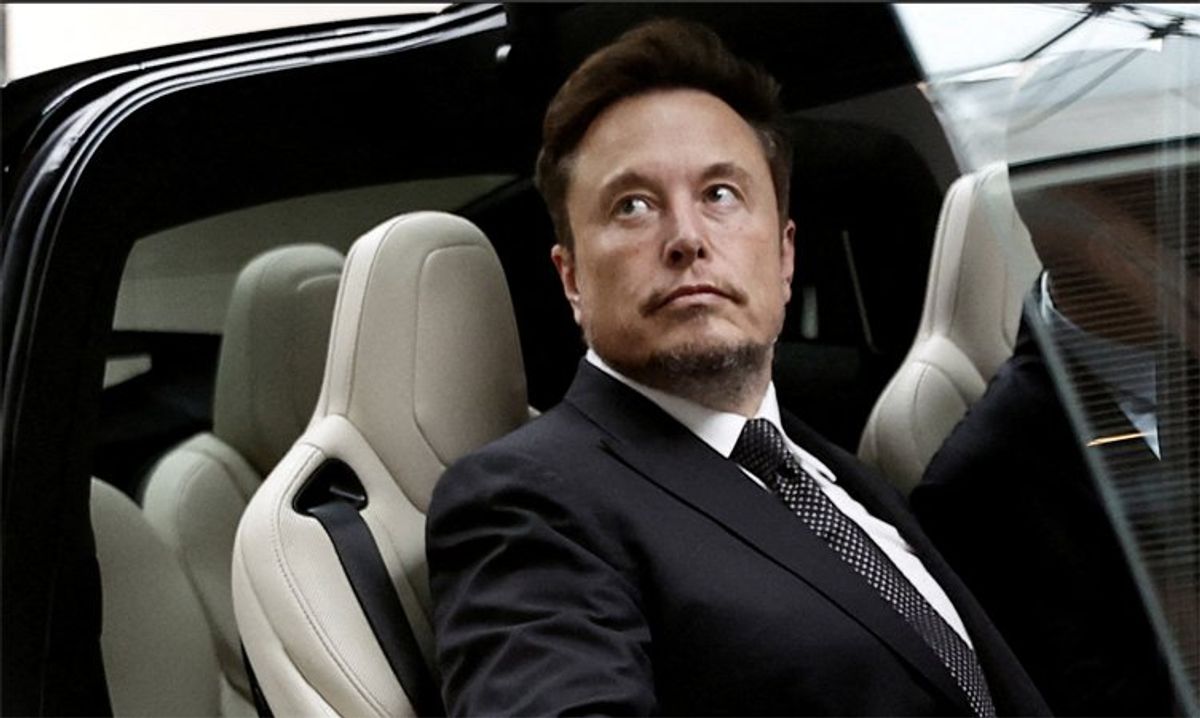
FILE PHOTO: Tesla Chief Executive Officer Elon Musk gets in a Tesla car as he leaves a hotel in Beijing, China May 31, 2023. REUTERS/Tingshu Wang/File Photo

Elon Musk is now facing an uphill battle after stepping away from his position as an advisor to Donald Trump to focus his attention on his embattled Tesla automotive company.
And with that comes the threat that he may lose the faith of investors who helped make him the wealthiest man in the world.

That is according to former Jalopnik editor-in-chief Patrick George in a column for The Atlantic where he pointed out that it is not just consumers who have fled the Tesla brand due to his close alignment with the unpopular Trump –– which is also currently on the rocks –– but also a "brain drain" at his company that has been occurring while his attention has been elsewhere, primarily with his Department of Government Efficiency (DOGE).

With the company now struggling due to a combination of a consumer boycott, dissatisfaction with a lack of innovation on newer models and plummeting stock prices, George suggested it will be up to the billionaire to turn things around at the company that makes up a large portion of his wealth.

And he currently doesn't have the supporting cast to help him succeed, according to the analysis.

According to the Atlantic report, "Something similar to DOGE’s steep staffing cuts has been playing out at Tesla. About a third of the executives who stood onstage with him two years ago have left Tesla or been ousted. Many other high-profile company leaders have resigned. Just since April, Tesla has lost its head of software engineering, head of battery technology, and head of humanoid robotics. Tens of thousands of rank-and-file employees left last year amid waves of mass layoffs."

Noting that Musk's hinting that AI will become a larger part of how the company is run, which led to more corporate departures, George wrote, "His actions might finally be catching up with him."

"Whether Tesla can rebound will test something truly scarce—not Musk’s wealth but the faith that others have in him. Musk has already alienated people on the left and right, but many people still fiercely believe in his ability to make them rich," he wrote before warning, "At some point, even they might start to vanish."

You can read more here.
Putin T-shirts, robots and the Taliban — but few Westerners at Russia’s Davos


B yAFP
June 18, 2025


Hundreds of Western companies sold-off, abandoned or gave away their Russian operations - Copyright AFP Olga MALTSEVA

Russia’s flagship economic forum kicked off Wednesday with stalls selling Vladimir Putin-themed merchandise and humanoid robots, but Westerners were few and far between — despite warming ties between Moscow and Washington under Donald Trump.

Once dubbed “Russia’s Davos”, the annual Saint Petersburg International Economic Forum (SPIEF) is designed to attract foreign investment and is the biggest showcase of Russian technology and business.

Some 20,000 guests from 140 countries are set to take part in the forum over the next four days, both online and in person, according to the Kremlin.

But for the fourth year running high-profile European and American representatives have been absent amid Moscow’s offensive on Ukraine, a stark contrast to before the conflict, when some Western leaders would attend.

Among the states sending high-level government figures this year are the likes of China, Vietnam, Iraq, Saudi Arabia, the Central African Republic and Burkina Faso.

Taliban officials were also spotted at the expo, amid Russia’s push to normalise ties with the militant Islamist group.

Russian officials said some Western executives will attend.

“American business representatives, but I can’t say at what level,” Kremlin aide Yuri Ushakov told reporters at a briefing Tuesday.

According to the official programme, not a particularly high one.

A panel on Thursday, titled simply “Russia-USA”, will feature the head of the American Chamber of Commerce in Russia, some private investors, the founder of a microphone manufacturer and head of a crypto project.

But in one high-profile win for Putin, Indonesian President Prabowo Subianto skipped an invitation to the G7 in Canada, choosing instead to meet Putin and attend SPIEF.


– Humanoid robot –


Among the events on the first day of the forum were panels focused on artificial intelligence and investment in the Global South.

Russia has channelled its economic interests away from the West and towards emerging markets in Asia and Africa due to sanctions over the Ukraine conflict.

One stand handed out T-shirts featuring quotes from Vladimir Putin and other government officials.

One from Foreign Minister Sergei Lavrov read: “Why the hell did I come here?”

Technology was also on display. A humanoid robot flaunting a Dior handbag was seen walking around the exhibits.

The forum comes amid intense speculation in Russia about the prospect of sanctions relief and the return of Western firms that left the country after Moscow launched its offensive on Ukraine in February 2022.

Hundreds of companies sold off, abandoned or gave away their Russian operations — ranging from McDonald’s and Nike to Ford and Goldman Sachs.

Putin has at times blasted them for departing, warned they will not be allowed to return and said Russia is better off without them.

He has also introduced punitive counter-sanctions, restricting the ability of firms from so-called “unfriendly” countries from accessing their profits and imposing huge exit fees and taxes on any wishing to leave.

Trump’s return to the White House and opening of diplomacy with Russia led to a frenzy of headlines in Russian media about whether he would ease US sanctions.

Russia’s top economic negotiator, Kirill Dmitriev, said Wednesday that the United States may “in the next couple of months” announce joint projects with Russia in the Arctic, without elaborating.

“The very important process of improving relations between American society and American companies towards Russia is currently underway,” he was quoted as saying by state media.

Once a fixture of Europe’s business calendar, SPIEF was where Western leaders, CEOs and major investors gathered to seal deals on entering and expanding their footprint in Russia.

Then-German Chancellor Angela Merkel attended in 2013, as did Mark Rutte, the Netherlands’ prime minister and now the Secretary General of NATO — the man marshalling the military alliance’s response to Putin’s Ukraine offensive.

Its prestige started to dip after 2014, when Russia annexed the Crimean peninsula from Ukraine and was hit with the first tranche of Western sanctions.

But even as recently as 2018, French President Emmanuel Macron and Japan’s then-Prime Minister Shinzo Abe sat on stage alongside Putin.
Nippon, US Steel say they have completed partnership deal


By AFP
June 18, 2025


A year and a half after announcing the original merger, Nippon and US Steel said they had closed their partnership deal, affecting legacy industrial sites such as those near Pittsburgh - Copyright GETTY IMAGES NORTH AMERICA/AFP/File Drew Angerer


John BIERS

Nippon Steel and US Steel announced Wednesday they have completed a partnership deal in which the US government will essentially have veto power over significant decisions affecting US jobs.

The agreement modifies a transaction originally announced in December 2023 in which Nippon Steel of Japan had agreed to acquire US Steel for $14.9 billion.

But the outright acquisition of the iconic US company sparked bipartisan political opposition, including from President Donald Trump, whose administration worked with the companies on a revamped deal in which the US government will have a “golden share” of the company that gives it a say on Nippon’s plans for the assets.

Trump, who railed against the proposed deal throughout the 2024 presidential campaign, last month announced a pivot he described in a May 23 social media post as a “planned partnership” in which Nippon pledged to invest billions of dollars and retain its headquarters in Pittsburgh.

On Wednesday, US Steel filed a notice with US securities regulators to delist its shares on the New York Stock Exchange. The NYSE halted trading, pointing to a “merger effective” order.

“The Companies have now completed the transaction as contemplated by their merger agreement,” Nippon and US Steel said in a joint press release. “The Companies have also entered into a National Security Agreement with the US Government, and US Steel will issue a Golden Share to the US Government.”


– Post-election window of opportunity –


Under the December 2023 transaction, Nippon agreed to pay $55 per share for US Steel, an all-cash deal that included a 40 percent premium. While the transaction included a pledge to maintain the name US Steel and the company’s Pittsburgh headquarters, industry watchers expected an exodus of US Steel executives.

But after the deal sparked opposition from the United Steelworkers Union and a broad range of politicians, including then president Joe Biden and former Ohio senator JD Vance — now Trump’s vice president — Nippon stepped up its lobbying efforts in Washington and Pittsburgh to win support for the transaction.

In early January, shortly before leaving office, Biden blocked the transaction, saying that placing “one of America’s largest steel producers under foreign control and create risk for our national security and our critical supply chains.”

But backers of the deal had been hoping the shift in political climate following the presidential election might revive the deal’s prospect.

Besides agreeing to the Pittsburgh headquarters and to maintaining US production, the revamped deal’s National Security Agreement calls for a majority of the US Steel’s board to be US citizens and for key leaders, including the CEO, to be US citizens.

The US government’s “golden share” will allow it the right to appoint one independent director and grant it consent rights for proposed capital budget cuts, the redomiciling of activities outside the United States and on acquisitions in the United States.

“I am delighted that we have made this day a reality,” said Nippon Vice Chairman Takahiiro Mori, who will serve as Chairman of US Steel. “We share President Trump’s commitment to protect the future of the American steel industry, American workers, and American national security, and we look forward to building a stronger and brighter future for US Steel.”

Representatives of the US Steelworkers Union did not immediately reply to a request for comment. But USW expressed deep skepticism in a message to members on Sunday, saying the deal appeared to be “no more than smoke screen to allow a wholly owned privately held subsidiary of a Japanese corporation to be called ‘American.'”
Brazil says free of bird flu, will resume poultry exports


By AFP
June 18, 2025


This May 17, 2025 image shows the grounds of the commercial poultry farm in Brazil's Rio Grande do Sul state that saw an outbreak of "highly pathogenic avian influenza" (HPAI) - Copyright AFP/File SILVIO AVILA

Brazil said Wednesday it was free of bird flu, paving the way for it to resume chicken exports to China and 20 other countries after a month-long suspension.

The world’s top exporter of chicken meat was forced to halt exports to its main client China, the European Union and fellow Latin American countries over an outbreak of “highly pathogenic avian influenza” (HPAI) on a farm in the southern state of Rio Grande do Sul.

A case was also later confirmed at Brasilia’s zoo, where a pigeon and a duck were found dead, but it did not lead to new restrictions on the poultry industry as it involved wild birds.

On Wednesday, the government said it had informed the World Organisation for Animal Health that the 28-day quarantine period without any new cases being detected had passed.

“The country is declaring itself free of highly pathogenic avian influenza,” the agriculture ministry said in a statement.

Agriculture Minister Carlos Favaro announced a “gradual resumption” of poultry exports.

Avian flu has spread globally in recent years, leading to mass culling of poultry, some human deaths, and rising egg prices.

Infections in humans can cause severe disease with a high mortality rate, according to the World Health Organization, but the virus does not appear to move easily from person to person.

Human cases detected so far were mostly in people who had close contact with infected birds and other animals, or contaminated environments.
POLITICAL PRISONER

‘Argentina with Cristina’: Thousands rally for convicted ex-president


By AFP
June 18, 2025


Argentina's former president Cristina Kirchner is serving a six-year sentence for fraud - Copyright AFP Tomas CUESTA
Leila MACOR

Tens of thousands of Argentines took to the streets Wednesday in support of former president Cristina Kirchner, who vowed to make a comeback as she serves a six-year fraud sentence under house arrest.

In a recorded speech played for supporters amassed on Buenos Aires’s Plaza de Mayo square, Kirchner said: “We will be back with more wisdom, more unity, more strength.”

Backers of the polarizing leftist massed on the square and spilled into surrounding streets for a demonstration called by the 72-year-old’s Justicialist Party.

Under the slogan “Argentina with Cristina,” protesters sang and beat drums, waving national flags and banners with messages such as “The motherland is not for sale.”

“We came because it’s an attack on democracy to outlaw someone like Cristina who the people want to vote for,” Rocio Gavino, a 29-year-old public employee, told AFP.

Kirchner supporters had been holding a vigil outside her home in Buenos Aires since the Supreme Court last week upheld her conviction and sentence for “fraudulent administration” while president, along with a lifelong ban on her holding public office.

On Tuesday, a court ruled she could serve her sentence at home under electronic surveillance.

She will be allowed limited visits, principally from family members, lawyers and doctors.

In 2022, Kirchner’s conviction sparked demonstrations in several cities, some of which ended in clashes with police.


– ‘Justice. End.’ –


Kirchner rose to prominence as one half of a political power couple with her late husband Nestor Kirchner, who preceded her as president.

Both are associated with the center-left Peronist movement founded by post-war president Juan Peron.

After two terms at the helm herself between 2007 and 2015, Kirchner served as vice president from 2019 to 2023 in the last center-left administration before the presidency of libertarian Javier Milei, whose austerity policies she has criticized.

Milei had welcomed the court’s dismissal of her appeal, writing on X: “Justice. End.”

Kirchner and her backers claim the case was a plot to end her career and unravel her legacy of protectionist economics and social programs.

“We are here because the national government, together with the judiciary, made the decision to ban Cristina from elections,” protester Federico Mochi, a Peronist youth leader, told AFP.

Lara Goyburu, a political scientist from the University of Buenos Aires, told AFP that Wednesday’s protest “demonstrates that the broader Peronist movement still retains some capacity for street mobilization” in a time of deep political polarization.


– ‘Harassment’ –


In preparation for the protests, police set up checkpoints on major roads to the capital, searching cars and buses — much to the annoyance of citizens.

Under a special protocol adopted Tuesday, they also erected barriers at the main train station and performed identity checks on anyone carrying pro-Kirchner placards or other political paraphernalia.

The protocol allows police to detain any citizen without an ID document for up to 10 hours without a court order.

“It’s harassment that makes no sense,” Daniel Catalano, a leader of the state workers’ union, told Radio El Destape.

Correpi, an NGO fighting police repression, said the measures amounted to the “destruction of the country’s democratic freedoms.”

Presidential spokesperson Manuel Adorni defended the operation.

“When you detect there might be some additional danger to society, you try to neutralize it. And that doesn’t go against the Constitution or the rule of law,” he told reporters.
US approves Gilead’s twice-yearly injection to prevent HIV


By AFP
June 18, 2025


The Gilead logo is displayed on a sign at Gilead headquarters on March 20, 2025 in Foster City, California - Copyright GETTY IMAGES NORTH AMERICA/AFP/File JUSTIN SULLIVAN

The US Food and Drug Administration on Wednesday approved Gilead Sciences’ twice-yearly injection to prevent HIV, a move the company hailed as a major breakthrough in the fight against the sexually transmitted virus.

Drugs to prevent HIV transmission, known as pre-exposure prophylaxis or PrEP, have existed for more than a decade. But because they typically require taking a daily pill, they have struggled to make a significant dent in global infections.

“This is a historic day in the decades-long fight against HIV,” said Daniel O’Day, Gilead’s chairman and chief executive officer, in a statement.

Lenacapavir, marketed under the brand name Yeztugo, has been shown in clinical trials to reduce the risk of HIV transmission by more than 99.9 percent in adults and adolescents — making it functionally akin to a powerful vaccine.

But optimism may be tempered by the drug’s expected eye-watering price tag.

While the company has not disclosed specifics, analysts estimate the US launch price could be as high as $25,000 per year.

Activists are calling for the price to be slashed to $25 per person annually to help end the HIV pandemic.

The approval also comes as President Donald Trump’s administration has slashed funding for HIV treatment and prevention programs both overseas and within the United States.
Waymo looks to test its self-driving cars in New York


By AFP
June 18, 2025


Human drivers will remain at the wheel in Waymo self-driving cars once the path is cleared for a test phase of operations in New York City - Copyright GETTY IMAGES NORTH AMERICA/AFP Eric Thayer

Google-owned Waymo on Wednesday said it has applied for a permit to start testing its self-driving cars in New York City, a first for the Big Apple.

Waymo’s autonomous vehicles have become part of the everyday landscape in a growing number of US cities, serving as safe transport options, tourist attractions, and symbols of a not-so-distant future.

Waymo plans to begin operating a small fleet of autonomous vehicles in Manhattan next month, with human drivers at the wheel until regulators allow otherwise, a spokesperson told AFP.

Waymo operations in New York, once properly permitted, will be in a test phase, according to the company.

Waymo first ventured into New York in late 2021, but did not let its cars operate autonomously then either.

New York State law limits the use of autonomous cars to testing and does not allow Waymo to offer the kind of robotaxi services it provides in San Francisco, Los Angeles, Phoenix and Austin, a Waymo spokesperson said.

New York officials said they are making safety a priority “which is why we have put in place safeguards and conditions for any type of autonomous vehicle to ensure that this technology is deployed appropriately.”

Founded in 2009, Waymo now has a fleet of 1,500 vehicles and provides more than 250,000 paid rides a week in the United States.

Waymo plans to launch its robotaxi service in Atlanta this summer, followed by Miami and Washington in 2026.

The collapse of Waymo’s main competitor, Cruise — due to high costs and following poor crisis management in response to a San Francisco accident — has propelled Waymo to market leadership.

Amazon subsidiary Zoox has a few dozen prototype vehicles on the road, and is not planning its first commercial launch until later this year in Las Vegas.

As for Tesla, it has promised to debut its robotaxi service on Sunday in Austin, Texas, after several postponements.
Myanmar’s Aung San Suu Kyi marks 80th in junta jail

By AFP
June 18, 2025


A protester holds a poster of Aung San Suu Kyi during a candlelight vigil to honour those who have died during demonstrations against the military coup in Yangon on March 13, 2021 - Copyright AFP STR

Myanmar’s deposed democratic leader Aung San Suu Kyi marked her 80th birthday in junta detention on Thursday, serving a raft of sentences set to last the rest of her life.

Suu Kyi was the figurehead of Myanmar’s decade-long democratic thaw, becoming de facto leader as it opened up from military rule.

But as the generals snatched back power in a 2021 coup, she was locked up on charges ranging from corruption to breaching Covid-19 pandemic restrictions and is serving a 27-year sentence.

“It will be hard to be celebrating at the moment,” said her 47-year-old son Kim Aris from the UK.

“We’ve learned to endure when it’s been going on so long.”

He is running 80 kilometres (50 miles) over the eight days leading up to her birthday, and has collected over 80,000 well-wishing video messages for his mother.

But Suu Kyi will not see them, sequestered in Myanmar’s sprawling capital Naypyidaw from where the military directs a civil war against guerilla fighters.

Aris said he has heard from his mother only once via letter two years ago since she was imprisoned.

“We have no idea what condition she’s in,” he said.

While she remains hugely popular in the majority Buddhist country, her status as a democracy icon abroad collapsed before the military takeover after she defended the generals in their crackdown against the Rohingya Muslim minority.

Hundreds of thousands were sent fleeing to neighbouring Bangladesh under her rule, though some argued she was powerless against the lingering influence of Myanmar’s military.

Nonetheless institutions and figures that once showered Suu Kyi with awards rapidly distanced themselves, and her second round of imprisonment has received far less international attention.


– Locked away birthday –


Suu Kyi, the daughter of Myanmar independence hero Aung San, became a champion of democracy almost by accident.

After spending much of her youth abroad, she returned in 1988 to nurse her sick mother but began leading anti-military protests crushed by a crackdown.

She was locked up for 15 years, most of it in her family’s Yangon lakeside mansion where she still drew crowds for speeches over the boundary wall.

The military offered freedom if she went into exile but her poised refusal thrust her into the spotlight and won her the 1991 Nobel Peace Prize.

This time, she disappeared from the public eye on the eve of the coup.

Aris said he fears she is suffering from untreated medical problems with her heart, bones and gums.

Myanmar’s junta offers only intermittent updates on her status and the conditions of her incarceration.

“She is in good health,” junta spokesman Zaw Min Tun told reporters in March, adding that she was provided with routine medical check-ups but was not unwell.

Suu Kyi was freed from her first confinement in 2010 and led her National League for Democracy party to electoral victory in 2015, never formally in charge as army-drafted rules kept her from the presidency.

The military has promised new elections at the end of this year, but they are set to be boycotted by many groups comprised of former followers of Suu Kyi’s non-violent vision who have now taken up arms.

If the octogenarian were released, Aris predicts she would likely step back from a “frontline position” in Myanmar politics.