Despite What Kremlin Thinks, Moscow Shifted Crimea From RSFSR To Ukrainian SSR In 1954 For Economic Rather Than Political Reasons – OpEd
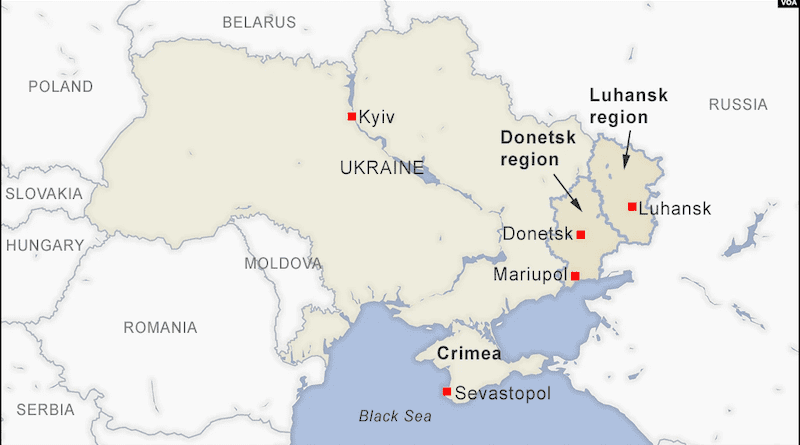
Locations of Ukraine, Crimea and Donetsk and Luhansk regions. Credit: VOA
Despite what Putin aide Vladimir Medinsky says, Moscow transferred Crimea from the RSFSR to the Ukrainian SSR in 1954 not to gain votes for Nikita Khrushchev or other political reasons but rather for economic ones concerning the recovery of that region from the results of World War II, Dmitry Kolezyov says.
On his telegram channel, the Russian journalist says that Medinsky’s falsification of history on this point raises broader questions about how reliable the history textbooks he is overseeing the rewriting of. But this Crimean question is important in its own right (t.me/kolezev/16356 reposted at echofm.online/opinions/krym-i-mify-medinskogo).
In the course of a conversation with Putin, Medinsky made two points about that historical event. On the one hand, he said that Khrushchev transferred Crimea to win votes from Ukrainian comrades because of the power struggle in Moscow. And on the other, he suggested that the party leader did so because he was a died in the wool Ukrainophile.
Neither of these arguments is true, Kolezov says. Khrushchev didn’t need the votes of Ukrainian party members as there was no party congress even scheduled at which their support might have been needed. They amounted to only 15 percent of Central Committee members. And no one accused Khrushchev of Ukrainophilia until after he was dead and rarely before 1991.
The reason that Moscow agreed to the transfer of Crimea to Ukraine was economic rather than political, Kolezyov says. Kyiv was far better positioned to help Crimea recover from the destruction of World War II than was the RSFSR government in Moscow. And indeed, he adds, that calculation proved to be correct.
Moreover, pace Medinsky, shifting territory from one republic to another was hardly rare in the USSR, the journalist continues. This was constantly happening for various reasons “from the ethnic composition of the population to the flourishing of pasture land.” (On that reality, see kommersant.ru/doc/2640080 windowoneurasia2.blogspot.com/2021/05/borders-in-post-soviet-space-were.html which contains my 1990 article for RFE/RL Report on the USSR “Can Republican Borders be Changed?”
Putin’s War Against Ukraine Increasing Corruption In Russia – Analysis
By Paul Goble
Corruption has long been a problem in Russia, even under its most authoritarian leaders. Many senior Russian officials suggest that it can never be rooted out (Window on Eurasia, September 9, 2021, December 6, 2022; RBC, May 20).
Even before his full-scale invasion of Ukraine in 2022, Putin has wielded corruption to make his beneficiaries reliant on his regime and supportive of its goals (Window on Eurasia, September 9, 2021). Corruption is historically worse in wartime because people are willing to pay bribes to evade service or avoid being sent to the front lines (Prodolzhenie Sleduet, August 31, 2023; see EDM, October 10, 2024; Versia, June 25).
Wartime also sees governments funneling money into military industries, creating new opportunities for businessmen and politicians to make vast and elaborate criminal schemes to siphon off money intended for military use (Vazhnie Istorii, February 17; RBC, June 16; Radio Svoboda, June 23).
Putin’s war in Ukraine is no exception. The longer it has continued, the worse corruption in Russia has become. The Kremlin has attempted to hide worsening corruption by hyping selected anti-corruption legal cases, though it seldom punishes those close to the Kremlin or willing to fight in Ukraine. Moscow has obscured worsening overall corruption by limiting the kinds of bribes ordinary Russians have to pay for government services such as getting a passport or medical care (Kholod, August 16, 2023; Russian Chamber of Commerce and Industry, December 9, 2024;The Insider, March 25; Radio Svoboda, June 23).
The Kremlin does not want to call attention to how the Putin regime facilitated the increase of corruption to ensure that those who profit will support the system and its war against Ukraine (Versia, April 1, 2024). Moscow is especially wary of backlash to corruption because it helped power the popularity of the late opposition figure Aleksei Navalny, Putin’s most serious domestic challenge to date (see EDM, February 20, 21, 2024).
In response to the threat posed by anger about corruption, Moscow has acknowledged it in limited terms. The Kremlin released extensive new data showing just how serious the problem of corruption has become since Putin’s full-scale invasion of Ukraine (Vazhnie Istorii, February 17; RBC, June 16; Radio Svoboda, June 23).
Because independent research, which tracks the rise of corruption—including individual trials and other data—indicates that the Kremlin’s data understates the problem, their release may seem risky. The Kremlin has likely calculated that many Russians will accept official corruption figures as more accurate than independent assessments because they are perceived as being imbued with government authority. The Kremlin’s acknowledgment of some degree of corruption is confirmation of the dramatic increase in wartime corruption in Russia.
The official figures released by the Prosecutor General’s Office last week call attention to a disturbing trend (TASS, December 9, 2024; RBC, June 19; Prosecutor Data RBC, accessed June 25).
Russian authorities identified 15,438 crimes classed as corruption during the first three months of 2025. This figure is 24 percent higher than the same period a year ago, much higher before 2022, and represents a greater rate of increase than between 2023 and 2024, when such crimes rose by only 5.7 percent. Corruption crimes also increased as a share of all crimes. In the first quarter of this year, corruption crimes accounted for 3.2 percent of all crimes, up from 2.6 percent in the same quarter of 2024.
Moreover, bribe charges between January and March rose from 7,300 in 2024 to 9,418 in 2025. The Prosecutor General’s Office claimed that the share of corruption charges involving small bribes has decreased, although it did not provide statistics to support this point. This claim suggests that the number of other crimes classified as corruption, including large bribes, has increased relative to small bribes over the past year. Large bribes typically involve senior officials or major businessmen, rather than ordinary Russians. Russian prosecutors, however, have only secured convictions in 5,478 of these cases (Prosecutor Data RBC, accessed June 25).
Bribery cases continue to attract the most attention, especially cases concerning bribes paid to evade military service or improve a soldier’s circumstances. Some Russian soldiers in Ukraine are paying bribes to commanders for leave or to avoid being sent to the front (Vazhnie Istorii, February 17).
These crimes, however, pale in comparison to those committed by higher-ups in business, the military, and government, who siphon off government spending intended for the military or other regime purposes, according to experts such as Alyona Vandysheva from Transparency International Russia (Radio Svoboda, June 23). These forms of corruption involve significantly more money, causing greater harm to the government and the Russian people (Kommersant, June 9).
The government seizing businesses and then handing control of those companies to those in Putin’s inner circle is another growing form of corruption. Between 2022 and March 17, 2025, the Kremlin seized companies with assets worth more than two percent of Russia’s gross domestic product (GDP) in 2024, approximately $32.7 billion (Novaya Gazeta, March 25).
In the first 2.5 months of 2025, Moscow nationalized companies with assets worth two-thirds of what it seized in all of 2024, a figure that is likely to continue increasing as Russia’s war against Ukraine demands more resources (Novaya Gazeta, March 25). This “new form of corruption” is not reflected in the Prosecutor General’s statistics, but it is more significant than crimes such as bribery because it affects a far greater number of Russians. The Russian people are often unaware of corruption schemes at the federal government level unless the Kremlin decides to make an example of some of those involved (The Insider, March 25).
Some observers suggest that the precipitous increase in corruption in Russia because of its war against Ukraine means Moscow cannot win, or even that the Putin regime cannot survive regardless of the war’s outcome. Vladimir Pastukhov, a Russian analyst based in London, has argued that “the Putin regime is not capable of standing up to the tensions a long war will produce” because it relies so heavily on corruption to prevent it from having to employ even greater amounts of repression than Stalin to keep its elites in line (Telegram/@v_pastukhov, January 10, 2024;Kasparov.ru, January 11, 2024).
Despite this prediction potentially being overstated, Moscow’s recent publication of data on the explosive growth of corruption in Russia suggests another trajectory. Putin may conclude that he must reduce corruption or face disaster, but that he can only do so by increasing repression to compensate.
- This article was published at The Jamestown Foundation’s Eurasia Daily Monitor Volume: 22 Issue

Paul Goble
Paul Goble is a longtime specialist on ethnic and religious questions in Eurasia. Most recently, he was director of research and publications at the Azerbaijan Diplomatic Academy. Earlier, he served as vice dean for the social sciences and humanities at Audentes University in Tallinn and a senior research associate at the EuroCollege of the University of Tartu in Estonia. He has served in various capacities in the U.S. State Department, the Central Intelligence Agency and the International Broadcasting Bureau as well as at the Voice of America and Radio Free Europe/Radio Liberty and at the Carnegie Endowment for International Peace. Mr. Goble maintains the Window on Eurasia blog and can be contacted directly at paul.goble@gmail.com .