Saturday, July 19, 2025

Stalinist Echoes in Tbilisi

 July 18, 2025

Facebook

This is the twenty-fourth part in a series about riding night trains across Europe, Turkey, and the Near East to Georgia and Armenia—to spend time in worlds beyond the pathological obsessions of Donald Trump. (Trump devoted this week to denying that there was anything to see in the Jeffrey Epstein files—unless, I suppose, if you’re interested in the sex life of an adjudicated sexual offender who happens to be president.)

Graffiti in Tbilisi, Georgia. Photo by Matthew Stevenson.

I spent three days on the bicycle in Tbilisi and eventually got the hang of cycling on the hills and in the constant traffic. From my hotel, I mastered a few back streets to avoid the racing SUVs with black-tinted windows on Rustaveli, the main thoroughfare, and one afternoon, to my amazement, as I was biking to the Tbilisi Open Air Museum of Ethnography (old wooden houses), I discovered bike lanes on Petre Melikishvili Street. 

At my dinners, I kept hearing the truisms that Georgia was openly for Kyiv in the war over Ukraine, but quietly supportive of Russia, in part because so many wealthy Russian businesses were now operating from offices in Tbilisi. On the sidewalks of Tbilisi, however, there was less consensus and more graffiti of the “Fuck Putin” variety.

+++

I never could decide what I thought of Tbilisi as a city. Its layout on two hillsides of a broad river makes for an awkward, divided footprint, and the rush of traffic everywhere takes any fun away from walking or bike riding. The new Soviet man only gets around at high speed.

That said, here and there around Tbilisi there are quieter, historic quarters, although I never did warm to the official Old Town, which has streets lined with iconic Georgia houses with wooden balconies hanging over the street (and Putin refugees drinking $8 coffees). 

Occasionally I would head there for lunch or cold water, and I can imagine it’s at its best in warm weather, when everyone eats and drinks outside on terraces. But there was something distracting about having to share small cobblestoned alleys with hulking SUVs on some urgent, oligarchic errand.

+++

Tbilisi has no shortage of museums, and in between my meetings I would head into the Museum of Fine Arts or the National Gallery, where sometimes I warmed to the art exhibitions (landscape paintings of Georgia) and sometimes I did not (abstract modernism). 

One morning I went to the Parliamentary Library, where there was some commotion over whether I had the right credentials to look at the books (I did, but it took thirty minutes to enroll me as a visiting scholar). 

Georgia first embraced democracy in 1918, when it fled the embers of the Russian empire, although it then spent much of the last 100 years as a Soviet buffer state.

Another afternoon I biked out to the ethnographic museum to look at old wooden Georgian houses, but mostly because it was something that my wife would have loved, and by now I was beginning to get homesick. 

I spent most of my time in two Stalin-related museums. One housed his printing press, from when he was a young party member churning out agitation propaganda; the other was the Museum of the Soviet Occupation, which is inside the Georgian National Museum. After my day of Stalinism (in all forms) in Gori, I was looking forward to both.

+++

It took me a while to find the Underground Printing House Museum, because my phone was off the internet grid and because the house is tucked away on a side street on a hill past the Sheraton Grand Hotel. 

I got there eventually and locked the bicycle in the courtyard, and while buying a ticket I figured out that the museum director (clearly an older man with time on his hands to volunteer) was prone to endless Stalinist monologues (it’s maybe why he got the job). 

After we spent about fifteen minutes in front of the first picture in the museum, I drifted off on my own and left him in the company of a Canadian couple (on a round-the-world trip) who never seemed to have heard of Stalin. 

The appeal of the house museum is that it has some early printing presses on which Stalin and his comrades issued their proclamations. Beneath the house there are a series of tunnels and secret basement rooms, in which the proletarian printers could hide from the police, if ever they were raided. 

The ruse worked for a while. When Stalin was there printing, Tbilisi was a small town, and this house was a cottage in the countryside, from which young, earnest men were coming and going (admittedly via secret tunnels). According to a caption on the walls (all dialogue is reported verbatim),

In 1906, the gendarmerie received an information, that something unacceptable to them has been happening here. Soon at about 150 gendarmes (policemen) came. Family members and those who worked on the printing machine, received the message too and everyone left the house immediately. The gendarmerie inspected everything, they could not find anything, but suddenly one gendarme took a newspaper, set it on fire and threw it into the well, the newspaper was sucked into the tunnel and they realized that there was something covered there. A firefighter was let down and a printing press was discovered.

After that, the house was blown up, the machine was removed and the place was completely burnt down.

In Stalinist biographies, one of the intriguing theories put forward is that Stalin himself turned in the location of the secret press to the police. Why would he do that? To consolidate his leadership in local party affairs? To settle grudges with his comrades? 

In his biography Stalin, historian Alex de Jong writes: “There is nothing farfetched about the notion that Stalin had reported its whereabouts to the authorities. The motive? A combination of pleasure and of profit.” Later in his career Stalin did far worse things to his compatriots.

+++

The Museum of the Soviet Occupation is far grander than the printing press museum, and far less idolatrous about Stalinism, as the theme of the museum is to record and commemorate “the victims of communism” from 1924 until 1989, when Soviet tanks made their last appearance in Tbilisi.

The exhibition has a postscript that shows the 2008 Russian occupation of the Tskhinvali region, north of Gori (which briefly the Russians also occupied). 

Near the museum entrance there’s a placard that lists all “the victims of communism,” of which: 80,000 were shot; 400,000 were deported; and another 400,000 died in World War II. And to show that the current conflict with Russia has its origins in such documents at the Treaty of Kars, there’s a petition in one of the cabinets that reads: “Protest lodged  by the population of the Georgian village of Dgvrisi against the adding of the village to the Autonomous District of Ossetia, signed by the representatives of the 80 families, December, 1921.” 

The exhibit has many photographs of famous Georgians who vanished in various purges. One is a picture of Dimitri Shevardnadze, who was the founder of the Georgian Art Museum. Under his picture, the caption reads: “Shot in 1937.” 

Finally, there was this poster from 1921 that struck me as more appropriate for today:

… WHAT DO WE HAVE TO OFFER TO THE CULTURAL TREASURE OF THE EUROPEAN NATIONS? –

THE TWO-THOUSAND-YEAR-OLD NATIONAL CULTURE, DEMOCRATIC SYSTEM AND NATURAL WEALTH.

SOVIET RUSSIA OFFERED US MILITARY ALLIANCE, WHICH WE REJECTED. WE HAVE TAKEN DIFFERENT PATHS, THEY ARE HEADING FOR THE EAST AND WE, FOR THE WEST.

WE WOULD LIKE TO YELL AT RUSSIAN BOLSHEVIKS:

TURN TO THE WEST TO MAKE A CONTEMPORARY EUROPEAN NATION…

NOE ZHORDANIA, HEAD OF THE GOVERNMENT OF THE DEMOCRATIC REPUBLIC OF GEORGIA

—Speech Made at at the Extraordinary Session of the Constituent Assembly on January 27, 1921

When the museum opened in 2006, the president of Ukraine, Victor Yuschenko, said his country needed something like this, while the Russian Vladimir Putin complained to Georgia’s president, Mikheil Saakasvilli, that both Stalin and Lavrentiy Beria (head of Stalin’s NKVD security apparatus) THE REAL SOURCE OF THE 'STALINIST' PURGES

had came from Georgia, which could have been an historical aside or a direct threat. 

Since Putin invaded Georgia two years later (and four months after NATO expressed interest in Georgian membership), I am assuming it was a threat.

Matthew Stevenson is the author of many books, including Reading the RailsAppalachia SpringThe Revolution as a Dinner Party (China throughout its turbulent twentieth century); Biking with Bismarck (France during the Franco-Prussian War); and Our Man in Iran. Out not long ago were: Donald Trump’s Circus Maximus and Joe Biden’s Excellent Adventure, about the 2016 and 2020 elections, and The View From Churchill, about the places that shaped the life of the British wartime prime minister. His next books are Playing in Peoria (by bike across the American Mid-West) and Friends of Kind, a literary travel history of World War I.


High Noon for the Mexican Wolf? 


 July 18, 2025
Facebook

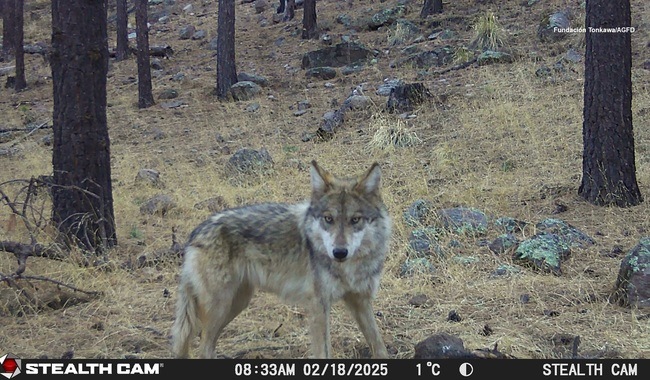
A Mexican gray wolf (Canis lupus baileyi) of undetermined sex was captured on camera roaming the back country of the Sierra Madre Occidental in northern Mexico, very precariously. The snapshot was recorded earlier this year on a trap camera in the Campo Verde region of the Chihuahua-Sonora borderlands but not publicized until this month. 

According to Mexico’s National Commission of Natural Protected Areas (Conanp), which administers the Campo Verde Natural Protected Area, the photo was considered significant in that the lobo in question did not possess a GPS collar and was likely the offspring of wolves released in the region under the auspices of the binational Mexico-U.S. Mexican gray wolf reintroduction program. 

Conanp reported that the first person who beheld the wolf’s image was a Campo Verde committee member who told the protected area’s chief of a “strange coyote” photographed by a trap camera while drinking water. Taking a peek, the chief immediately realized that the animal wasn’t a coyote, but its bigger cousin. 

Conanp asserted that the thirsty wolf photo showed “a great advance in in the conservation of wolves since it is now possible to speak of the first wild populations in the country after more than five decades.” 

In 2021, the Mexican federal government agency calculated that at least 14 wolf litters had been born into the country’s northern wild lands since the beginning of the reintroduction program a decade earlier. 

Covering about 280,000 acres, the Campo Verde Natural Protected Area offers suitable habitat for the recovery of the Mexican gray wolf. Mid-range mountainous elevations encompass pine and oak forests, hosting vital wolf prey like the white-tailed deer. 

Before U.S.-led extermination campaigns almost drove an apex predator to extinction, the Mexican gray wolf inhabited broad regions of northern and central Mexico, ranging as far south as the southern state of Oaxaca, as well as big swaths of the U.S. Southwest. In Mexico, the Mexican gray wolf is officially classified as an animal in danger of extinction.  

Currently, Conanp estimates that 30-35 wild wolves inhabit the Chihuahua-Sonora borderlands- about the same number estimated by Conanp and Mexican researcher Carlos López in 2019.  

The latest population estimate in Mexico represents a small number indeed, but it’s more than in the 1970s when a handful of the last known wild Mexican wolves was captured and successfully bred to later allow the release of wolves in both the United States and Mexico. 

Getting the lead on its southern neighbor, the U.S. reintroduced Mexican gray wolves to the Southwest beginning in 1998; Mexico followed suit starting in 2011. 

The U.S. component of the binational program has proven far more successful, with the latest U.S. Fish and Wildlife Service census numbers (late 2024) estimating at least 286 Mexican gray wolves in Arizona and New Mexico. Nonetheless, the canines face highly uncertain futures in both countries.  

Species recovery is seriously jeopardized by illegal killings, vehicle collisions, human-induced climate change, wildfires, and habitat encroachment.  

Moreover, the lobo’s historic territory has been squeezed by U.S. government policy that limits the acceptable presence of the predators to below Interstate 40, and prevents animals from moving freely across the landscape like they’ve done for eons by constructing high, impassable walls on the U.S.-Mexican border in New Mexico and Arizona. Any wolf that somehow manages to cross an increasingly fenced off border is subject to capture. 

Wolf advocates recognize that official binational efforts have returned the Mexican gray wolf to the wild, but they warn that population fragmentation threatens genetic diversity and long term species survival.

Although wolves again howl away in remote stretches of the Southwestern U.S. and northern Mexico, securing their renewed presence has been no easy task. Legal, political and public opinion battles have accompanied the return of the Mexican gray wolf, north and south. Now a new and possibly decisive showdown is shrouding the wolf’s future. 

On June 30, Arizona Congressman Paul Gosar rolled out the Enhanced Safety for Animals Act (HR 4255), which if approved will delist the Mexican gray wolf from Endangered Species Act protections. 

“Mexican wolves have preyed on cattle, livestock, and even family pets, causing significant financial losses and economic hardship on family-run ranches,” Gosar said in a statement justifying his legislation.  

Bearing the same initials as the Endangered Species Act, Rep. Gosar’s legislation is backed by 20 agricultural, ranching, commercial and county organizations, including the American Farm Bureau Federation, American Lands Council, Coalition of Arizona/New Mexico Counties and National Cattlemen’s Beef Association, among others. 

Cosponsors of the bill referred to the U.S. House Committee on Natural Resources include Republican Representatives Andy Biggs (Arizona), Lauren Boebert (Colorado), Eli Crane (Arizona), Abe Hamadeh (Arizona), Harriet Hageman (Wyoming), Jeff Hurd (Colorado) Doug LaMalfa (California), Tom McClintock (California), Pete Stauber (Minnesota), Tom Tiffany (Wisconsin), and Ryan Zinke (Montana).  

Gosar maintains that the Mexican gray wolf population is no longer in danger of extinction and should be delisted from the Endangered Species Act. 

Wolf advocates, of course, strongly beg to differ. Conservationists quickly condemned Gosar’s measure, characterizing it as akin to declaring an open season on wolves, especially in Arizona where, unlike New Mexico, no state law grants added protection to the endangered species. Wolf protectors predict that killings would also increase in neighboring New Mexico, where many such crimes have already been registered in spite of the federal and state protections. 

“Bypassing the Endangered Species Act to strip all protections from beleaguered Mexican gray wolves and leave them vulnerable to Arizona’s shoot-on-sight laws would cause a massacre,” contended wolf expert Michael Robinson of the Center for Biological Diversity. 

According to a statement issued by Robinson and representatives of eight other leading environmental and conservation groups, removing the Mexican gray wolf from the U.S. endangered species list would not only permit killing with impunity, but also end releases of captive wolves aimed at diversifying the gene pool of wild wolves, halt federal investigations of livestock kills possibly related to wolves, slash federal funding to compensate ranchers for livestock losses, and halt monitoring of wolves. In other words, ditto the Mexican gray wolf.  

Michelle Lute, executive director of Wildlife for All, termed the bill “a cynical ploy to appease special interests at the expense of the democratic process, public trust and the survival of one of North America’s most endangered mammals.” 

In addition to the Center for Biological Diversity and Wildlife for All, representatives of the Western Watersheds Project, Wolf Conservation Center, Lobos of the Southwest, WildEarth Guardians, Grand Canyon Wolf Recovery Project, and Sierra Club-Grand Canyon Chapter signed on to the statement expressing opposition to the Gosar bill. Stay tuned for upcoming battles in a matter of existential importance for Mexico, the United States and the world.     

Kent Paterson is a freelance journalist who covers the southwestern United States, the border region and Mexico. He is a regular contributor to CounterPunch and the Americas Program.