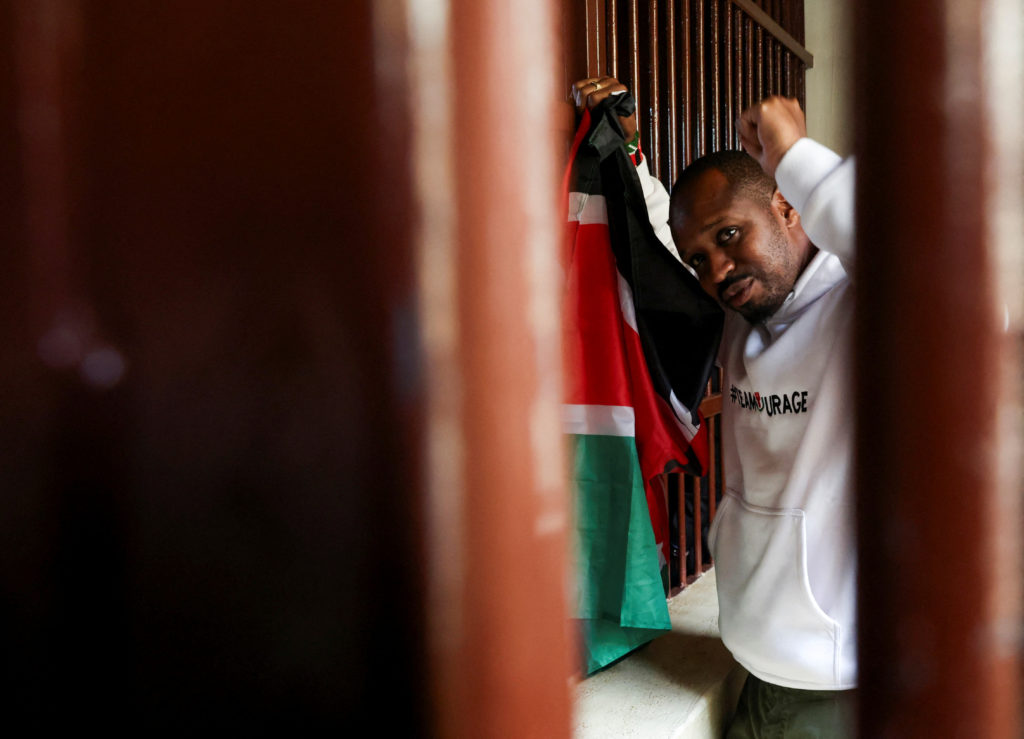
The Kenyan Directorate of Criminal Investigations (DCI) reported on Sunday that the human rights activist Boniface Mwangi was arrested in his residence for “facilitating terrorist activities” allegedly committed during a youth-led protest on June 26. Mwangi, before his arrest, jointly filed a lawsuit in front of the East African Court of Justice against the Tanzanian, Kenyan and Ugandan governments alleging his torture and several human rights violations.
Mwangi was arrested over alleged facilitation of terrorism during his involvement in the youth protests in late June. The International Commission of Jurists in Kenya (ICJ Kenya) issued a statement noting that “stand in unwavering solidarity with Kenya’s youth, human rights defenders, and civil society actors who continue to speak truth to power in the face of intimidation and injustice.”
Just before his arrest on Friday, Mwangi filed a lawsuit against the Tanzanian, Kenyan and Ugandan governments for the torture and deportation he and his colleague incurred in May, in front of the East African Court of Justice. The court has the jurisdiction to enforce violations of the Treaty for the Establishment of the East African Community. However, it does not have jurisdiction over human rights matters, marking future developments of stark significance. Both demanded at least one million US dollars in compensation for the human rights abuses by the authorities.
On May 19, Mwangi, alongside his colleague Agather Atuhaire, attempted to observe the trial of Tanzanian opposition leader and anti-corruption activist Tundu Lissu. On arrival, the two were detained by Tanzanian authorities, reported being tortured and sexually abused, and deported. The Commonwealth Lawyers Association, alongside other NGO’s, condemned these events, alleging a clear breach of the African Charter on Human and Peoples’ Rights. Additionally, the US Department of State called for a full investigation.
Being deported back to Kenya, Mwangi continued his activism efforts and media work. In late June, a mass youth protest broke out across the majority of the country, demonstrating and signalling discontent and disfavour of authoritarian elements in the current administration, spearheaded by President William Ruto. The protests partly escalated in a clash with the authorities, with hundreds being injured and arrested. During the protests, Mwangi repeatedly condemned the police brutality during the events and alleged that politicians were “hiring goons” to deter the peaceful demonstrations.
The Civic Freedom Forum called for the “immediate release” of Mwangi, stating:
Today it is Boniface Mwangi. Tomorrow it could be a student. A teacher. A mother. A me. This moment is a mirror to Kenya’s soul. Do we want a country that fears its citizens or one that listens to them?
Mwangi is a journalist, politician, and human rights activist, first gaining prominence after exhibiting photographs from the 2007 Kenyan post-election violence. He is a known oppositionist to the Kenyan Ruto government and, over a prolonged period, attended and organised protests, such as demonstrations against controversial tax increases targeting underprivileged Kenyans in 2024, leading to a history of previous arrests as a result of his activism.
By —Nicholas Komu, Associated Press
NAIROBI, Kenya (AP) — The prominent Kenyan activist Boniface Mwangi was on Monday charged with unlawful possession of ammunition in a case stemming from his alleged role in street protests against the government.
Opposition leaders and Mwangi’s followers had feared he would be charged with the more serious offense of terrorism.
He was freed on bond immediately after his appearance in court on Monday.
The charge sheet said the suspect possessed three canisters of tear gas without lawful authorization. His attorney, Njanja Maina, told reporters on Sunday that Mwangi never possessed such items.
Mwangi’s wife Njeri, in a post on the social media platform X, said on Saturday that security personnel raided their home and took the activist and his electronic gadgets while “talking of terrorism and arson.” Police said after his arrest on Friday that Mwangi was linked to the facilitation of violent activities in recent street protests. Detectives searched his home and his office.
The Kenya Human Rights Commission described the ammunition charge as a “trumped-up accusation.”
“This pattern of inventing charges to harass and silence activists like Mwangi erodes public confidence in the independence” of the justice system, the civic group said.
The rights group Amnesty International said in a statement Monday that legal action against Mwangi appears to be “part of a broader effort to intimidate lawful dissent and those committed to upholding the rule of law.”
“We are deeply concerned by the continued misuse of the Prevention of Terrorism Act to manage public order in more than 100 other cases,” Amnesty said. “This practice undermines Kenya’s criminal justice system and jeopardizes critical international partnerships aimed at safeguarding national security.”
Mwangi is a well-known pro-democracy activist in Kenya. On X, where he has 2 million followers, he describes himself as “The People’s Watchman.” He has been a critic of successive Kenyan governments.
Protesters who have rocked President William Ruto’s administration say they want to rid his government of corruption, marked by theft of public resources and the seemingly extravagant lifestyles of politicians.
They also say that Ruto, in power since 2022, has broken his own promises to working-class Kenyans. The protests started in mid-2024 when Ruto proposed aggressive new tax measures opposed by many Kenyans.
At least 500 people are facing criminal prosecution following arrests during protests in June and July that resulted in at least 47 deaths.