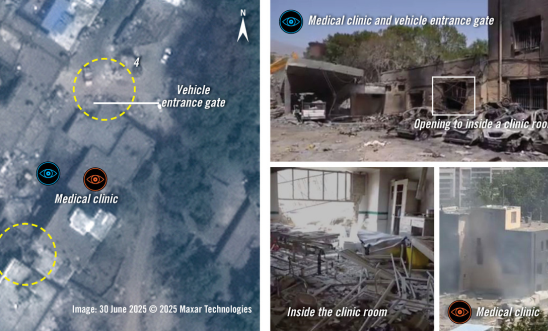
 Satellite imagery (left) from 30 June reveals two locations (shown with yellow circles) where munitions likely landed. Geolocated photos and videos (right) show that the vehicle entrance gate collapsed. The clinic’s interior was significantly damaged
Amnesty International UK
Press release
Video footage, satellite imagery, and eyewitness accounts reveal extensive civilian casualties and destruction
According to Iranian authorities, at least 80 civilians - 79 men and women and a five-year-old boy - were killed
Israeli military quickly claimed responsibility for the attack - senior officials boasted about it online
‘The evidence establishes reasonable grounds to believe that the Israeli military brazenly and deliberately attacked civilian buildings’ - Erika Guevara Rosas
The Israeli military’s deliberate air strikes on Evin prison in Tehran on 23 June constitute a serious violation of international humanitarian law and must be criminally investigated as war crimes, Amnesty International said today following a detailed investigation.
Verified video footage, satellite imagery, and interviews with eyewitnesses, prisoners’ families and human rights defenders indicate that the Israeli military carried out multiple air strikes on Evin prison, killing and injuring scores of civilians and causing extensive damage and destruction in at least six locations across the prison complex.
The attack occurred during the working day and prison visiting hours, when many parts of Evin prison were packed with civilians. At the time, the prison reportedly held between 1,500 and 2,000 detainees, including arbitrarily detained human rights defenders, protesters, political dissidents, persecuted religious minorities, and dual or foreign nationals often used as diplomatic leverage. Hundreds of civilians were also present within the complex. Hours after the strike, the Israeli military confirmed the attack, with senior officials publicly boasting about it on social media. According to Iranian authorities, at least 80 civilians - 79 men and women and a five-year-old boy - were killed.
Under international humanitarian law, a prison or place of detention is presumed a civilian object and there is no credible evidence in this case that Evin prison constituted a lawful military objective.
Erika Guevara Rosas, Amnesty International’s Senior Director for Research, Advocacy, Policy and Campaigns, said:
“The evidence establishes reasonable grounds to believe that the Israeli military brazenly and deliberately attacked civilian buildings. Directing attacks at civilian objects is strictly prohibited under international humanitarian law. Carrying out such attacks knowingly and deliberately constitutes a war crime.
“The Israeli forces should have known that any air strikes against Evin prison could result in significant civilian harm. Prosecution authorities around the world must ensure that all those responsible for this deadly attack are brought to justice, including through use of the principle of universal jurisdiction. The Iranian authorities must also grant the International Criminal Court jurisdiction over all Rome Statute crimes committed on or perpetrated from its territory.”
Scores of civilians killed and injured
Between 11am to 12pm Tehran time on 23 June, Israeli air strikes hit multiple locations over 500 metres apart inside Evin prison, destroying or damaging numerous buildings and other structures within the prison complex, as well as nearby residential buildings outside it.
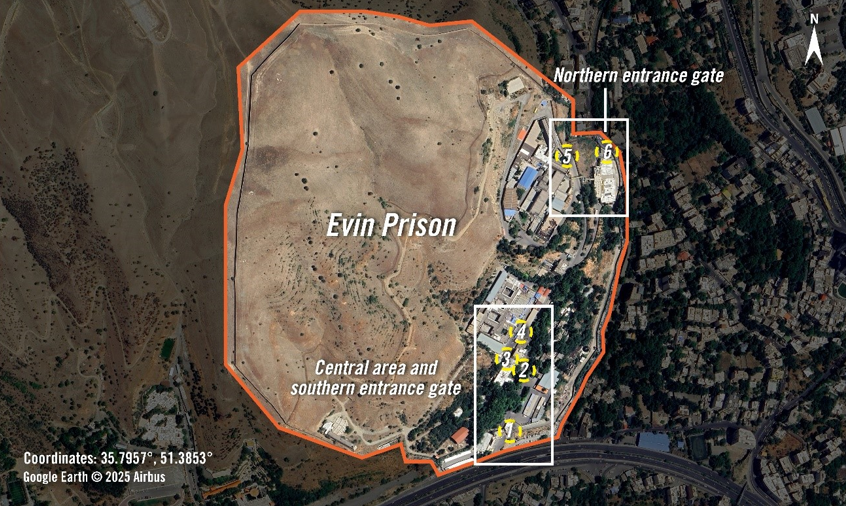
An overview of Evin prison, with the exterior walled perimeter marked in orange. The six yellow circles highlight areas with the most significant destruction, indicating these were the locations where the munitions landed. The blasts and resulting damage extended beyond the six areas.
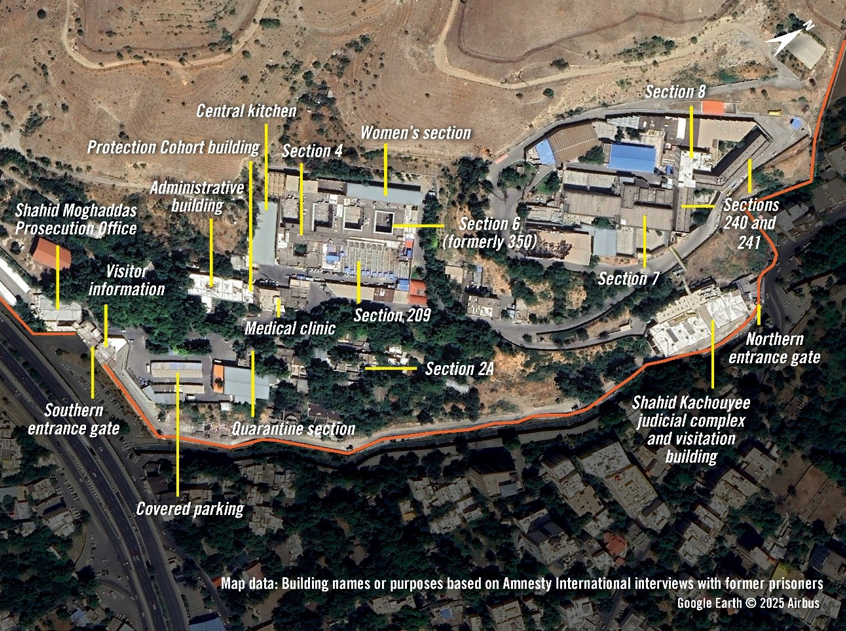
A map of Evin prison indicating building names or functions based on Amnesty’s interviews with former prisoners.
Evin prison is located in a populated area with residential buildings to its east and south. A nearby resident described the scene following the attack to Amnesty:
“I suddenly heard a terrible sound. I looked out of the window and realised that smoke and dust were rising from Evin prison. Both the sound of the explosion and the appearance of the dust and smoke were horrific... I had thought our home would be safe [as] we are near a prison... I couldn’t believe it.”
The authorities have so far named 57 civilians who were killed in the attack including five female social workers, 13 young men performing mandatory national service as prison guards or administrators, and 36 other prison staff – 30 men and six women – and the child of one of the social workers. After drawing public criticism for failing to disclose the identities of prisoners, their relatives and nearby residents who were killed, the authorities published a report on 14 July revealing two names: a nearby resident – Mehrangiz Imanpour – and a woman volunteering to help raise funds for debt prisoners – Hasti Mohammadi.
Amnesty had already verified the name of Mehrangiz Imanpour, as well as the names of one prisoner, Masoud Behbahani, a prisoner’s relative, Leila Jafarzadeh, and a passerby Aliasghar Pazouki, who were also killed.
Israeli officials’ self-incriminating admissions
Within hours of the attack, senior Israeli officials boasted about it on social media, framing it as a “targeted strike” against a “symbol of oppression for the Iranian people.”
Israel’s Defence Minister, Israel Katz, said on X that Israeli forces were attacking with “unprecedented force regime targets and government repression bodies in the heart of Tehran including…Evin prison”.
Minutes later, Foreign Affairs Minister Gideon Sa'ar posted on X: “We warned Iran time and again: stop targeting civilians! They continued, including this morning. Our response: [Long live freedom…].” Alongside this post was a video purporting to show CCTV footage of the prison gate being blown up. Analysis of the video by Amnesty indicates the footage was digitally manipulated likely using an old photograph of the prison gate. The video was first posted on Persian-language Telegram channels, but Amnesty could not trace its original source.
Later the same day, the Israeli military confirmed in a statement that they had carried out “a targeted strike” on “the notorious Evin prison”. The statement appeared to justify the attack by saying that “enemies of the regime” were held and tortured there and alleging that “intelligence operations against the State of Israel, including counter espionage” were carried out in the prison. However, the interrogation of detainees accused of spying for Israel or the presence of intelligence officials within the prison compound would not render the penal facility itself a legitimate military objective under international humanitarian law.
Entrance gate and prosecution office in the south
In the south of the prison, the main entrance gate, along with the adjoining wall and the visitor information building to the east of the gate were destroyed. The building to the west of the gate and the adjoining Shahid Moghaddas prosecution office were extensively damaged. Further inside the southern part of the prison, the car park and a building next to the quarantine section were damaged.
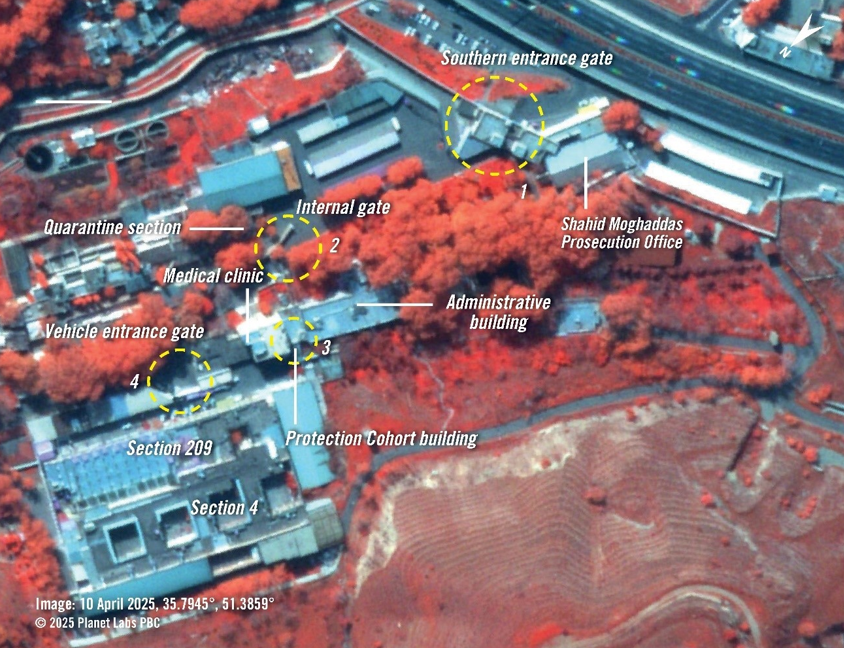
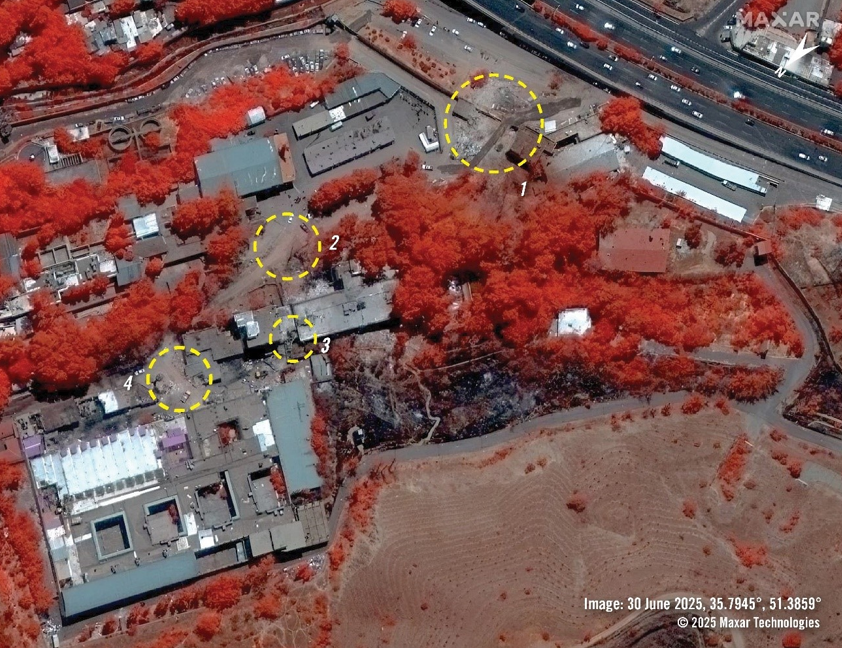
Before and after: false-colour, near infrared satellite imagery from 10 April and 30 June reveal the destruction in four distinct locations in the south and central parts of Evin prison where munitions likely landed (shown with yellow circles) and signs of burning (visible in near-infrared in dark black hues) in many areas, likely from vehicles that caught fire and spread to buildings in the area.
An informed source told Amnesty that a woman named Leila Jafarzadeh, 35, was killed while visiting the prosecution office to post bail in order to secure the release of her imprisoned husband.
The destruction of the entrance gate and its surroundings was captured in a verified video showing rescue workers carrying at least one injured person on a stretcher amid scenes of destruction and extensive rubble on the ground.
Footage published by state media and verified by Amnesty also shows structural damage to the prosecution office’s walls and building framework, indicating that the force of the blast penetrated deep into the building.
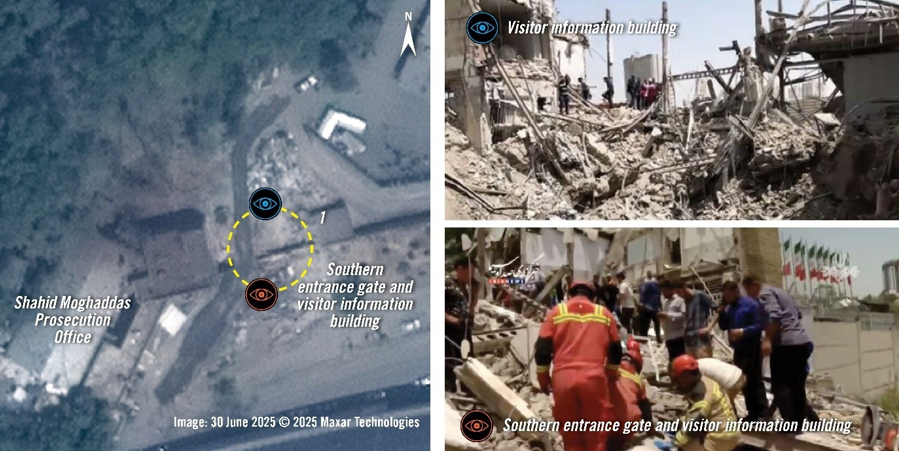
Satellite imagery from 30 June reveals a location (shown with a yellow circle) where munitions likely landed. Ground images (right) geolocated to the north and south areas of the southern entrance gate show major destruction.
Administrative building and quarantine section housing prisoners
Deeper inside the southern area of the prison, the administrative building and a smaller adjoining building which, according to a former prisoner, contained an office of the prison’s security force called the Protection Cohort, were significantly impacted, while several nearby structures were destroyed.
Satellite imagery from 30 June shows significant damage to part of the roof on the west side of the Protection Cohort building. Satellite imagery further shows that to the east of the building, an internal gate, perimeter wall and two small structures – likely guard posts – were all destroyed in the strike.
The two identified locations are consistent with the analysis of video footage and information received from two former prisoners of conscience Atena Daemi and Hossein Razagh.
Verified videos also depict destroyed windows, collapsed walls and extensive rubble on both the western and eastern sides of the administrative building. The first floor appears to be largely obliterated, with missing structural walls visible in multiple sections.
An image published by state media and verified by Amnesty shows what appears to be a crater inside the west side of the administrative building showing the first floor collapsed downward.
According to a state media report on 6 July, at least nine women, one man and a child were killed in the administrative building. Shargh Daily and Hammihan, two prominent newspapers in Iran, named three of the victims in reports published on 25 June and 1 July, respectively. They included social worker Zahra Ebadi, 52, who was killed along with her five-year-old son, Mehrad Kheiri; and an administrative staff member, Hamid Ranjbari, 40.
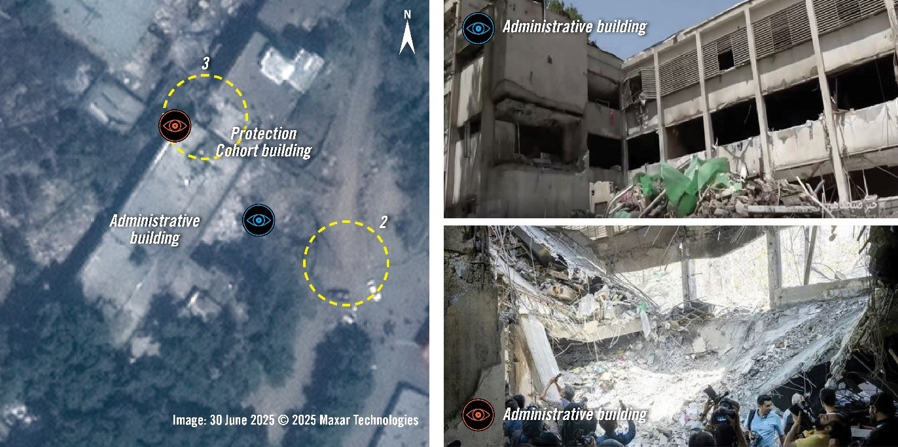
Satellite imagery (left) from 30 June reveals two locations (shown with yellow circles) where munitions likely landed. Ground images (right) show extensive damage to the administrative building.
Analysis of a verified video footage also shows that the quarantine section housing newly admitted prisoners, located near the administrative building, also sustained damage.
Medical clinic, kitchen and sections housing prisoners in the central part
In the central part of the prison, the medical clinic, central kitchen, section 4 housing male prisoners, section 209 which consists of solitary confinement cells where female and male prisoners are detained by the Minister of Intelligence, and the women’s section were extensively damaged.
Satellite imagery shows significant damage to structures adjacent to the medical clinic, while verified videos reveal damage to the clinic from the blast and burning cars.
A verified video shows the outside of the medical clinic covered in black soot and black smoke billowing from the windows. Another video shows significant destruction inside, with shattered windows, beds and medical equipment overturned and extensive rubble.
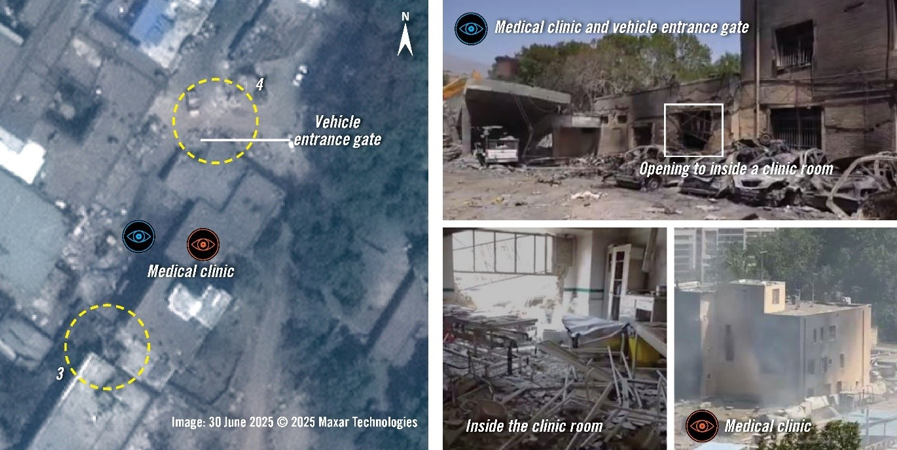
Satellite imagery (left) from 30 June reveals two locations (shown with yellow circles) where munitions likely landed. Geolocated photos and videos (right) show that the vehicle entrance gate collapsed. The clinic’s interior was significantly damaged, with walls and windows blown out, while the exterior shows severe fire damage and smoke.
The verified video evidence supports accounts from human rights defenders Narges Mohammadi and Sepideh Gholian, both based in Iran, who told Amnesty that multiple eyewitnesses in Evin prison described to them extensive damage to the medical clinic.
Narges Mohammadi said that male prisoners in section 4, which is opposite the medical clinic, informed her the prison’s ambulance was destroyed, an account supported by video showing nearby vehicles reduced to wreckage. She also said the prisoners told her they witnessed an individual with extensive burns on their body walking out of the medical clinic and collapsing on the ground.
Two prisoners - Abolfazl Ghodiani and Mehdi Mahmoudian – who survived the Evin prison attack and were transferred to Greater Tehran Penitentiary wrote in a letter from inside prison, which was published online on 1 July:
“Evin prison shook with several consecutive explosions. Two or three blasts occurred near Section 4 and when prisoners exited the section’s door, they saw the medical clinic burning… Prisoners recovered the bodies of around 15-20 people, including medical clinic personnel, prisoners, warehouse staff, guards and agents from beneath the rubble.”
Saeedeh Makarem, a doctor volunteering in Evin prison who was injured, including with burns, described in a series of posts on Instagram in July how prisoners helped her:
“They dragged me to the corner of the wall. I was half-conscious. They brought me water and a blanket, put a splint in my leg, wiped the blood from my face… They could have left, but they didn’t… They saved me.”
Political dissident Hossein Razagh also told Amnesty that section 4 prisoners described to him how prisoners were thrown against the walls due to the force of the blast and sustained head and face injuries.
These testimonies are corroborated by a verified video showing extensive damage to the front parts of sections 4 and 209. External doors and windows of sections 4 and 209 appear to have been shattered, with parts of the roof structure collapsed and large piles of rubble visible in the road. Multiple vehicles are destroyed and burned out, with black smoke damage on the surrounding building walls, indicating some of the fire may have originated from the cars. Satellite imagery from 30 June shows the burned buildings and black scorch marks from the cars. The blast also appears to have affected the roof of the prison kitchen and damaged its windows.
According to Amnesty’s research, the blast also affected section 209 staff offices, trapping some agents and guards under the rubble. Authorities have provided no information about the fate and whereabouts of prisoners held in solitary confinement in section 209, raising concerns about possible deaths or injuries.
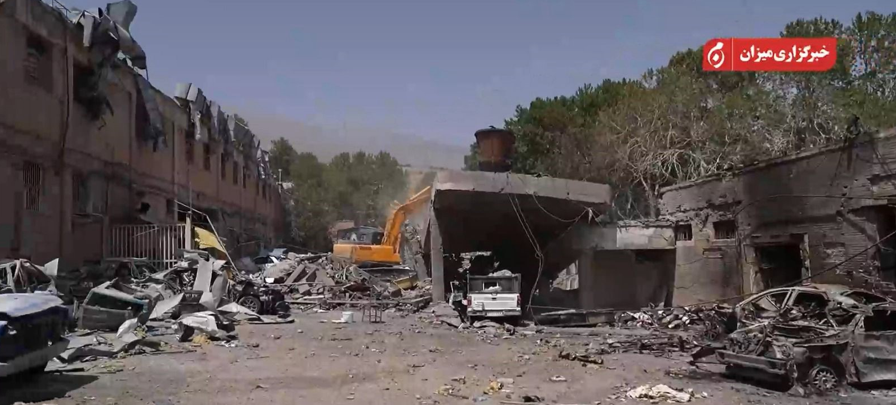
Image showing the road with Section 209 on one side (left) and the vehicle entrance gate on the opposite side (right).
Amnesty confirmed through an informed source the name of a prisoner in section 4, Masoud Behbahani, aged 71, who was killed. He suffered a heart attack when the blast threw him onto a chair and several prisoners fell on him. According to the source, instead of transferring him to a hospital, authorities transferred him to Greater Tehran Penitentiary where he died two days later after a second heart attack.
Amnesty also analysed an image taken from inside the women’s section showing visible damage to the ceiling and electrical infrastructure.
Entrance gate, judicial complex, visitors’ building and sections housing prisoners in the north
In the northern part of the prison, as visible in satellite imagery and verified videos, the entrance gate and adjacent wall were destroyed; the front part of the building containing the Shahid Kachouyee judicial complex and visitors’ building were extensively damaged; and two internal walls near sections 240 and 241 housing prisoners were destroyed.
Verified video and photographs also show blast-related damage to nearby high-rise residential buildings and vehicles outside the northern area of Evin prison. One video shows dozens of distressed people in Ahmadpour Street, at least one of whom appears to be injured.
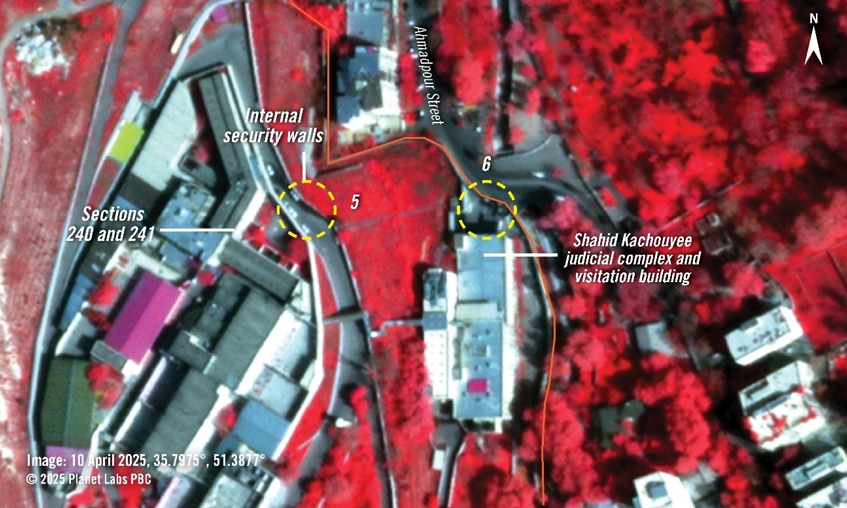
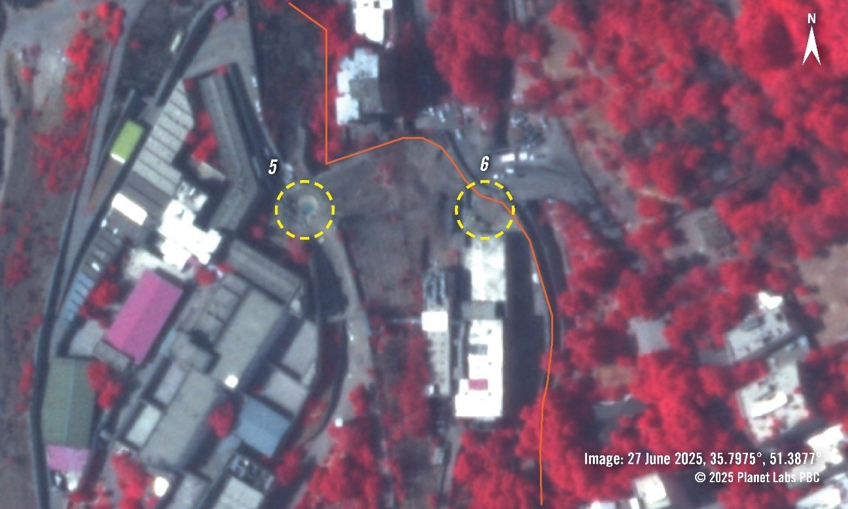
Before and after false-colour, near infrared imagery from 10 April and 27 June reveals the destruction in two distinct locations where munitions likely landed in the northern part of Evin prison (shown with yellow circles): the internal security walls and road in front of sections 240 and 241 and the north entrance gate in front of the visitation building and Shaheed Kachouyee judicial complex.
An informed source described to Amnesty how a nearby resident, Mehrangiz Imanpour, a 61-year-old painter who lived in Ahmadpour Street, was killed on her way home.
Shargh Daily reported that another passerby, Ali Asghar Pazouki, 69, was killed in front of the judicial complex and visitors’ building. State media published videos and photographs which show blast damage in this area.
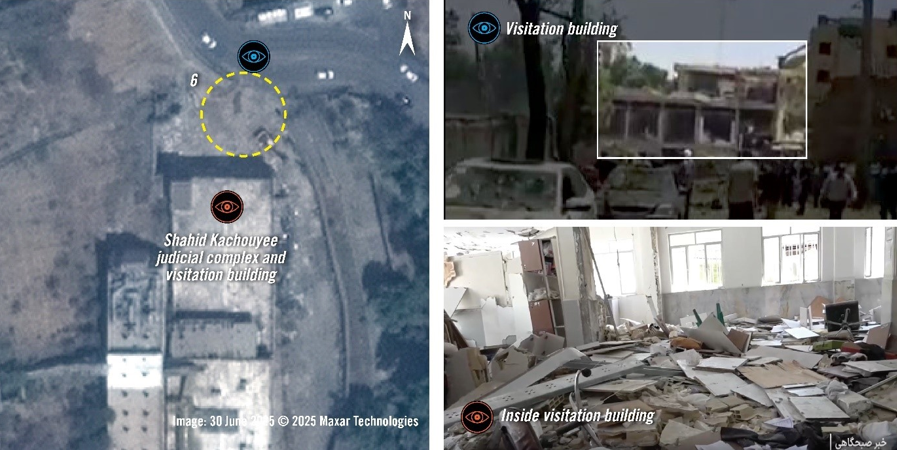
Satellite imagery (left) from 30 June reveals a location (shown with a yellow circle) where munitions likely landed. Geolocated images and videos (right) show extensive damage to the exterior and interior of the visitors’ building with windows shattered and parts of the roof and facade collapsed.
Satellite imagery analysed by Amnesty indicates that a road and two security walls deeper within the northern part of the prison, near a building containing sections 240 and 241, were also destroyed. These sections are known to contain hundreds of solitary confinement cells, but no images showing the condition of the building have emerged and the authorities have not released any information about the fate of prisoners held there.
Amnesty received accounts from prisoners’ families indicating that section 8, near sections 240 and 241, was damaged. Human rights lawyer Nasrin Sotoudeh told Amnesty that her arbitrarily imprisoned husband, human rights defender, Reza Khandan, and other prisoners, were injured when rubble was propelled into the courtyard.
Political dissident Mohammad Nourizad, who was in section 8, called his family while the air strikes were ongoing. A recording of his call was published online on 24 June:
“They are dropping bombs on us. Some people are injured, the windows have broken, and everyone has scattered... They just hit again. I don’t know, it seems intentional... but bombing a prison is incompatible with any logic or code of conduct...They [prison authorities] closed the doors on us and we have no news.”
International law and standards
Under international humanitarian law, direct attacks on civilians and civilian objects are prohibited. Attacks may only be directed at combatants and military objectives. Military objectives are limited to those objects which by their nature, location, purpose or use make an effective contribution to military action and whose partial or total destruction, capture or neutralisation, in the circumstances ruling at the time, offers a definite military advantage.
Attacking forces have an obligation to do everything feasible to protect civilians including by distinguishing between military targets and civilian objects; verifying whether their intended target is a military objective and cancelling an attack if there is doubt; choosing means and methods of attack that will avoid, or in any event, minimise civilian harm; and providing effective advance warning to civilians unless circumstances do not permit.
Even when targeting a legitimate military objective, an attack must not be carried out which may cause civilian harm that would be disproportionate in relation to the concrete and direct military advantage anticipated. If distinguishing between civilian objects and military targets is not feasible, the attack must not proceed.
Governments responsible for violations of international humanitarian law are required to make full reparations for the loss or injury caused. The UN Basic Principles and Guidelines on the Right to a Remedy and Reparation for Victims of Gross Violations of International Human Rights Law and Serious Violations of International Humanitarian Law enshrine the duty of states to provide effective remedies, including reparation to victims, including restitution, compensation, rehabilitation, satisfaction and guarantees of non-repetition.
Evidence gathered
Amnesty’s Evidence Lab analysed satellite images from before and after the strikes and verified 22 videos and 59 photographs, which show extensive damage and destruction to six areas in the south, central, and northern parts of Evin prison complex.
Additionally, Amnesty reviewed statements by Israeli and Iranian authorities and interviewed 23 people inside and outside Iran, including seven prisoners’ relatives; a nearby resident who witnessed the attack; two sources with information about two victims killed; two journalists; and 11 former prisoners including dissidents and human rights defenders who received information from prisoners, prisoners’ families, prison staff and emergency services attending the site. Amnesty also obtained from a source the recordings of four telephone calls between four prisoners and their families hours after the attack.
Amnesty sent questions regarding the attack to the Israeli Minister of Defence on 3 July. At the time of publication, no response had been received.
As part of Amnesty’s ongoing investigations into violations of international humanitarian law and other human rights violations in the context of the escalation of hostilities between Israel and Iran, Amnesty will also publish findings relating to attacks by the Iranian authorities against Israel.
Urgent action
Take action to support hundreds of displaced prisoners from Tehran’s Evin Prison, who are currently being held in cruel and inhuman conditions. See Amnesty’s Urgent Action for how to help.


.gif)