Thursday, July 31, 2025

Russia 8.7 quake triggers tsunami alerts along South America's Pacific coast

MOST RECENT OF STRONG TREMBLORS

Russia quake triggers tsunami alerts along South America's Pacific coast
In Latin America, Chile and Ecuador moved swiftly to activate emergency protocols as they gear up for a possible Pacific tsunami provoked by an earthquake in Russia's Kamchatka Peninsula. / unsplash
By bne IntelliNews July 30, 2025

A powerful 8.7-magnitude earthquake struck off Russia’s Kamchatka Peninsula on July 29, prompting a cascade of tsunami alerts across the Pacific, with varying responses across the region. The United States Geological Survey (USGS) placed the epicentre 133 km southeast of Petropavlovsk-Kamchatsky at a depth of 74 km. The Pacific Tsunami Warning Center (PTWC) issued warnings for potential waves up to 4 metres along the Russian coastline and placed vast areas of the Pacific Rim — from Japan to South America — under surveillance.

In Latin America, Chile and Ecuador moved swiftly to activate emergency protocols. Chile’s disaster agency Senapred declared a tsunami threat across all its coastlines, including Antarctica. Preventive evacuations were ordered in areas such as Easter Island, projected to be the first to experience wave activity, with impacts expected by 9:25am local time the next day. According to Senapred Director Alicia Cebrián, the window before wave arrival allowed time for logistical preparedness. Chilean authorities urged the public to monitor official updates and refrain from spreading misinformation.

Ecuador issued its alert shortly after, focusing on the Galápagos Islands and parts of the mainland coast. The Navy’s Oceanographic Institute (Inocar) placed the archipelago under a tsunami “Warning” status and the continental coast under “Watch.” Inocar released schedules estimating the arrival of waves to Puerto Seymour by 09:48 local time on July 30. Authorities advised the suspension of maritime activity and evacuation of beaches and ports.

Colombia also reportedly ordered evacuations along its Pacific coast on July 30. “As a preventative measure, it is recommended to evacuate the beaches and low-lying areas on the coasts of Nariño and Chocó,” the National Unit for Disaster Risk Management said. “Head to higher ground away from the coast.”

Peru, however, faced criticism over its delayed response. Despite the PTWC including Peru in its regional watch zone shortly after the seismic event, the Peruvian Navy refrained from issuing any formal tsunami alert for hours. Initial bulletins from its National Tsunami Warning System downplayed the threat. The first notice claimed no tsunami risk, the second called for intensified monitoring, and only the third — released hours later — acknowledged the quake's updated magnitude of 8.7, yet still denied a tsunami alert for the country.

Meteorologist Abraham Levy, posting on X, forecasted wave activity along the Peruvian coast ranging from 0.30 to 1.00 metres, beginning in the north at Talara around 11:15am and reaching the south by 1:40pm. La Punta in Callao was expected to see impact at approximately 12:35pm. He said that, although the waves may appear minor, they could still affect commercial, sporting, and recreational coastal zones.

Rear Admiral Jorge Vizcarra, head of the Navy’s Hydrography and Navigation Directorate, later confirmed to RPP the issuance of a tsunami alert on the night of July 29, indicating the possibility of wave trains rather than a single wave. He added that tidal conditions, such as high tide during the new moon phase, could exacerbate impacts depending on port locations.

Latin America has the fastest aging population in world

By Macarena Hermosilla


Though Uruguay leads the trend, population aging is accelerating across Latin America. File Photo by Raúl Martínez/EPA

July 29 (UPI) -- Uruguay is experiencing one of the most significant demographic transformations in Latin America, driven by a declining birthrate and an aging population.

According to projections from the National Institute of Statistics, the country's total fertility rate dropped to 1.27 children per woman in 2023 and is expected to fall to 1.20 by the end of this year -- well below the replacement-level threshold of 2.1.

The population, which peaked at 3.51 million people in 2020, is projected to decline steadily, falling to some 3 million by 2070. By then, more than 32% of residents will be over 65, while only 11.5% will be under 15.

Though Uruguay leads the trend, population aging is accelerating across Latin America.

Related

While the region is not the oldest in absolute terms -- Europe and East Asia have higher shares of older adults -- it is aging faster than anywhere else in the world.

According to the United Nations Population Division, Latin America will make the demographic shift from a young to an aging society in less than 40 years -- a transition that took Europe more than a century.

In countries such as Chile, Brazil and Argentina, more than 15% of the population is now over the age of 65, and the median age exceeds 32, reflecting a rapid demographic shift.

This shift coincides with a long-term drop in fertility, now averaging 1.8 children per woman. The decline is linked to a range of factors: improved access to education, increased female labor force participation, urbanization and evolving family values.

One particularly significant factor has been the decline in teenage pregnancies, which for years accounted for a substantial share of total births in several countries. In Latin America, fertility among women ages 15 to 19 remained high even as it declined in other age groups -- but over the past decade, it has dropped sharply.

Helena Cruz Castanheira, a demographer at the Latin American and Caribbean Demographic Center of the United Nations Economic Commission for Latin America and the Caribbean, said the decline happened faster than expected.

"We expected the fertility rate to stabilize around the replacement level -- 2.1 children per woman -- by 2020, but overall fertility continued to fall below that threshold, and one reason was the significant drop in births among teenagers," she said.

Uruguay again offers a clear example: between 2016 and 2018, access to free subdermal contraceptive implants accounted for one-third of the decline in teen fertility.

This trend is playing out in other countries, as well. In Colombia, for example, 2024 saw the lowest number of births ever recorded -- 445,011 -- of which only 3,159 were to teenage mothers.

Although the average age of first sexual activity has remained stable -- or even declined -- in some countries, what has changed is increased access to and use of contraceptives, partly due to public policies focused on sexual and reproductive health.

Still, Latin America and the Caribbean continue to have the second-highest rate of teenage fertility in the world, with 52 births per 1,000 women ages 15 to 19 in 2022, compared with the global average of 39.

Each year, more than 1.6 million girls and teens in Latin America become mothers -- many of them victims of sexual abuse and living in poverty and vulnerable conditions. This reality limits their access to education and employment and reinforces intergenerational inequality.

Cruz emphasized that the goal of demographic policy should be to ensure women can have the number of children they want, when they choose to.

"Unplanned teenage pregnancies are associated with more difficult life paths for young mothers. That's why countries must continue investing in sexual health, family planning and education," she said.

According to a report from Austral University in Argentina, only Ecuador, Paraguay, Mexico and Peru currently show a more favorable outlook, with a larger share of youth under 15 -- suggesting greater long-term productive potential.

By contrast, the population age 65 and older has grown steadily across the region, reaching or surpassing 15% in several countries. This trend is reflected in indicators such as median age, which now exceeds 30 in most nations. Uruguay, Chile, Brazil and Argentina report the highest figures.

As the population ages, there are fewer working-age people for each retiree.

Uruguay offers a clear warning: aging is happening faster than expected. Without adjustments to social, health, pension and elder care policies, the economic and social consequences could be severe.


Bangladesh’s Sheikh Hasina resigns as PM, leaves country amid nationwide protests

Army chief says he ordered forces not to fire on protesters.


Dhaka
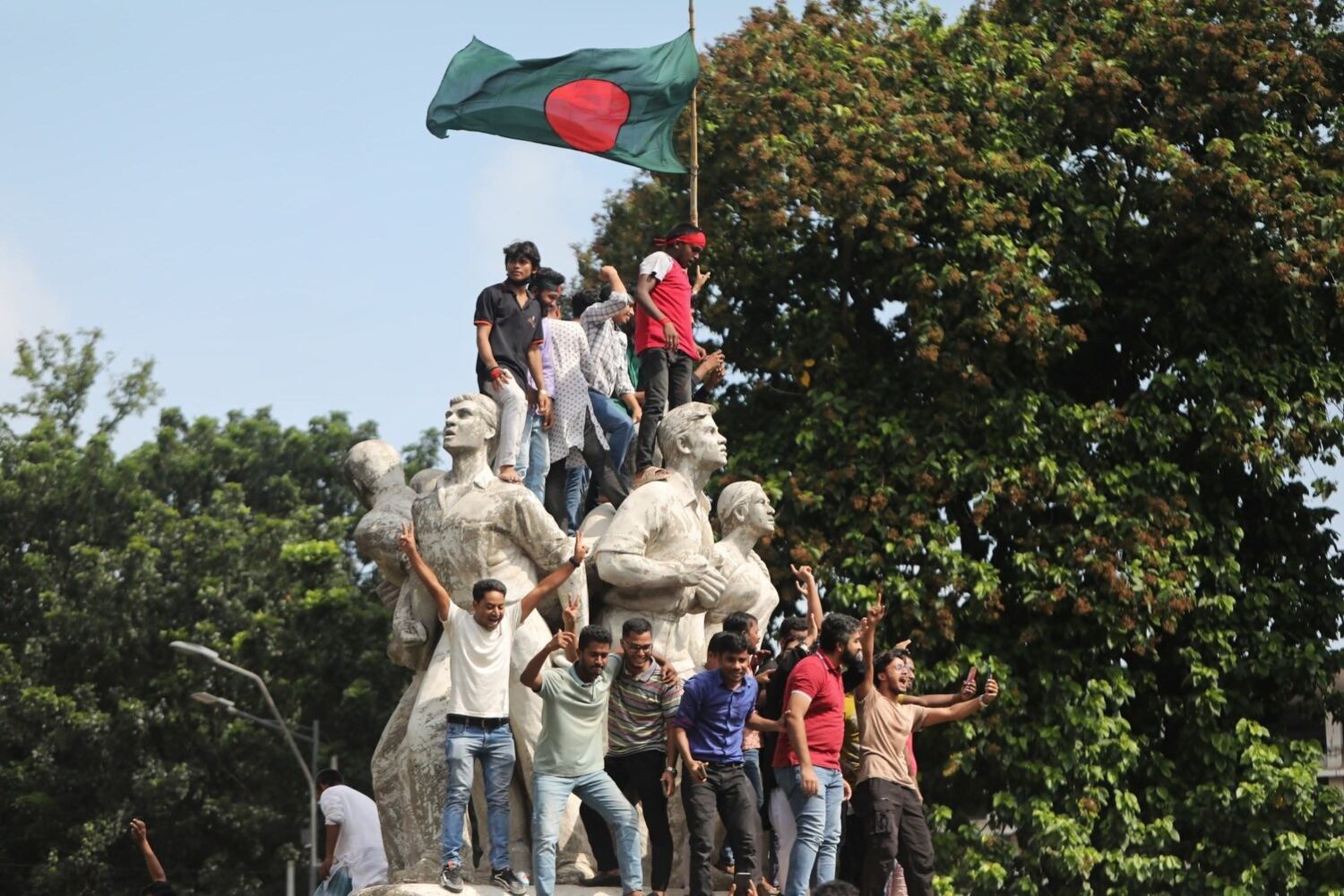
Protesters raise the Bangladesh flag after Prime Minister Sheikh Hasina resigned, amid student-led protests that turned deadly after security forces and supporters of her Awami League party clashed with demonstrators, in Dhaka, Aug. 5, 2024.
Protesters raise the Bangladesh flag after Prime Minister Sheikh Hasina resigned, amid student-led protests that turned deadly after security forces and supporters of her Awami League party clashed with demonstrators, in Dhaka, Aug. 5, 2024. ([BenarNews])

Bangladesh’s Sheikh Hasina has resigned as prime minister, the nation’s army chief announced Monday, in a stunning turn of events as the leader who had held office for 15 consecutive years appeared to give in to student protesters’ demands that she step down.

The announcement came as Dhaka and other cities braced for more violence as thousands of anti-government demonstrators defied a curfew and marched despite the heavy presence of government troops and police officers on the streets.

“Prime Minister Sheikh Hasina has already resigned and we are working to form an interim government,” Gen. Waker-uz-Zaman, the army chief, told reporters at a press conference in front of his cantonment office in Dhaka.

Late-breaking international news reports said Hasina had left Bangladesh, with one report from India saying she had arrived in the neighboring country by helicopter earlier in the day.

Hasina resigned a day after Bangladesh was plunged into the single deadliest day of violence in recent weeks of political tumult. As many as 98 people were killed across the country on Sunday, as students and protesters took to the streets and launched a civil disobedience campaign to demand that Hasina and her government resign over the killings of at least 200 demonstrators during a first phase of protests in July.

“I take all responsibility ... justice [is] to be ensured for every killing and other misconducts,” the army chief said.

BD-Hasina-resigns-2.JPG
A mural of former Bangladesh Prime Minister Sheikh Hasina is seen vandalized by protesters days before in Dhaka, Aug. 5, 2024. [Mohammad Ponir Hossain/Reuters]

Gen. Waker-uz-Zaman said he had “ordered the police and army not to open fire,” at the thousands of people out on the streets on Monday.

He said the decision to form an interim administration was taken after discussions with the representatives of major political parties and civil society, although no members from Hasina’s Awami League party were present at the meeting.

“At the meeting, representatives from BNP [Bangladesh Nationalist Party], Jamaat-e-Islami, Jatiya Party were present while no Awami League people attended.

“I will meet the president as soon as possible and will try to form an interim administration. It might take one or two days ... please cooperate with us,” the general said.

RELATED RFA CONTENT

RFA Insider podcast episode 12: Unrest in Bangladesh, moon alien abuse, Olympics korea naming mixup Opens in new window ]

The protesters were demanding justice for the 212 people who lost their lives during the earlier wave of civil unrest last month, when students staged protests against a quota system for government jobs. It was heavily weighted in favor of children and grandchildren of war veterans who had fought for Bangladesh's independence from Pakistan in 1971.

As a result of those protests, the Supreme Court’s appellate division slashed quotas for select groups to 7% from 56%, paving the way to make most government jobs merit-based in the country with a high unemployment rate among young people.

BD-Hasina-resigns-3.JPG
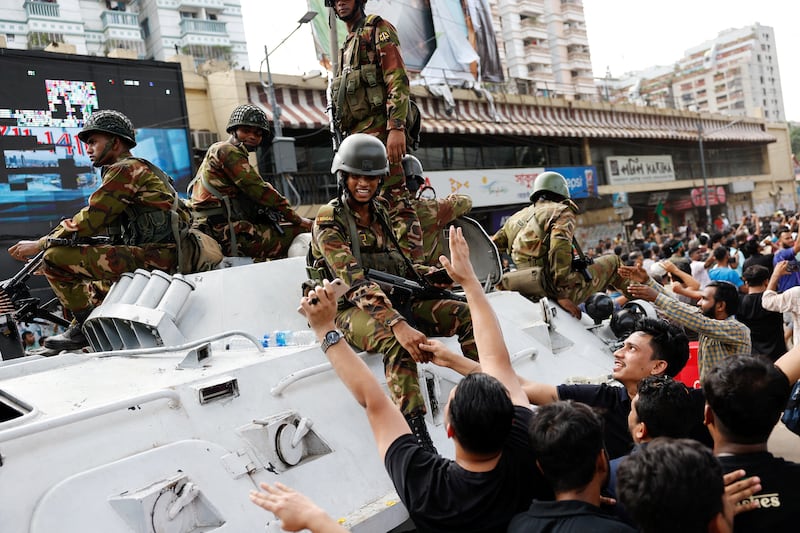
People shake hands with army personnel as they celebrate the resignation of Bangladeshi Prime Minister Sheikh Hasina in Dhaka, Aug. 5, 2024. [Mohammad Ponir Hossain/Reuters]

Hasina, who had held power uninterrupted since 2009, and her government were reelected in January in national polls that were widely criticized as tainted. In the months leading up to the general election, the opposition BNP had staged massive street protests in 2023 calling on her government to make way for a neutral caretaker administration to run the country during the election transition, but she refused to step down.

On the eve of her departure from office, the 76-year-old PM and daughter of the country’s founding leader, presided over a meeting of the national security council and appeared to order the armed forces and police to come down hard in stopping the protesters from spreading “anarchy.”

"No one of those who now are carrying out violence is a student. They are terrorists," A.B.M. Sarwer-E-Alam Sarker, the prime minister's assistant press secretary, quoted Hasina as saying, according to the state-run Bangladesh Sangbad Sangstha (BSS) news service.

BenarNews is an RFA-affiliated news outlet.

FASCIST FRIENDS OF A FEATHER

Guilty Verdict Against Álvaro Uribe Sparks Condemnation from U.S Lawmakers


Former Colombian President Álvaro Uribe Vélez addresses a crowd in Santa Fe de Antioquia. Photo: Twitter/Alvaro Uribe.

AColombian court on Monday found former President Álvaro Uribe Vélez guilty of witness tampering and procedural fraud, marking an unprecedented moment in the country’s history and igniting a political firestorm at home and abroad.

Judge Sandra Liliana Heredia, delivering her verdict in a packed courtroom after nearly 10 hours of deliberations, convicted Uribe of bribing a public official and abuse of process with criminal intent in a long-running case that has gripped the nation for over a decade. The 73-year-old becomes Colombia’s first former head of state to be convicted at trial.

Uribe’s legal team immediately announced plans to appeal the decision. The judge is expected to hand down a sentence on Friday. Under Colombian law, each charge carries a penalty of between six and twelve years in prison, meaning Uribe could be deprived of his freedom for nine years. His defense is requesting home detention until the appeal is decided this week.

“This is not the end of this process,” stated one of Uribe’s defense attorneys, Juan Felipe Amaya. “The appeal is next, and we will demonstrate that this decision, which we respect, is mistaken.”

Uribe himself, who joined the hearing via video link, maintains his innocence and insists that the case is politically motivated. “This is persecution,” he said in a brief statement issued by his Centro Democrático party. “I have always acted in defense of Colombia.”

The case centers on allegations that Uribe and his associates, including lawyer Diego Cadena, attempted to bribe imprisoned paramilitaries into retracting damaging testimony and issuing statements in Uribe’s favor. One of the key figures in the case, former paramilitary Juan Guillermo Monsalve, claimed Uribe had ties to the Bloque Metro, a right-wing militia active in the 1990s. Uribe was found guilty of influencing Monsalve, though he was acquitted of a separate charge of bribery.

“This court affirms that justice does not kneel before power,” Judge Heredia declared. “It is at the service of the Colombian people.” Her written decision spans more than 1,000 pages, and she emphasized that “we want to say to Colombia that justice has arrived.”

The conviction lands at a volatile moment for Colombia, less than a year before the 2026 presidential elections. Several of Uribe’s political allies and protégés are eyeing a return to power, and the verdict could have far-reaching consequences for the country’s conservative movement.

U.S. Republicans Decry “Judicial Persecution”

The verdict has also drawn swift and forceful condemnation from leading conservative U.S. lawmakers, many of whom have long considered Uribe a close ally in the fight against terrorism and leftist insurgencies in Latin America.

U.S. Secretary of State Marco Rubio called the ruling a “dangerous precedent,” stating: “Former Colombian President Uribe’s only crime has been to tirelessly fight and defend his homeland. The weaponization of Colombia’s judicial branch by radical judges has now set a worrisome precedent.”

Congressman Mario Díaz-Balart of Florida went further, linking the case to President Gustavo Petro’s left-wing administration. “As I have stated on numerous occasions, the decision involving a judicial farce, political persecution, and a witch hunt against former President Álvaro Uribe Vélez represents a clear violation of the rule of law and reflects the growing influence of far-left forces aligned with Gustavo Petro.”

Díaz-Balart also cited broader concerns about governance in Colombia, noting “the ongoing deterioration of democracy, public security, the rise in political violence, and the expansion of criminal groups under Petro.”

Republican Senator Bernie Moreno, a Colombian-American and vocal critic of leftist governments in the region, warned that the decision could signal a descent into authoritarianism: “Colombia gets one step closer to illegitimacy. We’ve seen this movie before in Venezuela. I’ll be leading a bipartisan delegation of Senators and senior government officials to reaffirm our commitment to Colombia and its great people. It’s not too late.”

Congresswoman María Elvira Salazar of South Florida also weighed in, calling the verdict “an infamy” and accusing Colombia’s judiciary of following a script reminiscent of Havana or Caracas: “They condemn him because he refused to negotiate with criminals. This is castrochavismo 101: political persecution against anyone who opposes their radical agendas. From the United States, we raise our voice: Uribe is not alone!”

While many in Colombia’s leftist circles hailed the verdict as a triumph of judicial independence, critics, especially from the right, see it as part of a broader campaign to neutralize one of the country’s most influential political figures. Uribe, who left office in 2010 with an approval rating above 70%, remains a divisive but towering figure in Colombian politics. Whether his conviction marks the final chapter in a storied and controversial career – or the start of a political and legal comeback – remains to be seen.

U.S President Donald J.Trump has yet to issue a statement regarding the “political persecution” of the two-term Conservative leader. Trump recently announced punitive 50% tarrifs on Brazil aimed at protecting former Brazilian President Jair Bolsonaro from a “witch hunt” by the South American country’s high court. “This trial should end immediately!” wrote Trump in a strongly worded message to prosecutors of Brazil’s Supreme Court, who accuse Bolsonaro of plotting a violent coup. Within days of President Trump’s affirmations, Secretary of State Marco Rubio slapped a US visa ban on Brazil’s supreme court justice, Alexandre de Moraes, who is presiding over Bolsonaro case.

Colombia ex-President Alvaro Uribe found guilty in landmark bribery trial

The ruling, which Uribe’s legal team said he will appeal, is the latest decision in a long-running, hugely politicised case.

People hang a banner reading "Uribe guilty", as they protest against former Colombian President Alvaro Uribe outside the Paloquemao court complex while waiting for the ruling in a criminal case against him, in Bogota, Colombia, July 28, 2025
 [File: Luisa Gonzalez/Reuters]

Al Jazeera
Published On 29 Jul 2025

Former Colombian President Alvaro Uribe has been found guilty of witness tampering and bribery in a landmark trial, becoming the country’s first ex-president to ever be found guilty at trial.

Judge Sandra Liliana Heredia ruled on Monday that there was enough evidence to determine that Uribe, 73, conspired with a lawyer to coax three former members of paramilitary groups who were in prison into changing testimony they had provided to Ivan Cepeda, a left-wing senator who had launched an investigation into Uribe’s alleged ties to a paramilitary group in the 1990s.

Recommended Storiesl


The case dates to 2012, when Uribe filed a libel suit against Cepeda with the Supreme Court. But in a twist, the high court dismissed the charges against Cepeda and began investigating Uribe in 2018.

Uribe faces up to 12 years in prison, but a sentencing will be delivered in a separate hearing on Friday. He is expected to appeal the ruling.
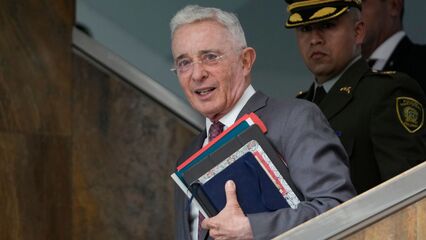

Colombia’s ex-President Uribe faces trial for witness tampering, fraud charges

Uribe’s critics have celebrated his trial as the deserved downfall of a man repeatedly accused of close relationships with violent right-wing paramilitaries, but never convicted of any crime.

The former leader, 73, and his supporters say the process is a persecution and that he is innocent.

Uribe and one of his lawyers, Jaime Granados, joined the hearing via videolink, while another lawyer, Jaime Lombana, appeared in person.

“This is not the end of this process, the appeal is next and we are going to demonstrate that this decision, which we respect, is wrong,” lawyer Juan Felipe Amaya, part of Uribe’s legal team, told journalists at the court.

Granados told the hearing that the presumption of Uribe’s innocence should be maintained and asked for him to remain free during the remainder of the process.

Both detractors and supporters gathered outside the court, with some Uribe backers sporting masks of his face.

Even if the conviction is eventually upheld, Uribe may be allowed to serve his final sentence on house arrest because of his age

.
A man holds a mask depicting former Colombian President Alvaro Uribe, during a protest in support of him outside the Paloquemao court complex before the ruling in a criminal case against him, in Bogota, Colombia, July 28, 2025 
[Luisa Gonzalez/Reuters]

Uribe’s trial triggered criticism from United States Secretary of State Marco Rubio. Uribe had a close relationship with the US during his two terms as president between 2002 and 2010, as right-wing governments in Latin America have often had.

“Uribe’s only crime has been to tirelessly fight and defend his homeland. The weaponisation of Colombia’s judicial branch by radical judges has now set a worrisome precedent,” Rubio said on X.

Colombian President Gustavo Petro, a leftist, defended the ruling, writing on X that “a strong justice system” will enable Colombia to emerge from violence. He added in another message that Rubio was interfering with Colombia’s sovereignty.

“A decision against the ex-president could generate some kind of reprisal by the government of the United States,” Banco de Bogota said in a note on Monday, referring to a proposal by US Republican lawmaker Mario Diaz-Balart to cut non-military aid to Colombia next year, partly on concerns of due process violations in the Uribe case.

Uribe, who was placed under house arrest for two months in 2020, is head of the powerful Democratic Centre party and was a senator for years both before and after his presidency.

He has repeatedly emphasised that he extradited paramilitary leaders to the US.

Colombia’s truth commission says paramilitary groups, which demobilised under deals with Uribe’s government, killed more than 205,000 people, nearly half of the 450,000 deaths recorded during the ongoing civil conflict.

In recent decades, right-wing paramilitary groups across Latin America – backed by the US – along with the armed forces of allied governments, have been responsible not only for killings, but also for forced disappearances, sexual violence, mass displacement, and other grave human rights abuses.

Al Jazeera


The Art of Command

How Uganda’s General Muhoozi is adopting the Donald Trump approach to power


Author
Kayondo Birungi Eric

Analysis | 07/29/2025
Political Parties / Election Analyses - East Africa
General Muhoozi Kainerugaba attends a “thanksgiving” ceremony in Entebbe, Uganda, 
Photo: picture alliance / ASSOCIATED PRESS | Hajarah Nalwadda

Despite their vastly different worlds, General Muhoozi Kainerugaba, son of long-serving Uganda President Yoweri Museveni, and US President Donald Trump appear to share the same political playbook. The striking similarities in political style defined by hypernationalism, confrontational rhetoric, and militarized political identities are fast defining Uganda’s political future as a military dynasty. General Muhoozi’s military career is deeply entangled with political speculation and aspiration and, more recently, his public engagement particularly on social media hints at a future shot at the presidency.

Kayondo Birungi Eric is a political commentator based in Kampala, Uganda.

With the 2026 general elections only a few months away, General Muhoozi’s Trump-like approach is increasingly blurring the line between the military and public discourse. Though not specifically coining the “Uganda First” mantra, his public statements frequently emphasize Uganda’s sovereignty, military prowess, and national unity. General Muhoozi is using a populist approach as a means of dominating public discourse, silencing critics of the ruling National Resistance Movement (NRM) party and more importantly extending his father’s legacy.
The Erosion of Democratic Norms

Uganda has a troubled political history, placing the army at the leadership of political power since its independence in 1962. As President Museveni and the ruling NRM mark 40 years in power, the military is progressively serving as a model for the functioning of other state institutions and ideology. Since 1986, Uganda under President Museveni has moved away from its status as post-conflict nation with early promises of democratic expansion. While regular elections have been held since 1994, the political space has systematically narrowed, characterized by widespread human rights abuses, suppression of dissent, and a highly militarized political landscape. There has been a fusion between the state, the NRM, and more recently, the political fortunes of the first family. President Museveni has systematically built a system where the military is the ultimate guarantor of his regime. The government has framed militarization as a necessary response to the complex threats the country faces, and the question remains whether this approach will ultimately provide stability or become a source of greater fragility.


Uganda’s civil society’s failures in terms of political mobilization are in significant part due to the brutal constraints imposed upon it.

At the heart of Uganda’s militarization transformation is General Muhoozi, also the Chief of the Ugandan Defence Forces, a powerful figure with a loyal following within the armed forces. His political ambitions became clear in 2023 when he launched the Uganda Patriotic League (PLU), a political outfit with an opaque but ambitious programme cantered on national unity, development, and security. General Muhoozi’s frequent social media outbursts, threatening of critics, and even going so far as to declare himself next in line for president have further cemented his role as Uganda’s most powerful political outsider. He has used his unrivalled position to undermine state institutions, recently snubbing a parliamentary summons over his behaviour and attacking the Uganda Human Rights Commission over demands to produce abducted persons in courts of law.

Given General Muhoozi’s high-ranking military position and familial ties to the presidency, such statements align with the longstanding allegations of state-sponsored repression including kidnappings, illegal detentions, and torture of dissidents. The recent passing of the Uganda People’s Defence Forces (Amendment) Bill allows for civilians to be tried under military tribunals despite being struck down by the Uganda Supreme Court in 2024. The current state of affairs effectively normalizes political violence and impunity and suggests that the security forces are now weaponized against citizens. Furthermore, sections within the military and General Muhoozi’s supporters are increasing their nationalist rhetoric, an indication of a dangerously regressing political culture.

His rapid ascent within the military has fuelled speculation that Museveni is grooming him for power, a move that would formalize militarized dynastic rule. The behaviour of the security forces now points to a deeper crisis, blurring the lines between state and military authority. Uganda’s militarization under the NRM regime did not begin with General Muhoozi but has accelerated under his new influence within the army. Over the past decade, military officers have held key civilian positions from Foreign Service, ministerial positions and government parastatals. The UPDF, once portrayed as a professional institution, is currently intertwined with President Museveni’s political survival strategy. It is now common to find serving military officers monitoring opposition figures, enforcing controversial policies and openly endorsing General Muhoozi’s political ascent. His supporters argue that his leadership would ensure a smooth transfer of power, but critics warn of a scenario where the military is the ultimate arbiter of power under a civilian guise.
Splintered Political Opposition

Despite a resurgence of political activism in the last 15 years, increasing state brutality, a prolonged incumbency, continued suppression of civic space, and internal dynamics have fostered uncertain political environment for the opposition. In response, Uganda is witnessing a proliferation of new political formations and strategic repositioning of old formations. The Democratic Alliance (DA), a breakaway from the National Unity Platform, the People’s Front for Freedom (PFF), a splinter group from the Forum of Democratic Change, and a flurry other outfits have registered with the Electoral Commission within the last 12 months. The NRM has also been strategic in co-opting more established political parties, which has further weakened the opposition’s cohesion. Meanwhile, President Museveni signed a cooperation agreement with Democratic Party and has appointed members of the Uganda People’s Congress (UPC) to his government.

This direction points to a desperate process of internal restructuring and attempts to revitalize political engagement ahead of the 2026 general elections. However, while these new formations could be interpreted as a healthy sign of democratic evolution, they also raise concerns about further fragmentation of the opposition vote and resources. In an environment where the NRM benefits from a divided opposition, the proliferation of smaller parties might inadvertently weaken the collective ability to challenge President Museveni’s regime effectively.

At the same time, Uganda’s civil society is operating in a challenging landscape. Its failures in terms of political mobilization are in significant part due to the brutal constraints imposed upon it. These persistent failures in protecting civic space, ensuring accountability, and building a cohesive resistance are also further entrenching an expanding authoritarian state.


Despite the political hurdles, the potential for mobilization especially among the youth remains strong, underscoring the resilience of the fight for regime change.

The coming months will be critical. With general elections scheduled for early 2026, Museveni — now 81 — is seeking to extend his 39-year rule. However, the lack of electoral reform, along with restrictions on political parties and civil society remains a hurdle. In a broader context, the militarization of the political landscape has reversed earlier gains made in terms of democratic governance and pluralism. While the 1995 constitution was a democratic milestone, subsequent amendments like the removal of presidential term limits in 2005 and age limits in 2017 have allowed Museveni to seek re-election indefinitely. For ordinary Ugandans, the cost is already clear: democratic space is shrinking, the fear of speaking out is heightened, and the normalization of military rule proceeds apace.

Despite the political hurdles, the potential for mobilization especially among the youth remains strong, underscoring the resilience of the fight for regime change. Whether these aspirations can materialize in the face of an increasingly militarized state will be a defining question for the next election and beyond.

The lead up to the 2026 elections demonstrates how the current militarization strategy is dissolving the foundational boundaries between the Ugandan state and the Museveni regime. This evolving military dynasty most likely to be inherited by General Muhoozi is subverting constitutional order, replacing democratic contestation with coercion, and reproducing militarized order within state institutions. Unless domestic resistance coalesces with similar vigour as witnessed in the past, the 2026 elections will likely cement Uganda’s descent into a military-bureaucratic autocracy — unfortunately for Uganda, a repeat of a sad history.

Sister of North Korean leader rules out talks with U.S. on denuclearization

Kim Yo-jong, sister of North Korean leader Kim Jong-un, attends a wreath laying ceremony at Ho Chi Minh Mausoleum in Hanoi, Vietnam on March 2, 2019. [REUTERS/YONHAP]

Kim Yo-jong, sister of North Korean leader Kim Jong-un, attends a wreath laying ceremony at Ho Chi Minh Mausoleum in Hanoi, Vietnam on March 2, 2019. [REUTERS/YONHAP]

 
Kim Yo-jong, the powerful sister of North Korean leader Kim Jong-un, on Tuesday ruled out any discussion of denuclearization with the United States, calling it “an insult.”
 
Kim issued her statement on Tuesday, claiming that while the personal relationship between North Korean leader Kim Jong-un and U.S. President Donald Trump “is not bad,” connecting that relationship to the goal of denuclearization would be “nothing short of an insult” to Pyongyang.
 

Related Article

  
Kim Yo-jong reiterated what she called North Korea’s “irreversible status as a nuclear-armed state,” citing a fundamentally changed geopolitical landscape. 
 
She referred to North Korea and the United States as “two nuclear-armed states,” and urged Washington to adopt “a new way of thinking” and explore alternative approaches to engagement.
 
“If the United States clings to failed ideas of the past and refuses to accept today’s reality, any future meeting between the two sides will remain nothing more than an American wish," she said. 
 
Her comments suggest Pyongyang wants to shift away from unilateral nuclear disarmament toward mutual arms control negotiations, casting itself as a nuclear peer of the United States. 
 
She said that North Korea remains “open to all options” for defending its national status — an apparent signal that Pyongyang is open to talks, but only if denuclearization is taken off the agenda.
 
Experts warned that her statement reflects a hardened stance. 
 
“North Korea is making it clear that unless the United States fundamentally shifts policy to recognize its nuclear status, there will be no return to previous types of negotiations," said Lee Byong-chul, a professor at the Institute for Far Eastern Studies at Kyungnam University.
 
A photo released by the official North Korean Central News Agency on Jan. 29 shows North Korean leader Kim Jong-un inspecting a nuclear material production base and the Nuclear Weapons Institute at an undisclosed location in North Korea. [EPA/YONHAP]

A photo released by the official North Korean Central News Agency on Jan. 29 shows North Korean leader Kim Jong-un inspecting a nuclear material production base and the Nuclear Weapons Institute at an undisclosed location in North Korea. [EPA/YONHAP]

 
Hong Min, a senior fellow at the Korea Institute for National Unification, also said that "North Korea is unlikely to respond to behind-the-scenes contacts, and a public shift in the United States' position is what they’re looking for.”
 
The presidential office said on Tuesday morning that South Korea and the United States have "consistently remained open to dialogue with North Korea to resolve the North Korean nuclear issue and promote peace on the Korean Peninsula.”
 
“The government will continue efforts to restore inter-Korean trust and create conditions for the resumption of U.S.-North Korea talks in a stable peace environment," the presidential office said. 
 
The statement emphasized a dialogue with North Korea but avoided any reference to denuclearization, the very goal Kim Yo-jong rejected. That omission stood in contrast to responses from the United States and Japan.
 
In response to an inquiry from Reuters, the White House said President Trump remains open to speaking with Kim Jong-un to achieve "a fully denuclearized North Korea.”
 
Japanese Chief Cabinet Secretary Yoshimasa Hayashi also said at a regular briefing on Tuesday that Tokyo “will continue to seek the dismantling of North Korea’s nuclear and ballistic missile programs.”
 
Critics warned that Seoul’s failure to directly reaffirm the denuclearization principle could send the wrong message, especially as it is the country most directly threatened by North Korea’s nuclear arsenal.
 
Unification Minister Chung Dong-young drew additional scrutiny on Monday, echoing Kim Yo-jong’s criticism of the upcoming U.S.-South Korea joint military drills, known as Ulchi Freedom Shield (UFS). 
 
Unification Minister Chung Dong-young delivers his introductory remarks at a Cabinet meeting presided over by President Lee Jae Myung at the presidential office in central Seoul on July 29. [YONHAP]

Unification Minister Chung Dong-young delivers his introductory remarks at a Cabinet meeting presided over by President Lee Jae Myung at the presidential office in central Seoul on July 29. [YONHAP]

 
Chung said he would propose an "adjustment of the exercises to President Lee Jae Myung." 
 
The presidential office later said it would also consider the views of the Defense Ministry, but the ministry clarified that no changes had been made to the current UFS schedule set for next month. 
 
Critics said North Korea could interpret the government’s mixed messaging as an opening to delay or cancel the drills.
 
Kim Yo-jong also said, “The year is 2025, not 2018 or 2019,” referencing the period when diplomacy between Pyongyang and Washington had briefly flourished. Her remark suggested North Korea may be trying to recreate that momentum by again pushing for a suspension of joint military exercises.
 
The Korea Marine Corps 1st Division Tank Battalion and the U.S. Marine Corps 4th Regiment Reconnaissance Battalion conduct a joint exercise in Pohang, North Gyeongsang, on March 6. [YONHAP]

The Korea Marine Corps 1st Division Tank Battalion and the U.S. Marine Corps 4th Regiment Reconnaissance Battalion conduct a joint exercise in Pohang, North Gyeongsang, on March 6. [YONHAP]

 
But this time, she raised the stakes, implying that North Korea would only return to talks if the objective shifts from denuclearization to arms control. 
 
Observers said that stance reflects Pyongyang’s growing confidence in its nuclear capabilities, bolstered by deeper ties with Russia and a more conciliatory tone from the South Korean government.
 
North Korea did not publish Kim Yo-jong’s latest remarks in its state-run newspaper Rodong Sinmun, suggesting lingering sensitivity around the failure of the 2019 Hanoi summit, which ended without a deal and dented Kim Jong-un’s authority.


Translated from the JoongAng Ilbo using generative AI and edited by Korea JoongAng Daily staff.

BY PARK HYUN-JU [paik.jihwan@joongang.co.kr]
CLIMATE CRISIS

Turbulence hits Delta flight: 25 hospitalised, emergency landing in Minneapolis

The Airbus A330-900, which can seat over 250 people, landed around 7:45 pm Wednesday

AP Published 31.07.25


A Delta Air Lines flight from Salt Lake City to Amsterdam was hit by serious turbulence, sending 25 passengers to hospitals and forcing the flight to divert to Minneapolis-St. Paul International Airport, the airline said.

The Airbus A330-900, which can seat over 250 people, landed around 7:45 pm Wednesday. The airport fire department and paramedics met the flight. The 25 passengers were taken to hospitals for evaluation and treatment, the airline said.

One passenger said people who weren't wearing seat belts were thrown about the cabin.

“They hit the ceiling, and then they fell to the ground,” Leann Clement-Nash told ABC News. “And the carts also hit the ceiling and fell to the ground and people were injured. It happened several times, so it was really scary.”

Delta said in a statement: “We are grateful for the support of all emergency responders involved.”

Serious injuries from in-flight turbulence are rare, but scientists say they may be becoming more common as climate change alters the jet stream.

A man was killed when a Singapore Airlines flight hit severe turbulence in May 2024, the first person to die from turbulence on a major airline in several decades.


Judge orders Trump administration to explain why order to restore Voice of America wasn't followed

Story by DAVID BAUDER
Published on  

A federal judge on Wednesday essentially accused the Trump administration of ignoring his orders to restore Voice of America's operations and explain clearly what it is doing with the government-run operation that provides news to other countries.

U.S. District Judge Royce Lamberth of the District of Columbia gave the administration until Aug. 13 to explain how it will get VOA working again. The outlet that dates back to World War II has been largely dark since March.

Lamberth said the administration needs to show what it is doing with the $260 million Congress appropriated for VOA's operations this year.

Kari Lake, the adviser appointed by Trump to run the government news agencies, said in June that 85% of employees at VOA and its overseers at the U.S. Agency for Global Media had lost their jobs. She called it a “long overdue effort to dismantle a bloated, unaccountable bureaucracy.”

Lamberth said there's a process for eliminating funding that had previously been appropriated — Congress must vote on it, as it recently did for NPR and PBS funding. But that hasn't happened here, he said.

He scolded the administration for providing “cagey answers” and omitting key information when asked for it in previous court orders.

“Without more explanation, the court is left to conclude that the defendants are simply trying to run out the clock on the fiscal year, without putting the money Congress appropriated toward the purposes Congress intended,” Lamberth wrote. “The legal term for that is ‘waste.’”

There was no immediate comment from the White House.

___

David Bauder writes about the intersection of media and entertainment for the AP. Follow him at http://x.com/dbauder and https://bsky.app/profile/dbauder.bsky.social.