FASCIST FRIENDS OF A FEATHER
Guilty Verdict Against Álvaro Uribe Sparks Condemnation from U.S Lawmakers

Former Colombian President Álvaro Uribe Vélez addresses a crowd in Santa Fe de Antioquia. Photo: Twitter/Alvaro Uribe.
AColombian court on Monday found former President Álvaro Uribe Vélez guilty of witness tampering and procedural fraud, marking an unprecedented moment in the country’s history and igniting a political firestorm at home and abroad.
Judge Sandra Liliana Heredia, delivering her verdict in a packed courtroom after nearly 10 hours of deliberations, convicted Uribe of bribing a public official and abuse of process with criminal intent in a long-running case that has gripped the nation for over a decade. The 73-year-old becomes Colombia’s first former head of state to be convicted at trial.
Uribe’s legal team immediately announced plans to appeal the decision. The judge is expected to hand down a sentence on Friday. Under Colombian law, each charge carries a penalty of between six and twelve years in prison, meaning Uribe could be deprived of his freedom for nine years. His defense is requesting home detention until the appeal is decided this week.
“This is not the end of this process,” stated one of Uribe’s defense attorneys, Juan Felipe Amaya. “The appeal is next, and we will demonstrate that this decision, which we respect, is mistaken.”
Uribe himself, who joined the hearing via video link, maintains his innocence and insists that the case is politically motivated. “This is persecution,” he said in a brief statement issued by his Centro Democrático party. “I have always acted in defense of Colombia.”
The case centers on allegations that Uribe and his associates, including lawyer Diego Cadena, attempted to bribe imprisoned paramilitaries into retracting damaging testimony and issuing statements in Uribe’s favor. One of the key figures in the case, former paramilitary Juan Guillermo Monsalve, claimed Uribe had ties to the Bloque Metro, a right-wing militia active in the 1990s. Uribe was found guilty of influencing Monsalve, though he was acquitted of a separate charge of bribery.
“This court affirms that justice does not kneel before power,” Judge Heredia declared. “It is at the service of the Colombian people.” Her written decision spans more than 1,000 pages, and she emphasized that “we want to say to Colombia that justice has arrived.”
The conviction lands at a volatile moment for Colombia, less than a year before the 2026 presidential elections. Several of Uribe’s political allies and protégés are eyeing a return to power, and the verdict could have far-reaching consequences for the country’s conservative movement.
U.S. Republicans Decry “Judicial Persecution”
The verdict has also drawn swift and forceful condemnation from leading conservative U.S. lawmakers, many of whom have long considered Uribe a close ally in the fight against terrorism and leftist insurgencies in Latin America.
U.S. Secretary of State Marco Rubio called the ruling a “dangerous precedent,” stating: “Former Colombian President Uribe’s only crime has been to tirelessly fight and defend his homeland. The weaponization of Colombia’s judicial branch by radical judges has now set a worrisome precedent.”
Congressman Mario Díaz-Balart of Florida went further, linking the case to President Gustavo Petro’s left-wing administration. “As I have stated on numerous occasions, the decision involving a judicial farce, political persecution, and a witch hunt against former President Álvaro Uribe Vélez represents a clear violation of the rule of law and reflects the growing influence of far-left forces aligned with Gustavo Petro.”
Díaz-Balart also cited broader concerns about governance in Colombia, noting “the ongoing deterioration of democracy, public security, the rise in political violence, and the expansion of criminal groups under Petro.”
Republican Senator Bernie Moreno, a Colombian-American and vocal critic of leftist governments in the region, warned that the decision could signal a descent into authoritarianism: “Colombia gets one step closer to illegitimacy. We’ve seen this movie before in Venezuela. I’ll be leading a bipartisan delegation of Senators and senior government officials to reaffirm our commitment to Colombia and its great people. It’s not too late.”
Congresswoman María Elvira Salazar of South Florida also weighed in, calling the verdict “an infamy” and accusing Colombia’s judiciary of following a script reminiscent of Havana or Caracas: “They condemn him because he refused to negotiate with criminals. This is castrochavismo 101: political persecution against anyone who opposes their radical agendas. From the United States, we raise our voice: Uribe is not alone!”
While many in Colombia’s leftist circles hailed the verdict as a triumph of judicial independence, critics, especially from the right, see it as part of a broader campaign to neutralize one of the country’s most influential political figures. Uribe, who left office in 2010 with an approval rating above 70%, remains a divisive but towering figure in Colombian politics. Whether his conviction marks the final chapter in a storied and controversial career – or the start of a political and legal comeback – remains to be seen.
U.S President Donald J.Trump has yet to issue a statement regarding the “political persecution” of the two-term Conservative leader. Trump recently announced punitive 50% tarrifs on Brazil aimed at protecting former Brazilian President Jair Bolsonaro from a “witch hunt” by the South American country’s high court. “This trial should end immediately!” wrote Trump in a strongly worded message to prosecutors of Brazil’s Supreme Court, who accuse Bolsonaro of plotting a violent coup. Within days of President Trump’s affirmations, Secretary of State Marco Rubio slapped a US visa ban on Brazil’s supreme court justice, Alexandre de Moraes, who is presiding over Bolsonaro case.
The ruling, which Uribe’s legal team said he will appeal, is the latest decision in a long-running, hugely politicised case.

Published On 29 Jul 2025
Former Colombian President Alvaro Uribe has been found guilty of witness tampering and bribery in a landmark trial, becoming the country’s first ex-president to ever be found guilty at trial.
Judge Sandra Liliana Heredia ruled on Monday that there was enough evidence to determine that Uribe, 73, conspired with a lawyer to coax three former members of paramilitary groups who were in prison into changing testimony they had provided to Ivan Cepeda, a left-wing senator who had launched an investigation into Uribe’s alleged ties to a paramilitary group in the 1990s.
Recommended Storiesl
The case dates to 2012, when Uribe filed a libel suit against Cepeda with the Supreme Court. But in a twist, the high court dismissed the charges against Cepeda and began investigating Uribe in 2018.
Uribe faces up to 12 years in prison, but a sentencing will be delivered in a separate hearing on Friday. He is expected to appeal the ruling.
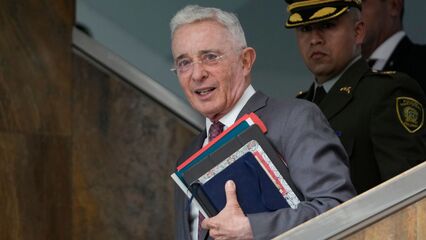
Colombia’s ex-President Uribe faces trial for witness tampering, fraud charges
Uribe’s critics have celebrated his trial as the deserved downfall of a man repeatedly accused of close relationships with violent right-wing paramilitaries, but never convicted of any crime.
The former leader, 73, and his supporters say the process is a persecution and that he is innocent.
Uribe and one of his lawyers, Jaime Granados, joined the hearing via videolink, while another lawyer, Jaime Lombana, appeared in person.
“This is not the end of this process, the appeal is next and we are going to demonstrate that this decision, which we respect, is wrong,” lawyer Juan Felipe Amaya, part of Uribe’s legal team, told journalists at the court.
Granados told the hearing that the presumption of Uribe’s innocence should be maintained and asked for him to remain free during the remainder of the process.
Both detractors and supporters gathered outside the court, with some Uribe backers sporting masks of his face.
Even if the conviction is eventually upheld, Uribe may be allowed to serve his final sentence on house arrest because of his age

Uribe’s trial triggered criticism from United States Secretary of State Marco Rubio. Uribe had a close relationship with the US during his two terms as president between 2002 and 2010, as right-wing governments in Latin America have often had.
“Uribe’s only crime has been to tirelessly fight and defend his homeland. The weaponisation of Colombia’s judicial branch by radical judges has now set a worrisome precedent,” Rubio said on X.
Colombian President Gustavo Petro, a leftist, defended the ruling, writing on X that “a strong justice system” will enable Colombia to emerge from violence. He added in another message that Rubio was interfering with Colombia’s sovereignty.
“A decision against the ex-president could generate some kind of reprisal by the government of the United States,” Banco de Bogota said in a note on Monday, referring to a proposal by US Republican lawmaker Mario Diaz-Balart to cut non-military aid to Colombia next year, partly on concerns of due process violations in the Uribe case.
Uribe, who was placed under house arrest for two months in 2020, is head of the powerful Democratic Centre party and was a senator for years both before and after his presidency.
He has repeatedly emphasised that he extradited paramilitary leaders to the US.
Colombia’s truth commission says paramilitary groups, which demobilised under deals with Uribe’s government, killed more than 205,000 people, nearly half of the 450,000 deaths recorded during the ongoing civil conflict.
In recent decades, right-wing paramilitary groups across Latin America – backed by the US – along with the armed forces of allied governments, have been responsible not only for killings, but also for forced disappearances, sexual violence, mass displacement, and other grave human rights abuses.


No comments:
Post a Comment