Friday, September 19, 2025


Divers Confirm Identity of Long-Lost Trawler on Georges Bank

Seiner's sister ship Harvard at time of launch (public domain / Boothbay Region Historical Society)

Published Sep 18, 2025 8:29 PM by The Maritime Executive


The private diving and artifact-recovery company Atlantic Wreck Salvage has discovered the wreck of the long-lost trawler Seiner, a large fishing vessel that went down off Nantucket in 1929. 

Seiner was a steam trawler delivered in 1921 and homeported out of New London, Connecticut. The 140-foot vessel departed on her final voyage on January 9, 1929, but disappeared after her normal noon report on January 18. The ship was never found, and a large-scale search and rescue effort turned up no sign of her crew of 21 men. It was believed that she went down in a storm on Georges Bank, which was (at the time) a bountiful fishing ground known for its cod and haddock stocks. 

In 2022, Atlantic Wreck Salvage's vessel Tenacious visited Georges Bank to conduct a sidescan sonar search for historic wreck sites. They found Seiner, though they did not yet know it for certain, and they had to return to shore before they had time to dive on the site. 

Tenacious and her crew returned to Georges Bank in July 2025 to resume their work. They carried out a dive inspection of the Seiner wreck on July 27-28, and from visible characteristics, it was possible to verify the wreck's identity.

“The team was able to identify Seiner from features such as the double drum trawl winch, remains of the raised forecastle deck, shape of the stern, and the presence of a steam engine and boiler,” said AWS' Captain Eric Takakjian in a release. 

Sadly, the company's founder and the skipper of Tenacious, Capt. Joe Mazraani, died on July 29 while identifying another wreck on Georges Bank. Mazraani's partner, criminal defense attorney and diver Jennifer Sellitti, continues to operate Tenacious as AWS' managing member. 


Study Supports Growing Case for Long-Term Use of Biofuel Blends

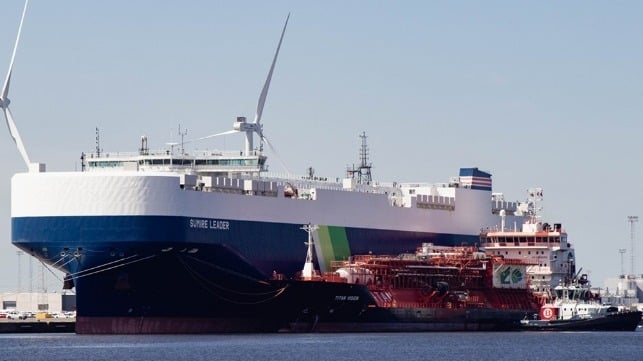
car carrier fueling
An NYK car carrier was used to test biodiesel an starting in July 2025 NYK reported it was adopting bio-LNG for its car carriers (NYK)

Published Sep 18, 2025 7:23 PM by The Maritime Executive


The maritime industry has undertaken a range of tests exploring the use of biofuels, blending fats with diesel to create a more environmentally friendly transition fuel, with the latest test confirming the long-term operational feasibility of biodiesel. The results conducted using an NYK car and truck carrier (PCTC) further confirm the viability of the fuel.

DNV highlights the potential for biofuels in its new Maritime Outlook report. While it acknowledges the challenges over future availability, DNV notes that biofuel is easy to use. Its case study also showed that biofuel would be more economical for operators than paying the proposed penalties in the pending IMO regulations.

The Singapore-based Global Centre for Maritime Decarbonisation released the report for its Project LOTUS (Long-term impact of continuous use of biofuels on vessel operations) study. Launched in May 2024, it was a six-month trial to assess the impact of continuous use of a B24 blend, comprising 24 percent fatty acid methyl ester (FAME or biodiesel) with very low sulfur fuel oil (VLSFO). 

The focus of the study was on engine performance and operations of the fuel oil delivery systems. According to GCMD, until now, the impacts of long-term use of biodiesel on main and generator engines, fuel storage and supply systems, and other shipboard components have not been comprehensively evaluated. Additionally, operational protocols for fuel conditioning, onboard storage, and comprehensive inspection checklists remain limited.

Project LOTUS was designed to address those gaps by implementing a structured monitoring approach to track fuel and lubricant quality at key sampling points across these systems, and inspect engine and fuel system components throughout the trial.

The report highlights that the continuous use of the fuel blend had no adverse impact on engine performance or the operation of the fuel oil delivery system. Further, the project developed a structured monitoring framework tailored for continuous biodiesel use.

“Project LOTUS grounds the conversation around the extended use of biofuels in evidence,” said Professor Lynn Loo, CEO of GCMD. “Our findings show that they can be deployed safely and reliably, providing a concrete pathway for shipping’s decarbonization.”

As part of the project, they tested 94 fuel and lubricating oil samples, along with conducting detailed engine inspections and measurements during the vessel’s dry dock overhaul. At the conclusion of the six-month study, the main engine on the NYK car carrier had operated for 2,888 hours and the auxiliary engine for 1,813 hours.

GCMD reports the engines performed comparably to when they operated in VLSFO. Key observations confirmed no excessive sludge in fuel injection valves, no scratches in fuel injection pump plungers, and no liner or piston wear beyond original equipment manufacturer (OEM) specifications. Scavenge drain and engine oil analyses also showed no excessive wear elements.

Another key concern, the impact of prolonged biodiesel storage, was tested with the report showing that the fuel quality remained within ISO 8217 specifications. They did find that the acid value of B24 blends increased 2.5-fold after six months of storage, but no microbial growth was observed in fuel samples.

OEMs also confirmed engine and hardware compatibility with long-term B24 use, with no significant impact on operational costs, provided appropriate maintenance and handling practices are followed. Further, they conducted interviews with other vessel operators using biodiesel and found similar results. 

Further, the report notes that while OEMs and classification societies take an abundance-of-caution stance, the vessel operators surveyed have adopted a more pragmatic, risk-based strategy to adopting biodiesel blends by adapting existing standard operating procedures for VLSFO with recommended technical guidance where practicable. The report concludes that this suggests that when operators carry out appropriate operations in line with such guidance, biodiesel use does not present major issues.


Cruise Ship Transits the Suez Canal Bound for Saudi Arabia

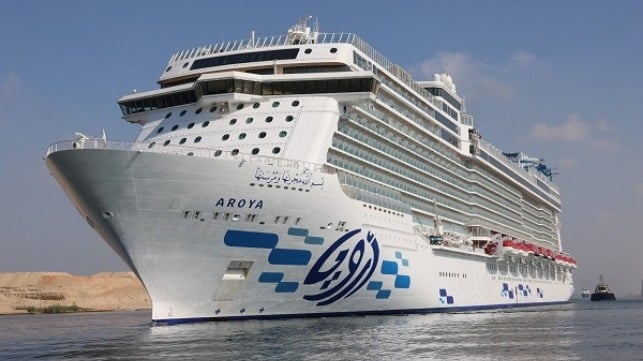
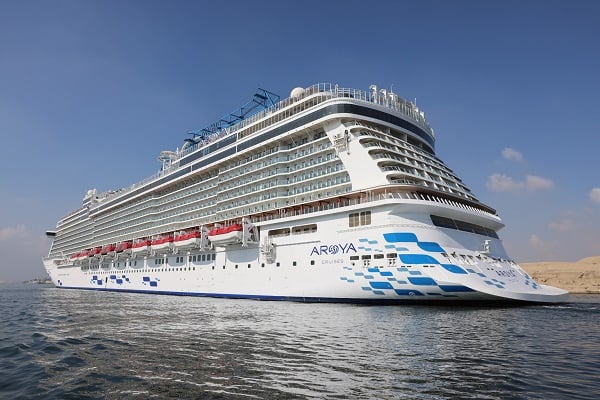
cruise ship Suez Canal
Aroya transited the Suez Canal bound for Saudi Arabia and in February plans to sail to Dubai (Suez Canal Authority)

Published Sep 18, 2025 8:52 PM by The Maritime Executive


The cruise ship Aroya, which was launched by  the Cruise Saudi initiative, made what has become a rare transit of the Suez Canal for ships with passengers. Like all the other segments of the shipping industry, most cruise ships began diverting away from the Red Sea in 2024 and have yet to return due to the continuing security threat from the Houthis.

The Suez Canal Authority highlighted that the 151,000 gross ton cruise ship made the transit on Wednesday, September 17, traveling from Istanbul with approximately 2,300 passengers and 1,500 crew aboard. It will be making a stop in Sharm El-Sheikh, Egypt, before completing the cruise in Jeddah, Saudi Arabia. 

The cruise ship is scheduled to spend the first part of the winter season operating from Jeddah. In February 2026, it is scheduled to transit the Red Sea, passing Yemen, bound for Dubai. It will make the return trip in the spring of 2026 as it repositions back to the Mediterranean for summer cruises.

The ship is registered in the Marshall Islands, but its association with the Saudis is well known, who are considered to be enemies by the Houthis. The ship had previously made the Suez Canal transit in December 2024 on its pre-maiden voyage delivery run from Germany, where it was refitted for Aroya Cruises before its maiden voyage, and again in June 2025 when it repositioned into the Mediterranean for the summer season.


Built by Germany’s Meyer Werft, the cruise ship operated from 2017 till the financial collapse of Genting Hong Kong for its Dream Cruises as the World Dream. It cruised in Asia until it was laid up in March 2022. It was acquired by Cruise Saudi, which relaunched at the end of 2024 as a ship specifically designed for the Saudis and the Arab world. It has a capacity to carry over 3,300 passengers when full.

The Suez Canal Authority highlighted the transit as part of its marketing efforts to restore vessel traffic. The Chairman and Managing Director of the Suez Canal Authority, Admiral Ossama Rabiee, highlighted the authority’s marketing efforts and toll reductions and incentives available for cruise ships. He said they have flexible marketing policies for cruise ships.

The Suez Canal had been a popular point for the cruise industry, with Rabiee highlighting that 69 cruise ships made the transit between 2021 and 2024. He said approximately 38,000 passengers had transited the Suez Canal on these ships, and it provided approximately $15.8 million in revenue for the authority.

Cruise ships, however, have continued to reposition to avoid the Red Sea dangers. Italy-based Costa Cruises announced in July that it was canceling its planned cruises from the Middle East scheduled for the winter of 2025-2026. MSC Cruises announced last week that it was canceling a planned 25-day cruise between Dubai and the UK, and it has also again rerouted its world cruise to travel around South Africa. MSC Euribia will be sailing without passengers from Germany to reposition to Dubai, where it is due to start cruising in November.

Dubai had been a popular winter homeport for cruise ships, and most world cruises transited the Suez Canal. The Suez Canal Authority, however, remains optimistic that it will be able to rebuild the cruise segment of its operations. 


Dutch Expand Emission-Free Inland Shipping with Swappable Battery Packs

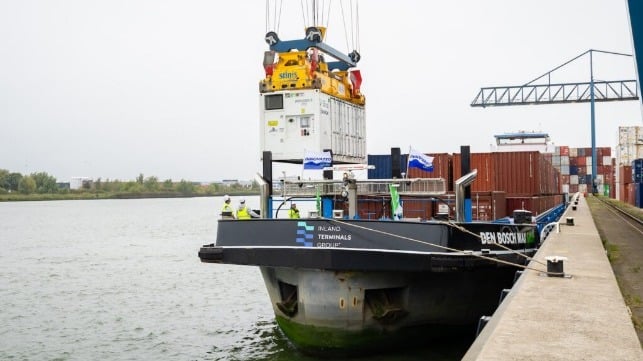
battery powered inland cargo ship
Swappable battery pack being placed on the Dutch inland cargo vessel (ZES)

Published Sep 18, 2025 9:32 PM by The Maritime Executive


Zero Emission Services (ZES), working in collaboration with Nefcargo and Inland Terminals Group, highlighted the launch of its ZES 2.0 service for electric-powered inland cargo shipping. The next phase of the program provides more powerful containerized batteries for the inland ships, which will provide a more economical model for the industry.

The 2.0 Zespacks are swappable battery containers. The company rolled out swapping stations on September 17 at Alphen aan den Rijn, Alblasserdam, and Den Bosch in the Netherlands. It reports that more terminals will soon follow in Rotterdam, Moerdijk, and Nijmegen, with the goal of establishing a robust network that makes battery-electric inland shipping more accessible.

The vessels swap the batteries instead of having to wait longer periods to recharge their power systems. It expedites shipping. They also only pay for the power used, which ZES says makes battery-electric sailing financially more attractive. A subsidy scheme is also available for shipowners converting to battery power.

The first vessel to adopt the exchangeable battery containers is the Den Bosch Max Groen. It was built by Concordia Damen and delivered in January 2021 as the second of two electric-powered inland cargo ships. Both vessels are 90 meters long and 11.5 meters wide (approximately 295 x 38 feet), with the shipbuilder highlighting that the dimensions are the maximum required to pass through the locks of the Dieze Canal at Engelen. Using an innovative design, they were able to give each vessel a capacity of 132 TEU, which is 24 more TEUs than the previous inland vessels.

The first phase of the battery-powered shipping was launched as a partnership to transport cargo for the beer company Heineken. Nedcargo transports approximately 2.5 billion bottles of Heineken beer annually to the ports of Rotterdam and Antwerp. The battery-powered operation cuts CO2 emissions by 800 tonnes per year.

The vessel will be operating between Den Bosch and the Port of Rotterdam. The trip is approximately 60 miles in each direction.

ITG highlights that the new battery operation is part of its broader scheme to transition. Eduard Backer, CEO of ITG, explains, “Alongside this battery-electric vessel, our group also operates a hydrogen-powered ship. Hydrogen is suited to longer distances, while battery containers are ideal for shorter shuttle services. Waterborne transport is the path to a lower footprint. And with the upcoming CO2 levy (ETS-2), this will also bring financial benefits for shippers.”


Bigscale pomfret are an ocean enigma


WHOI scientists delve into the elusive fish’s role in the food web


Peer-Reviewed Publication

Woods Hole Oceanographic Institution

Pomfret are an ocean enigma 

image: 

Scientists followed the movements of big-scale pomfret by fitting them with satellite-based tracking tags and releasing them back to the ocean.

view more 

Credit: (Photo courtesy: Danny Mears)


Woods Hole, Mass. – Woods Hole Oceanographic Institution (WHOI) researchers have shown large sharks can spend hours deep in the oceans' mesopelagic zone, which lies 200 to 1,000 meters (650 to 3,300 feet) below the surface. This region is home to more biomass than any other layer of the ocean, but most of its inhabitants are too tiny to serve as meals for large predators, so why are they spending so much time there?

A new study published in Marine Ecology Progress Series highlights the important roles of mid-sized predators, such as bigscale pomfret, linking the upper and lower layers of the ocean foodweb. Until now, scientists didn’t have enough data on how this fish—and similar species—move, making it hard to understand their behavior and role in the ecosystem. In this study, researchers used satellite-based tracking tags to follow the pomfret’s movements, something that was previously hard to do with deep-sea fishes.

“The data shows bigscale pomfret are permanent residents of the ocean’s twilight zone, and follow the pattern of diel migration. This means they stay deep during the day and come to shallower waters to feed at night,” said Martin Arostegui, lead author of the study and a research associate at WHOI. “Since these species spend a majority of their life on the move and in hard-to-reach places, it wouldn’t have been possible for us to tag enough of them during a few days at sea. Thus, we collaborated with a commercial longline fisher, Captain Danny Mears, who did that work as part of our research team.”

"Bigscale pomfret are so different from the tunas and swordfish we usually catch that we are fascinated by them whenever they show up in our gear," Mears said. "My crew and I were excited for the opportunity to help with the satellite tagging for this study. It's been very rewarding to see the data."

This new research also provides insight into how water clarity affects bigscale pomfrets' migration patterns. When the fish moved from the Slope Sea to the clearer waters of the Sargasso Sea, their behavior changed noticeably. This indicates that water clarity influences the depth these fish occupy, which could impact food webs by changing the prey they target and their susceptibility to predators such as large sharks.

“We always talk about the mesopelagic layer like it’s this giant buffet for big predators—but we’ve been skipping over the species in the middle,’ said WHOI biologist Camrin Braun, the senior author of the study and principal investigator of WHOI’s Marine Predators Group. “These mesopelagic fish are doing the hard work of connecting the deep ocean to the surface food web. If we don’t understand them, we’re basically trying to solve a puzzle with the middle pieces missing.”

 ###

About Woods Hole Oceanographic Institution

Woods Hole Oceanographic Institution (WHOI) is a private, non-profit organization on Cape Cod, Massachusetts, dedicated to marine research, engineering, and higher education. Established in 1930, its mission is to understand the ocean and its interactions with the Earth as a whole, and to communicate an understanding of the ocean’s role in the changing global environment. WHOI’s pioneering discoveries stem from an ideal combination of science and engineering—one that has made it one of the most trusted and technically advanced leaders in fundamental and applied ocean research and exploration anywhere. WHOI is known for its multidisciplinary approach, superior ship operations, and unparalleled deep-sea robotics capabilities. We play a leading role in ocean observation and operate the most extensive suite of ocean data-gathering platforms in the world. Top scientists, engineers, and students collaborate on more than 800 concurrent projects worldwide—both above and below the waves—pushing the boundaries of knowledge to inform people and policies for a healthier planet. Learn more at whoi.edu.


New research shows how plant roots bend and growth downward toward gravity


University of Nottingham
Gravity Root 

image: 

How roots bend in response to gravity stimulus in normal and mutant plants.


view more 

Credit: University of Nottingham


Scientists have uncovered how the plant hormone auxin helps roots bend and downwards towards gravity – a process called gravitropism - even after encountering obstacles in soil. 

Experts from the University of Nottingham’s School of Biosciences and Shanghai Jiao Tang University (SJTU), identified how auxin activates a specific gene, which strengthens cell walls on the lower side of the root. This reinforcement prevents growth below while allowing cells above to expand, making the root bend downward. The findings have been published today in Science Advances.

Root gravitropism, which shapes root angle and overall root system, occurs because cells on the upper and lower sides of roots expand differently in response to gravity. Dr Rahul Bhosale, Associate Professor in the School of Biosciences co-led the study with Dr. Guoqiang Huang at SJTU, said: “Until now it was unclear how auxin inhibits cell expansion on the lower side of roots. Our research resolves this longstanding question by showing that auxin promotes cell wall biosynthesis, strengthening the walls to block growth on the lower side. This dual mechanism explains auxin’s seemingly opposite roles in promoting and inhibiting cell elongation.”

This research expands the teams earlier work showing that the hormone abscisic acid (ABA), which helps plants respond to drought, changes root growth angles by affecting auxin levels during water stress. Together, these discoveries give a clear picture how roots sense their environment and adjust their growth direction.

Dr Bhosale added: “We already knew that auxin is important for root gravitropism, but for a long time, we did not know what acts downstream of auxin. That is what we have uncovered in this new research which is important for fundamental understanding of how the root system works. Understanding the role of hormones in this much detail opens up possibilities for engineering crops that are stress resistant and can overcome obstacles in the soil.”


Pioneering research reveals problem gambling quadruples the risk of suicide among young people four years later


University of Bristol


New research has shown how harmful gambling is clearly linked to a marked and long-lasting increase in suicide attempts among young people in the UK.

The study, by researchers at the University of Bristol, found that compared to someone who experiences no gambling harms, problem gamblers face triple the suicide risk one year later, and quadruple the risk four years on.

Researchers analysed data from 2,801 people in the renowned Children of the 90s study, which has followed the health and development of 14,000 pregnant women and their families since the early nineties, and which continues to follow their lives.

Lead author Olly Bastiani, PhD researcher at the University of Bristol Translational and Applied Research Group, said: “This study tracked people from birth, meaning we could look at the long term impacts of problem gambling, and could rule out alternative explanations that hinder previous studies, such as that people might be drawn to problem gambling as a way of escaping pre-existing suicidal feelings.”

The Problem Gambling Severity Index (PGSI) is the questionnaire most commonly used to assess harmful gambling, with a score of eight and above indicating problem gambling. The future suicidality link was most stark among 20-year-olds, where there was a 20% increase in suicide attempts for every increment on the PGSI, meaning that those scoring eight and above experienced quadruple the rate of suicide attempts four years later.

Senior author Dr Philip Newall, a lecturer in Psychology at the University of Bristol and world-leading expert in gambling harms, said: “The people in this study were growing up at a time when gambling was less accessible and visible than it is today. This shows that much more needs to be done to prevent the next generation from experiencing these gambling harms.”

Research shows one in five members of the UK population are currently being harmed – either directly or indirectly – by gambling, and up to 496 suicides are linked to gambling every year in England. A recent report estimated the economic costs associated with gambling harm to be £1.77 billion.

The researchers say these latest findings, published in the journal Addiction, highlight a pressing need for much more advice and support for young people at an early stage.

Dr Newall said: “Gambling is a part of the government’s suicide prevention strategy, and these results help underscore the need for additional population-wide measures to prevent gambling harms, such as meaningful restrictions on gambling advertising.”

The Bristol Hub for Gambling Harms Research, based at the University of Bristol, is a global hub for interdisciplinary research, which aims to raise awareness of gambling harms, strengthen consumer protection through policy change, and improve support and treatment.


Penn Medicine joins national effort to digitally map the human body


NIH-Funded Whole Person Physiome Center will unite experts nationwide to create AI-ready models of physiology for research and clinical care


University of Pennsylvania School of Medicine


PHILADELPHIA— Researchers from the Perelman School of Medicine at the University of Pennsylvania are joining a national collaboration to launch the Whole Person Physiome Research and Coordination Center (WPP-RCC), an initiative funded by the National Institutes of Health (NIH) to create the first comprehensive digital map of the healthy human body. The effort will bring together leading experts in physiology, precision medicine, and computational biology to evolve our understanding of human health. The WPP-RCC is supported by 21 NIH institutes and offices as part of the NIH Whole Person Initiative and is overseen by The National Center for Complementary and Integrative Health.

“This initiative represents a bold step forward in how we study and model human physiology,” said Katalin Susztak, MD, PhD, a professor of Nephrology, Genetics and director of the Penn/CHOP Kidney Innovation Center, who will serve as one of the principal investigators of the WPP-RCC, alongside researchers from the Stanford School of Medicine, Indiana University, and Liming Pei, PhD, an associate professor of Pathology and Laboratory Medicine at Penn and an investigator in the Children’s Hospital of Philadelphia (CHOP) Research Institute.

 “By integrating clinical data, computational modeling, and physiological processes, we aim to build a dynamic, AI-ready resource that will empower researchers and clinicians to better understand health and disease,” said Pei.

How it works

The Whole Person Physiome map will combine how the body works with medical data like test results and vital signs. It’s being designed so that computers and artificial intelligence can easily access it. There will also be computer models and graphics showing what a healthy person looks like, along with clear visuals and helpful tools. Ideally, doctors and scientists will be able to enter patient or research data into the system and see how changes—like a disease or treatment—might affect the body as a whole.

A place for expert collaboration

The WPP-RCC will coordinate a multi-tier network of clinical and scientific experts to construct the Whole Person Physiome map. It will serve as the central hub for collaboration, consensus-building, and integration with other large-scale efforts in organ and molecular modeling, and tool development.

By design, the WPP-RCC will be open and collaborative, inviting researchers across domains to contribute to the Whole Person Working Group and to apply WPP resources to their own studies. Annual data jamborees will foster community engagement, while close integration with NIH stakeholders will ensure alignment with evolving research priorities.

The WPP-RCC represents a major step toward digitizing human physiology as an evolving resource — one that will empower discovery and inspire new therapies.

###

Penn Medicine is one of the world’s leading academic medical centers, dedicated to the related missions of medical education, biomedical research, excellence in patient care, and community service. The organization consists of the University of Pennsylvania Health System (UPHS) and Penn’s Raymond and Ruth Perelman School of Medicine, founded in 1765 as the nation’s first medical school.

The Perelman School of Medicine is consistently among the nation's top recipients of funding from the National Institutes of Health, with $580 million awarded in the 2023 fiscal year. Home to a proud history of “firsts,” Penn Medicine teams have pioneered discoveries that have shaped modern medicine, including CAR T cell therapy for cancer and the Nobel Prize-winning mRNA technology used in COVID-19 vaccines. 

The University of Pennsylvania Health System cares for patients in facilities and their homes stretching from the Susquehanna River in Pennsylvania to the New Jersey shore. UPHS facilities include the Hospital of the University of Pennsylvania, Penn Presbyterian Medical Center, Chester County Hospital, Doylestown Health, Lancaster General Health, Princeton Health, and Pennsylvania Hospital—the nation’s first hospital, chartered in 1751. Additional facilities and enterprises include Penn Medicine at Home, GSPP Rehabilitation, Lancaster Behavioral Health Hospital, and Princeton House Behavioral Health, among others.

Penn Medicine is an $11.9 billion enterprise powered by nearly 49,000 talented faculty and staff.