Friday, September 19, 2025


MAIB Cites Mechanical Failures, Modifications, and Crew Response to Fire
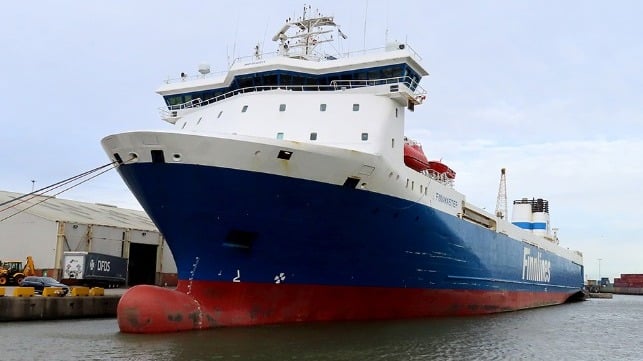
RoRo cargo ship
Finnmaster sustained significant fire damage due to a 2021 incident (MAIB report)

Published Sep 18, 2025 5:07 PM by The Maritime Executive


The UK’s Marine Accident Investigation Branch issued a report on a 2021 fire aboard a RoRo cargo ship as it was departing the Port of Hull, England. It found a broad series of mechanical failures, improper parts used in non-standard modifications, and a failure by the crew to “follow accepted procedures,” which contributed to the significant damage to the vessel’s auxiliary engine room. However, there was no loss of life, and the vessel was recovered and moved back to the dock despite these issues.

The cargo RoRo Finnmaster (8,800 dwt) was built in 1998 and operated on a regular route between Hull and Helsinki, Finland, for Finnlines, carrying RoRo and containerized cargo. The ship had a crew of 16 aboard and was making its normal departure from Hull when, eight minutes after leaving the dock on September 19, 2021, smoke alarms sounded and a fire was discovered in the auxiliary engine room. The ship was still within the confines of the harbor and, within four minutes, lost all main electrical power and propulsion, leaving it drifting while the crew struggled to put out the fire.

Eleven minutes after the Finnmaster had left the dock, the first of two tugs was alongside, followed by a second one in an additional 11 minutes. They had the ship back alongside a dock approximately 50 minutes after it had cast off. The crew had finally been able to extinguish the fire through a combination of the CO2 system and entering the space with dry powder extinguishers. 
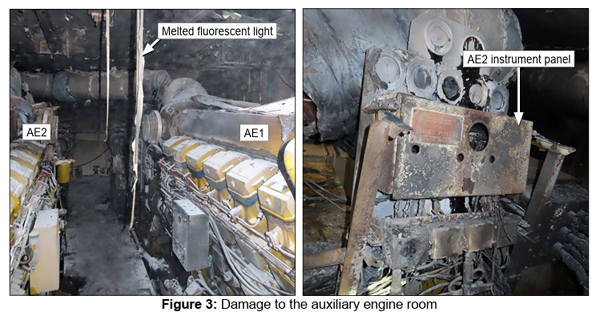
 

(MAIB report)


MAIB found in its investigation that the fire started when one of the auxiliary engines malfunctioned, causing hot exhaust gas to impinge on a flexible hose, which then failed and leaked fuel under pressure onto a hot component. They concluded that the hose had been installed in the fuel system during a modification that “did not meet the required standard” and that it was fitted “in an inappropriate position.” The class society, RINA, had not had oversight or approval for the modification.

Once the fire started, other mechanical failures resulted as they sought to respond to the growing emergency. The emergency generator’s circuit breaker malfunctioned, so it could not be connected to the power supply. The CO2 fire-extinguishing system failed to fully operate due to a defective flexible hose assembly and leaks in the pilot system. The ultrahigh-frequency handheld radio system being used by the engineers failed, cutting off communication to the master on the bridge.

The 167-page report also highlights actions by the crew who attempted to enter the auxiliary engine room with dry powder extinguishers but were forced out by the heat. Some crew remained at their operational stations, and some went to emergency muster stations. The electrician attempted to restore power, but the crew was working with flashlights. Some of them attempted to re-enter the auxiliary engine room when they discovered not all the CO2 bottles had activated. They reported remnants of a small fire and, wearing compressed air breathing apparatus, re-entered and extinguished the fire with a dry powder extinguisher. The report says the crew’s response, affected by the loss of critical safety systems, was “ineffective.”

MAIB made a total of 12 recommendations, split between the Finnish administration as the ship’s flag state, the owners Finnlines, and RINA, the responsible class society. They called for IMO amendments and guidance on the testing of emergency power and radio systems, as well as fire-extinguishing systems. To the shipping company, they recommended revised and updated training, response, and defect reporting procedures.  They recommended that RINA make a recommendation to the International Association of Classification Societies for an urgent review into the procedural requirements for service supplies conducting maintenance of fire protection systems, and the guidance on support provided to chief engineers.

The vessel sustained significant damage to equipment in the auxiliary engine room. The heat from the fire melted plastic components and damaged wiring. Smoke damage, however, was limited largely to the compartment. The ship was repaired but from to Grimaldi the following year. It continues in service managed since 2024 by Balearia. 


Iranian Oil Exports to China are Back on the Rise

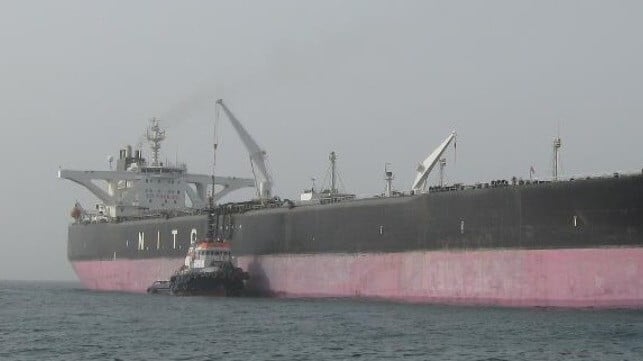
An Iranian tanker in calmer times, before sanctions (NITC)

Published Sep 18, 2025 4:01 PM by The Maritime Executive


After a period from March to May in which Iranian exports of crude oil to China fell substantially, in the three months from June to August sales have resumed their upward trend.

According to Kpler, Chinese ports unloaded 1.68 million barrels per day in August, an increase of more than 20% over offloading in July. The August figure was well above the average of 1.45 million bpd for the first eight months of 2025. While monthly figures can be erratic, Iranian sales to China appear to be on an upward trend. However, this may not be translating into increased revenues for Iran, as market prices for crude have fallen with supply still expanding faster than demand, despite Russia’s export difficulties. Iran is having to offer discounts of about $5 per barrel in order to tempt the Chinese purchasers to ignore the potential risks of US sanctions.

Iranian crude exports to China from Kpler and Vortexa estimates (CJRC)
The increase in crude shipments comes notwithstanding a substantial increase in sanctions listings, both of ships, shipping agents and offload crude terminals in China, from the US authorities but also from the EU and UK. The brutal fact however is that sanctions on the Iran to China shipping operation are largely ineffective when all elements of the supply chain are either Iranian-owned, or owned by Chinese companies who can happily carry on business because they operate within China’s internal market, or enjoy the blessing of the Chinese government. Sanctions discourage the involvement of legitimate companies in the trade, but there are sufficient numbers of unscrupulous operators attracted by the heightened profit margins to keep the operation in train. Fictitious companies and registrations may be detected and such entities sanctioned, but by that point the beneficial owners will have long since shuttered whatever has been sanctioned, and got out the paint pot to put a new name on a successor company.

Indeed, it could fairly be said that many of the government sanctions programs are political window-dressing, with no realistic prospect of being effective - save in deterring legitimate operators from taking part in the trade, to the benefit of cowboy operators instead. Winning the prize for ineffectiveness is the UK program, which despite listing hundreds of entities has failed to impose any penalty this year (or since records began) for breach of Iranian sanctions, though it has levied fines of $1 million for breaches of Russian-related sanctions.

The news is not entirely bleak, however. Attacking the supply chain directly is likely to remain ineffective, at least until consideration is given to resuming seizures of ships and cargos at sea, as last occurred in 2023. But linking breaches of sanctions to imposition of tariffs could encourage governments to go along with the sanctions - except that leaders of most of the countries concerned stood alongside each other in solidarity at the recent military parade in Beijing to celebrate the end of the Second World War in Asia.

The opinions expressed herein are the author's and not necessarily those of The Maritime Executive.


Real-Time Engine Oil Quality Monitoring is Now in Reach

iStock
iStock

Published Sep 18, 2025 6:24 PM by The Maritime Executive


Lube oil contamination is one of the fastest ways to get into trouble in the engine room, and engineers monitor their oil closely for signs of problems. But it's hard to catch everything without a lab on board - at least, until recently. Castrol has come up with a new solution, SmartMonitor, that regularly checks the oil's properties and lets the crew (and shore staff) know about any developing issues. To find out more, TME caught up with Castrol Technical Service Manager, Are Sletten, who has been working with the product throughout early trials. 


Just for background, what's the standard process for analyzing engine oil?


What happens normally on board the vessel is that an engineer takes a physical oil sample in a bottle and repeats the process once every three months. They will ship it to the laboratory. It takes two to three weeks before you get a reply, because it takes time for shipping and there is processing time at the lab. And then it will be checked and the results will be sent. 


How does Castrol's new equipment do it differently?


The SmartMonitor unit will give you the same information as a lab report, but every hour. It will automatically take a sample from the main engine, run it through the unit, and then drain it back into the engine. 


SmartMonitor will give you the total base number, viscosity, oxidation, and water content, when used in an engine application. There is a display on the unit that the engineer can have a look at to see if everything is okay, but the unit also feeds data up to the cloud, and then the customers on shore can go into our website and view the results. They have access to the graphs, the trends, the alarm limits, and all of that. So, if you want to go back and see if something happened last week, you could go back and see the trend. 


What can this help prevent? How does it save the operator money?


It's sort of like insurance: you might not need it, but in the event you do, then it will more than pay for itself. First, if you detect any water early, that's very valuable because of the damage that water ingress can do to an engine. The second most important factor is viscosity, especially when customers are considering new fuels. Fuel oil is always affecting the lube oil in the engine. In this time when people are testing biofuels, ammonia and methanol, having this on board is a valuable way to make sure that the fuel is not causing problems.


For example, if there is a little bit of methanol fuel getting into the engine oil, the viscosity will go down, and then you lose your lubrication. If you lose the lubrication film, you might end up with bearing damage. This unit will tell you instantly if viscosity is going down and of course it has a low-level alarm to alert the engineers. At the same time, company managers on shore can get the alert via email or on the phone as a text message.  


Even if you're not paying attention, it's watching the engine every hour. It's a huge help for inexperienced engineers, and it takes a bit of stress off for senior engineers as well. 


Do you have any early success stories? 


We have done trials for several years and we have prevented engine damage. With one customer, the unit gave an alert that there was water in the engine oil. The engineers thought it was a faulty sensor and believed the unit was wrong, but we asked them to check anyways. They found that there was water in the oil, and because our SmartMonitor caught it early, they were able to fix the problem at lower cost. The customer then bought several more of our SmartMonitor units for their other vessels.

-TME