It’s possible that I shall make an ass of myself. But in that case one can always get out of it with a little dialectic. I have, of course, so worded my proposition as to be right either way (K.Marx, Letter to F.Engels on the Indian Mutiny)
Friday, September 19, 2025
MERIT IS D.E.I.
BHP likely to name first female CEO in its 140-year history, FT reports
By Reuters
September 19, 2025
A view shows the BHP Limited logo at their headquarters in Melbourne, Australia, March 24, 2025. REUTERS/Hollie Adams/ File Photo Purchase Licensing Rights, opens new tab Companies
Sept 19 (Reuters) - BHP Group (BHP.AX), opens new tab is likely to appoint Geraldine Slattery, the head of its Australia operations, as its first female chief executive in its 140-year history, the Financial Times reported on Friday. If appointed, Slattery will be one of only a handful of female CEOs at major global mining firms, with a previous notable name being Cynthia Carroll, the first woman to run Anglo American (AAL.L), opens new tab for five years until 2012.
BHP CEO Mike Henry is expected to step down by the middle of 2026 after five years at the helm, the report said, citing unnamed people "familiar with the board's thinking". According to the FT report, the company has said its board was "not in a rush" to make a change.
BHP declined to comment on the matter in an emailed response to Reuters. Slattery has been at BHP for three decades and previously led the company's U.S. petroleum business.
Other notable female mining top bosses include Mpumi Zikalala, CEO of Kumba Iron Ore (KIOJ.J), opens new tab in South Africa, and Mfikeyi Makayi, CEO of the Zambia copper unit of KoBold Metals.
BHP, the world's biggest listed miner, regularly rotates top talent through key roles, with internal CEO candidates being mentored for years by the chair and some board members as a sort of pre-screening, a source familiar with the company told Reuters in May. Peer Rio Tinto (RIO.AX), opens new tab also has a new chief executive and appointed insider Simon Trott to the top job in mid-July. Trott earlier headed the company's most profitable iron ore unit.
Reporting by Shivangi Lahiri in Bengaluru; Editing by Leroy Leo and Pooja Desai
Column: Aluminum’s years of plenty are drawing to a close
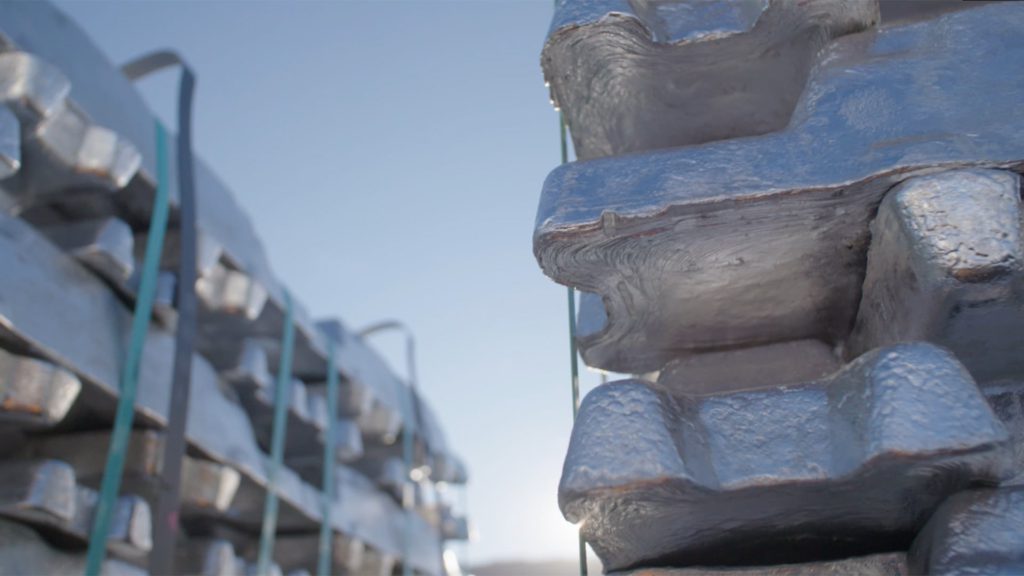
The global aluminum market has been in structural supply surplus for so long that it’s hard to imagine a genuine shortage of the light metal.
Sure, there have been periodic squeezes on the London Metal Exchange (LME) contract over the years and another one is roiling the market right now.
But these have been clashes between traders and banks tussling over control of LME inventory. The stocks financing trade, and its multiple warehousing spin-offs, is predicated on there being lots of surplus metal to play with.
That, however, may be changing.
Indeed, if you believe Citi, this is a market that is “sleepwalking into the biggest deficits in 20 years”.
It’s a punchy call, as is the bank’s expectation that the price will have to rise from its current level around $2,700 per metric ton to over $3,000 and stay there to stop the world running out of metal.
So how come a market defined by historical excess is now facing imminent shortfall?
China’s production of primary aluminum 2020-2024
China hits the ceiling
The answer lies in China.
China’s production of primary aluminum has grown from four million tons in 2002 to 43 million tons in 2024. The country now accounts for 60% of global output.
China has also become the world’s largest aluminum consumer over the same time-frame but persistent over-production has spilled out in the form of semi-manufactured products. Exports last year hit a new record of 6.7 million tons.
China, however, is fast approaching peak aluminum thanks to the government’s mandated capacity cap of 45 million tons per year. August output was equivalent to 44.5 million tons, according to consultancy AZ Global.
Some further output flex is possible if operators increase smelter amperage. But with Beijing showing no sign of adjusting the cap, the country’s seemingly relentless production growth is shuddering to a halt.
China’s imports of primary aluminum
China’s aluminum trade patterns are adjusting to the new reality.
Exports of products such as rod, tube and foil fell by 9% year-on-year in the first seven months of the year. Imports of primary metal, on the other hand, rose by 11% to 1.5 million tons on the back of a near doubling in shipments from Russia.
Stocks depletion
Sanctions on Russian aluminum mean the metal can’t be delivered to the LME if it was produced after April 2024, which is why so much is now going to meet China’s import demand.
The diversion of what was once one of the exchange’s main sources of physical liquidity has contributed to falling exchange stocks.
What’s noticeable, though, is the absence of any significant new inflow from other sources even though the market has been in the grip of a dominant long position since May.
LME registered and off-warrant aluminum stocks
The warranting of 156,000 tons of aluminum between the end of June and the middle of August flattered to deceive.
Just about all the metal that “arrived” was drawn down from off-warrant stocks in the LME system.
Total LME aluminum stocks, registered and off-warrant, have held steady just above the 700,000-ton mark since May. There were over a million tons this time last year. Four years ago there were over three million tons.
The stocks games are continuing, judging by the cancellation of almost 100,000 tons earlier this month, but the exchange liquidity pool is much smaller than it once was.
All eyes on Indonesia
It is the combination of stalled production growth in the world’s largest supplier and low exchange inventory that has got analysts such as Citi reassessing aluminum’s outlook over the coming years.
Outside of China, primary aluminum production has been in long-term decline, not least due to China’s massive exports, long a bone of contention with Western governments.
True, US President Donald Trump’s decision to hike US import tariffs to 50% may encourage some limited restarts of smelter capacity in the United States.
But elsewhere others are struggling to stay afloat in the face of high energy costs. South32 warned last month that it may close its smelter in Mozambique if it can’t secure a viable power contract by the end of next year.
New primary supply hopes rest almost exclusively on Indonesia, where Chinese companies are investing in new smelters in a collective off-shoring from capacity-capped China.
On paper the project pipeline could deliver seven million tons of new capacity over the second half of this decade. In reality, that’s highly unlikely.
New aluminum smelters will either have to compete with other sectors for energy supplies or build their own captive power plants.
Current pricing makes the latter challenging, according to Citi, which expects Indonesian capacity to reach only 2.3 million tons per year by 2030.
Crisis of a different kind
That may not be enough to keep up with global demand growth, which is getting a booster from aluminum’s usage in energy transition sectors such as solar and electric vehicles. Hence Citi’s call for a structural shift to higher pricing over a five-year horizon.
The concept of a deficit market is a novelty for the aluminum market.
Past crises have been caused by too much rather than too little metal.
Back in the 1990s it was the flood of aluminum that poured through the broken Iron Curtain after the collapse of the Soviet Union. This century it’s been China’s massive over-production that has led to low prices and a string of smelter casualties in the rest of the world.
The next aluminum crisis, though, is shaping up to be altogether different.
(The opinions expressed here are those of the author, Andy Home, a columnist for Reuters.)
The EU is wrangling over its climate targets with the clock ticking down on a key UN deadline - Copyright AFP NICOLAS TUCAT
Adrien DE CALAN, Umberto BACCHI
EU countries will seek Thursday to settle on an emissions-cutting plan to bring to a key UN conference in Brazil, as divisions on the bloc’s green agenda threaten its global leadership on climate.
Environment ministers for the 27-nation bloc are gathering in Brussels with the clock ticking down on a United Nations deadline to produce plans to fight global warming for 2035.
One of the world’s biggest greenhouse-gas emitters behind China, the United States and India, the EU has to date been the most committed to climate action, by some margin.
As such the bloc was hoping to pull ahead and derive its submission to November’s COP30 climate conference from a more ambitious 2040 goal.
But that is yet to be agreed by member states, leaving Brussels scrambling for a last-minute solution.
Denmark, which holds the EU’s rotating presidency, has suggested submitting to the UN a “statement of intent”, rather than a hard target.
That would include a pledge to cut emissions between 66.3 percent and 72.5 percent compared to 1990 levels — with the range expected to be narrowed down at a later stage.
“This approach would ensure that (the) EU does not go to (the) UN Climate Summit empty-handed,” said a spokesperson for the Danish presidency of the European Council.
But even that is hardly a done deal and talks on Thursday could prove lengthy. One European diplomat suggested reporters prepare “a sleeping bag”.
– ‘Better than nothing’ –
The nearly 200 countries party to the 2015 Paris Agreement on climate action were supposed to put forward updated policies in February, providing a tougher 2035 emissions reduction target and a detailed blueprint for achieving it.
But only a handful made the deadline, since extended to September — still allowing plans to be assessed before COP30 starts on November 10, in the Brazilian city of Belem.
While not as good as a formal submission the “statement of intent” was “much better than nothing”, said a senior EU diplomat.
“It sort of saves the EU face at international level,” added Elisa Giannelli, of the E3G climate advocacy group.
The UN has pushed for world leaders, among them EU chief Ursula von der Leyen, to announce their commitments at the General Assembly in New York next week.
The EU has set a goal of becoming carbon neutral by 2050 under its so-called European Green Deal, and says it has already cut emissions by 37 percent compared to 1990.
But climate has increasingly taken a backseat in Brussels, as political winds turned.
With wars in Ukraine and the Middle East, security and defence are now top of mind, said Linda Kalcher, director of the Strategic Perspectives think tank, noting that EU leaders’ talks on climate are much less frequent now.
Right-wing electoral gains in several member states and the European Parliament have curbed ambitions, and the European Commission has pivoted to boosting industry, faced with fierce competition from China and US tariffs.
– ‘Short-sighted’ –
That was where the commission’s proposal to cut emissions by 90 percent by 2040, which was to inform the UN goal, got bogged down.
Denmark and Spain are among those pushing for approval. But others, like Hungary, the Czech Republic and Poland, think it over-ambitious and detrimental to industry.
France, which is suffering from shaky finances and a prolonged political crisis, wants more clarity on the investment framework to support decarbonisation before committing.
“We are not living in a European Green Deal era anymore,” said Giannelli.
Rather than seeing climate action as “an opportunity for international trade, economic growth, and competitiveness”, some nations have taken the “short-sighted view” that it is a costly exercise benefiting “only climate”, she said.
Last week, Paris and Berlin called for the 2040 target to be discussed at a leaders’ summit in October — effectively pushing back a decision that the commission had hoped could have been reached Thursday.
The delay sent a “bad signal” and brought into question EU leadership, said Michael Sicaud-Clyet of environmental group WWF, adding that the bloc was “losing its credibility” on climate.
“We continue to work together to find a compromise,” Wopke Hoekstra, the European Commissioner for Climate, told AFP, adding that he thought a deal on 2040 could still be reached before COP30.
Ahead of IMO Meeting, Critiques of Net-Zero Framework Emerge
Following the Trump administration's pointed criticism of the IMO's net zero greenhouse gas framework, a growing chorus of voices from industry are proposing to relax the terms of the agreement, which was tentatively approved at MEPC 83 five months ago.
On Thursday, a group of large shipowners announced that they would like to see changes in the deal and have "grave concerns" about the current text. Signatories include Bahri, Frontline, Capital Group, TMS, Dynagas, Gaslog, Hanwha Shipping, Angelicoussis Group and Stolt Tankers, among others.
"As it stands, we do not believe the IMO NZF will serve effectively in support of decarbonizing the maritime industry," the owners told Reuters in a joint statement, adding that "realistic" adjustment was needed before adoption should be considered.
Separately, DNV has suggested a rethink of the deal's terms for LNG, currently the shipping industry's most popular alternative fuel choice. The availability of true zero-carbon fuel is low, and DNV forecasts that the production projects to make it are likely to face headwinds for some time. Citing "pragmatism," DNV CEO Knut Orbeck-Nilssen has advocated for a more accepting view of LNG within IMO's net-zero framework.
On the other side of the Atlantic, ABS has advocated for a full "timeout" to think through the details of the net-zero framework. Chairman and CEO Christopher J. Wiernicki recently advised that "achieving net zero for shipping by 2050 looks like a wildcard."
While the deal has its skeptics, the Getting to Zero Coalition - Maersk, NYK, Fincantieri, Gard, CMB.Tech, BV and LR, among many others - has urged IMO to pass it as written. "Every year that action is delayed will compound into further delays down the road, as existing projects are scrapped and the planning cycle must begin anew. The absence of global regulatory guidance will raise the costs of change in the long run—costs that the industry, countries, and consumers will bear," the Coalition wrote.
But the overall policy environment has also changed since IMO took the first step down road to carbon regulation nine years ago. Carbon reduction measures have fallen into disfavor in Washington, and face headwinds in Europe as well. France - once a stalwart proponent of climate action, and a key backer of the Paris Agreement - is now quietly pushing to slow down formalization of Europe's 2040 climate goals, Politico reports. A key vote on 2040 targets was scheduled for September 18, but was canceled last week after demands for a delay from France and Germany - the opposite of what might have been expected in years past.
Long Beach Salvage Operation Passes 50 Boxes Recovered
One of the steps is to stabilize the boxes so that they can safely access the emissions barge alongside (USCG)
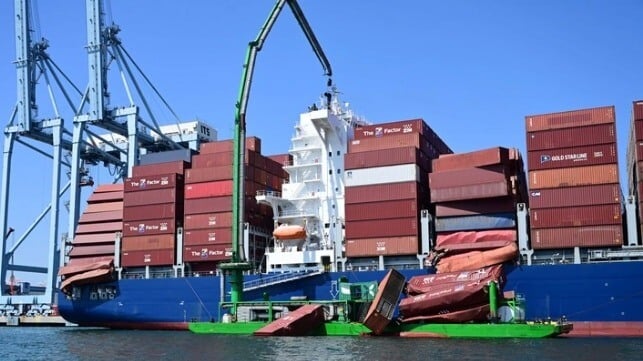
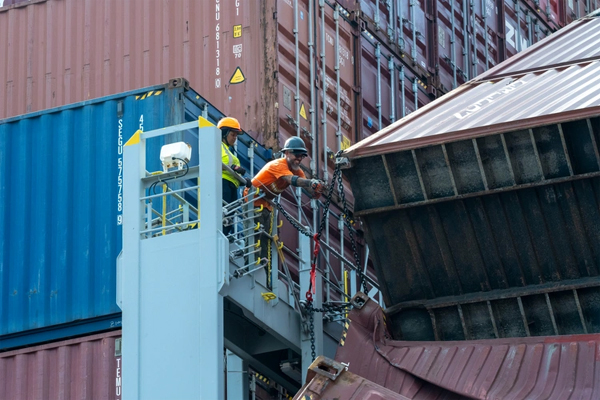
The Unified Command overseeing the operations in the Port of Long Beach reports that progress is continuing to be made in the efforts to recover from the container collapse aboard the vessel Mississippi alongside Pier G on September 9. One of the focuses, in addition to removing boxes from the harbor, is to stabilize the collapsed containers and to safely reach the damaged emission barge that is alongside the vessel.
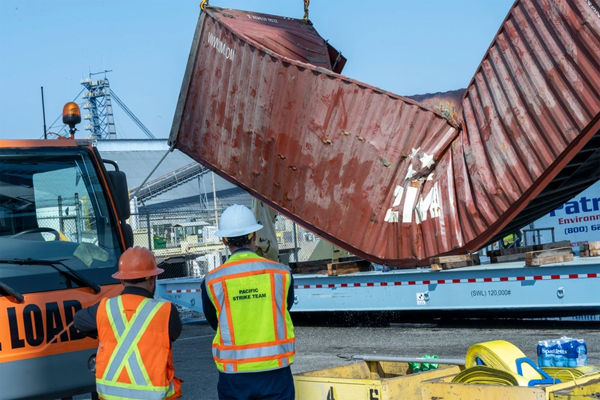
In the update, they reported that a total of 54 containers have now been recovered from the harbor and from the pier. In addition to boxes falling into the harbor, a small number fell off the port side of the vessel onto Pier G. The first two boxes were recovered the day after the accident, and as of last weekend, September 14, a total of 32 containers had been recovered.
Two container bays, one midship and the other on the stern, collapsed during the incident on September 9. Numerous boxes remain askew on the vessel, with one of the efforts focusing on stabilizing those boxes. The Unified Command reports that unaffected boxes are being unloaded so that crews can safely access STAX 2. The company that operates the emissions barge, Stax Engineering, told The Maritime Executive earlier this month that its team was working to assess the damage and get the vessel back into service. Several of the boxes landed on the barge, causing one minor injury as the crew ran from the scene.
The Unified Command reports the operation is ongoing with a “Container Recovery Group,” and salvage crews working alongside International Longshore and Warehouse Union members. It previously estimated that 75 containers had fallen from the Mississippi.
The 500-yard safety zone remains in place around the Mississippi. The Captain of the Port has been working with vessels, and as of Wednesday, September 17, a total of 55 commercial vessels have been guided through the safety zone to maintain operations in the port. A containment boom remains around the site, although they previously said the oil leaking from the emissions barge had been stopped.
JBS Terminais Has Joined the Portchain Connect Network
Portchain today announced JBS Terminais will join the Portchain Connect network. JBS Terminais will use Portchain Connect to increase the quality and speed of their berth alignment with customers through digital handshakes and secure data sharing. Portchain is excited to partner with JBS Terminais to simplify their communication channels and improve overall berth alignment. Portchain Connect enables JBS Terminais to receive real-time schedule and move count updates directly from carrier systems, and enables them to respond and counterpropose quickly, to align the vessel schedule with the terminal berth plan.
“Portchain Connect has been a valuable tool in bringing more clarity and collaboration to berth alignment, ensuring all partners stay informed and aligned.” Bruno Duarte, Operational Strategy and Performance Coordinator at JBS Terminais
Portchain Connect Portchain Connect streamlines the flow of schedule data to shorten the time to align the berthing window. The platform allows terminals and carriers to share and receive quality data and reduce delays in information transmission. Portchain Connect provides users with an easy- to-use overview of all their vessel calls and ensures they can securely transfer berthing information, remove the costs associated with manual non-digitised communication, and align on berthing windows to improve schedule reliability. Download the brochure for more information.
"We are proud to partner with JBS Terminais as they join the growing Portchain Network, working together to achieve smarter, faster, and more coordinated berth alignment." Thor Thorup, CCO & Co-Founder at Portchain
The products and services herein described in this press release are not endorsed by The Maritime Executive.
IRONY
wind turbine installation vessel
First U.S.-Built WTIV Charybdis Arrives in Virginia to Begin Installations
OF WIND TURBINES OUTLAWED BY TRUMP
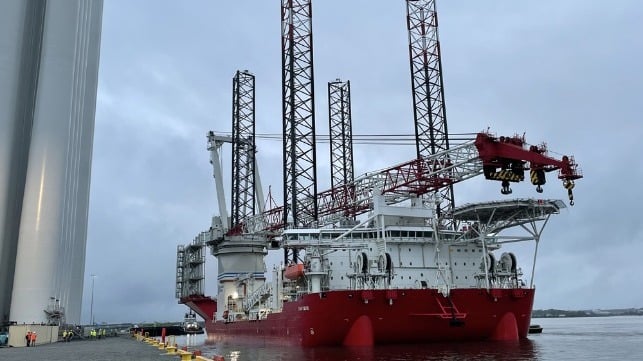
Charybdris arrived in Virginia this week as the first WTIV built in the United States (Dominion Energy)
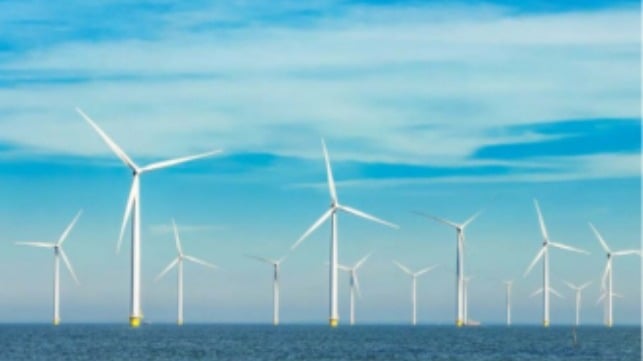
Charybdis, the massive wind turbine installation vessel built for Dominion Energy, has reached its home in Virginia after nearly five years of construction. The vessel, which is the first for the U.S. registry and one of the biggest vessels of its kind, remains on track to begin installations for the Coastal Virginia Offshore Wind (CVOW) project later this month, a spokesperson for Dominion Energy told The Maritime Executive.
Dominion confirmed that the vessel docked on Wednesday, September 17, at Portsmouth Marine Terminal in the Hampton Bays area of Virginia. It had departed Texas on August 22, according to its AIS signal.
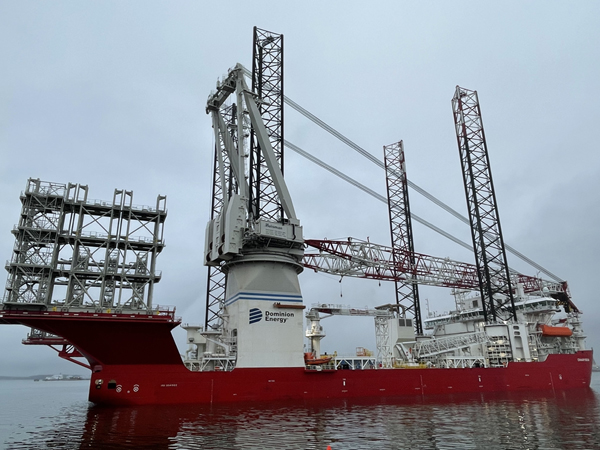
Built by Seatrium’s AmFELS shipyard in Brownsville, Texas, Charybdis is 472 feet by 184 feet (144 x 56 meters) with accommodations for up to 119 people. The 426-foot crane is capable of lifting up to 2,200 tons, including next-generation turbines up to 12 megawatts or larger.
Work on the ship began in December 2020, and it was launched in April 2024. Jack-up and sea trials began early this year, and Dominion reports delivery occurred earlier this month. Built and registered in the U.S., the vessel is Jones Act compliant, giving it greater flexibility in its operations versus the international vessels that have been employed for the installation of the other U.S. wind farms.
Charybdis is one of the largest vessels of its kind (Dominion Energy)
With the arrival of the ship in Virginia, CVOW moves into its next phase and is anticipated to begin delivering its first electrons to the grid in just a few months, early 2026. The company reports the project is at approximately the 60 percent mark in its installation.
Work has been completed for the installation of 168 of the monopile foundations, as well as 59 of the transition pieces, for a total of 176 turbines. The first of three offshore substations has also been installed, while the deepwater offshore export cables have also been installed. Work is currently underway on the near shore offshore export cables and the inter-array cables. Onshore, work is 93 percent complete for the electric transmission installation.
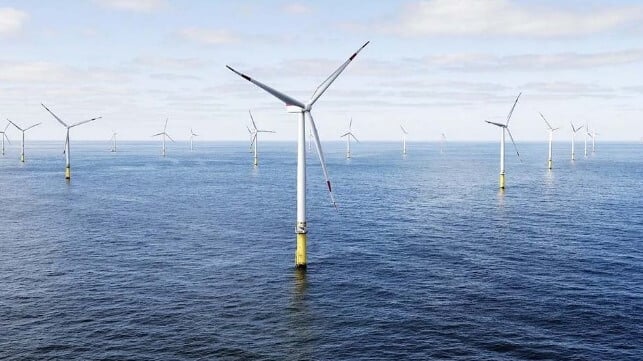
Construction of the offshore wind farm remains on schedule for completion in late 2026. It will be the largest U.S. offshore wind farm with a total of 176 Siemens Gamesa 14 MW turbines and a total capacity of 2.6 GW.
Connecticut and Rhode Island Seek Injunction to Restart Revolution Wind
Connecticut and Rhode Island are seeking a preliminary injunction so that work could resume on the Revolution Wind project (Orsted)
The attorneys general from Connecticut and Rhode Island asked a court on Wednesday for a preliminary injunction against the stop work order imposed on Ørsted’s Revolution Wind offshore wind project. They called the actions by the Trump administration “abrupt and arbitrary,” saying that the states would face “immediate and irreparable harm” if the work did not resume immediately.
Nearly two weeks ago, the states also filed suit in Rhode Island against the stop work order, which was issued on August 22. Their actions are in addition to a suit filed in Washington, D.C. by the project developers. The states are arguing for a preliminary injunction while the legal cases are resolved. They highlight that work has now been stopped for nearly a month on a project that is 80 percent complete.
The target date for completion of the project was November 2026. A project engineer for Ørsted, however, has said that if the delays continue, completion would be delayed at least till January 2027. The states highlight that Revolution Wind has contracts and obligations to the utility companies in Rhode Island and Connecticut. They said the first deadline is December 31, 2026.
“We have no time to waste in getting Revolution Wind back online, which is why we’re asking the Court to put a stop to this in short order,” said Rhode Island Attorney General Neronha. He highlights union workers who have been sidelined, as well as saying that companies are now reluctant to pursue economic ventures due to the uncertainty created by the stop work order. He also cites rising and increasingly unstable energy costs.
Connecticut Attorney General Tong also said the “nonsensical stop work order” is causing both immediate and irreparable economic and environmental harm to Connecticut. “Every day that Revolution Wind sits mothballed in the ocean is another day of unemployment, another day of unaffordable energy costs, and another day burning fossil fuels when clean, affordable, American-made energy is within our sights,” said Tong.
Rhode Island Governor Dan McKee reports that he wrote to the Interior Secretary Doug Burgum on September 3 to outline the status of the project and issues for the states. He requested a face-to-face meeting with Donald Trump to negotiate a resolution. The governor said he does not think the administration “fully understands the consequences of what they are doing here.” He has not received a response to the meeting request.
The U.S. Department of Justice, on September 16, made its first court filing responding to the legal challenges to the stop work order. It contends that the project “failed to reach an agreement with the Defense Department on measures to mitigate impacts from electromagnetic emissions and fiber-optic sensors.”
A report in the Rhode Island Current newspaper highlights that the project received its final federal approvals in November 2023 after years of federal review. However, it was given an extension and a further delay till July 2025 to submit a plan for minimizing interference with federal marine fisheries surveys. It was also working with the Department of Defense on a 2024 agreement to deconflict the project with national defense interests. However, they were not required to submit additional documents to DoD, and it is pointed out that DoD in 2020 had no objections to the project.
After imposing the stop work order, the administration has said it would also seek to challenge other permits issued during the Biden administration. It has filed court challenges to Maryland’s first offshore wind farm and a planned future project for Massachusetts. It permitted New York’s Empire Wind to restart after stopping work for a month in April, leaving Revolution Wind as the only largely installed (or operational) offshore wind farm that the administration is challenging.
New Zealand to Clarify Conflict Between Offshore Wind and Seabe Mining
New Zealand is seeking to encourage development by clarifying its legislation
The government of New Zealand reports that it will be taking steps to encourage the development of its offshore energy and natural resources. It plans to revise legislation to resolve potential conflicts between offshore wind energy development and seabed mining as a key step to permit both sectors to proceed.
“New Zealand has some of the world’s greatest offshore wind potential, offering a significant opportunity to generate economic growth while powering our homes and businesses," said Energy Minister Simon Watts. “Offshore wind requires a significant upfront investment. That’s why we are establishing a clear regulatory regime through the Offshore Renewable Energy Bill that was introduced last year, to give developers the certainty they need to invest and kickstart the sector.”
The industry has been calling for action by the government while the development of key projects has been stalled. BlueFloat Energy, which was seeking opportunities in New Zealand, reportedly wrote the ministers last year saying the country needed to choose between offshore wind and seabed mining. BlueFloat later pulled out of New Zealand.
A partnership between Copenhagen Infrastructure Partners and the government-owned NZ Super Fund, however, has an ambitious project saying it would commit approximately US$3 billion for a wind farm consisting of up to 70 wind turbines to be located 15 to 25 miles off the coast of South Taranaki, at the southwestern side of the North Island, and on the Tasman Sea. The company has set an initial goal of 1 GW while noting the project could be scaled to 2 GW.
New Zealand’s cabinet has agreed to amend draft legislation. According to the minister, the changes will create greater investment certainty for both offshore wind and seabed mining. The reports said it would only impact seabed mining and not the oil and gas sector or existing mineral projects.
“The amendments will enable the government to use secondary legislation to designate specific marine space where permits could be invited for offshore renewable projects while there is a pause on granting new permits for seabed mining under the Crown Minerals Act,” explained Watts. “This is a pragmatic step to address a key concern raised by the industry.”
While the amendments and legislative steps will remove a key hurdle, New Zealand has not yet designated its first areas. Watts, however, said that it is likely to be somewhere in South Taranaki.
The CIP-led partnership, known as Taranaki Offshore Partnership, reports it has already invested heavily in the project. It has undertaken wind measurements and surveys. It anticipates that the wind farm could be in the construction and commissioning phase by 2030. It anticipates it will take three to four years to complete.
Saudi Arabia and UK Lead Effort to Revitalize Yemen's Coast Guard
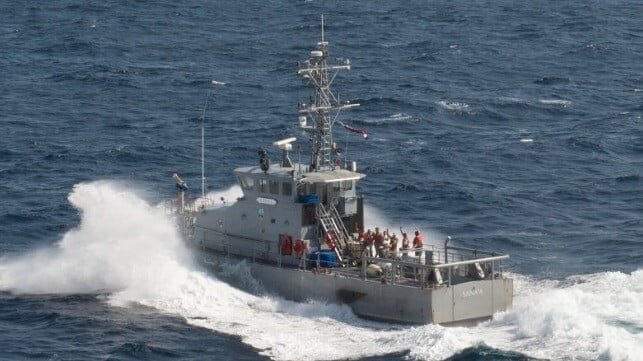
A Yemeni patrol vessel in better times, 2014 (USN)
Saudi Arabia and the United Kingdom have launched an international partnership to revitalize the Yemeni Coastguard, with the aim of improving security in the Red Sea and Bab el Mandeb.
At a conference held in Riyadh attended by 35 countries, the Yemen Maritime Security Partnership was established to provide funding training equipment and support for Yemen’s Coastguard. The initiative is to be supported by a permanent secretariat, the Technical Assistance Fund For Yemen (TAFFY). Saudi Arabia is putting forward $4 million immediately as seed funding, and the UK with assistance from the Welsh government is to provide technical assistance and support for TAFFY during the implementation phase. TAFFY also has ambitions to take on wider government capability-building tasks.
The UK had announced a package of support for the Yemeni Coastguard in November last year, comprised of fast patrol boats, training, and assistance. The UK has had a long-term interest in nurturing the Yemeni Coastguard since it was founded in 2003, having provided assistance in building its information and communications structure before the organization crumpled as the civil war in Yemen worsened. A cadre of 30 coastguard officers are currently undergoing a two-year English language training course sponsored by the British Embassy in Yemen.
The 35 Countries who attended the conference included Australia, Canada, Japan, and the United States, as well as GCC nations and the European Union. A significant conference attendee was Oman, who in the past has mediated the release of sailors held hostage by the Houthis. The breadth of participation suggests the forum could develop utility in solving broader issues of security in the Red Sea.
In June last year, Major General Tariq Saleh held discussions with the chief of the Coast Guard Service, Major General Khaled Al-Qamali on how to improve cooperation. The General’s National Resistance Forces have made several high-value interceptions of inbound Houthi arms in the Red Sea.
The effort to nurture the effectiveness of the Yemeni Coastguard and to develop a homegrown solution is in part an acknowledgement of the difficulties of providing protection for merchant shipping in the Red Sea and Bab el Mandeb using conventional naval forces. Although the separate EU and US led naval forces have had some success when deployed in areas under attack, it has proven impossible to provide sufficient coverage to protect all merchant shipping - and also extremely expensive. The success of the National Resistance Forces in making interceptions at sea is an encouragement to adopt non-military approaches to policing the problem, employing small craft, local knowledge and intelligence.
Former U.S. Navy Admiral Gets Six Years for Influence-for-Hire Scheme
Adm. Robert Burke (USN, ret'd.) has been sentenced to six years in federal prison for making a deal to trade his influence in the Pentagon for a lucrative post-retirement job. As a four-star admiral, Burke is among the highest-ranking officers ever convicted of a federal crime.
“Today’s sentence sends a clear message: if you sell your honor and trade your influence, you’ll pay the price," said U.S. Attorney Jeanine Pirro in a statement. "Instead of leading by example, [Burke] cashed in that trust — turning four stars into dollar signs and trading duty for a corporate payday."
While it is commonplace for admirals to take positions with defense contractors after leaving the military, prosecutors alleged that Burke arranged a six-figure military contract for his future employer before he departed the service.
The story began in 2018, when training firm Next Jump received a subcontract from the Navy for a pilot program. The Navy terminated it the following year, leaving Next Jump without any military contracts. Next Jump's co-chief executives, defendants Yongchul "Charlie" Kim and Meghan Messenger, emailed Adm. Burke - the vice chief of naval operations - in hopes of reestablishing the business relationship.
That outreach did not yield results for Next Jump right away, but in 2021 Burke agreed to take Kim's call. At the time, Burke was Commander Naval Forces Europe and Africa. Kim allegedly laid out a job proposal for Burke. If the admiral secured a workforce training contract for Next Jump from Naval Forces Europe, and stayed in the Navy six months afterwards to promote the training service-wide, he would get a $500,000 per year post-retirement job at Next Jump, prosecutors said. That sequence of events unfolded as allegedly discussed: Next Jump delivered trainings in Naples and Rota, and Burke went to work for the firm in late 2022 at a comparable pay rate.
Burke's defense lawyer, Tim Parlatore - a Navy Reserve JAG officer with a top-level Pentagon role - argued that the military and government investigation into Burke's case had been done incompetently. However, a jury convicted Burke in May; Kim and Messenger's case went to trial in August, but ended in a hung jury and a mistrial. According to Parlatore, Burke may have had a better chance at his trial if his jury had seen the same evidence allowed in Kim and Messenger's case.
Federal prosecutors asked for a 10-year sentence for Burke after his conviction. On Tuesday, U.S. District Judge Trevor McFadden sentenced him to six years in prison, plus three years of supervised release.
EU, UK, and Australia Launch New Sanctions for Russian Energy and Tankers
EU and Australia each sanction large batches of shadow fleet tankers (file photo)
The European Union announced earlier than planned its 19th sanction package, as Australia also moved to expand its efforts, and the UK added Russian supporters from Georgia. The steps come as Donald Trump has reportedly been pushing the Europeans to cut energy imports, but has yet to introduce further U.S. sanctions on Russia and the shadow tanker fleet.
The President of the European Commission, Ursula von der Leyen, detailed the sweeping package as the next step in Europe’s efforts. She said that “Russia has shown the full extent of its contempt for diplomacy and international law,” citing the increased drone and missile attacks on Ukraine. She noted that even the EU’s office in Kyiv was struck.
In addition, the EU assets that the threats to the union are rising. It pointed to the Russian drones that had violated the airspace of both Poland and Romania. “These are not the actions of someone who wants peace,” said von der Leyen, reporting that Europe was responding by increasing the pressure.
“So we are banning imports of Russian LNG into European markets,” she said in the statement detailing the proposed next phase of the sanctions. “It is time to turn off the tap. We are prepared for this.”
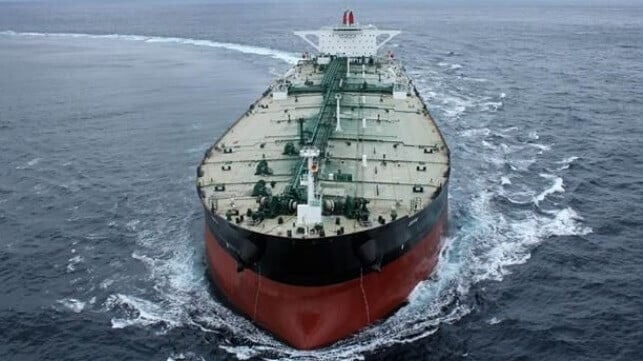
The EU will sanction an additional 118 vessels from the shadow fleet. This will bring its total to 560 vessels, once again surpassing the UK, which recently claimed to have the most tankers under sanction. This comes after the EU lowered the price cap on Russian oil to $47.60.
The EU also proposes a range of other steps, including full transaction bans against Rosneft and Gazpromneft. It is also expanding with sanctions for international refineries, oil traders, and petrochemical companies in third countries, including China, that are dealing with Russia. Additional financial sanctions will include banks supporting the trade and aiding in sanction evasion, as well as, for the first time, the EU proposes restrictive measures on crypto platforms and prohibiting transactions in cryptocurrencies.
Von der Leyen asserted that the efforts have already brought down Russia’s oil revenues by 90 percent. The sanctions, she said, are severely affecting the Russian economy. She cited 17 percent interest rates, high inflation, and declining access to financing and revenues. The efforts still require full approval, while they also noted that the package is aligning with G7 partners.
Australia also responded, announcing it would add another 955 shadow fleet vessels to its sanctions. With these additional listings, the Albanese government will have sanctioned more than 150 shadow fleet vessels since it first sanctions rolled out in June 2025. Australia said it is taking its actions alongside international partners, including the European Union, the United Kingdom, Canada, New Zealand, and Japan, and that it is adopting the $47.60 price cap. Australia also maintains its total ban on imports from Russia of oil and refined petroleum.
The UK expanded its sanctions list just a week ago, adding 70 tankers to the restrictions. In total, it has sanctions on 495 tankers versus 440 currently by the EU, which gave the UK the claim that it has now targeted more oil tankers than any other country.
Today’s action by the UK targets two Georgians, a politician and a businessman, who it says are supporting Russia. As part of these efforts, the UK added two small, Russian-owned product tankers to the sanctions. It reports that the Bavly (6,613 dwt) and the Karakuz (6,640 dwt), both flagged in Russia, are transporting Russian oil to the Georgian port of Batumi.
Historical Association Finds Long-Sought Wreck of 19th-Century Schooner
There are an estimated 1,500 shipwrecks in Lake Michigan alone
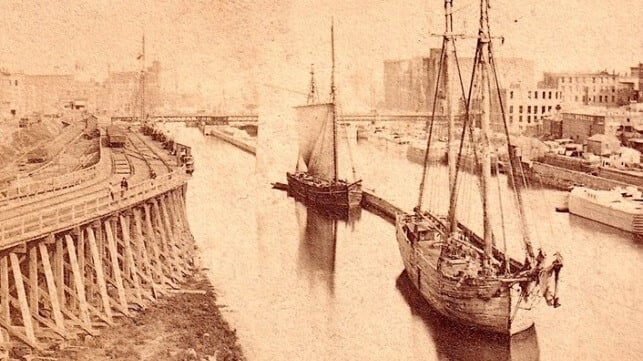
F.J. King in better days (Collection of Brendon Baillod)
The prolific wreckfinders at the Wisconsin Historical Society and the Wisconsin Underwater Archaeology Association have unveiled another historic Great Lakes shipwreck. Over the weekend, the association announced that it has discovered the long-sought wreck of the F.J. King, which foundered in Lake Michigan in 1886.
The F.J. King was a wooden cargo schooner built in 1867 for bulk trades on the Great Lakes. Her dimensions allowed her to transit the Welland Canal, expanding her opportunities for trading.
On September 14, 1886, F.J. King was under way with a load of iron ore, headed for Chicago. Off the Door Peninsula, she was hit by a gale and seas of up to 10 feet. In the pounding, her wooden hull began to admit water. The crew pumped by hand in an attempt to keep her afloat, but within a few hours it became apparent that the ship would sink. The master ordered abandon ship, and all the crew got off safely. At about 0200 hours on the 15th, the schooner sank below bow-first; the survivors were rescued by another schooner and delivered safely to Baileys Harbor. There were no fatalities.
The location of the wreck remained a mystery, and a point of local curiousity. The master's last reported position didn't line up with visual observations of the vessel's masts from the local lighthouse keeper. Clues and hints to the site's whereabouts showed up periodically - like bits of wreckage that came up in fishing nets - but decades of searching yielded nothing, even after a local club posted a healthy bounty.
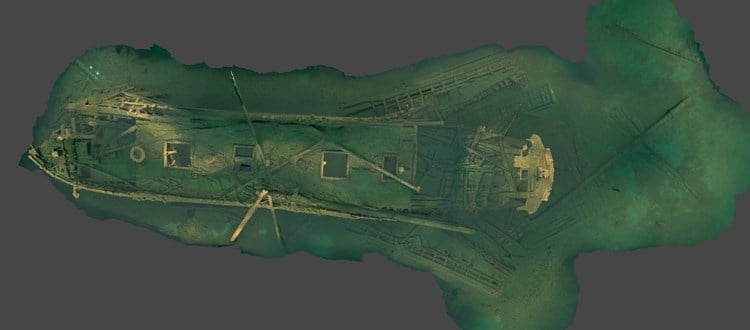
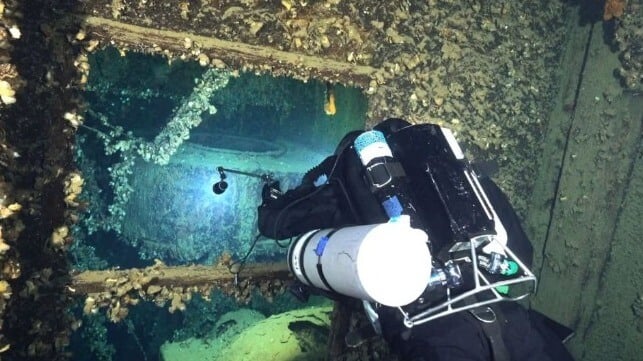
WUAA had a small search grid to run based on the lighthouse keeper's account, but didn't expect to find anything that day. They departed their pier on a trial run to familiarize themselves with a sidescan and a small ROV, and stumbled upon the wreck after two hours of operating. They measured its length on sonar and found it to be 140 feet - about the same as F.J. King. At this point they were pretty sure that they had it, and a quick ROV dive confirmed its identity and its remarkably intact condition.
Composite photo of the wreck site (WUAA)
“We reasoned that the captain may not have known where he was in the 2AM darkness, but the lighthouse keeper’s course and distance to the masts were probably accurate," said principal investigator Brendon Baillod. The wreck position was about half a mile from the lighthouse keeper's estimate.
Great Lakes wreckfinding is an active area of archaeological pursuit, and the Wisconsin Underwater Archaeology Association has discovered four other wrecks in the last three years. A similar group in Michigan, the Great Lakes Shipwreck Historical Society, has found countless more. There are an estimated 1,500 shipwrecks in Lake Michigan alone
Marine Archaeologists Salvage Artifacts From Titanic's Sister Ship
Marine archaeologists in Greece have recovered artifacts from the wreck of the HMHS Britannic, a sister ship of the Titanic and the largest vessel lost during the First World War.
Britannic was built at Harland & Wolff at the height of WWI and delivered in late 1915. While she had been ordered as a passenger ship, but she was immediately pressed into service as a hospital ship in Royal Navy service, requisitioned for transporting casualties of the costly and ultimately unsuccessful Gallipoli campaign.
She made three voyages, including the evacuation of the Dardanelles in January 1916. After that, she was paid off and dispatched to Belfast for a refit as a passenger liner - but was immediately recalled to duty in the middle of the conversion and dispatched to the Mediterranean again for an additional two voyages as a hospital ship.
Her design was modified to benefit from the safety lessons of the Titanic'ssinking, including a double hull in way of the engineering compartments and raising up her watertight bulkheads another six decks. The revised design was intended to keep the vessel afloat with six compartments flooded. In the event of an abandon-ship scenario, she carried extra lifeboats and could in theory reposition them from one side to the other to enable full launch with a heavy list.
But these changes were not enough to save her from meeting the same fate as Titanic. The Brittanic's career only lasted about 11 months in total: on the morning of November 21, 1916, she hit a German mine in the Kea Channel in the Cyclades. There were no patients on board, just the normal crew complement of 674 seafarers and 392 medical staff.
Though only four compartments initially flooded, the ship listed and began downflooding through open portholes in lower-deck wards, which had been left ajar for ventilation. A failed watertight door between two boiler rooms added to the problem.
The master navigated the vessel towards shore, hoping to effect an intentional grounding. During this evolution, two lifeboats were launched without authorization on the port side and were demolished by the exposed port propeller, killing 30 people. Ultimately the screws were stopped and the abandon-ship order given; 35 lifeboats made it away, and 1036 personnel survived.
Brittanic lay on the bottom in shallow water, her position unknown until 1975, when she was rediscovered by Jacques Cousteau. This year, in May, a British team of archaeological divers revisited the site to conduct a recovery operation, with support from Greek authorities. Despite challenging site conditions, they resurfaced historical artifacts from the wreck, including ceramic tiles, cabin fittings, a navigation lamp, a bell, and a passenger's personal binoculars.
All of the recovered items were taken to specialized underwater antiquities labs in Athens for proper treatment. The ultimate plan is to put them on display in Piraeus' new National Museum of Underwater Antiquities.