Monday, September 22, 2025


This Was Always Coming – OpEd
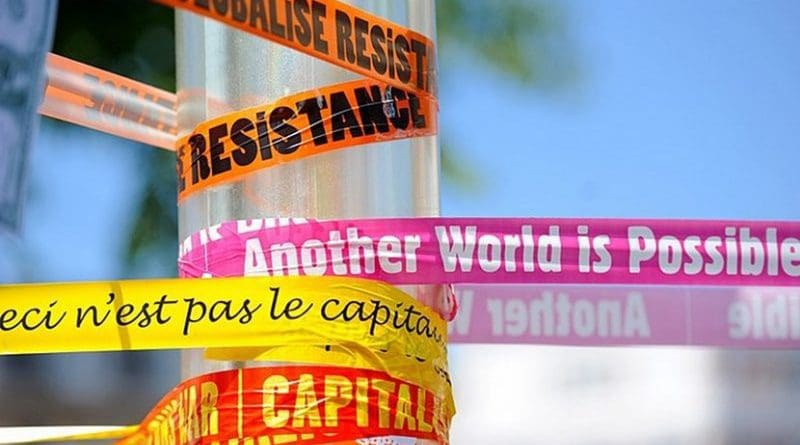
Anti-capitalism and anti-globalization banners. Photo by Guillaume Paumier, Wikimedia Commons.


By 

For decades — or perhaps centuries — collapse has been underway: the fragmentation of social, economic, and political order; the hollowing-out of law at both domestic and international levels; and the unrelenting duplicity and hypocrisy of those in power pushing the boundaries.


Today, chaos reigns: widespread violent extremism, state impunity, acute social divisions, and appalling environmental degradation. It was always going to come to this. Death and destruction are inbuilt.

Structural injustices and destructive behaviours are pushing planetary and socio-economic systems beyond their carrying capacities, toward critical tipping points and potential collapse.

The destruction of civilisation’s architecture, visible all around us, is the inevitable outcome of the poisonous ideology that underpins our age — colonial neoliberalism, coupled with State complacency.

Neoliberalism is inherently divisive and unjust, and therefore incapable of producing peace or social justice. Entwined with imperialism, it functions as the ideological instrument of global domination, suppression, and control.

Emerging in the late 20th century under Thatcher and Reagan, neoliberalism was exported globally through institutions such as the IMF, World Bank, and World Trade Organisation (WTO). Social protections and workers’ rights were dismantled, public industries privatised, and industry deregulated.


Through debt, trade agreements administered via the WTO, and Structural Adjustment Programmes (SAPs), nations in Sub-Saharan Africa and South-East Asia were subordinated economically and politically to the Global North — extending colonial control through economic and political mechanisms.

At its ideological core, neoliberalism rests on a nihilistic doctrine: that materialism, profit, and individual desire are key human values. Within this reductive worldview, production is organised solely around what is profitable for capital — exploiting labour, resources, and productive assets, enriching imperial and colonial centres rather than meeting human needs or safeguarding the planet.

It is an inhumane, violent system, administered by colonial powers dominated by the US, to the detriment of the poor everywhere and of the natural world.

Colonial neoliberalism builds upon centuries of domination of the Global South by the North. From the 1500s onwards, European powers plundered Africa, Asia, and the Americas, extracting resources and subjugating populations into forced labour for their enrichment.

After the Second World War, the United States took up the reins of exploitation, using economic and military power to assert its will. Hundreds of thousands were killed in suppressive acts of unrelenting violence in Korea, Vietnam, the Congo, and Chile. Through direct actions, coups, and covert operations, economic control and political suppression were used by US administrations of both colours to subjugate these nations.

Today, the same inhumane playbook is being applied in Palestine, where Israel — a Euro-American settler colony and imperial outpost in the Middle East — is, as the UN Independent International Commission of Inquiry recently confirmed, carrying out genocide against Palestinians in Gaza, alongside the systematic destruction of Palestinian society and the environment. Hamza Hamouchene describes this as a Holocide: “the total destruction of the social and ecological life in Palestine,” capturing the entwined human and environmental devastation wrought by imperial-colonial systems, in full view, and to the shame of all.

Economic democracy

Whilst Western democracies may allow a degree of political participation, there is no economic democracy. Neoliberalism concentrates economic power in the hands of a tiny few — a number that shrinks year on year, even as their wealth expands. Ordinary people — the 99.9% — have no meaningful control over the economic systems that govern their lives.

Financial software

The central force driving economic policy and corporate life is the pursuit of profitable returns for capital — a goal almost always prioritised over social needs such as healthcare, education, and affordable housing.

The consequences of this doctrine are manifold: vast inequalities of wealth, income, and opportunity; austerity and crushing debt; weak, dependent governments at the mercy of markets and multinational corporations; inadequate public services; and ongoing environmental destruction, compounded by governmental inaction.

Alongside these structural injustices, the Ideology of Greed and Division promotes a self-perpetuating series of destructive values: selfishness, conformity, and relentless competition are elevated, while cooperation and compassion are marginalised. It fuels divisions of all kinds, and division begets conflict, within individuals, communities, nations, and globally.

The extreme fractures now visible across society — economic, social, political, legal, and ecological — are tearing at the very fabric of life.

This total chaos was always going to happen. This divisive, unjust, and unhealthy way of living, founded on a violent ideology rooted in exploitation, greed, and division, could only lead to this point — and beyond. We may not yet have reached the limit of destruction: a colossal crisis of interrelated failures.

Nowhere is the system’s barbarism clearer than in Palestine, where Israel’s genocide lays bare the vicious logic of empire: impunity for the powerful, the abandonment of international law, unrestrained violence, and the subjugation of truth.

It is a system violent without limits, driven by men obsessed with power and control, that enables figures like Netanyahu — and others, including Trump — to seize power and commit unimaginable crimes.


Graham Peebles

Graham Peebles is an independent writer and charity worker. He set up The Create Trust in 2005 and has run education projects in India, Sri Lanka and Ethiopia where he lived for two years working with acutely disadvantaged children and conducting teacher training programmes. Website: https://grahampeebles.org/

 

Basmati Fault Line – OpEd

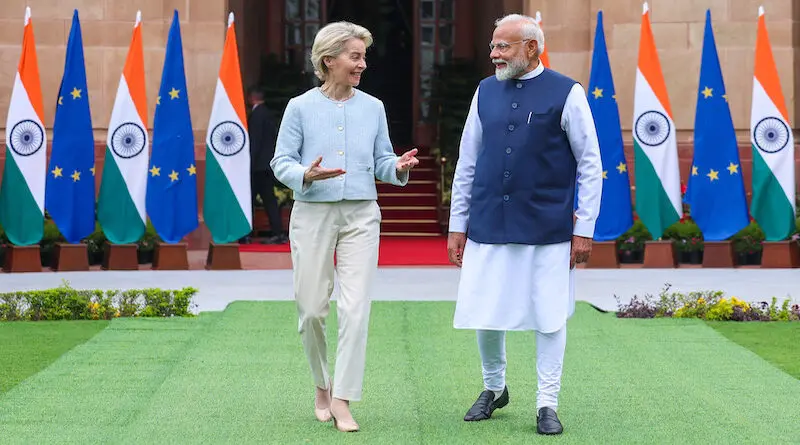
India's PM Narendra Modi meets the President of the European Commission, Ms. Ursula Von Der Leyen. Photo Credit: India Prime Minister Office


By 

By Jake Scott


After nearly two decades, the European Union (EU) and India are edging closer to finalizing a free trade agreement. Talks, first launched in 2007 and repeatedly stalled—due partly to the EU bloc’s ratification and bureaucratic lethargy, and partly to India’s reluctance towards EU-wide policies—are suddenly moving with purpose. Both sides want to conclude a deal by the end of 2025, a deadline that feels ambitious but not impossible.

The context is clear enough: India is under new pressure after Washington slapped tariffs on its steel and aluminum exports, while Brussels is eager to diversify trade partnerships in an era of supply chain shocks and geopolitical fragmentation. Together, the two markets represent more than a quarter of the world’s population and a combined GDP that rivals China’s. A deal would not just matter bilaterally; it would reshape the rules of global trade.

The obstacles are formidable. The first and most obvious is tariffs. The European Union wants India to slash its notoriously high import duties on cars, wines, spirits, and dairy products; sectors that carry both economic and cultural weight in Europe. India has long resisted, anxious about exposing its domestic industries to a flood of foreign competition. Given the recurring farmers’ protests against cheaper grain imports, it is easy to understand why politicians are anxious not to upset their voters further.

On the other side, Delhi wants easier access for its textiles, pharmaceuticals, and agricultural products. Brussels, however, is reluctant to give ground without reciprocal concessions. That tension between protecting sensitive sectors and expanding market access is the backbone of every trade negotiation, and here it is especially in focus. After the bruising that the EU received in the US–EU trade negotiations, it is understandable that they are cautious about future deals.

Then come the regulatory hurdles, the “soft” trade barriers. The EU’s standards for food safety, environmental compliance, and intellectual property are among the strictest in the world (a fact that has scuppered many EU–US trade talks in the past), and Indian exporters argue that meeting these benchmarks requires costly adjustments that tilt the playing field in Europe’s favor.


Services are another sticking point. India, which has built its contemporary global reputation and international economic strength on IT outsourcing and skilled labor mobility, wants recognition for qualifications and smoother pathways for professionals to immigrate to Europe. Yet the EU, wary of domestic political sensitivities over labor movement, is cautious about opening the door too wide.

The impasse is not merely economic but cultural: a matter of trust, control, and sovereignty. With an eye on the souring of Canada–India relations, and the controversy over the H-1B visa in the US, the EU is trying to protect its service-focused economies just as India is trying to shield its domestic manufacturing and agricultural base.

Environmental regulation is an even more contentious frontier. The EU’s Carbon Border Adjustment Mechanism, which levies imports from high-emission industries, is seen in Delhi as a disguised tariff that penalizes developing economies. India, still heavily reliant on coal and pursuing growth targets that demand vast energy consumption, argues that such rules ignore its lower per capita emissions and developmental stage. Given India’s high levels of CO2emission, this could be deadly to their modernization.

Brussels, however, views carbon pricing and deforestation-free supply chains as non-negotiable pillars of its trade policy. With a Europe-wide program to decarbonize and increase green energy-supply, this is a real sticking point. Reconciling these positions will require either creative exemptions, phased implementation, or side deals that soften the blow for Indian exporters.

Symbolism also matters. Few issues illustrate this better than the battle over basmati rice. India has applied for exclusive geographical indication rights to the term “Basmati” in the European market. Pakistan, which also exports large volumes of the grain, insists it has equal claim. For the EU—which is no stranger to officially stamping certain food names like feta, gruyere, and champagne—granting India exclusivity risks embroiling the bloc in South Asian rivalries.

For India, however, this is not just about commercial advantage; it is about national pride. A compromise that preserves market access for Pakistan while recognizing India’s claim in some form may be the only way forward. In a negotiation where every concession is wrangled, even rice becomes geopolitical.

What India ultimately hopes to secure from the deal is clear. Diversification is top of the list: with the US imposing tariffs and China increasingly unpredictable, Delhi wants a stable anchor in Europe. Market access for labor-intensive industries is vital for job creation, while regulatory simplification would ease costs for exporters.

India also wants reassurance that EU environmental and consumer rules will not amount to protectionism dressed up as principle. And, not least, Delhi wants recognition of its geographical product indications, with basmati rice at the forefront. In short, India is seeking growth, security, and respect: the ability to play on equal terms with one of the world’s most rule-setting economic blocs.

At a time when global trade is fragmenting, the EU–India deal would stand as proof that two large, diverse economies can still find common ground.

For Europe, it is a chance to project influence in Asia without being pulled into the binary of US–China rivalry. For India, it offers a pathway to embed itself more deeply into global supply chains while defending its developmental priorities. For the world, it is a test case: can climate concerns, regulatory standards, and traditional trade barriers be reconciled in a way that allows both growth and sustainability?

If the agreement succeeds, it will create a template for future trade deals, showing how developing countries can integrate into a system often written by advanced economies without surrendering autonomy. If it fails, it will be another reminder of how difficult it remains to bridge the gap between protectionism and openness, sovereignty and cooperation.

Either way, the stakes are high. A deal between the EU and India is not just about tariffs on cars or labeling rights on rice. It is about whether the architecture of global trade can adapt to a multipolar, contested, and environmentally constrained world.

  • About the author: Dr Jake Scott is a political theorist specialising in populism and its relationship to political constitutionality. He has taught at multiple British universities and produced research reports for several think tanks.

war

By 

Last weekend, Jill and I visited the uniquely experimental Polyface farm here in Virginia. A long-standing, successful older farm where its owner and operator, Joel Salatin, has developed regenerative farming methods grounded in the pragmatic realities of the small farm and homestead. Jill and I were lucky enough to get a private tour of the farm and to have Joel teach us about sylvan farming and pigs.


Joel has a system of paddocks, with low-lying electric fencing (two-wire) interspersed throughout his vast forest lands of about 2,000 acres. Although the amount of land used for his 400 pigs at any one time is much smaller. Pigs are kept in 35 animal “herds” and are rotated in lightly forested areas. 

These pig paddocks have had some trees felled, so that the dappled earth grows vegetation that the pigs can eat. Old-growth forest (with the exception of acorn season) doesn’t have much undergrowth and is less suited for sylvan farming. Joel moves a feeder – along with the pigs, so that they have access to tested, non-pesticide residue feed also. Although the pigs eat every bit of vegetation, greenery, and all the scraps given, they also require feed in order to gain healthy weight for slaughter. In the fall, pigs are put into forest areas heavy with oaks, so that they can forage the acorns – their favorite!

Joel has basically developed his own breed of pig, although he is too modest to put a name on them. Although Jill did. The “Polyface Pig,” as Jill calls them, is built like a torpedo, with a straight topline, and is a mix of heritage breeds. It is built for hardiness, the ability to build healthy muscle, and is less lean than the pig used on factory farms. It can tolerate changes in the weather more readily and has pigmented skin that doesn’t burn to a crisp in the hot sun. This is a hardy pig, developed from multiple heritage breeds, and is quite docile. What is important is hardiness, tractability, and meat quality. This is a pig being created for the small farm and particularly for rotational grazing. 

Sylvan farming is essentially farming within a forest-like environment, blending agriculture with forestry to create a sustainable, diverse, and productive system. In the case of pigs, they need to be rotated often, or they do too much erosion damage and even uproot trees. However, in Virginia and in other states “east of the Mississippi,” where forest is plentiful and most of it is not old-growth, pigs can be a wonderful addition to a homestead.

In the meantime, although more difficult to find, pork and ham can be bought from quality sources online and locally. It is absolutely worth going out of your way to buy pig meat from ethically sourced farms. 


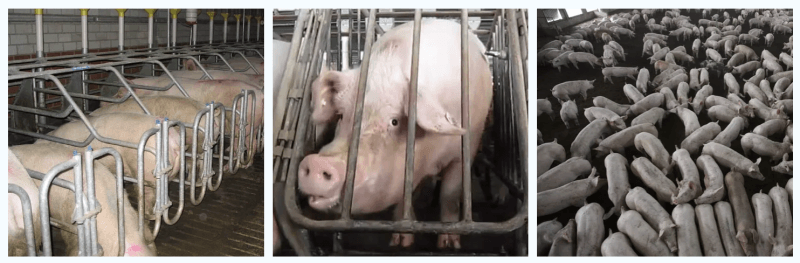
Pig factory farms pose risks not only to the animals inside but also to human health, the environment, and surrounding communities. The most significant issues are air and water pollution, antibiotic resistance, and inadequate animal welfare.

My hope is that one day the USDA will intercede and make this type of factory farm illegal in the United States.

Factory-farmed pig

On the home front, Jill has been wishing for a small dog that we can travel with, as our Aussies just don’t fit under the seat on planes very well. Well, a small Pomeranian kind of fell into our laps via an old friend from Georgia last week. So we are now the proud(?) owners of a beautiful peach and white “dog-cat”. Her age and history are largely unknown, and she has gone through a number of homes in a very short time this year. No fault of her own – as she is cute as a button and has attached herself 200% to Jill.

The big dogs were at first a little taken aback, as Sunny (now named Kitty) is an adult dog in the size of a puppy, with so many silly behaviors. Within a day or so, they also have become smitten. We have never owned a small dog before, so we are having to figure some stuff out as we go. Of course, she will be a mostly indoor dog, but she is already learning that birds are not for chasing and horses are big.

One thing about our dogs, once they’re here, this is their forever home. Honestly, I am surprised by Kitty’s absolute open heart and silly exuberance. 


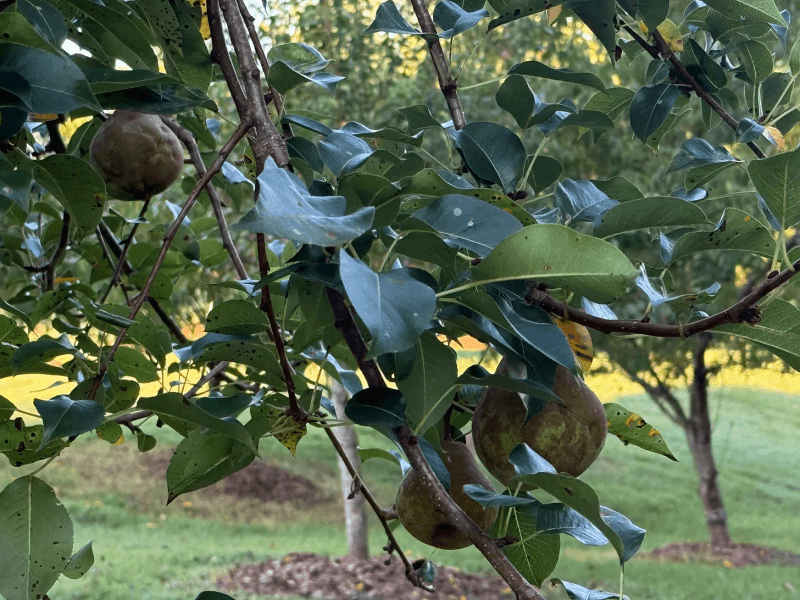
The garden has been a source of pure joy this summer, and we have managed to reduce our need to buy produce significantly. We are now harvesting Asian pears and have a good crop. However, this variety has a thick skin that has developed some blemishes due to the high number of pests in Virginia.

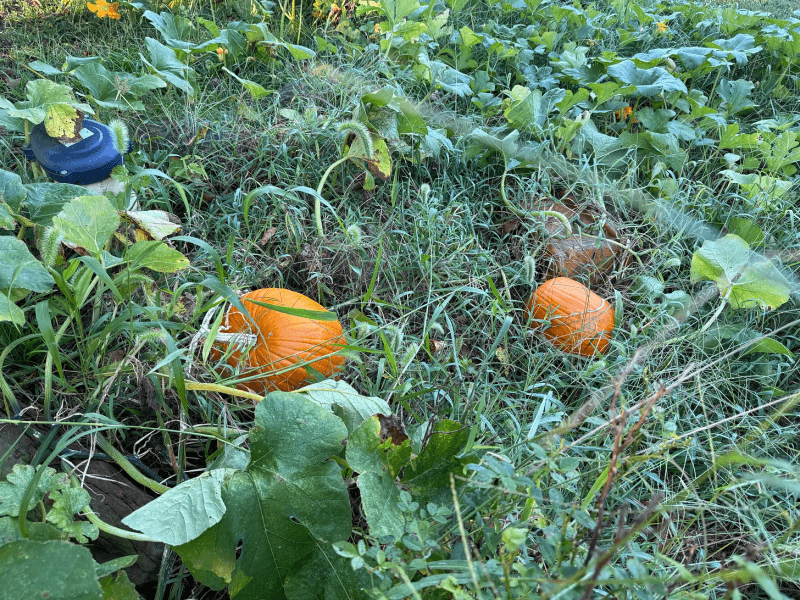
In May, Jill planted pumpkin seeds, and so we have about 10 to 15 orange orbs floating in a sea of huge, lily-pad-shaped leaves. The cool nights are already causing the leaves to turn a little yellow around the edges. Soon, we will begin picking the pumpkins, as many have a withered, dry stem – a sign it is time to harvest. We will store them on cardboard, in a cool dark place – bottom or stem-side up, and I imagine that we will find a child or two to bestow some on.

Jill intends to oven-bake the pumpkin, then cube the flesh and freeze it for use later.

Gizmo the emu loves to take a shower, and watching this 100-pound roll around to get wet is pretty entertaining.

As she is now living in a pasture, we are considering who would be a suitable companion for her to live with. Goose visits her often, but she clearly would like more company.


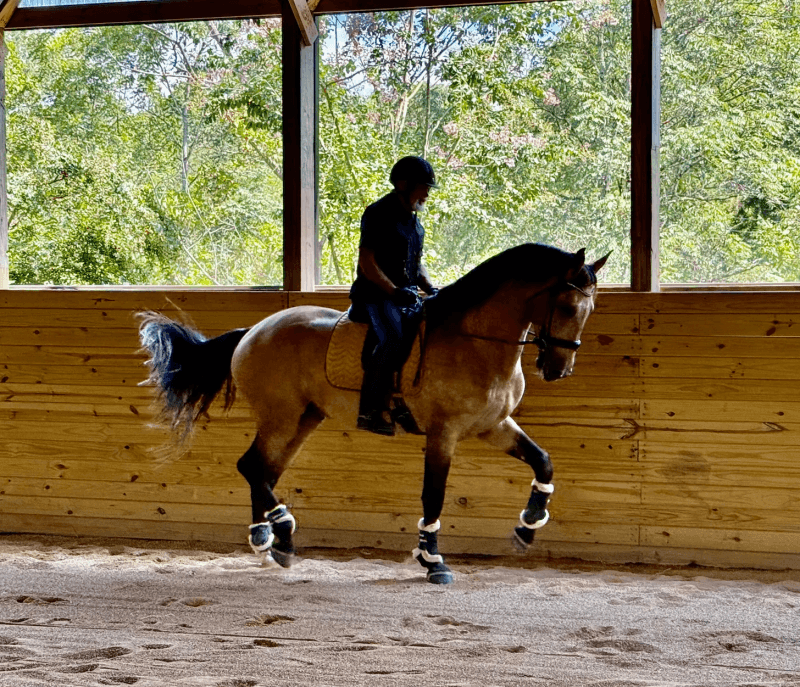
In other farm news, Quartz – our five-year-old Lusitano stallion- came home for a week while his trainer was traveling. Jill wrenched her back temporarily, and so her dreams of riding him each day were dashed. So, I volunteered and…fell in love. This young horse has all the makings of a dressage champion, and I am excited to say that I will be a big part of that journey.

I am not sure whether I shared photos of Quartz – but here he is, in all his glory.

Next year, we will again be standing Jade, as well as Quartz. That means we will be collecting semen and shipping it to mare owners for artificial insemination. In practical terms, this means that contracts have to be drawn up, advertisements made, questions fielded by potential customers, a new phantom bought for collection (this is also called a mare mount), and the old laboratory equipment dusted off and organized. Then we or an employee must be available to collect semen, analyze it, and send it off via express mail when needed.

Below is me riding Jade, Quartz’ sire last week. Yeah, I was a little sore after a week of riding each day.

Before Covid took over our lives, selling horse semen for artificial insemination was a big part of our farming income. But it is a lot of work! This time around, we intend to cross-train our farm manager, so that if we travel, semen can still be shipped without Jill having to stay on the farm.

Both stallions are desired for the breed, and people also want to “crossbreed to create performance horses. Having a niche market like this is often the difference between paying the taxes and making a profit.


Tomorrow, it is off to Atlanta to enter the CDC lion’s den on Thursday for the ACIP meeting.

A busy week ahead!


Robert Malone

Robert W. Malone is a physician and biochemist. His work focuses on mRNA technology, pharmaceuticals, and drug repurposing research.