Monday, September 22, 2025

High Stakes At UN’s Annual Climate Week – Analysis

UN Climate Week has begun its 17th edition, convening in New York City under the theme “Power On.” (Supplied)


By 

UN Climate Week has begun its 17th edition, convening in New York City under the theme “Power On.” This runs parallel to UN General Assembly High-Level Week and will gather people from different areas, including heads of government, corporate leaders, civil society actors and researchers.


The discussions occur at a pivotal moment, as states also prepare for November’s COP30 climate change conference in Belem, Brazil. The deliberations in New York highlight the central debates shaping the UN climate agenda and the steps that ought to be taken to translate commitments into tangible and verifiable outcomes.

One of the issues to concentrate on is the persistent gap between global climate pledges and implementation. Despite successive rounds of announcements, aggregate greenhouse gas emissions remain inconsistent with trajectories compatible with the Paris Agreement’s goals. This is partially because the financing of adaptation and resilience measures in developing economies remains particularly constrained, even as estimates of annual needs continue to rise.

As a result, it is critical to align political will, financial flows and technical standards in advance of COP30. Brazil’s hosting of the conference will most likely expand key debates on tropical forests, financing instruments and indigenous rights, given the centrality of the Amazon to global climate stability.

A second important issue to focus on is the scale and allocation of climate finance. While commitments from various actors appear to have grown, flows toward adaptation continue to lag behind those for mitigation. Some private sector investments tend to favor renewable energy and low-carbon infrastructure in middle-income markets, leaving the most vulnerable countries underserved. Therefore, paths should be designed to make adaptation projects more attractive to private capital. There is also a focus on creating investment vehicles that can bring in private finance without displacing the limited public resources that remain critical for high-need adaptation projects.

A third issue is related to the modes of delivery. Current channels, which include multilateral development banks, national budgets and project-based instruments, seem to be inadequate in terms of meeting projected adaptation needs. As a result, there ought to be more attention paid to project preparation facilities and technical assistance to allow the translation of pledged funds into outcomes on the ground.


It is worth noting that this year’s theme, “Power On,” is highlighting the increase in renewable energy deployment, grid modernization and efficient-energy strategies. Discussions should extend beyond technology to encompass just transition policies that address the socioeconomic impacts of the phasing out of fossil fuels.

This is due to the notion that the international community needs to ensure there are equitable outcomes for workers and regions that are dependent on hydrocarbons. Energy transitions must be socially sustainable as well as environmentally necessary, particularly in developing economies and regions facing high energy poverty.

A fourth issue is the governance of tropical forest finance. Brazil’s proposed tropical forest financing facility is intended to mobilize significant capital, yet some believe that it raises questions regarding safeguards, baseline measurement, permanence and indigenous participation. This can be addressed by an effective design that ensures the protection of rights and verifiable conservation outcomes, particularly in the context of the Amazon’s ecological and cultural importance. There also needs to be robust monitoring, reporting and verification systems to ensure that financial flows translate into tangible reductions in deforestation and degradation, while also providing meaningful benefits to local communities.

Another key theme that is normally discussed at the UNGA is accountability and measurement. Some argue that there is a need for third-party-verified metrics to track both emissions reductions and resilience outcomes. Transparent and standardized climate finance reporting and nonstate contributions are a central tenet of the credibility of the international climate regime. There should be the capability to monitor progress and enforce accountability.

Another topic, in addition to the technical and financial dimensions, is the broader challenge of how to implement climate commitments within complex political and social contexts. The credibility of climate action depends on how measurable outcomes are delivered by institutions, rather than the accumulation of pledges. Potential methods include linking decarbonization to social protections and embedding safeguards within finance mechanisms.

The participation of local governments, civil society organizations and indigenous communities is central to the successful implementation and long-term sustainability of climate change projects.

But there seems to have been a clear shift from rhetorical ambition to the practical, technical and political work of implementation at the 2025 UNGA debate on climate change. Nevertheless, we should remember that the international climate regime’s credibility depends on measurability and accountability. This means the capacity to track finance, produce adaptation outcomes, reduce emissions and ensure social protections with precision.

The focus ought to be on designing systems and instruments that can translate intent into action. The effectiveness of international climate efforts will be determined not by further promises and pledges, but by the ability of institutional and financial arrangements to produce verifiable outcomes at the necessary scale and speed.

Finally, the exploration of innovative approaches, from new blended finance structures to decentralized monitoring systems, should be continued. Climate action requires coordination between governments, financial institutions, private corporations and civil society. This multifaceted and integrated approach reinforces the notion that measurable climate solutions reflect the complex, interconnected nature of contemporary climate governance.

In a nutshell, this week’s crucial UNGA climate change debate should focus on the convergence of science, policy and finance in the pursuit of actionable climate solutions. Bringing together diverse people and institutions helps realize global commitments. Accountability, transparency and rigor in implementation are also essential to meeting any climate-related objectives.


Dr. Majid Rafizadeh

Dr. Majid Rafizadeh is a Harvard-educated Iranian-American political scientist. X: @Dr_Rafizadeh


This Was Always Coming – OpEd

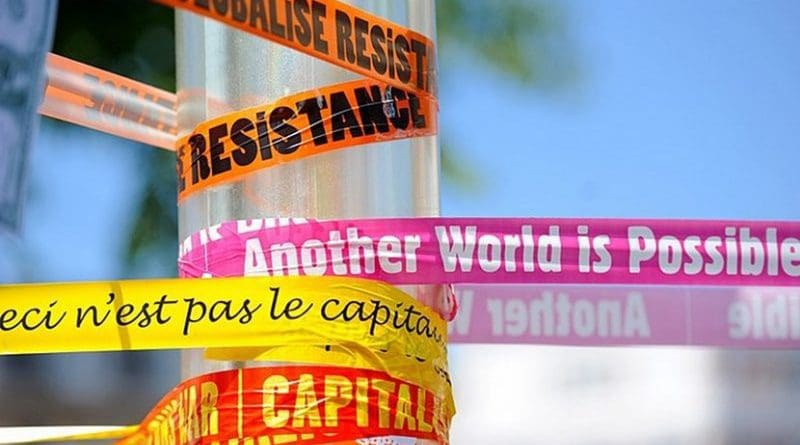
Anti-capitalism and anti-globalization banners. Photo by Guillaume Paumier, Wikimedia Commons.


By 

For decades — or perhaps centuries — collapse has been underway: the fragmentation of social, economic, and political order; the hollowing-out of law at both domestic and international levels; and the unrelenting duplicity and hypocrisy of those in power pushing the boundaries.


Today, chaos reigns: widespread violent extremism, state impunity, acute social divisions, and appalling environmental degradation. It was always going to come to this. Death and destruction are inbuilt.

Structural injustices and destructive behaviours are pushing planetary and socio-economic systems beyond their carrying capacities, toward critical tipping points and potential collapse.

The destruction of civilisation’s architecture, visible all around us, is the inevitable outcome of the poisonous ideology that underpins our age — colonial neoliberalism, coupled with State complacency.

Neoliberalism is inherently divisive and unjust, and therefore incapable of producing peace or social justice. Entwined with imperialism, it functions as the ideological instrument of global domination, suppression, and control.

Emerging in the late 20th century under Thatcher and Reagan, neoliberalism was exported globally through institutions such as the IMF, World Bank, and World Trade Organisation (WTO). Social protections and workers’ rights were dismantled, public industries privatised, and industry deregulated.


Through debt, trade agreements administered via the WTO, and Structural Adjustment Programmes (SAPs), nations in Sub-Saharan Africa and South-East Asia were subordinated economically and politically to the Global North — extending colonial control through economic and political mechanisms.

At its ideological core, neoliberalism rests on a nihilistic doctrine: that materialism, profit, and individual desire are key human values. Within this reductive worldview, production is organised solely around what is profitable for capital — exploiting labour, resources, and productive assets, enriching imperial and colonial centres rather than meeting human needs or safeguarding the planet.

It is an inhumane, violent system, administered by colonial powers dominated by the US, to the detriment of the poor everywhere and of the natural world.

Colonial neoliberalism builds upon centuries of domination of the Global South by the North. From the 1500s onwards, European powers plundered Africa, Asia, and the Americas, extracting resources and subjugating populations into forced labour for their enrichment.

After the Second World War, the United States took up the reins of exploitation, using economic and military power to assert its will. Hundreds of thousands were killed in suppressive acts of unrelenting violence in Korea, Vietnam, the Congo, and Chile. Through direct actions, coups, and covert operations, economic control and political suppression were used by US administrations of both colours to subjugate these nations.

Today, the same inhumane playbook is being applied in Palestine, where Israel — a Euro-American settler colony and imperial outpost in the Middle East — is, as the UN Independent International Commission of Inquiry recently confirmed, carrying out genocide against Palestinians in Gaza, alongside the systematic destruction of Palestinian society and the environment. Hamza Hamouchene describes this as a Holocide: “the total destruction of the social and ecological life in Palestine,” capturing the entwined human and environmental devastation wrought by imperial-colonial systems, in full view, and to the shame of all.

Economic democracy

Whilst Western democracies may allow a degree of political participation, there is no economic democracy. Neoliberalism concentrates economic power in the hands of a tiny few — a number that shrinks year on year, even as their wealth expands. Ordinary people — the 99.9% — have no meaningful control over the economic systems that govern their lives.

Financial software

The central force driving economic policy and corporate life is the pursuit of profitable returns for capital — a goal almost always prioritised over social needs such as healthcare, education, and affordable housing.

The consequences of this doctrine are manifold: vast inequalities of wealth, income, and opportunity; austerity and crushing debt; weak, dependent governments at the mercy of markets and multinational corporations; inadequate public services; and ongoing environmental destruction, compounded by governmental inaction.

Alongside these structural injustices, the Ideology of Greed and Division promotes a self-perpetuating series of destructive values: selfishness, conformity, and relentless competition are elevated, while cooperation and compassion are marginalised. It fuels divisions of all kinds, and division begets conflict, within individuals, communities, nations, and globally.

The extreme fractures now visible across society — economic, social, political, legal, and ecological — are tearing at the very fabric of life.

This total chaos was always going to happen. This divisive, unjust, and unhealthy way of living, founded on a violent ideology rooted in exploitation, greed, and division, could only lead to this point — and beyond. We may not yet have reached the limit of destruction: a colossal crisis of interrelated failures.

Nowhere is the system’s barbarism clearer than in Palestine, where Israel’s genocide lays bare the vicious logic of empire: impunity for the powerful, the abandonment of international law, unrestrained violence, and the subjugation of truth.

It is a system violent without limits, driven by men obsessed with power and control, that enables figures like Netanyahu — and others, including Trump — to seize power and commit unimaginable crimes.


Graham Peebles

Graham Peebles is an independent writer and charity worker. He set up The Create Trust in 2005 and has run education projects in India, Sri Lanka and Ethiopia where he lived for two years working with acutely disadvantaged children and conducting teacher training programmes. Website: https://grahampeebles.org/


Basmati Fault Line – OpEd

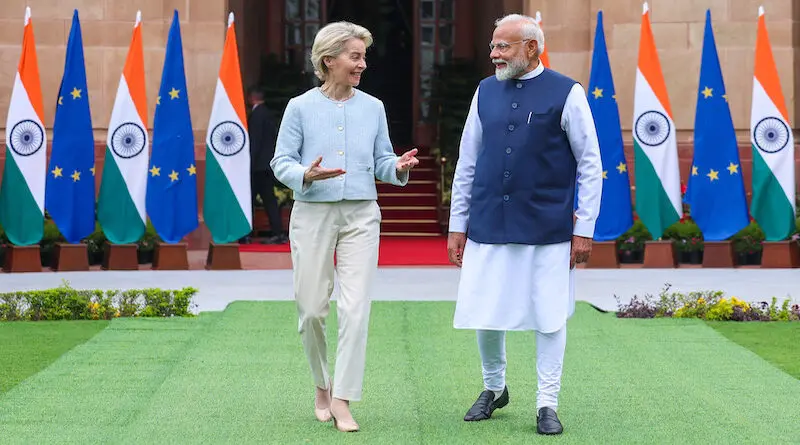
India's PM Narendra Modi meets the President of the European Commission, Ms. Ursula Von Der Leyen. Photo Credit: India Prime Minister Office


By 

By Jake Scott


After nearly two decades, the European Union (EU) and India are edging closer to finalizing a free trade agreement. Talks, first launched in 2007 and repeatedly stalled—due partly to the EU bloc’s ratification and bureaucratic lethargy, and partly to India’s reluctance towards EU-wide policies—are suddenly moving with purpose. Both sides want to conclude a deal by the end of 2025, a deadline that feels ambitious but not impossible.

The context is clear enough: India is under new pressure after Washington slapped tariffs on its steel and aluminum exports, while Brussels is eager to diversify trade partnerships in an era of supply chain shocks and geopolitical fragmentation. Together, the two markets represent more than a quarter of the world’s population and a combined GDP that rivals China’s. A deal would not just matter bilaterally; it would reshape the rules of global trade.

The obstacles are formidable. The first and most obvious is tariffs. The European Union wants India to slash its notoriously high import duties on cars, wines, spirits, and dairy products; sectors that carry both economic and cultural weight in Europe. India has long resisted, anxious about exposing its domestic industries to a flood of foreign competition. Given the recurring farmers’ protests against cheaper grain imports, it is easy to understand why politicians are anxious not to upset their voters further.

On the other side, Delhi wants easier access for its textiles, pharmaceuticals, and agricultural products. Brussels, however, is reluctant to give ground without reciprocal concessions. That tension between protecting sensitive sectors and expanding market access is the backbone of every trade negotiation, and here it is especially in focus. After the bruising that the EU received in the US–EU trade negotiations, it is understandable that they are cautious about future deals.

Then come the regulatory hurdles, the “soft” trade barriers. The EU’s standards for food safety, environmental compliance, and intellectual property are among the strictest in the world (a fact that has scuppered many EU–US trade talks in the past), and Indian exporters argue that meeting these benchmarks requires costly adjustments that tilt the playing field in Europe’s favor.


Services are another sticking point. India, which has built its contemporary global reputation and international economic strength on IT outsourcing and skilled labor mobility, wants recognition for qualifications and smoother pathways for professionals to immigrate to Europe. Yet the EU, wary of domestic political sensitivities over labor movement, is cautious about opening the door too wide.

The impasse is not merely economic but cultural: a matter of trust, control, and sovereignty. With an eye on the souring of Canada–India relations, and the controversy over the H-1B visa in the US, the EU is trying to protect its service-focused economies just as India is trying to shield its domestic manufacturing and agricultural base.

Environmental regulation is an even more contentious frontier. The EU’s Carbon Border Adjustment Mechanism, which levies imports from high-emission industries, is seen in Delhi as a disguised tariff that penalizes developing economies. India, still heavily reliant on coal and pursuing growth targets that demand vast energy consumption, argues that such rules ignore its lower per capita emissions and developmental stage. Given India’s high levels of CO2emission, this could be deadly to their modernization.

Brussels, however, views carbon pricing and deforestation-free supply chains as non-negotiable pillars of its trade policy. With a Europe-wide program to decarbonize and increase green energy-supply, this is a real sticking point. Reconciling these positions will require either creative exemptions, phased implementation, or side deals that soften the blow for Indian exporters.

Symbolism also matters. Few issues illustrate this better than the battle over basmati rice. India has applied for exclusive geographical indication rights to the term “Basmati” in the European market. Pakistan, which also exports large volumes of the grain, insists it has equal claim. For the EU—which is no stranger to officially stamping certain food names like feta, gruyere, and champagne—granting India exclusivity risks embroiling the bloc in South Asian rivalries.

For India, however, this is not just about commercial advantage; it is about national pride. A compromise that preserves market access for Pakistan while recognizing India’s claim in some form may be the only way forward. In a negotiation where every concession is wrangled, even rice becomes geopolitical.

What India ultimately hopes to secure from the deal is clear. Diversification is top of the list: with the US imposing tariffs and China increasingly unpredictable, Delhi wants a stable anchor in Europe. Market access for labor-intensive industries is vital for job creation, while regulatory simplification would ease costs for exporters.

India also wants reassurance that EU environmental and consumer rules will not amount to protectionism dressed up as principle. And, not least, Delhi wants recognition of its geographical product indications, with basmati rice at the forefront. In short, India is seeking growth, security, and respect: the ability to play on equal terms with one of the world’s most rule-setting economic blocs.

At a time when global trade is fragmenting, the EU–India deal would stand as proof that two large, diverse economies can still find common ground.

For Europe, it is a chance to project influence in Asia without being pulled into the binary of US–China rivalry. For India, it offers a pathway to embed itself more deeply into global supply chains while defending its developmental priorities. For the world, it is a test case: can climate concerns, regulatory standards, and traditional trade barriers be reconciled in a way that allows both growth and sustainability?

If the agreement succeeds, it will create a template for future trade deals, showing how developing countries can integrate into a system often written by advanced economies without surrendering autonomy. If it fails, it will be another reminder of how difficult it remains to bridge the gap between protectionism and openness, sovereignty and cooperation.

Either way, the stakes are high. A deal between the EU and India is not just about tariffs on cars or labeling rights on rice. It is about whether the architecture of global trade can adapt to a multipolar, contested, and environmentally constrained world.

  • About the author: Dr Jake Scott is a political theorist specialising in populism and its relationship to political constitutionality. He has taught at multiple British universities and produced research reports for several think tanks.

war