Sunday, November 23, 2025

“A House of Dynamite,” the “Failsafe” Film for 2025


My interest in conflict and war goes back decades. In 1961, the film Failsafe starring Henry Fonda as the U.S. president presented a dire warning about the nuclear arms race taking off. It revealed our vulnerability: human error, miscommunication, and technological failure. The tragic ending was shocking. Film director Kathryn Bigelow’s new A House of Dynamite is equally gripping, demonstrating to viewers the reality of our modern world, our closeness to global destruction. Failsafe was alarming. House of Dynamite is foreshadowing.

In 1961, I was at UCLA earning a doctoral degree in evolutionary biology and studying animal behavior, including humans. My early interests included conflict resolution and gender differences. Decades later, after a period of writing fiction and promoting one of my novels, I was drawn back to the topic of war. Voice of the Goddess, a Bronze-age epic, told of a non-violent, non-warring, goddess-worshipping culture on the island of Crete and a warrior hero from the nearby mainland Mycenaean culture. To promote the book, I gave a talk entitled, “If women ran the world there would be no war.”

During the talk, a woman in the audience challenged my book’s core message. She cited the work On Aggression by my academic forefather, Konrad Lorenz, arguing that aggression is an unchangeable part of human nature. With limited speaking time, I couldn’t explain why Dr. Lorenz was only partly right, particularly when it comes to the relationship of women to war.

But the question did rattle my certainty that if women ran the world, war wouldn’t exist. I subsequently launched into two and a half decades of research to answer the questions: when did we start making war, why do humans make war, and could we stop? In my research, I determined that men have not been and will not be able to end war without significant shared leadership with women. The number of women who were able to break into powerful decision-making spaces was, to my knowledge, so few in 2015 that I felt the problem wouldn’t be remedied in my lifetime. In 2018, I wrote my last book on the subject – War and Sex and Human Destiny. It felt like a farewell to the subject.

Time moved on, and I went back to writing fiction. But six years later, Mika Brzezinski, a TV host on Morning Joe, announced that Forbes magazine would soon host another meeting in Abu Dhabi of 500 powerful women from around the world. Women from Forbes’s annual 50 Over 50 and 30 Under 30 lists would gather to address the world’s challenges. I caught my breath! A sufficient empowerment of women had happened without my noticing. This change in women’s status, along with advancements in technology and communication since the 1960s meant that ending international wars had become a genuine possibility.

So how does that relate to A House of Dynamite? The global community has built a house and stored explosives within it: landmines, Semtex, C-4, atomic and other bombs, and yes, dynamite. And we are choosing to live in that house. Democracies around the world appear to be losing their grip. Nuclear-armed nations are spending to refurbish and upgrade nuclear arsenals. The president of Russia, after invading Ukraine, on several occasions has brandished his nuclear saber. Non-nuclear nations like Iran are feeling the urgent need to acquire their own Weapons of Mass Destruction (WAMDs). All this to say, an enforceable international peace treaty is urgently needed. The good news is that in this century we have the knowledge and the means to fashion one.

In 2024, I, with several close friends, laid the foundation for a campaign to make enduring international peace a reality, Project Enduring Peace (PEP). Drawing on my research, we have developed a petition that outlines the means to secure a lasting treaty, based on historical examples from the Iroquois Confederacy to the European Union. If the global community successfully blocks wars between nations, none need fear attack by another. Disputes would be resolved by negotiations or other means. Eventually, nuclear arsenals would be perceived as dangerous and expensive burdens. Nations would become secure enough to abandon them, allocating the saved resources elsewhere.

A House of Dynamite makes the case that we need to act before it is too late. PEP is offering a perspective that anyone can support by signing the Project Enduring Peace Petition urging the United Nations to make haste to begin peace treaty negotiations. It’s our choice: we can continue to risk living in our existentially dangerous house or rise up, escape the treadmill of international warfare, and leave behind an enduring legacy of global peace.

Dr. Judith L. Hand is an evolutionary biologist and author whose work centers on the biological roots of human conflict and the pathways to a warless future. She is also the Co-Founder of Project Enduring Peace, a non-profit committed to educating the public about peace systems and ending all inter-state wars through a global peace treaty.

H: Kathryn Bigelow’s Empire of Fear

November 21, 2025
Still from A House of Dynamite.

Kathryn Bigelow is back, and not much has changed. Eight years since her last feature film, the first woman to win the Best Director Oscar for her unwavering depiction of the trauma of the occupier, the American filmmaker has made yet another war film – one that, like The Hurt Locker and Zero Dark Thirty, is seeped in the language of responsibility, yet, like those movies, remains problematic at its core.

A House of Dynamite arrives dressed as an anti-war, anti-nuclear weapons story. It claims to confront the horror of nuclear weapons with clear-eyed realism – to show, without melodrama, the suddenness with which the world could unravel. But peel back the surface and the film reveals something far darker: a work of imperial fantasy, a fever dream – wholly detached from any semblance of political reality – in which the United States imagines itself as the victim of the bomb it invented.

The film’s plot is absurd. It imagines a nuclear strike on the US – a missile bound for Chicago, which will wipe out the city and kill ten million people in the blink of an eye. It’s a fantasy that might have made sense in the 1960s, at the height of Cold War paranoia after the October Crisis (Cuban Missile Crisis). In 2025, however, it borders on delusion. No nation on Earth could, or would, launch a nuclear attack on the US. In fact, the only country ever to have used atomic weapons against civilians is the US itself – and not once, but twice. Yet Bigelow asks us to imagine – in 2025, no less – that the empire which annihilated Hiroshima and Nagasaki now trembles beneath its own mushroom cloud.

This inversion is not new to the veteran filmmaker. Bigelow has always filmed the machinery of empire with reverence. In Zero Dark Thirty, torture is procedural, and the lives of Pakistani civilians are afterthoughts – objects in the way of the US manhunt for Bin Laden; collateral ultimately rationalised by the ends. In The Hurt Locker, war is stripped of history and turned into a soldier’s addiction. A House of Dynamite continues the same project but with a slightly different disguise. Gone are the overt symbols of triumphalism or battlefields; in their place, a solemn tragedy. The film mourns American fragility so earnestly that the terror of annihilation becomes one more opportunity for self-mythology.

It follows officials, generals, and analysts struggling to save the homeland, all from different perspectives, which ultimately collapse into the same one anyway. Even as these people repeatedly make comments about how this could spell the deaths of hundreds of millions around the world, the US is all we see. Beyond a token exchange with Russia’s foreign minister, the rest of the world ceases to exist for the duration of the film’s almost two-hour runtime. No one asks what would happen to Pyongyang, Tehran, or Beijing if a nuclear war began; the only catastrophe worth filming is American. The empire’s imagination, it turns out, cannot stretch beyond its own borders. Even at the end of the world, the camera never leaves Washington.

This claustrophobic gaze serves a purpose. By erasing everyone else from the frame, the film plays on the fears baked into American exceptionalism. And so, the dread of sudden obliteration it imagines is less an argument against nuclear weapons and more for endless defence spending. Early in the story, a $50 billion missile-interception system is introduced. It has a 61 per cent chance of success, according to the film. “A coin toss,” as the viewer is constantly told. When it fails, the not-so-subtle implication is this: even as millions of Americans struggle to live paycheck to paycheck, without access to healthcare, the billions going towards the war machine are necessary because what if, one day, an adversary decides to nuke us on a whim?

This logic comes at a time when militarism, in the eyes of the US public, is waning. The US military faces plummeting recruitment, record scepticism, and rising outrage over its global conduct – at the core of which lies its facilitation of Israel’s genocidal assault on Gaza. Within this climate, A House of Dynamite functions as a cultural triage designed to resuscitate faith in the institution by reminding Americans of their supposed vulnerability. Want to protect your family from the next imaginary nuke? Well, you’d better keep funding the war machine that is currently incinerating fishermen in the Caribbean.

Part of what makes the film so insidious is how convincingly it moves. Bigelow’s realism – her eye for detail and her fluency in military ritual – is well regarded. This gives every frame in A House of Dynamite a sheen of authenticity, especially for those unfamiliar with the politics of empire. It is also why Bigelow has long enjoyed privileged access to the security state. The procedural accuracy of Zero Dark Thirty, for example, famously benefited from CIA cooperation. “We really do have a sense that this is going to be the movie on the UBL [Bin Laden] operation – and we all want the CIA to be as well-represented in it as possible,” stated an internal email sent from the CIA’s Office of Public Affairs in June 2011, about that movie. This is how modern propaganda works, not through flag-waving, but through immersion. The more “authentic” it feels, the less you question the fantasy. It is why Zero Dark Thirty retains credibility and reverence among the liberal elite and American critics, and Red Dawn doesn’t.

When A House of Dynamite reaches its climax, the unnamed POTUS (Idris Elba) must decide how to retaliate after the $50-billion coin-toss fails. An adviser mutters to the president about “bad guys” – the script’s actual term, believe it or not – for the possible culprits. The president hesitates, reluctant to start a nuclear holocaust yet seemingly forced to defend the US. Bigelow stages the moment as tragedy, but the politics are obscene. The implication is that even the contemplation of mass murder is a uniquely American burden. There is no anti-war message here, only the self-flattering belief that US violence, even nuclear annihilation, would be reluctant, and therefore righteous.

By the time the film reaches its conclusion, A House of Dynamite has achieved something almost admirable in its cynicism. It transforms a fantasy of impossible destruction into moral theatre. It asks us to sympathise with the empire’s fear while ignoring the empire’s victims. This is propaganda for an age of liberal despair. The danger is never what America does. The danger is what might happen to America.

For all its talk of “the human cost”, A House of Dynamite never imagines a human outside the frame of the US flag. And to put this movie out now – while Gaza starves under American bombs, while arms manufacturers post record profits – is to see how seamlessly culture serves capital. The mushroom cloud over Chicago is fiction; the bombs over Fallujah and Rafah are not.


Hamza Shehryar is a writer and journalist. He covers film, culture, and global politics.

Ukrainian sumo wrestler shocked to win first title

Tokyo (AFP) – Ukrainian sumo wrestler Danylo Yavhusishyn said Monday that he had surprised even himself by becoming the first from his country to win a tournament in the ancient Japanese sport.


Issued on: 24/11/2025 - RFI

Ukrainian sumo wrestler Danylo Yavhusishyn, also known by his ring name Aonishiki, 
won the Kyushu Grand Sumo Tournament on Sunday © - / JIJI PRESS/AFP

The 21-year-old, who fled the war in Ukraine three years ago, is set to be promoted to sumo's second-highest rank this week after winning the Kyushu Grand Sumo Tournament.

The victory earned Yavhusishyn, who is known by his ring name Aonishiki, his first title in only his 14th tournament.

He did it by beating Mongolian grand champion Hoshoryu on Sunday.

"To be quite honest I wanted to win the tournament but I didn't really think that I could," he told reporters in Fukuoka.

"I'm really happy."

Yavhusishyn was born in central Ukraine and took up sumo at the age of seven, becoming a national champion at 17.

His age meant he narrowly avoided Ukraine's military draft for men aged 18 and older after Russia invaded and he sought refuge in Germany, before moving to Japan.

His parents stayed in Germany and he arrived in Japan knowing nothing of the language.

Yavhusishyn said he spoke to his parents after winning the tournament and that he had also received messages from friends in Ukraine.

"I've had lots but I haven't been able to reply to them all yet," he said.

"It will take time to reply to them all but I'll start doing them one by one after this."

Yavhusishyn became the second Ukraine-born professional sumo wrestler when he made his debut in July 2023, following in the footsteps of Serhii Sokolovskyi, better known as Shishi.

Yavhusishyn's promotion to sumo's upper divisions was the fifth fastest since the current system of six tournaments a year was introduced in 1958.

He kept his title hopes alive at the Kyushu Grand Sumo Tournament by beating Hoshoryu on the penultimate day, then triumphed over the Mongolian again to clinch the title.

"It was the last tournament of the year, so I wanted to give a good account of myself so that I wouldn't end the year with any regrets," said Yavhusishyn.

© 2025 AFP


Letters to the Editor: Shipwrecks Remind Us All of Our Humanity

El Faro
The wreck of SS El Faro, lost with all hands in a hurricane off the Bahamas on Oct. 1, 2015 (USN/USCG)

Published Nov 23, 2025 1:21 PM by The Maritime Executive


While‍‌‍‍‌‍‌‍‍‌ the maritime community is remembering the 50th anniversary of the Edmund Fitzgerald, I have been wondering why shipwrecks still have such a strong impact on people's imagination. The Franklin Expedition, the Titanic, or the Fitzgerald, for instance, are not only tragic events at sea. People who have never stepped on a ship and could not point out port or starboard still feel something when they hear about these lost crews. These events become more than history. They turn into human stories that move from one generation to the next.

We tend to forget that a ship is not simply a machine - it is an operating society. Every vessel has its own structure, daily lives, rites and superstitions. The crew is a small community, the foundation of which is mutual trust, discipline, and cooperation. The sudden disappearance of that micro-community is something that we register as more than a mere historical footnote; it is the downfall of a miniature world that used to drift on the waters.

Throughout my research on the Franklin Expedition, I have come to realize that people relate to such stories not because they are highly technical from a maritime perspective, but because they deal with human themes that are common to all people: ambition, fear, courage, and fragility.

The Titanic is the most obvious case. The majority of people who find the Titanic fascinating would not be able to explain the technicalities of the hull design or watertight compartments, but they understand immediately the human stories onboard: the families that were looking for a new life, the crew members who were doing their jobs, the common wish for safety that was broken by the cold Atlantic.

This long-lasting fascination is not a morbid one. It is a deep, primal empathy. Shipwrecks tell the truth that we all know and yet deny: regardless of how advanced a vessel is or how carefully a society is set up, nature still has a say in its survival. Wrecks remind us of the thin line that separates order from chaos, safety from disaster.

In the end, we return to these stories because they remind us of ourselves. They say something about our vulnerability, our strength, and the small communities we form to survive a world we cannot fully control.

Kai Tarr is a 26-year-old former paramedic and current Regis University student based in Colorado. His work focuses on disaster response, public safety, and the ways communities make meaning out of tragedy. Despite living in a landlocked state, he has a long-standing interest in maritime history, especially the Franklin Expedition and Great Lakes shipwrecks. 

The opinions expressed herein are the author's and not necessarily those of The Maritime Executive


Cambodia Has Another Maritime Border Problem - With Vietnam

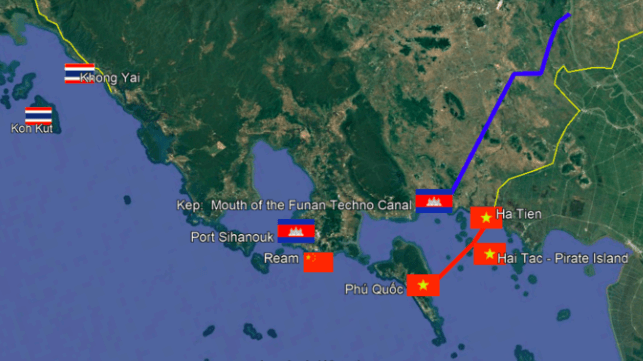
Another Cambodian maritime border issue - the planned Hà Tiên to Phú Qu?c causeway impeding access to the Funan Techno Canal linking to the Mekong (Google Earth/LandSat/CJRC)

Published Nov 23, 2025 2:13 PM by The Maritime Executive


Cambodia has another maritime border issue.

Tensions are rising between Thailand and Cambodia, the inheritance of a poorly drawn map dating back to French colonial times. This issue affects Cambodia in the Khong Yai area, where a coastal strip of Thai territory approximately 30 miles long, but in many places less than a mile in width, prevents Cambodia access to the sea. In the border war this summer, Thai marines, with naval gunfire support, repelled an attempt by Cambodia to seize access to the sea across this narrow strip of land.

But further to the South and on her border with Vietnam, Cambodia faces a far more serious problem.

Cambodia, with Chinese finance supposedly restricted to 49%, is building the Funan Techno Canal, to link the Mekong River through Cambodia territory directly to the Gulf of Thailand near Port Sihanouk. This route for sea-going ships will mean that vessels will no longer need to pass through the mouth of the Mekong in Vietnamese territory before gaining access to the open seas. Vietnam benefits commercially from the current political geography, as Cambodia has to ship through Vietnamese territory and Ho Chi Minh City is effectively the entry port for Mekong river traffic into Cambodia. This business would fall away when the Funan Techno Canal opens.

The Vietnamese are also worried that water diverted from the Mekong into the Funan Techno Canal will lower water levels in the Mekong Delta, and hazard shipping channels.

In response, and after failed attempts to engage in negotiations, the Vietnamese are now planning to build a road causeway across what would have been the main sea route to the entrance of the new canal, linking their port city of Hà Tiên with the Vietnamese islands of H?i T?c and Phú Qu?c.

The Vietnamese claim the project is proceeding at pace, and is due for completion in 2027. But while the intent may be there, and is being talked up on Vietnamese social media, satellite imagery shows only a limited length of the causeway has been built so far. The Vietnamese may be waiting to speed up construction until the Cambodian canal has progressed further.

By closing this sea approach to the mouth of the canal, the Vietnamese would not be restricting access completely. There is to be a bridge for fishing boats in the causeway, and access to the canal entrance will remain, but solely through Cambodian territorial waters to the north of Phú Qu?c Island. This approach is only 0.8 miles wide at its narrowest, and the maritime border may not allow Cambodia access to the deepwater channel which ocean-going ships will need.

The Vietnamese are not in the mood for compromise or for making life easy for Cambodia. Under the umbrella of the ASEAN organization, the navies of the two countries keep up a pretense of enjoying good neighborly relations. The Vietnamese TP-01 Class patrol boat P251 conducted joint maneuvers with the Koh Svay Class patrol craft Koh Kras (P1142) of the Royal Cambodian Navy in March this year, but the same Vietnamese patrol boat was seen in a show of force with four other Brigade 127 patrol boats in the same area last month.


Fire Contained Aboard ONE Container Ship at Port of Los Angeles

fire on containership Port of Los Angeles
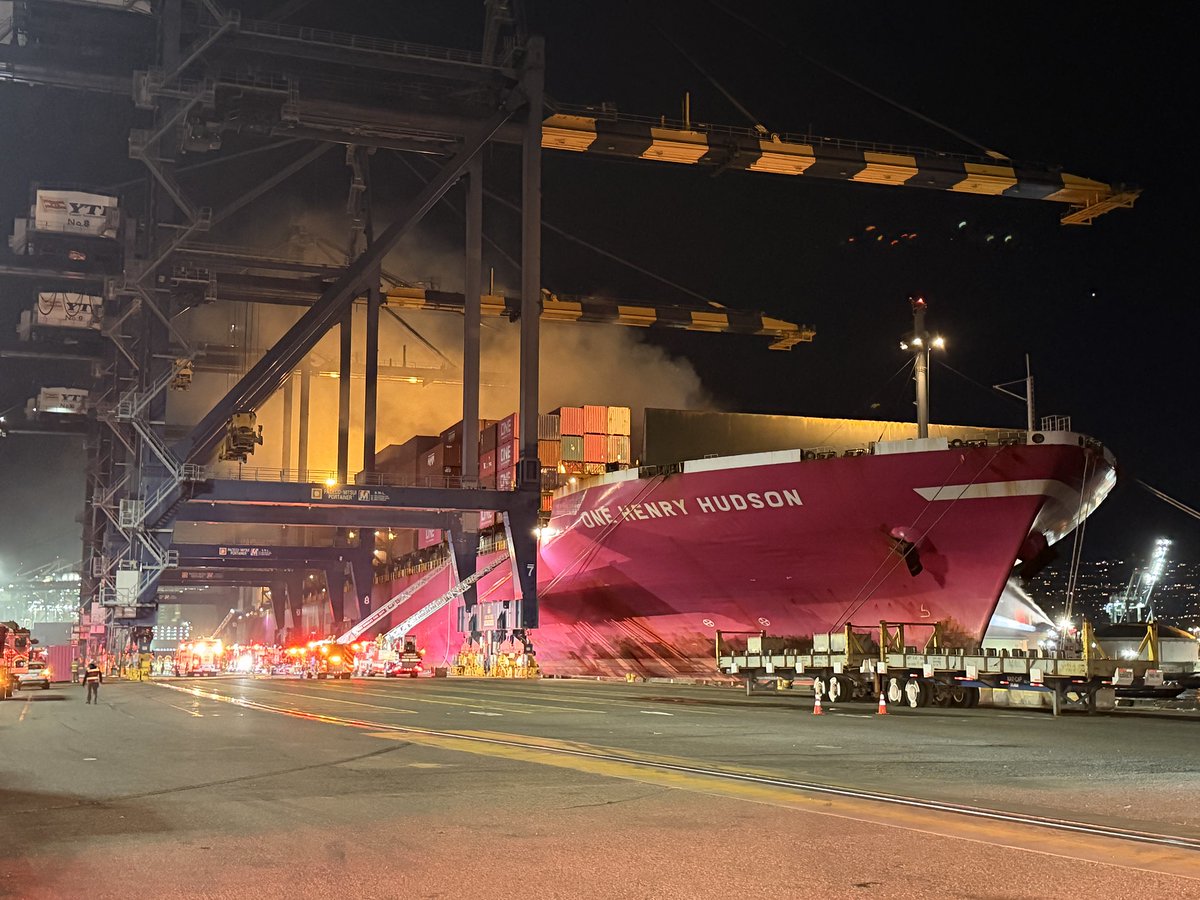
Electrical fire started below deck on the docked containership (Port of Los Angeles)

Published Nov 23, 2025 3:42 PM by The Maritime Executive


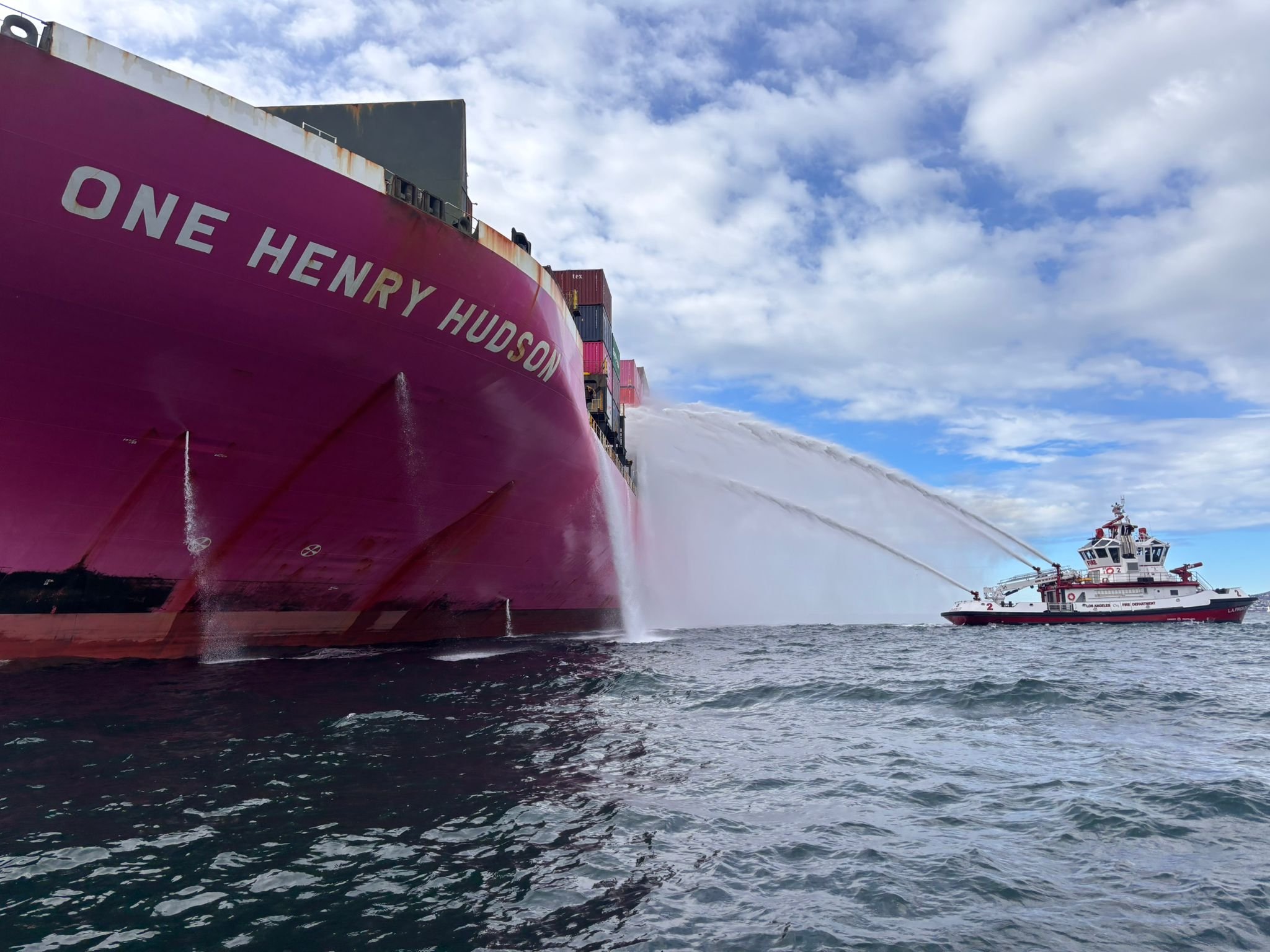
[Updated] Fire crews from Los Angeles and Long Beach responded to a fire aboard an Ocean Network Express (ONE) container ship docked at the Port of Los Angeles on Friday evening. As of 1330 hours on Saturday, the fire was isolated to a single cargo hold aboard the ship, and a fire boat from the Port of Los Angeles was on scene to provide cooling water. The ship has been moved to an anchorage about one mile offshore.

The Coast Guard has set up a safety zone of about half a nautical mile in radius around the ship, and is directing nearby vessel traffic. As salvors and crewmembers continue the response, the service is helping out with stability and hazardous material assessments on board. 

Courtesy USCG

"The Los Angeles Fire Department (LAFD) personnel were the first to arrive on scene and immediately coordinated a response with local partners from other agencies," said Assistant Chief Carlos Calvillo, LAFD incident commander. "Fire burned on multiple sub-levels below deck in areas that were largely inaccessible, which required a high level of communication and coordination from everyone to ensure the safety of on scene personnel and the crew members aboard the vessel. Remarkably, and thankfully, no injuries have been reported as a result of this ship fire."

Residents in nearby communities were told to keep windows closed in order to keep out smoke. 

“The successful isolation of this vessel fire shows a strong partnership between the Port of Los Angeles and our local partners,” said Capt. Daniel Cobos, Port of Los Angeles Police Department incident commander. “Our coordinated response ensured operations continued uninterrupted at one of the largest ports in the country.” 

It is unclear how many containers might have been damaged, but the fire onboard has been substantially contained. Los Angeles Fire Department Capt. Adam Van Gerpen told the media that at least 40 containers were involved in the fire, and it was possible that it had spread to 100 or more after an explosion aboard the ship.

The crew aboard the ONE Henry Hudson (98,849 dwt) reported a below-deck electrical fire on the vessel at approximately 6:38 p.m. local time, according to the LA Fire Department. The vessel, which was built in 2009, had arrived from Tokyo, Japan, on November 19 and has a capacity of 8,212 TEU. The vessel is flagged in Panama.

Shortly before 8:00 p.m. local time, the fire department reported there was an explosion aboard the vessel affecting power, including lights and crane operations on the ship. Because of the dangers, firefighters were ordered to remain above deck. Fireboats were positioned alongside the vessel to provide cooling to the hull. 

The fire spread into several container bays, according to the fire department. Responders were working with full breathing and safety apparatus because of reports that there was dangerous cargo aboard the vessel and in the area of the fire. At its peak, 186 fire personnel were working the incident. Fixed-wing aircraft and drones were being used with heat-sensing equipment to show the extent of the fire.

Early reports said that 15 crewmembers had been evacuated from the vessel, with two remaining aboard and six unaccounted for by the fire department. They later reported that all 23 crewmembers were safe, and that members of the crew assisted in moving and anchoring the vessel outside the port. Some remain aboard and are still involved in the efforts to respond to the fire. 

Operations were temporarily suspended at the Yusen Container Terminal, where the vessel was docked, as well as three additional terminals in the port. Operations at the port resumed as normal on Saturday.


Lifeboat Falls Off Cruise Ship During Safety Drill

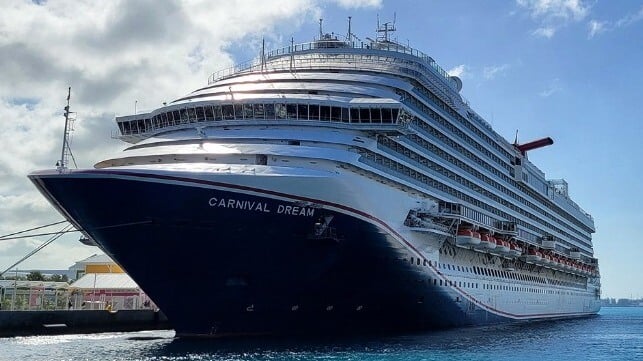
Carnival Dream (file image courtesy Kiran891 / CC BY SA 4.0)

Published Nov 23, 2025 10:33 PM by The Maritime Executive


Last week, passengers aboard the cruise ship Carnival Dream reported that one of the vessel's lifeboats broke away from its davit and fell into the water while the ship was berthed at Cozumel, Mexico. Photos from the scene appear to show structural damage to the bow of the lifeboat. 

The dropped boat was on the starboard side, opposite the pier, according to Cruise Hive. It fell into the water and drifted up to a wharf, where it was retrieved. The remainder of the lifeboat's bow was still hanging from the falls. 

"The team on Carnival Dream was conducting an unmanned test of lowering one of the lifeboats when a latch got caught on one of the cables, resulting in the vessel hanging from one end then falling into the water below," a Carnival spokesperson told Cruise Hive. 

It is the second time that Carnival Dream has lost a stowed lifeboat, and the second time that bystander images showed signs of damage to the lifeboat's bow. The first instance was reported on December 30, 2018 while the cruise ship was under way in the Gulf of Mexico. The lifeboat was successfully retrieved by the crew. 

Aboard Carnival Dream, the lifeboat davits hang out over the water, not over a promenade deck, so the falling boat was not positioned to injure bystanders. No injuries were reported.  

In decades past, lifeboats were among the most dangerous objects aboard merchant ships, accounting for hundreds of lives lost and an estimated one out of six seafarer deaths. When a laden lifeboat would be accidentally released in midair (video below) due to human error or equipment failure during a safety drill, the personnel trapped inside often suffered injury or death when they hit the water. A safer drill procedure - to lower away the boat without anyone in it - has been allowed by IMO's Maritime Safety Committee since 2009, and has likely saved countless lives. 

Top image: Carnival Dream (file image courtesy Kiran891 / CC BY SA 4.0)


Success of Naval Laser Weapon Leads to $400M Contract

Royal Navy
Courtesy Royal Navy

Published Nov 23, 2025 5:20 PM by Royal Navy News


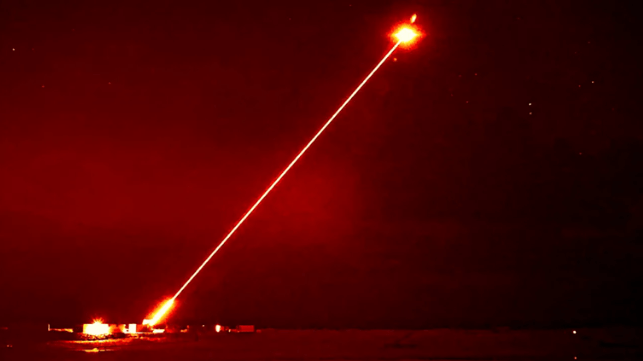
More than $400 million is being invested in the Royal Navy’s first ever laser weapon after it downed high-velocity drones in the latest trials.

The success of the latest firings has prompted Whitehall to sign a $415 million contract with defense firm MBDA UK to continue developing the weapon – and install it on a Type 45 destroyer within two years.

At present the Daring class rely on Sea Viper missiles, cannon and small arms, plus the Phalanx system to deal with aerial threats.

All have proved successful in action: Sea Vipers and HMS Diamond’s 30mm gun were all used to obliterate drones launched by Houthi rebels in the Yemen against Red Sea shipping.

DragonFire offers a cheaper ($13 per shot compared with, for example, over $1.3 million for a Sea Viper missile), highly-accurate (it can hit a £1 coin at a range of one kilometer) alternative, with no danger of expending ammunition.

In its most recent trials, DragonFire detected, tracked, engaged and finally destroyed above-the-horizon drones flying at high speeds – a UK first.

Working with science/tech firm/defense firms QinetiQ and Leonardo, MBDA will hone the design and functioning of the system before installing the high-power device on one of the Portsmouth-based destroyers - five years ahead of original plans.

Chris Allam, MBDA UK’s Managing Director said the UK was at forefront of laser weaponry and DragonFire would be a “truly game-changing weapon system” for the Royal Navy.

Luke Pollard, Minister for Defence Readiness and Industry, said DragonFire would place the Royal Navy “at the leading edge of innovation in NATO, delivering a cutting-edge capability to help defend the UK and our allies in this new era of threat”.

It will be the first high-power laser weapon in service with any European nation, and the program will create or sustain nearly 600 jobs across the UK.

This article appears courtesy of Royal Navy News. The original may be found here

The opinions expressed herein are the author's and not necessarily those of The Maritime Executive.


Taiwan War Plans May Be Behind the Purge of Top Chinese Officers

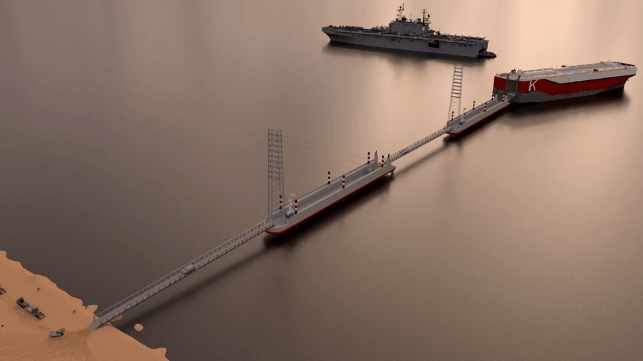
Depiction of the PLAN pier and causeway beach invasion landing system (Wikideas1 / Public domain)

Published Nov 23, 2025 5:09 PM by The Maritime Executive


In October, the Maritime Executive summarized what was then known about a purge amongst the senior ranks of the People’s Liberation Army (PLA). Nine officers of four-star rank were identified as having been purged, including three senior officers from the PLA Navy (PLAN). The dismissals were made public in an announcement made by Chinese Ministry of Defense on October 17.

Our assumption was that the purge had been much deeper, extending from the four-star level down into the lower ranks of the military hierarchy.

That the purge was deeper than publicly acknowledged was confirmed at the Fourth Plenum of the Chinese Communist Party (CCP) Central Committee, held at the end of October, when the seats of approximately half of the Central Military Commission (CMC) delegates were left vacant. There appears to have been a power struggle within the CMC, likely to have been rooted in disagreements on military approaches to taking over Taiwan - with those dismissed being those who would have had to lead a blunt force invasion of Taiwan with which they disagreed. Of the nine dismissed, seven were either former or current senior officers in the Eastern Theater Command, which being adjacent to Taiwan, would lead on the invasion. President Xi Jinping has consistently pushed a hardline military solution to the 'Taiwan problem', investing particularly in an expansion of the PLAN 's operational capability, whilst a group of military officers opposed to this policy have advocated instead a more nuanced approach.

Many of those dismissed had only recently been promoted. Most were considered to be members of the Fujian clique, a group considered to be closely aligned and loyal to President Xi Jinping personally. Rumors had been circulating about the dismissals since April.

The official announcement of the nine dismissals and expulsions from the CPC attributed the removals to disciplinary violations and allegations of corruption, an implausibly generic explanation given the spread of posts of those purged. Subsequently in the press, the nine were accused of disloyalty to the CPC. This gave weight to a more logical explanation: that those dismissed - mostly concerned with political work within the PLA - were the leading representatives of a faction within the CPC which had begun to have misgivings about the political direction of the CMC and CPC Chairman, President Xi Jinping

Of the nine four-star officers dismissed, Admiral Miao Hua had been head of the CMC's Political Work Department, the organization within the PLA responsible for upholding conformity to CPC doctrine. This activity is synonymous with oversight of personal loyalty to the personality of President XI and his particular interpretation of CPC ideology. Dismissed alongside him was Admiral Yuan Huazhi, a marine officer, until recently head of the PLAN Political Works Department. Admiral Wang Houbin was dismissed from his post as commander of the PLA Rocket Force, but he had been the PLAN Deputy Commander from 2019-23 and had held a senior operational post previously in the East Sea Fleet.

The most senior officer dismissed was CMC Vice Chairman General He Weidong, who had been a member of the 24-strong Politburo and is also believed to have been the lead strategic planner for operations against Taiwan. General He Hongjun, deputy head of the CMC Political Work Department was unusually a senior officer from Tibet, but managed to commit suicide before his dismissal was announced. Two other senior officers had been holding operational posts, General Wang Chunning in command of the PLA’s Armed Police, and - perhaps the casualty of greatest significance - Lieutenant General Lin Xiangyang, commander of the Eastern Theater.

Additional Eastern Theater Command officers now suspected of being under investigation or who have already been covertly dismissed include Vice Admiral Wang Zhongcai, commander of the East Seas Fleet, and Major General Ding Laifu, commander of the 73rd Army Group, one of three such ground force formations within the command.

Vice Admiral Wang Zhongcai (left) in happier times, visiting the Philippines in his former role as chief of the China Coast Guard, 2020 (PCG file image)

Vice Admiral Li Hanjun, PLAN Chief of Staff, was apparently purged in June. General Wang Haijiang, commander of the land-locked Western Theater Command, was apparently dismissed in March. There have been additional senior dismissals in the PLA Ground Forces, Air Forces and Rocket Forces.

Despite these upheavals and differences of opinion within and between the political and military high command over approaches to Taiwan, there has been no evident scaling back of aggressive military operations, around either Taiwan or in the Nine Dashed Line waters of the South China Sea claimed by China.

The dismissals will have caused disruption in the chain of command, and a loss of the expertise and knowledge amongst those intimately involved in planning operations against Taiwan. Certainly, PLAN officers will be nervous and less inclined to take the initiative or engage in critical thinking. But this handicap has not yet manifested itself in any noticeable reduction in PLAN operational effectiveness.


New Tactics Could Curb Immigrant Rubber-Boat Traffic in English Channel

Gendarmerie
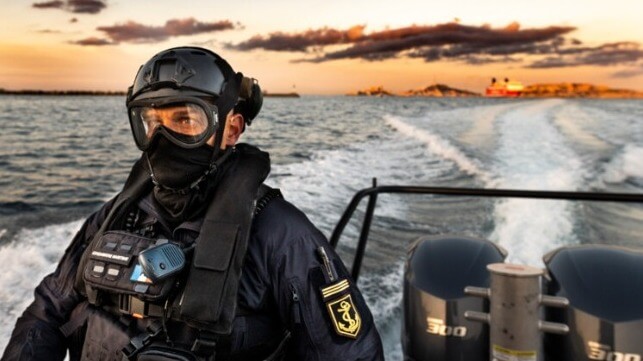
File image courtesy Gendarmerie Nationale

Published Nov 23, 2025 3:16 PM by The Maritime Executive


Illegal immigrants continue to make passage across the 25-mile-wide English Channel to claim asylum in the United Kingdom.

In recent months, the number of refugees making landfall in the UK has been rising. According to British government figures, 45,264 refugees made the crossing in 2024. More than 39,000 have crossed so far this year, and if the trend continues and undetected crossings are also included, the total by the year's end will be greater than in 2024, and probably higher than in any previous year.

The upward trend in crossings is despite the further agreement with France in July to curb the crossings, for which assistance the British government funds the French efforts. 

Notwithstanding the agreement and the payments, the numbers crossing the Channel since July have increased further. The French police claim to be stopping about a quarter of all crossings, by intercepting refugees and the rubber boats on the beach before they reach the water.

Under French law, police are not allowed to intercept boats at sea, even if they are dangerously overloaded, have unqualified crews and fail to meet basic safety standards. Although most refugees are young men, smugglers normally include some women and children as passengers on each rubber boat attempting the crossing, in order to increase the likelihood that boats which are swamped will be rescued. A dip in the English Channel in winter can quickly lead to death through hypothermia, and in any case most refugees cannot swim.

The English Channel is one of the world's busiest shipping lanes, and the rubber boat traffic also presents a considerable hazard to shipping.

The French gendarmerie however are promising to introduce new tactics, using nets to foul the propellers of the rubber boats just offshore. This tactic has been designed to bring the rubber boats to a halt gently, without risk of capsizing, but presents considerable boat handling challenges if the sea state is anything other than flat calm.

The British government's efforts to stop the cross-channel traffic is based on the concept of "stopping the smuggling gangs." But given that the lure of free food, hotel accommodation and healthcare is a powerful pull factor for would-be refugees - an offering much more attractive than alternatives offered elsewhere in Europe - smuggler gangsters taken down are quickly replaced by others keen to capitalize on average passage payments of $3,000 per person, a very lucrative criminal activity.