Sunday, January 25, 2026

AU


Poland has more gold than the European Central Bank and has no intention of slowing down
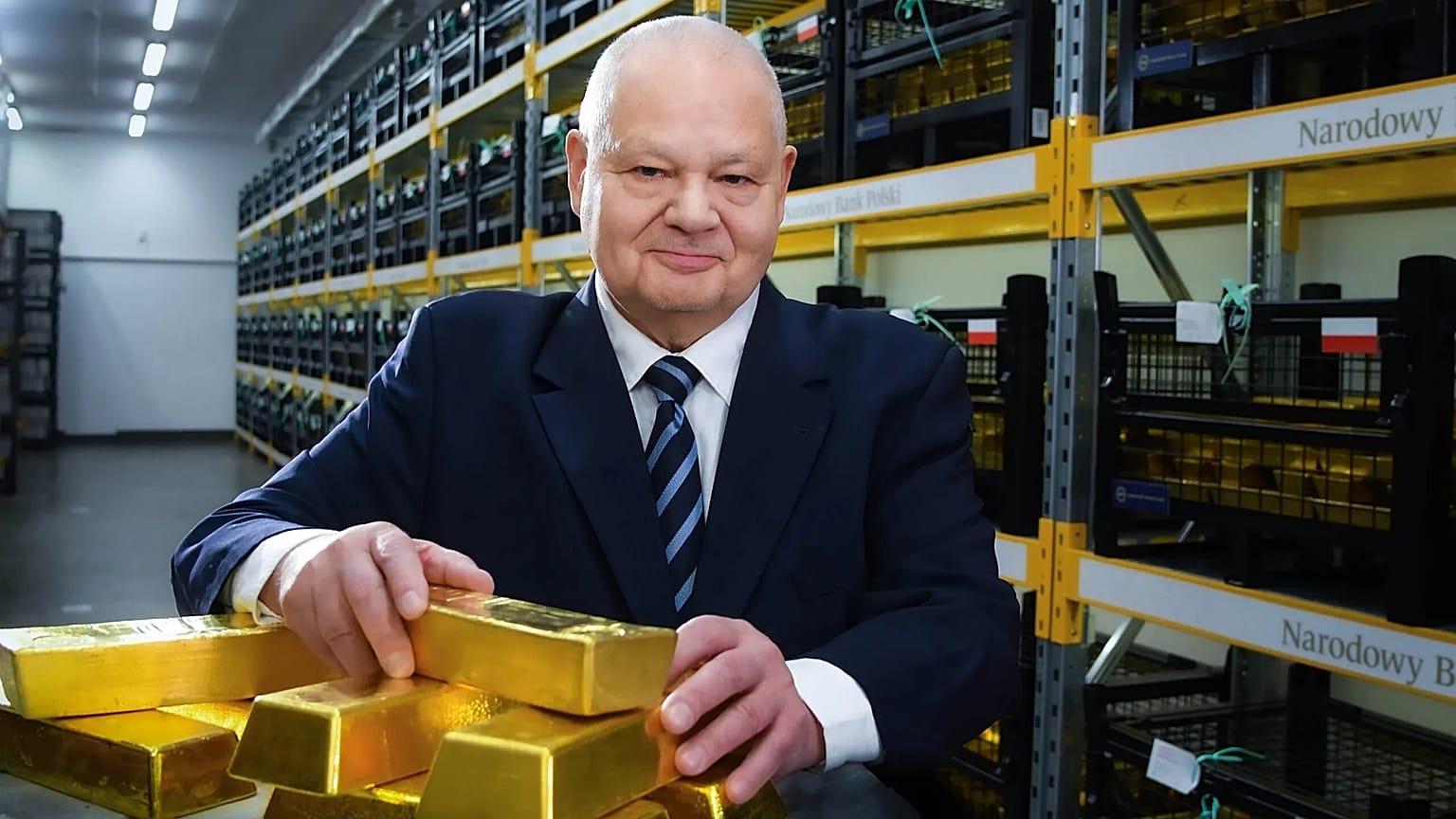
Prof. Adam Glapiński, President of the NBP
Copyright Narodowy Bank Polski


By Glogowski Pawel
Published on 

The National Bank of Poland has increased its bullion reserves to around 550 tonnes, valued at more than €63 billion.

The President of the National Bank of Poland (NBP), Adam Glapiński, has emphasised for years that gold plays a special role in the structure of reserves.

It is an asset free of credit risk, independent of the monetary policy decisions of other countries and is resistant to financial shocks.

High gold reserves also contribute to the stability of the Polish economy.

The bank's ambitions are far-reaching: the target is to have 700 tonnes of gold and the total value of bullion reserves to be around PLN 400 billion (€94 billion).\\

As recently as 2024, gold accounted for 16.86% of Poland's foreign exchange reserves. Estimates at the end of December 2025 showed a jump to 28.22%, marking one of the fastest changes in the structure of reserves among central banks worldwide.

The largest transactions were carried out in the final months of 2025, during a period of heightened market volatility and geopolitical tensions.
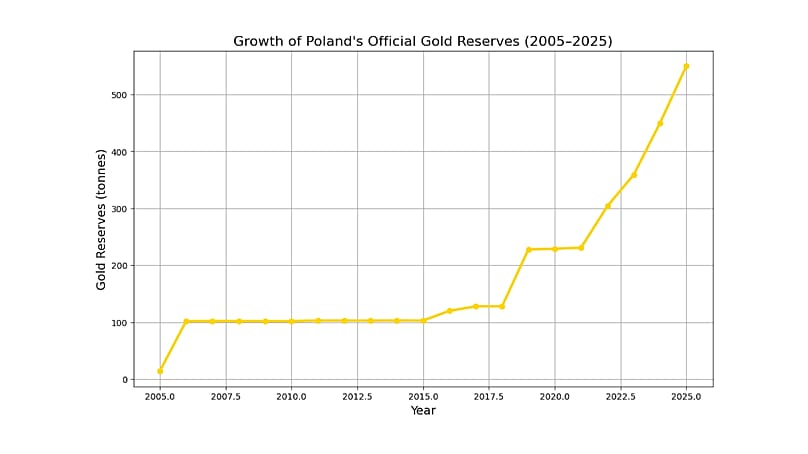
Poland is steadily increasing its gold reserves.
Poland is steadily increasing its gold reserves. Euronews/Paweł Głogowski

On the initiative of Glapiński, the NBP's management board has decided to further strategically increase the share of gold.

Glapiński announced earlier in January that he would ask the board to adopt a resolution to increase reserves to 700 tonnes of bullion.

Investing in gold

According to analyses by the World Gold Council, 2025 brought a continuation of the global trend of gold accumulation by central banks. With few exceptions, most countries increased their holdings, treating bullion as a strategic hedge against currency and financial crises.

In 2025, as many as 95% of central banks surveyed expect global gold holdings to increase over the next twelve months.

The reasons why central banks invest in gold are explained by Marta Bassani-Prusik, director of investment products and foreign exchange values at the Mint of Poland.
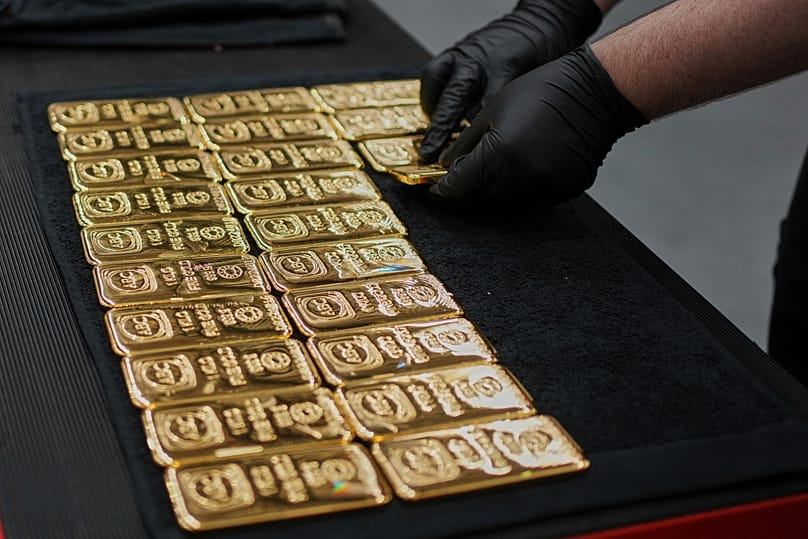
A worker lays out one kilogram gold cast bars at the ABC Refinery in Sydney, 30 April, 2025 AP Photo

"One of the key motivators for central banks is the independence of the gold price from monetary policy and credit risk. Equally important is asset diversification and reducing the share of the dollar and other currencies in reserves," she explains.

Experts point out that not all central banks report the full scale of their purchases. China or Russia are often pointed to in this context. Some market observers interpret these actions as part of preparations for an alternative money model, in which gold could play a much greater role than before.

More gold than the ECB

The information that Poland now holds more gold than the European Central Bank (ECB) is not only symbolic. The ECB manages the monetary policy of the eurozone, but its own gold reserves are relatively limited and the burden of owning bullion lies mainly with the national banks of the member countries.

The ECB's gold reserves amount to around 506.5 tonnes. Against this background, the scale of the NBP's holdings - 550 tonnes - is impressive and strengthens Poland's position in the European financial architecture.

However, critics of the NBP's extensive acquisition of gold point out that the funds earmarked for the purchase could be placed in bonds, which generate interest income. Indeed, gold does not provide current income.
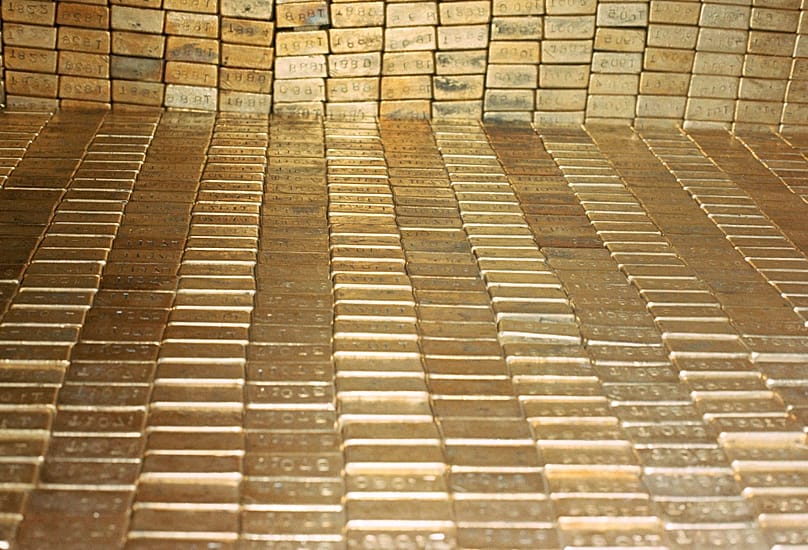
The US Depository at Fort Knox opened for inspection for members of Congress, 24 September, 1974 AP Photo

Record prices and forecasts for 2026

The NBP's purchases have coincided with historic records for gold prices. Although the rate of listing growth may slow down in 2026, forecasts from major financial institutions remain optimistic. ING estimates an average price of around $4,150 per ounce, Deutsche Bank says $4,450 and Goldman Sachs raises its forecast to $4,900. In a scenario of strong global demand, J.P. Morgan allows for as much as $5,300 per ounce.

"Rising demand from central banks is a response to economic tensions and dynamic geopolitical changes. Although institutional purchases do not directly translate into prices, they indirectly influence the decisions of individual investors," Bassani-Prusik emphasises.

Gold returns to the favour of investors

For the NBP, gold is an element of the country's long-term financial security strategy.

As Mint of Poland experts note, the greater the uncertainty in the markets, the greater the interest in assets perceived as a "safe haven." There is also a growing awareness among retail investors of the role of gold in long-term capital protection.

However, some economists oppose this thesis and feel that a high proportion of gold may not meet the needs of flexible reserve management in a modern economy and funds could be better allocated in other, more productive investments.

Reaching 550 tonnes is an important milestone, but announcements of further purchases suggest that Poland has not yet said its last word. In a world of rising geopolitical tensions and a changing financial order, gold is once again becoming one of the key assets and Poland wants to be at the forefront of this game.


MONOPOLY CAPITALI$M

Barrick’s North America spin-off hinges on Newmont’s approval
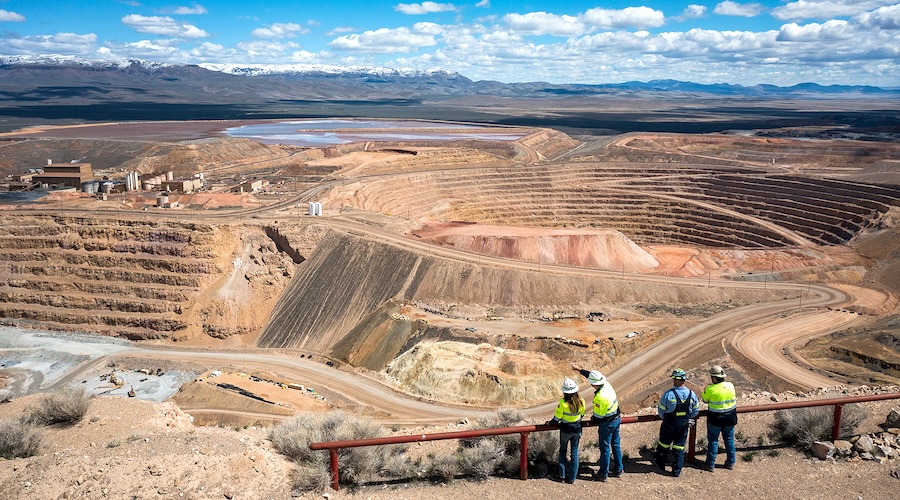
Nevada Gold Mines is a joint venture between Barrick and Newmont. (Image courtesy of Barrick Mining.)

Canadian miner Barrick’s efforts to spin off its North American assets will hinge on the company’s joint venture partner Newmont, according to documents seen by Reuters and former Barrick executives that demonstrate a reversal of fortunes for two global mining companies.

Denver-based Newmont’s power over Barrick’s strategy is a significant change from a few years ago when the Canadian miner had hoped to buy Newmont’s minority stake in the Nevada mines. A decade earlier, Barrick tried to acquire Newmont.

Newmont has the first right of refusal if Barrick tries to sell its stake in Nevada Gold Mines (NGM), the company’s main North American asset, the documents show. Barrick owns 61.5% and Newmont 38.5% in the mine.

Last year, Barrick announced a restructuring of operations to carve out the North America business from riskier operations in the rest of the world, following former CEO Mark Bristow’s departure.

Barrick’s proposed initial public offering of North American assets includes NGM, Pueblo Viejo mine in the Dominican Republic and the underdeveloped Fourmile mine, also in Nevada.

In filings made with the US Securities and Exchange Commission, the joint venture agreement between Barrick and Newmont specifies that either party must offer its Nevada joint venture interest to the other member before it considers selling to a third party. Any transfer of shares requires the consent of the other party, the documents seen by Reuters show.

Barrick will also need Newmont to fund the capital for Fourmile, according to a person aware of the development which the miner has been touting as its future flagship asset and will also become part of the IPO. During a call with analysts in October 2025, Newmont’s incoming CEO Natasha Viljoen said the company was waiting for some information from Barrick before committing additional capital.

Barrick’s effort to restructure, potentially by splitting into two entities, is one of the most anticipated mining stories of 2026, given strong investor interest in gold bullion with prices hitting successive record highs. The company is expected to outline its plans in February during its Q4 earnings.

In an email response, Barrick said it respects the joint venture with Newmont and abides by all the terms. Newmont spokesperson said the company’s Nevada Gold Mines joint venture agreement has not changed from what is publicly available.

“Regarding Barrick’s potential IPO of its North American gold assets, Newmont does not have any information above and beyond what is in the public domain,” Newmont spokesperson said. The company did not comment on whether it will fund the Fourmile expansion.

Although Barrick shares jumped 130% in 2025, the company’s returns have been lower than its peers in the last five years, gaining 52% over the period while rival Agnico Eagle jumped 142%. Barrick is still considered undervalued.

Newmont’s say over the sale of the Nevada mines despite having only a minority stake in them is unusual, according to three executives aware of the restructuring efforts. The current contract was set up after years of back and forth between the companies, where Barrick in 2019 was keen to buy Newmont. The merger did not happen, and both companies struck a joint venture for Nevada.

“Newmont has done a really good job of being able to call the shots, it was not long ago that Barrick wanted to buy Newmont,” said a former executive of Barrick aware of the joint venture details.

Barrick had a tumultuous year in 2025. Mali’s military government seized its mine there and incarcerated its employees before the company negotiated a deal to get the mine back and its employees released. Barrick’s CEO left, and the company is looking to restore investor confidence under the leadership of chairman John Thornton.

Interim CEO Mark Hill is running the company while Barrick hunts for a new CEO, who must deal with large institutional investors such as BlackRock and activist firm Elliott. This month, Barrick appointed Helen Cai as new chief financial officer. The North America business is valued at around $42 billion and analysts expect the new company could trade better than the current combined entities.

On Friday shares of Barrick were trading up by 1.90% at the Toronto Stock Exchange and Newmont shares were trading up 1.52% at New York Stock Exchange.

(By Divya Rajagopal; Editing by Caroline Stauffer, Veronica Brown and David Gregorio)

Mali’s president tightens direct control over key mining sector


Colonel Assimi Goïta. (Image:f Mali’s Presidence Office.)

Mali’s military leader has created a new ministerial-level role to oversee the mining sector, strengthening the presidency’s direct oversight of the critical gold industry, and appointed a former Barrick Mining executive to fill it.

Legal documents governing the role show the minister will have powers to supervise mining policy implementation, monitor compliance with the mining code, and review reports submitted by title holders – responsibilities previously handled by the mines ministry.

According to a January 19 presidential decree, Hilaire Bebian Diarra, an earth-science specialist who switched from Barrick to the government last year while leading negotiations for the company over control of the Loulo-Gounkoto complex, has been appointed to the role.

The Malian national was named special adviser to the presidency during the bitter dispute over Mali’s top industrial gold mine, as Assimi Goita’s government pushed for higher taxes and greater state participation in mining projects.

The move was widely seen as a strategic blow to the Canadian miner.

Diarra was not immediately available for comment.

Stronger structures to oversee mining

Mali is one of Africa’s biggest gold producers, and several national mining forums in recent years have urged the creation of stronger structures to oversee security, compliance, and community impacts in its mining industry.

A senior government official said the presidency has assumed the lead on mining oversight, with key exploitation permits decided by the presidency and contract talks – including the Barrick dispute – also run from the presidential palace.

The finance ministry meanwhile now fronts fiscal matters, and the mining ministry focuses on regulation.

Diarra’s elevation comes as Mali tightens its grip on the mining sector, its biggest revenue generator, under a 2023 mining code that helped recover 761  billion CFA francs ($1.2  billion) in arrears, the government said in December.

The tougher code rattled miners and triggered a two-year standoff with Barrick, pushing industrial gold output down by 23% in 2025, provisional mines ministry data showed.

(By Tiemoko Diallo; Editing by Maxwell Akalaare Adombila, Jessica Donati and Jan Harvey)


Mining stocks on cusp of Supercycle as AI boom stokes metals


Stock Image.

Global mining stocks have shot to the top of fund managers’ must-have list, as soaring metals demand and tight supplies of key minerals hint at a new supercycle in the sector.

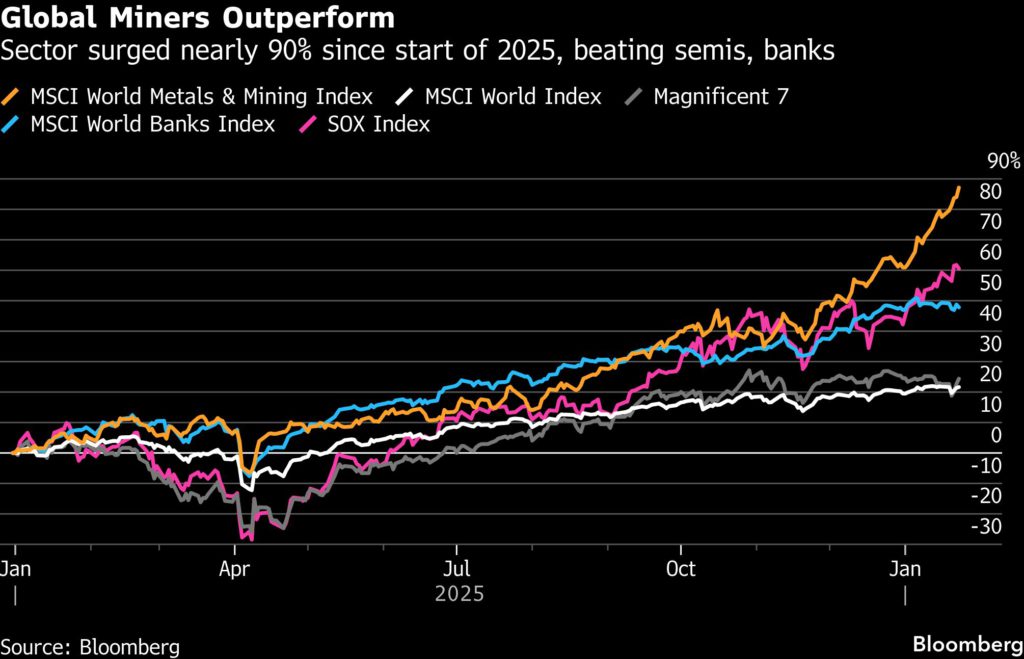
With a nearly 90% gain since the start of 2025, MSCI’s Metals and Mining Index has beaten semiconductors, global banks and the Magnificent Seven cohort of technology stocks by a wide margin. And the rally shows no sign of stalling, as the boom in robotics, electric vehicles and AI data centers spurs metals prices to ever new highs.

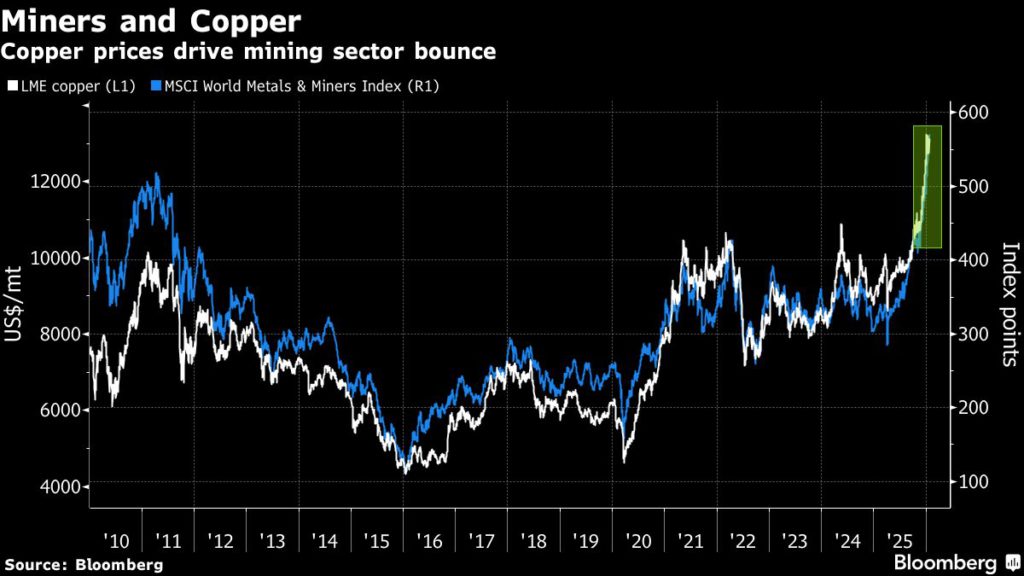
That’s particularly true of copper, which is key to the energy transition and has surged 50% over the same period. But analysts are also bullish on a range of other minerals, including aluminum, silver, nickel and platinum. Gold, meanwhile, is expected to continue benefiting from US monetary and fiscal policy concerns, as well as geopolitical risks, even after hitting successive record highs.

The outperformance is a stark reversal from prior years when the sector was out of favor, hit by volatile commodity prices and fears of a growth slowdown in China, the world’s largest metals consumer. But fund managers, who had piled into tech and financial stocks, now appear reassured by Beijing’s pledges to support the economy, including via interest-rate cuts.

“Mining stocks have quietly moved from a boring defensive sleeve to an essential portfolio anchor — one of the few sectors positioned to capture both shifting monetary policy dynamics and an increasingly volatile geopolitical landscape,” said Dilin Wu, a research strategist at Pepperstone Group Ltd. in Melbourne.

A major driver for the change is that commodities such as copper and aluminum have become less correlated to economic cycles. Historically seen as short-cycle trades, dictated by how fast or slow the world economy is growing, they have gradually morphed into structural investments.

In addition, they are benefiting from transition strategies, where investors buy assets such as metals to gain exposure to the AI theme.

Hence, the rush to buy the dip whenever weak data knocks mining stocks. European fund managers now have a net 26% overweight on the sector, according to Bank of America Corp.’s monthly survey. That’s the highest in four years, though still well below the 38% net overweight held in 2008.

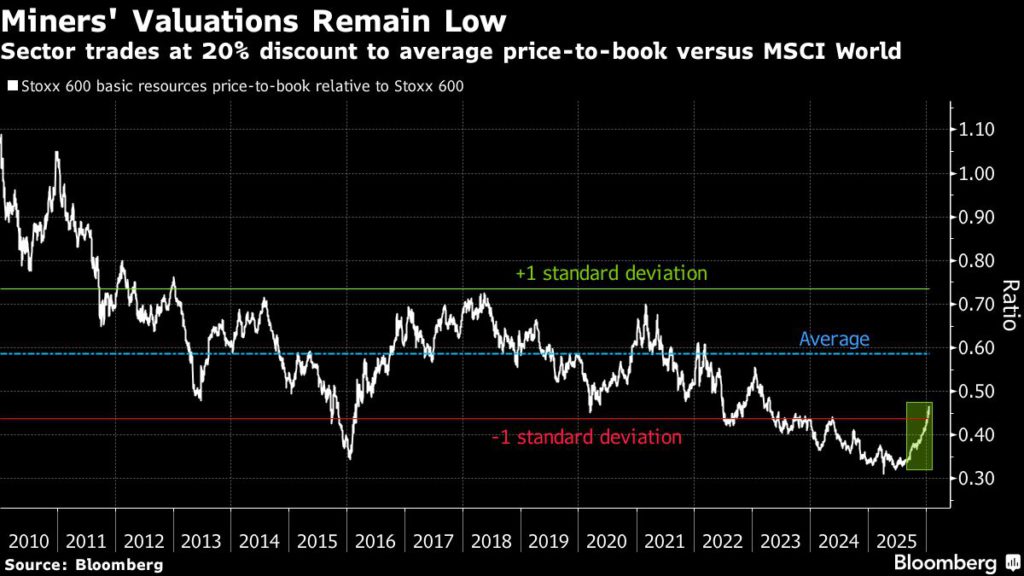
And yet, the sector looks pretty undervalued.

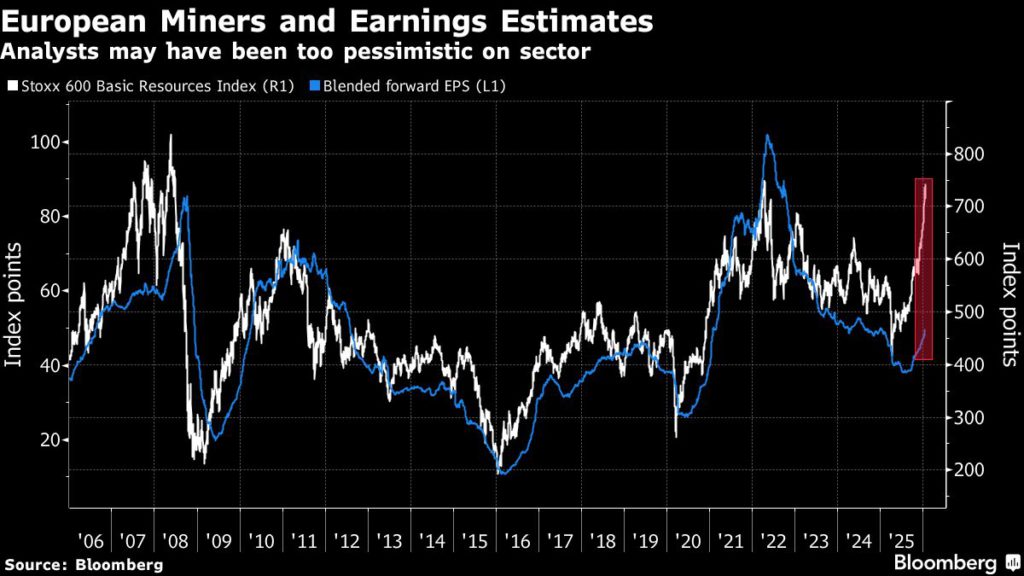
The Stoxx 600 Basic Resources index trades at a forward price-to-book ratio of about 0.47 relative to the MSCI World benchmark. That’s an about 20% discount to the long-term 0.59 ratio and well below prior cycle peaks above 0.7.

“This valuation gap persists even as the strategic relevance of natural resources has risen materially,” Morgan Stanley analysts led by Alain Gabriel wrote.

Gabriel also notes companies’ increasing preference for “buy over build.” Various M&A transactions are underway — notably Anglo American Plc’s acquisition of Teck Resources Ltd. and a potential merger between Rio Tinto Plc and Glencore Plc. While the industry’s capital-intensive nature is driving the trend, Morgan Stanley also attributes it to miners’ willingness to pursue scale and portfolio optimization, particularly in copper.

Given this is happening at a time of supply deficits, the backdrop should support higher commodity prices and valuation multiples, Gabriel added.

To be sure, top miners including BHP Group and Rio Tinto still derive the bulk of their earnings from iron ore, which is feeling the effects of the collapse of the last China-led supercycle. That’s motivating a push into copper M&A. Freeport-McMoRan Inc. and Antofagasta Plc are among the few firms offering pure exposure to copper.

For some, the pace of the rally is a reason for caution. BofA downgraded the sector to underweight in Europe, citing risks from negative economic surprises. Nick Ferres, chief investment officer for Vantage Point Asset Management in Singapore, said he’s trimmed gold exposure for now.

“I get concerned when the price of any asset moves non-linear or parabolic, that is why we are a bit cautious at the moment,” Ferres said. “But the miners are very inexpensive. If gold remains elevated, we would re-enter or scale back up on a pullback.”

Bloomberg Intelligence sees copper remaining in deficit this year, with supply shortfalls possibly worse than in 2025. On gold, BI analysts say bullion could push toward $5,000 an ounce, while Goldman Sachs Group Inc. expects it at $5,400 by end-2026 — about 8% above current levels.

“The upside drivers for commodities are now more powerful and more diversified,” said Gerald Gan, chief investment officer at Singapore-based Reed Capital Partners Ltd. “In the coming months, we plan to gradually increase our portfolio exposure to mining stocks.”

(By Michael Msika and Winnie Hsu)

CU

Striking workers disrupt access to Chile’s Escondida, Zaldivar copper mines


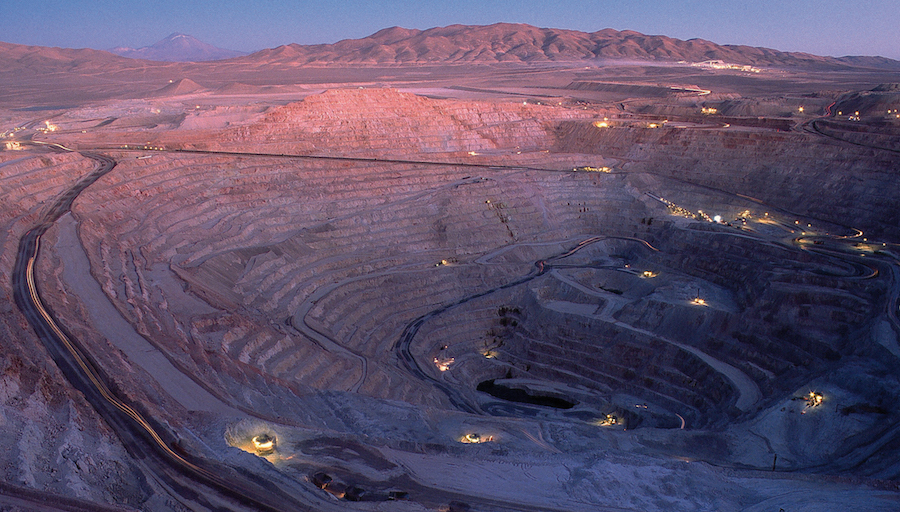
Escondida mine in Chile. (Image courtesy of BHP)

Striking contract workers are disrupting a critical route that provides access to Chile’s Escondida and Zaldivar copper mines, causing issues with shift changes and intermittent vehicle traffic, global miner BHP said on Friday.

The workers, who are employed by contractor Finning and have been on strike since the beginning of the month, have launched intermittent blocks in the La Negra industrial sector and on the road leading to BHP’s Escondida mine and Antofagasta Minerals’ Zaldivar mine.

BHP confirmed that the roadblocks were affecting vehicle traffic and shift changes at its Escondida mine.

“Our company has been affected for four days by a third-party conflict. The blockades on the mining route have led to intermittent vehicle traffic to and from our operations, with delays in shift changes,” said Pablo Pisani, Vice President of Corporate Affairs and Communications for Escondida-BHP, in a statement.

“We urgently call on the authorities and all involved parties to resolve this situation so that we can carry out our activities under appropriate conditions,” he added.

Union sources had previously told Reuters the disruption of the “mining route,” the access road that connects the northern city of Antofagasta with mining sites.

Members of Union 2 of the machinery contractor Finning, which provides services to various mining companies, began their work stoppage after their contract negotiations failed, and in the last four days, temporary blockades have been increasing.

Antofagasta Minerals did not respond to a request for comment.

(By Fabian Cambero; Editing by Cassandra Garrison)

Rising copper prices help Freeport-McMoRan offset Grasberg production dip


Grasberg is responsible for more than a quarter of Freeport’s total output. (Screenshot of Bando Tamayo’s video | YouTube)

Copper miner Freeport-McMoRan reported a better-than-expected fourth-quarter profit on Thursday, as higher copper and gold prices offset a production drop after an accident at Indonesia’s Grasberg mine killed seven workers last September.

The world’s largest publicly traded copper producer said it expects about 85% of production at Grasberg – the world’s biggest gold mine and second-biggest copper mine – to be back online by the second half of the year.

“The Grasberg incident was humbling, but our team has risen to the challenge and is dedicated to safely and sustainably restoring our operations,” CEO Kathleen Quirk told an investor conference call.

Freeport cut its 2026 production outlook by 50 million pounds to 3.4 billion pounds due in part to the Grasberg incident. The company also introduced a 2028 production outlook below what some analysts had expected.

The company’s shares fell 1.2% to $59.82 in midday trading in New York.

Copper demand on the rise

Growth in the artificial intelligence and defense sectors is expected to boost global copper demand 50% by 2040, a positive harbinger for Freeport and other copper producers.

The Phoenix-based company said it expects its US copper production to rise 8% this year due in part to output from its leach assets, which extract the red metal from piles of waste rock.

By the end of the decade, Freeport aims to be producing 800 million pounds annually of copper in the US via leaching. That is roughly the size of a new mine’s output, yet at lower cost and with fewer regulatory issues.

The surging global demand for copper has sparked a buyout frenzy across the industry, with Anglo American and Teck Resources finalizing a $53 billion merger and Rio Tinto in early talks to buy Glencore.

Quirk told Reuters last month that Freeport would focus on developing existing assets to grow, not M&A.

Results beat expectations

For the quarter, Freeport posted a profit of $406 million, or 28 cents per share, compared to $274 million, or 19 cents per share, in the year-ago period.

Excluding one-time items, Freeport earned 47 cents per share. By that measure, analysts expected earnings of 29 cents per share, according to IBES data from LSEG.

Freeport’s copper production in the quarter was down 38.5% to 640 million recoverable pounds from a year earlier, while gold production was down about 85% to 65,000 recoverable ounces.

Copper prices gained more than 40% last year, driven largely by shortage fears amid rampant growth from the artificial intelligence and defense sectors.

Gold prices rose 64% last year due to its perceived status as a safe store of value during economic and political instability.

(By Ernest Scheyder and Tanay Dhumal; Editing by Devika Syamnath and Nia Williams)

 FE

BHP ships Jimblebar iron ore to Malaysia, Vietnam as China ban stalls sales

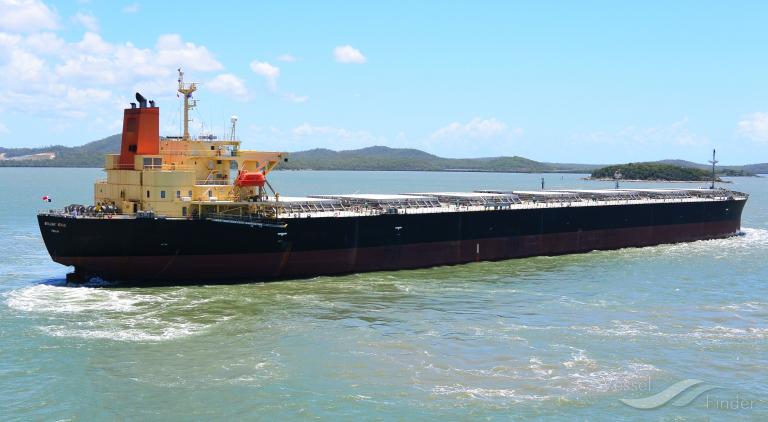
Lowlands Blue vessel. Credit: Marine Database

BHP Group has shipped iron ore cargoes barred from sale in China to Malaysia and Vietnam, seeking alternative buyers as its stocks of Jimblebar pile up at Chinese ports amid a protracted contract dispute with Beijing.

China Mineral Resources Group (CMRG), set up in 2022 to centralize iron ore purchasing and win better terms from miners, barred Chinese steel mills and traders from buying BHP’s Jimblebar Blend Fines (JMBF), a type of medium-grade iron ore, last September during talks over a new contract that have still not concluded.


As talks drag on, a vessel, Lowlands Blue, laden with around 95,000 metric tons of BHP’s JMBF, docked in Malaysia on January 14, the first such cargo discharged in Malaysia since shipping data tracker Kpler’s records began in 2019.

Meanwhile, the Cape Yamabuki shipped roughly 75,000 tons of JMBF to Vietnam in December, according to Kpler data and two traders with knowledge of the matter. It was the first such cargo to Vietnam since at least 2024, Kpler data showed.

BHP diversifies buyers

While the shipments are small compared to BHP’s annual production of more than 60 million tons of JMBF, the unusual trades demonstrate the Australian mining group’s efforts to diversify its buyers to mitigate its China difficulties.

The world’s No. 3 iron ore supplier said on Tuesday it was still hammering out annual contract terms with the state iron ore buyer and “optimizing distribution channels” in the meantime. It declined to comment on the reported shipments.

Stocks of BHP’s Jimblebar fines at major Chinese ports were up 360% from late September to 8.1 million tons as of January 13, according to two separate traders.

Chinese steelmakers are not allowed to take delivery of JMBF cargoes already at ports, sources told Reuters.

Meanwhile, daily global exports of JMBF are down 74% from January 2025, according to a Reuters calculation based on Kpler data.

BHP has been offering more discounts for its iron ore including the Jimblebar fines to try to facilitate sales in China, several trade sources said.

For example, discounts of BHP’s Newman fines, a type of medium-grade iron ore, for February shipments have widened to $4.73 a ton against the average of Argus and Mysteel’s benchmark 61% indices, versus $2.48 for January shipments, according to two of the traders.

The deep discount prompted the Vietnamese steel mill order, according to a trader with knowledge of the deal.

All sources requested anonymity given the sensitivity of the matter.

(By Reuters staff; Editing by Kevin Liffey)

Ivanhoe Atlantic pivots to US IPO after rail deal win


Kon Kweni iron ore project’s camp. (Image courtesy of Ivanhoe Atlantic.)

Ivanhoe Atlantic is weighing a US initial public offering later this year after securing long-awaited approval to use a key rail corridor to export iron ore from Guinea.

The move marks a reversal from plans to list in Australia and follows formal approval from Liberia earlier this month to rehabilitate and use its railway network. The move cleared the final regulatory hurdle for transporting iron ore from the company’s Kon Kweni project in Guinea.

Guinean lawmakers approved the cross-border arrangement in December, ending a dispute that has delayed development of the deposit for more than a decade.

Under a $1.8 billion agreement signed with Liberia in April last year, Ivanhoe Atlantic can move iron ore along what it calls the “Liberty corridor”, the shortest export route from Kon Kweni to port. The company expects construction to begin soon, with first shipments targeted for 2027.

Kon Kweni is designed to produce between 2 million and 5 million tonnes a year in its initial phase, before expanding to as much as 30 million tonnes annually. The first phase is expected to deliver ore grading about 66.5% iron, among the highest globally, while a second phase would require roughly $850 million in investment to upgrade export infrastructure.

Ivanhoe Atlantic is also advancing the nearby Nimba project, with both deposits known for high-grade ore used in lower-emissions steelmaking that requires less energy and produces fewer greenhouse gases.

Altered strategy

The company had previously lined up bankers to explore an Australian IPO, but shifting US policy has altered that plan.

“We are not in a hurry to go public; we want to do it well,” executive chair J. Peter Pham told the Financial Times, adding that increased mining support from the Trump administration had “affected our calculus” in choosing a listing venue.

Over its 25-year concession, Ivanhoe Atlantic expects to pay Liberia about $1.4 billion in rail user fees and roughly $600 million in other taxes and charges.

Ivanhoe Atlantic is majority-owned by I-Pulse Inc., founded and chaired by Canadian-American billionaire Robert Friedland, who is also co-chair of Ivanhoe Mines (TSX: IVN). Ivanhoe Mines partnered with China’s Zijin Mining Group to develop the Kamoa-Kakula copper complex in the Democratic Republic of Congo, one of the world’s largest copper mines.

Friedland rose to prominence with the 1996 sale of Canada’s Voisey’s Bay project and later helped develop Mongolia’s Oyu Tolgoi copper deposit, now owned by Rio Tinto (ASX, LON: RIO). He secured rights to Kon Kweni in 2019 after taking over from a BHP-led consortium.

The planned IPO would extend Friedland’s influence in West Africa, positioning the Kon Kweni mine and rail link as a US-backed alternative to large Chinese-led mining projects in the region. The US steel industry remains dependent on recycled material and lower-grade iron ore imports.


The Modular Pivot: Repurposing Containers as Strategic Infrastructure

Containers
Public domain / Pixabay

Published Jan 22, 2026 2:59 PM by Andreas Atrott


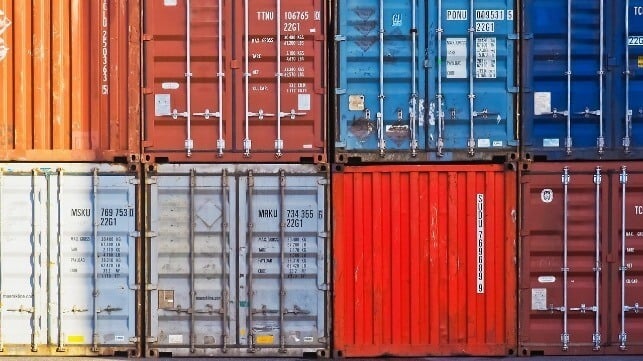
The intermodal container is one of the most impactful innovations of the last century. As the international standard for ocean, rail, and road transport, shipping containers form the backbone of our modern globalized economy.

The economic logic that standardized the global supply chain is now being applied to the fixed-asset challenges of land-side operations. The strength, simplicity, portability, and cost-effectiveness of shipping containers has been noted by non-maritime sectors, who have realized that containers can be utilized in myriad other ways. Intermodal containers are fast becoming infrastructure staples: neat, modular, readily available, and able to plug gaps and meet needs where other solutions fail.

From moving cargo to building capacity

The container standardization that revolutionized global trade in the 1950s is now helping to solve key 21st-century infrastructure challenges. With economies and markets more connected and competitive than ever, speed of deployment, scalability, and capital efficiency are paramount. As infrastructure, shipping containers address these multi-faceted requirements.

Built to handle harsh ocean conditions and with a lifespan measured in decades, containers offer incredible strength and durability. They are standardized, readily available, and cost-effective, ensuring fast, global adoption of new use cases. And their modular nature means they can be used as interlocking components to create large, complex, and specialized structures.

The international standard for transporting cargo is fast becoming the international standard for building capacity, storage, and usable space.

Port optimization: enhancing terminal agility

The use of shipping containers as infrastructure began in ports. With unfettered access to containers, ports are uniquely positioned to repurpose unused units as they see fit. While spare containers have long been used as supplementary storage, modern terminals are increasingly turning to them for on-site infrastructure: integrated power substations, automated gatehouses, temporary offices, and more.

The simplicity and portability of containers make them ideal for short-term uses, while their adaptability and longevity also make them just as valuable for long-term applications. A key use case is in port expansion projects, where containers can form everything from site offices to space-efficient storage. Here they relieve the port of the need to install permanent, high-capex infrastructure that will ultimately be brought down when the project is completed.

Industrial integration and remote site operations

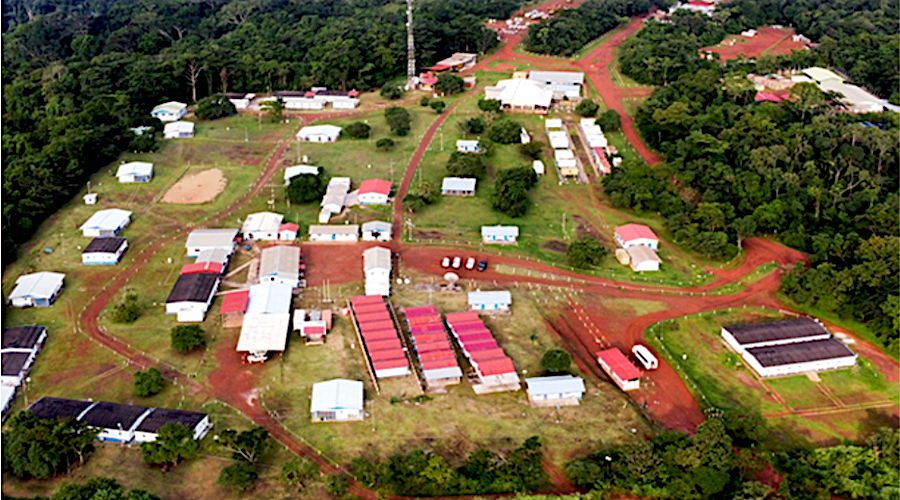
The portability of intermodal containers, and their unique ability to arrive pre-assembled to some of the most remote places on earth, make them an alluring piece of infrastructure for the mining industry. The sector has led the way in customizing containers for worker accommodations, remote site offices, even off-grid power generation and storage. Similar use cases apply to the construction industry, where shipping containers form the basis of temporary storage and site offices.

By leveraging the inherent modularity of the intermodal unit – and its capacity for bespoke engineering – project managers are increasingly adopting 'plug-and-play' systems. This approach allows for the off-site integration of complex industrial components, which can then be deployed to remote locations with minimal on-site civil works. The result is a significant compression of project lead times and a reduction in the logistical volatility typically associated with remote infrastructure development.

Rapid deployment powering resilience and disaster response

A more recent infrastructure use case for intermodal containers is in rapid deployment scenarios. With the twenty-foot equivalent unit (TEU) forming the basis of the world’s transport infrastructure, containers are now being fitted out for a range of fast responses.

Humanitarian logistics is a prime example. Customized shipping containers have become a catalyst for recovery efforts, used as mobile hospitals, command centers, and temporary housing. Ports have long served as the primary staging grounds for rapid deployments during global crises, and the institutional knowledge port authorities bring further enhances the speed with which emergency aid and infrastructure are dispatched.

The pace and cost-effectiveness of container-based emergency deployments, and the ability to place containers almost anywhere with flat ground, allows them to outperform the "stick and brick" builds that were previously the default in disaster recovery efforts.

The sustainability dividend of container-based infrastructure

In order to be used in global logistics, intermodal containers must be rated "cargo worthy" (CW): a valid CSC plate is confirmation that the container is structurally sound and meets strict standards for stacking, lifting, and transit. But containers that fall short of these standards and reach the end of their transport service life are still perfectly usable as infrastructure.

This makes shipping containers a truly sustainable building material. The rating below CW is "wind and watertight." WWT-rated containers are structurally sound enough for most non-transport uses, and a second life as infrastructure saves them from slowly rusting away into obsolescence. They also help with scope 3 emissions reporting, such as by minimizing the environmental footprint of industrial development, which traditionally relies on carbon-intensive materials like concrete and steel.

The future of global modularity

A consequence of current global volatility is that "fixed" infrastructure is becoming a liability. Modularity presents a compelling solution to any number of challenges, from rising sea levels to moving borders.

The rise of non-transport container usage hints at a future in which infrastructure is "liquid": able to be moved, scaled, or repurposed according to shifting geopolitical, economic, and humanitarian needs.

For maritime and industrial leaders, intermodal containers should no longer be thought of as a cost, a line item, a way of moving goods from A to B. They’re a strategic infrastructure asset, and one with the potential to deliver unprecedented adaptability across a wealth of sectors.

Andreas Atrott is the director and founder of Containerbase Pty Ltd. He has more than 15 years of experience in the container industry, starting with a stint at Kuehne + Nagel, and now operates container supply companies in both Germany and Australia. 
 

The opinions expressed herein are the author's and not necessarily those of The Maritime Executive.


Delivery of a New Pilot Boat for the Le Havre Pilots

Le Havre pilots

Published Jan 24, 2026 4:11 PM by The Maritime Executive


[By JFA Naval and the Le Havre Pilots]

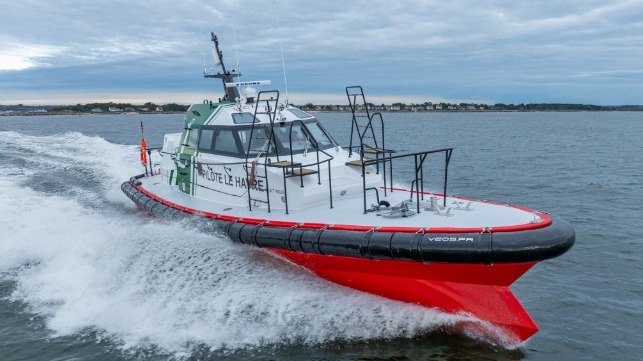
JFA Naval and the Le Havre Pilots are pleased to announce the delivery of the new pilot boat Saint-Michel. Built in Concarneau, this polyester composite vessel designed by naval architect Didier Marchand (Pantocarène), joined the fleet of the Le Havre Pilot Station in mid-January.

Specifically designed for pilot boarding and disembarking operations in the roads of Le Havre, the Saint-Michel is an ORC 155–type pilot boat, capable of carrying up to eight persons on board. She strengthens the operational capabilities of the Le Havre Pilots, meeting the high standards of safety, performance and comfort required for maritime pilotage missions.

Performance, stability and comfort at sea

The pilot boat has been designed to operate in rough sea conditions. Self-righting in the event of accidental capsize, she features a specially reinforced hull and a heavy-duty peripheral fender system designed to efficiently absorb lateral impacts that may occur during berthing operations alongside vessels underway.

Particular attention has been paid to the comfort and ergonomics of the wheelhouse, designed to be both functional and quiet. The wheelhouse is mounted on suspensions in order to significantly reduce noise and vibration levels, thereby improving working conditions for the crew.

The Saint-Michel is powered by two 500 hp MAN engines, installed in a V-drive configuration. This propulsion system provides both high speed and excellent manoeuvrability, even in demanding weather conditions. In compliance with the latest environmental regulations, the vessel is equipped with an SCR exhaust system with urea injection.

The internal layout includes a forward storage area, a technical space housing the electrical switchboards, a fuel storage compartment, an engine room, as well as a steering compartment and aft peak. All technical spaces have been designed to facilitate access, maintenance and equipment removal during daily operations. The ORC 155 features a forward wheelhouse and an aft deck incorporating a large engine casing, removable for major engine maintenance operations.

Following the delivery of Iroise, a supply vessel built for the French Lighthouse and Buoyage Authority in October last year, the Saint-Michel marks JFA Naval’s second vessel delivered to professional maritime operators.

Pilot Boat Specifications
•    Length overall:     16.18 m
•    Hull length:         15.61 m
•    Waterline length:     15.10 m
•    Beam:             4.91 m
•    Draught:         1.50 m
•    Fuel capacity:         2.5 m³
•    Propulsion:         2 × MAN 500 hp – D2676LE477
•    Navigation category:     Class 3
•    Crew + pilots:         2 + 8
•    Top Speed:         25 knots
 

The products and services herein described in this press release are not endorsed by The Maritime Executive.


Kongsberg Maritime Formally on its Way to Becoming a Stand-Alone Company

Kongsberg Maritime
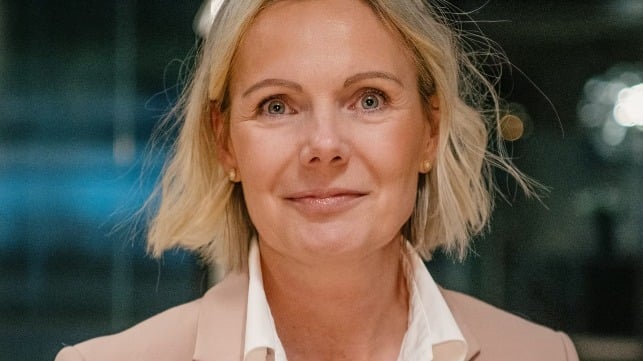
Lisa Edvardsen Haugan, incoming CEO of the new company.

Published Jan 25, 2026 11:23 AM by The Maritime Executive


[By: Kongsberg Maritime]

At an extraordinary general meeting of Kongsberg Gruppen on Thursday afternoon, the separation of Kongsberg Maritime was formally approved by the shareholders. The plan is to list the world-leading maritime company on the Oslo Stock Exchange on April 23.

Kongsberg Gruppen ASA, as we know it today, will continue as two companies. The business areas Kongsberg Defence & Aerospace and Kongsberg Discovery will form the new KONGSBERG, while the business area Kongsberg Maritime will be spun off as its own company, independent of the group.

“This was one of many milestones we will go through, and it was good to have this step confirmed. At Kongsberg Maritime, we are ready to take the next step and stand on our own feet. We are uniquely positioned to take part in the upcoming value creation in the global maritime sector. We have the people, the knowledge, and the innovation power needed to solve the technological challenges the maritime sector will face in the coming years,” says Lisa Edvardsen Haugan, incoming CEO of the new company.

Since the split was announced on October 30, 2025, Kongsberg Maritime has been working to strengthen the organization to prepare it as best as possible for a future as an independent company. A new management team is in place, the divisional structure has been changed, and critical functions have been strengthened.

“Going forward, we will continue to build on our already leading position and seize new business opportunities, including in the growing market for solutions with both civil and defence applications,” says Edvardsen Haugan.

She adds that the company's headquarters will remain in Norway.

“Kongsberg Maritime and the rest of the Norwegian maritime cluster have great strategic importance for the country, and we will work to strengthen that significance. At the same time, we will continue to expand our footprint and follow our customers wherever they are, since over 80% of our revenues come from the global market.”

On the ownership side, the Norwegian state has stated its intention to maintain its majority share of 50.004% of the shares in both the new KONGSBERG and Kongsberg Maritime.

“I am very pleased that the Norwegian government recognizes the importance of retaining its ownership in the company and look forward to an active and good dialogue going forward,” says Lisa Edvardsen Haugan.

Here is the full protocol from the general meeting on January 22.

The new board of directors for Kongsberg Maritime consists of Chair Per Arthur Sørlie and members Margareth Øvrum, Ivar Hansson Myklebust, Kristin Holth, and Anders Bade.

This is an experienced and competent group that is now starting the work of becoming an independent board for the future Kongsberg Maritime ASA. Chair Per Arthur Sørlie is currently the deputy chair of the board of Kongsberg Gruppen ASA and, through that work, has very good knowledge of Kongsberg Maritime.

Kongsberg Maritime is a leading technology partner for the maritime industry. From advanced offshore vessels to cruise ships, and from fishing vessels to complex naval vessels, we strengthen the entire maritime industry with groundbreaking technology and solutions. Together with customers and research partners, we solve technological challenges and make smart improvements to existing fleets and offshore installations. Our customers include shipping companies and shipyards operating in various maritime segments. Kongsberg Maritime has more than 8,000 employees in 35 countries and is present in the markets where our customers operate.

The products and services herein described in this press release are not endorsed by The Maritime Executive.