Wednesday, January 28, 2026

Race to save Sudan's plundered heritage as museums fall victim to war

In almost three years of civil war in Sudan, the country's museums have been ravaged, with thousands of its archaeological treasures looted and feared trafficked. Researchers in Sudan and beyond are racing to catalogue and recover the losses, estimated at $110 million.

Issued on: 25/01/2026 - RFI
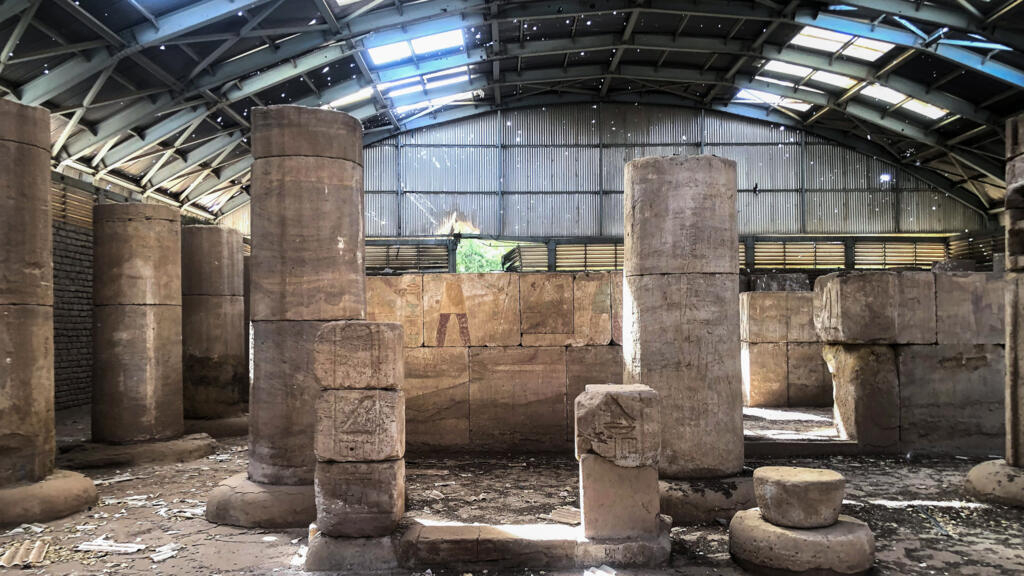
Damage seen at the Sudan National Museum in Khartoum on 11 April, 2025, after the army recaptured the country's capital from paramilitaries. © AFP

The Sudan National Museum in Khartoum bears battle scars. Beneath holes left in its facade by rocket fire, a large bay window lies shattered. The gardens are littered with explosives.

Home to a vast collection tracing thousands of years of human history in the Nile Valley, the building was ransacked when paramilitaries fighting the armed forces overran the capital, soon after the war began in April 2023.

The army recaptured the city from its opponents, the Rapid Support Forces (RSF), last March – finally allowing the museum's employees to assess the damage.

"Inside, all the locks had been broken and all the doors left wide open," said Jamal Mohammed Zein, the first member of staff to return.

"I headed straight for the main store room, which houses more than 100,000 archaeological artefacts. Objects were strewn all over the floor. The crates had been opened and looted. Many artefacts had been broken or chipped," he told RFI.

Damage to the Sudan National Museum in Khartoum, seen on 11 April, 2025. © AFP

Suspected trafficking

As employees work to clean and repair what remains, a committee of experts is making an inventory of the losses. At least 4,000 items are missing, according to Rihab Khidir, the archaeologist who heads the panel.

"They completely ransacked the Kushite gold room, which housed hundreds of ornamental pieces," she said. "Necklaces and rings made entirely of gold. Jewellery dating back to the time of the Kush civilisation, from the kingdom of Napata and Meroe, that was found inside royal burial chambers."

The museum held the world's most important collection of artefacts from the kingdom of Kush, an ancient Nubian culture whose pharaohs once conquered Egypt. It also housed objects that testified to the rich range of influences, including Islamic and Christian, that have shaped Sudan over its long history.

Museum authorities say they have evidence that at least three trucks loaded with artefacts left Khartoum in August 2023, heading west. The RSF are suspected of trying to smuggle the treasures out of Sudan, selling them to foreign dealers to finance the ongoing conflict.

From the early days of the fighting, international experts sent pleas to the RSF warning that "heritage is a red line", according to Khidir.

"It is part of our culture, a piece of our history that has nothing to do with the current conflict. They got the message and said they were willing to cooperate, and yet everything was stolen."

Symbolic losses

The National Museum was not the only heritage site raided. At least a dozen others across Sudan have been damaged or plundered, with the total losses estimated at nearly $110 million.

In Darfur, scene of some of the most brutal battles, militia turned the regional museum of Nyala into a barracks.

In the city of El-Fasher, under siege for more than a year before it fell to the RSF last October, the palace of Ali Dinar, Darfur's last sultan, was destroyed in shelling.

The palace was "a symbol of the sovereignty of the Fur people and resistance to colonisation", said Ali Noor, secretary-general of the Sudanese committee of the Blue Shield, an international NGO that works to protect cultural heritage in emergencies.

Noor believes the destruction, in a country riven by ethnic and religious divisions, is no accident. "It is the deliberate physical and cultural extermination of entire communities from our historical heritage."

Global preservation efforts


Critics say Sudan's heritage, like the human victims of its war, has suffered from a lack of global attention. But in Sudan and abroad, a patchwork of initiatives are attempting to stem the damage.

Experts from the country's National Corporation for Antiquities and Museums have been documenting and moving collections from sites judged to be in danger.

One of the National Museum's curators, Shadia Abdrabo – now based in Paris on a French research grant – is compiling an online database of artefacts in all of Sudan's museums to help establish what's missing.

Unesco is funding emergency efforts to secure vulnerable world heritage sites, including the former royal city of Meroe, seat of the Kushite kings, as well as the pyramids at Gebel Barkal. It has also helped train police and customs officers in Sudan and neighbouring countries to spot stolen antiquities, and appealed to international museums and collectors to refuse suspect items.

The Louvre, the British Museum and others have lent support. Meanwhile an international task force has been set up to mobilise institutions and donors outside Sudan.

The efforts are beginning to bear fruit. Last week, the Sudanese government announced the recovery of 570 objects taken from the National Museum – roughly 30 percent of what was lost.

Artefacts that were recovered after being looted from the National Museum in Khartoum are displayed in Port Sudan on 13 January 2026. © AFP - SOPHIE PONS

The delicate figurines, vases and scarab-shaped amulets were reportedly retrieved after months of investigation helped by Interpol and Unesco.

The government has promised a financial reward to any member of the public who returns other looted objects or shares information about their whereabouts.
Museum restored online

Separately, part of the National Museum's collection is once more on view in a virtual museum that went live at the start of this month.

Visitors can explore some 500 of the museum's treasures in an online recreation of the building as it was before the war. A recreation of the famed Kushite gold room will be uploaded later this year.

Commissioned before the conflict started, the project was supported by the French Section of the Sudanese Directorate of Antiquities (SFDAS), a government-funded research institute that works on archaeological projects with Sudan.

"This is a great source of hope for our Sudanese colleagues, as it allows them to continue researching and promoting Sudanese heritage," said Faïza Drici of SFDAS.

It is also hoped the virtual collection, by providing a public record, will make it harder for traffickers to sell off looted items.
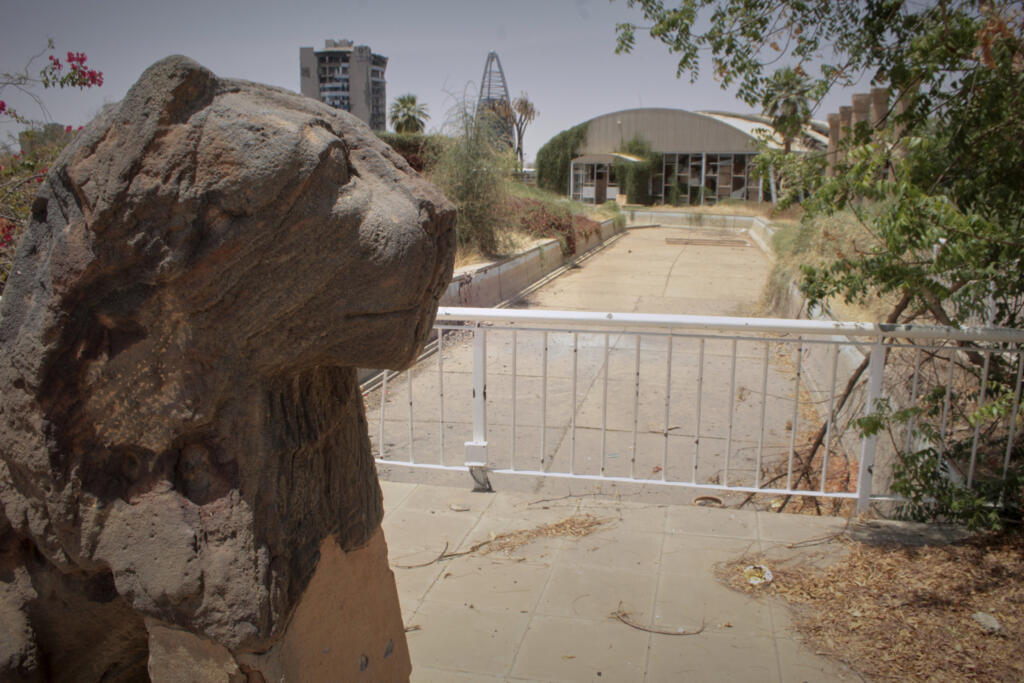
A stone lion from the ancient city of Meroe in the garden of the Sudan National Museum, on 3 April 2025. © AP - Khaled Abd Al Gader

In Khartoum, reopening the museum in reality remains a distant dream.

For archaeologist Khidir, still working to document the scale of what has been lost, the paramilitaries fighting Sudan's war have missed the true value of what they stole or destroyed.

"The Rapid Support Forces are foolish," she said. "Who do they want to rule? Those who have no history have no present. Heritage is our roots. They say their hearts are with their homeland. They say they want to govern the country, so why don't they protect our heritage?

"This stolen heritage, this civilisation, belongs to an entire people, and even to all of humanity."

This article has been adapted from RFI interviews by Eliott Brachet, Gaëlle Laleix and Savannah Ruellan.

 

Russian Strike Damages Port of Pivdennyi

Pivdennyi
Courtesy Ukraine Sea Ports Authority

Published Jan 28, 2026 6:28 PM by The Maritime Executive


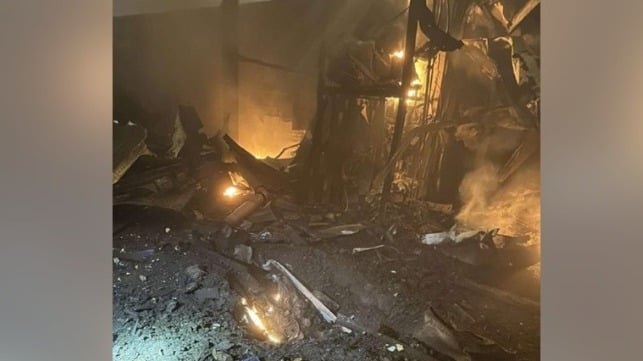
Russia has once again conducted a drone strike on the Ukrainian seaport of Pivdennyi, according to the Ukraine Sea Ports Authority, causing infrastructure damage. 

According to the authority, the strike damaged rail infrastructure and caused a fire. Ukraine's Deputy Prime Minister for Reconstruction, Oleksiy Kuleba, added that hangars, a locomotive and production buildings were damaged in the attack. Cleanup operations continued Wednesday, and the port remains in operation. 

Three were injured elsewhere in the region in a wave of Russian drone attacks, including one who was hospitalized. 

Russia has ramped up attacks on Ukraine's seaports in an effort to damage its export economy, which centers on agricultural goods. 96 attacks on seaports were repored in 2025, according to Ukrainska Pravda, affecting more than 300 facilities. 

Pivdennyi is no exception, and has faced its share of the onslaught. In December, it was forced to suspend operations for several days after Russian strikes caused a large vegetable oil spill. 

Lost naval mine washes up in Romania

This week, Romanian authorities responded to a report of a naval mine that had drifted up on the coast near Constanta, a long-running hazard of the ongoing hostilities in the Black Sea.

Personnel at the Romanian military's Midia firing range spotted the mine and reported it up the chain of command. Local police helped to secure the scene, and expert demolition divers from the Romanian Navy's 39th Diving-Engineering Center came to dispose of the explosive device.

The mines are a serious hazard to merchant shipping and to civilians. In August 2025, three swimmers were killed by mine blasts at a beach near Zakota, Ukraine. The area had been closed to swimming for safety reasons. Oleh Kiper, regional governor, said in a statement that "being in unchecked waters is fatally dangerous" in the area around Odesa. 

Mines have washed up on beaches as far away as Georgia, on the far southeastern corner of the Black Sea, and have been repeatedly spotted in the shipping lanes. Turkey, Bulgaria and Romania have a joint agreement on naval cooperation to find and clear these hazards to shipping. 


Russian Crewmembers Released from Seized Tanker Held in Scotland

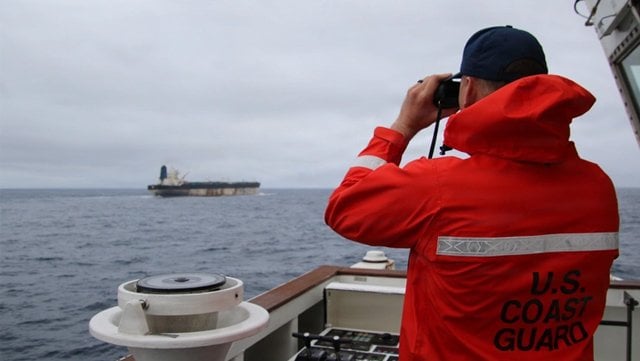
tanker being watched by USCG
USCG observing the tanker during the pursuit across the Atlantic (USCG)

Published Jan 28, 2026 12:47 PM by The Maritime Executive


Russia’s Foreign Ministry said on Wednesday, January 28, that the United States has released two Russian crewmembers from the seized tanker Marinera (Bella 1), which is being held in Scotland. The United States had committed to the release of the two Russian nationals shortly after the vessel was seized in the waters between Scotland and Iceland on January 7.

According to the brief statement from the Russian authorities, the two crewmembers are on their way home. It is unclear what positions they held on the ship. The United States appears to be planning to prosecute the senior officers from the tanker.

Russia had complained that the United States had not followed through on its commitment to release the crew. Initially, it had called the seizure of the vessel “maritime piracy,” a similar accusation made by Russian officials as shadow fleet tankers were inspected in the Baltic. 

When the United States said it was exploring legal action against the crew of the tanker, Russia immediately responded say it was “categorically unacceptable.” Russian officials have been demanding the release of the crew.

There was a crew of 28 reportedly aboard the tanker. Six of the crew are reported to be from Georgia, including the captain, who the United States continues to detain. In addition, there were 17 from Ukraine, and three from India.

U.S. officials told a court in Scotland earlier this week that it was the intent to repatriate most of the crew. However, the U.S. rushed the captain and the first officer out of Scotland aboard a U.S. Coast Guard cutter late on Monday or early Tuesday. A wife of the captain had started a legal case seeking an order to prevent the crew and tanker from being removed from Scottish jurisdiction. 

The U.S. informed Scottish prosecutors early Tuesday that the captain and first officer were no longer in Scotland. The reports said the intent was to continue to detain five individuals from the ship. Media reports said the crew had earlier been moved to shore and placed in a hotel under the supervision of immigration authorities.

When the tanker arrived in Scotland, the reports said it was there to resupply. It is unclear what the intent now is for the tanker, but GMS, the world's largest cash buyer of surplus tonnage, told Reuters it was negotiating for the purchase of tankers seized by the United States. For now, the Marinera (Bella 1) is anchored in Moray Firth, in northeast Scotland near Inverness. 


Russia suffers more losses in its war against Ukraine than any other country since WWII — report

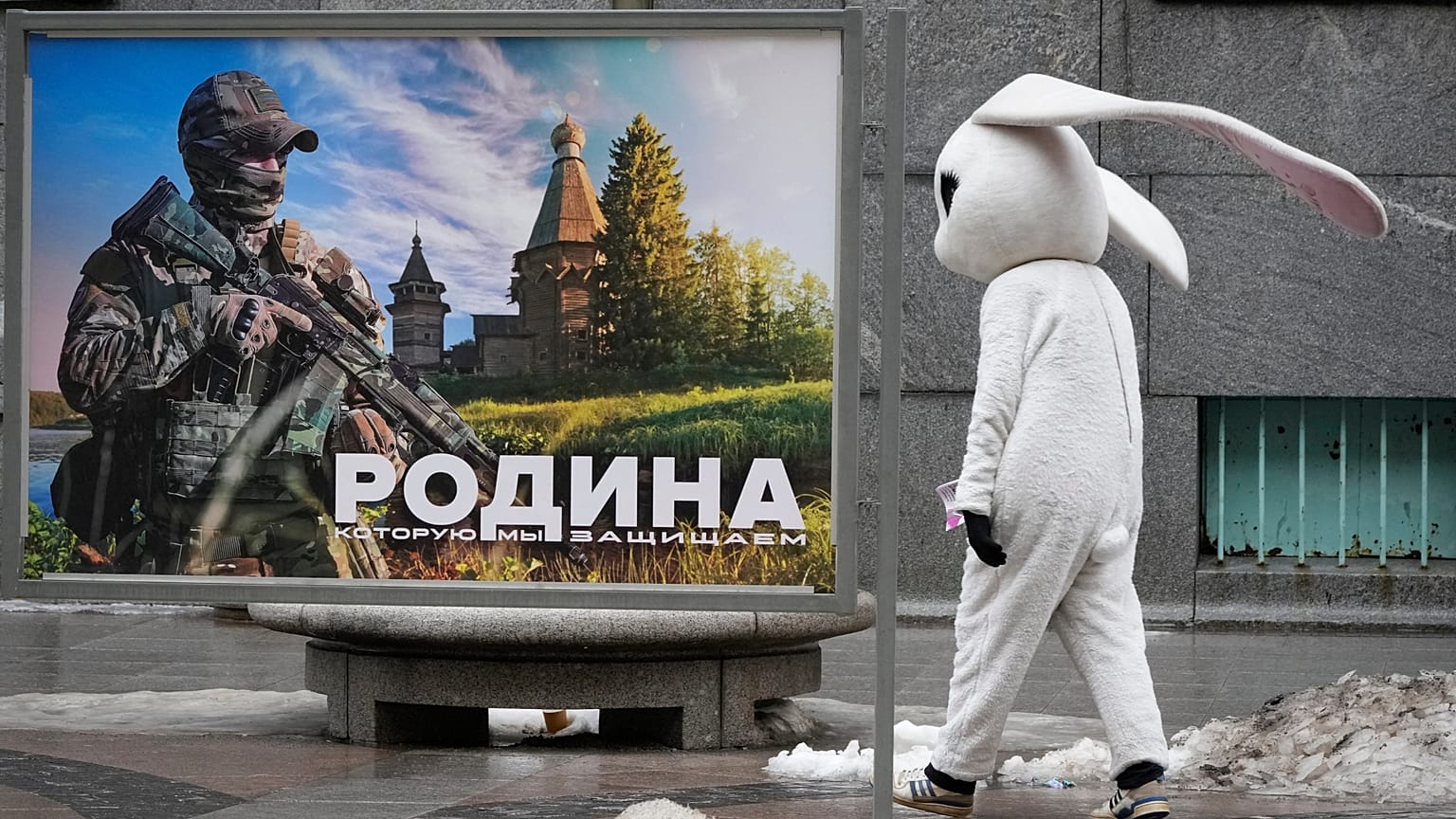
FILE: A street performer walks past a patriotic billboard showing a Russian serviceman and the slogan "The Motherland that we defend" in St. Petersburg, Russia, March 14, 2023
Copyright AP Photo

By Sasha Vakulina
Published on 

Russia sustained 1.2 million casualties almost four years into its all-out war in Ukraine, suffering more losses than any major power in any war since World War II, according to a CSIS report.

Russia has paid “an extraordinary price for minimal gains” in its war against Ukraine, the Center for Strategic and International Studies stated in its latest report.

According to the CSIS, Russian forces have suffered nearly 1.2 million casualties since the beginning of its full-scale invasion of Ukraine.

This number is roughly equal to the population of Brussels.

The CSIS explained that the million-plus figure includes killed, wounded and missing, while the death toll alone has seen 325,000 Russian soldiers killed since February 2022.

“No major power has suffered anywhere near these numbers of casualties or fatalities in any war since World War II,” the CSIS said.

For comparison, US battlefield casualty and fatality numbers are "significantly lower," according to the report, with the United States "suffering 54,487 battle deaths during the Korean War (and) 47,434 deaths during the Vietnam War."

Later US interventions resulted in even fewer casualties, with "149 deaths during the 1990–1991 Gulf War, 2,465 deaths in Afghanistan during Operation Enduring Freedom and Operation Freedom’s Sentinel, and 4,432 deaths in Iraq during Operation Iraqi Freedom".

At the same time, the CSIS pointed out that despite massive human losses, Russian forces are advancing “remarkably slowly on the battlefield”.

In the Pokrovsk offensive, for example, Russian forces advanced at an average rate of just 70 meters per day.

“This is slower than the most brutal offensive campaigns over the last century, including the notoriously bloody Battle of the Somme during World War I,” the CSIS said, adding that Russian forces have gained less than 1.5% of Ukrainian territory since the start of 2024.

The think tank also estimated that Moscow is paying a heavy economic price for its all-out war against Ukraine. According to the report, Russia “is becoming a second- or third-rate economic power” as its economy is under strain due to the war.

Kyiv wants to inflict further damage

Last week at the World Economic Forum annual meeting in Davos, Ukrainian President Volodymyr Zelenskyy said that Russian losses had risen to 35,000 killed per month in December last year.

This translates to roughly 48 Russian soldiers killed per hour.

In December 2024, this number was less than half of today's numbers, Zelenskyy said, pointing to 14,000 Russian troops killed a year ago.

Ukraine’s Defence Minister Mykhailo Fedorov added later that “all these losses are verified on video”.

“If we reach 50,000 (killed), we will see what happens to the enemy”, Fedorov said, calling it a “strategic objective” for Kyiv. “They view people as a resource, and shortages are already evident".

Zelenskyy also stated at Davos that Moscow mobilises between 40,000 and 43,000 troops per month. Neither Ukraine nor Russia reveals their losses publicly.

PUTIN'S WAR ON CIVILIANS

Kyiv faces worst winter of war as Russia pounds Ukraine's power system

For more than three months, not a day has passed without Russian air raids striking Ukraine's power plants, plunging the country into cold and darkness in the depths of winter. RFI spoke to residents in the capital, Kyiv, where the situation is particularly critical.


Issued on: 23/01/2026 - RFI

People in Kyiv try to keep warm outside during a power outage caused by Russia's regular air attacks on Ukraine's energy sector that leave residents without power, heating and water, on 18 January 2026. © AP - Danylo Antoniuk

Millions of Ukrainians have been under constant threat of Russian air strikes since the war began in 2022. In Kyiv, large-scale raids typically came every two or three weeks – but this year, Russia has ramped up its attacks, which now pound the capital daily.

While Moscow denies targeting Ukrainian civilians, they have become the primary victims of hundreds of drones and missiles that have struck the country's energy infrastructure since October.

More than 3 million residents in Kyiv are facing prolonged shortages of electricity, water and heat in the middle of a harsh winter. Ukraine is in the grip of a polar cold snap, with temperatures approaching -20C in the past two weeks.

Following a devastating strike on the city's power stations on 9 January, Mayor Vitali Klitschko urged residents to leave Kyiv if they could.

Two weeks later he said that, according to estimates based on mobile phone use, nearly 600,000 people had left the Ukrainian capital.


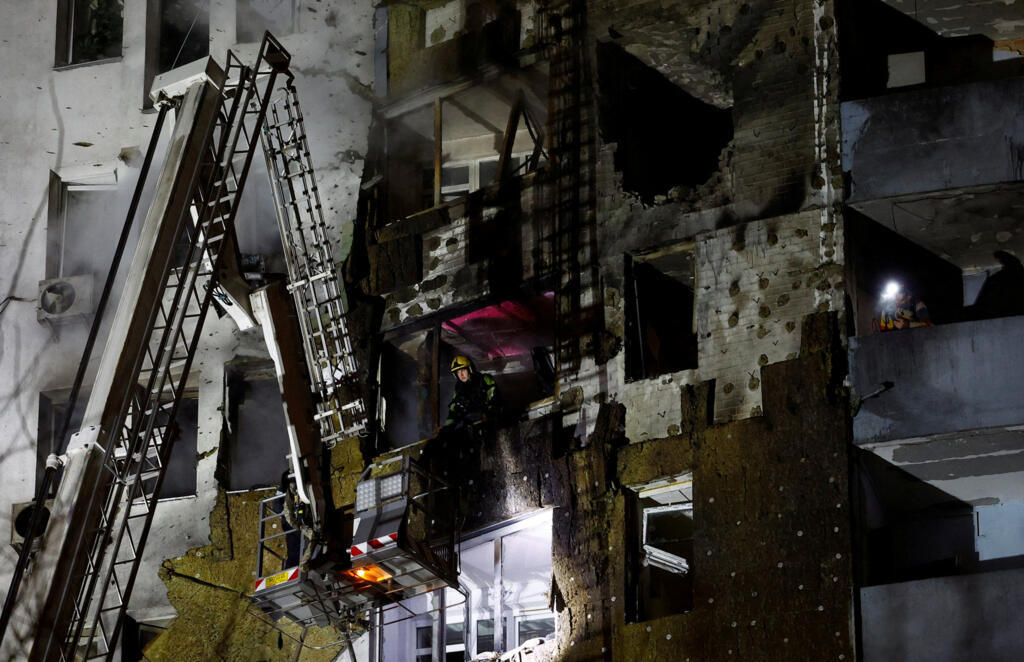
Firefighters work in an apartment building that was hit by a Russian drone strike, in Kyiv, Ukraine, 9 January 2026. © Valentyn Ogirenko / Reuters


Not everyone can get out.

On the left bank of the city, home to several working-class neighbourhoods, residents of high-rise apartment blocks are particularly vulnerable. They live close to power stations targeted by the Russians, and they can no longer rely on basic utilities.

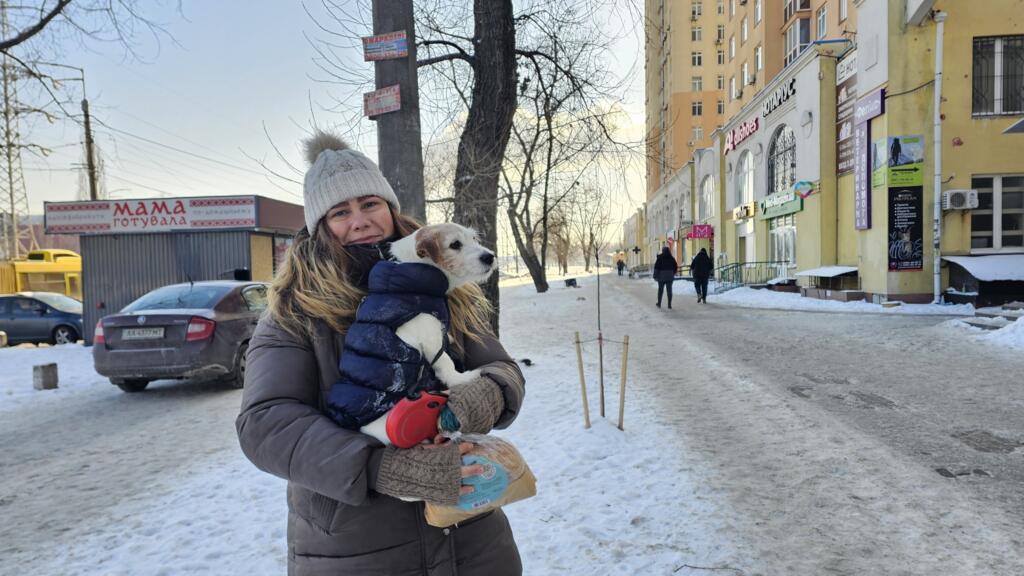
"We find ourselves without electricity for 10 hours, 20 hours at a time," says Oksana, who lives in the area with her children.

"When it does come back on, it's in the middle of the night, so I get up to charge all our batteries. Without electricity, there is no water either, and as the building has several floors, it no longer reaches the upper floors."

Oksana, a mother in Kyiv who no longer has regular power or water in her flat. © Emmanuelle Chaze/RFI

Her building has already been gutted by a drone strike, the windows on lower floors replaced with wooden boards.

Yet Oksana has no plans to leave Kyiv. "We do have family in the west, where we took refuge in early 2022, but my husband is disabled and awaiting surgery, so I can't see myself leaving now. What's more, all our loved ones, including my parents, live here in buildings nearby.

Islands of warmth

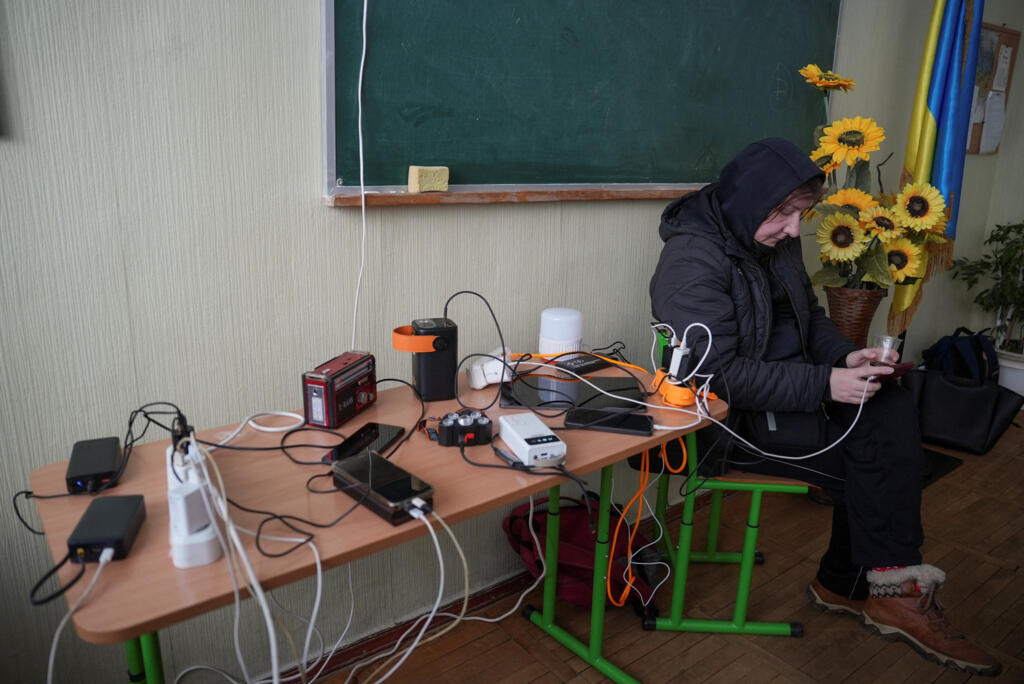
For residents who remain, daily life revolves around the few hours of electricity – their only chance to recharge phones, run the washing machine, or stock up on tap water.

Valentina, a pensioner, is in survival mode. "Thank God, part of the building is still heated, and at home, I keep my coat on so I don't get cold."

A resident charges her mobile inside a classroom turned into a humanitarian aid point during a blackout in Kyiv on 11 January 2026. © Reuters/Anna Voitenko


Faced with a worsening humanitarian crisis, the city has deployed around 50 mobile generators. In the courtyards of some apartment blocks, rescue workers have set up large orange tents that serve as so-called "points of invincibility" – energy islands where residents can come to warm up, work remotely or even spend the night if conditions no longer allow them to sleep at home.

In the historic centre of Kyiv, opposite Taras Shevchenko National University, a yurt set up by a Ukrainian-Kazakh association serves as a sanctuary of warmth and electricity. Natacha welcomes visitors with hot tea and Kazakh pastries.

"The Kazakhs believe in our victory, and with this yurt they are showing us a little love and support. They can't supply us with weapons, but they are showing us in other ways that they are on our side," she tells RFI.

Natacha mans a yurt serving as an emergency shelter in Kyiv, in January 2026. © Emmanuelle Chaze / RFI

Ukraine has turned thousands of public buildings, restaurants and schools into similar shelters since the start of the air raids in the winter of 2022.

But in Kyiv, many of these havens are no longer able to take residents in.
Schools closed

Until recently, the city centre – home to government offices, embassies and international organisations – had been relatively spared from power cuts. Now the situation has deteriorated significantly.

Cafes and restaurants are still operating, albeit in semi-darkness, thanks to small diesel generators that put out a deafening hum and heady fumes. Yet public buildings that once stayed open 24/7 to provide residents with heat and electricity remain shut.

Alla, caretaker at a deserted school, explains why. "There's no heating, no internet connection, no electricity here, and no one to come and fill the generator's tank, so we're staying closed."

Schools in Kyiv will remain closed for several more days: the school holidays have been extended until early February so that pupils can stay out of the city.

Corruption scandal exposes ‘absolute impunity’ in Ukraine’s energy sector

"The city's energy grid is still operating in emergency mode," main private electricity supplier DTEK warned in one of its latest statements.

"Nothing like this has ever happened on a global scale. For the past month, there has not been a single day without power cuts, and our engineers have the historic task of getting us back on our feet."

Ukraine's new Energy Minister Denys Shmyhal has promised to restore infrastructure as quickly as possible, but has also warned of further Russian strikes – "including on infrastructure that keeps nuclear power plants running".

This article was adapted from the original in French by RFI correspondent Emmanuelle Chaze.
RESISTANCE IS LIFE

Southern Ukraine’s winemakers continue production, as war rages on in the region

The vineyards of southern Ukraine are still producing wine nearly four years into the war with Russia, following the full-scale invasion of February 2022 – even as nearby fighting and repeated air raid alerts take their toll on daily life.


Issued on: 25/01/2026 - RFI


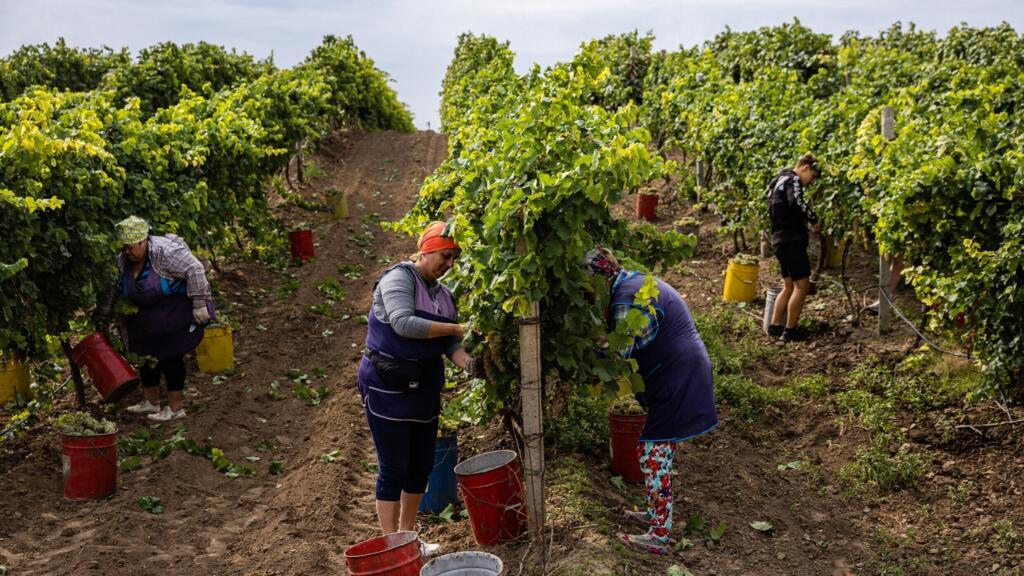
Workers harvest grapes at a vineyard in Ukraine’s southern Mykolaiv region, despite the fighting nearby. AFP - DIMITAR DILKOFF

Strikes have intensified in southern Ukraine in recent weeks, prompting the government to order the evacuation of civilians, including around 40 children, from villages near Zaporizhzhia, as Moscow’s forces advance.

But on the outskirts of Mykolaiv, a city by the Black Sea, the Beykush estate continues to make wine – 10 kilometres from Russian positions.

To reach the vineyard now requires a military escort and passing through several checkpoints.

For security reasons, visiting the vines themselves is not always possible. Attacks are launched regularly from across the river, shaping how and when work can be done.

The pressure on Ukraine’s wine sector began back in 2014, when Russia’s annexation of Crimea wiped out more than half of the country’s national production.

Ukrainians responded by turning to local wines, a patriotic reflex that helped new vineyards emerge. That has continued since Russia’s invasion in 2022, helping sustain producers such as Beykush.

'Working is a way of holding on'

At the estate, production was stopped for just one month, even as nearby Mykolaiv was caught up in intense fighting. Since then, work has continued under constant threat.

“At the beginning of the war, work was the only thing that helped keep our spirits up,” winemaker Ola Romanenko told RFI.

“It gave us something to focus on instead of thinking about the constant danger. And even today, working is a way of holding on, of not thinking about everything else.”

The estate has not been hit directly, but drones often fly overhead before crashing nearby or heading towards Odesa. The team has had to adapt quickly to the risks.

Only four people now handle production at the winery. Romanenko lives on site, while the other employees are neighbours. During the harvest, local residents also help out so the work can be done as quickly as possible.

A shell fragment lies among vines in Ukraine’s southern Mykolaiv region. Wine production has continued despite the presence of unexploded ordnance and nearby fighting. 
AFP - DIMITAR DILKOFF


The winery has also set up shelters.

“We have a basement for our barrels, which is very safe,” she said. “We also have an old tasting room that is almost underground and works as a shelter. If the noise is too loud or the danger too high, we go there.”

The team stays in constant contact with the army, and helps to support it financially.

“For security, we make donations,” she said. “Some QR codes on our bottles allow people to support the rehabilitation of soldiers. Several of our employees are also serving in the army and we help them.”

Despite the conditions, production has not fallen. Beykush produces around 19,000 bottles a year across 15 different wines, and output has even increased since 2022.

'Identity is our strength'

The wines have also gained international recognition.

“This year, at the most prestigious competition in London, Larbinat won gold in the orange wine category,” Romanenko said. “L’Oca Deserta, a red, won silver. They sell so well that some are already sold out.”

In Mykolaiv, Marina Stepanova runs one of the city’s few remaining wine shops. With frequent air raid alerts, power cuts and a curfew, opportunities to go out in the evening are limited.

She told RFI that while foreign importers were keen to support Ukraine’s wine sector in 2022, that interest has since faded. Local producers are now relying mainly on Ukrainian customers.

At the entrance to Stepanova's shop, one shelf is dedicated to wines from the Mykolaiv region, with more Ukrainian bottles further inside. A small room at the back is used for tastings.

Here, local architect Efren Polanco invites foreign colleagues to sample regional wines.

“When you introduce yourself and say you come from France, you have your identity, your personality,” he told the visitors. “For our wine, it’s the same. Identity is our strength.”

Pouring a glass from the Beykush estate, Polanco added: “This wine is like the blood of the Mykolaiv region.”

Outside, an air raid alert sounded. Inside, the small group clinked glasses.

This article is based on a report in French by RFI's Accents d'Europe podcast.


France to ditch US platforms Microsoft Teams, Zoom for ‘sovereign platform’ citing security concerns


By Pascale Davies
Published on 

France announced that it will roll out the Visio platform across all government departments by 2027.

France will replace the American platforms Microsoft Teams and Zoom with its own domestically developed video conferencing platform, which will be used in all government departments by 2027, the country announced on Monday.

The move is part of France's strategy to stop using foreign software vendors, especially those from the United States, and regain control over critical digital infrastructure. It comes at a crucial moment as France, like Europe, reaches a turning point regarding digital sovereignty.

“The aim is to end the use of non-European solutions and guarantee the security and confidentiality of public electronic communications by relying on a powerful and sovereign tool,” said David Amiel, minister for the civil service and state reform.

On Monday, the government announced it will instead be using the French-made videoconference platform Visio. The platform has been in testing for a year and has around 40,000 users.

What is Visio?

Visio is part of France's Suite Numérique plan, a digital ecosystem of sovereign tools designed to replace the use of US online services such as Gmail and Slack. These tools are for civil servants and not for public or private company use

The platform also has an artificial intelligence-powered meeting transcript and speaker diarization feature, using the technology of the French start-up Pyannote.

Viso is also hosted on the French company Outscale’s sovereign cloud infrastructure, which is a subsidiary of French software company Dassault Systèmes.

The French government said that switching to Visio could cut licensing costs and save as much as €1 million per year for every 100,000 users.

The move also comes as Europe has questioned its overreliance on US information technology (IT) infrastructure following US cloud outages last year.

“This strategy highlights France's commitment to digital sovereignty amid rising geopolitical tensions and fears of foreign surveillance or service disruptions,” Amiel said


FAKE NEWS


‘A new battleground’: France takes its fight against disinformation online


Determined to push back against online falsehoods, the French state is turning to facts, humour and a new digital voice to challenge misleading narratives wherever they spread.


Issued on: 24/01/2026 - RFI

An illustration photo shows letters cut out of newspapers arranged to read "Fake news", set up in front of a screen displaying social media logos, in Mulhouse, eastern France, on 20 February 2025. AFP - SEBASTIEN BOZON

France has set up a new digital rapid-response unit – titled “French Response” – to push back against what it sees as a rising tide of online disinformation, and it wasted little time making its presence felt.

When the US secretary of state Marco Rubio took a swipe at European culture on X this week, the English-language account run by the French foreign ministry jumped in almost immediately.

“Our culture,” it replied, posting a neatly laid-out table comparing quality-of-life indicators.

On life expectancy, student debt and several other measures, the European Union came out comfortably ahead of the United States


New online battleground

The post was pointed, data-driven and with a hint of dry humour. The recently launched account is France’s latest attempt to defend itself in what officials describe as an increasingly hostile online information environment, where false or misleading claims spread at speed.

French foreign ministry spokesman Pascal Confavreux said information had become “a new battleground”.

“We’re choosing to occupy the space by turning up the volume and raising our voice,” he explained. The strategy appears to be working, at least in terms of reach.

The account has already attracted around 100,000 followers – a modest figure next to X owner Elon Musk’s more than 230 million, but significant for a government-run feed.

Staffed by a small team of diplomats, former journalists and fact-checkers, French Response has been particularly active this week as political and business leaders gathered for the World Economic Forum in Davos.

It has taken aim at posts it considers misleading from Russian and US accounts, and has even found itself rebutting claims linked to the White House under President Donald Trump.


Between wit and statecraft

That included a moment of high-profile Franco-American sparring.

On Tuesday, French president Emmanuel Macron appeared in Davos wearing aviator sunglasses, which his team later said were the result of a burst blood vessel in his eye.

Macron used the occasion to say France did not like “bullies”, a remark widely interpreted as aimed at Trump.

The next day, newspapers splashed images of Macron in shades across their front pages, with commentators likening him to Maverick from Top Gun.

French Response revelled in the attention. “When the world does your French response for you,” it posted, shortly after Trump mocked Macron’s sunglasses online.

Not all of the account’s interventions have been so light-hearted.

When a Russian account falsely claimed Macron had left Davos early to avoid Trump – in reality, the French leader had never planned to be there on the same day – the reply was swift and cutting: “Another impeccably planned French leave.”

(with newswires)


Sea levels are rising across the world. But in Greenland, scientists say they’re about to fall

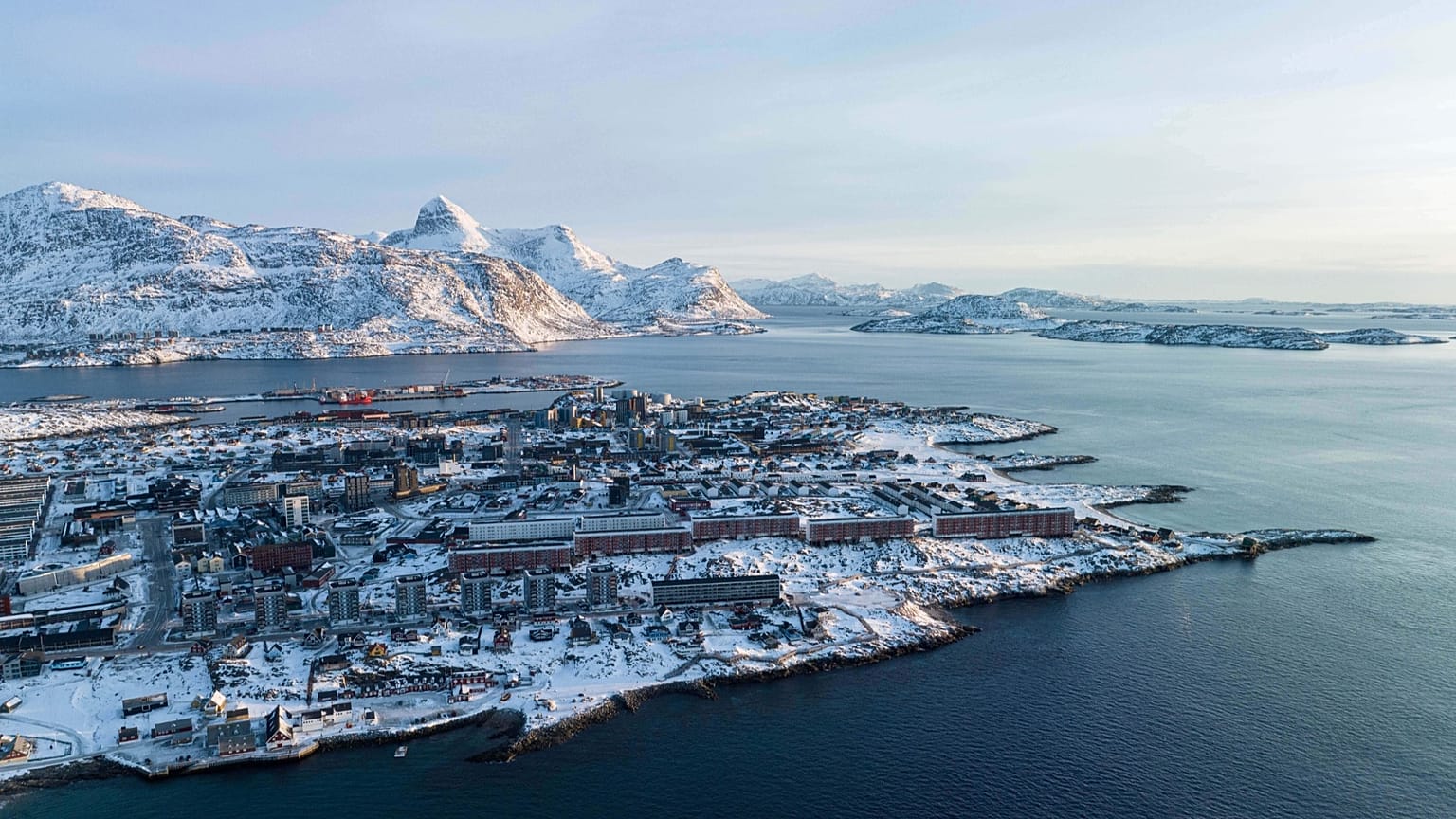
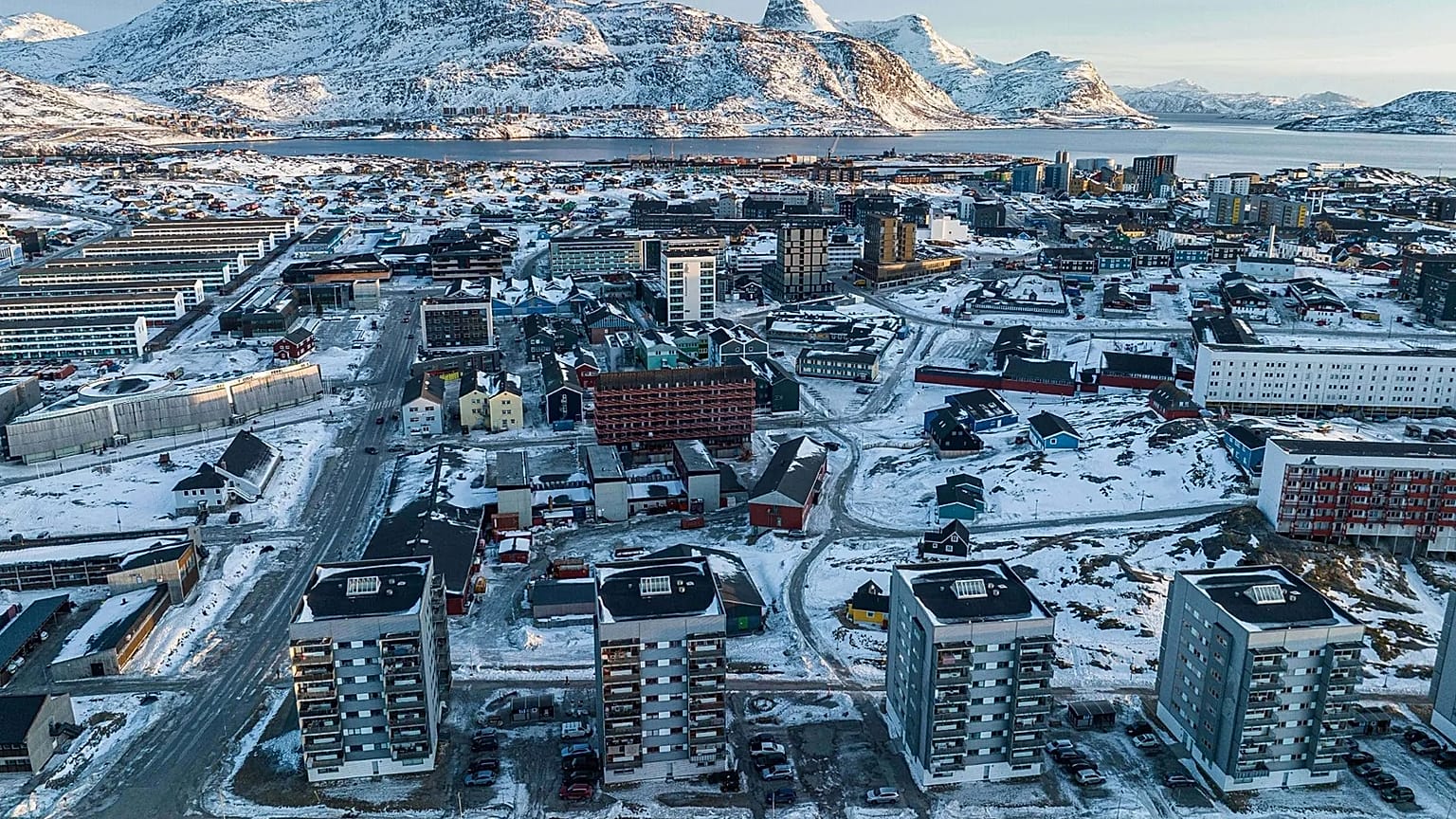
Houses are seen near the coast of a sea inlet of Nuuk, Greenland, on Sunday, Jan. 25, 2026.
Copyright Copyright 2026 The Associated Press. All rights reserved

By Liam Gilliver
Published on 

Scientists say Greenland’s sinking sea levels will have a ripple effect on coastal communities, shipping routes, fishing and infrastructure.

Rising temperatures are causing sea levels to rise around the world, putting millions at risk of severe flooding and coastal erosion. But in Greenland, the opposite is happening.

Researchers at the Lamont-Doherty Earth Observatory, which is part of the Columbia Climate School, warn that sea levels around the autonomous island are actually projected to fall despite heat-trapping emissions triggering record ice melt.

The study, published in Science Communications, predicts that in a low-emissions future, the decline in sea level will likely measure around 0.9 metres by the year 2100. In a high-emissions future, this will drop to 2.5 metres.

Why are Greenland's sea levels set to sink?

It may seem paradoxical that a nation covered predominantly in ice could face a drop in sea levels in a warming world, but this is exactly why Greenland is an anomaly. As the ice sheet loses mass, the land beneath it rises – free from its immense weight.

Study co-author Jacqueline Austermann likens the effect to the decompression of a memory-foam mattress after the person lying on it gets up.

Researchers blame both recent and historic ice loss for driving Greenland’s rebound, explaining that as mass is lost from the ice sheet, sea levels will decline even further because of gravity.

“When the ice sheet is very large, it has a lot of mass,” says lead author Lauren Lewright.

“The sea surface is pulled toward the ice sheet because of that gravitational pull. As the ice sheet loses mass, its gravitational pull on the sea surface decreases, translating into sea level fall.”

Both of these effects will account for up to 30 per cent of Greenland’s future sea level decline, and are technically known as “glacial isostatic adjustment”.

Leaving coastal communities ‘high and dry’

Rising sea levels have long been linked to increased coastal flooding and accelerated shoreline erosion. In fact, for every centimetre of sea level rise, around six million people on the planet are exposed to coastal flooding.

When the opposite occurs, there are still consequences. Coastal communities in Greenland build their infrastructure with current sea levels in mind, meaning they could be left “high and dry” if there’s a noticeable drop.

“The biggest impact is on local communities and the effects on shipping routes, fishing and infrastructure,” says Austermann.

There is a chance that falling sea levels will help certain glaciers stabilise when they enter the ocean, which could potentially slow their decline. However, researchers say they don’t know if the predicted sea level fall is enough for the stabilising effect to take place.

Greenland’s elite dogsled unit patrols desolate, icy Arctic


By AFP
January 28, 2026


Dogsled teams are low-tech and durable, members of the Sirius patrol argue, making them the best tool for patrolling Greenland's vastness
 - Copyright AFP Olivier MORIN


Daphnée CARAVACA, with Pia OHLIN in Stockholm

Donald Trump has ridiculed Denmark’s defence of Greenland as amounting to “two dogsleds”, but the Sirius Dogsled Patrol is no joke: the elite navy unit works in extreme conditions where only the toughest survive.

Denmark has allocated billions to beef up security of its vast Arctic island, but when it comes to policing the frozen wilderness of northern and eastern Greenland in winter, it relies on six low-tech two-man teams with a dozen dogs each.

Between January and June, when the sun begins to reappear after falling below the horizon for two months, the dogsled patrols set off for four to five months, in temperatures that can drop to -40C (-40F) and where they may not encounter another soul.

They ski alongside the dogs, covering around 30 kilometres (19 miles) a day.

The dogs pull a 500-kilo (1,100-pound) sled packed with tents specially designed for the harsh weather, food supplies, fuel and other provisions to last them to the nearest of the 50 or so supply depots dotted around the region, typically located 7-10 days’ journey apart.

The patrol monitors an area measuring 160,000 square kilometres (60,000 square miles) — the size of France and Spain.

“The reason we use a dog sled, rather than a snowmobile, is that the sled and dogs are durable. We can operate for a very, very long time over enormous distances in extremely isolated environments,” Sebastian Ravn Rasmussen, a former member of the Sirius patrol told AFP.

“A snowmobile would quickly break down under these conditions,” the 55-year-old Dane said.

“When a snowmobile breaks down — really breaks down -– you can’t go any further. And we are very, very far from home.”

“A dog sled can break down, but we can repair it. And we may lose a dog, or we may lose two or three dogs on a patrol, but we can still continue at reduced speed,” he added.

In a dire emergency, the patrols are prepared to eat the dogs to survive, though “the likelihood of that happening is very small”.

– ‘See, feel, sense’ –

The US president has repeatedly threatened to seize the mineral-rich island, an autonomous territory of Denmark, and argued that Copenhagen is not doing enough to protect it from Russia and China.

But Ravn Rasmussen said dogsled patrols are more effective than high-tech helicopters, satellites and planes.

“This area is huge, really huge,” he said.

“In winter, everything is white, and if you are flying in a helicopter, for example, and have to monitor an area, you cannot see if a snowmobile has been driven down to a fjord.”

“You simply have to get down on the ground to be able to see, feel and sense whether there have been others in the area who should not be there.”

Shorter patrols run through November and December, while in the summer, once the ice has broken up, the area is patrolled by ships.

Ravn Rasmussen said much of the military work the patrols do is classified and can’t be disclosed to the public.

They have helped cruise ships, including one grounded in 2023, and stopped a Russian expedition from entering the Northeast Greenland National Park without the necessary permits.

– Tough selection process –

The patrolmen are equipped with rifles and handguns, to be used as a last resort against angry polar bears and musk ox.

“We have to be able to cope with any situation that may occur,” Ravn Rasmussen said.

It takes the patrol three to four years to cover Greenland’s entire northern and eastern area.

Ravn Rasmussen said his feathers weren’t ruffled by Trump’s mockery.

“American presidents come and go, but the Sirius patrol will remain. This is because it is the most effective way of doing things,” he said.

Around 80 to 100 people apply to join the Sirius patrol each year, with the only prerequisite being completion of Denmark’s basic military training.

Around 30 or 35 of those are selected for rigorous physical and mental tests, and in the end, only five or six are asked to join the patrol.

They’ll be sent to Greenland for a 26-month deployment with no visits home.

Most of the members are Danes, though a handful over the years have been Greenlanders. No woman has yet applied.

The first dog sled patrols began in eastern Greenland during World War II, when they discovered and helped destroy German weather stations, denying the Germans crucial information for their U-boat campaign in the Atlantic.

The Danish military created a permanent dog sled presence in 1950.

Greenland dispute a 'strategic wake-up call for all of Europe,' says France's Macron

Houses are seen in Nuuk, 25 January, 2026
Copyright AP Photo


By Sophia Khatsenkova
Published on 

Trump repeatedly threatened to annex the world's largest island, citing its importance for US national security.

French President Emmanuel Macron said on Wednesday that a recent standoff with the United States over Greenland was "a strategic wake-up call for all of Europe," speaking alongside the leaders of Denmark and the Danish autonomous territory.

The "awakening" must focus "on asserting our European sovereignty, on our contribution to Arctic security, on the fight against foreign interference and disinformation, and on the fight against global warming," Macron said in Paris.

Macron hosted Danish Prime Minister Mette Frederiksen and Greenlandic leader Jens Frederik Nielsen at the Élysée Palace, a meeting aimed to send a clear political signal of European support in response to the expansionist ambitions expressed by US President Donald Trump.

According to Paris, the three leaders discussed "the security challenges in the Arctic and the economic and social development of Greenland that France and the European Union are ready to support."

French President Emmanuel Macron meets with Denmark's Prime Minister Mette Frederiksen and Greenland Prime Minister Jens-Frederik Nielsen in Paris, 28 January, 2026 Thomas Padilla/AP

"I think Europe has learned some lessons over the past few weeks," Mette Frederiksen said, emphasising the need for a Europe more capable of defending itself.

She also highlighted NATO's key role.

"NATO will have an important role to play in the Arctic."

Greenlandic Prime Minister Jens Frederik Nielsen stressed the political and ideological dimension of cooperation with Paris.

The partnership between France and Greenland, he said, "does not concern Greenland alone" but is part of a shared defence of "democratic values."

This show of European solidarity comes as France prepares to strengthen its diplomatic presence in the region.

Paris plans to open a consulate in Nuuk, the capital of the Danish semi-autonomous territory, on 6 February.

US President Donald Trump waves as he walks from Marine One after arriving at the White House, 27 January, 2026 AP Photo

The Paris meeting is part of a broader diplomatic sequence. In recent days, Frederiksen has intensified European consultations, attending a summit on energy and security cooperation in the North Sea in Hamburg, followed by a visit to Berlin.

With its 57,000 inhabitants, Greenland remains a key territory due to its strategic position and natural resources, at the heart of an increasingly contested Arctic region.

Trump repeatedly threatened to annex the world's largest island, citing its importance for US national security. He also claimed, without evidence, that if America didn't take control of Greenland, Russia or China would.


Rutte faces backlash for telling Europeans to 'keep on dreaming' about independence from US security


By Jorge Liboreiro
Published on 


NATO Secretary General Mark Rutte is under fire for his dismissive remarks about the idea of European separation from Washington's protection. "You can't, we can't," he said.

NATO Secretary General Mark Rutte is facing a backlash after saying that the European Union should "keep on dreaming" about becoming independent from the United States, its largest ally, in matters related to security and defence.

His comments came on the heels of US President Donald Trump's attempt to seize Greenland from Denmark through punitive measures, an unprecedented dispute that brought the nearly 80-year-old transatlantic alliance to the brink of collapse.

The tensions were defused by a deal on Arctic security brokered by Rutte.

"When President Trump is doing good stuff, I will praise him, and I don't mind him publishing text messages," Rutte told members of the European Parliament on Monday afternoon, referring to Trump's leaking of the two men's personal communications.

"If anyone thinks here, again, that the European Union, or Europe as a whole, can defend itself without the US, keep on dreaming. You can't. We can't. We need each other."

Rutte argued that European nations would have to spend 10% of their GDP, rather than 5% as under the current goal, to make up for the loss of Washington's backing.

"You'd have to build up your own nuclear capability. That costs billions and billions of euros," he said. "In that scenario, you would lose the ultimate guarantor of our freedom, which is the US nuclear umbrella. So, hey, good luck!"

Rutte's intervention at the Parliament quickly attracted interest on social media, where clips were widely shared by users and picked over by analysts.

In response, Paula Pinho, the chief spokesperson of the European Commission, said the political focus should remain on making the EU "increasingly resilient" and "increasingly independent" on "various fronts", including security and defence.

"We have a positive story to tell in terms of how we've been able to reduce our dependence on imports of fossil fuels from Russia," Pinho said on Tuesday afternoon. "Such dependencies are seen also in other areas: on defence, on critical raw materials.,"

"We are engaged in doing all that needs to be done to reduce that dependence, to reduce that exposure."

Pinho referred to the speech delivered by Commission President Ursula von der Leyen last week, calling for greater "European independence" in response to the growing geopolitical instability and confrontation. Von der Leyen also teased an upcoming security strategy with special emphasis on the hotly contested Arctic region.

"We're really pulling together a number of measures with one aim," Pinho went on. "To ensure that we can (achieve) such a gradual independence."

'Trump is not my daddy'

However, the fiercest backlash against Rutte came from France, a vocal advocate of the concept of "strategic autonomy" and the "Made in Europe" preference for public tenders.

"No, dear Mark Rutte. Europeans can and must take charge of their own security. Even the United States agrees. It is the European pillar of NATO," said French Foreign Minister Jean-Noël Barrot on his X account.

Benjamin Haddad, France's deputy minister for European affairs, echoed the message, pointing to the fact that Europe, not the US, is the largest donor to Ukraine.

"We have to go much further (on defence). We have no other choice. We see a world that is becoming more brutal, more violent. We see threats coming from American allies against the sovereignty of Denmark," Haddad said in an interview with DW.

"It is now time to take matters into our own hands and defend our security. But the truth is: Europeans are not weak. We have the tools. We have the instruments."

Nathalie Loiseau, a prominent French MEP who attended the committee meeting at which Rutte spoke, delivered a blunter assessment.

"It was a disgraceful moment," Loiseau wrote on her social media. "Rutte thinks that being rude (to) Europeans will please Trump. We don't need a Trump zealot. NATO needs to rebalance between US and European efforts."

Meanwhile, Charles Michel, the former president of the European Council, mocked the NATO chief for having called Trump "daddy" during last year's war between Israel and Iran. Trump later used the term to defend his own foreign policy decisions.

"Dear Mark Rutte, you're wrong. Europe will defend itself. And Donald Trump is not my daddy," Michel said. "Europe's future requires vision, courage and leadership. Not resignation, submission and fatalism."