Monday, February 02, 2026

American Garbage

We consume far beyond our means because our military keeps enough of us feeling secure, and we have such a large military because we consume far beyond our means.


Andrea Mazzarino
Feb 01, 2026
TomDispatch

I learned one of my most valuable lessons about US power in my first year as a Brown University doctoral student. It was in anthropology professor Catherine Lutz’s seminar on empire and social movements. I’d sum up what I remember something like this: Americans consume one hell of a lot—cars, clothes, food, toys, expensive private colleges (ahem…), and that’s just to start. Since other countries like China, the United Kingdom, and Japan purchase substantial chunks of US consumer debt, they have a vested interest in our economic stability. So, even though you and I probably feel less than empowered as we scramble to make mortgage, car, or credit-card payments, the fact that we collectively owe a bunch of money globally makes it less likely that a country like China will want to rock the boat—and that includes literally rocking the boat (as with a torpedo).

In classes like that one at Brown, I came to understand that the military power we get from owing money is self-reinforcing. It helps keep our interest rates low and, in turn, our own military can buy more supplies (especially if President Donald Trump’s latest demand for a $1.5 trillion Pentagon budget goes through!). Our own debt somewhat ironically allows this country to continue to expand its reach, if not around the globe these days, at least in this hemisphere (whether you’re thinking about Venezuela or Greenland). Often when I splurge on a fancy Starbucks latte or a new pair of shoes, I think about how even critics of US military hegemony like me help prop up our empire when we do what Americans do best—shop!

To put this crudely, we consume far beyond our means because our military keeps enough of us feeling secure, and we have such a large military because we consume far beyond our means.

American Trash and the Politics of Consumption

And boy, can we shop! As of August 2025, US consumer debt ballooned to nearly $18 trillion and then continued to rise through the end of last year.

Here’s one consequence of our consumptive habits: We Americans throw a lot of stuff out. Per capita, we each generate an average of close to two tons of solid waste annually, if you include industrial and construction waste (closer to one ton if you don’t). Mind you, on average, that’s roughly three times what most other countries consume and throw out—much more than people even in countries with comparable per capita wealth.

Reminders of our waste are everywhere. Even in my state, Maryland, which funnels significant tax dollars into environmental conservation, you can see plastic bags and bottles tangled in the grass at the roadside, while the air in my wealthy county’s capital city often smells like car exhaust or the dirty rainwater that collects at the bottom of your trash can. Schoolchildren like mine bring home weekly piles of one-sided worksheets, PTA event flyers, plastic prizes, and holiday party favors. Even the rich soil of our rural neighborhood contains layers of trash from centuries of agricultural, household, and military activity, all of which remind me of the ecological footprint we’re leaving to our children and grandchildren.

Not all of us create or live with garbage to the same degree.

To our credit, some of us try to be mindful of that. In recent years, three different public debates about how to fuel our consumptive habits (and where to put the byproducts) have taken place in my region. Residents continue to argue about where to dispose of the hundreds of thousands of tons of our county’s waste (much of it uneaten food) that’s currently incinerated near the scenic farmland where I live. Do we let it stay here, where it pollutes the land and water, not to mention the air, and disturbs our pastoral views? Or do we haul at least some of the residual ash to neighboring counties and states, to areas that tend to be poor majority-minority ones? While some local advocacy groups oppose the exporting (so to speak) of our trash, it continues to happen.

A related dispute has taken place in an adjacent county that’s somewhat less wealthy but also majority white. That debate centers on the appropriate restrictions on a data center to be built there that will store information we access on the internet and that’s expected to span thousands of acres. How far away need it be from residents’ homes and farms? Will people be forced to sell their land to build it?

While many of our concerns are understandable—I’m not ready to move so that we can have a data center nearby—it turns out that some worries animating such discussions are (to put it kindly) aesthetic in nature. Recently, a neighbor I’d never met called me to try to enlist our family in a debate about whether some newcomers, a rare Indian-American family around here, could construct a set of solar panels in a field along a main road, where feed crops like alfalfa can usually be seen blooming in the springtime.

My neighbor’s concern: that the new family wanted to use those fields for solar panels to supply clean energy to their community (stated with emphasis, which I presumed to denote the Asian-Americans who would assumedly visit them for celebrations and holidays). Heaven forbid! She worried that the panels would disrupt the views of passersby like us and injure a habitat for the bald eagle—ironic concerns given how much of a mess so many of us have already made renovating our outbuildings, raising our dogs and chicken flocks, and chopping down trees that get in the way of our homes or social gatherings.

Many such concerns are raised sincerely by people who care deeply about land and community. However, the fact that, to some, solar panels are less desirable than the kinds of crops that look nice or feed our desire for more red meat should reframe the debate about whose version of consumption (and garbage) should be acceptable at all.

Indeed, not all of us create or live with garbage to the same degree. Compared to white populations, Black populations are 100% more likely and communities of Asian descent 200% more likely to live within 6 miles of a US Superfund site (among America’s most polluted places). Such proximity is, in turn, linked to higher rates of cancer, asthma, and birth defects.

Nor do whites suffer such impacts in the same ways. According to an analysis by the Environmental Protection Agency—and let’s appreciate such an analysis while we still have access to it, since the Trump administration’s EPA just decided to stop tracking the human impact of pollution—Black Americans live with approximately 56% more pollution that they generate, Hispanic Americans experience 63% more than what they create, and—ready for this?—white Americans are exposed to 17% less than they make.


Military Contamination


Our military, far from being just another enabler of unequal consumption and suffering, contributes mightily to the waste we live with. In the US, hundreds of military bases are contaminated by so-called forever chemicals, such as PFAS, in the drinking water and the soil. We’re talking about chemicals associated with cancer, heart conditions, birth defects, and other chronic health problems. The civilian populations surrounding such bases are often low-income and disproportionately people of color. Of course, also disproportionately impacted are the military families and veterans who live and work around such bases, and tend to have inadequate healthcare to address such issues.

An example would be the Naval Submarine Base in New London, where my family spent a significant amount of time. Encompassing more than 700 acres along the Thames River, that base was designated a Superfund site in 1990 due to contamination from unsanctioned landfills, chemical storage, and waste burial, all of which put heavy metals, pesticides, and other toxic substances into the environment.

Rather than bore you with more statistics, let me share how it feels to stand on its grounds. Picture a wide, deep river, slate gray and flanked by deciduous trees. On the bank opposite the base, multifamily housing and the occasional restaurant have been wrought from what were once factories. After you pass the guard station, a museum to your left shows off all manner of missiles, torpedoes, and other weaponry, along with displays depicting the living spaces of sailors inside submarines, with bunks decorated with the occasional photo of scantily clad White women (presumably meant to boost troop morale).

To your right, there are brick barracks, office buildings, takeout restaurants, even a bowling alley, and submarines, their rounded turrets poking out of the water. Along roadways leading through the base, old torpedoes are painted in bright colors like children’s furniture and repurposed as monuments to America’s military might. The air smells like asphalt and metal. Signs of life are everywhere, from the seagulls that swoop down to catch fish to the sailors and their families you see moving about in cars. It’s hard to comprehend that I’m also standing on what reporters have called “a minefield of pollution… a dumping ground for whatever [the base] needed to dispose of: sulfuric acid, torpedo fuel, waste oil, and incinerator ash.”

Empire of Waste


When I say that our military produces a lot of garbage, I don’t just mean in this country. I also include what it does abroad and the countries like Israel that we patronize and arm. Last summer, I corresponded with anthropologist Sophia Stamatopoulou-Robbins, who spent more than a year documenting the human casualties and costs of what the Israeli military and other Israelis have done in Israeli-occupied Palestine. That includes the mass dumping of garbage there from Israeli territories and the barricading of Palestinian communities from waste disposal sites, all of which have led to environmental contamination.

I think progressives would do well to consider how important it is that our signs, our social media posts, our political speeches, and even our patterns of consumption send a message—that many are welcome here, skin color, pronouns, and even specific brands of left-wing ideology be damned.

For example, Stamatopoulou-Robbins visited the 5,000-person Palestinian village of Shuqba, surrounded by open land on all sides and controlled by the Israeli government. Nearby cities and settlements dump waste, including X-ray images, household appliances, broken electronics like cell phones, industrial waste, wrecked vehicles, and car parts right in its neighborhood. One young man told Stamatopoulou-Robbins that he and his wife couldn’t have a baby because of the toxic environment. Many others, he told her, experienced the same problem, along with higher-than-average rates of cancer and respiratory and skin problems. His story, Stamatopoulou-Robbins wrote me, was one of many similar tales in Shuqba, tales that multiplied across the West Bank, where Israeli settlements and trucks from Israel, as she put it, “regularly dump their wastes in proximity to Palestinian residential areas and farmland.”

Her research drives home how we experience pollution all too often depends on who we are. I’m a case in point. My family and I pride ourselves on being the first to inhabit our sprawling rural property since the family whose ancestors built a home on it in 1890 and passed it down to two subsequent generations. In 2020, when we initially came to look at it, we couldn’t afford the asking price. However, the older couple who, in the end, sold it to us wanted a family in the house who would raise children there as they had. As they put it flatteringly, we were a “salt-of-the-earth” family (and the feeling was mutual).

Trash and Belonging


Nowadays, the news abounds with references to who is a “real” American, and who belongs beyond our borders. References to purity and contamination apply not just to our growing piles of waste but to human beings, too. Consider candidate Donald Trump’s promise, at a 2023 campaign rally, to “root out the communists, Marxists, fascists, and the radical left thugs that live like vermin within the confines of our country,” or his claim that Rep. Ilhan Omar (D-Minn.) and other Somali immigrants are nothing less than—yes—“garbage.”

And it’s true that what (or who) we consider garbage, and what (or who) we tolerate in our field of vision matters. My family recently renovated an old cabin behind our house to serve as an office for me to see my psychotherapy patients in person. The idea was that the veterans and military families who come to me for help with trauma, many of whom themselves are lower-income people of color, would have a peaceful place to process it.

As we demolished an outer wall to add a bathroom to my new office, something fell out of that wall: an old paper advertisement for black licorice candy (“Licorice Bites”) that depicted a Black baby, eyes wide in the stereotypical fashion of Jim Crow Era ads, trying to crawl away from an alligator, its mouth gaping open. Good thing, I thought, that it hadn’t fallen out of that drywall when a patient of mine was there. The experience, while fleeting, reminded me of writer Ta-Nehisi Coates’s point that Americans so easily minimize foreign genocides because we’ve done such a striking job of burying (in the case of my house, literally!) the atrocities of slavery, the segregated world that followed it, and their role in our country’s expansion.

Whoever put it there, that ad in my cabin wall—just like local gossip about that Indian-American family—is a reminder of who belongs and who doesn’t in this country. Like an Egyptian pyramid filled with a pharaoh’s possessions, remnants of American lives remind us of how some of us are kept sick, intimidated, and belittled, while feeding the appetites of others.

In the meantime, I think progressives would do well to consider how important it is that our signs, our social media posts, our political speeches, and even our patterns of consumption send a message — that many are welcome here, skin color, pronouns, and even specific brands of left-wing ideology be damned. Who is “of this earth” is questionable at best.

We should also ask why pictures denigrating Black people and half-naked women, and monuments to weaponry, so excite the patriotic souls of enough Americans that it’s easy to find them throughout our land. We cannot continue to allow the other side’s exclusionary ideals to dominate today’s political messaging.


© 2023 TomDispatch.com

Andrea Mazzarino
Andrea Mazzarino co-founded Brown University's Costs of War Project. She is an activist and social worker interested in the health impacts of war. She has held various clinical, research, and advocacy positions, including at a Veterans Affairs PTSD Outpatient Clinic, with Human Rights Watch, and at a community mental health agency. She is the co-editor of "War and Health: The Medical Consequences of the Wars in Iraq and Afghanistan" (2019).
Full Bio >


Trump is like this fascist dictator — it isn't Hitler


The Conversation
January 31, 2026 
By Rachelle Wilson Tollemar, Adjunct Professor of Spanish, University of St. Thomas.


Minneapolis residents say they feel besieged under what some are calling a fascist occupation. Thousands of Immigration and Customs Enforcement agents have been swarming a city whose vast majority in 2024 did not vote for Donald Trump — or for a paramilitary roundup of its diverse population.

Tragically, two residents have been killed by federal agents. Consequently, social media is aflame with comparisons of Trump’s immigration enforcers to Hitler’s Gestapo.

While comparisons to Hitler’s fascist regime are becoming common, I’d argue that it may be even more fitting to compare the present moment to a less-remembered but longer-lasting fascist regime: that of Francisco Franco, dictator of Spain from 1936 until his death in 1975.


In 2016, critics warned that Trump’s campaign rhetoric was grounded in textbook fascism, exhibiting signs such as racism, sexism and misogyny, nationalism, propaganda and more. In return, critics were met with intense backlash, accused of being hysterical or overly dramatic.

Now, even normally sober voices are sounding the alarm that America may be falling to fascist rule.

As a scholar of Spanish culture, I, too, see troubling parallels between Franco’s Spain and Trump’s America.

Putting them side by side, I believe, provides insightful tools that are needed to understand the magnitude of what’s at risk today.

Franco’s rise and reign


The Falange party started off as a a small extremist party on the margins of Spanish society, a society deeply troubled with political and economic instability. The party primarily preached a radical nationalism, a highly exclusive way to be and act Spanish. Traditional gender roles, monolingualism and Catholicism rallied people by offering absolutist comfort during uncertain times. Quickly, the Falange grew in power and prevalence until, ultimately, it moved mainstream.

By 1936, the party had garnered enough support from the Catholic Church, the military, and wealthy landowners and businessmen that a sizable amount of the population accepted Gen. Francisco Franco’s coup d'etat: a military crusade of sorts that sought to stop the perceived anarchy of liberals living in godless cities. His slogan, “¡Una, Grande, Libre!,” or “one, great, free,” mobilized people who shared the Falange’s anxieties.

Like the Falange, MAGA, the wing of the Republican Party named after Trump’s slogan “Make America Great Again,” repeatedly vilifies the left, who mostly live in cities, as godless anarchists who live like vermin.

Once in power, the Francoist regime commissioned a secret police force, the Political-Social Brigade — known as the BPS — to “clean up house.” The BPS was charged with suppressing or killing any political, social, cultural or linguistic dissidents.
Weakening resistance

Franco not only weaponized the military but also proverbially enlisted the Catholic Church. He colluded with the clergy to convince parishioners, especially women, of their divine duty to multiply, instill nationalist Catholic values in their children, and thus reproduce ideological replicas of both the state and the church. From the pulpit, homemakers were extolled as “ángeles del hogar” and “heroínas de la patria,” or “angels of the home” and “heroines of the homeland.”

Together, Franco and the church constructed consent for social restrictions, including outlawing or criminalizing abortion, contraception, divorce, work by women and other women’s rights, along with even tolerating uxoricide, or the killing of wives, for their perceived sexual transgressions.

Some scholars contend that the repealing of women’s reproductive rights is the first step away from a fully democratic society. For this reason and more, many are concerned about the U.S. Supreme Court’s recent overturning of Roe v. Wade.

The #tradwife social media trend involves far-right platforms echoing Francoist-style ideologies of submission, restriction, dependence and white male dominance. One of TikTok’s most popular tradwife influencers, for instance, posted that “there is no higher calling than being a wife and a mother for a woman.” She also questioned young women attending college and rebuked, on air, wives who deny their husbands sexual intimacy.


Weakening the economy

Economically, Franco implemented autarkic policies, a system of limited trade designed to isolate Spain and protect it from anti-Spanish influences. He utilized high tariffs, strict quotas, border controls and currency manipulation, effectively impoverishing the nation and vastly enriching himself and his cronies.

These policies flew under the motto “¡Arriba España!,” or “Up Spain.” They nearly immediately triggered more than a decade of suffering known as the “hunger years.” An estimated 200,000 Spaniards died from famine and disease.


Under the slogan “America First” — Trump’s mutable but aggressive tariff regime — the $1 billion or more in personal wealth he’s accumulated while in office, along with his repeated attempts to cut nutrition benefits in blue states and his administration’s anti-vaccine policies may appear to be disconnected. But together, they galvanize an autarkic strategy that threatens to debilitate the country’s health.
Weakening the mind

Franco’s dictatorship systematically purged, exiled and repressed the country’s intellectual class. Many were forced to emigrate. Those who stayed in the country, such as the artist Joan Miró, were forced to bury their messages deeply within symbols and metaphor to evade censorship.

Currently in the U.S., banned books, banned words and phrases, and the slashing of academic and research funding across disciplines are causing the U.S. to experience “brain drain,” an exodus of members of the nation’s highly educated and skilled classes.


Furthermore, Franco conjoined the church, the state and education into one. I am tracking analogous moves in the U.S. The conservative group Turning Point USA has an educational division whose goal is to “reclaim" K-12 curriculum with white Christian nationalism.

Ongoing legislation that mandates public classrooms to display the Ten Commandments similarly violates religious freedom guarantees ratified in the constitution.


Drawing comparisons


Trump has frequently expressed admiration for contemporary dictators and last week stated that “sometimes you need a dictator.”

It is true that his tactics do not perfectly mirror Francoism or any other past fascist regime. But the work of civil rights scholar Michelle Alexander reminds us that systems of control do not disappear. They morph, evolve and adapt to sneak into modern contexts in less detectable ways. I see fascism like this.

Consider some of the recent activities in Minneapolis, and ask how they would be described if they were taking place in any other country.

Unidentified masked individuals in unmarked cars are forcibly entering homes without judicial warrants. These agents are killing, shooting and roughing up people, sometimes while handcuffed. They are tear-gassing peaceful protesters, assaulting and killing legal observers, and throwing flash grenades at bystanders. They are disappearing people of color, including four Native Americans and a toddler as young as 2, shipping them off to detention centers where allegations of abuse, neglect, sexual assault and even homicide are now frequent.

Government officials have spun deceptive narratives, or worse, lied about the administration’s actions.

In the wake of the public and political backlash following the killing of Alex Pretti, Trump signaled he would reduce immigration enforcement operations] in Minneapolis, only to turn around and have Defense Secretary Pete Hegseth authorize the use of an old military base near St. Paul, suggesting potential escalation, not de-escalation. Saying one thing while doing the opposite is a classic fascist trick warned about in history and literature alike.

The world has seen these tactics before. History shows the precedent and then supplies the bad ending. Comparing past Francoism to present Trumpism connects the past to the present and warns us about what could come.


From ‘Moscow gold’ to record reserves: Spain’s gold, then and now

Gold bullion.
Copyright Public Domain Pictures

By Christina Thykjaer
Published on 

The Bank of Spain closed 2025 with gold and currency reserves valued at almost €94 billion, an all-time high driven by astronomical demand for the metal.

At the end of 2025, the Banco de España recorded gold and foreign exchange reserves were valued at nearly €94 billion, the highest figure since comparable statistics became available.

The increase reflects, above all, the rising demand for gold on the international market — recent dips aside — as a safe-haven asset in a year marked by geopolitical and financial uncertainty.

But in Spain, gold is never just an accounting figure. It is also a matter of historical memory. And few expressions are as charged as those referring to so-called “Moscow gold,” one of the most controversial episodes in Spain’s 20th-century economic and political history.

Gold to finance the revolution

Before 1936, Spain’s gold reserves were not exceptional by international standards, but they were sufficient to place the country on the global financial map.

According to historian Magdalena Garrido Caballero, Professor of Contemporary History at the University of Murcia, this gold gave Spain a degree of room for certain international manoeuvres albeit far removed from those of major economic powers.

That margin, however, evaporated with the outbreak of the Spanish Civil War. The diplomatic isolation of the Second Republic, reinforced by the Non-Intervention Committee, left the Republican government with few options for financing the purchase of arms and supplies.

In this extreme context, the Republican government decided to transfer most of the Banco de España’s gold reserves abroad, primarily to the Soviet Union. The aim was clear: to pay for arms, supplies and military assistance to sustain the war effort.

The transfer was real and well documented. In October 1936, some 510 tonnes of gold left the Algameca depot in Cartagena.

It was not an improvised or clandestine operation, but a conscious decision made by the Republic’s legitimate authorities in a context of total war.

Return the gold?

Contemporary historiography has dismantled many of the myths constructed in later decades. Garrido Caballero stresses that the central misconception is the idea that the gold could — or should — have been returned.

Studies by historians such as Ángel Luis Viñas and Pablo Martín Aceña show that the gold was spent during the war, through verified and documented payments, enabling the Republic to resist the military uprising for almost three years.

From this perspective, the “Moscow gold” did not constitute either theft or plunder by the Soviet Union, but a financing operation carried out under exceptional circumstances.

Some of the gold was also sold to France for the same purpose, although this episode never acquired the same symbolic weight.

'Fascist' talking point

After the war, Franco’s regime turned the “Moscow gold” into a powerful propaganda tool.

According to Garrido Caballero, the regime exploited the episode to justify the severity of the post-war period, to reinforce the image of an exploitative Soviet enemy and to delegitimise the Second Republic.

The issue appeared repeatedly in diplomatic reports, the national and international press, and official speeches for decades.

Internationally, however, the matter gained little traction. The United Kingdom viewed it as a bilateral issue between states, while Soviet authorities consistently maintained that there were no outstanding reserves of the gold sent by the Republic.

Where is Spanish gold held today?

Almost 90 years on, the question still resurfaces: where is Spain’s gold?

The answer is much less dramatic than the persistent myth. Spain today holds around 281 tonnes of gold, divided between the Bank of Spain and deposits in the United States, the United Kingdom and Switzerland, according to data from the World Gold Council.

This gold is not tied to the amounts sent to the USSR, but a result of decades of monetary policy, European integration and asset management within the Eurosystem.

From historical trauma to financial asset

The 2025 record does not mean Spain has recovered its lost gold.

Rather, it reflects the rise in the metal’s price on international markets. Today, gold no longer fully backs a national currency or it is not used to finance wars. Instead, it functions as an asset of stability, leverage and confidence in a globalised financial system.

A comparison between 1936 and 2025 reveals a profound shift. During the Civil War, gold was a tangible resource on which a government’s survival depended. This is no longer the case.


Op-Ed 

The Hardest Part of Fighting Fascism Comes After the Fascists Have Fallen

Having lived in Argentina after dictatorship, I know restoring democracy requires far more than just deposing fascists.
January 31, 2026

A woman holds a white handkerchief as people carry a banner with pictures of missing people, victims of Argentina's last dictatorship, during a demonstration to mark the 49th anniversary of the 1976 military coup, at Plaza de Mayo square in Buenos Aires, Argentina, on March 24, 2025.
Matias Baglietto / NurPhoto via Getty Images

Ilived in Argentina in the mid-1980s, just after the fall of the brutal military dictatorship that ruled from 1976 to 1983. The country was taking its first, shaky steps back toward democracy. It was a time of great hope, but also of grave uncertainty — because while the generals were gone, the political culture that enabled them remained.

Like most of the nation, I was captivated by the pioneering trials of the military generals that promised to restore justice. But watching the trials, reading the commentary, and witnessing the national response, it became increasingly clear that after a dictatorship collapses, its shadow lingers. Institutions that propped it up may be quick to pivot but slow to reform. And a political culture conditioned to authoritarian rule does not easily snap back.

I see that same danger now in the United States.

Let’s be clear: Fascism isn’t some distant or hypothetical threat — it is already here. Unmarked vans and masked agents snatch students off the streets without due process. Judges and lawyers are intimidated. The most powerful institutions in society — universities, tech firms, law firms, billionaires, legislators — preemptively prostrate themselves to an autocratic leader’s whims, not because they are forced to, but because they calculate that accommodation is safer than resistance. Tens of millions of people are demonized while the military is deployed against civilian populations. These are not warning signs. They are the thing itself.

Of course we must resist. We must speak out, organize, and push back against creeping authoritarianism wherever it appears. But resistance alone is not enough. Post-dictatorship Argentina demonstrates that the harder question comes later: What happens if — and when — authoritarianism is pushed back? What happens after?

Democracy is not just a system of government. It is a way of thinking, of arguing, of living together.

In Argentina, the military junta was defeated, but the nation’s political culture remained deeply scarred. The public had seen generals on trial, but many still struggled to grasp why their crimes mattered. The substance of the prosecution — that to fight terrorism, members of the military became terrorists themselves — was incomprehensible not only to the defendants but also to an alarming number of legislators who had returned to power. Even after convictions, defendants like Jorge Rafael Videla, commander of the first and most ruthless of the three military juntas, proclaimed innocence, maintaining that the proceedings were nothing more than a “trial generated by political motivations.” Ex-president Roberto Eduardo Viola, convicted of responsibility for torture and murder, echoed Videla, adding that “had the military not won [the dirty war] the country would not now be living in democracy. Instead, we would now be a Marxist international dictatorship.”

It was not only these men who needed to face their crimes. Early in the trials, nearly an entire day was spent hearing the defense counsel’s attempt to prove that the daughter of a prominent human rights lawyer might have been a terrorist, and therefore her murder was justified. The claim was not only false; it inverted the very idea of justice. The spectacle continued until the editor of the English-language newspaper that had illegally published the names of the disappeared was called to testify. When a defense attorney asked him how he knew the woman was not a terrorist, the editor replied simply: “Because everyone knows that a person is innocent until proven guilty.”

That moment was electric. It was also sobering. A foundational democratic principle had to be restated aloud, as if newly rediscovered. Years of authoritarian rule had so corroded civic norms that even the presumption of innocence could no longer be assumed as common sense.

A public culture trained to reward cruelty, spectacle, and domination does not revert on its own to one grounded in deliberation and care.

Democracy is not just a system of government. It is a way of thinking, of arguing, of living together. It rests on habits of mind — about truth, responsibility, evidence, dissent, and the limits of power. Once those habits are degraded, they are not easily restored.

Argentina faced a powerful temptation in the years after the trials to move on. The central call of human rights organizations was for “castigo a los culpables” (punishment to the guilty). But conviction of these brutal authoritarian generals would not restore democratic culture. To treat justice as an endpoint — try the guilty, punish them, close the chapter — does not ensure a robust democracy capable of resisting the next aspiring fascist leader. Punishment alone could not repair what had been broken. Fear had reshaped social life and cynicism had replaced trust. Many people had internalized the idea that the right strong leader who didn’t have to deal with interference from independent legislatures or courts might fix the nation’s problems.

The United States now risks a similar fate. Even if authoritarian leadership is removed through elections or legal action, the damage will persist. Institutions that learned to comply will not automatically relearn courage. Citizens who learned that politics is dangerous, rigged, or pointless will not suddenly reengage. A public culture trained to reward cruelty, spectacle, and domination does not revert on its own to one grounded in deliberation and care.

This is why focusing solely on an individual villainous leader misses the deeper problem. Authoritarianism is not just a personality; it is a political project that reshapes institutions and habits alike. When it recedes, what remains are organizations that survived by accommodating power, and citizens unsure of what democracy is for. Without a deliberate effort to rebuild democratic culture, post-authoritarian societies risk becoming democracies in name only. Elections return, but fear and distrust remain. Free speech exists on paper, but silence persists in practice.

Without a deliberate effort to rebuild democratic culture, post-authoritarian societies risk becoming democracies in name only.

In the long aftermath of military rule, Argentine democracy moved unevenly forward, struggling at times to sustain public trust and institutional legitimacy. Fast-forward to today, and the country has entered a new phase of democratic erosion — one in which elections still occur, but many citizens place their faith in an anti-democratic populist who treats democracy as a means rather than a shared project. Javier Milei, elected president in 2023, treats democratic institutions as obstacles rather than aspirations. He governs through permanent crisis rhetoric, stokes division, and routinely questions the legitimacy of political opposition, not merely their policies. In doing so, he undermines the idea that democracy exists to balance interests, protect minorities, or sustain public goods.

In the years following 1983, Argentina did many things right: civilian control of the military; war crimes trials; and memory, truth, and justice initiatives. Milei emerges not despite that history, but partly because of what remained unresolved, what was never fully repaired. Deep distrust of political institutions remained and economic precarity hollowed out solidarity. Milei is not a return to military dictatorship, but he is a symptom of democratic exhaustion — an anti-democratic populist who exploits the failures of democratic culture rather than openly rejecting democracy itself.

If the United States manages to restore democratic governance after this authoritarian moment, it will need far more than new leaders. It will require a massive cultural and educational project — one that re-teaches not only how democracy works, but why it matters. One that confronts institutional complicity rather than glossing over it. And one that restores civility, compassion, and trust.

Schools and universities are among the few public institutions capable of cultivating democratic habits at scale.

Schools and universities will be central to this work. They are among the few public institutions capable of cultivating democratic habits at scale (which is why they are among the first institutions to be attacked by authoritarian regimes). But they, too, will have to reckon with their own failures — with the ways they rewarded obedience over inquiry and collapsed in the face of political pressure. Democratic renewal will demand that education once again be understood not as workforce preparation, but as preparation for shared self-government.

When the military dictatorship in Argentina fell, one could still see in the streets of Buenos Aires the green Ford Falcons which were used to transport many of the desaparecidos to and from clandestine prisons in the countryside. They stood as monuments to tragedy and as metaphors for the remnants of authoritarian rule. Yet, every Thursday afternoon, the Madres de Plaza de Mayo (mothers demanding truth about their sons and daughters who were murdered during the military dictatorship) continue even today to march in front of the Casa Rosada to remind the nation of the fragility of the rule of law.

When the violent power-grabbers who currently lead the U.S. government are held accountable for their abuses, we will breathe a sigh of relief. Accountability is necessary, but it is not sufficient. Justice and fair and free elections matter, but democracy does not survive on procedures alone. It survives when people believe it is worth defending — when they experience it not as an abstract ideal, but as a way of living together that makes dignity, disagreement, and solidarity possible.

That work does not end when autocrats fall. In many ways, it only begins.

This article is licensed under Creative Commons (CC BY-NC-ND 4.0), and you are free to share and republish under the terms of the license.


Joel Westheimer
Joel Westheimer is professor of democracy and education at the University of Ottawa and an education columnist for the Canadian Broadcasting Company. Westheimer is a member of the National Academy of Education and a fellow of the Royal Society of Canada. He can be reached at joelwestheimer@mac.com. Find out more at joelwestheimer.org.


THEY ARE THE REAL GOP

Putting a Stop to the Cowardly Corporate Democrats

The party leadership’s aversion to building their own momentum to answer the basic questions “Whose side are you on?” and “What does the Democratic Party stand for?” remains as pathetic as it was in 2022 and 2024. Enough.


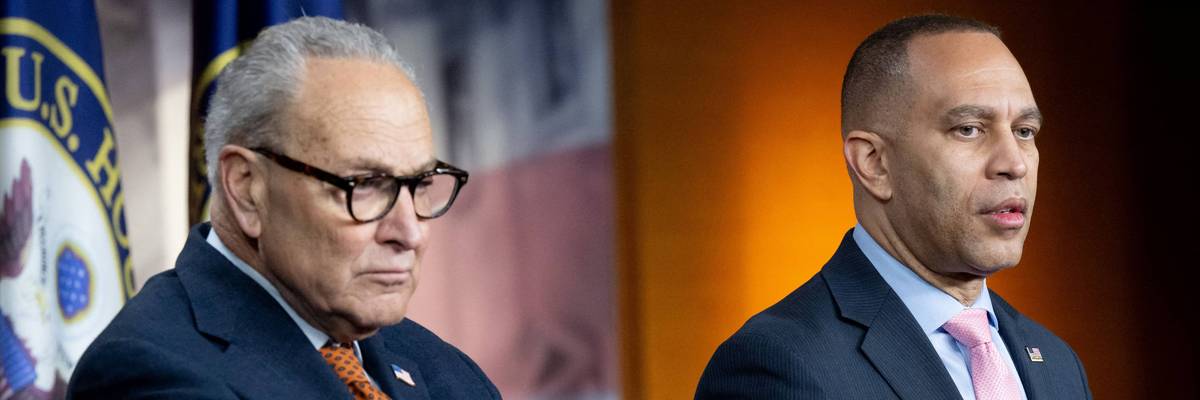
US Senate Minority Leader Chuck Schumer (L), Democrat of New York, and US House Minority Leader Hakeem Jeffries (R), Democrat of New York, hold a press conference on Capitol Hill in Washington, DC, on January 8, 2026.
(Photo by Saul Loeb / AFP via Getty Images)


Ralph Nader
Feb 02, 2026
Common Dreams

“How’s the Democratic Party’s ground game in Pennsylvania?” I asked a friend several weeks before the 2024 presidential election. He replied optimistically that there were far more door knockers this year than in 2022. It turned out these door knockers were just urging a vote for the Democrats without putting forth a compelling agenda attached to candidate commitments on issues that mean something to people where they live, work, and raise their families. There was no Democratic Party “Compact for the American People.” Biden visited Pennsylvania, which went Republican, many times, with his most memorable message being that he grew up in Scranton.

Once again, the vacuous, feeble Democratic Party is relying on the Republicans and the cruel, lawless dictator Trump to beat themselves to gain control of the Senate and the House.


Progressives Rip ‘Spineless’ Dem Leaders for ‘Empty’ Response to Trump’s Venezuela Attack

Legendary reporter Seymour Hersh last week made the case for the Republicans taking themselves down, to wit: “I have been told by an insider that the internal polling numbers are not good …” and that “Anxiety in the White House that both the House and the Senate might fall to the Democrats is acute. Trump’s poll numbers are sliding …. The public lying of Cabinet members in defense of ICE has not helped the president or the party. Trump hasn’t delivered on the economy, except for the very rich, and he hasn’t made good on early promises to resolve the disastrous war between Russia and Ukraine.”

GOP operatives are assuming the Democrats will take back the House by a comfortable number and now think the Senate, where the GOP holds a three-seat majority. There are six seats in play. The GOP’s biggest fear is that their negatives continue to increase, propelled by a pile of unpopular Trumpian actions, ugly behavior, and corruption. The combination of all these things could create a critical mass and produce a landslide comparable to the Reagan-led victory in 1980. In this election, the Republicans defeated seemingly unbeatable Senate veterans like Senator Magnuson, Senator Nelson, and Senator Church, and gave the GOP control of the Senate.

Our Republic has been invaded by the Trumpsters, who are taking down its institutional pillars, its safety nets, and its rule of law. Our democracy is crumbling by the day.

So, what is the Democratic Party doing during this GOP slump? It is Déjà vu all over again. The Dems are furiously raising money from commercial special interests and relying on vacuous television and social media ads. They are not engaging people with enough personal events, and they are not returning calls or reaching out to their historical base – progressive labor and citizen leaders. Most importantly, they are not presenting voters with a COMPACT FOR AMERICAN WORKERS. Such a compact would spark voter excitement and attract significant media coverage.

Their aversion to building their own momentum to answer the basic questions “Whose side are you on?” and “What does the Democratic Party stand for?” remains as pathetic as it was in 2022 and 2024. Ken Martin, head of the Democratic National Committee (DNC), recently quashed a detailed report he commissioned about why the Democrats lost in 2024. He has refused to meet with leaders of progressive citizen organizations. We visited the DNC headquarters and could not even get anyone to take our materials on winning issues and tactics. We offered the compiled presentations of two dozen progressive civic leaders on how to landslide the GOP in 2022. This material is still relevant and offers a letter-perfect blueprint for how Democrats could win in 2026. (See winningamerica.net). (The DNC offices are like a mausoleum, except for visits by members of Congress entering to dial for dollars.)

Imagine a mere switch of 240,000 votes in three states (Pennsylvania, Michigan, and Wisconsin) would have defeated Trump in 2024. That margin would have been easily accomplished had the Democratic Party supported the efforts of AFL-CIO and progressive union leaders who wanted the Dems to champion a “Compact for Workers” on Labor Day, with events throughout the country. (See letter sent to Liz Shuler, President of AFL-CIO, on August 27, 2024).

The compact would have emphasized: raising the federal minimum wage from $7.25 to $15 per hour, benefiting 25 million workers and increasing Social Security benefits frozen for over 45 years, could have benefited over 60 million elderly, paid for by higher Social Security taxes on the wealthy classes. The compact would also include: a genuine child tax credit would help over 60 million children, cutting child poverty in half; repeal of Trump’s massive tax cuts for the super-rich and giant corporations (which would pay for thousands of public works groups in communities around the nation); and Full Medicare for All (which is far more efficient and life-saving than the corporate-controlled nightmare of gouges, inscrutable billing fraud, and arbitrary denial of benefits).

Droves of conservative and liberal voters would attend events showcasing winning politics, authentically presented, as envisioned for the grassroots Labor Day gatherings, suicidally blocked by the smug, siloed leaders of the Democratic Party in 2022 and 2024.

Clearly, this is a Party that thinks it can win on the agenda of Wall Street and the military/industrial complexes. (See Norman Solomon’s book The Blue Road to Trump Hell: How Corporate Democrats Paved the Way for Autocracy. It can be downloaded for free at BlueRoad.info.) The Democratic Party scapegoats the tiny Green Party for its losses again and again at the federal and state levels to the worst Republican Party in history – BY FAR.

It is fair to say that, with few exceptions, the Democratic Party apparatus is coasting, playing “it safe,” and expecting that the Trumpsters will deliver the Congress to it in November.

The exceptions are warning about this hazardous complacency, such as adopting James Carville’s ridiculous advice just to let the GOP self-destruct (though recently he also has urged a progressive economic agenda). There are progressive young Democrats challenging incumbent corporate Democrats in the House. They are not waiting for a turnover in the Party’s aging leadership. They believe the country can’t wait for such a transformation. Our Republic has been invaded by the Trumpsters, who are taking down its institutional pillars, its safety nets, and its rule of law. Our democracy is crumbling by the day.

As for the non-voters, disgusted with politics, just go vote for a raise, vote for health insurance, vote for a crackdown on corporate crooks seizing your consumer dollars and savings, and vote for taxing the rich. That’s what your vote should demand, and these are the issues that should be conveyed to the candidates campaigning in your communities.

Tell the candidates you want a shakeup, not a handshake. (See, the primer for victory, “Let’s Start the Revolution: Tools for Displacing the Corporate State and Building a Country that Works for the People” 2024).


Trump Says He’s “Not at All” Deescalating in MN After Democrats Fold on Shutdown


The statement came hours after Trump celebrated a deal with Schumer to avoid a shutdown.

By Sharon Zhang , 
Truthout
January 30, 2026

President Donald Trump admitted on Thursday evening that his administration is “not at all” deescalating its immigration raids in Minneapolis, confirming that his administration’s pledges to do so were lies, just hours after Senate Democrats folded on negotiations to prevent a government shutdown.

When a reporter asked Trump on Thursday evening whether or not he would be drawing back in Minneapolis, he responded: “Well, we want to keep our country safe. We’ll do whatever we can to keep our country safe.”

“So, not pulling back?” the reporter asked.

“No, no, not at all,” the president said.

This stands in stark contrast to what his administration has said this week.


Democrats Cave on Demands for DHS Reforms, Agree to Short-Term Spending Bill
The deal — a major concession from Democrats — funds DHS and its immigration-related agencies for another two weeks. By Chris Walker , Truthout  January 30, 2026

After federal agents killed ICU nurse Alex Pretti on Saturday, Senate Democrats had threatened a government shutdown over the inclusion of Department of Homeland Security (DHS) funding and, within it, a historic increase to Immigration and Customs Enforcement’s (ICE) budget.

Seemingly in response, the Trump administration scrambled to claw back some of its messaging.

The White House reneged on top officials’ comments calling Pretti an “assassin” and “terrorist,” and the administration booted Border Patrol official Gregory Bovino from his position overseeing the raid in Minneapolis. The new chief of Operation Metro Surge, “border czar” Tom Homan, assured the media that the operation was going to “draw down.” Trump himself said on Tuesday that “we’re going to deescalate a little bit” in Minneapolis.

And, for good measure, Trump administration insiders leaked some stories to the media about turmoil within Trump’s cabinet about immigration policy.

Just hours after Trump and Senate Minority Leader Chuck Schumer (D-New York) announced that they had reached a deal to avert a shutdown, however, Trump changed his tune. That deal, which would give DHS two weeks of funding to operate while negotiations are ongoing, was announced Thursday afternoon.

Trump’s comments lend credence to critics who said that the administration was only posturing about deescalating while never planning to do so.

The Senate still hasn’t passed the funding package due to some Republican holdouts. However, other Republicans have framed the negotiations as a win — and critics have slammed the deal as one that disproportionately benefits Trump.

The threat of a government shutdown was a major leverage point for Democrats. It would begin this weekend, just a week after federal agents’ killing of Alex Pretti in Minneapolis, giving Democrats power over Republicans to extract concessions on the Trump administration’s ICE operation.

Trump was desperate to avoid it — especially after his party shouldered much of the blame for the historically long shutdown last year. In a post on Truth Social on Thursday evening, he lauded the package.

“The only thing that can slow our Country down is another long and damaging Government Shutdown. I am working hard with Congress to ensure that we are able to fully fund the Government, without delay,” he said.

Meanwhile, critics have slammed Schumer for the deal, which only buys Republicans time to distance themselves from the Pretti killing and continue the administration’s raids in Minneapolis and other cities unhindered.

“Leader Schumer should ask the Minnesotans who are watching their neighbors get killed in cold blood if a deal with no plan to stop ICE is enough right now,” said MoveOn Civic Action.


Kremlin developing Siberian rare earths to tempt Trump, exploit Europe’s shortages

Kremlin developing Siberian rare earths to tempt Trump, exploit Europe’s shortages
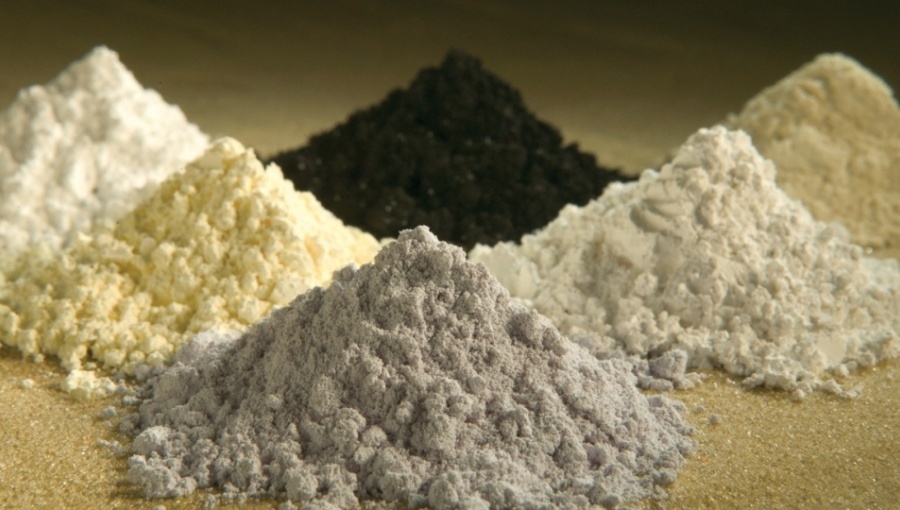
Moscow plans to increase its global share of rare earth supply from 1.3% to 10% by 2030 and start to compete with China as the sole source of the minerals. / bne IntelliNews
By Bne Aris in Berlin February 2, 2026

Kremlin leverages Siberian rare earths to exploit Europe’s mineral shortage and break sanctions

The Kremlin is positioning a $9.2bn mining development in Siberia as a geopolitical critical minerals bargaining chip to use in potential peace talks with the West, leveraging global anxiety over access to rare earth metals (REMs) to gain some leverage, according to a recent policy brief published by the European Council on Foreign Relations.

The project — known as the Angara-Yenisei Valley — aims to transform a remote region of Siberia into a major hub for the extraction and processing of lithium, germanium, and other critical minerals essential to technology and in short supply, as Moscow seeks to present itself as an alternative to the Chinese monopoly over the hard to find minerals and metals.

“Russia is actively preparing to use the Angara-Yenisei Valley as a geopolitical bargaining chip in future peace negotiations,” wrote Kirill Shamiev, a fellow at ECFR, in the brief. He argued that as European and US leaders explore possible diplomatic paths to end the war in Ukraine, Moscow hopes the strategic value of its mineral resources will create a powerful incentive for re-engagement.

Russian President Vladimir Putin is playing to US President Donald Trump’s minerals diplomacy where he has linked mineral concessions to the majority of the peace deals he has been negotiating in his first year in office – starting with tying aid to Ukraine with a minerals deal signed on April 30 last year.

The US has been caught napping, having allowed China to build up a virtual monopoly over the production and processing of critical minerals and REMs over the last decade, while the rest of the world has largely ignored the sector, relying almost completely on imports from China.

After China, Russia has some of the largest deposits of the minerals in the world and is already a significant producer of some of them like enriched uranium and the platinum-group metals (PGMs), as well as plentiful deposits of more mundane metals.

Trump has made it very clear that he wants to do business with Russia and gain access to these natural resources. Putin has made it plain that he understands this desire and has dangled various projects and joint ventures under the American nose. During the Alaska summit on August 15, the two presidents also discussed a joint venture to exploit REMs in Alaska, among the several options on the table.

Access to REMs has shot up the agenda after China began to strangle supplies to the West as part of a trade row with the US over tariffs last year.

The EU is also in the firing line as it has almost no deposits of its own and is now signing trade deals, like last week’s EU-India “mother of all trade deals” that includes mineral concessions and supplies.

According to Shamiev, EU imports of rare earth elements fell 29% in 2024 due to the stricter Chinese export licensing controls, leaving key sectors — including defence and high-tech manufacturing — exposed. “Countries like Estonia, which already import 88% of their rare earths from Russia, face a dangerous dependency,” he wrote, warning that logistical convenience risks becoming “an opening for Russian bullying.”

Moscow plans to increase its global share of rare earth supply from 1.3% to 10% by 2030 and start to compete with China as the sole source of the minerals. The Kremlin is relying on the Angara-Yenisei Valley to lead the effort. The Kremlin has designated the site a special economic zone, offering tax incentives to foreign investors in the hope of attracting European and US capital and technology, despite existing sanctions.

“Russia’s proven rare earth reserves—about 28.7m tons—rank among the world’s largest, but Russia lacks the latest technologies for extraction and processing. Chinese partners are reluctant to share them and Western sanctions complicate things further,” says Samiev.

Oversight of the project has been assigned to high-ranking officials, with former Defence Minister and now Security Council Secretary Sergey Shoigu responsible for its development and First Deputy Prime Minister Denis Manturov serving as chairman of its supervisory board — signalling the political importance the Kremlin attaches to the initiative.

While no formal offer has emerged, Russian officials believe Europe’s weak growth and potential trade frictions with Washington could make cooperation on raw materials politically acceptable. Ultimately, Shamiev warns that this economic “carrot” is designed to fracture European unity and secure the stability of the Putin regime.

“The Kremlin is betting that economic pragmatism will override sanctions,” Shamiev warned. “By exploiting Europe's desire for strategic autonomy from China, Moscow hopes to fracture EU unity and entrench Russian leverage in any eventual settlement.”

Analysts say the strategy represents a long-term effort to reshape Russia’s postwar relationship with the West — one grounded not in energy dependence, but in control over the materials essential for green and digital industries.