Death @ Amazon in Germany
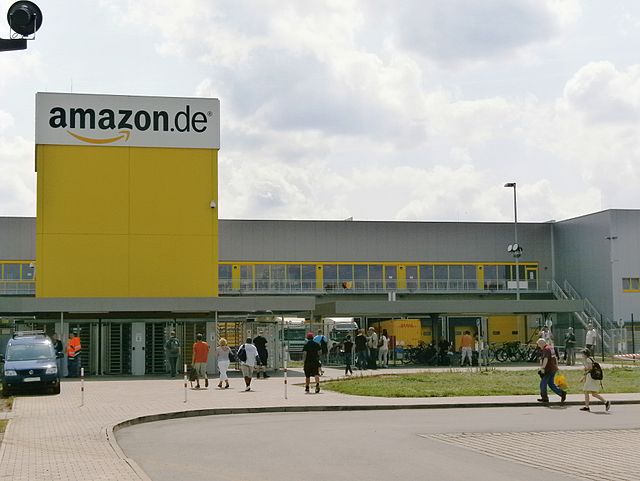
Barely half a year after the Amazon boss’ lavish wedding in Venice in “The Great Gatsby” style, surrounded by 250 guests, just one hour’s flying time away — in Bezos’ private jet, the Gulfstream G700, of course — a lonely Amazon worker died, abandoned in a rather non-tasteful Amazon toilet at Jeff Bezos’ East German Amazon warehouse in Erfurt.
Seemingly, not much has changed since Friedrich Engels’ seminal study The Condition of the Working Class. Two hundred years of capitalism — and workers still die lonely deaths while billionaire bosses excessively celebrate themselves.
It was by no means the first Amazon worker to die in one of Amazon’s warehouses. This time it was in Germany’s Erfurt. The 215,000-strong East German city is a near-perfect location. It lies not only in the heart of Europe, but also within highly neoliberal East Germany, where unions are kept weak and labor law is sparsely enforced.
To make matters worse, the East German state of Thuringia is not only home to the neo-fascist AfD’s real Führer — Björn Höcke — but also to Germany’s worst neo-Nazi killer commando, the NSU.
Still worse, the latest polling shows Germany’s conservative CDU at 24% and Höcke’s neo-fascist AfD at 39%. In other words, Germany’s petty-bourgeois party, the CDU, and its neo-Nazi counterpart, the AfD, together enjoy the support of almost two-thirds of the local population — 63%. Put differently: exit Erfurt’s train station, and two out of three people you meet are either conservative or outright neo-Nazi.
Welcome to Erfurt in 2026. This is not new. Hitler’s Nazi party received a whopping 40% in Erfurt in 1932 and 45% in March 1933.
Back at Amazon’s toilet, the worker died during his shift after reporting sickness — unnoticed by management. Meanwhile, colleagues report high pressure and stress at work at Amazon’s so-called “Fulfillment Center” (Orwellian Newspeak) in Erfurt-Stotternheim. As Amazon boss Bezos found fulfillment in Venice, perhaps the worker found his fulfillment in one of Amazon’s toilets while dying.
Unlike Bezos’ over-the-top wedding show, the worker was found lifeless in the Amazon toilet during the morning shift. Worse, he had previously tried — in vain — to report sickness to his Amazon supervisor. In general, management has a “duty of care” for workers. This is supposed to mean that workers leave work in one piece and alive.
Union calls on Amazon to clarify the circumstances of the man’s death and to improve working conditions at the site appear to have been fruitless. Worryingly, workers have spoken of so-called “high performance requirements” — work intensification pushed to the limits of what is humanly possible.
This is spiced up with bans on vacations, particularly during “Black Friday,” Christmas, etc. Amazon’s management also operates what workers call a “lack of pay for sick leave” policy. The message: do not get sick from being worked like a slave — there will be no pay. On the shop floor, there is constant pressure to meet management’s rather arbitrary “standards.”
Failing to meet them means punishment for many of Amazon’s 2,000 workers. To a large extent, Amazon prefers temporary employment, putting workers at an even greater disadvantage. There is constant fear of job loss if a worker takes sick leave or works “too slowly” — as defined unilaterally by management.
Interestingly, and despite Amazon’s notorious Uber-surveillance, what happened in Amazon’s toilets remained — strangely — undetected. Perhaps also to avoid attention from local neo-Nazis, the name of the Algerian worker was not published — for good reason. Fifty years ago, Algerian workers were hunted by neo-Nazis through the streets of Erfurt in what was then “socialist” East Germany.
Meanwhile, after media reports on the death at Amazon in Erfurt became a disquieting sign — not for Amazon’s management, but for the state — local occupational health and safety authorities and Thuringia’s public prosecutor’s office began investigating. Months or years later, a small report will be published — in the local newspaper, page 18, bottom left.
In the meantime, there is a picture with a black frame at Amazon in Erfurt. It bears the name and photo of the man who lost his life two weeks ago. “It is with silent sadness that we say goodbye to our employee,” it reads — in English. The days when workers burned down the satanic mills of capitalism after a worker died are long gone.
Yet the man’s death is framed – by Amazon’s management – as “sudden and completely unexpected.” Of course — how could anyone expect workers to die when work pressure and stress have been cranked up to inhumane levels for years?
It is said the man was friendly and helpful. Sincere condolences are extended to his family and all those close to him. One mourning card is signed: “Management, Works Council and the employees of Amazon Erfurt GmbH.” After pressuring workers to dehumanizing levels, Amazon’s management — normally fiercely opposed to works councils and trade unions — suddenly brings the works council on board. Such institutions are useful when camouflaging management’s Uber-pressure becomes unbearable.
The man was 59 years old, a German-Algerian, and an employee at the Amazon warehouse in a suburb of Erfurt. On the morning of November 17, 2025, he collapsed in an Amazon toilet during his morning shift and died of a heart attack. Heart attacks are not unrelated to stress.
What is officially stated as “since then, the question has been raised as to what responsibility Amazon bears for the death of this man” basically means: thank God there are only questions — no strikes, no attacks on Amazon and no riots. Corporate PR can take care of that.
Unsurprisingly, the death occurred in the middle of “Black Friday” and the already-starting Christmas “business” — synonymous with a further intensification of work pressure.
What is framed as “the most stressful time of the year” is not stressful “just because.” It is stressful because Amazon’s management makes it so.
The activity of “picking” is especially hard — not because it simply “is” hard, but because it is made hard by management. For about 30 years, the man lived in Germany — in other words, he was local. Before Amazon, he was self-employed for a long time, ran a pizza delivery service with 35 employees, and a café with his wife.
A local newspaper once described him as a highly motivated entrepreneur; he was even awarded for his work with the pizza business. But that was a long time ago.
It is not known when he began working at the Amazon logistics center — not even this is disclosed by management. What “is” known is that during his shift he reported feeling unwell to his supervisor. What happened next is disputed. There is a management narrative and a worker narrative.
“Officially,” it is said that it was agreed the employee would go on a break and then decide whether to go home. In this case, “officially” may well mean: do not believe anything unless it is officially denied.
Through management ignorance, carelessness, or both, it was assumed that the worker had left the premises and gone home. Management was wrong.
Most workers do not consider this version credible. Amazon workers are closely monitored — a euphemism for super-surveillance. Worse for management’s fairytale, workers who leave must officially “check out.”
This means management should have noticed when a worker was absent from his workplace for an extended period. Yet it gets worse. The man lay in the toilet for hours after his collapse before being found.
Amazon does not deny this — it is hard to deny facts when they pile up. Still, an Amazon PR spokesman stated: “We would like to emphasize that the tragic incident was not an accident at work.” Of course. A man’s death is merely a “tragic incident” to management. And of course it was not an accident at work. It happened in Timbuktu.
Even a union representative does not go so far as to call the death an accident at work. But the union correctly notes the man might have been saved if help had arrived “more quickly.” “More quickly” is generous: despite a highly sophisticated surveillance system, management failed to notice his absence for hours. That is not delayed help — it is no help at all.
Worse, this is not the whole story. Recently, Amazon abolished its company paramedic in Erfurt to cut costs. What a coincidence: eliminate medical staff, and a man dies shortly afterwards.
A company paramedic would have recognized the warning signs and called an emergency doctor. Amazon got rid of them.
To smokescreen cost-cutting at workers’ expense — or lives — an Amazon spokesman rushed to present a counter-story. He did not deny the paramedic’s removal. Instead, Amazon claimed its first-aid program had been “significantly expanded,” with almost 300 employees trained.
As it turned out, a short first-aid course does not replace properly trained paramedics. It is cheaper. How such cost calculations work has been known since the infamous Ford Pinto case of the 1970s.
After the employee’s death, Amazon interrupted the shift and sent workers home on full pay. This time, Amazon reacted differently than it did three years ago in Leipzig, where a worker collapsed and died during a shift and business continued as usual.
One day after the man’s death, an association of Algerians in Germany posted his picture on Facebook. Meanwhile, Amazon workers know that surveillance is omnipresent and that supervisors see everything — and that data is stored.
Following the death, Thuringia’s state government issued calls “for clarification.” Occupational health and safety authorities were informed by Verdi on November 18. On November 27, authorities arrived on site “to clarify the facts.”
Amazon insists the death should not be classified as an accident at work. Central to this is Amazon’s denial that the worker had tried to call in sick.
Meanwhile, the public prosecutor’s office investigates. Verdi has criticized Amazon’s inhumane working conditions for years and demands healthy work secured by a collective agreement.
After more than twelve years of struggle, workers are prepared for a long national and international labor dispute. This will include strikes.
The majority of Amazon workers in Erfurt are migrants, many from non-EU countries such as Syria, Iran, Afghanistan, or African states. Management pressure is imposed on the basis of existential fear — insecure residence permits, job loss, deportation.
Amazon ruthlessly exploits a situation the state could resolve. But xenophobia wins elections — especially in a country that once drove racism to its extreme: Auschwitz. As so often, racism works in favor of capital.
Many workers hope prosecutors will investigate whether Amazon’s working conditions contributed to the man’s death. Even if so, any punishment will likely be mild — not to frighten a multinational corporation.
Workers know one thing for sure: Amazon’s working conditions make them sick. Fear, pressure, surveillance, and sanctions form a toxic mix — especially for migrants.
At the same time, the case shows how difficult it is for trade unions to organize resistance. Still, there is no alternative if Amazon’s modern “satanic mills” are to become even slightly bearable.
One worker — call him Amir — said the deceased had been working in “picking,” the most exhausting job, involving removing packages from robots. You work alone, without contact, under extreme time pressure, often in poor lighting.
Recently, new lights were installed — so bright that eyes hurt. One worker vomited three times during a shift. When he asked to go home, the area manager replied: “No, we have too much to do. You have to keep picking.” He continued out of fear — fear of illness records, fear of angering managers who rule their shop-floor kingdoms.
Amir said the man lay in the toilet for hours before being found. He was surprised the operation was stopped and workers were sent to the canteen, informed of the death, ordered to observe a minute’s silence, and then sent home.
Last year in Leipzig, work continued as usual after a death. Now, Amazon fears bad press. Since then, workers have been told no one can forbid them from going home. But, Amir says, “you are at the mercy of area managers.”
“If they don’t like you, you’re screwed,” he says. Transfers, assignments — everything depends on them. Every day, workers see seriously ill colleagues working on. When asked why, the answer is always the same: if you go home, you pay the price.
Just yesterday, another worker lost consciousness in Amir’s area. Nobody knows why. But many can imagine. Probably not because Amazon’s billionaire boss was indulging