Wednesday, February 04, 2026


Source: Originally published by Z. Feel free to share widely.

Donald Trump is on the warpath again, threatening Greenland, Iran, Canada, and Cuba. Will he be TACO—Trump Always Chickens Out—or will he carry through on the threats—seizing Greenland, seeking to overthrow the Iran and Cuba regimes, destabilizing Canada? Let’s take a look.


Greenland: A “Core National Security Interest”


Jeff Landry, the Trump administration’s envoy to Greenland—he’s also governor of Louisiana—has written an op-ed for the New York Times January 29 that tells us the US intends to dominate the island.


“When President Trump took office last year, he recognized an uncomfortable fact that many others have avoided: America must guarantee its own unfettered and uninterrupted access to key strategic territories in the Western Hemisphere, including both Greenland and the Panama Canal.”


Pairing those two locations is revealing, since Landry proposes that “Greenland fits squarely within” the idea behind the Monroe Doctrine for Latin America. Now that Trump believes he has a “framework for a future deal” on Greenland, the US will use it to (in Landry’s words) “set the rules in one of the world’s most strategically consequential regions in perpetuity.”


“American dominance in the Arctic is nonnegotiable,” writes Landry. “Greenland is a core national security interest for the United States,” repeating what Trump said at Davos. That’s an extraordinary statement: It elevates Greenland to the level of Europe’s or the US homeland’s defense, among other national interests.


And it’s wrong. Chinese and Russian activities in and around Greenland hardly amount to a national security threat. Contrary to Trump’s statement in a January 9 press conference, there are no Chinese and Russian destroyers circling Greenland, nor “Russian submarines all over the place.” Nor, finally, are there any indications that Russia or China plans to “occupy” Greenland. All we see are Russian and Chinese fishing boats.


Nevertheless, the US is going to build more bases in Greenland, establish a “Golden Dome” missile defense, build more icebreakers, and vigorously patrol the Arctic waters to prevent a Russian or Chinese takeover. These plans may conceal a long-term design on Greenland and its mineral resources. After all, governments typically are prepared to go to war over “core national security interests.”


Iran: Make a Deal or Perish


Once again, President Trump is threatening to attack Iran. Just a few weeks ago, the threat turned on Iran’s reaction to massive protests and the possible execution of protesters. The US was “locked and loaded”; protesters could count on the US. But Trump was evidently persuaded by Arab countries and the US military not to attack.


Now Trump, having failed to back up his promises as thousands of protesters were killed or jailed, is saying Iran has revitalized its nuclear weapon capability. That’s the capability he had claimed was “obliterated” in US attacks last June. Trump has ordered US military vessels to the Middle East, saying that “like with Venezuela, it is ready, willing, and able to rapidly fulfill its mission, with speed and violence, if necessary.”


News reports indicate Trump is considering various options, including putting US troops into Iran. Evidently, Trump has become so enamored with the successful seizure of Venezuela’s leader that he thinks Iran can be as easily dealt with. Yet Trump also says he hopes to avoid the use of force. In short, more gunboat diplomacy.


Iran is responding, as in the past, with threats of its own and offers to talk. If the US attacks, Iran says it will spark a regional war and that Israel and US bases in the region will be targets.


But Iran’s foreign minister, Abbas Araghchi, has also said Iran was “ready to begin negotiations if they take place on an equal footing, based on mutual interests and mutual respect.” He said there were no immediate plans to meet with US officials, adding: “I want to state firmly that Iran’s defensive and missile capabilities will never be subject to negotiation.”


In the past, Iran has also said its nuclear enrichment program is off the bargaining table. That point collides with the demand made by Steve Witkoff, Trump’s special Middle East envoy, that Iran stop its enrichment program and transfer all its enriched uranium out of the country.


Will Trump order another attack on Iran? More bombing is certainly possible, whereas a direct intervention in Iran would invite disaster. Trump’s war threats have activated some in the Senate to craft a resolution that would remove US military forces “from hostilities within or against the Islamic Republic of Iran” unless authorized by Congress. Prospects for stopping Trump by resolution or the War Powers Act seem dim considering that these measures were not enacted to prevent his Venezuela adventure.


Canada: Squeezing with Separatism and Tariffs


Angered by Prime Minister Mark Carney’s upstaging him at Davos, Canada’s trade deal with China, and Canada’s supposed refusal to certify Gulfstream business jets, Trump’s team has looked for ways besides high tariffs to pressure Carney’s government. US treasury secretary Scott Bessent recently
suggested US support for a separatist group in Alberta, arguing that the province is a “natural partner” of the US.


That support apparently extends to the highest level of the US government, according to an account in The Daily Beast. “Very, very senior” officials in the Trump administration have had secret meetings with far-right Canadian separatists trying to shake the foundations of the country. The covert meetings between high-ranking U.S. officials and the Alberta Prosperity Project,” says the report, “have met U.S. State Department officials in Washington, D.C. three times in the last nine months.”


One member of that project who attended the meetings claimed: “The US is extremely enthusiastic about a free and independent Alberta. We’re meeting very, very senior people leaving our meetings to go directly to the Oval Office.” The group is hoping to place a referendum on independence on the ballot.

US officials deny supporting this movement, but the State Department acknowledges that meetings did take place. The US officials’ denials ring hollow. The very fact that US officials would engage with Canadian separatists is a shocking level of interference in Canadian affairs. It shows that if Trump cannot fulfill his dream of making Canada the 51st state, he may still try to pry off one province.


Cuba: Economic Warfare or Regime Change?

Following up on Marco Rubio’s threats to Cuba, the island’s oil imports are drying up. Trump has made sure Venezuelan oil is no longer available, threatening to raise tariffs on any country that might provide it. Cuba’s usual sources of oil, Mexico and Angola among them, are being closed down, almost certainly under US pressure.


Mexico’s President Claudia Scheinbaum insists the decision is a sovereign one, and that Mexico will continue to provide oil as humanitarian assistance. But when we consider that Trump has threatened to go after drug cartels in Mexico, and that the US-Mexico-Canada free trade agreement is up for renewal shortly, it is hard to credit Scheinbaum’s claim.


Trump has made clear the US strategy for regime change: an economic blockade. “Cuba will be failing pretty soon,” he boasted. Indeed, by some estimates, Cuba has only about 3 weeks of oil, after which a humanitarian crisis is being predicted. Diesel is essential to producing electricity and for transportation, water delivery, and agriculture.


During the Cold War, the US embargo of Cuba was justified by Cuba’s support of revolutionary movements in Latin America and Africa. Now the pretext is that Cuba is a national security threat because it provides “a safe haven for transnational terrorist groups, such as Hezbollah and Hamas”. No evidence has been offered in support of this charge—and I doubt any evidence exists.


TACO Time?


A president who began his second term riveted on dismantling democracy and doing away with the rule of law has now become an imperialist, with military interventions and weaponizing tariffs the main instruments for accomplishing US goals. How far will he go in each of the four cases?


Trump has a history of backing off from threats, but the Venezuela experience has clearly made him think he has license to intervene abroad with impunity, especially in Latin America where weak regimes are in no position to resist. There’s a good chance he will overreach, as imperialists do, facing pushback that he and his advisers had not foreseen in Greenland and NATO, in Iran, and in Canada.
He will also face domestic political costs as independents and even some MAGA supporters resent his overseas adventures for taking money and attention away from a corroding economy. So, TACO time or wartime?


Either way, Trump will threaten world peace and stability, alienate traditional friends, and possibly spark new wars. Increasingly unpopular at home, he may just be desperate enough to authorize more outrageous actions abroad.


Mel Gurtov, syndicated by PeaceVoice, is Professor Emeritus of Political Science at Portland State University.


Venezuela and Iran: Oil and Survival

Source: Originally published by Z. Feel free to share widely.

Venezuela, under threat following the attacks of January 3, and in perspective alongside the historical mirror that is Iran, allows us to study the models of classic oil nationalism and pragmatic resistance. But beyond the economy, some analysts have put forward the theory that Venezuelan and Iranian oil is not just a business, but vital ammunition in the war scenario being proposed by the United States.

The 2026 Reform: Privatization or Tactical Lifeline?

To understand the current reform, we must look at the red numbers. In 2014, Venezuela had annual oil revenues of close to $40 billion. Following US sanctions and the financial blockade, that figure plummeted to just $740 million in 2020. The state, owner of the resource, was left without the capacity to extract it and without banks to collect payment.

The response was the Anti-Blockade Law of 2020, which gave rise to the Petroleum Participation Contracts (CPP). According to the inputs from the recent high-level meeting, CPPs are not traditional concessions. They are service agreements where the private sector invests and operates, collecting its investment directly through physical production (barrels), eliminating the financial transaction that the US could block.

The government defends the success of the model: revenues in five years increased to a record $14 billion in 2025, which, although far from historical revenues, were considerably higher than the $740 million at the worst point in 2019. The reform now seeks to give this mechanism legal status, removing it from the realm of exceptionality, which often placed the Venezuelan state at a disadvantage. Jorge Rodríguez, president of the National Assembly, sums it up as a “flexibilization of tariffs” in which the private sector provides the capital and the state maintains sovereignty over the oil field. While Caracas discusses the new legal basis for adapting to the new conditions of energy relations with the US, Donald Trump sent a message from Washington on 23 January confirming the US president’s change of stance on oil geopolitics: “Venezuela has the largest oil reserves in the world… larger than Saudi Arabia’s,” suggesting that the US could make “a lot of money” from this pragmatic relationship.

The Clash of Visions and Internal Criticism

The reform has sparked some criticism. Former oil minister Rafael Ramírez, who faces corruption charges in Venezuela, described the measure on January 27 as a “repeal of the 1976 nationalization.” For those who have historically defended oil nationalism, the CPPs, within the framework of the reform of the Hydrocarbons Law, hand over operational control—which they consider to be the real value—to transnational corporations.

The government counters with “war pragmatism”: the 2006 model (with 90 percent of revenue going to the state) was ideal in peacetime, but unviable under siege. The new scheme ensures between 65-70 percent of revenue and, most importantly, keeps the industry alive. This represents a forced retreat due to circumstances in order to avoid total suffocation.

The New Cold War: the China factor

This is where the global dimension comes into play. Why are Donald Trump and Washington now showing tacit tolerance for this Venezuelan model (as seen through the licenses granted to Chevron) while maintaining their tough rhetoric? The answer may lie in the goal of containing China.

Several analyses, including those by conservatives such as Tucker Carlson, have put forward a thesis that resonates in the media and geopolitical think tanks: the United States is preparing for a large-scale kinetic or trade conflict with China. In this scenario, control of Venezuelan oil reserves ceases to be a market issue and becomes a matter of pure national security.

Carlson warns that the Trump administration finds it unacceptable that the world’s largest reserves (Venezuela) and one of the keys to the Persian Gulf (Iran) are supplying China. “The oil is going to China… it should be coming to us,” is the underlying interpretation of Washington’s new doctrine.

From this perspective:

Cutting off resources to the enemy: The goal is no longer just to “change the regime” in Caracas for “democratic” reasons, but to decouple Venezuela from China. If the CPPs and licenses allow Venezuelan crude to flow to the Gulf of Mexico (US) instead of Shanghai, Washington wins a strategic battle without firing a bullet.

The Iranian Case: With Iran, the situation is more volatile. Carlson suggests that hostility toward Tehran seeks to cut off China’s main secure energy artery in the Middle East. Controlling or neutralizing Iranian oil leaves China’s industrial and military machinery vulnerable to a naval blockade. And at the same time, controlling the supply routes.

This “New Cold War” explains the current paradox: the US, while turning the Caribbean into a large military base, is allowing Venezuela to breathe economically (through Chevron and, in the future, the participation of other large US companies), because it prefers a pragmatic Venezuela that sells to the North, rather than an unaligned Venezuela that is a secure energy supplier to China and, financially, contributes to putting the nail in the coffin of the dollar as a global currency.

The Historical Mirror: Iran and Venezuela (The “Petroleumscape”)

This dynamic is not new. Venezuela and Iran share a historical “petroleum landscape.” Both suffered Western-orchestrated coups when they attempted to nationalize their resources (1948 and 1953). Both founded OPEC in 1960 to defend themselves.

In recent years, the Caracas-Tehran alliance has been existential. Iran taught Venezuela how to navigate sanctions (covert fleets, refinery repairs, among others). Now, both countries find themselves in the vortex of the US-China dispute. The legal reform in Venezuela is, at its core, a maneuver to survive on this chessboard: ensuring its own cash flow to alleviate the US threat, even though the geopolitical gravity inevitably pushes for greater pressure from Washington on both countries.

This Story Has Been Going On For More Than 100 Years.

The partial reform of the Hydrocarbons Law is much more than a technical adjustment; it is an act of survival on the eve of a major global conflict. Venezuela is sacrificing part of its income and operational control (which it was already doing via the CPP with the Anti-Blockade Law) to reinsert itself into the Western market and try to circumvent the blockade.

Ultimately, in the war for global hegemony waged by Washington, which sees Beijing as its main contender, Venezuelan and Iranian oil are the ultimate strategic trophies. Venezuela and its 100-year history of oil, as we began to study, is one of the battlefields.


Carmen Navas Reyes is a Venezuelan political scientist with a master’s degree in Ecology for Human Development (UNESR). She is currently pursuing a doctorate in Our America Studies at the Rómulo Gallegos Foundation Center for Latin American Studies (CELARG) in Venezuela. She is a member of the International Advisory Council of the Tricontinental Institute for Social Research.

This article was written by Globetrotter.

Water, Power, and Soil

Source: Originally published by Z. Feel free to share widely.

Across the MENA region, governments are racing to secure water. Dams are raised, aquifers drilled deeper, desalination plants multiplied, and cross-border transfers negotiated. These investments were necessary. They prevented collapse. They bought time.

But time is no longer enough.

A hard truth now confronts the region: capturing water does not guarantee security.

Much of the water mobilized still escapes—rushing across degraded landscapes, flooding cities, draining aquifers, and leaving fields dry.

In one of the world’s most water-stressed regions, this is no longer an environmental issue.

It is a national security risk.

Water Scarcity Is Not Just About Rain

The MENA region is often portrayed as doomed by climate and geography. Low rainfall, rising temperatures, growing populations—these realities are real. But they are not the full story.

Rain still falls. Sometimes violently.

What is missing is the capacity of territories to retain, absorb, and recycle water.

Compacted soils, bare slopes, sealed urban surfaces: water runs fast, erodes, destroys, and disappears. Weeks later, drought returns. This cycle fuels food insecurity, rural collapse, urban flooding, and political instability.

The paradox—floods followed by shortages—is not a climate accident.

It is the signature of broken hydrological cycles.

Soil: The Region’s Most Overlooked Strategic Asset

Most water strategies focus on infrastructure. Pipes, reservoirs, treatment plants.

They ignore the most powerful water system of all: living soil.

A functioning soil absorbs rainfall, stores moisture, feeds vegetation, and releases water gradually. Through evapotranspiration, plants return moisture to the atmosphere, supporting local humidity and rainfall patterns. This “green water” cycle is essential in arid and semi-arid climates.

When soils degrade—through erosion, overgrazing, monoculture, or poor land management—this cycle collapses. Water becomes runoff. Runoff becomes loss. Loss becomes dependence.

A territory that cannot hold water cannot hold stability.

Floods, Droughts, and Urban Unrest: One Systemic Failure

From flooded cities to dried-out hinterlands, the MENA region is experiencing two crises that are often treated separately. They are, in fact, the same crisis.

Cities built to evacuate water quickly amplify flood damage and strain public budgets.

Rural landscapes stripped of vegetation fail to recharge aquifers, driving migration and social pressure.

Climate change accelerates the problem, but it does not create it.

The core issue is territorial: water moves too fast through broken landscapes.

Water, Food, and Energy: A Security Triangle

Food sovereignty remains a strategic priority across MENA. Yet massive agricultural investments rest on a fragile foundation: degraded soils and energy-intensive irrigation.

A healthy soil reduces evaporation, stabilizes yields, and lowers dependence on pumping and desalination. A degraded soil turns every drought into a crisis and every harvest into a gamble.

The same logic applies to rangelands and pastoral zones. Where water no longer infiltrates, biomass collapses, livelihoods fail, and pressures rise—often feeding cross-border migration and unrest.

Restoring hydrological cycles is not environmental idealism. It is risk management.

Urban Water Failure Is a Political Liability

Rapid urbanization has turned water into a political fault line. Cities that treat rain as waste face:

  • recurring floods,
  • rising cooling costs,
  • increased reliance on external water and energy supplies.
  • Urban water mismanagement erodes trust, strains state capacity, and amplifies inequality. In fragile contexts, this becomes a direct governance challenge.

By contrast, cities designed to infiltrate, store, and reuse water create resilience, lower costs, and reduce exposure to shocks.

This is not urban ecology. It is urban security.

Deserts and Oases: A Forgotten Strategic Lesson

For centuries, societies across the MENA region survived in extreme climates by mastering one principle: slow the flow.

Water, sand, wind—nothing was allowed to rush unchecked. Terraces, bunds, infiltration systems, and layered vegetation formed resilient territorial systems. These were not primitive solutions. They were strategic adaptations.

Reactivating these principles—updated for modern agriculture, industry, and cities—extends infrastructure lifespans and reduces vulnerability.

Water Cycles and Regional Stability

Broken hydrological systems do more than waste water. They:

  • accelerate rural collapse,
  • increase food imports,
  • intensify energy dependence,
  • fuel migration flows,
  • and amplify social unrest.

In a geopolitically volatile region, these dynamics translate directly into security risks.

Water sovereignty is not stored in reservoirs alone. It is cultivated in soil, landscapes, and territories.

Conclusion: You Can’t Militarize Water Physics

The MENA region’s future will not be secured by engineering alone. No dam, no desalination plant, no pipeline can compensate for landscapes that cannot hold water.

Water follows physical laws, not political borders. States that align with these laws gain resilience. Those that ignore them inherit instability.

The strategic choice is clear:

  • Stop chasing water.
  • Start governing the cycles that sustain it.

In Defence of a Basic Land Income

Source: Degrowth UK

By now, most people have heard of basic income in its various forms and meanings. However, there has been little analysis of whether such proposals, aimed at ensuring minimum coverage of citizens’ basic needs, generally as a complement to the universal basic services that constitute the Welfare State, remain viable from the point of view of industrialised countries’ socio-economic metabolisms, which are facing a drastic decline in the coming years1.

Some of us supported this type of proposal in the 1980s and 1990s, but then becoming aware of the unsustainability of the system on which it necessarily relies (complex states and financial systems disconnected from biophysical reality), began to think about truly sustainable alternatives that would be more resilient in a foreseeable scenario of collapse and that would be oriented towards the same emancipatory and distributive goal. We gave it the name ‘Leira básica’ in Galician2 and also Basic Land Income [Spanish: Renta Básica de la Tierra]. A few years ago, the idea even became part of the electoral programme of the small Partido da Terra3.

Distributing land instead of money

Basically, what basic land income proposes is to replace the monetary income intended to satisfy basic needs with the usufruct4 of sufficient land to satisfy those needs. In other words, instead of having official money to pay for everything we need (food, water, energy, clothing, housing) in the capitalist market, we would have land where we could provide for ourselves by our own means. It is therefore a commitment to land distribution, in line with the historical demands of the Spanish left5 (‘Land for those who work it’, agrarian reform) and currently of La Vía Campesina or the Landless Rural Workers’ Movement (MST) in Brazil, but it is also a strong commitment to self-management.

Of course, this does not imply that the entire population should be engaged in food production in the countryside (although it would undoubtedly encourage this, promoting a necessary return to our depopulated countryside), but rather that it envisages the possibility of people who continue to live in urban areas having a way to enjoy the benefits of this public (government or communal) cultivation. Such a mechanism could be as simple as a social currency, detached from any currency of the unsustainable official financial system, and linked to the capacity of these areas to generate wealth each year, based on natural productivity and human labour. We envisage lands cultivated organically or traditionally with minimal use of fossil-based inputs to ensure their sustainability. Ideally, these areas would be communal and the management of the Basic Land Income would be diverse and totally decentralised. Thus, for example, a region with several towns and a specific agricultural area could calculate its total annual productivity and thereby issue a maximum amount of this “land currency”, to which everyone would be entitled, although many would be able to enjoy part of the production directly on site and therefore would hardly need to use it. The urban population not directly involved in cultivation would use this currency extensively, to purchase food, clothing made from local natural fabrics, etc. in local shops or agroecological markets. In other words, a highly relocalised economy could be organised based on resilient pillars such as labour, productive land and local renewable energy, driven by the needs of the local population.

Advantages over basic income

In a scenario of degrowth forced by the decline of fossil fuels, not only are the international financial system and its various currencies kaput6, but the state itself, as we know it, is doomed to decline, to collapse — in the sense used by Joseph Tainter7, that is, to sharply reduce its complexity ­- in the near or medium term future.

In other words, the State needs to obtain euros, pounds or dollars (i.e. official money), usually through taxes or debt, (and in the Eurozone) it no longer has the capacity to issue currency, and in order to sustain a certain level of tax revenue, it needs to maintain a certain level of economic activity. People began to perceive this sustainability problem with furlough [as paid leave from employment was called in the UK – ERTE in Spain], and the minimum living wage during the Covid pandemic: how long will the state be able to pay salaries, provide aid to all kinds of sectors and also pay this pseudo-UBI if economic activity remains at a minimum8?. The deficit, as we know, has skyrocketed, and debts are multiplying astronomically thanks [at the time of writing] to [the EU] Next Generation [programme]. But this makes the system unsustainable, and with it, the very possibility of the State having access to euros on a massive and indefinite basis. A growing debt and an economy doomed to decline are a bad combination, a very unreliable foundation on which to base something as important as basic income. In fact, public services themselves are at risk if we do not know how to navigate with full awareness the ‘rough waters’ of the energy descent that lies ahead.

The Valencian economist Vicent Cucarella, President of the Regional Audit Chamber, has repeatedly warned that less energy will mean less revenue for the state9. Therefore, if we want to ensure food, housing, and energy for heating and cooking, we had better not gamble on an income provided by a declining state and denominated in a zombie currency.

What’s more, the energy transition will mean a drop in the overall rate of energy return on investment, which is what sustains the complexity of civilisation (the energy sources that deliver higher net energy yields allow us to do more things as a society). To put it simply, we could say that without oil there is no basic income, because it is largely the energy subsidy provided by fossil fuels that has enabled the development of states with very powerful capabilities, extensive and widespread public services and solid sources of income. Therefore, the fall in the global rate of return pushes us to seek simpler and more resilient solutions than the basic income proposals we have been familiar with. That’s because it will always be simpler for everyone to have their own plot of land to live on and feed themselves from, than to maintain a complex, energy-guzzling state that obtains money through taxes and then distributes it among citizens so that they in turn spend it on the private, industrial and fossil fuel-dependent agri-food system. Distribute the real wealth of the land, rather than the ephemeral and inflated wealth of money.

However, ‘simple’ does not necessarily mean easy to implement. But we already know that all aspects of this transition/collapse that we are undergoing will be enormously difficult. To begin with, we could start thinking about setting up a large public land bank, perhaps through a State Agricultural Holdings Company, similar to the (Spanish) State Industrial Holdings Company, or perhaps even better at municipal or regional level. And we could make it easier for anyone who needs it to have access to such land for family use, to participate in some kind of post-capitalist cooperatives backed by the State, which could also serve as a bridge between the usually conflicting ideas of basic income and work guarantee.

Notes

1 See Petrocalipsis by Antonio Turiel, or the new edition of En la espiral de la energía by R. Fernández Durán & L. González Reyes.

Translator’s addition: Heinberg, R. (2007). Peak everything: Waking up to the century of decline in Earth’s resources Forest Row.

2 Translator: The word ‘leira’ in Galician, referring to a cultivated parcel of land, does not have a precise translation. In addition to that meaning, it rhymed with, and had the same number of syllables as, the Spanish for income, ‘renta’, so it was coined as a provocative rewording.

3https://es.wikipedia.org/wiki/Partido_de_la_Tierra_%28Galicia%29

4 Translator: Usufruct is a land tenure system where a person (or collective) has tenure of land, given certain conditions, e.g. its cultivation. It is the form of tenure used for crofting in the Scottish Highlands and Islands.

5 TranslatorAnd indeed the British radical and socialist movement up until the mid C19th.Predecessors of this idea can also be found in British political history, like Thomas Spence’s Plan for common ownership and social dividend of the land, and G. K. Chesterton distributist slogan ‘Three acres and a cow’.

6 Expression by ecological economist Xoán R. Doldán, the first academic to publicly warn about Peak Oil in Galicia.

7 In his book The Collapse of Complex Societies.

8 I explained some of these issues in my book La izquierda ante el colapso de la civilización industrial (The Left Facing the Collapse of Industrial Civilisation).

Translator: English language references to this issue include,
Büchs, M., & Koch, M. (2019). Challenges for the degrowth transition: The debate about wellbeing. Futures, 105, 155–165. https://doi.org/10.1016/j.futures.2018.09.002
Koch, M. (2022). Social Policy Without Growth: Moving Towards Sustainable Welfare States. Social Policy and Society, 21(3), 447–459. https://doi.org/10.1017/S1474746421000361

https://www.elsaltodiario.com/saber-sustentar/Vicent-Cucarella-sector-publico-menos-enerxia-menos-ingresos

By Manuel Casal Lodeiro, Coordinator of the Instituto Resiliencia. Originally published in Spanish, in Revista Ecologista No. 108, 01/06/2021 . Translated by Mark H Burton, with input from the author.


Source: Originally published by Z. Feel free to share widely.

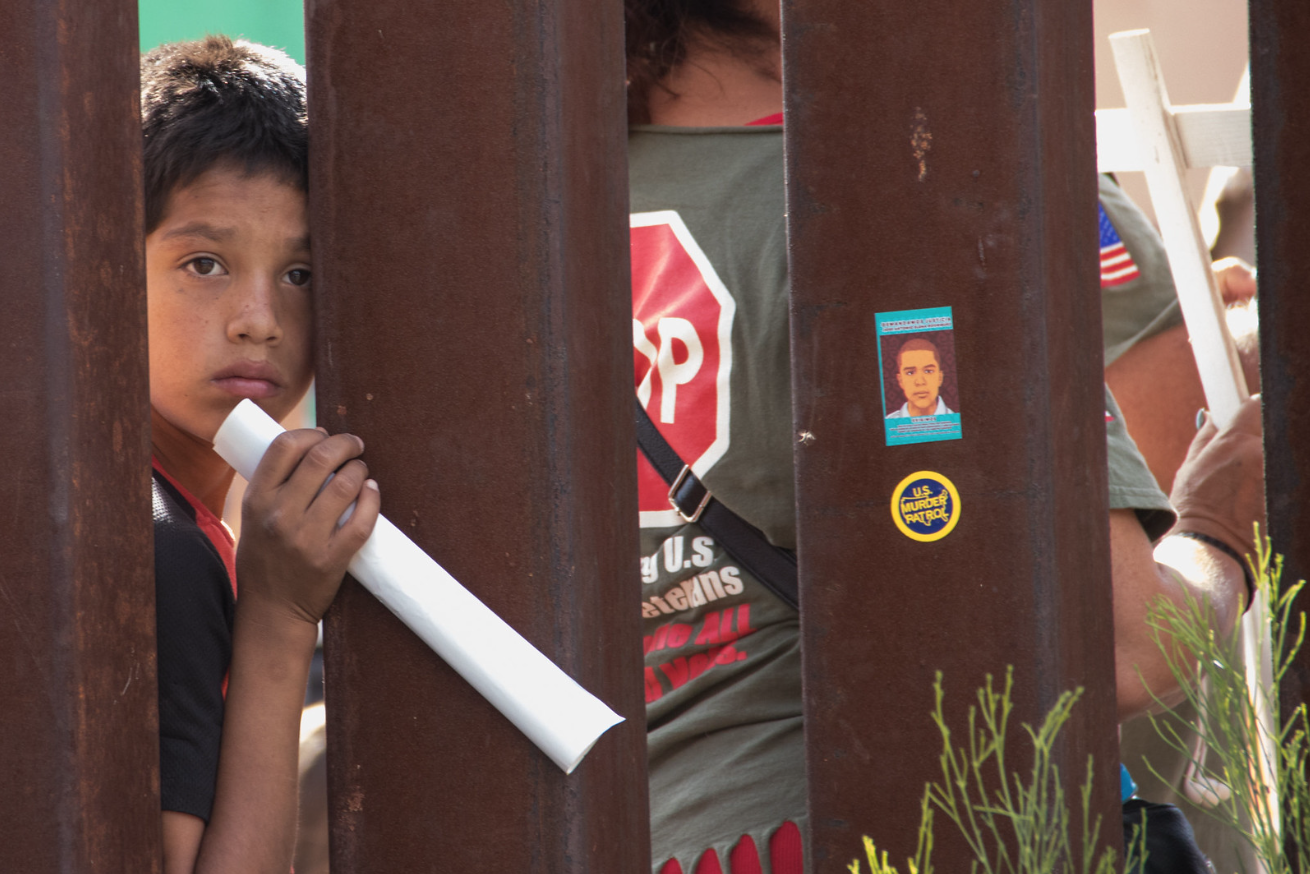
And here I am, an American, staring at the border again . . . and slowly coming to realize the paradox of it. Borders don’t actually exist. They’re invisible lies. They’re also virtually everywhere.

Consider the border Alex Pretti crossed on Jan. 24, on a street in Minneapolis, as he stepped between some U.S. Border Patrol agents and the woman they had just pushed down. He crossed the border that separates ordinary people from the federal Proud Boys (or whoever they are), the masked invaders who were occupying the city to enforce The Law. Pretti interfered with them! He dared to try to protect the fallen woman, who herself had just crossed the same border. In so doing, they both went from being ordinary citizens to “domestic terrorists.” 

“Yet our greatest threat isn’t the outsiders among us, but those among us who never look within.”

The words are those of poet Amanda Gorman, who wrote a poem honoring Alex Pretti after the agents shot him 10 times. Another killing! Oh my God! Another cut to the American soul — a cut, by the way, that comes with complete immunity, according to Team Trump. They’re waging civil war against those who cross the border that separates right from wrong. “Fear not those without papers,” Gorman’s poem continues, “but those without conscience.”

You know what? As terrifying as the idea of a new civil war sounds, I prefer it to something worse: a great national shrug and acquiescence to the Trump agenda. ICE, as so many people have pointed out, is acting like the Trump Gestapo, as his administration rids sacred (white) America of the brown-skinned other, who may or may not be immigrants. What matters is that they’re different from “real” Americans. Right?

Regarding the whole concept of the border: It seems so real and viable until you start questioning it, which includes looking into its history.

As Elisa Wong and Raymond Wei write: “The way that we think of borders today, as firm boundaries that are violently enforced, is a relatively new thing, and we would argue it doesn’t serve humanity’s best interests. While ‘strong borders’ are often argued as a necessity for our security, we think they limit humanity’s potential as a global community.

“In ancient times, rivers, oceans, and mountains marked the boundaries of territory. . . . As humans began building kingdoms and empires, more walls began to form, thus more firmly delineating borders.”

And in Medieval times, from around 1000 to1700 A.D, European kingdoms started engaging with each other in a state of unending warfare, violently squabbling over the limits of their territory. And plunk! Global borders were created, and whole contents started getting divided almost randomly into European territorial possessions.

“At the Berlin Conference in 1884,” Wong and Wei write, “European leaders met to carve up Africa for themselves, which split local tribes across arbitrary lines and laid the groundwork for ethnic conflicts that still rage today’”

Oh, let us evolve toward a trans-border world! This is the core of the American civil war that is now, seemingly, getting underway. This is why protesters are flooding the streets in Minneapolis and across the country. This is why they’re enduring pepper spray and tear gas and flash bang grenades. This is why some people are being killed. But the rational — effective — response to violent aggression is not counter-violence.

“Anger and hatred are natural in response to such atrocities,” David Cortright writes, “but it is essential to avoid causing physical harm, to maintain a nonviolent intention and commitment despite increasing government provocation. A major outburst of protester violence would be disastrous, diverting attention from the message of support for victimized communities. That’s exactly what the White House is hoping for — to cover up ICE abuses, reinforce their lies about violent protesters and justify additional domestic militarization.”

And he quotes — who else? — Martin Luther King: “Hatred multiples hate. Darkness cannot drive out darkness; only light can do that. Hate cannot drive out hate; only love can do that. Violence multiplies violence.”

Yeah, that’s the world as we know it: endless war. But America’s new civil war must not — will not — go that way. “Loving ICE” doesn’t mean accepting their actions or their purpose, but rather, challenging it head on, courageously and nonviolently. What we choose to love fully and unconditionally is Planet Earth itself — a planet without borders — and all who live within it. Yes, that includes ICE agents. It includes Donald Trump. But loving them also means standing up to them — and handing them their conscience.

 Robert Koehler (koehlercw@gmail.com), syndicated by PeaceVoice, is a Chicago award-winning journalist and editor. He is the author of Courage Grows Strong at the Wound, and his album of recorded poetry and artwork, Soul Fragments.