Tuesday, February 10, 2026

Azerbaijan’s Distancing From Russia May Lead To Former Soviet Space’s Demise – Analysis

NO GOD

By 

Russian President Vladimir Putin has suffered a major geopolitical defeat as a result of his full-scale invasion of Ukraine. He has accelerated the steps other former Soviet republics have been taking to distance themselves from Moscow (see EDM, July 22, 2025, February 3).

Nowhere have these moves been more fateful than in Azerbaijan. Baku now counts countries far beyond the borders of the former Soviet space other than Moscow as major partners. Azerbaijan’s relations with Moscow have sharply deteriorated over the last several years (see EDM, January 15, 2025, January 15).

As a result, there are signs that Azerbaijan may soon break with the Commonwealth of Independent States (CIS), an organization that Moscow has long hoped would prevent post-Soviet states from moving away from Russia (Minval Politika). Baku has made steps to strengthen relations with other outside powers, such as the United States, Türkiye, and the People’s Republic of China (PRC) in particular (see EDM, May 1, 14, September 10, 2025, January 28). These strengthening relations are promoting the demise of the former Soviet space as a geopolitical reality and the unchallenged Russian sphere of influence, regardless of the relationships they maintain with Moscow. 

The limited territorial gains Putin has made as his expanded war in Ukraine enters its fifth year are far overshadowed by other developments. Not only have Russia’s losses in lives, treasure, and even legitimacy at home overshadowed this ongoing conflict, but its geopolitical defeats across the former Soviet space have been gaining traction. Country after country in the post-Soviet space have been distancing themselves from Moscow and breaking with, or at least not fully participating in, Moscow-organized structures such as the CIS. That has been recognized in Moscow and alarmed Russian analysts, who see it as a sign of Russia’s decline, even if it is sometimes ignored or downplayed in other capitals (Nezavisimaya Gazeta, October 11, 2023).

In the words of Russian journalist Stanislav Kucher back in 2023, what his country and the world are now witnessing is “the final collapse of the [Soviet Union] in the form of the departure of its ‘fragments’ from the orbit of the Russian Federation.” At present, he continues, “Russia has only one ally in the post-Soviet space: Belarus. The rest will either fence themselves off and arm themselves, or smile sweetly and then go ahead and arm themselves as well.” Given that, he concludes, “never before” has the CIS States been so meaningless and divided (Telegram/@StanislavKucher, December 7, 2023). Some of these have simply cut back their relationships with the CIS and Moscow, while others have slammed the door. The point, Kucher says, is they have left (see EDM, February 7, 2023).


Another Moscow expert, Aleksandr Dyukov of the Institute of Russian History, is even more despairing. He noted in November 2025 that the CIS has not achieved either of its two original purposes as a forum for “a civilized divorce” of the former union republics and as the basis of the maintenance of ties that had linked them together and could lead to the formation of a new union state (Svobodnaya Pressa, November 26, 2025).

Ever more of the former union republics are entering into relationships with each other and with other countries in ways that exclude Russia, Dyukov continues. Many of them are now its “competitors” rather than its “strategic partners,” however often they, or people in the Russian capital, say otherwise. Azerbaijan is a critically important example of this. It has built an alliance with Türkiye, thus becoming a competitor rather than an ally of Russia (see EDM, June 23, 2021). It will continue to act in that way even if its relations with Moscow should become more polite in the future.

There are compelling reasons for Dyukov’s pessimism. For over a decade, some in Baku have been calling for Azerbaijan to adopt a more independent line (Window on Eurasia, July 22, 2014). Both anger about Moscow’s overbearing language and actions, and especially Azerbaijan’s ever-closer ties with Türkiye and the United States, have fed those feelings. Relations with the United States have progressed through the U.S. role in brokering a settlement to Azerbaijan’s conflict with Armenia and through plans for the Trump Route for International Peace and Prosperity (TRIPP) corridor, which will link Azerbaijan with the West.

Many in Baku are also celebrating U.S. Vice President J.D. Vance’s visit to the Caucasus this week (see EDM, August 12, 2025;Azernews, February 10). Just how far things have gone in that direction is reflected in an article by influential Baku foreign policy commentator A. Shakur, published on February 5 by the Minval outlet (Minval Politika, February 5). He writes, like aging actors who are of no interest to anyone but their aging fans, Russian officials have gone through the motions of trying to keep the CIS and the former Soviet space alive. In recent years, however, they have been capable “only of organizing informal summits” that the leaders of other countries may or may not attend. He pointedly notes that Azerbaijani President Ilham Aliyev has missed the last two (seeEDM, January 15).

Shakur continues:

In the 1990s, both Moscow and the West seriously considered that the CIS would become the framework under which the former Soviet republics would merge into a new confederation or federation. Publicly, the organization was presented as ‘a civilized divorce;’ but in reality, repeated attempts were made to establish supranational structures within it (Minval Politika, February 5).

Since then, he argues, “the CIS itself has in effect entered a vegetative state.” It has been an organization Moscow has “continued to try to use to promote supranational elements, including in such seemingly harmless areas as the teaching of the Russian language in other countries,” but that has lost all real significance (see EDM, October 31, 2024).

Those efforts and meetings cannot hide the reality that the CIS is already half dead, he continues. The three Baltic countries were never members, Georgia and Ukraine have left after Moscow invaded them, and Moldova and Armenia are preparing to withdraw. According to him, Kazakhstan, Uzbekistan, and Tajikistan may soon follow, given their problems with Russia (Minval Politika, February 5). If Azerbaijan leaves, such exits will become even more likely. That will be the end, because Moscow has few resources at present to do anything about this approaching end of the former Soviet space. Its economy is not doing well, and both its use of force against its neighbors and mistreatment of citizens of these countries in Russia are only driving ever more of these states away from Russia.

Equally, or perhaps even more important, Shakur continues, countries beyond the borders of the former Soviet Union are “strengthening their positions,” including, but not limited to, the Organization of Turkic States, the PRC, the European Union, and the United States (see EDM, February 19, October 23, November 19, 20, 2025, January 21, 28). Shakur points out that “Azerbaijan’s closest allies—Türkiye and Pakistan—are not CIS members—nor are many of its main economic partners” (see EDM, October 23, 2024; Minval Politika, February 5).

This prompts “a fundamental question,” the commentator says. “What practical purpose does the CIS have for Azerbaijan, especially given Russia’s continuing ambitions within it,” including the use of naked force as in Ukraine? “Has the time not come,” he then asks rhetorically, “for Baku to leave this platform altogether?” If it takes that step, Shakur suggests, that will do more than destroy the CIS. It will undermine the notion that the post-Soviet space is more relevant to the geopolitical calculations of other countries than the interests and location of its current or past members (Minval Politika, February 5). There are hopeful signs that this new thinking is spreading not only in Moscow but also in Western capitals.

Time is running out for Bosnia’s public broadcaster

Time is running out for Bosnia’s public broadcaster
/ bne IntelliNews
By Nadja Lovadinov in Sarajevo February 10, 2026

Bosnia & Herzegovina’s state-level public broadcaster, Radio and Television of Bosnia and Herzegovina (BHRT), faces the risk of collapse after nearly a decade of financial obstruction and political inaction. The broadcaster must settle a BAM22mn (€11mn) debt to the European Broadcasting Union (EBU) by the end of February. Failure to do so could result in the blocking of its accounts. 

“If the accounts were blocked over the BAM22mn, it would mean that BHRT would be unable to operate for roughly two years,” said Lejla Babović,a senior BHRT executive, speaking to bne IntelliNews. “We earn about BAM1.2mn a month before taxes. A BAM22mn debt amounts to nearly 20 months of income. With blocked accounts, we simply wouldn’t be able to function.”

BHRT’s predicament is the result of years of political obstruction. Under the 2005 Law on the Public Broadcasting System, licence-fee revenues collected across the country are meant to be shared among the country’s three public broadcasters, with roughly half allocated to BHRT. However, since 2017, Radio Television of Republika Srpska (RTRS) — the official broadcaster for one of the country’s two regional entities — has refused to transfer its legally mandated share, depriving BHRT of an estimated €50mn.

In March 2025, the Constitutional Court of Bosnia and Herzegovina ruled that BHRT’s property rights had been violated. A few months later, in July, the Supreme Court of Republika Srpska also ruled in BHRT’s favour, overturning a previous decision and confirming the broadcaster’s entitlement to a share of the license fees collected in the entity. 

Despite these rulings, the funds were not transferred, and in November 2025, protests were held outside the country’s parliament in Sarajevo, during which BHRT called on the Council of Ministers to enforce the public broadcasting law and urged the state to provide temporary financing to cover debts owed to BHRT by Republika Srpska.

Media observers and press freedom organisations argue that RTRS’s refusal reflects broader political pressure by Republika Srpska’s ruling party, the nationalist, separatist leaning Alliance of Independent Social Democrats (SNSD), to weaken and delegitimise state-level institutions.  

A 2022 report by Reporters Without Borders noted that RTRS has long obstructed proposals to establish a unified national public broadcaster spanning both entities, arguing that “paying its share of revenues to BHRT would be tantamount to recognising the existence of such an institution.”  

The prolonged shortfall has left BHRT struggling to cover staff salaries, pension contributions, and basic operating costs like electricity bills. Babović said the financial squeeze has hollowed out morale inside the broadcaster too. “People are demotivated, but they still come to work every day, as if everything is normal, as if we have money, like the BBC,” she said. 

Babović also noted that last year’s hike in minimum wages has added extra financial pressure. According to the broadcaster, if no resolution is reached in settling the outstanding debt to the EBU, over 700 employees could be left without pay from March 1. 

Calls are mounting for Bosnia & Herzegovina’s High Representative Christian Schmidt to intervene using his Bonn Powers, a set of extraordinary authorities that allow the high representative to override domestic institutions.

On December 1, in a letter addressed to the Office of the High Representative (OHR), the BH Journalists Association requested Schmidt’s intervention to secure a “temporary or permanent mechanism for financing BHRT”. The letter criticised the OHR for “silently observing, without any relevant or legitimate response, and without institutional interest” in the repeated violations of that law. The letter also cited the July 2025 Viaduct arbitration case as a precedent. In that case, Schmidt used his Bonn powers to allocate €50mn from the state budget to settle a debt dispute after Republika Srpska failed to pay the Slovenian construction firm Viaduct. 

On January 20, the BHRT workers union also sent a letter to Schmidt’s office urging him to intervene and “end the agony of the public service media”.  

However, despite these appeals, an intervention by Schmidt seems unlikely. In an interview with BHRT on January 20, he acknowledged the broadcaster’s financial distress but deflected responsibility, stating, “This is the responsibility of the parliament. I can provide support, but I should not be the one doing these jobs.”

Not everyone agrees with this stance. Babović argues that Schmidt should intervene, also citing the Viaduct case as precedent. She also noted that any intervention would largely circulate money within the state system. “Around 80% of BHRT’s debt is owed to local suppliers” such as taxes, VAT, utilities, she said. “We owe each other money, so taxes would be paid and the state would immediately benefit.”

The deteriorating situation of the public broadcaster has also drawn international attention. In a joint open letter to the European Commission, the European Broadcasting Union (EBU), Central and Eastern European public broadcasters, and media freedom groups, warned that “BHRT’s collapse would eliminate the only independent, state-level source of information deepen the influence of foreign-backed disinformation networks, and undermine Bosnia and Herzegovina’s EU accession process.” 

On February 3, Luigi Soreca, head of the European Union Delegation to Bosnia and Herzegovina, issued a statement via X warning that BHRT’s potential collapse would represent a major setback for Sarajevo's EU goals, after the country formally opened accession negotiations in March 2024. “Every European Commission progress report on Bosnia and Herzegovina mentions BHRT in a dedicated chapter. In the last reform agenda report, the country’s authorities had promised that BHRT’s financing issues would be resolved by December 2025, but that has not happened,” Babović said, 

Babović warned that due to the “various outside influences and ongoing hybrid wars”, the absence of BHRT would be a “media catastrophe, not just for Bosnia and Herzegovina, but for the entire Southeast Europe”. Babović also pointed out that a serious security situation could unfold “if BHRT’s infrastructure were shut down — first and foremost critical transmitters and connections, which many state agencies and the Ministry of Defence rely on”.  

The upcoming general elections in October heighten the stakes. A joint letter to the OHR issued on January 21 by the Media Freedom Rapid Response and its partners, warned that the “disappearance of BHRT would mean the loss of an important source of reliable information at a critical moment for voters”.  

Babović argued that, “RTRS is under complete control of the SNSD, and the federal broadcaster is under the control of the ruling coalition. Without BHRT, we would be left with two autocratic media systems, and two autocratic regimes, where there would be no objective access and no impartial information for the public. 

“RTRS might even openly support the SNSD, making it harder for the opposition to get airtime. A similar situation could occur in the Federation. There would be war-mongering propaganda on the entity broadcasters, and I don’t know how far that could go.”

Babović said an urgent solution is needed. She added the Council of Ministers could still decide to allocate funds from the budget reserve, but political tensions make this near impossible. “All eyes are on Schmidt,” she said. “Even though he says this should be resolved by the country’s authorities, he needs to step in, especially in this election year, and prevent BHRT’s collapse.”


Slovenia launches artificial intelligence factory with new supercomputer

Slovenia launches artificial intelligence factory with new supercomputer
PM Robert Golob said his government’s investments in AI are aimed at boosting competitiveness and strengthening Slovenia’s technological excellence. / gov.si
By bne IntelliNews February 9, 2026

Slovenian Prime Minister Robert Golob attended the opening of the Slovenian Artificial Intelligence Factory (SLAIF), a new national hub that will host a next-generation supercomputer and make advanced computing capacity available to industry for the first time, his office said on February 9.

Speaking at the event, Golob said the government’s investments in artificial intelligence are aimed at boosting competitiveness and strengthening Slovenia’s technological excellence.

He stressed the importance of creating conditions that allow expert knowledge to be transferred into the economy.

“One of the greatest advantages of the new supercomputer and the artificial intelligence factory is precisely this connection between knowledge and the economy,” Golob said.

“The system will not be intended only for scientists, but will also be accessible to others, with industry and the economy at the forefront.”

The prime minister added that the government is also considering access for citizens, which would pave the way for a national generative artificial intelligence platform hosted within SLAIF.

The project is co-financed by the Ministry of Higher Education, Science and Innovation and the European Commission through the European High Performance Computing Joint Undertaking (EuroHPC JU).

The new supercomputer is expected to replace the existing EuroHPC Vega system by 2027, ensuring continuity in Slovenia’s access to cutting-edge supercomputing and big data infrastructure.

Authorities say SLAIF will play a key role in accelerating innovation, increasing productivity and enhancing the global competitiveness of the Slovenian economy.


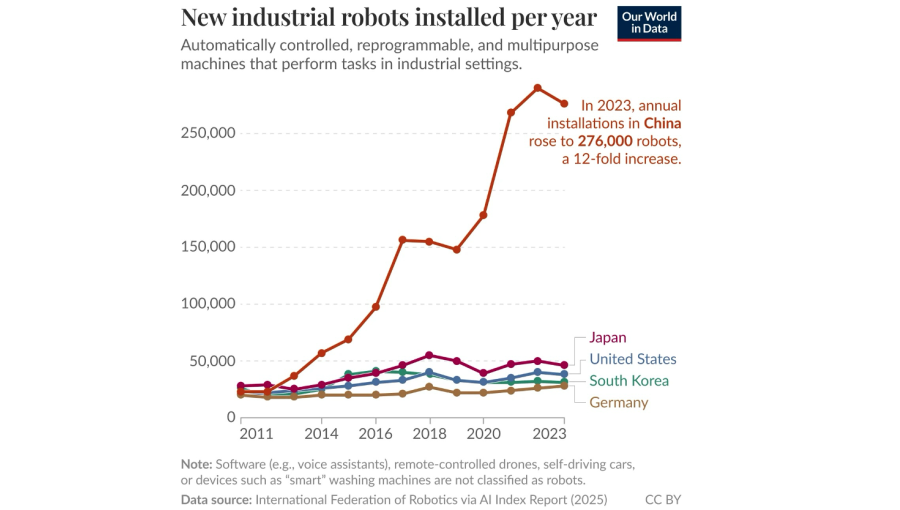
New industrial robots installed per year – OWID

New industrial robots installed per year – OWID
China is leading in yet another tech revolution: the number of humanoid robots it is installing on factory floors is soaring. / bne IntelliNews
By bne IntelliNews February 9, 2026

Industrial robots are rapidly becoming a common part of manufacturing in some countries. The chart here shows how many new ones are installed each year in the industrialized countries for which we have available data from the International Federation of Robotics (IFR), Our World in Data  (OWID) reports.

In this dataset, industrial robots are defined as automatically controlled, reprogrammable, and multipurpose machines used in industrial settings. The data covers only physical industrial robots, not software or consumer technologies.

The chart shows that in 2011, China, the United States, Japan, Germany, and South Korea were all installing similar numbers of these robots. However, in the decade that followed, the paths of these countries diverged. By 2023, annual installations in China had risen to 276,000 robots, a twelvefold increase.

Over the same period, installations in the United States, Japan, Germany, and South Korea also increased, but much more slowly: none of them even doubled. The United States, which saw the second-largest rise, went from 21,000 new installations in 2011 to 38,000 in 2023.

These figures refer to new robots installed each year; that is, annual additions to the existing stock of robots. The IFR also publishes data on the total number of robots in operation, and by this measure, China also had the largest installed base, at around 1.76mn robots in 2023.

Relative to its large manufacturing sector, China’s stock of robots today does not stand out – but the data here shows that this is changing quickly.

Explore the interactive version of this chart.


GLOBALIZATION IS MONOPOLY CAPITALI$M

Polish parcel company InPost to be acquired by consortium with Advent, FedEx for €7.8bn

Polish parcel company InPost to be acquired by consortium with Advent, FedEx for €7.8bn
InPost handled 1.4bn parcels in 2025, up 25% on the previous year. / InPost
By bne IntelliNews February 9, 2026

A consortium led by private equity firm Advent and FedEx have reached a conditional agreement on an intended recommended all-cash public offer for all shares in Poland’s leading out-of-home delivery and automated parcel lockers company InPost at an offer price of €15.60 (cum dividend) per share, InPost announced on February 9. Thus, the transaction, expected to close in H2 2026, will be worth €7.8bn.

“The consortium will be structured with Advent holding 37%, FedEx holding 37%, A&R holding 16% and PPF holding 10% of the shares in (the indirect sole shareholder of) the offeror entity upon settlement of the offer. PPF will tender all of its shares under the offer and will subsequently reinvest part of its proceeds in exchange for a 10% indirect equity stake in (the indirect sole shareholder of) the offeror upon settlement,” InPost’s market filing reads.

Advent previously owned a majority stake in InPost before it went public. A&R is owned by InPost’s founder and CEO Rafał Brzoska.

“The offeror intends to launch the offer as soon as practically possible and in accordance with the applicable statutory timetable. The offer memorandum is expected to be published, and the offer is expected to commence, in Q2 2026,” the release continues.

Based on the required steps and subject to the approval of the offer memorandum, InPost and the offeror anticipate that the offer will close in H2 2026.

“A key element of the new puzzle is the entry of FedEx Corporation into the game – the American giant is not taking over InPost in the traditional way, as there will be no operational integration of the two entities,” commented the Parkiet daily.

CEO of FedEx Raj Subramaniam said, as quoted in InPost’s release, that together with InPost’s leadership and fellow consortium members, “we see a clear path to unlocking growth, improving the efficiency of our B2C last mile operations, enhancing returns, and better serving customers across Europe.”

“Our headquarters, our brand, business management and the core of our innovation capabilities will remain in Poland, which continues to be the blueprint for our successful strategy. With the support of our partners, I believe we can unlock InPost’s full potential and further grow our position as an e-commerce enabler in Western Europe,” Brzoska added.

The Wall Street Journal noted that InPost had been rolling out its automated parcel lockers, which are typically found in transport hubs and supermarkets, to more countries in recent years. “The company pitches its lockers as a cheaper, more convenient and environmentally friendly alternative to doorstep deliveries,” the paper said.

The company has also grown through acquisition, buying up delivery businesses in the UK and Spain. Last year, it handled 1.4bn parcels, up 25% on the year before, it added.

As noted by Reuters, the offer price of €15.60 per share marks an around 17% premium to InPost's closing price on February 6, but it is below InPost's 2021 IPO (after which the company was listed in Amsterdam) price of €16.