Nearly half of Europeans would back banning Musk's X if it keeps breaking EU law, new poll finds
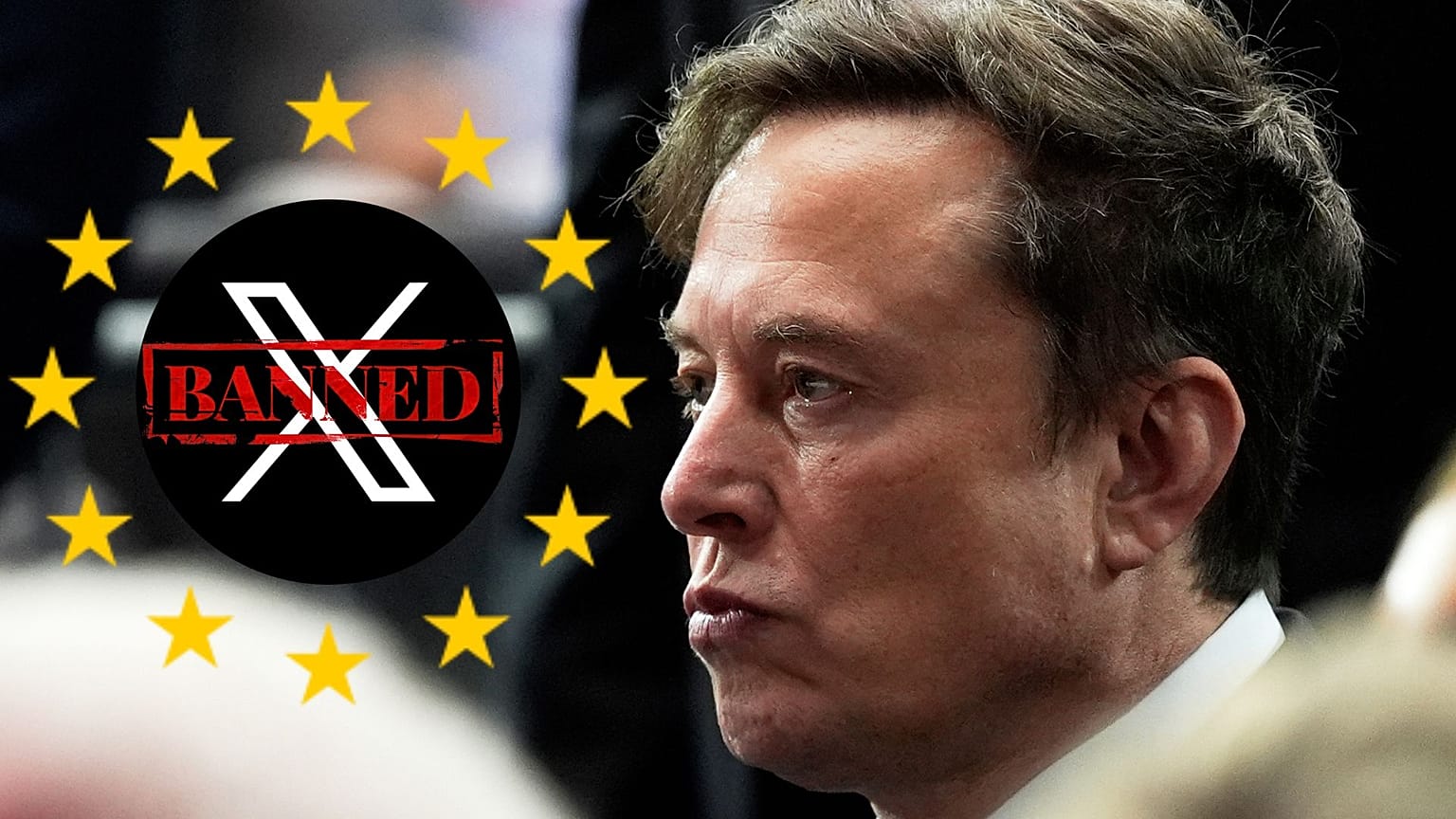
A new YouGov survey across Germany, France, Spain, Italy, and Poland shows nearly half of Europeans (47 percent) would back banning social media platform X from the EU if it continues to breach EU rules.
Almost one in two Europeans would support banning the social media platform X from the European Union if it continues to breach EU rules, according to a new YouGov survey conducted across five major member states.
The polling, carried out in Germany, France, Spain, Italy and Poland, suggests growing frustration among voters around what they see as a lack of compliance by the Elon Musk-owned platform with European digital regulations.
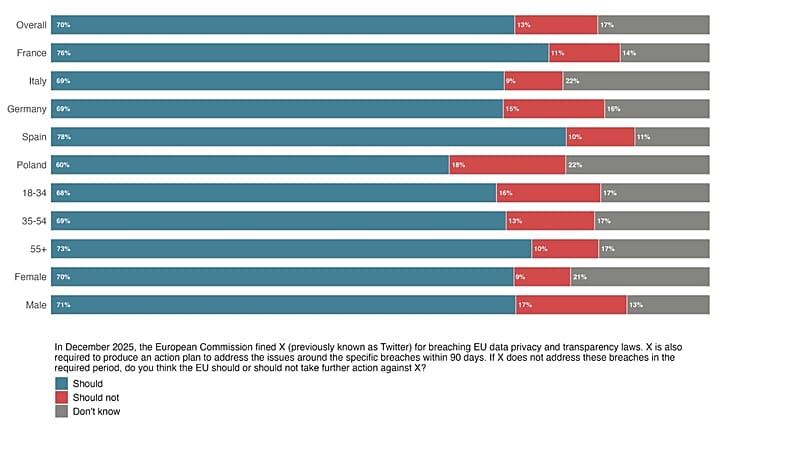
Between 60 and 78 percent of respondents in each country said the EU should take further action against X if it fails to address breaches identified by the European Commission last year.
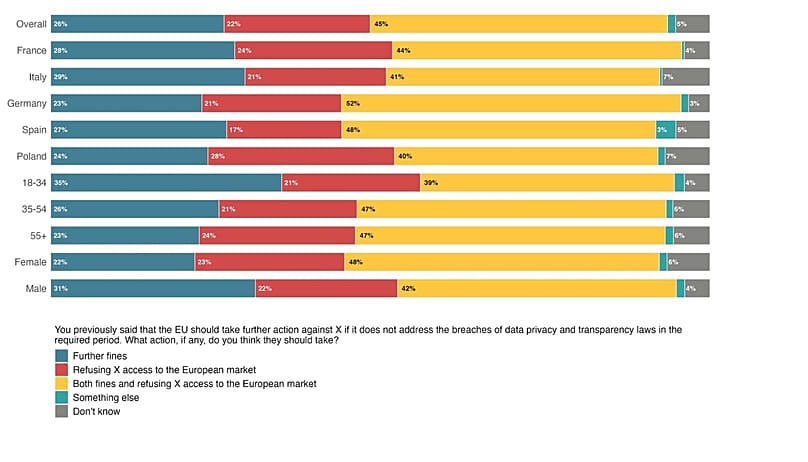
Among those in favour of more measures, a majority - ranging from 62 to 73 percent – said the platform should be banned if it refuses to comply. Overall, 47 percent of all respondents supported a potential ban.
The findings come after the European Commission fined X €120 million on 5 December last year under the Digital Services Act (DSA) for failing to meet transparency obligations.
At the centre of the probe is the blue checkmark, previously used to signal official accounts at no cost but now sold for €7 a month, which risks confusing users about the veracity of identities.
The Commission also found that X did not comply with the transparency obligation for advertising on social media platforms, blurring the line between advertising and content that could lead to financial scams for users. X now has 90 working days to respond to the findings.
Since then, the company and its built-in AI assistant, Grok, have also faced further scrutiny. Critics accuse the platform of amplifying harmful content, including deepfake pornography and child sexual abuse material.
French prosecutors last week raided X's Paris office as part of an ongoing investigation into child abuse content.
Public appetite for tougher measures against X
The YouGov data suggests a strong appetite for stronger enforcement against Big Tech platforms. If X fails to respond adequately to the Commission’s fine, 70 percent of respondents said they would support repercussions.
Among those, between 17 and 28 percent favoured imposing further fines. Between 23 and 29 percent supported banning the platform outright.
The largest group – 40 to 52 percent of those backing action – said the Commission should both fine and ban the service from operating in the EU.
"Europeans are done with empty warnings. X has been fined, investigated, and given every opportunity to comply – and it has chosen to laugh in the face of the EU instead," said Ava Lee, the executive director of People vs Big Tech, a movement of 149 civil society organisations.
"X may be the first major platform to face this level of scrutiny by the Commission, but it will not be the last," she added.
"The latest polling data shows that European lawmakers have a golden opportunity to use X to set a vital precedent and send a clear message to Big Tech: European laws come first."
Despite the strong support reflected in the survey, banning a major platform would be considered an extreme step under EU law, and the Commission has not indicated that it is currently considering such a move.
Should social media be banned?
The poll was conducted against a backdrop of increasing political debate over social media regulation.
Spain, France, Denmark, Italy, Greece, Finland, Germany, and the United Kingdom are considering measures to restrict or ban social media use for minors entirely in response to concerns over "illegal and hateful content."
On 10 December 2025, Australia set a precedent by introducing the world’s toughest social media restrictions for under-16s, where millions of underage accounts were removed.
But interviews with teenagers, parents and researchers indicate that many children are still accessing banned apps through simple workarounds, raising questions about whether the rules can be effectively enforced.
Researchers stress that it's still too early to judge whether Australia's ban has been effective.
"Most of them, their first touch point is six months. So, I would encourage other countries, policy makers and constituents really enthusiastic about this idea to wait on the data," said Professor Kathryn Modecki from the University of Western Australia.

No comments:
Post a Comment