
Suffocating an Island: What the U.S. Blockade Is Doing to Cuba
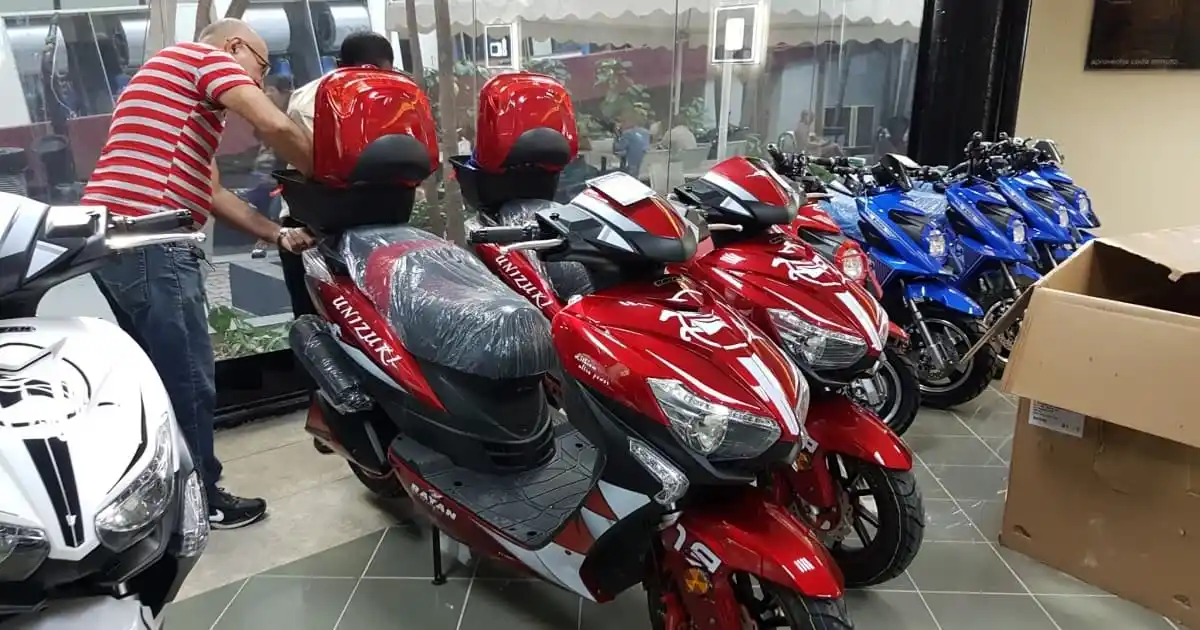
Electric motorcycles are Cuba’s response to the fuel crisis.
Marta Jiménez, a hairdresser in Cuba’s eastern city of Holguín, covered her face with her hands and broke down crying when I asked her about Trump’s blockade of the island—especially now that the U.S. is choking off oil shipments.
“You can’t imagine how it touches every part of our lives,” she sobbed. “It’s a vicious, all-encompassing spiral downward. With no gasoline, buses don’t run, so we can’t get to work. We have electricity only three to six hours a day. There’s no gas for cooking, so we’re burning wood and charcoal in our apartments. It’s like going back 100 years. The blockade is suffocating us—especially single mothers,” she said crying into her hands “and no one is stopping these demons: Trump and Marco Rubio.”
We came to Holguín to deliver 2,500 pounds of lentils, thanks to fundraising by CODEPINK and the Cuban-American group Puentes de Amor. On our last trip, we brought 50-pound bags of powdered milk to the children’s hospital. With Trump now imposing a brutal, medieval siege on the island, this humanitarian aid is more critical than ever. But lentils and milk cannot power a country. What Cubans really need is oil.
There were no taxis at the airport. We hitchhiked into town on the truck that came to pick up the donations. The road was eerily empty. In the city, there were few gas-powered cars and no buses running, but the streets were full of bicycles, electric motorcycles, and three-wheeled electric vehicles used to transport people and goods. Most of the motorcycles—Chinese, Japanese, or Korean—are shipped in from Panama. With a price tag near $2,000, only those with family abroad sending remittances can afford them.
Thirty-five-year-old Javier Silva gazed longingly at a Yamaha parked on the street. “I could never buy one of those on my salary of 4,000 pesos a month,” he said. With inflation soaring, the dollar now fetches about 480 pesos, making his monthly income worth less than ten dollars.
Cubans don’t pay rent or have mortgages; they own their homes. And while healthcare has deteriorated badly in recent years because of shortages of medicines and equipment, it remains free–a system gasping but not abandoned.
The biggest expense is food. Markets are stocked, but prices are out of reach—especially for coveted items like pork, chicken, and milk. Even tomatoes are now unaffordable for many families.
Holguín was once known as the breadbasket of Cuba because of its rich agricultural land. That reputation took a severe hit this year when Hurricane Melissa tore through the province, destroying vast areas of crops. Replanting and repairing the damage without gasoline for tractors or electricity for irrigation is nearly impossible. Less food means higher prices.
Production across the economy is grinding to a halt. Factories can’t function without electricity, and many skilled workers have given up their state jobs because wages are so low. Jorge, whom I met selling bologna in the market, used to be an engineer at a state enterprise. Verónica, once a teacher, now sells sweets she bakes at home—when the power is on. Ironically, while Marco Rubio claims he wants to bring capitalism to Cuba, U.S. sanctions are crushing the very private sector that most Cubans now depend on to survive.
I talked to people on the street who blame the Cuban government for the crisis and openly say they can’t wait for the fall of communism. Young people told me that their goal is to leave the island and live somewhere they can make a decent living. But I didn’t meet a single person who supported the blockade or a U.S. invasion.
“This government is terrible,” said a thin man who changes money on the street—an illegal but tolerated activity. But when I showed him a photo of Marco Rubio, he didn’t hesitate. “That man is the devil. A self-serving, slimy politician who doesn’t give a damn about the Cuban people.”
Others put the blame squarely on the United States. They point to the dramatic improvement in their lives after Presidents Obama and Raúl Castro reached an agreement and Washington eased many sanctions in 2014–2016. “It was the same Cuban government we have now,” one man told me. “But when the U.S. loosened the rope around our necks, we could breathe. If they just left us alone, we could find our own solutions.”
The only way Cubans are surviving this siege is because they help one another. They trade rice for coffee with neighbors. They improvise—no hay, pero se resuelve (we don’t have much, but we make it work). The government provides daily meals for the most vulnerable—the elderly, the disabled, mothers with no income—but each day it becomes harder as the state has less food to distribute and less fuel to cook with.
At one feeding center, an elderly volunteer told us he spends hours every day scavenging for firewood. He proudly showed us a chunk of a wooden pallet, nails and all. “This guarantees tomorrow’s meal,” he said—his face caught between pride and sorrow.
So how long can Cubans hold on as conditions worsen? And what is the endgame?
When I asked people where this is leading, they had no idea. Rubio wants regime change, but no one can explain how that would happen or who would replace the current government. Some speculate a deal could be struck with Trump. “Make Trump the minister of tourism,” a hotel clerk joked, only half joking. “Give him a hotel and a golf course—a Mar-a-Lago in Varadero—and maybe he’d leave us alone.”
Who will win this demonic game Trump and Rubio are playing with the lives of eleven million Cubans?
Ernesto, who fixes refrigerators when the power is on, places his bet on the Cuban people. “We’re rebels,” he told me. “We defeated Batista in 1959. We survived the Bay of Pigs. We endured the Special Period when the Soviet Union collapsed and we were left with nothing. We’ll survive this too.”
He summed it up with a line Cubans know by heart, from the great songwriter Silvio Rodríguez: El tiempo está a favor de los pequenos, de los desnudos, de los olvidados—time belongs to the small, the exposed, the forgotten.
In the long sweep of time, endurance outlasts domination.
Three Canadian airlines have suspended flights to Cuba due to a lack of guaranteed fuel supply. Germany also issued a travel warning.
What to know:Two more Canadian airlines join Air Canada in suspending services to Cuba
Germany issued an advisory against all non-essential travel to Cuba
Fuel stocks on the island are running out as US puts pressure on Cuba's oil suppliers
Which airlines have suspended services to Cuba?
Two more Canadian airlines, Air Transat and WestJet, announced a halt in flights to Cuba. The move comes after Air Canada said Monday it was stopping service to the island due to a lack of guaranteed fuel supply.
Air Transat said it was canceling all flights to Cuba until at least April 30. This follows "the rapid developments of the past few hours and the announcement by Cuban authorities of an anticipated aviation fuel shortage at destination airports," it said in a statement.
Cuba warned on Sunday that jet fuel will be unavailable at airports across the island beginning 10 February through 11 March.
WestJet announced an "orderly wind-down" of its services, adding it would begin sending empty planes to Cuba, stocked with extra fuel, to bring customers home.
Air Canada said it would also send empty flights to pick up and fly home about 3,000 customers in Cuba.
Similar crises have prompted carriers to refuel in nearby third countries, including Panama, the Bahamas, the Dominican Republic and the United States.
The fuel shortage is a further economic blow to the country that relies heavily on tourism.
Why doesn't Cuba have oil and jet fuel?
Historically, Venezuela was the biggest supplier of oil and jet fuel to Cuba followed by Mexico.
Venezuela provided about one-third of the island's daily needs in 2025.
But Cuba hasn't received any crude or refined products from the South American country since mid-December when the US started blocking Venezuelan oil exports to the communist-run island.
This was even before US troops kidnapped Venezuelan leader Nicolas Maduro in early January.
Mexico only ever shipped a fraction of the oil that came from Venezuela.
But Mexican President Claudia Sheinbaum confirmed on Monday that oil shipments to Cuba are "on hold" following US President Donald Trump threats to impose tariffs on any country that provides oil to the Caribbean island.
Why has Germany issued a travel warning for Cuba?
Germany advised on Tuesday against all non-essential travel to Cuba
"Cuba is facing an acute energy crisis, which is also being compounded by widespread dilapidated energy infrastructure," the German foreign ministry said in the advisory.
The country is facing "significant shortages in energy and fuel supplies, which are affecting all areas of life" including medical care, it said.
"Public transport, street lighting, traffic lights, cash machines, communication and security systems are already severely restricted or may fail," it said.
How bad is Cuba's energy crisis?
The oil shortages have threatened to plunge Cuba into complete darkness, with power plants struggling to keep the lights on.
The Cuban government has announced emergency measures, including a four-day working week for state-owned companies and fuel sale restrictions.
Cuban officials also announced Monday that bank hours have been reduced and cultural events suspended.
In the capital Havana, the public bus system has effectively ground to a halt, leaving residents stranded as endemic power outages and grueling fuel lines reach a breaking point.
Edited by: Roshni Majumdar
Kate Hairsine Reporter and senior editor
Issued on: 10/02/2026 - FRANCE24

The island economy was already struggling under the burden of decades of US sanctions, but the situation in Cuba has rapidly deteriorated since Donald Trump signed an executive order threatening to impose tariffs on countries that sell or provide oil to the Caribbean nation. As airlines suspend flights to the island, long queues are forming at gas stations, with fewer buses running and power cuts hitting homes, hospitals and other state institutions. FRANCE 24's Sharon Gaffney speaks with Lillian Guerra, Professor of Cuban and Caribbean History at the University of Florida.
BY: Sharon GAFFNEY
VIDEO BY: Sharon GAFFNEY
Andreas Knobloch0
As the US oil embargo on Cuba takes hold, the country is rapidly running out of fuel. The effects on the country's economy and population could be devastating, a Latin America expert in Havana told DW.
For days, a cold weather front had brought polar air to Cuba, causing temperatures to drop below freezing on some parts of the island for the first time in recorded history.
But the frosty air hasn't been the only thing bearing down on Cuba from the north.
The United States, after attacking Venezuela — Cuba's closest ally — and abducting its leader Nicolas Maduro has effectively cut off Venezuelan oil supplies to Havana. And in late January, US President Donald Trump called Cuba "an unusual and extraordinary threat" to national security and threatened to impose tariffs on any state that supplied oil or oil products to the island nation.
Cuban President Migual Diaz-Canel initially slammed the move as "fascist, criminal and genocidal." He has since stated that his country was willing to talk with the US, but "without pressure or preconditions."
He has also warned that Cuba was "close to failing" and announced forthcoming rationing plans to address the energy crisis.
'Trump is harming us simple people'
"Trump is crazy, he wants to take away the very air that we breathe," says Aleida, who runs a homestay in Havana and did not want to share her last name, like all private citizens DW spoke with. "And the other one is even more of a fanatic when it comes to Cuba."
She's referring to Marco Rubio, the US secretary of state and son of Cuban migrants. He's long been seen as a leading voice of "maximum pressure" toward Venezuela and Cuba to force regime change.
"We can only wait and see what happens next," Aleida says, her face drawn with concern.
Rachel, a 21-year-old civil servant, feels a similar uncertainty: "Sometimes I think that [Trump] will attack us next, and sometimes I think he won't let us drown, so he can make himself look like the good guy."
She adds that she expects day-to-day life to get more difficult moving forward.
"Trump is harming us simple people, not the government," says Ramon, a taxi driver in his mid-sixties whose main income is from tourism, which declined sharply in the past year.
By now, gas can only be bought with foreign currency and after hours of waiting in line at dollar-only gas stations.
The country is only able to produce about 40% of the energy it requires. Blackouts have become commonplace — they can last 10 to 15 hours and have even reached the capital, Havana.
Bert Hoffmann, a leading researcher at Germany's GIGA Institute for Latin American Studies, says that apart from that, life in Havana is running its regular course.
"I've observed a widespread wait-and-see attitude. There's a great normalization of crisis, a sort of keep calm and carry on," he tells DW. "The blackouts have increased, fuel is in even shorter supply, but it's been fairly gradual. There are still cars on the road."
He adds, however, that this appearance of normalcy is deceptive: The country has "no prospects" of getting oil into the country in the near future, he believes.
A watershed moment in Caracas
Hoffmann says that things have been different since January 3, the day when Venezuela ceased being Cuba's main oil supplier. The island's second-largest supplier, Mexico, also halted its planned oil shipments to Cuba in January.
Hardly any oil shipments have reached the island since December. In January, Cuba appears to have purchased a one-off tanker shipment of oil, bought at spot prices. Departing from Lome, Togo, the shipment was supposed to arrive in early February, but changed its course along the way toward the Dominican Republic.
Hoffmann believes it's safe to assume that this happened due to pressure from the United States.
"That means that, even if Cuba is able to buy oil, it wouldn't arrive," he says, arguing that the same would apply to possible shipments from Algeria, Angola, China or Vietnam.
"For the time being, I'd assume that the US is investing a lot in preventing this," Hoffmann adds. "It's likely that Cuba won't be getting any oil into the country for the foreseeable future. And that's brutal."
Cuba's current demand for oil is an estimated 100,000 barrels of crude oil per day (bpd). Until now, between a third and a quarter of that was sourced from Venezuela. In 2025, Mexico supplied between 6,000 and 12,000 bpd, while Russia and Algeria delivered smaller amounts.
"There are rumors that the oil will run out in February," Rachel says. "It's February now."
She hopes the country will be able to reduce its consumption to be able to make the remaining oil last a little longer.
Cuba can't cover its needs with renewable energy or local oil
In the past years, with the support of China, Cuba invested massively in solar energy. But these parks are unable to cover the country's electricity needs. The island's power supply still relies mainly on accident-prone thermal plants of Soviet design, making Cuba heavily dependent on energy imports.
Cuba's own heavy oil can only cover about 40% of the country's overall energy consumption. But it's ill-suited for most fuels, so it's mainly used for power generation.
Hoffmann says nobody really knows how long the remaining oil will last. In late January, the British daily Financial Times predicted the resources could be stretched another 15 to 20 days.
Either way, the fallout will be fatal.
"Basically, it's a matter of [an unknown number of] weeks until the fuel runs out. Then, not only will tourists not be able to get from the beaches to the airports, but food won't make it from the farms to the cities," Hoffmann explains.
And without food the people will go hungry.
Speaking about a German company that produces medical oxygen for hospitals in Cuba, he continues: "If the trucks have no fuel, then the hospitals won't be able to get any oxygen, and the patients will die."
Mexico wants to mediate between Cuba and the US
Mexico recently announced it would be sending humanitarian aid, and was evaluating "diplomatic channels" to be able to send oil to Cuba. But the country's possibilities are limited, as Mexico's economy is very heavily tied to that of the United States. And with the US-Mexico-Canada (USMCA) trade accord set for formal review this summer, Trump has extra leverage.
Mexican President Claudia Sheinbaum has offered to mediate talks between Havana and Washington. But it's unclear what there is to talk about. US State Secretary Rubio has already stated at a recent Senate hearing that he "would love to see" regime change in Cuba.
Unlike Venezuela, Cuba has less economic value than it does symbolic importance. The Caribbean island in many ways represents states' resistance to the Monroe doctrine, which the United States often cites to claim a special sphere of influence in the western hemisphere — notably Latin America.
"They have a score to settle," Hoffmann says. "Washington believes they've got all their hands around [Cuba's] neck, and the time has come for Cuba to capitulate — whatever that might mean in specific terms."
Consequently, he says he has a hard time imagining "which points Cuban leaders might agree upon with Trump and Rubio."
Russia to continue supplying oil to Cuba
Over the past days, Trump has said that his administration was involved in talks with Cuba's leadership, who in turn has denied that ― while both sides had communicated, Cuba said, they had not progressed to formal negotiations.
On Tuesday, Cuba's deputy foreign minister Carlos Fernandez de Cossio told the Spanish news agency EFE that "we've exchanged messages," but it "would be a mistake to say that a bilateral negotiation is being designed."
Havana has, however, repeatedly expressed its willingness to engage in dialogue "that is serious, constructive, responsible and respectful of both states' sovereign equality," de Cossio said.
In light of the effective oil blockade, de Cossio added that his country had "limited options" to manage resources. His government has recently announced a contingency plan "that will require a lot of work, creativity and sacrifice," the minister said.
Meanwhile, Russia's ambassador to Havana, Viktor Koronelli, told Russian news agency RIA in an interview that Moscow would continue to supply oil to Cuba.
"Russian oil has been supplied to Cuba on numerous occasion in recent years," he said. "We expect this practice to continue."
This article was originally written in German and translated by Maren Sass.

No comments:
Post a Comment