

The United States has no right to wage war on Iran, or to have a say who governs the country. The opinion pages of the New York Times and Washington Post, however, are offering facile humanitarian arguments for the US to escalate its attacks on Iran. These are based on the nonsensical assumption that the US wants to help brighten Iranians’ futures.
In two editorials addressing the possibility of the US undertaking a bombing and shooting war on Iran, the Washington Post expressed no opposition to such policies and endorsed economic warfare as well.
Crediting Trump with “the wisdom of distinguishing between an authoritarian regime and the people who suffer under its rule,” the first Post editorial (1/2/26) approvingly quoted Trump’s Truth Social promise (1/2/26) to Iranian protesters that the US “will come to their rescue…. We are locked and loaded and ready to go.”
For the Post, the problem was not that Trump was threatening to bomb a sovereign state, but that “airstrikes are, at best, a temporary solution”:
If the administration wants this time to be different, it will need to oversee a patient, sustained campaign of maximum pressure against the government…. The optimal strategy is to economically squeeze the regime as hard as possible at this moment of maximum vulnerability. More stringent enforcement of existing oil sanctions would go a long way…. Western financial controls are actually working quite well.
Thus, the paper offers advice on how to integrate bombing Iran into a broader effort to overthrow the country’s government in a hybrid war. Central to that project are the sanctions with which the Post is so thoroughly impressed. Such measures have “squeeze[d] the regime” by, for example, decimating “the government’s primary source of revenue, oil exports, limiting the state’s ability to provide for millions of impoverished Iranians through social safety nets” (CNN, 10/19/25).
That the US continues to apply the sanctions, knowing that they have these effects, demonstrates that it has no interest in, as the Post put it, “free[ing]” Iranians “from bondage.”
‘Always more room for sanctions’
The second Washington Post editorial (1/23/26) expressed disappointment that, despite “mass killings” and the “most repressive crackdown in decades,” “Trump has ratcheted back his earlier rhetoric.” It emphasized that “the regime is now mocking Trump for backing down.” The paper offered advice for the president:
Airstrikes alone won’t bring down the regime—or make it behave like a normal country. But Israel and the US have shown in recent years that bombing can cause significant tactical setbacks. And there is always more room for sanctions pressure….
The president cannot maintain effective deterrence by turning the other cheek [in response to Iranians who have taunted him]. How he responds is just as important as how quickly he does it.
The implication is that, to deter Iran’s government from killing Iranians, the US needs to kill Iranians. After all, bombing campaigns come with “mass killings” of their own: The US/Israeli aggression against Iran last June killed more than 1,000 Iranians, most of them civilians.
Meanwhile, those sanctions the paper wants to use to deter the Iranian government from “harm[ing] its own people” do quite a bit of damage in their own right, often causing “low-income citizens’ food consumption” to “deteriorate due to sanctions”—a rather novel approach to harm reduction.
Bombing other countries, depriving them of food—is this what it means to “behave like a normal country”?
‘Too depraved’ for reform
Over its own pro–regime change piece, the New York Times editorial board headline (1/14/26) declared: “Iran’s Murderous Regime Is Irredeemable.”
“The Khamenei regime is too depraved to be reformed,” the editors wrote, spending the majority of the piece building its case to that effect before turning to solutions. For the Times, these start “with a unified expression of solidarity with the protesters,” and quickly move to punitive measures against the Iranian government:
The world can also extend the sanctions it has imposed on Iran. The Trump administration this week announced new tariffs on any countries that do business with Iran, and other democracies should impose their own economic penalties.
For the authors, “deprav[ity]” needs to be resisted by Washington and its partners, who have demonstrated their moral superiority with their presumably depravity-free sanctions. These have, as Germany’s DW (11/23/25) reported, “caused medical shortages that hit [Iran’s] most vulnerable citizens hardest,” preventing the country from being able “to purchase special medicines—like those required by cancer patients.”
The Times also supported US military violence against Iran—if with somewhat more restraint than the Post, asking Trump to “move much more judiciously than he typically does.” The Times wants him to seek “approval from Congress before any military operation,” and make “clear its limitations and goals.” The paper warned Trump not to attack “without adequate preparation and resources”:
Above all, he should avoid the lack of strategic discipline and illegal actions that have defined the Venezuela campaign. He should ask which policies have the best chance of undermining the regime’s violent repression and creating the conditions for a democratic transition.
One glaring problem with suggesting that a US “military operation” should be based on “policies [that] have the best chance of…creating the conditions for a democratic transition” is that very recent precedents show that US wars don’t bring about democracy, and are not intended to do so; instead, such wars bring about social collapse.
Consider, for example, US interventions in Libya and Syria. In both cases, the US backed decidedly nondemocratic forces (Jacobin, 9/2/13; Harper’s, 1/16) and, as one might expect, neither war resulted in democracy. In Libya’s case, the outcome has been slavery and state collapse (In These Times, 8/18/20). In Syria, the new, unelected government is implicated in sectarian mass murder (FAIR.org, 6/2/25).
If DHS killed Pretti, why not bomb Iran?
There are no grounds for believing that the US would chart a different course if it bombs Iran again. But that hasn’t stopped other Times contributors from suggesting that the US should conduct a war in Iran—for the good of Iranians, of course.
Times columnist Bret Stephens (1/27/26) worried about the “risk” posed by “the example of a US president who urged protesters to go in the streets and said help was on the way, only to betray them through inaction.”
Invoking the DHS’s killing of Minneapolis resident Alex Pretti, Stephens urged “thoughtful Americans” to encourage the same administration that killed him to exercise “the military option” in Iran:
But if Pretti’s death is a tragedy, what do we say or do in the face of the murder of thousands of Iranians? Are they, as Stalin might have said, just another statistic?
Stephens is citing people’s outrage against the US government killing a protester as a reason they should support the US government inflicting more violence against Iran. The logical corollary to that would be that if you’re opposed to Iran suppressing anti-government forces, you should therefore be in favor of Tehran launching armed attacks to defend protesters in the US.
Masih Alinejad, a US-government-funded Iranian-American journalist, wrote in the Times (1/27/26) that Trump
encouraged Iranians to intensify their mass protests, writing, “HELP IS ON ITS WAY.” That help never came, and many protesters now feel betrayed. Still, the USS Abraham Lincoln aircraft carrier strike group has recently arrived in the Middle East. Mr. Trump has not said what he plans to do now that it is there, but it does give him the option of striking a blow against government repression.
Policy of pain
Both Stephens and Alinejad present their calls for the US to assault Iran in moral terms, suggesting that the US should demonstrate loyalty to Iranian protestors by “help[ing]” them through an armed attack on the country in which they live. Their premise is that the US is interested in enabling the Iranian population to flourish, an assertion contradicted by more than 70 years of Washington’s policy of inflicting pain on Iranians in an effort to dominate them.
That US policy has included overthrowing Iran’s democratically elected government in 1953 (NPR, 2/7/19), propping up the Shah’s brutal dictatorship for the next 26 years (BBC, 6/3/16; AP, 2/6/19), sponsoring Saddam Hussein’s invasion of the country and use of chemical weapons against it (Foreign Policy, 8/26/13), partnering with Israel in a years-long campaign of murdering Iranian scientists (Responsible Statecraft, 12/21/20), and currently maintaining—along with its allies—a sanctions regime that is associated with a substantial drop in Iranian life expectancy (Al Jazeera, 1/13/26).
If Stephens or Alinejad had evidence that the US is so radically re-orienting its conduct in the international arena, one imagines that they would want to share with their readers the proof that the Trump administration’s magnanimity is so profound that it overrides the UN Charter, and justifies America carrying out a war to “help” a country it has terrorized for decades.
Iran on the Brink?
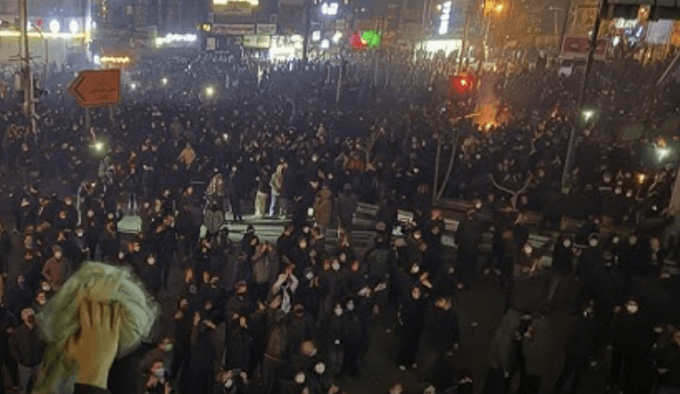
Iran, YouTube screenshot.
The Iranian regime has faced down a wave of mass protest. Merchants, students, workers, and national minorities joined huge demonstrations throughout the country against economic conditions and state repression. The regime has responded with the utmost brutality, killing between a low estimate of 6,000 people and a high of 30,000. This has for the moment repressed the struggle. But the conditions that triggered it remain unresolved. Meanwhile, Trump has assembled an armada in the region, threatening to attack the regime. Tempest’s Ashley Smith interviews Houshang Sepehr, editor of the website, Solidarité Socialiste avec les Travailleurs en Iran, about the roots of the uprising, the response of the state, the role of U.S. imperialism, and the trajectory of the struggle.
Ashley Smith: What precipitated the current uprising in Iran? What kinds of people, classes, and social groups have joined the movement? Has it extended to Iran’s national minorities, especially the Kurds? What kinds of actions have people organized? Is it mainly demonstrations? Have workers taken strike action?
Houshang Sepehr: To answer your question, one must take into consideration two distinct factors, conjunctural factors and structural ones.
I’ll begin with the conjunctural factors that sparked this movement: the sharp fall of Iran’s currency, the Rial against the dollar, which further fueled already runaway inflation. That affected broad sections of society and pushed the situation to a boiling point. It went so far as to drive the bazaar merchants— who for decades were a pillar of the Islamic Republic and loyal to the clergy and the state—to protest.
In response to the downturn in business and the instability that makes any economic activity unpredictable, a segment of Tehran’s merchants went on strike and marched through the bazaar. These protests quickly spread to students at universities in Tehran and other major cities, triggering the closure of these institutions. In these cities, the working class staged demonstrations. Significantly, barely a day after the bazaar merchants went on strike, the regime retreated and granted all of their demands.
With that, the merchants called off their participation in the struggle. But workers continued because their grievances were deeper. One of those was anger at the government’s decision to end subsidies for fuel and many basic goods as well as its abolition of the preferential currency exchange rate for imported goods. These triggered a sudden rise in food prices, making it hard for people to afford to put food on the table.
However, this uprising has much deeper roots than these immediate causes. Structural factors, which have made life unbearable for large segments of the population, have played a major role in the emergence of this movement. The regime’s neoliberal policies have produced unimaginable levels of social inequality. Paltry wages bear no relation to the skyrocketing prices of basic necessities. Workers face extreme job insecurity. There is widespread unemployment. Everyone is experiencing social insecurity. And, when anyone dares speak out or protest, they face brutal state repression.
What was particularly striking at the outset of these protests was the prominent role played by people in smaller cities. They suffer greater economic deprivation. The protests gradually spread from these to the major cities. Given the geographic breadth of the protests across Iran, national minorities were also widely present. From Kurdistan to Baluchistan, people joined the nationwide protests. The protests were largely confined to demonstrations, which, prior to their bloody suppression, at times also led to clashes with the state’s forces of repression.
There were also strikes. These came out of a wave of job actions. Workers’ strikes and street demonstrations — along with those of other segments of the labor force — around trade-union and economic demands have been occurring on an almost daily basis across Iran. Just a few days before the bazaar merchants’ strike began, six thousand contract workers in the Assaluyeh oil and gas industries organized a major, historic action demanding the abolition of the contracting system.
Almost every sector of society has been in motion. For instance, in Tehran, while public demonstrations were taking place in several neighborhoods, retirees in other parts of the city continued to stage weekly street gatherings. As the movement grew, they joined the wider protests that engulfed the city.
AS:What are the main economic and political grievances that people express? Are there any unifying demands?
HS:This uprising was crushed with brutality before it could reach the stage of articulating “positive” demands. In this uprising, slogans rejecting the Islamic Republic and the existing order predominated from the outset. The people’s common and unifying demands were expressed in slogans such as “Death to the dictator,” “Death to Khamenei,” and “We do not want the Islamic Republic.”
Radio Zamaneh conducted a study of videos of demonstrations in the first six days of the uprising. They found that the above slogans accounted for 65 percent of the total. Economic demands, which had been the initial trigger of the protests, were limited to 14 percent. Slogans in support of Reza Pahlavi, the son of the deposed monarch, such as “Long live the King” or “This is the final battle, the Pahlavi will return” made up 20 percent of the total.
Slogans calling for the monarchy cannot be considered demands. Many who chanted them did so out of the absence of a political alternative. They view the situation, in their own words, as a choice between the bad and the worse. This does not, of course, mean that there are no monarchist supporters among the protesters. There are. That said, we should also remember that various forces from the regime to elements of the opposition have used AI to doctor videos to advance their particular political aims.
But the most important point is that the slogans have been negative, not positive. People know what they’re against, not what they’re for. The uprising has therefore lacked a clear horizon and a concrete social and political alternative to the existing situation. It has remained confined to rejecting the status quo. Thus, the most common, unifying slogan was for the overthrow of the Islamic Republic with little sense of what to replace it with.
AS: What are the political groupings and class organizations trying to influence the direction of the struggle? Have any kinds of democratic formations developed to coordinate the protests and strikes? What are the main debates in the movement?
HS: The uprising was suppressed before it took organizational form with contending political alternatives. Of course, all existing political currents in the opposition have sought to influence the uprising, but not all of them have equal means to exert this influence. For example, mainstream Iranian social media abroad have sought to present the son of the deposed Shah as the instigator and leader of these protests and as the country’s future leader. Persian-language television channels such as Iran International and Manoto, which are largely funded by Israel, have highlighted his role. So have the BBC and other major international media outlets.
The Israeli-backed media and international broadcasters have enormous funds, operate around the clock, and can influence people. Other opposition political formations — from the Left to republicans, nationalists, the Mojahedin-e-Khalq (MEK),and others — also attempt, through their more limited media platforms, to steer the protests in the direction they favor. But their reach remains very constrained.
Republican and nationalist organizations emphasize opposing the restoration of the monarchy, stress the necessity of national independence, and opposing imperialist intervention. Progressive forces in all their diversity oppose the monarchists, which are far-right, support the U.S. and Israel, and call for their intervention. Abroad, they challenge the influence of MEK, which collaborates with Western imperialists.
Left-wing organizations focus primarily on the nature of the future political system. Some insist on parliamentary democracy, while others advocate council (soviet) democracy. There are disagreements between them not only over the future form of Iranian society, but also over how to conduct the struggle itself. Some argue for peaceful methods, while others advocate confronting state repression with force up to and including armed struggle.
Most of these debates are carried on outside the country. Inside, we (partly due to the internet blackout since January 8) have little sense of the debates. However, it is natural to assume that all these currents are vying for organizational and political influence, even if they are still in embryonic form.
AS:How does this uprising compare to the Woman, Life, Freedom movement? How does it compare to the Green Movement? Is there continuity between the current uprising and previous ones? What lessons, if any, have people drawn and put into action today?
HS:The continuity between the current uprising and previous uprisings (at least over the past eight years) lies primarily in the structural causes that led to all of them— the expansion of inequality, poverty, the difficulty of making a living, despotism, and the repression of individual and social freedom.
The main difference between the current uprising and “Woman, Life, Freedom” in 2022 and “Bread, Work, Freedom” in 2018 is the absence of positive slogans and demands. These two earlier uprisings had clear slogans and demands. The one in 2022 was focused on demands for women’s liberation, targeting the patriarchal, theocratic character of the government and agitating for individual freedom and lifestyle choices. The one in 2018 focused on economic demands. Today’s uprising is like the one in 2018, protesting against the deterioration of economic conditions.
In the 2022 uprising, although all social strata—except the large bourgeoisie—participated widely, including workers, wage earners, and the working masses, the leadership of the movement was primarily in the hands of the young urban middle class. In the current uprising, while all social classes are present (including parts of the bourgeoisie, such as the bazaar’s merchants), the working class and laboring people are more prominent. The participation today of small towns and rural villages also distinguishes it from previous uprisings. Despite these differences, the common feature of all these uprisings is the demand to get rid of the Islamic Republic regime in its entirety.
These recent uprisings are different from the 2009 Green Movement. It began with the slogan “Where is my vote?” that challenged the regime’s totalitarian tendencies and sought reform, not the overthrow of the regime. Factions of the system’s establishment were present in and partially led the movement. By contrast, in the recent movement, no part of the establishment has broken with the regime.
AS:How has the regime responded? What is it likely to do in the face of such a widespread uprising? Does it still retain bases of support? What are the class and social bases of that support? Can the regime mobilize them in defense of its rule?
HS:This uprising has faced the harshest repression the regime has employed in its 47-year history, only comparable with the bloody repression of the Kurds in the early 1980s. The scale and forms of this violence and massacre are so extreme that they leave little room for any other action. Even after the slaughter of thousands of people, the regime continues to arrest people in large numbers.
Naturally, the government can rely on its institutional structures like the military forces such as Army, the Islamic Revolutionary Guard Corps (IRGC), and the Basij, its paramilitary Islamist militia. It also has a base of support among social strata that depend on it economically. These include managers and bourgeois elements tied to the regime through foundations as well as the financial and commercial institutions of the Revolutionary Guards and religious centers. The military forces of repression (the Basij and the IRGC) were created to defend the regime and continue to serve this purpose. It is estimated that this support includes roughly ten percent of the population.
AS:What about the loyalty of sections of the regime? Are there any splits? Any divisions between the military brass and rank and file soldiers? Are there any establishment forces capable of tilting toward sympathy to co-opt and neutralize the struggle? Or is the regime united in repression of the protests?
HS:So far, no rift has been observed within the regime. Even within the military forces, there has been no defiance of orders among its lower ranks. It should be noted that in the recent repression, in addition to the Basij and the IRGC, regular law enforcement and police forces were also involved. There is no force within the ruling system that sympathizes with the protests. None are trying to absorb or channel the movement. The huge state apparatus remains intact, and the regime is united as a whole in suppressing the movement at any cost.
AS:What impact have external players like the U.S., Israel, and monarchists grouped around the Shah’s son had on the movement? How do the various layers involved in the struggle view these states and especially the monarchists? What do activists think of Trump’s threats to intervene?
HS:With the internet cut off, it is not possible to answer this question precisely. However, it seems that the boasts of the former Shah’s son and Trump’s threats toward the regime have been believed to some extent by a portion of the protesters. The calls by the Pahlavi family and Trump’s encouragement to confront the forces of repression have had some effect, but the failure of Trump’s threats to materialize—especially after the brutal suppression—has left part of the population disillusioned. Given the horrific repression and the absence of any organized opposition within the country, it is not surprising that some pinned their hopes on Trump.
AS:What do you say to those on the international Left that dismiss this uprising as just another “color revolution” triggered and manipulated by U.S. imperialism and its allies like Israel?
HS:First, this is a completely mass-based, independent, and genuine uprising, arising from the accumulated anger and exhausted patience of the people in response to all the social and political injustices. It is also an expression of profound opposition to the Islamic Republic, which has repressed the popular classes for nearly 50 years.
Second, those international left factions you mentioned are the “campists.” They reduce all politics to geopolitics and explain the protests almost entirely based on the positions taken by states from the U.S. to Israel and Iran. Since the U.S.or Israel seek to exploit the situation, campists judge the movement to be reactionary or manipulated. They see protesters as the conscious or unconscious instruments of imperialism.
In this view, the starting point is no longer the real people’s lives and their hardships—not inflation, not economic insecurity, not austerity, not repression, not despotism, not class struggle—but rather the games of alliances and rivalries between states. This perspective erases internal social contradictions and, in doing so, renders any possibility of self-organization and class autonomy impossible.
It is natural that imperialist powers seek to exploit the crises of their rivals or opponents for their own advantage. But this fact cannot serve as an excuse to deny the real material suffering and popular protest of people crushed under economic austerity, inflation, and repression. By reducing everything to geopolitics class-based critique is sidelined. Ultimately this approach can end up defending the worst repression under the banner of anti-imperialism.
The perspective described above—“campism” or “the anti-imperialism of fools”—stands in contrast to another strand of the Left that uncritically praises and sanctifies everything that happens in the streets. In this view, any popular anger is automatically considered progressive. Criticism of slogans or the prevailing direction of the movement is deemed impermissible; any critique is either labeled anti-movement or dismissed as elitist. Yet the street is never a neutral space; it is always a field of struggle.
There is no guarantee that the orientation of any social movement will always be emancipatory. When the Left and class-based politics are properly absent, other forces fill the vacuum. In such a situation, simplistic, nationalist, or reactionary monarchist discourses can hijack entirely legitimate social anger and struggle.
Ultimately, these two opposing interpretations respond to the same underlying issue: the absence of an organized, class-based political alternative. One restricts politics to the states; the other leaves it to the spontaneity of the streets. In both cases, the possibility for popular anger to be transformed into a conscious, collective project is lost.
This sorrowful situation is the product of a deeper crisis within the Iranian Left—a Left that has become disconnected from workplaces and the concrete realities of people’s lives. As a result, geopolitics and media take the place of on-the-ground work, since they are less costly and less risky. In this way, class-based politics retreats, leaving the field open to dominant narratives, whether those of the regime or of its reactionary opponents.
AS: What position do you think the international Left should adopt toward this uprising?
HS:In line with what was answered in the previous question, there is not the slightest doubt that the international Left must show absolute and unconditional solidarity and empathy with this uprising. Of course, such solidarity does not preclude criticism.
AS: The Middle East and North Africa and indeed much of the world have experienced waves of uprisings without mass democratic organization and without rooted left-wing parties and organizations. This has meant that the uprisings found themselves prone to being co-opted by reactionary forces or crushed by the state. How are Iranian radicals wrestling with these challenges?
HS: This is a valid point. Popular movements and uprisings that emerge from deep-seated grievances all demand an end to the existing oppression and hardships. They are united in rejecting and negating the status quo. However, they naturally differ over alternatives they propose and the means of pursuing them. In other words, these movements themselves are a site of political struggle.
As I noted above, in the absence of progressive political and social alternatives from the Left, such uprisings are either vulnerable to co-optation by reactionary forces or subject to repression and defeat. Iranian radicals must strive to lead these movements toward progressive alternatives and clarify how this can be done. Yet, due to the absence of organized leftist, class-based forces in the country, their efforts face significant obstacles and challenges.
AS :Where is this revolt headed? What impact will it have on regional and international politics?
HS: This uprising is in a state of flux. Many possibilities lie ahead. It may quickly rise again, or it may sink into a prolonged period of dormancy—especially given the unprecedented massacre it has suffered. At present, it has subsided due to this heavy repression.
If it succeeds, that is, if the Islamic regime is pushed back and imperialist schemes are neutralized, it would have a profound impact on the balance of power in favor of workers and all progressive social strata in the region and internationally. And it would deal a serious blow to political Islam in the world.
Moreover, it would serve as an example for other liberation movements across the region and the world. Unfortunately, under current conditions, we are far from this scenario. On the contrary, in the event of the movement’s failure, whether the Islamic Republic remains in power or an imperialist scenario prevails, the consequences would be catastrophic for the entire region and the world.
This piece first appeared in Tempest.
As negotiations conclude in Oman, the Trump administration must consider that a hypothetical war would be politically disastrous with 85% of Americans saying they don’t want to be at war with Iran. If Trump wishes to improve his 39% approval rating and prevent a potentially catastrophic regional war, it might be time to return to a time-tested framework that is capable of containing Iran’s nuclear program and reducing the risk of war. By reviving the Joint Comprehensive Plan of Action (JCPOA), Trump would signal to the American people and the international community that he is worthy of his self-proclaimed title: “the President of Peace.”
The JCPOA, which was signed by the US, Iran, and other global powers in 2015, put limits on the Iranian nuclear program in exchange for sanctions relief. Due to the agreement, Iran capped its uranium enrichment, reduced its stockpiles, and dismantled some of its nuclear infrastructure. Most importantly, it accepted thorough nuclear inspections by the International Atomic Energy Agency (IAEA). The deal was criticized by hardliners in both the US, who thought it was too lax, and Iran, who thought it was too restrictive.
When Trump withdrew from the JCPOA during his first term, it signaled a break from the more diplomatic Iran policy of the Obama administration which produced the agreement in the first place. The first Trump administration intensified sanctions against Iran in an attempt to renegotiate the JCPOA. However, no agreement was reached. Subsequently, the first Trump administration took a hardline stance against Iran, including illegally assassinating Iranian general Qasem Soleimani.
During the Biden presidency, attempts were made to return to the JCPOA framework. Negotiations were indefinitely postponed after Iran began selling weapons to Russia in the midst of the Russo-Ukrainian War. Ultimately, the Biden administration proved that diplomacy did not fail because it was flawed or the Iranians were unable to cooperate. Indeed, diplomacy failed because it was purposely abandoned by Washington in favor of militarism. As a consequence, Iran began stockpiling uranium enriched to 60 percent, which is the current justification for the second Trump administration’s hawkish Iran policy. This is despite the fact that the US withdrawal from the JCPOA made Iranian nuclear enrichment inevitable.
While the negotiations in Oman have been considered “a good start” by both sides, the threat of war still looms. From Washington’s perspective, any deal which at a minimum allows for the inspection of Iranian nuclear facilities to ensure they do not rush to build a bomb should be considered preferable to war. Sanctions have failed to spark regime change in Iran since they were first imposed on Iran in 1979. Limited strikes and assassinations have only made war more likely without providing any material benefits. The Trump administration has few viable options aside from negotiating in good faith while ignoring criticism from the neoconservative right.
One of the biggest criticisms of those who opposed the JCPOA is that it did not meaningfully prevent Iran from supporting its regional proxies: the Yemeni Houthis, the Lebanese Hezbollah, and the Palestinian Hamas. While these proxy groups threaten Israel, they do not constitute a threat to the United States. The second Trump administration must not make the same mistake as the Biden administration: prioritizing foreign nations over stopping nuclear proliferation.
Reviving the JCPOA is not idealism; it is a pragmatic solution to the threat of nuclear proliferation. It is an acknowledgement that sanctions on Iran have failed, and the only path forward is through diplomacy. With the US and Iran finally engaging in discussions, the IAEA has signaled that it is ready to resume nuclear inspections. Trump should take this unique opportunity to foster regional stability and to live up to his self-proclaimed title: “the President of Peace,” after being “the President of War” thus far.
J.D. Hester is an independent writer born and raised in Arizona. He has previously written for Antiwar.com, Asia Times, The Libertarian Institute, and other outlets. You can send him an email at josephdhester@gmail.com. Follow him on X (@JDH3ster).
Iran's exiled opposition is increasingly fractured as the country marks the anniversary of the 1979 Islamic Revolution on Wednesday – with activists, researchers and journalists reporting intimidation campaigns and deep political divisions that make collective action difficult.
Issued on: 11/02/2026 - RFI
Opponents of the Iranian regime living abroad say that rather than uniting in an effort to change realities on the ground, they are splitting and turning on each other.
A minority has created what some describe as a climate of fear – particularly on social media – targeting anyone who voices disagreement.
“It’s tough right now,” British-Iranian anthropologist Pardis Shafafi, who researches state violence and political repression in Iran, told Norwegian news site Filter Nyheter.
Shafafi, a member of the EHESS, a Paris-based academic research centre, said she did not expect her comments to trigger attacks from a pro-monarchist group in Europe.
She described heightened activism from radical fringes of the opposition in exile.
"When you post things online, it's very common for a stranger to question you about yourself and the people you follow," she said. "And it very often spirals into accusations of espionage."
Shafafi is not the only one reporting this pattern: blacklists and death threats issued against journalists or researchers accused of being propagandists.
Hiding in silence
Whether monarchist, left-wing, nationalist or Islamist, opposition figures abroad continue to tear each other apart.
In France, several public figures of Iranian origin have described – publicly or anonymously –receiving threats after speaking out in ways seen as too sympathetic to the Iranian regime. One filed a complaint against unknown individuals over death threats but declined to give an interview.
Reza Pahlavi, the son of Iran's former king and the best-known opposition figure abroad, has tried to distance himself from the most radical voices in the monarchist camp. But those voices have succeeded in creating a toxic climate.
Self-censorship is spreading among opponents.
"The majority is hiding in silence, out of fear," said Aïda Tavakoli, a French-Iranian activist and founder of We Are Iranian Students, a non-partisan secular organisation linked to student opposition groups in Iran.
The activist told RFI she can detect in the most extreme positions taken by some – "a minority", she said – the immense pain of experiencing grief from a distance, mixed with survivor's guilt and the absence of a place to channel anger.
Prison scars
"Many activists now in exile were imprisoned by the Islamic Republic," Shafafi said. "For these people, contradiction is not just a narrative disagreement. It is the denial of the most traumatic event that happened to them."
Shafafi is the author of The Long Iranian Revolution – State Violence and Silenced Histories, due to be published in June.
Extreme polarisation within the opposition is also fuelled by an inability to agree on the legacy of the 1979 Islamic Revolution. But after the worst repression ever experienced by modern Iran, some want to believe in a resurgence.
"I have many more people from all political sides – monarchists, republicans, left-wing, right-wing, feminists and non-feminists – contacting me to ask whether we could find unity because we don't recognise ourselves in the extremes on either side," Tavakoli said.
At a conference in Paris last week, Tavakoli recognised some of the people behind violent comments posted on social media. "They came to thank me and said it helped them to understand that our disagreement is not personal violence," she told RFI.
Cyber pressure
It is all the more important to work to overcome disagreements, Shafafi said, because the authorities exploit them.
"A large part of these conflicts is a smokescreen created by trolls working for the regime," she said. "It equips and finances this cyber-army to ensure the opposition remains fragmented and to discredit anyone who manages to rally support.
"We saw this pattern in 2022 and it is important to remember it. What the regime fears most is a popular and united movement that is coherent and capable of opposing it."
This story was adapted from the original version in French by Aabla Jounaïdi
February 11, 2026
By Ivan Eland
The upcoming negotiations between the United States and Iran may be the only way to avoid military conflict between the two countries. President Donald Trump, assuming that recent large public anti-regime protests have weakened the Iranian government, has taken what he sees as an opportunity to pressure the Iranians over their nuclear and ballistic missile programs and assistance to foreign groups in the Middle East. He has moved air and naval forces to the region and may even think such threats or actions could collapse the regime.
Trump’s military intimidation could take a couple of different paths. A politician who has campaigned on staying out of foreign bogs seems to have become drunk with the potential of military action after the U.S. military’s successful snatch of Venezuelan President Nicolas Maduro. Yet Trump avoided a sustained military action on the ground that would have been required to change the socialist regime there. Instead, he seems to have been satisfied with the surviving regime providing him protection money in the form of revenues from a prospective rejuvenation of the now-outdated and decrepit Venezuelan oil industry. (However, Trump may be out of office before such raw imperialism results in substantial payments.)
Thus, the first path the U.S. might follow in its threats or actions toward Iran is limited military strikes to coerce more concessions from Iran. The Iranians already seem willing to negotiate a deal similar to the one negotiated by Barack Obama in 2015 but loudly scrapped by the incoming Trump administration: Iran severely limits its enrichment of nuclear material and sends its stockpile of such material to a third country.
It would not be the first time that Trump has made threats and then settled for a “for-show” agreement similar to the one he could have gotten without the blustering. This outcome seems to be happening in the case of the recent Trump military threats against Greenland. Negotiations with Denmark and Greenland, a semi-autonomous region of that country, will likely arrive at a point similar to where Trump started before the threats: the ability to greatly expand the U.S. military presence on the island, with only a few legal niceties changed.
The same sleight of hand was used during the first Trump administration, after he had railed against the unfairness of the Bush I/Clinton North American Free Trade Agreement during the 2016 election campaign, only to scrap it and negotiate the only slightly modified U.S.-Mexico-Canada Agreement (USMCA) subsequently after taking office.
Thus, Trump’s threats, along with his desire for short-term, very public “wins,” might leave him satisfied with an updated, minimally modified version of Obama’s 2015 nuclear deal with Iran. However, he would never admit that that was all he got.
Yet one factor looms in the background that has not been present in these other cases: Trump’s desire to be regarded as the greatest friend of Israel among U.S. presidents. In addition to the Iranians giving up their nuclear program, Israeli officials aim to limit Iran’s work on ballistic missiles that could strike their territory and its assistance to regional groups that could do the same: for example, Hamas in Gaza, Hezbollah in Lebanon, and the Houthis in Yemen. Also, Israel successfully persuaded Trump to attack Iran’s nuclear program in 2025, not only to try “obliterate” it (which obviously failed, as demonstrated by the continued negotiations over it) but also to take down Iranian air defenses to allow future attacks. Israel applauds any U.S. attacks on Iran, because they weaken its primary regional foe.
However, in war, the enemy has a vote. Iran’s nuclear program is designed primarily to deter Israel, as is its ballistic missile program and aid to regional allies. With its air defenses already denuded, Iran might be especially reluctant to give up these two deterrents in any negotiations.
The second path Trump could go down is heavier military strikes to try to take out remaining deeply buried Iranian nuclear facilities, or as a final decisive blow to attempt to collapse an already weakened regime. But why expend such firepower when Iran already seems ready to severely limit its nuclear program through negotiation? Also, perversely, heavy U.S. military strikes may actually strengthen the Iranian regime by inducing the well-known “rally-around-the-flag” effect, which increases popular support when a government is attacked by an outside enemy, especially a more powerful one.
Trump still seems to want to avoid foreign quagmires, so maybe he will take path number one: negotiating a revamped Obama-style nuclear deal with Iran, selling it as something shiny and new, and then calling it a day. In contrast, the more ambitious and risky second path could lead to further unplanned escalation if the Iranians fail to capitulate or choose to go down fighting.
Ivan Eland
Ivan Eland is Senior Fellow and Director of the Center on Peace & Liberty at The Independent Institute. Dr. Eland is a graduate of Iowa State University and received an M.B.A. in applied economics and Ph.D. in national security policy from George Washington University. He has been Director of Defense Policy Studies at the Cato Institute, and he spent 15 years working for Congress on national security issues, including stints as an investigator for the House Foreign Affairs Committee and Principal Defense Analyst at the Congressional Budget Office. He is author of the books Partitioning for Peace: An Exit Strategy for Iraq, and Recarving Rushmore.
February 11, 2026
RFE RL
By Mani Parsa
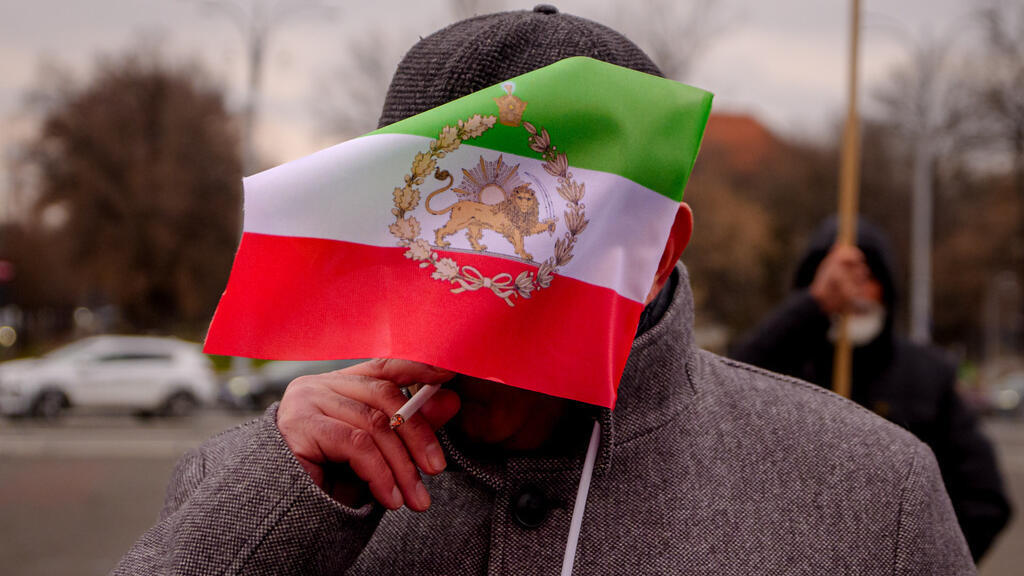
Reeling from massive demonstrations, Iran’s theocratic rulers are scrambling to reclaim the traditional Lion and Sun symbol, which has been embraced by anti-regime demonstrators.
Ali Akbar Salehi, director of the government-run Iranology Foundation, asserted on February 8 that the Islamic republic owns the Lion and Sun symbol — and condemned its use by “others.”
The Lion and Sun has long been one of Iran’s enduring national symbols, in use until the country’s 1979 Islamic revolution. Its origins trace back to astrology — symbolizing the sun in the Leo constellation — but from the 12th century, it became deeply embedded in Iranian art and culture.
From the 15th century onward, the symbol appeared intermittently on Iranian flags. But after the Islamic revolution, the Lion and Sun was outlawed and condemned as a vestige of the oppressive, Westernizing monarchy. As a replacement, the regime embellished Iran’s green-white-red tricolor with four crescents and a sword, surmounted by a diacritic, which formed a stylized representation of the Arabic word “Allah.”
Speaking at the First National Congress on Foreign Policy and the History of Foreign Relations, Salehi insisted that the Islamic republic of Iran owns the symbol and said that it had clear religious roots.
“The philosophy of the Lion and Sun is from Ali (a close companion of the Prophet Muhammad), God, and religion. We gave them this Lion and Sun, now others are using it, even though it belongs to us,” Salehi said.
The “others” Salehi was referring to are the anti-regime protesters who, in recent weeks, have hoisted the Lion and Sun flag in the streets — a symbol of national pride, secularism, and defiance of theocratic rule.
Protests in Iran erupted on December 28 over economic woes including currency collapse but morphed into anti-regime demonstrations that were met with lethal force, with thousands of people killed.
The Lion and Sun also became a prominent symbol for Iranians abroad demonstrating against the regime. As a gesture of support for the protesters, the social media platform X announced on January 9 that it was replacing the current Iranian flag emoji with the Lion and Sun.
According to Salehi, the Iranian state still has an international legal claim on the Lion and Sun symbol. In 1922, the Red Lion and Sun Society was formed, Iran’s equivalent of the Red Cross and Red Crescent humanitarian organizations. And under the 1929 Geneva Conventions, the Lion and Sun was recognized as one of three official emblems — alongside the Red Cross and Red Crescent — for safeguarding medical aid.
In the wake of the 1979 Islamic Revolution, Iran swapped its red Lion and Sun for the Red Crescent, in keeping with other Muslim states. The International Red Cross and Red Crescent Federation, however, upholds Iran’s sole legal claim to the traditional emblem and its right to use it whenever it chooses.
Ongoing Debate
Salehi, who has a nuclear engineering background and was once the head of the Atomic Energy Organization of Iran, is no stranger to controversy. Appointed head of the Iranology Foundation in 2025, academics from the University of Tehran wrote an open letter, calling his appointment “inappropriate” because of his lack of expertise.
And this isn’t the first time there has been debate about the Lion and Sun. In May 2020, parliamentary deputy Qolam Haydar Ebrahim Baysalami said: “The possibility of returning the red Lion and Sun emblem to Iran is possible through the Foreign Ministry.” “The Red Crescent,” he added, “is an Ottoman emblem and replacing it with the red Lion and Sun was a historical oversight.”
Six years earlier, in May 2014, Ali Younesi, the senior assistant for ethnic and religious minorities for former moderate President Hassan Rohani, said that the Lion and Sun in the former Iranian flag were “symbols of Ali and Muhammad” and suggested that the motif replace the Red Crescent.
At the time, Younesi’s remarks provoked strong reactions from some members of the Iranian parliament. As a response, the hard-line Mashreq news website republished part of a speech by Ayatollah Ruhollah Khomeini, the founder of the Islamic republic, where he denounced the “ill-fated ‘Lion and Sun.'”
“The Iranian flag should not be an imperial flag, the emblems of Iran should not be imperial emblems. They should be Islamic emblems,” Khomeini said. “The works of the tyrant must go. These are the works of the tyrant…. It should be the works of Islam.”
RFE/RL journalists report the news in 21 countries where a free press is banned by the government or not fully established.
Tehran ready for nuclear inspections, insists it is not seeking weapons
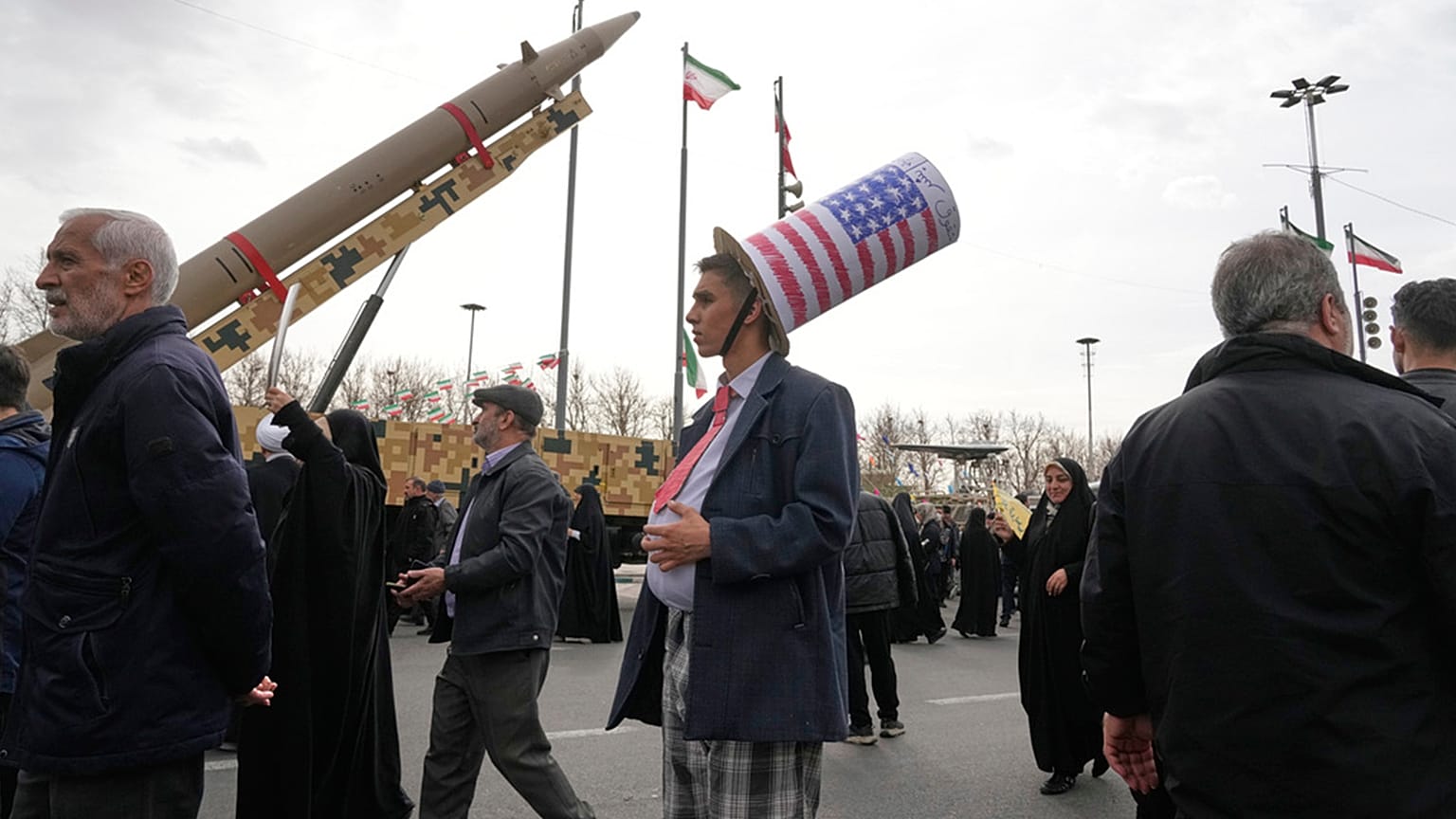
Iran’s President Masoud Pezeshkian said on Wednesday Tehran is ready for any verification of its nuclear programme, amid renewed talks with the US and raging internal unrest.
Iranian President Masoud Pezeshkian said on Wednesday his country is prepared for "any verification" of its nuclear programme, insisting Tehran is not seeking atomic weapons.
"We are not seeking to acquire nuclear weapons. We have stated this repeatedly and are ready for any verification," Pezeshkian said during a speech at Azadi Square in Tehran marking the 47th anniversary of Iran's Islamic Revolution.
"Our country, Iran, will not yield to their excessive demands," he added, after Tehran resumed indirect talks with Washington on its nuclear programme.
The anniversary comes as the country's ruling theocrats remain under pressure from US President Donald Trump, who suggested sending another aircraft carrier group to the Middle East.
Trump made the suggestion in an interview published Tuesday night, as Israeli Prime Minister Benjamin Netanyahu prepares to come to Washington to push the US toward the strictest possible terms in any agreement reached with Tehran in the fledgling nuclear talks.
The US bombed Iranian nuclear sites last June during a 12-day Iran-Israel conflict.
IAEA access remains suspended
Meanwhile, the International Atomic Energy Agency (IAEA) has not been able to verify the status of Iran's near weapons-grade uranium stockpile since the 12-day conflict, when Tehran suspended its cooperation with the UN nuclear watchdog.
IAEA chief Rafael Grossi reached an agreement with Iranian Foreign Minister Abbas Araghchi in September 2025 to resume inspections, but the UN reimposed sanctions on Iran that same month, leading the country to halt implementation of the agreement.
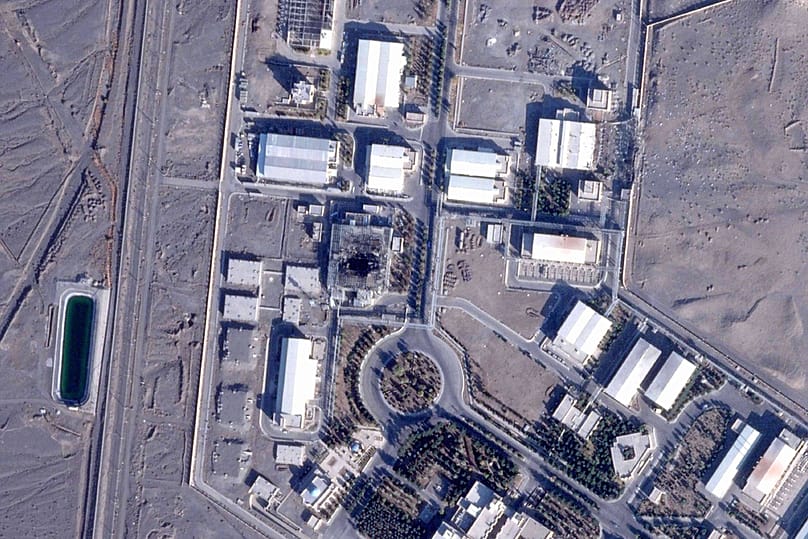
A fresh round of indirect nuclear talks between Iran and the US concluded in Muscat on last Friday, mediated by the Sultanate of Oman.
Pezeshkian has described the talks as "a step forward," emphasising that Tehran's rationale concerning the issue is based on the rights enshrined in the Non-Proliferation Treaty.
Senior Iranian security official Ali Larijani travelled from Oman to Qatar on Wednesday, with Qatar hosting a major US military installation.
A country torn
The anniversary also comes as the public angrily denounced Tehran's bloody crackdown on nationwide protests that took place in late December and early January.
Protests began on 28 December 2025, sparked by a currency collapse and persistent hyperinflation, but quickly turned into nationwide anti-regime demonstrations, prompting Tehran's violent crackdown and a complete information blockade.
Human rights organisations and insiders in Iran have reported that anywhere from 6,000 to 30,000 are feared killed in the suppression, although precise casualty figures remain difficult. Authorities have also detained tens of thousands across the country.
In mid-January, the US president urged Iranians to keep protesting, stating "help is on the way".
However, Trump has held off on an intervention following a restart in US-Iran talks and what Washington said was a pledge by Tehran to halt the crackdown, including any executions of arrested demonstrators.
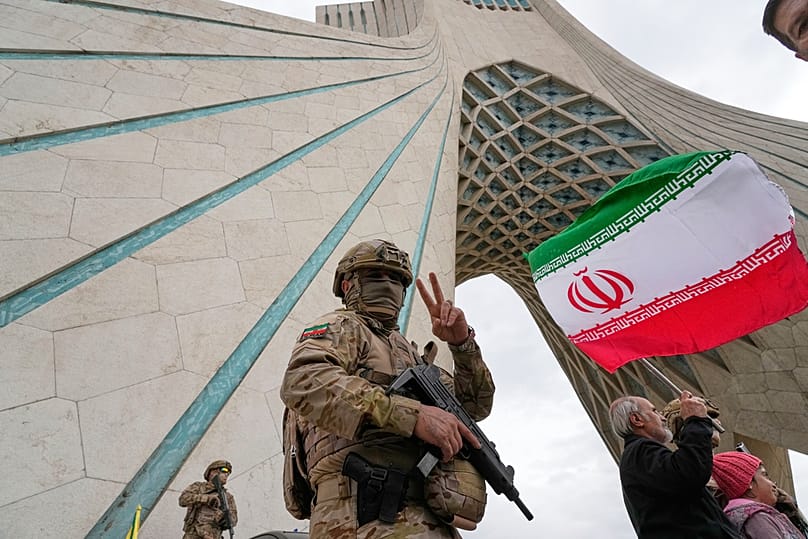
On Iranian state TV, authorities broadcast images of people taking to the streets across the country Wednesday to support the theocracy and its 86-year-old Ayatollah Ali Khamenei.
But on Tuesday night, as government-sponsored fireworks lit the darkened sky, witnesses heard shouts from people’s homes in the Iranian capital, Tehran, of “Death to the dictator."
In the streets Wednesday, people waved images of Khamenei and his predecessor Ayatollah Ruhollah Khomeini, the founder of the Islamic Republic, alongside Iranian and Palestinian flags. Some chanted “Death to America” and “Death to Israel.”
Others criticised Iran's exiled Crown Prince Reza Pahlavi, who had been calling for anti-government protests.
February 11, 2026
By Mahin Horri
On Tuesday, February 10, 2026, political prisoners across Iran marked the 107th consecutive week of the “No to Executions Tuesdays” campaign. The hunger strike, which began as a protest within prison walls, has now expanded to 56 detention facilities nationwide, including Evin, Ghezel Hesar, and prisons in major provincial capitals. This expansion comes in the immediate aftermath of the nationwide uprising in January 2026, posing a direct challenge to the clerical regime’s intensified crackdown.
In a statement released for the 107th week, the striking prisoners highlighted a dramatic surge in capital punishment aimed at quelling public dissent. According to the campaign, in the first three weeks of the current Persian month (starting January 21, 2026), the regime has executed over 207 individuals, including two women. The statement notes that thousands of detainees face the threat of execution without due process. Specifically, the prisoners raised the alarm for Kurdish political prisoner Naser Bekrzadeh, who has been sentenced to death for the third time and faces imminent execution.
The crackdown has extended beyond protesters to include professionals aiding the injured. The statement reports that security forces have arrested numerous lawyers, doctors, and medical staff, a move the prisoners describe as indicative of the regime’s “growing terror” following the January uprising.
Despite the repression, the prisoners emphasized that the path forward is resistance, not submission. “Compatriots, in these conditions, silence is not an option; the only option and path to salvation is outcry and protest,” the statement read. They further articulated their vision for the future: “In these sensitive conditions, we desire a free and equal Iran, devoid of violence and executions, and the ‘right to self-determination’ by the people.”
The campaign has transcended prison walls, finding a “new stage” of social expansion. In tandem with the hunger strikes inside, residents in dozens of cities—including Tehran, Tabriz, Isfahan, Rasht, Zahedan, and Kermanshah—have staged protests supporting the prisoners. The slogan “No to Executions” has become a common chant in street demonstrations.
Protesters have adopted radical slogans linking the executions to the survival of the Supreme Leader’s regime. Chants documented during these protests include “Fire is the answer to execution,” “Freedom for political prisoners is the national slogan,” and “Khamenei’s crime: thousands of martyrs of the January uprising.”
Families of the incarcerated and those killed during protests have become the “stable pillars” of this movement, rallying with photos of their loved ones and chanting “Do not execute.” This solidarity has effectively bridged the gap between individual grievances and a collective national demand for the abolition of the death penalty.
The participating prisons in the 105th week of the hunger strike include: Evin Prison (women’s and men’s wards), Ghezel Hesar Prison (units 2, 3, and 4), Karaj Central Prison, Fardis Prison in Karaj, Greater Tehran Prison, Qarchak Prison, Khorin Prison in Varamin, Chobindar Prison in Qazvin, Ahar Prison, Arak Prison, Langerud Prison in Qom, Khorramabad Prison, Borujerd Prison, Yasuj Prison, Asadabad Prison in Isfahan, Dastgerd Prison in Isfahan, Sheiban Prison in Ahvaz, Sepidar Prison in Ahvaz (women’s and men’s wards), Nezam Prison in Shiraz, Adelabad Prison in Shiraz (women’s and men’s wards), Firuzabad Prison in Fars, Dehdasht Prison, Zahedan Prison (women’s and men’s wards), Borazjan Prison, Ramhormoz Prison, Behbahan Prison, Bam Prison, Yazd Prison (women’s and men’s wards), Kahnuj Prison, Tabas Prison, Birjand Central Prison, Vakilabad Prison in Mashhad, Gorgan Prison, Sabzevar Prison, Gonbad-e Kavus Prison, Qaemshahr Prison, Rasht Prison (men’s and women’s wards), Rudsar Prison, Haviq Prison in Talesh, Azbaram Prison in Lahijan, Dizel Abad Prison in Kermanshah, Ardabil Prison, Tabriz Prison, Urmia Prison, Salmas Prison, Khoy Prison, Naqadeh Prison, Miandoab Prison, Mahabad Prison, Bukan Prison, Saqqez Prison, Baneh Prison, Marivan Prison, Sanandaj Prison, Kamyaran Prison, and Ilam Prison.
Mahin Horri writes for the People's Mojahedin Organization of Iran (PMOI/MEK).
Iran’s Comprehensive Peace Proposal to the United States
The Middle East stands at a crossroads between endless war and comprehensive peace. A framework for peace does exist. Will the US finally seize it?
History occasionally presents moments when the truth about a conflict is stated plainly enough that it becomes impossible to ignore. Iranian Foreign Minister Abbas Araghchi’s February 7 address in Doha, Qatar (transcript here) should prove to be such a moment. His important and constructive remarks responded to the US call for comprehensive negotiations, and he laid out a sound proposal for peace across the Middle East.
Last week, US Secretary of State Marco Rubio called for comprehensive negotiations: “If the Iranians want to meet, we’re ready.” He proposed for talks to include the nuclear issue, Iran’s military capabilities, and its support for proxy groups around the region. On its surface, this sounds like a serious and constructive proposal. The Middle East’s security crises are interconnected, and diplomacy that isolates nuclear issues from broader regional dynamics is unlikely to endure.
On February 7, Iranian Foreign Minister Araghchi’s responded to the United States’ proposal for a comprehensive peace. In his speech at the Al Jazeera Forum, the foreign minister addressed the root cause of regional instability – “Palestine… is the defining question of justice in West Asia and beyond” and he proposed a path forward.
The Foreign Minister’s statement is correct. The failure to resolve the issue of Palestinian statehood has indeed fueled every major regional conflict since 1948. The Arab-Israeli wars, the rise of anti-Israel militancy, the regional polarization, and the repeated cycles of violence, all derive from the failure to create a State of Palestine alongside the State of Israel. Gaza represents the most devastating chapter in this conflict, where Israel’s brutal occupation of Palestine was followed by Hamas’s attack on Israel on October 7, 2023, and then by Israel’s genocide against the people of Gaza.
In his speech, Araghchi condemned Israel’s expansionist project “pursued under the banner of security.” He warned of the annexation of the West Bank, which Israeli government officials, as National Security Minister Ben Gvir, continually call for, and for which the Knesset has already passed a motion.
Araghchi also highlighted another fundamental dimension of Israeli strategy which is the pursuit of permanent military supremacy across the region. He said that Israel’s expansionist project requires that “neighboring countries be weakened—militarily, technologically, economically, and socially—so that the Israeli regime permanently enjoys the upper hand.” This is indeed the Clean Break doctrine of Prime Minister Netanyahu, dating back 30 years. It has been avidly supported by the US through 100 billion dollars in military assistance to Israel since 2000, diplomatic cover at the UN via repeated vetoes, and the consistent US rejection of accountability measures for Israel’s violations of international humanitarian law.
Israel’s impunity has destabilized the region, fueling arms races, proxy wars, and cycles of revenge. It has also corroded what remains of the international legal order. The abuse of international law by the US and Israel with much of Europe remaining silent, has gravely weakened the UN Charter, leaving the UN close to collapse.
In the concluding remarks of his speech, he offered the US a political solution and path forward. “The path to stability is clear: justice for Palestine, accountability for crimes, an end to occupation and apartheid, and a regional order built on sovereignty, equality, and cooperation. If the world wants peace, it must stop rewarding aggression. If the world wants stability, it must stop enabling expansionism.”
This is a valid and constructive response to Rubio’s call for comprehensive diplomacy.
This framework could address all the interlocking dimensions of the region’s conflict. The end of Israel’s expansion and occupation of Palestine, and Israel’s return to the borders of June 4, 1967, would bring an end to outside funding and arming of proxy groups in the region. The creation of a Palestinian state alongside the state of Israel would enhance Israel’s security as well as that of its neighbors. A renewed nuclear agreement with Iran, strictly limiting Iran to peaceful nuclear activities and paired with the lifting of US and EU sanctions, would add a crucial pillar of regional stability. Iran already agreed to such a nuclear framework a decade ago, in the Joint Comprehensive Plan of Action (JCPOA) that was adopted by the UN Security Council in Resolution 2231. It was the US during Trump’s first term, not Iran, that withdrew from the agreement.
A comprehensive peace reflects the foundation of modern collective security doctrine, including the United Nations Charter itself. Durable peace requires mutual recognition of sovereignty, territorial integrity, and equal security guarantees for all states.
Regional security is the shared responsibility of all states in the region, and each of them faces a historic obligation. This comprehensive peace proposal is not new, it has been advocated for decades by the Organization of Islamic Cooperation (57 Muslim‑majority countries) and the League of Arab States (22 Arab States). Ever since the 2002 Arab Peace Initiative, all of these countries have endorsed, on a yearly basis, the framework of land-for-peace. All major Arab and Islamic states, allies of the US, have played a crucial role in facilitating the latest round of US-Iranian negotiations in Oman. Additionally, Saudi Arabia has clearly reminded the US that it will normalize relations with Israel only on the condition of the establishment of a Palestinian State.
The United States faces a moment of truth. Does it really want peace, or does it want to follow Israel’s extremism? For decades, the US has blindly followed Israeli misguided objectives. Domestic political pressures, powerful lobbying networks, strategic miscalculations, and perhaps a bit of blackmail lurking in the Epstein files (who knows?) have combined to subordinate American diplomacy to Israel’s regional ambitions.
The US subservience to Israel does not serve American interests. It has drawn the United States into repeated regional wars, undermined global trust in American foreign policy, and weakened the international legal order that Washington itself helped to construct after 1945.
A comprehensive peace offers the US a rare opportunity to correct course. By negotiating a comprehensive regional peace grounded in international law, the United States could reclaim genuine diplomacy and help to establish a stable regional security architecture that benefits all parties, including Israel and Palestine.
The Middle East stands at a crossroads between endless war and comprehensive peace. The framework for peace exists. It requires first and foremost Palestinian statehood, security guarantees for Israel and the rest of the region, a peaceful nuclear deal restoring the basic agreement adopted by the UN a decade ago, lifting of economic sanctions, the unbiased enforcement of international law, and a diplomatic architecture that replaces military force with security cooperation. The world should rally behind a comprehensive framework and take this historic opportunity to achieve regional peace.
- First published at Common Dreams.

No comments:
Post a Comment