It’s possible that I shall make an ass of myself. But in that case one can always get out of it with a little dialectic. I have, of course, so worded my proposition as to be right either way (K.Marx, Letter to F.Engels on the Indian Mutiny)
Tuesday, February 17, 2026
ByteDance says it will add safeguards to AI video tool Seedance 2.0 following Hollywood backlash
Copyright AP Photo/Chris Pizzello
By Mohammad Shayan Ahmad with AP
Published on
After facing mounting pressure from Hollywood alongside legal threats from Disney, ByteDance moves to tighten safeguards on its AI video app, Seedance 2.0.
Chinese tech firm ByteDance has said it will place restrictions on a controversial AI (artificial intelligence) powered video creation tool, following copyright complaints from major media companies.
Seedance 2.0, the latest model of the AI video generator released on February 12, which is only available in China, went viral and allows users to create realistic images and videos of famous actors and cartoon characters in short text prompts.
One of these images showed Brad Pitt and Tom Cruise in a fight. The AI has been praised by many online for its highly realistic output, compared to already existing models like DeepSeek.
But several Hollywood companies have threatened to take legal action against ByteDance.
Relate
OnFebruary 13, Disney sent a cease and desist letter to the company accusing them of training Seedance with a “pirated library” that included famous Disney characters from Star Wars, Marvel and more, according to media reports.
A source told Reuters that the letter claimed Seedance was using and distributing creative works as “public-domain clip art,” violating the copyright and intellectual property of Disney.
Paramount Skydance also sent a cease and desist letter to ByteDance, blaming them for copyright infringement, Variety reported.
“We have heard the concerns regarding Seedance 2.0,” ByteDance said in a statement on Sunday.
“We are taking steps to strengthen current safeguards as we work to prevent the unauthorised use of intellectual property and likeness by users,” it added.
The company did not clarify what measures were being taken.
The BBC reported that ByteDance had previously stated that it had “paused the ability for users to upload images of real people.”
SAG-AFTRA, a US labour union that protects the rights of on-screen actors and artists, voiced its concerns about the “unauthorised use of its members’ voice and likeness.” In a statement, they demanded"responsible AI development” that ceases to exist in the case of ByteDance.
In 2025, Disney also sent a cease and desist letter to Character.ai, which was accused of using their characters without permission. The chatbot service removed all characters that infringed on Disney’s intellectual property following the letter.
Disney and NBC Universal also sued online image generator Midourney in 2025, for the same reason of copyright infringement. Although the case is still ongoing, it shows the strides Disney and other creative companies are willing to take to protect their intellectual property.
However, these companies are also making deals with AI businesses. Disney struck a $1 Billion deal with OpenAI to allow its video generator, Sora AI, to creatively use the likeness of characters such as Mickey Mouse, Cinderella, and Luke Skywalker in a three-year licensing agreement.
Analysis: Will Big Tech's colossal AI spending crush Europe's data sovereignty?
Big Tech companies are going all in on AI development, raising their projected capital expenditure to over $700bn (€590bn) this year, an increase of roughly 75% compared to 2025.
Several Big Tech companies have reported earnings in recent weeks and provided estimates for their spending in 2026, along with leading analysts' projections
The data point that seems to have caught Wall Street’s attention the most is the estimated capital expenditure (CapEx) for this year, which collectively represents an investment of over $700bn (€590bn) in AI infrastructure.
That is more than the entire nominal GDP of Sweden for 2025, one of Europe's largest economies, as per IMF estimates.
Global chip sales are also projected to reach $1tn (€842bn) for the first time this year, according to the US Semiconuctor Industry Association.
In addition, major banks and consulting firms, such as JPMorgan Chase and McKinsey, project that total AI CapEx will surpass $5tn (€4.2tn) by 2030, driven by "astronomical demand" for compute.
CapEx refers to funds a company spends to build, improve or maintain long-term assets like property, equipment and technology. These investments are meant to boost the firm's capacity and efficiency over several years.
The expenditure is also not fully deducted in the same year. CapEx costs are capitalised on the balance sheet and gradually expensed through depreciation, representing a key indicator of how a company is investing in its future growth and operational strength.
The leap this year confirms a definitive pivot that began in 2025, when Big Tech is estimated to have spent around $400bn (€337bn) on AI CapEx.
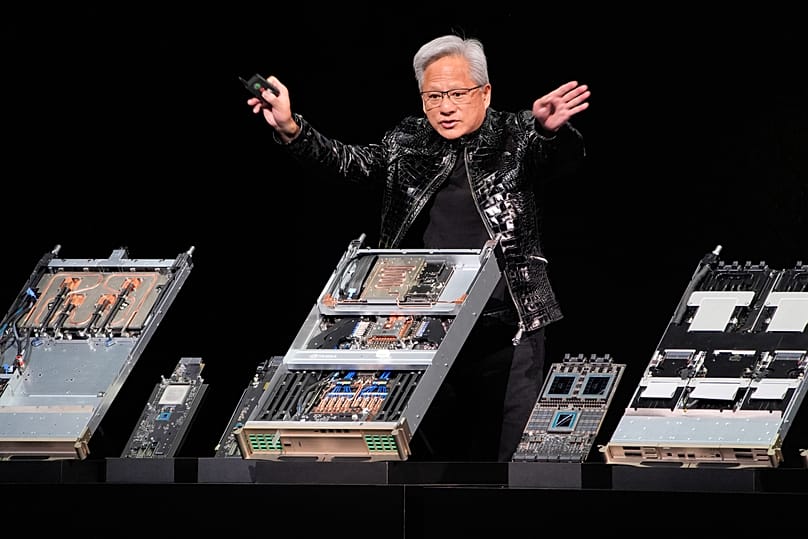
As Nvidia founder and CEO Jensen Huang has repeatedly stated, including at the World Economic Forum in Davos last month, we are witnessing "the largest infrastructure build-out in human history".
Nvidia CEO speaking about the NVIDIA Rubin AI super computing platform at a news conference, Las Vegas, Jan. 2026 AP Photo/John Locher
Hyperscalers bet the house
At the top of the spending hierarchy for 2026 sits Amazon, which alone is guiding to invest a mammoth $200bn (€170bn).
To put the number into perspective, the company’s individual AI CapEx guidance for this year surpasses the combined nominal GDP of the three Baltic countries in 2025, according to IMF projections.
Alphabet, Google’s parent company, follows with $185bn (€155bn), while Microsoft and Meta are set to deploy $145bn (€122bn) and $135bn (€113bn) respectively.
Oracle also raised its 2026 CapEx to $50bn (€42.1bn), nearly $15bn (€12.6bn) above earlier estimates.
Additionally, Tesla projects double the spending with almost $20bn (€16.8bn), primarily to scale its robotaxi fleet and advance the development of the Optimus humanoid robot.
Another of Elon Musk's companies, xAI, will also spend at least $30bn (€25.2bn) in 2026.
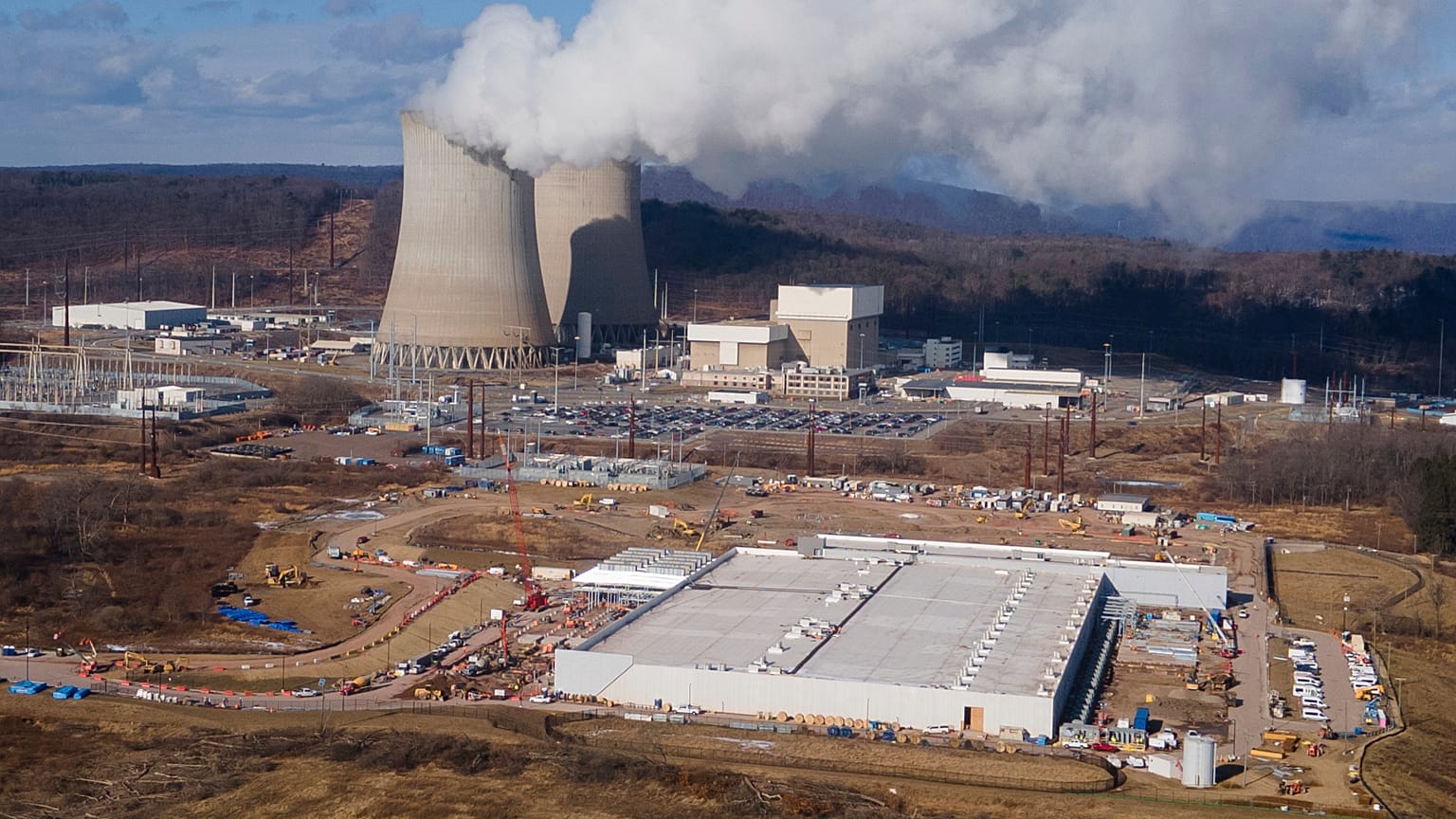
A new $20bn (€16.8bn) data centre named MACROHARDRR will be built in Mississippi, which Governor Tate Reeves stated is "the largest private sector investment in the state's history".
xAI will also expand the so-called Colossus, a cluster of data centres in Tennessee that has been described by Musk as the world's largest AI supercomputer.
Furthermore, the company was acquired by SpaceX in an all-stock transaction at the start of this month.
The merger valued SpaceX at $1tn (€842bn) and xAI at $250bn (€210bn), creating an entity worth $1.25tn (€1.05tn), reputedly the largest private company by valuation in history.
There are also reports that SpaceX intends to IPO sometime this year, with Morgan Stanley allegedly in talks to manage the offering that now includes exposure to xAI.
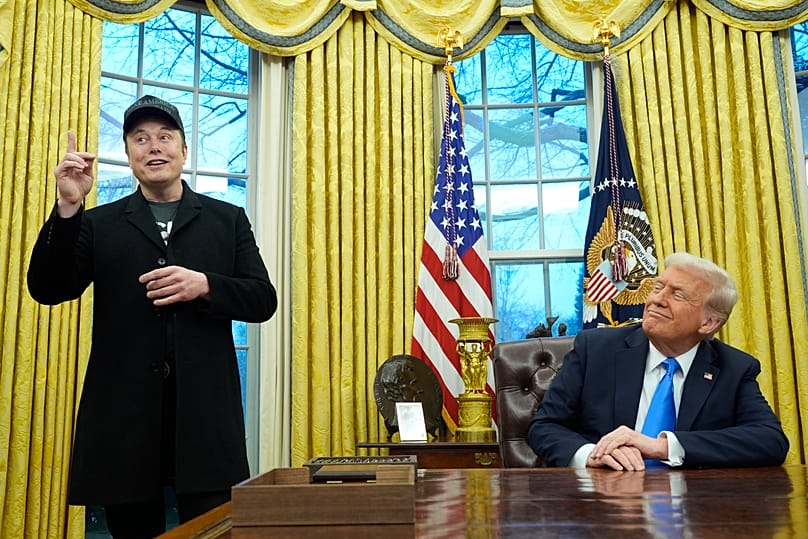
Elon Musk stated that the goal is to build an "integrated innovation engine" combining AI, rockets and satellite internet, with long-term plans that include space-based data centres powered by solar energy.
President Trump smiles as Elon Musk speaks in the Oval Office, Feb. 2025 AP Photo/Alex Brandon
Conversely, Apple continues to lag in spending with "only" a projected $13bn (€10.9bn).
However, the company announced a multi-year partnership with Google last month to integrate Gemini AI models into the next generation of Apple Intelligence.
Specifically, the collaboration will focus on overhauling Siri and enhancing on-device AI features. Therefore, one could say that Apple is outsourcing a lot of the investment it needs to be competitive on AI development.
As for Nvidia, it will report earnings and release projections on 25 February.
The company is primarily in the business of selling AI chips, and is expected to get the lion's share of the Big Tech's spending. Particularly, for the build-out of data centres.
In last August's earnings call, CEO Jensen Huang estimated a cost per gigawatt of data centre capacity between $50bn (€42.1bn) and $60bn (€50.5bn), with about $35bn (€29.5bn) of each investment going towards Nvidia hardware.
Wall Street has had mixed feelings about the enormous spending Big Tech companies have planned for 2026.
On the one hand, investors understand the necessity and urgency of developing a competitive edge in the artificial intelligence age.
On the other, the sheer scale of the spending has also spooked some shareholders. The market’s tolerance hinges on demonstrable ROI from this year onwards, as the investments are also increasingly financed with massive debt raises.
Morgan Stanley estimates that hyperscalers will borrow around $400bn (€337bn) in 2026, more than double the $165bn (€139bn) that was loaned out in 2025.
This surge could push the total issuance of high-grade US corporate bonds to a record $2.25tn (€1.9tn) this year.
Currently, projected AI revenue for 2026 is nowhere near matching the spending, and there are valid concerns. For instance, the possibility of hardware rapidly depreciating due to innovation, and other high operational costs such as energy usage.
It can be confidently stated that the numbers have a heavy reliance on future success.
As Google CEO Sundar Pichai acknowledged this month, there are “elements of irrationality in the current spending pace".
An American flag is displayed over an entrance to the NYSE, New York, Feb 2026 AP Photo/Seth Wenig
Back in November, Alex Haissl, an analyst at Rothschild & Co, became a dissenting voice as he downgraded ratings for Amazon and Microsoft.
In a note to clients, the analyst wrote “investors are valuing Amazon and Microsoft's CapEx plans as if cloud-1.0 economics still applied”, referring to the low-cost structure of cloud-based services that allowed Big Tech firms to scale in the last two decades.
However, the analyst added “there are a few problems that suggest the AI boom likely won't play out in the same way, and it is probably far more costly than investors realise".
This view is also shared by Michael Burry, who is best known for being among the first investors to predict and profit from the subprime mortgage crisis in 2008. Burry has argued that the current AI boom is a potential bubble pointing to unsustainable CapEx.
Big Tech’s AI race is funded by a tremendous amount of leverage. Whether this strategy will pay off, and which companies will be the winners and the losers, only time will tell.
At the moment, Nvidia certainly seems to be a great beneficiary. Moreover, Apple has a distinct approach by increasing third party reliance, through a partnership with Google, instead of massively scaling their spending. It is a different trade-off.
Related
Europe’s industrial deficit
Amid all this spending, urgent questions have also been raised about Europe’s ability to compete in a race that has become a battle of balance sheets.
For the European Union, the transatlantic contrast is sobering. While American firms are mobilising nearly €600bn in a single year, the EU’s coordinated efforts do not even match the financial firepower of the lowest spender among the US tech titans.
Brussels has attempted to rally with the AI Factories initiative, and the AI Continent Action Plan launched last April, which aim to mobilise public-private investments.
However, the numbers tell a stark story. Total European spending on sovereign cloud data infrastructure is forecast to reach just €10.6bn in 2026.
While this is a respectable 83% increase year-on-year, it remains a rounding error compared to the US AI build-out.
Last year, at the time when the initiatives mentioned were being discussed, the CEO of the French unicorn Mistral AI, Arthur Mensch, stated that “US companies are building the equivalent of a new Apollo program every year”.
Mensch also added that “Europe is building excellent regulation with the AI Act, but you cannot regulate your way to computing supremacy”.
Arthur Mensch, CEO of Mistral AI, during an event on the sidelines of the AI Action Summit in Paris, February 2025 AP Photo/Aurelien Morissard
Mistral represents one of the only flickers of European resistance in the AI race. The French company is employing the same strategy as most of Big Tech and aggressively expanding its physical footprint.
In September 2025, Mistral AI raised a €1.7bn Series C at a valuation of almost €12bn, with the Dutch semiconductor giant ASML leading the round by singly investing €1.3bn.
During the World Economic Forum in Davos last month, Mistral's CEO confirmed a €1bn CapEx plan for 2026.
Just last week, the company also announced a major €1.2bn investment to build a data centre in Borlänge, Sweden.
In a partnership with the Swedish operator, EcoDataCenter, the facility will be designed to offer "sovereign compute" compliant with the EU’s strict data standards, and leveraging Sweden’s abundant green energy.
Set to open in 2027, this data centre will provide the high-performance computing required to train and deploy Mistral’s next-generation AI models.
This is an important move for the company, as it is the first infrastructure project outside France, and it is also a core venture for European data sovereignty.
Meanwhile, US tech titans are attempting to placate European regulators by offering "sovereign-light" solutions. Several Big Tech projects have been rolled out for "localised cloud zones", for example in Germany and Portugal, promising data residency.
However, critics argue these remain technically dependent on US parent companies, leaving the European industry vulnerable to the whims of the American economy and foreign policy.
Relate
As 2026 unfolds, the stakes are clear. The US is betting the house, and its credit rating, on AI dominance.
Europe, cautious and capital-constrained, is hoping that targeted investments and regulation will be enough to carve out a sovereign niche in a world increasingly run on American technology.
These are China's new AI models that have just been released ahead of the Lunar New Year
Major Chinese AI companies such as Alibaba, ByteDance, and Zhipu have all announced launches in the weeks leading up to the Lunar New Year, while the industry awaits a possible new drop byDeepSeek.
China is ringing in the Lunar New Year with a flurry of new artificial intelligence (AI) model launches. Tech companies, such as Alibaba, ByteDance, and Zhipu, have all announced new product launches in the weeks leading up to China’s biggest holiday, while industry watchers expect a new Deepseek model soon.
China is widely regarded as a major competitor to the United States in the race to adopt and develop artificial intelligence models.
Thenew deployments are preparing the Chinese market for AI agents, systems that can make decisions and execute tasks, such as navigating websites and generating content, without needing human assistance.
Alibaba’s Qwen 3.5
E-commerce giant Alibaba released its latest AI model, Qwen3.5, hours before the Lunar New Year starts on 16 February. The model understands text, images, and videos across 200 languages, the company says.
The new model can deploy AI agents up to five times faster than previous models and its competitors, including the latest models of OpenAI’s ChatGPT and Anthropic’s Claude, the company said. Their agents can fill out forms, navigate websites, and complete multi-step workflows.
Relate
Early tests show Qwen3.5 can generate functional 3D games, browsers, websites, and analyse medical imagery. The model is also up to 60 percent cheaper than its predecessor model, Qwen2.5, the company said.
In 2025, Alibaba committed 380 billion yuan (€50.6 billion) to cloud computing and AI in the next three years, one of the company’s largest tech investments to date.
ByteDance’s launches
ByteDance, the Chinese company behind TikTok, announced two new AI developments in the weeks before the Lunar New Year.
The latest version of the company’s AI chatbot, Doubao 2.0, launched over the weekend. The newest model includes complex reasoning and multi-step task execution that matches OpenAI’s ChatGPT and Google’s Gemini current models, Reuters reported.
ByteDance also released SeeDance 2.0 on February 14, the second version of its image-to-video and text-to-video app. The software lets users create “immersive” audio and video with director-level controls. One viral video features a rooftop fight between American actors Tom Cruise and Brad Pitt.
Relate
The American Motion Picture Association criticised SeeDance2.0 for unleashing the use of copyrighted works on “a massive scale,” according to a statement.
“By launching a service that operates without meaningful safeguards against infringement, ByteDance is disregarding well-established copyright law that protects the rights of creators and underpins millions of American jobs,” the statement reads.
ByteDance representatives told the BBC that it will take steps to strengthen current safeguards on the platform to protect intellectual copyright..
Zhipu AI’s GLM-5
Zhipu AI released its open source GLM-5 model on February 11, a model that the company says is engineered for “agentic intelligence, advanced multi-step reasoning, and frontier-level performance,” in coding, creative writing and problem-solving.
The model can build assistants that plan, browse, call tools and manage multi-step workflows over long sessions, the company says. It can also generate full-length reports and process and reason long academic papers.
GLM-5 uses DeepSeek’s sparse attention mechanism DSA, which cuts computational costs while enhancing model efficiency.
Relate
The company claims the model was also trained entirely on Huawei Ascend chips and “achieves full independence from US-manufactured semiconductor hardware,” which the company said is a “milestone in self-reliant AI infrastructure”.
Last month, Zhipu went public on the Hong Kong stock exchange and raised HKD 4.35 billion (€465 million) for what the company said will be its next-generation model development.
Coming soon: DeepSeek’s V4
DeepSeek, the Chinese AI company known for its open source cheap models, is expected to release its fourth version sometime around the Lunar New Year, according to The Information.
When V4 is released, it could replace the V3 model, which powered the assistant app that became the top-rated free application available in the United States and worldwide, overtaking ChatGPT last January.
DeepSeek’s V3 rattled global markets last year and sparked a global sell-off of US-led tech stocks. Industry giants, including chipmaker Nvidia, saw shares plummet by 17 per cent and erased $600 billion (€573 billion) in market capitalisation before recovering later in the day.
While it hasn’t been released yet, DeepSeek fuelled anticipation last week when its chatbot upgraded its context window, the amount of information that it can remember and handle in a single task, according to the South China Morning Post.
Some European countries, such as Italy, Denmark, and the Czech Republic banned government agencies from using DeepSeek models on their devices due to data security and cybersecurity concerns. Local media in Belgium reported that government officials stopped using DeepSeek in December.
‘Real economic consequences’: US warned over ESTA visa changes
Copyright Copyright 2020 The Associated Press. All rights reserved.
By David Del Valle
Published on
Research by the World Travel and Tourism Council reveals that the US risks losing 157,000 jobs and up to 4.7 million international tourists.
Proposed changes to the US visa waiver programme (ESTA), which would require international travellers to provide more extensive disclosure of their social media activity, could have a major economic impact on the country.
New research from the World Travel and Tourism Council (WTTC), produced in conjunction with GSIQ and Oxford Economics, warns that the measure could reduce spending by international visitors by up to $15.7 billion (€13.2 billion) and affect up to 157,000 US jobs.
According to the survey of several ESTA-eligible markets, 66% of travellers are already aware of the proposed change, suggesting that any changes could have an almost immediate effect on tourist perceptions and behaviour.
One in threeinternational travellers (34%) said they would be less likely to travel to the US in the next two to three years if the new requirements were implemented. In contrast, only 12% said they would be more likely to visit the country, leaving a clearly negative balance of travel intentions.
Beyond the decision to travel, the survey reveals a deterioration in the perception of the destination. A significant proportion of travellers believe that the policy would make the US seem less welcoming and attractive for both leisure and business travel. In addition, a majority of respondents do not believe that the measure would improve their personal security when visiting the country.
The WTTC's economic modelling posits a high-impact scenario in which the United States would receive 4.7 million fewer international arrivals in 2026 from ESTA countries, a drop of 23.7% compared to a business-as-usual scenario.
More broadly, the losses could amount to $21.5 billion (more than 18 billion euros) in travel and tourism GDP. The employment impact would also be considerable:up to 157,000 jobs at risk, a figure equivalent to three times the average monthly jobs created in 2025, when around 50,000 jobs per month were generated in the country.
The report highlights that the US has already lost 11 million international visitors between 2019 and 2025, so new barriers to entry could further weaken its competitiveness in an increasingly contested global market.
Compared to other major tourist destinations such as the UK, Japan, Canada or Western European countries, the proposed entry policy is perceived as significantly more restrictive, which could put the US at a competitive disadvantage.
"US border security is critical, but the planned policy changes will hurt job creation, something the US administration values highly," said Gloria Guevara, president and CEO of WTTC.
"Our research concludes that more than 150,000 jobs could be lost if this policy moves forward. Even modest changes in visitor behaviour will have real economic consequences for the US travel and tourism industry, especially in a highly competitive global marketplace."
WTTC urges US policymakers to carefully assess the economic and employment implications of the measure, recalling that tourism is one of the key drivers of the US economy and international connectivity. Otherwise, the proposed policy will carry a high risk of reducing travel demand and weakening the United States' competitive position in a highly competitive global tourism market.
EU Fight to ban Russian steel intensifies in Brussels
The European Parliament is pushing for a full ban on Russian steel to choke off Moscow’s revenues, but several EU governments still rely on importing it. High-stakes negotiations start next week.
Four years after Russia’s invasion of Ukraine, the European Union is still importing Russian steel – and not everyone is happy about it.
Next week, MEPs and EU member states will begin negotiations on whether to ban Russian steel outright. What began as a sanctions debate has morphed into a high-stakes political fight.
Swedish lawmaker Karin Karlsbro is preparing to take on the EU council, which represents the member states, with Belgium, Italy, the Czech Republic and Denmark all arguing that they still need imports of unfinished steel for major construction projects.
“It is a big provocation that we haven't done everything possible to limit Putin's war chest,” Karlsbro told Euronews. “The Russian steel industry is a backbone of Russian war, it is the Russian war machinery.”
Finished Russian steel was banned in 2022, but semi-finished steel, a key input for further processing, was spared after a number of countries secured an exemption until 2028 to cushion the blow to their industries.
“Unfinished steel can’t be produced anywhere in the EU,” a European diplomat from one of those countries told Euronews, “while it is required for big infrastructures.”
Three million tonnes
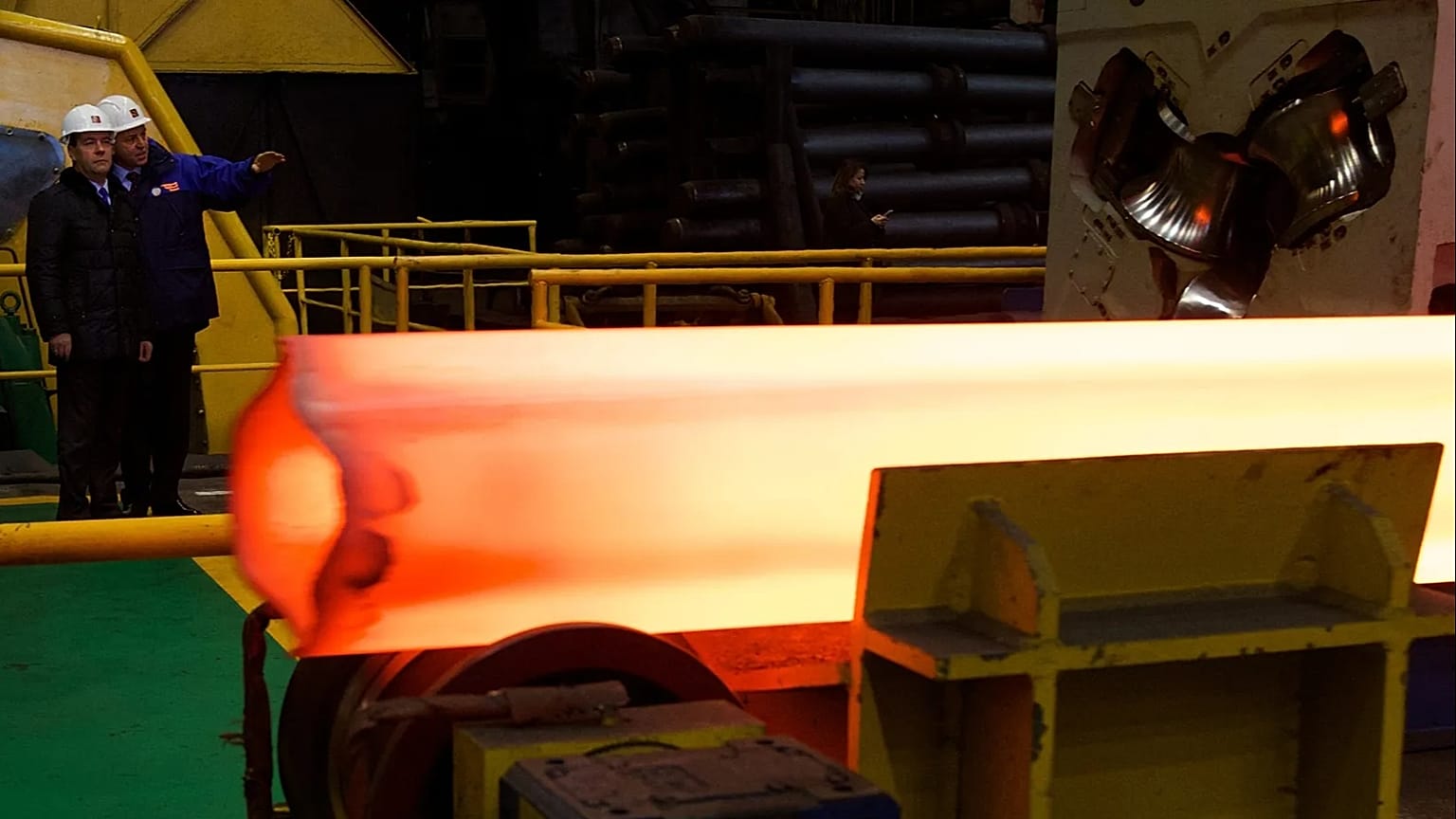
Karlsbro says she was astonished to learn that EU imports of Russian steel amount to nearly 3 million tonnes a year, roughly equivalent to Sweden’s entire annual output and worth around €1.7 billion.
For her, the type of steel is beside the point.
“There is absolutely no argument that this is special steel or highly qualified steel with any essential quality. There is simply no additional reason to buy this steel,” she said.
To bypass the unanimity required for the adoption of EU sanctions by the member states, Karlsbro inserted a ban on Russian steel into a separate European Commission proposal aimed at shielding the bloc from global steel overcapacity, as US tariffs divert excess supply toward Europe.
The European Parliament’s trade committee approved the move on 27 January.
The procedural shift is crucial. Unlike sanctions, the trade file requires onlythe support ofa qualified majority of EU countries, potentially sidelining governments that might otherwise veto a full ban.
“The Parliament is playing politics on this,” an industry source familiar with the file told Euronews.
Another diplomat from a country dependent on Russian semi-finished steel said the ban was important for his government, which is why the 2028 deadline has been set – highlighting the dilemma the EU faces as it balances industrial needs with the need to confront the full-scale invasion of Ukraine.
The talks are beginning as the fourth anniversary of Russia’s invasion approaches, and the clock is ticking. By June, the EU must adopt the Commission’s plan to shield its market from a glut of global steel.
One diplomat insisted the two files – banning Russian steel and protecting the EU market from overcapacity – pursue “totally different goals”.
Still, the same diplomat acknowledged the ban could pass, as there are not enough member states pushing to maintain a phase-out only by 2028.
Belgium reprimands US ambassador over circumcision accusations
The Belgian government has clashed with the US after Donald Trump's ambassador accused Brussels of antisemitism over its laws regulating circumcision.
The United States' ambassador to Belgium has met with the country’s Ministry of Foreign Affairs in Brussels after being summoned by the Belgian government.
The meeting was arranged after Ambassador Bill White said in a post on X on Monday that "antisemitism is unacceptable in any form and it must be rooted out of our society".
The reaction from the Belgian government was swift and furious, with one source telling Euronews: "This is not the role of US ambassador. The law applies to all people, that's Belgian democracy."
“Labelling Belgium as antisemitic is not just wrong, it’s dangerous disinformation that undermines the real fight against hatred,” Foreign Minister Maxime Prévot wrote in a post on X.
The row erupted in relation to an investigation into three men accused of performing circumcisions on baby boys without required medical certification. Belgian law states that circumcision of baby boys is permitted so long as a doctor or medical professional conducts the operation.
"Over 25,000 safe circumcisions have taken place in Belgium in the last year," a person familiar with the situation told Euronews.
Prévot, who summoned the ambassador, is out of the country, and was represented at Tuesday's meeting by the Secretary General of the ministry, Theodora Gentzis.
Euronews understands that throughout the meeting on Tuesday afternoon, White reiterated calls for Belgian authorities to drop the investigation into the three men.
'False, offensive and unacceptable'
After the 25-minute meeting with White, the ministry issued a statement saying that White had been reminded that the Vienna Convention on Diplomatic Relations defines the role of ambassador and its limitations.
"Personal attacks on a member of the Belgian government and any interference in Belgium's internal affairs are contrary to these basic diplomatic rules," the statement read.
"Belgium attaches great importance to its relations with the United States of America. However, this dialogue must be based on respect for our institutions and our sovereignty. Any suggestion that Belgium is antisemitic is completely false, offensive and unacceptable."
"The fight against antisemitism is a priority for Belgium. Our country consistently and unequivocally condemns all forms of antisemitism and racism, both on its territory and abroad.“