Saturday, March 14, 2026


Gulf war tensions push geopolitical risk index to 9/11 highs - Oxford Economics

Gulf war tensions push geopolitical risk index to 9/11 highs - Oxford Economics
https://www.dropbox.com/scl/fi/gopzepe72wby4t038nejw/Screenshot-2026-03-13-at-19.20.19.png?rlkey=d4p99r4aeqfpogq22478bjqvh&dl=0 / bne IntelliNews
By Ben Aris in Berlin March 13, 2026

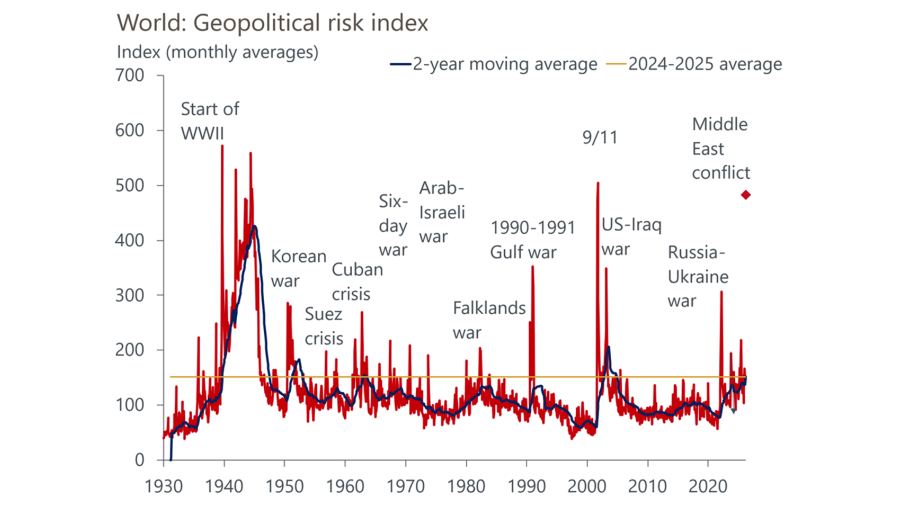
The outbreak of what has been called “the worst energy disruption in history” by the IEA International Energy Agency (IEA) has sent the global geopolitical risk index to levels not seen since the 9/11 terrorist attacks on New York.

The energy, stocks and debt market have been roiled by the collapse of oil and gas deliveries to the international market after Iran shut off the Straits of Hormuz on March 2 in a conflict with the US and Israel that shows no signs of coming to a quick end.

The IEA tried to calm traders by announcing the largest release of oil from reserves in history, but after oil prices briefly dropped from a peak of $120 on March 9 to $85 per barrel, they sprang back to $100 after three tankers were hit by Iranian rockets the next day. The newly appointed Iran's Supreme Leader Mojtaba Khamenei issued his first public statement and swore to seek revenge for the launch of Operation Epic Fury.

The Geopolitical Risk Index has surged since hostilities erupted, reaching its highest level since 2001, according to Oxford Economics. The current reading is also on par to the peak recorded during the Gulf War as uncertainty across global markets builds.

Economists warn that periods of elevated geopolitical tension tend to weigh on corporate decision-making, particularly when firms face uncertainty about energy markets, trade flows and the broader economic outlook.

“Higher geopolitical uncertainty may prompt firms to delay investment plans,” Oxford Economics said, adding that the ultimate economic impact will depend heavily on the duration and severity of the conflict. The consensus amongst analysts after the first ten days is that the conflict will likely be short, about a month, as the US navy would reopen the Straits of Hormuz. However, in just the last few days that confidence has started to fade after the navy admitted it could not send ships into the Straits as it is “too dangerous to traverse.”

The Gulf region is likely to suffer the most from the conflict, but the wider global economy is more inured to the crisis, as the Gulf accounts for only around 2% of global GDP. Moreover, unlike the 2022 energy crisis, since then many economies, led by China, have invested heavily into renewables and nuclear power and have more options to make use of alternative energy sources, including coal.

Oxford Economics noted that its investment outlook had already been relatively cautious before the conflict escalated. “Although there's likely to be a significant impact on the GCC, the ripple effects for the rest of the world will probably depend on the duration of the conflict and the extent to which firms see the global economic outlook as more uncertain,” the firm said.

“Prior to the conflict, our investment forecasts were relatively cautious, but a sustained disruption to energy markets would likely be the catalyst for further weakness,” the consultancy said.

 

Pattern of tanker missile strikes spread beyond chokepoints as maritime threat reaches ‘critical’ level

Pattern of tanker missile strikes spread beyond chokepoints as maritime threat reaches ‘critical’ level
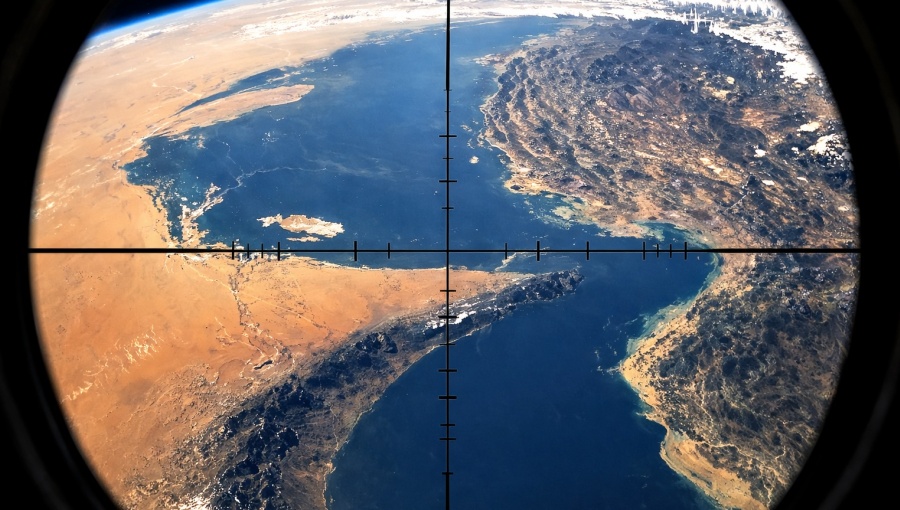
Attacks on commercial vessels across the Persian Gulf, Strait of Hormuz and Gulf of Oman are widening in scope and geography, raising risks for ships at anchor, offshore operations and key regional ports. / bne IntelliNews
By Ben Aris in Berlin March 13, 2026

Attacks on commercial vessels across the Persian Gulf and surrounding waters are intensifying and spreading beyond the traditional shipping lane chokepoint in the Straits of Hormuz, maritime security officials warned.

The Joint Maritime Information Center (JMIC) said in its latest advisory that the regional maritime threat level remains “CRITICAL”, with more than 20 security incidents recorded since hostilities began on February 28, G Captain reported on March 13.

Three vessel strikes were reported in the past 24 hours alone, according to the advisory, signalling a widening operational risk for commercial shipping across the Persian Gulf, Strait of Hormuz and Gulf of Oman. The US has backed away from US President Donald Trump’s pledge to provide naval escorts for commercial shipping to pass through the Straits, saying it was “too dangerous to traverse.”

Analysts said the pattern of incidents suggests the campaign is aimed at broad disruption of maritime trade rather than targeting Western operators.

“The incidents involve a wide range of vessel types and flag states, with no consistent pattern of Western ownership linkage,” the advisory said.

Recent attacks indicate that vessels operating outside traditional transit corridors are now also being targeted, including ships at anchor, port approaches and offshore ship-to-ship transfer operations, G Captain reports.

Among the latest incidents, the tanker Zefyros was struck by projectiles while conducting a ship-to-ship transfer about five nautical miles south of Al Basrah, Iraq, leaving the vessel adrift after a fire. The tanker Safesea Vishnu was also hit during the same operation, with its crew abandoning ship and one reported casualty.

Elsewhere, the container ship Source Blessing was struck by a projectile while anchored roughly 35 nautical miles north of Jebel Ali in the United Arab Emirates, triggering a fire on board but causing no reported injuries.

Other vessels damaged in recent days include the container ship Safeen Prestige, hit in the Strait of Hormuz after a suspected explosive attack, the tanker Sonangol Namibe, which suffered cargo hold damage and an oil leak following an explosion in the northern Arabian Gulf, and the container ship One Majesty, struck by a projectile that caused structural damage.

The attacks have also extended to regional energy infrastructure, with drone strikes reported on fuel storage tanks at the Port of Salalah in Oman.

Shipping through the Strait of has slowed sharply, although Tehran is now introducing an informal permits-for-passage scheme, allowing tankers from mostly Asian countries to pass. Iran’s tanker fleet is operating as normal, according to reports, and is currently exporting more oil than it did pre-war. Pre-war some 20mn barrels of oil a day transited the Straits, but with the new permit scheme and the western pipelines to the Red Sea that has fallen to around 10mb/d.

Automatic Identification System (AIS) monitoring cited by JMIC showed only one confirmed commercial cargo vessel transit through the strait in the past 24 hours, compared with a historical average of about 138 daily crossings.

The security situation has been compounded by widespread electronic warfare affecting navigation systems. JMIC said more than 600 incidents of GNSS and GPS interference had been recorded in the past day, causing AIS anomalies, signal degradation and position errors affecting hundreds of vessels.

Mariners have been advised to increase bridge vigilance and rely on radar and visual navigation methods where satellite-based systems prove unreliable.

JMIC warned that the maritime threat environment across the region is likely to remain highly volatile, with continued risks from missiles, drones and unmanned surface vessels, particularly for ships at anchor, offshore energy installations and vessels engaged in ship-to-ship cargo transfers.

U.S. farmers rush to sell crops as Iran war fuels rally

ByReuters
Published: March 13, 2026 

Soybeans grow in a farm field, Thursday, Oct. 23, 2025, in Willow Grove, Del. (AP Photo/Cliff Owen)

CHICAGO — U.S. grain prices have surged since the Iran war began, triggering a flurry of corn and soybean sales by farmers who squirreled away last year’s harvests due to weak prices.

Since the U.S. and Israel attacked Iran, farmers across the Midwest have capitalized on climbing prices by selling corn, soy and wheat from storage bins to ethanol producers and major traders including Archer-Daniels-Midland ADM.N and Bunge BG.N.

Growers also raced to sign contracts to pre-sell crops they have not yet planted and expect to harvest this year.

The rally was a welcome surprise for farmers and allowed many to lock in modest profits to cover soaring fertilizer, chemical and seed bills, though they said the gains were not enough to end a downturn in the agricultural economy.

Dave Kestel, a farmer in Manhattan, Illinois, said he sold about 40 per cent of the corn and soybeans he harvested last year and roughly 10 per cent of what he expects to harvest in 2026. He had been paying daily charges to store last year’s crops and was eager to unload them when prices jumped.

“I was doing the farmer happy dance,” Kestel said.

Soybean futures Sv1 touched a May 2024 high above $12 per bushel on the Chicago Board of Trade on Thursday. Corn futures Cv1 reached the highest point since May 2025 this week, while wheat Wv1 set the highest level since June 2024.

Last year, prices sagged due to ample supplies and as soy exports suffered due to President Donald Trump’s trade war with China. The U.S. Department of Agriculture has started distributing $12 billion in aid to farmers hurt by Trump’s trade policy.

QUICK TO SELL

Analysts said the aid strengthens balance sheets in the short term but does little to improve underlying profitability.

Farmers were quick to sell crops as they sought to stem losses and questioned how long the rally would last. Corn and soybean prices at times have each been up about 6 per cent from their levels since before the war began.

“We are basically filling all of our grain elevators in North America and in South America as we speak,” Julio Garros, Bunge’s chief operating officer, said during an investor event on Tuesday.

A spike in oil prices because of the war lifted prices for crops used to make biofuels. Also boosting corn prices, the conflict disrupted crucial fertilizer shipments.

The gains were generally enough to allow farmers to make money, though break-even levels vary, said Angie Setzer, partner at advisory firm Consus Ag Consulting.

“When the market rallied big, it provided a lot of opportunities that they had been waiting for,” said Setzer, whose customers sold corn, soybeans and wheat.

Some farmers took chances on the size of their fall harvests. Keaton Lyons, who farms about 1,200 acres in Rensselaer, Indiana, agreed to sell about 100,000 bushels of corn he will soon plant.


“Pricewise, I feel really good,” Lyons said. “The thing that I’m nervous about is we don’t have a kernel in the ground and we’re 65 per cent sold.”


FARMERS SEIZE OPPORTUNITY

Many farmers sold much of last year’s soybean crop in late 2025, but a large share of corn remained unpriced, so the recent surge could really help corn-heavy operations, said Wesley Davis, partner at Meridian Agribusiness Advisors.

As of December 1, growers were storing 14 per cent more corn on farms than a year earlier and 2 per cent more soybeans, U.S. Department of Agriculture data show.

In Waseca, Minnesota, Richard Guse, who farms about 3,500 acres with his brother and son, said he made a small profit selling about a third of his 2025 corn crop to ethanol producer Guardian Energy for $4.25 per bushel this week.

“The prices have run up in a hurry,” Guse said. “It goes down a lot faster than it comes up.”

(Reporting by Tom Polansek. Additional reporting by Karl Plume and P.J. Huffstutter; Editing by David Gregorio)


'On tariffs, we are caught in US domestic politics,' lead Brussels trade lawmaker says

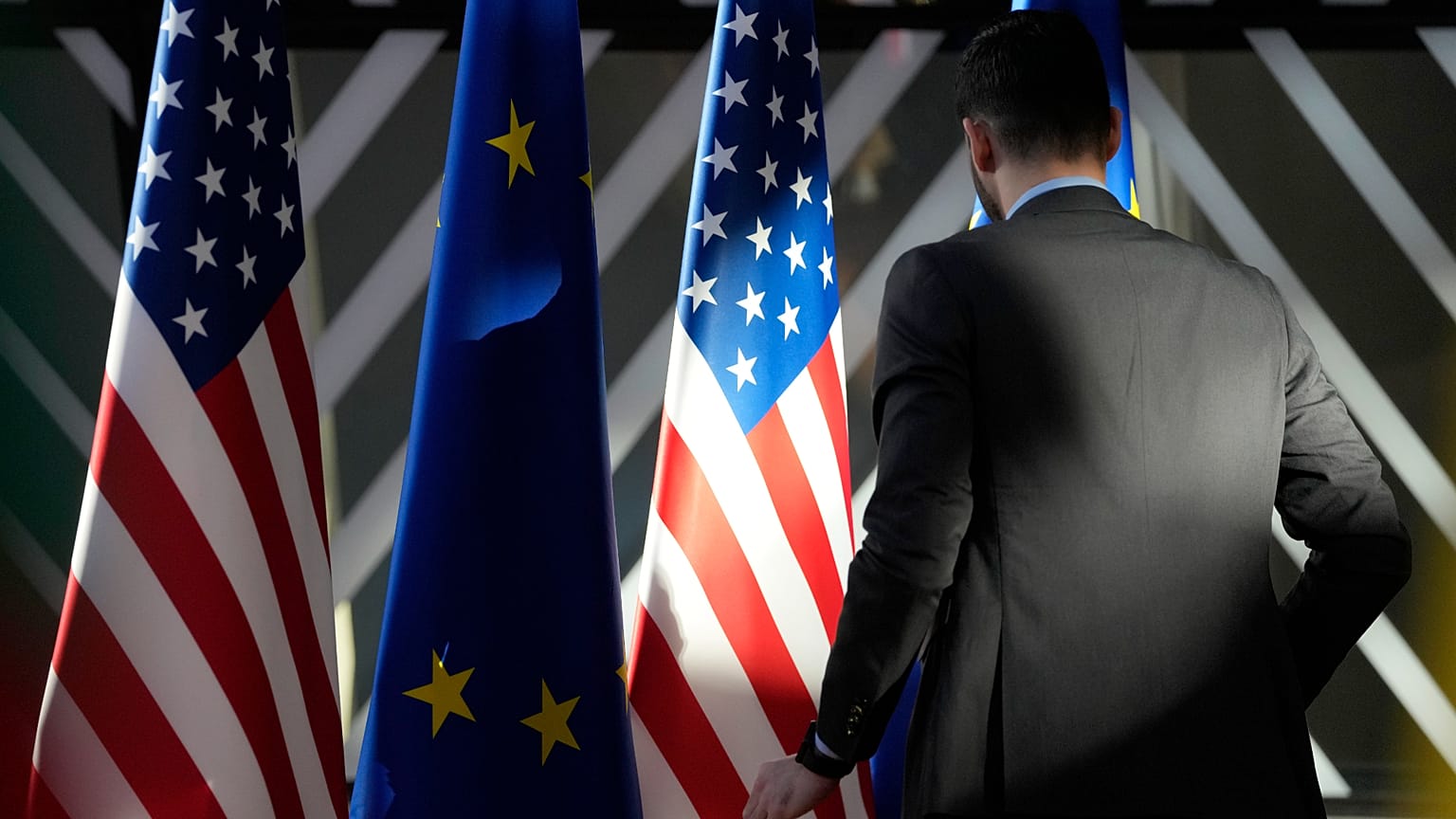
A worker adjusts the US and EU flags prior to the EU-US Energy Council Ministerial meeting on April 4, 2023.
Copyright AP Photo

By Peggy Corlin & Vincenzo Genovese
Published on 

MEPs will reach out to US trade officials next week in a bid to salvage the transatlantic trade deal as Washington opens new investigations on EU goods. But lawmakers worry Brussels is being pulled into an unpredictable standoff driven by US domestic politics.

EU lawmakers in Brussels are worried that the bloc is drifting into the crosshairs of US domestic politics, as the White House launched new trade investigations into EU goods accusing the European Union is "implementing close to zero" of trade commitments.

Next week could prove decisive for the EU–US trade deal struck last summer.

Washington has stepped up pressure on the EU in recent days to implement the agreement cut last summer between the head of the European Commission Ursula von der Leyen and President Donald Trump, tripling tariffs on the EU.

Still, MEPs have kept the implementation process, which also includes investment pledges from the Europeans in the US, frozen, seeking clarity after the Supreme Court of the United States ruled in February that US tariffs imposed in 2025 were illegal.

The fate of the deal remains uncertain after the White House launched new investigations into EU products this week that could lead to tariffs exceeding the 15% ceiling agreed under the pact.

“It is domestic politics and the worst-case scenario has happened: we got involved,” Croatian MEP Željana Zovko, lead negotiator for the European People’s Party, told Euronews.

She added: “We were waiting for the Supreme Court’s decision but now of course this administration will do its utmost to do it its own way.”

In the days following the court’s ruling, the US administration has looked for new legal grounds for tariffs and invoked Section 122 to impose fresh duties of 10% on EU goods, on top of the 4.8% tariffs already in place under most-favored nation regime.

The provision allows temporary duties for a maximum of 150 days, after which the US Congress would need to agree an extension. The Supreme Court suggested in its initial ruling that the President had exceeded his powers under emergency grounds.

As Washington looks for a way to make the tariff salvo permanent, it is also increasing the pressure on allies by opening new investigations into trading partners including the EU over alleged unfair trade practices. China and India were also targeted.

The probes could pave the way for tariffs above the 15% ceiling agreed in the deal struck in July 2025 by Ursula von der Leyen and Donald Trump in Turnberry, Scotland.

Next week will be pivotal for the EU-US deal

“Now uncertainty is increasing even more for our businesses,” Zovko said.

Since the court ruling, the EU has sought clarity from Washington on whether the Turnberry agreement signed last year still stands or has been broken.

US officials assured EU trade chief Maroš Šefčovič they would stick to the deal, though they have not detailed how the 10% tariffs after the court ruling will be replaced in the long-term. In return, the US expects the EU to implement the agreement fully and quickly.

US Trade Representative Jamieson Greer raised the temperature on Wednesday, lashing at the Europeans on the basis that “the EU has done approximately zero percent of what they were supposed to do for their trade deal with us.”

This week’s investigations should be taken seriously, German MEP Bernd Lange (S&D) told Euronews, despite the erratic moves by the US administration since the court ruling

“Section 301 will allow the US to differentiate between countries and therefore add pressure to each of them,” he said.

Next week could be pivotal for the EU–US trade deal.

Italian MEP Brando Benifei (S&D) will travel to Washington hoping to meet Greer. He may be joined by Lange, the chair of the EU trade committee, on Monday although a decision has not been made yet.

The trip comes as negotiators in the European Parliament must decide whether to resume work on the agreement or postpone the vote once more. A vote is required to cut EU duties on US goods to zero, as foreseen in the Turnberry deal.

But political groups remain divided.

“When I read what the socialists are saying, I'm losing hope that we will have a vote, despite reassurance given by Iratxe García Pérez [Spanish MEP, chair of the S&D] and Bernd Lange,” a source at the EPP told Euronews.

Benifei said the EU needs a clear political signal from Washington that it will stick to the deal, otherwise “there is no way we can vote on the file.”

Half of Americans are against Canadian tariffs, preferring to keep CUSMA intact, survey finds

By Anam Khan
BNNBloomberg.ca

Picture of the Canadian flag taken in Ottawa. Ottawa is the capital city of Canada, and a major hub for economy, politics and business in America.

Most Americans do not want to cut Canada out of the Canada-U.S.-Mexico Agreement (CUSMA), according to new data released Wednesday from the Angus Reid Institute.

A new survey finds that twice as many Americans want to keep the trade deal as those who want to end it. Three quarters of Americans have a favourable view of Canada, with more than half of the population describing it as “the most important” or a “very important” trading partner to the U.S.

The poll found about 51 per cent of the American population would not even tariff Canadian goods if they had it their way.

Furthermore, Trump’s MAGA Republican base is more likely to want tariffs, but about half say they prefer splitting Mexico and Canada and negotiating separate deals, than not.


American views of Canada and CUSMA


There has been a great sense of betrayal among Canadians during Trump’s second term in office following the imposition of sweeping tariffs and his repeated public suggestions that Canada should be annexed as the 51st state, the survey finds.

And while some Canadians might be angry, three-quarters of Americans still have a “friendly” view of Canada.

This is despite the counter actions taken by the Canadian government in response to U.S. tariffs, which includes Canadians avoiding U.S. travel and removing American liquor off shelves, both of which were called ‘nasty’ by the American ambassador to Canada.

Canada’s favorability rating in the U.S. is currently higher than that of any other major American allies, with the United Kingdom at 68 per cent favourable and the European Union at 60 per cent, the poll found.


American perception of Trump’s tariffs


While U.S. inflation has cooled under Trump, his administration’s tariffs had an inflationary effect on retail prices last year, with the New York Federal Reserve President claiming that the tariffs have kept inflation under the U.S. Federal Reserve’s two per cent goal, the survey finds.

Meanwhile, two thirds of Americans believe that tariffs are mostly paid by American consumers and businesses, while the rest believe the cost is passed to foreign companies or spread among domestic consumers, businesses and foreign companies and governments.

More than half of Americans disapprove of Trump’s tariff policies (57 per cent), nearly double the rate of approval (30 per cent).


Top issues for Americans


According to the survey, nearly half of Americans are most concerned about the cost of living, while roughly one-third prioritize government corruption and healthcare costs.

Political leanings appear to influence what issues Americans prioritize, but the high cost of living ranks high across the board.


While MAGA supporters focus on the border and crime, other Republicans have a different take on healthcare. Meanwhile, Democrats are more concerned with the fallout from U.S. Immigration and Customs Enforcement (ICE) crackdowns than their Republican counterparts.


METHODOLOGY


The Angus Reid Institute conducted an online survey from March 2 5, 2026 among a representative randomized sample of 1,529 American adults who are members of Angus Reid Forum USA. For comparison purposes only, a probability sample of this size would carry a margin of error of +/- 3 percentage points, 19 times out of 20. Discrepancies in or between totals are due to rounding. The survey was self-commissioned and paid for by ARI.


Anam Khan

Journalist, BNNBloomberg.ca
March 11, 2026 

Price shocks from Iran war could give Canada leverage in CUSMA talks: experts

ByThe Canadian Press
March 13, 2026 

WASHINGTON — Countries around the world are grappling with skyrocketing costs for key commodities like oil and fertilizer as the war with Iran continues to upend global trade.

With no end in sight, the war is likely to cast a shadow over trade negotiations ahead of the mandatory review of the Canada-U.S.-Mexico Agreement on trade — and could ultimately offer Canada more leverage in those talks.

“If you’re sitting in Washington and you’re seeing what’s happening to global markets, you’re going to be looking at your secure producers and suppliers perhaps slightly differently from the way you … might’ve been looking at them before the conflict began, which was solely in tariff terms,” said Fen Osler Hampson, a professor of international affairs at Carleton University in Ottawa and co-chair of the Expert Group on Canada-U.S. Relations.

Crude oil and natural gas prices shot up after Iran essentially closed the Strait of Hormuz in response to the United States-Israel bombing campaign.

A fifth of the world’s oil typically sails through the strait.

But oil and gas are not the only commodities being affected.

Fertilizer inputs and potash are also being held up, causing global prices to spike with just weeks to go until planting season.

American farmers are already feeling the brunt of U.S. President Donald Trump’s erratic foreign and trade policies. The Trump administration provided a financial bailout last year after farmers were pummeled by increased costs and dropping sales due to the president’s worldwide tariffs.

Aluminum prices also jumped after the Iran war began, sending shock waves through American industries already staring down Trump’s separate 50 per cent tariffs on the product.

Canada is an alternative supplier for many of those key commodities. Trump has claimed repeatedly that the United States doesn’t need anything from Canada; the war in the Middle East might suggest otherwise.

“Suddenly, your closer partners, with whom you might have had a slightly antagonistic relationship … it may be time to play nice because they have things that (Trump) wants in abundance,” Hampson said.

The relationship between Canada and the United States has been upended by Trump’s tariffs and his repeated calls for Canada’s annexation. Trump called Prime Minister Mark Carney a “governor” in a social media post earlier this week.

Canadian and Mexican officials have been preparing for tough negotiations on the continental trade pact known as CUSMA, which has been shielding both countries from the worst effects of Trump’s tariffs.

Trump has put into question his commitment to CUSMA, which was negotiated during his first administration. The president has called the deal “irrelevant” and has said it may have served its purpose.

The CUSMA review sets up a three-way choice for each country to make in July. They can renew the deal for another 16 years, withdraw from it or signal both non-renewal and non-withdrawal — which would trigger an annual review that could keep negotiations going for up to a decade.

Trump did have a lot of leverage going into the CUSMA review. His ever-changing tariff policy kept Canada and Mexico on edge and slowed investment as businesses in both countries searched for stability.


The Trump administration also has other tools to pressure the United States’ closest neighbours.

The Department of Justice recently launched an antitrust investigation into fertilizer producers — including Saskatchewan’s Nutrien — around collusion and price-fixing, Bloomberg reported last week.

The government of Saskatchewan is aware of the investigation, the province’s Ministry of Energy and Resources said in a media statement.

“Fertilizers are globally traded commodities in a highly competitive environment,” the statement said. “Pricing is determined by the market, not the producing companies.”

While it’s not clear if that investigation is directly linked to CUSMA negotiations, potash is certainly on the Trump administration’s mind as the Iran war continues.

Luke Lindberg, the undersecretary for trade and foreign agricultural affairs at the U.S. Department of Agriculture, told Politico recently that “any company or any part of the fertilizer supply chain who tries to use this opportunity to price-gouge American farmers and ranchers will not be tolerated, and I think that is the message that will be clearly delivered.”

The Iran conflict and the price shocks it has triggered should remind Washington that the United States depends on other nations when it sits down to talk about the future of CUSMA, said Inu Manak, senior fellow for international trade at the Council on Foreign Relations.

“We need to have trusted partners if we’re going to actually address some of these challenges and survive these shocks,” Manak said.

As a major commodity producer, Canada is essential to the U.S. industrial base, she added, pointing to potash, oil and the integrated market.

“I think in a way, the mindset going into the negotiations now is potentially shifting a bit and giving Canada space to sort of focus on those issues and to say, ‘Look, we want to work with you. We have been working with you for a very long time. Here are the things that maybe we can do to strengthen those bonds rather than to weaken them,’” she said.

Manak said Canada may also have gained leverage from the deep unpopularity of the Iran war among Americans — who are preparing to go to the polls for midterm elections in November.

That doesn’t mean Trump’s threats will stop, she added.

“Buckle up for a lot of uncertainty.”

This report by The Canadian Press was first published March 13, 2026.

— With files from Jeremy Simes in Regina and The Associated Press

Kelly Geraldine Malone, The Canadian Press

Canada among countries under investigation by Trump administration
March 13, 2026 

WASHINGTON -- The Trump administration has expanded its trade investigations to 60 countries, including Canada, in an effort to shore up the president’s tariff policies.

“We are trying to move very quickly,” United States Trade Representative Jamieson Greer told CNBC Friday. “We are trying to move in a matter of months.”

Greer’s office announced Wednesday that it was launching investigations of excess industrial capacity in the European Union and a handful of other countries under Section 301 of the Trade Act of 1974.

A Thursday evening news release from the office expanded the list of countries targeted by the investigations, citing forced labour.

“Despite the international consensus against forced labor, governments have failed to impose and effectively enforce measures banning goods produced with forced labor from entering their markets,” Greer said in the news release.

“For too long, American workers and firms have been forced to compete against foreign producers who may have an artificial cost advantage gained from the scourge of forced labor.”

Canada is aware of the latest trade investigation, said Canada-U.S. Trade Minister Dominic LeBlanc’s spokesperson.

“We are committed to working with our (Canada-U.S.-Mexico Agreement) partners to further a North American approach to tackling forced labour in international supply chains, as we have done over the last number of years,” Gabriel Brunet said in an email.

The new investigations are meant to give President Donald Trump a legal basis to continue his worldwide tariff agenda.

Last month, the U.S. Supreme Court struck down Trump’s favourite tariff tool, which he used for his “Liberation Day” tariffs and fentanyl-related duties on Canada, Mexico and China.

In response to the top court’s ruling, Trump implemented a 10 per cent worldwide tariff using Section 122 of the 1974 Trade Act. Those tariffs do not apply to goods compliant with the Canada-U.S.-Mexico Agreement on trade.

Section 122 tariffs can only increase to 15 per cent and expire after 150 days unless Congress votes to extend them. An extension would be unlikely to get the approval of Congress.

Canada is also being hammered by Trump’s separate Section 232 tariffs on specific industries, including steel, aluminum, automobiles and cabinetry.

Trump is hoping to implement longer-term tariffs through Section 301 investigations but the process does require public consultations and reports.

Greer told CNBC that “if we find that countries have been involved in unfair trading practices” — such as subsidies, excess capacity or forced labour — “we can quantify that harm to U.S. commerce and then try to resolve that issue with that country.”

If the country doesn’t resolve the issue, Greer said, the Trump administration will impose tariffs.


It’s not immediately clear what the 301 investigation of Canada could cover, or if it will look beyond the justification of “forced labour.”

The Federal Register notice published by the trade representative’s office about the investigation says that “Canada, Mexico, and the European Union have adopted measures intended to stop the importation or sale of products produced using forced labor.”

Canada already has legislation intended to curb forced labour in supply chains, which requires annual reports to the federal government. Canada has rules forbidding forced labour in supply chains and free trade agreements.

There are other long-standing irritants in the Canada-United States trading relationship and Trump has complained repeatedly about Canada’s dairy supply management system.

The 301 investigations are launching as Canada, Mexico and the U.S. prepare for a mandatory review of the Canada-U.S.-Mexico Agreement on trade, better known as CUSMA.

Trump has cast doubt on his commitment to the trade pact, which was negotiated during his first term. He has called it “irrelevant” and has said it may have served its purpose.

The U.S. has officially launched negotiations on the CUSMA review with Mexico, which is also subject to a 301 investigation. Ottawa and Washington have not announced a similar move.

While Greer has claimed often that Canada has barriers that make it difficult to negotiate — he has cited provincial bans on sales of U.S. alcohol — he met with Canada’s new trade team in Washington last week.

Canada’s chief trade negotiator Janice Charette and newly appointed Ambassador to the United States Mark Wiseman were joined by Canada-U.S. Trade Minister Dominic LeBlanc in the meeting.

This report by The Canadian Press was first published March 13, 2026.

Kelly Geraldine Malone, The Canadian Press


Trump seeks to close US$1.6 trillion revenue gap with raft of new tariffs

By The Associated Press
 March 14, 2026 

Containers are piled up at a cargo terminal in Frankfurt, Germany, Monday, March 9, 2026. (AP Photo/Michael Probst)

WASHINGTON — The Trump administration this week stepped up its ambitious effort to replace about US$1.6 trillion in lost tariff revenue that was eliminated by the U.S. Supreme Court’s decision to strike down a range of the president’s import taxes.

Recovering that lost revenue, which the White House was counting on to help offset the steep, multi-trillion dollar cost of its tax cuts, is possible but will be challenging, experts say. The administration has to use different legal provisions to impose new duties, and those provisions require longer, complex processes that U.S. companies can use to seek exemptions. It could be months or more before it is clear how much revenue the replacement tariffs will yield.

“I wouldn’t bet against this administration being able to get back on paper the same effective tariff rate they had before,” said Elena Patel, co-director of the Urban-Brookings Tax Policy Center. But the new approach will “make it easier for people to contest the tariffs, which is going to put a big asterisk on the revenue until all that is settled.”

On Wednesday, U.S. Trade Representative Jamieson Greer said the administration will investigate 16 economies — including the European Union — over whether their governments are subsidizing excessive factory capacity in a way that disadvantages U.S. manufacturing. The investigation will also cover China, South Korea, and Japan, Greer said.

In addition, he said there would be a second investigation of dozens of countries to see if their failure to ban goods made by forced labor amounts to an unfair trade practice that harms the United States. That investigation will also cover the EU and China, as well as Mexico, Canada, Australia, and Brazil.


Both investigations are being conducted under Section 301 of the 1974 Trade Act, which requires the administration to consult with the targeted countries, as well as hold public hearings and allow affected U.S. industries to comment. A hearing as part of the factory capacity investigation will be held May 5, while a hearing on the forced labor investigation will occur April 28.

It’s a far cry from the emergency law that President Donald Trump relied on in his first year in office, which allowed him to immediately impose tariffs on any country, at nearly any level, simply by issuing an executive order.

Moments after the Supreme Court’s ruling, Trump imposed a 10 per cent tariff on all imports under a separate legal authority, but that duty can only last for 150 days. The president has said he would raise it to 15 per cent, the maximum allowed, but has yet to do so. Some two dozen states have already challenged the new tariffs. The administration is aiming to complete its Section 301 investigations before the 10 per cent duties expire.

The effort underscores the importance that the Trump White House has placed on tariffs as a revenue-raiser at a time when the federal government is facing huge annual budget deficits for decades into the future. Previous administrations, by contrast, used tariffs more sparingly to narrowly protect specific industries.

Erica York, vice president of federal tax policy at the Tax Foundation, noted that the first investigation covers roughly 70 per cent of imports, while the second would cover nearly all of them.

“That breadth suggests the goal isn’t to address the issues at hand, but instead to recreate a sweeping tariff tool,” she said.

Trump sees tariffs as a way to force foreign countries to essentially help pay the cost of U.S. government services, even though all recent economic studies find that American companies and consumers are paying the duties, including ones from the Federal Reserve Bank of New York and economists at Harvard University. In his state of the union address last month, Trump even touted his tariffs as a potential replacement for the income tax, which would return the United States’ tax regime to the late 19th century.

Trump also wants tariffs to help pay for the tax cuts he extended in key legislation last year. The tax cut legislation is expected, according to the most recent estimates by the nonpartisan Congressional Budget Office, to add $4.7 trillion to the national debt over a decade, while all Trump’s duties, including ones not struck down by the court, were projected to offset about $3 trillion — or two-thirds of that cost.

The court’s ruling Feb. 20 that he could no longer impose emergency tariffs eliminated about $1.6 trillion in expected revenue over the next decade, according to the CBO.

Some of Trump’s tariffs remain place, including previous duties on China and Canada that were imposed after earlier 301 investigations. The administration has also slapped tariffs on some specific products, including steel, lumber, and cars. Those, combined with the 10 per cent tariff for part of this year, should yield about $668 billion over the next decade, the Tax Foundation estimates.

“It’s going to take a really big patchwork of these other investigations to make up for the (lost) tariffs,” York said.


The administration’s efforts are also unusual because they reflect an overreliance on tariffs to bring in more government revenue. Trump has also said the duties are intended to return manufacturing to the United States, and he has used them to leverage trade deals.

“What makes this really different,” said Kent Smetters, executive director of the Penn Wharton Budget Model, “it is really the first time tariffs have been mainly used as a revenue raiser.”

Patel, meanwhile, argues that raising revenue can be done more reliably and straightforwardly by Congress. Laws like Section 301 are traditionally intended to be used to address specific trade policy concerns in particular countries.

“It’s not supposed to be there to raise revenue,” she said. “If we want to raise revenue through tariffs, then Congress should impose a broad based tariff.”

Christopher Rugaber, The Associated Press

Canadian PM Carney defends record as economy sheds 84,000 jobs in February

ByStephanie Ha
March 13, 2026

Prime Minister Mark Carney steps off a government plane as he arrives in Oslo, Norway, Friday, March 13, 2026. THE CANADIAN PRESS/Adrian Wyld

OTTAWA - Prime Minister Mark Carney is defending his economic record amid the latest Statistics Canada jobs report that showed the unemployment rate rose to 6.7 per cent in February, up two points from the previous month.

Canada’s economy also unexpectedly lost 84,000 jobs in February, the biggest Canadian job loss in four years.

Many economic analysts expected the labour market would gain 10,000 jobs in February.

Speaking to reporters in Bardufoss, Norway on Friday, Carney was asked directly about his handling of the economy.

“If you look at the performance of the labour market over the course of the last six months, we’ve created over 80,000 jobs net over the last six months,” Carney said. “The United States has created 6,000 jobs. The United States, 11 times the size of our economy.”


“Unemployment (of) 6.7 per cent is lower than the level when I came into came into office a year ago,” he added.

After Carney won the federal election, unemployment hit 7.0 per cent in May 2025 – the highest level since September 2016 outside of the pandemic.
Uncertainty surrounding trade with U.S.

The prime minister also acknowledged the uncertainty surrounding the trading relationship with the United States as a factor in the current economic picture.

“Given the scale of the trade actions, the uncertainty that is associated, as well as with the trade actions by the United States, that that is causing big adjustments in the Canadian economy,” Carney said. “That’s why we’re making major investments across a whole range of areas.”

During last year’s federal election campaign, Carney pledged to create higher paying jobs and build the fastest growing economy in the G7.

Last month, the Liberal government unveiled its new defence industrial strategy aimed at creating 125,000 jobs by 2035.

Conservative Leader Pierre Poilievre, meanwhile, is blaming Carney in part for the latest jobs report.

“We are saddened to see that Canada is in the weakest position after a year of Mark Carney,” Poilievre said while in Windsor, Ont. on Friday. “It is true, we do have global problems, and we cannot discount or try to control what President Trump does. But all the countries are facing those tariffs.”


Stephanie Ha

Supervising Producer, Ottawa News Bureau, CTV News
Canada is racing to refine this key battery ingredient at home


Updated: March 10, 2026 

Canada’s battery supply chain story has a weak link: graphite.

Even if Canada mines lithium and builds battery plants, electric vehicles still need a lot of graphite for the anode, and most battery-grade processing is concentrated in China, which refines 90 per cent of the world’s supply.

Now, there is a concrete Canadian move to bring the refining process home.

Canadian mineral exploration company Nouveau Monde Graphite is backed by government funding and has supply deals with major buyers.

“We cannot just once again repeat the model that’s been used in the past, where we extract the resource, send it elsewhere to be refined and then purchase it back,” said Julie Paquet, a spokesperson for Nouveau Monde Graphite (NMG).

Last month, the company secured a binding offtake agreement and a US$25 million investment from Panasonic Energy to support its Phase-2 Matawinie Mine and Battery Material Plant in Bécancour, Que.

Panasonic agreed to buy 13,000 tonnes of active anode material per year.

NMG also signed a deal to supply 18,000 tonnes per year of battery-ready anode material to General Motors.

Canada has the world’s 10th-largest graphite reserves, according to Natural Resources Canada.

Those deals matter because they help Canada move faster to build out its own supply chain, says Max Yerrill, a critical minerals analyst at BMO Capital Markets.

He says by increasing its graphite capacity and suppressing global prices, China has kept competitors out. It also used its leverage in the critical minerals markets, specifically graphite, and put export restrictions on it, creating a significant strategic vulnerability for Canada’s green energy goals.

“So building graphite in our own backyard is a huge strategic advantage, because it helps us maintain sovereignty,” says Yerrill.Canada unlocks $12B in critical mineral deals as minister calls supply chains ‘national security’
‘Huge stamp of approval’

These high-profile deals put Canada’s graphite sector on the map as a legitimate global player, explains Yerrill.

Panasonic Energy is a key battery supplier to major automakers, including Tesla.

“When a company like Panasonic is willing to partner with a Canadian company, it’s a huge stamp of approval,” he said, adding that the process for Panasonic to buy graphite can take years.

“It signals to the market that they’ve done their homework. They know what they’re doing.”
Jumbo flakes of graphite from Nouveau Monde Graphite’s Phase 2 Matawinie Project (Credit: Nouveau Monde Graphite)

The Japan-based company, which operates globally, told BNN Bloomberg it is focusing on building a stable and resilient supply chain in North America while also reducing its carbon footprint.

“We have set a medium- to long-term goal of achieving a 50 per cent local procurement rate in North America,” a Panasonic spokesperson said in an email.

Paquet says NMG is already seeing domestic interest and that the Canadian government is providing a framework to secure supplies.
Canada is copying China’s strategy

China’s critical mineral industry has grown massively because it gives huge subsidies to its domestic producers, “which has allowed them to continue to operate at rock-bottom commodity prices,” says Yerrill.

“What we’re seeing is the Canadian government is doing the same thing. We’re providing incentives, financing, price support for our domestic producers in order to avoid the supply chain reliance,” says Yerrill.

NMG is heavily backed by government support as Canada moves to secure critical mineral supplies.

The Matawinie Mine, which is 120 km north of Montréal, Que., was selected as one of the projects by the government’s Major Project Office last year. The office identified the mine as part of Canada’s “strategy to be a powerhouse in the extraction and upgrading of critical minerals.”Five things to know about Quebec graphite mine added to major projects list

Rendering of Nouveau Monde Graphite’s Phase-2 Matawinie Mine. The project is designed for a 25-year life of mine with a planned production of approximately 106,000 tonnes per annum (tpa) of graphite concentrate. (Credit: Nouveau Monde Graphite).

The Canada Growth Fund (CGF) said it invested US$25 million in Nouveau Monde in December 2024 as part of a US$50 million private placement alongside Investissement Québec to support pre-final investment decision spending.

A spokesperson for CGF told BNN Bloomberg that its investment in NMG “is the only one it has made to date in the graphite sector.”

Yerrill says money is always an issue when building a new mining and refining process.

“It’s a huge de-risking event for that company because they know there’s a backer with deep pockets that’s willing to help them get into production,” says Yerrill.

Paquet said Nouveau Monde is aiming to launch construction on the Matawinie mine this spring, with commercial production expected by late 2028. Paquet said the Bécancour battery material plant would follow, with the goal of starting commercial-scale production around early 2029.


Anam Khan
Journalist, BNNBloomberg.ca
Carney says Canada a reliable oil exporter with moves to increase production


ByThe Canadian Press
March 14, 2026 

Commander of Brigade North of the Norwegian Army, Brig.-Gen Terje Bruoygard, left, speaks with Prime Minister Mark Carney and Norwegian Prime Minister Jonas Gahr Store, right, as they view a demonstration at the site of NATO Exercise Cold Response in Bardufoss, Norway, Friday, March 13, 2026. THE CANADIAN PRESS/Adrian Wyld

OSLO — Prime Minister Mark Carney and Norwegian Prime Minister Jonas Gahr Store touted their reputations as low-risk global oil producers on Saturday, as they met in Oslo and agreed to deepen ties on everything from Arctic security to space, critical minerals and energy.

Carney and Store held bilateral talks where the war in Iran and its impact on global oil supply chains were front and centre.

“From Norway’s perspective, from Canada’s perspective, we are low-risk producers of oil, we are low risk producers of natural gas,” Carney said during a media scrum with Store at the Holmenkollen Skifestival.

His comments came as world oil markets are reeling from the war in the Middle East, which has closed of oil shipments through the Strait of Hormuz, through which about one-fifth of global oil is normally shipped.

On Wednesday, the 32 member countries of the International Energy Agency, including Canada, agreed to a co-ordinated release of 400 million barrels of oil, the largest such emergency release in IEA history.

On Friday, Canada announced it would increase its oil production by 23.6 million barrels as part of that.

“That will provide additional, not in the short term but in the medium term -- again, very low carbon oil in terms of production and transportation, which is one of the reasons why it’s attractive,” Carney said.

While most of the emergency release comes from IEA member oil reserves, Canada and Norway, as net oil exporters, are not required to hold oil reserves. Upping production is the only way they can contribute.

“The rules are you should have at least 90 days reserves for those importers,” Carney said. “What we do is we provide oil to the global market. We will continue to do so because we are a safe, low-risk, low-cost, and increasingly low-carbon exporter,”

The prime minister also met Saturday with Norwegian energy company Equinor to talk about the proposed $14 billion Bay du Nord oil project off the coast of Newfoundland. Canada approved the project, which sits about 500 kilometres east of St. John’s, in 2022, but Equinor has not yet made a final investment decision.

Carney called it a “very attractive project” that Canada wants to move forward. Equinor is expected to make its decision in 2027, and the first oil would not be produced until 2031.

“Again, very low-carbon oil in terms of production and transportation,” Carney said.

Environment groups in Canada, however, are skeptical of the project, and say it contradicts Canada’s promise to stop subsidizing oil and gas production.

A spokesperson for Carney said the prime minister also met with Landsvirkjun, the national energy company of Iceland.

Carney also met with Maersk, an international shipping company responsible for about 15 per cent of global container traffic, the spokesperson said.

Carney’s trip to Norway began Friday, when he witnessed NATO exercises in Bardufoss, in the northern part of the country, as Canadians absorbed news that in February, Canada lost 84,000 jobs.

Carney acknowledged that any job loss is difficult for the families affected by it, but said the government is not only looking for long-term investments, but also providing some short-term aid, in the form of an income tax cut and an increase to the GST credit.

“And the government is very focused on growing this economy and part of how we’re going to grow this economy, yes, it’s immediate measures, as I’ve just indicated, but it’s also getting the confidence and the investment in the country,” he said. “A country that’s more independent, that’s diversifying our partnerships, that’s building first and foremost at home, and then secure abroad.”

Carney said wages have grown faster than inflation in recent months, though he also acknowledged they haven’t yet caught up to overall inflation over the last few years.

Carney said that the government is moving forward with a variety of significant projects, and pointed to new military bases and the upcoming construction of the Mackenzie Valley Highway announced in Yellowknife at the start of this trip.

The prime minister also touted the creation of the Major Projects Office to speed up approvals of nation building projects. A senior official briefing reporters on the trip -- under the condition they not be named -- said the office has not yet issued an approval but several projects are under consideration.

Carney and Store had a working dinner at the Norwegian prime minister’s residence, after which they issued a joint statement committing to work closely on areas like critical minerals, outer space security, developing critical minerals and supporting Ukraine in its war with Russia.

The two nations also agreed to hold a ministerial conference, in co-operation with Ukraine, in Toronto at the end of September, focused on returning Ukrainian prisoners of war, unlawfully detained civilians and children forcibly transferred to Russia.

During the visit to Holmenkollen, just north of Oslo, Carney met with some Canadian athletes competing in the International Ski Federation Nordic World Cup. This included Olympians Alison Mackie and Xavier McKeever.

Canadian media were informed that Carney also met with the king and queen of Norway at the Holmenkollen Skifestival, but that was a closed event.

“The like-mindedness is really based on some key economic foundations,” Store said during the media scrum.

“Prime Minister Carney, during this year, has made a real new boost in that relationship across the Atlantic. And we sometimes call Canada an honorary Nordic.”

Carney and Store are scheduled to meet with the leaders of four other Nordic nations on Sunday.

Store said that the meeting was convened after he told the leaders of Iceland, Denmark, Finland and Sweden -- collectively known as the Nordic Five -- that Carney was going to be in Norway.

David Baxter, The Canadian Press
‘Energy warfare’: The impact of the Iran war on the global energy market
CTV NEWS
Published: March 14, 2026 

In this satellite photo from Planet Labs PBC, Iran's Kharg Island is seen on Feb. 26, 2026. (Planet Labs PBC via AP)

The toll of the Iran war on global energy supplies has been clear: Iran’s effective closure of the Straight of Hormuz has dramatically disrupted the transit of millions of barrels of oil a day.

Now, the U.S. has hit military targets on Kharg Island – said to be crucial to Iran’s economy – but so far has not hit key oil infrastructure.

“It would also be a massive escalation if they went after specifically the oil terminal, but this war is proving to be unpredictable,” said Sajjan Gohel, international security director of the Asia-Pacific Foundation, in an interview with CTV News.

The island handles about 90 per cent of Iran’s oil exports.

The former CEO of the Canada Energy Regulator said targeting the oil terminal could have a major impact.


“If the oil-producing infrastructure in Iran also is damaged, in the long term that means these price shocks could continue for quite a while after the conflict ends,” said Gitane De Silva in an interview with CTV News.

U.S. President Donald Trump has not targeted the energy infrastructure in Iran so far, but said “the United States will be bombing the hell out of the shoreline, and continually shooting Iranian Boats and Ships out of the water,” in one of several Saturday social media posts where he vowed to “one way or another” open the Straight of Hormuz.


“Iran has very much decided on energy warfare,” said Gohel.

Iran’s deliberate disruption of the flow of oil through the Straight of Hormuz, which accounts for about 20 per cent of global oil supplies, has caused significant price shocks across global energy markets.

Richard Masson, former CEO of the Alberta Petroleum Commission, said, “I think the whole situation is just continuing to spiral downward.”

But Saturday, Trump made an apparent call on social media for a co-ordinated and collaborative effort to get ships moving though the passage again.

“The countries of the World that receive oil through the Hormuz Straight must take care of that passage, and we will help,” he wrote.


Gohel warned of the potential broadening of the conflict, saying, “This is spreading and it’s roping in more countries as we speak.”

Experts have warned that if the U.S. were to strike oil infrastructure in Iran it would destabilize the global energy market far beyond what we’ve already seen.

We don’t have to have reserves’: Carney

Meanwhile, the 32-member countries of the International Energy Agency (IEA), of which Canada is a founding member, have agreed to release hundreds of millions of barrels of oil from emergency reserves, in an effort to provide short-term relief to global energy markets.

Industry experts have called the move an important step but warn it won’t fill the void.

“It’s the equivalent of about 3 million barrels a day, whereas there’s between 9 and 10 million barrels a day that aren’t able to transit through the Straight of Hormuz,” said De Silva.

“It could be helpful, but it won’t resolve the problem in the immediate term.”

Prime Minister Mark Carney was asked Saturday why Canada doesn’t maintain a strategic reserve itself.

“The exporters of oil, like Norway, like Canada, we don’t have to have reserves because we’re providing oil to the market,” the prime minister told reporters.

De Silva says setting up a reserve would be costly and notes energy companies themselves keep their own reserves.

“They do have a stockpile that they keep in case of possibly a pipeline outage or other things. So certainly it’s not like if we stop pumping oil today, we’d run out tomorrow,” she said.

“I think there’s a question about right now in this moment, are public funds better spent on that or are public funds better spent on supporting the infrastructure needed to get those goods to market?”


Jeremie Charron

Journalist, CTV National News