Saturday, March 14, 2026

Red fox stowaway from UK finds shelter in NY’s Bronx zoo after transatlantic trip


After a journey from Southampton, England, to New York, a red fox that slipped onto a cargo ship is the care of the Bronx Zoo, according to zoo officials. Once the 11-pound male fox gets a clean bill of health from veterinarians, zookeepers said they would be looking for a long-term home for the animal.


 14/03/2026 -
By: FRANCE 24

There are tens of thousands of urban foxes in Britain, according to academic research. © Loic Venance, AFP

A red fox that managed to slip onto a US-bound ship in Britain was discovered by customs officers in the Port of New York, a zoo in the city has said.

The animal that zookeepers believe to be around two years old somehow boarded a vessel in Southampton, England, and was detected on arrival at the Port of New York and New Jersey, the Bronx Zoo said late Wednesday.

Once veterinarians give the 11-pound male fox a clean bill of health, zookeepers said they would be looking for a long-term home for the animal, which is said to be doing well.

"The Bronx Zoo regularly works with officials to help rescue wildlife that is illegally trafficked through nearby ports and airports," the zoo said.

Red foxes are one of the most prevalent carnivorous mammals globally and are found in Europe, Asia and North America as well as in parts of Africa.

There are tens of thousands of urban foxes in Britain, according to academic research, and Britain has some of the highest-density fox populations in the world.

They have been a part of the city landscape since the 1930s, when urban sprawl began to encroach on their rural territory.

(FRANCE 24 with AFP)


Fantastic Mr Stowaway: Fox sails from Britain to New York port

By AFP
March 12, 2026


There are tens of thousands of urban foxes in Britain, according to academic research - Copyright AFP LOIC VENANCE

A red fox that managed to slip onto a US-bound ship in Britain was discovered by customs officers in the Port of New York, a zoo in the city has said.

The animal that zookeepers believe to be around two years old somehow boarded a vessel in Southampton, England, and was detected on arrival at the Port of New York and New Jersey, the Bronx Zoo said late Wednesday.

Once veterinarians give the 11-pound male fox a clean bill of health, zookeepers said they would be looking for a long-term home for the animal, which is said to be doing well.

“The Bronx Zoo regularly works with officials to help rescue wildlife that is illegally trafficked through nearby ports and airports,” the zoo said.

Red foxes are one of the most prevalent carnivorous mammals globally and are found in Europe, Asia and North America as well as in parts of Africa.

There are tens of thousands of urban foxes in Britain, according to academic research, and Britain has some of the highest-density fox populations in the world.

They have been a part of the city landscape since the 1930s, when urban sprawl began to encroach on their rural territory.
Shark nets planned for €100 million Club Med resort threaten endangered species in South Africa

Scientists warn that proposed shark nets for protecting swimmers near a new €100 million Club Med resort in South Africa could threaten a host of endangered species, calling for a full environmental impact assessment to prevent endangered marine life from becoming casualties of the luxury resort project, on track to open in July.


Issued on: 14/03/2026 
FRANCE24
By: Eunice Masson


Members of the KwaZulu-Natal Sharks Board retrieve a dead Indian Ocean humpback dolphin from their nets. © Dave Savides


Scientists are warning that proposed shark nets near a €100 million Club Med resort in South Africa could threaten endangered marine species, intensifying tensions between tourism development and marine conservation.

The €100 million development on KwaZulu-Natal’s northern coast combines beach and safari experiences in the coastal village of Tinley Manor, bordering the buffer zone of the protected uThukela Banks Marine Protected Area.

The coastline is habitat to several shark species, including bull and great white sharks.

Both the KwaZulu-Natal Sharks Board and the local KwaDukuza Municipality advocated for the installation of “bather safety gear” as a precautionary “necessity” for public safety.


Such gear refers to traditional shark nets and drumlines in waters home to endangered marine species such as the Indian Ocean humpback dolphin.

Leading scientists in South Africa strongly oppose the use of such measures, arguing they are obsolete and that better ones exist. Moreover, the nets will kill large numbers of other marine animals, many of them endangered.

Nevertheless, the lodge remains on track to open on July 4 as scheduled, with the controversial safety measures in place.
No shark encounter since 1994

With up to 1,000 additional visitors expected to visit the resort's beaches per day, resort developer Collins Residential said the KwaDukuza Municipality applied to the Department of Forestry, Fisheries and the Environment (DFFE) “to assess appropriate bather-safety measures” for this stretch of coastline.

Collins Residential said an initial environmental impact assessment was made. But the public participation process held in November took place without a full environmental assessment.

“After further engagement with the relevant environmental authorities, it was determined that a full Environmental Impact Assessment is required in terms of the National Environmental Management Act,” Collins Residential said, responding on behalf of Club Med.

However, the DFFE confirmed to FRANCE 24 that Collins Residential's initial assessment “did not evaluate the impacts” of installing the nets and drumlines.

Dr Enrico Gennari, founder of the Oceans Research Institute, argues that in the absence of a full environmental impact assessment, “the public participation process has been flawed”, specifically citing “wrong and outdated information”.

Moreover, Gennari said, the project is unnecessary.

“None of us believes that there is any data that supports that adding nets and drumlines at Tinley Manor will reduce the risk of an encounter. And you know why? Because there has been no encounter at that location since 1994, and also no bites.”
Declining shark populations

Following the public participation process, Gennari and 10 other leading shark and maritime mammal scientists in South Africa felt compelled to publish an open letter opposing the installation of shark nets at Tinley Manor beach.

The KwaZulu-Natal Sharks Board did not respond to FRANCE 24’s request for comment.

In their open letter, the scientists noted that the risk of shark encounter was already low, due to the “population declines of most of the shark species in the area”.

Following the death of a juvenile white shark in a net last year, the Two Oceans Aquarium Foundation wrote that “shark nets catch more than 500 sharks and other species every year”. Gennari noted in a recent article for Oceans Research News that “several independent indicators suggest that South Africa’s white shark population is more likely to be declining than stable”.

Scientists argue that any discussion around shark nets must distinguish between target and non-target species, as well as threatened and protected species.

According to DFFE data on captures by the KwaZulu-Natal Sharks Board’s nets and drumlines between 2016 and 2019 - 2021, an average of 58 target species are caught per year, including tiger, white and bull sharks.

This compares with around 381 non-target animals per year, including marine mammals, turtles, non-dangerous sharks, rays and birds.

The most concerning recent casualty was an endangered Indian Ocean humpback dolphin in mid-February in Alkantstrand in Richards Bay, about 124km north of Tinley Manor.

The death of the endangered dolphin – fewer than 500 remain in South Africa – triggered renewed calls to halt the installation of lethal shark nets at Tinley Manor.

The shoreline along Tinley Manor was previously one of the highest-risk sites for humpback dolphin deaths in shark nets.

The SouSA Consortium – a group of conservationists and organisations working to protect the species – said in a statement that “re-installing lethal gear” in the area “is an unacceptable risk for the species, a risk that seems inconsistent with Club Med's high environmental standards, considering less than 1% of all animals caught in the nets are released alive”.

According to Gennari, the KwaZulu-Natal Sharks Board’s approach to bather safety is to “remove potentially dangerous sharks”.

“Their idea is one less shark, one less risk of an encounter for a human. So they are not there to separate people from sharks. They are there to kill sharks, large sharks and, unfortunately, by doing that, they kill much more.”
Alternatives

Scientists argue that non-lethal methods could also improve bather safety. Gennari explained that the most effective approach is usually a combination of several measures.

Proposed alternatives include drone surveillance, modern drumlines that allow sharks to be released alive and electromagnetic barriers designed to deter sharks.

Other options – including shark spotters and sonar technology to detect sharks – were also identified by the KwaDukuza Municipality.

However, some of these alternatives cannot yet be implemented.

“KZNSB’s research into alternative technologies for bather safety, including an electrical shark-repelling cable concept, is ongoing but not yet deployable,” the municipality wrote in its public participation document.
Club Med at a crossroads

Club Med now finds itself at a crossroads “in terms of its ethical approach”, Gennari said.

Collins Residential, speaking on behalf of Club Med, said that “sustainability is central to how Club Med designs and operates its resorts”.

“If it is true that they are looking after the wildlife population in the area, they cannot be seen as intentionally targeting and killing species that are at risk of extinction," Gennari said.

"They need to decide: Are we [here] just for the money, or is [it] really true that we are interested in the well-being of our planet?”

Green Globe is a global certification standard for the travel and tourism industry aimed at promoting economic, social and environmental sustainability.

Collins Residential said that in 2025, nearly 90% of Club Med resorts worldwide achieved Green Globe certification for daily operations, including 100% of resorts in Africa. In South Africa, Club Med “aims to secure Green Globe certification within its first year of opening”.

Gennari emphasised that scientists are not opposed to the lodge’s development, but are simply calling for sustainable solutions.

He encouraged Club Med to collaborate with people “willing to help in making the right decision, using scientific data and a long-term approach to sustainable development”.

“It’s up to them, however, to make that decision.”
AI fakes about Iran-US war swirl on X despite policy crackdown

Washington (United States) (AFP) – AI-created videos circulating on Elon Musk's X depict American soldiers captured by Iran, an Israeli city in ruins, and US embassies ablaze -- a surge of lifelike deepfakes despite a policy crackdown to curb wartime disinformation.


Issued on: 15/03/2026 - RFI

The Middle East war has unleashed a deluge of AI-generated visuals on X © Kirill KUDRYAVTSEV / AFP

The Middle East war has unleashed an avalanche of AI-generated visuals, dwarfing anything seen in previous conflicts and often leaving social media users unable to distinguish fabrication from reality, researchers say.

In a bid to protect "authentic information" during conflicts, X announced last week that it would suspend creators from its revenue sharing program for 90 days if they post AI-generated war videos without disclosing they were artificially made.

Subsequent violations will result in permanent suspension, X's head of product Nikita Bier warned in a post.

The new policy is a notable pivot for a platform heavily criticized for becoming a haven of disinformation since Musk completed his $44 billion acquisition of the site in October 2022.

It also won praise from senior State Department official Sarah Rogers, who called it a "great complement" to X's Community Notes -- a crowd-sourced verification system -- that results in "less reach (thus monetization)" for inaccurate content.

But disinformation researchers remain skeptical.

"The feeds I monitor are still flooded with AI-generated content about the war," Joe Bodnar of the Institute for Strategic Dialogue told AFP.

"It doesn't seem like creators have been dissuaded from pushing misleading AI-generated images and videos about the conflict," he said.

Bodnar pointed to a post from a premier "blue check" X account -- which is eligible for monetization -- that shared an AI clip depicting an Iranian "nuclear-capable" strike on Israel.

The post garnered more views than Bier's message about cracking down on AI content.
Incentive for fakes

X did not respond when AFP asked how many accounts it had demonetized since Bier's announcement.

AFP's global network of fact-checkers -- from Brazil to India -- identified a stream of AI fakes about the Middle East war, many from X's premium accounts with blue checkmarks that can be purchased.

They include AI videos depicting a tearful American soldier inside a bombed-out embassy, captured US troops on their knees beside Iranian flags, and a destroyed US navy fleet.

The flood of AI-fabricated visuals -- mixed with authentic imagery from the Middle East -- continues to grow faster than professional fact-checkers can debunk them.

Grok, X's own AI chatbot, appeared to make the problem worse, wrongly telling users seeking fact-checks that numerous AI visuals from the war were real.

Researchers have also warned that X's model -- allowing premium accounts to earn payouts based on engagement -- has turbocharged the financial incentive to peddle false or sensational content.

One premium account, which posted an AI video of Dubai's Burj Khalifa skyscraper engulfed in flames, ignored a request from Bier that it label the content as AI.

The post remained online, racking up more than two million views.
'Countermeasure'

Last month, a report from the Tech Transparency Project said X appeared to be profiting from more than two dozen premium accounts belonging to Iranian government officials and state-controlled news outlets pushing propaganda, potentially in violation of US sanctions.

X subsequently removed blue checkmarks for some of them, the report said.

Even if X's demonetization policy were strictly enforced, a vast number of X users peddling AI content are not part of the revenue sharing program, researchers say.

Those users are still subject to being fact-checked through Community Notes, a system whose effectiveness has been repeatedly questioned by researchers.

Last year, a study by the Digital Democracy Institute of the Americas found more than 90 percent of X's Community Notes are never published, highlighting major limits.

"X's policy is a reasonable countermeasure to viral disinformation about the war. In principle, this policy reduces the incentive structure for those spreading disinformation," said Alexios Mantzarlis, director of the Security, Trust, and Safety Initiative at Cornell Tech.

"The devil will be in the implementing detail: Metadata on AI content can be removed and Community Notes are relatively rare," he said.

"It is unlikely that X will be able to guarantee both high precision and high recall for this policy."

burs-ac/js

© 2026 AFP
Israeli planes spray herbicides on Syrian farmers’ fields


Issued on: 12/03/2026 - 


Footage from January and February 2026 captures Israeli aircraft spraying herbicides over agricultural land in southern Syria. The FRANCE 24 Observers team spoke to a farmer who described the significant losses resulting from these spraying operations.

Videos sent to our team show Israeli planes flying at a low altitude over farmland in late January and early February in Quneitra, southern Syria. Syrian farmers claim that the aircraft have been spraying chemicals over their crops.

These planes were all spotted over the buffer zone that separates Syria from the Israeli-occupied Golan Heights. This zone is supposed to be demilitarised. However, since the fall of Bashar al-Assad at the end of 2024, the Israeli military has established bases there and even further inland.

Following these spraying operations, farmers say their crops turned yellow in just a few days. Local agricultural authorities report that hundreds of hectares have been affected, including fruit trees.

‘I lost 7.5 hectares of wheat’


We spoke with one local farmer who asked to remain anonymous.

“On January 27, 2026, Israeli aircraft conducted an extensive herbicide spraying operation. On February 5, 2026, the crops began to turn yellow and, on February 7, 2026, they started to wither.

Personally, I lost 7.5 hectares of wheat. I had purchased the seeds and farmed the land on credit. My creditors are now demanding their money, and the crops have been destroyed by the Israeli occupation."

Israeli authorities have not responded to our requests for comment.

Similar spraying operations have also been reported in southern Lebanon.

Analysts believe this could be a move to stop vegetation from growing, which might otherwise provide cover for armed groups. Others say it could be an attempt to expand Israeli control over the border regions.


‘What Israel effectively has been doing is creating a dead zone’

By analysing satellite images, the NGO PAX has calculated how much land in Syria was hit. Wim Zwijnenburg, disarmament project leader at PAX, told our team:

“We looked at the damaged vegetation and compared it with the week before it was sprayed and the week after it was sprayed. We could follow this line of affected vegetation for roughly 55 kilometres from the south to the north in the Golan Heights.

A rough estimate is that between six and 10 square kilometres of area was sprayed with herbicides, which is roughly twice the size of Central Park in New York.

What Israel effectively has been doing is creating a dead zone on the borders with Syria and Lebanon, allegedly for security reasons.”

Read the full story on our website:


READ MORE      How Israel is spraying herbicides on Syrian crops
INTERVIEW

What are the consequences of war in the Middle East for African countries?


As oil prices soared to more than $100 a barrel this week, what will the economic consequences of the war in the Middle East be for African countries? Which sectors are most at risk? RFI spoke to Guinea-Bissau economist Carlos Lopes, former executive secretary of the United Nations Economic Commission for Africa and now a lecturer at the University of Cape Town.


Issued on: 14/03/2026 - RFI

Motorists queue at a gas station in Moroni, capital of the Comoros, on 15 January 2024. © Olympia de Maismont / AFP

RFI: What impact is the rise in oil prices having on African economies? Have prices at the petrol pump increased? What are the consequences for industry, transport and power stations?

Carlos Lopes: First, there is the impact on prices for imports in the immediate future. We can imagine that prices will continue to rise. A number of countries do not have sufficient reserves to cope with the logistical difficulties we are going to face, with all the demand, whether it was passing through the Gulf countries for refining or coming from the Gulf countries. So we have a whole host of difficulties with insurance. Maritime transport is undergoing a complete reorganisation. All these consequences will of course be reflected in the price at the pumps.

But we also have two other huge logistical difficulties, namely African exports that used to pass through the Gulf, particularly gold, which was helping quite a few African countries and is normally transported by air. So there is a lot of disruption to air traffic. There are also a number of minerals that were being sent for refining in the Gulf countries. So we will have cash flow problems in these countries. And then there are fertilisers: a number of fertilisers used in Africa come from the Gulf. And now that the Strait of Hormuz is practically closed, we will also have disruptions in agricultural campaigns.

All of this will increase inflation, cause the value of African currencies to plummet, and lead us to a situation that, in my opinion, will be much more difficult than the one we experienced at the beginning of the war in Ukraine. We are in a situation that could be very costly for Africa, because in the last five years, most of the major investments have come from the Gulf countries, particularly the United Arab Emirates. And so all of this is going to be extremely disruptive.

But for countries with significant reserves, such as Nigeria and Angola, and for oil-producing countries, could the situation be seen as an opportunity?

Of course, rising oil prices will help a number of oil-producing countries. But in my opinion, these countries will suffer much more from imported inflation and other difficulties, particularly logistical ones, and so any gains will not be enough to offset the losses.

On the subject of logistics, the reorganisation of maritime traffic involves, in particular, rounding Africa via the Cape of Good Hope in South Africa. Do you think this could be beneficial for African ports?

Theoretically, yes, but let's say that the big advantage is that they can resupply themselves, particularly with fuel. Of course, there will be an increase in demand, but this demand will still be largely dependent on logistical factors that are not entirely controlled by African ports.

For example, in South Africa, we already had fuel supply problems with the traffic as it was. There are countries such as Namibia that are, let's say, better organised to benefit, for example, from the Cape of Good Hope bypass. We have countries like Kenya that may also benefit, with the port of Mombasa. Djibouti is certainly well prepared to absorb some of the traffic. But there are many countries that do not have, let's say, the logistical flexibility to take advantage of these supplies.

In the longer term, could this crisis be a signal for certain countries to speed up decisions and investments in order to better cope with global energy shocks?

Absolutely. And politically, there is already a desire to change things a little. So now we need to speed things up because, with everything that is happening in the world of development aid, there is a realisation that Africa needs to take care of its own problems, rather than relying on others who have priorities that are becoming increasingly complex given the state of the world.

This article was adapted from the original version in French by Charlotte Idrac.
Residents refuse to leave the Lebanese Hezbollah bastion of Tyre despite Israeli strikes

As Israel has ramped up attacks on south Lebanon it has called for residents to evacuate – but some in the Hezbollah stronghold of Tyre are refusing to leave their homes and businesses despite the danger.


Issued on: 14/03/2026 - 
By: FRANCE 24
Video by: Catherine NORRIS TRENT/Achraf ABID

A resident of south Lebanon's Tyre speaks to FRANCE 24 about why he is refusing to evacuate the city despite Israeli air strikes. © FRANCE 24 screengrab
04:02


As fierce fighting continues in southern LebanonIsrael has issued mass evacuation orders for 10% of Lebanon’s territory there, including the city of Tyre.

In the country's fifth largest city, FRANCE 24's team on the ground found an atmosphere of defiance, with those who haven’t already fled refusing to leave.

"We grew up with Israeli crimes, what happened here will not change our resolve," said Khalil, the manager of a local energy business.

The power plant he works in was destroyed by Israeli strikes, but he vowed to stay in the city. "We are already cleaning everything up, and we will rebuild everything as it was before, even better," he said.

Click on the video player above to watch the full FRANCE 24 report.

'We all need solidarity': volunteers mobilise to help Lebanon's displaced


Hundreds of thousands have been displaced in Lebanon as Israel orders swathes of the country to evacuate amid its bombing campaign against Hezbollah in the south. As the humanitarian crisis worsens, local NGOs are doing what they can to help.

Issued on: 14/03/2026 - RFI

Volunteers prepare meals at the community kitchen Nation Station for displaced people and refugees in Beirut, Lebanon, on 5 March, 2026. © Reuters - Claudia Greco
02:06


In the Geitawi neighbourhood of Beirut, around 40 people are preparing huge pots of bulgur and tomatoes.

The premises are a former petrol station, converted by NGO Nation Station into a community kitchen after the Beirut port explosion in August 2020.

Its volunteers are cooking for people displaced by the war launched by Israel and the United States against Iran and its allies, including Hezbollah.

"Most people have nowhere to go, the shelters are full, we cannot meet all their needs. Many NGOs have doubled their efforts, as we have, but it is not enough," says Joséphine Abou Abdo, the co-founder of Nation Station.

"The government does not have the means to help. And there are not enough people helping to support us. This is a serious crisis – I would even say it's worse than during the last war."

'Powerless'

Hanna Dulière, a 14-year-old French national, is among the volunteers. "In this country, we all need a certain amount of solidarity, otherwise nothing will hold together," she says.

Another French volunteer, Soledad André-Amra, says helping out gives her a sense of purpose.

"We feel very powerless about what is happening. It is important to be able to do something, even if it is not much," she says. "There are still a lot of people living on the streets today and hundreds of thousands of people have been displaced."

The roughly 2,200 hot meals they are preparing will be delivered to 15 schools that are housing people fleeing the conflict.

More than 800,000 people are currently displaced in Lebanon, according to the country's Disaster Risk Management Unit – roughly one in seven of the country's 5.8 million people. Nearly 126,000 of those displaced are housed in shared shelters.

Israel has placed nearly 1,500 square kilometres of Lebanese territory under evacuation orders, including much of the south of the country and Beirut's southern suburbs, both Hezbollah strongholds.

Last week, Lebanon’s Prime Minister Nawaf Salam warned that if the war didn’t end, a humanitarian disaster was looming.

"The humanitarian and political consequences of this displacement could be unprecedented," he said.


France, UN push for direct talks to end hostilities between Israel and Lebanon

French President Emmanuel Macron on Saturday said Lebanon was ready to engage in "direct talks" with Israel and offered to host negotiations in Paris. This came on the heels of a visit to Beirut by UN chief Antonio Guterres, who also urged for a diplomatic solution the crisis.


Issued on: 14/03/2026 - RFI

Smoke rises following an Israeli airstrike in Dahiyeh, Beirut's southern suburbs, Lebanon, Saturday, 14 March 2026. AP - Hassan Ammar

"The Lebanese government has signalled its willingness to engage in direct talks with Israel," Macron said on social media platform X, adding that "all sections of society must be represented in these talks."

Macron said he had spoken to Lebanon's President Joseph Aoun and Prime Minister Nawaf Salam and told them that "France is ready to facilitate these talks by hosting them in Paris".

"Everything must be done to prevent Lebanon from descending into chaos," Macron added.

"Hezbollah must immediately halt its reckless course. Israel must abandon plans for a large-scale offensive and cease its massive air strikes."

Lebanon was drawn into the Middle East war last week when the militant group, funded and armed by Iran, attacked Israel in response to the killing of Iran's supreme leader Ayatollah Ali Khamenei in US-Israeli strikes.

Hezbollah chief Naim Qassem said on Friday his group was ready for a long confrontation with Israel.

France said it was deeply concerned by the escalation of violence and the displacement of people – calling on all parties to respect international humanitarian law and protect civilian populations.

Foreign Minister Jean-Noël Barrot announced that France was sending 60 tonnes of aid to help with the humanitarian crisis.

Rescue workers carry a body from an apartment destroyed in an Israeli airstrike in the southern port city of Sidon, Lebanon, Saturday, 14 March 2026. AP - Mohammad Zaatari

Diplomatic avenues

Meanwhile, UN chief Antonio Guterres said Saturday on a visit to Beirut that diplomatic channels remained open to end the war between Israel and Hezbollah.

"There is no military solution, only diplomacy, dialogue and full implementation of the UN Charter and Security Council resolutions. The diplomatic avenues are available, including through my special coordinator for Lebanon... and through key member states," he said.

"We are doing everything we can now to bring about an immediate de-escalation and the cessation of hostilities," Guterres told reporters.

"My special coordinator is engaging with all actors around the clock to bring the parties to the table and UNIFIL peacekeepers... remain in position," he said, referring to the UN Interim Force in Lebanon.

He said attacks against peacekeepers and positions were "completely unacceptable and they must stop. They are in breach of international law and may constitute war crimes".

Three peacekeepers serving with the Ghanaian contingent were wounded earlier this month in south Lebanon.

"My message to the international community is simply step up your engagement, empower the Lebanese state and support the Lebanese Armed Forces to secure the capabilities and resources they need," Guterres said.
Decisive phase

Israel, which had continued to strike targets in Lebanon even before the war, despite a 2024 ceasefire with Hezbollah, has launched deadly air attacks, sent ground troops into border areas and issued evacuation warnings that have displaced hundreds of thousands of people.

On Saturday Israel said the war had entered a "decisive phase", as explosions rocked cities across the Middle East, with strikes on the US embassy in Baghdad and a major Emirati energy facility.

Israel's Defence Minister Israel Katz warned that the war would "continue as long as necessary".

Israeli air and ground assaults have killed at least 826, including 106 children since 2 March, according to the Lebanese authorities.

An overnight strike in Burj Qalawiya, southern Lebanon killed a dozen doctors, paramedics and nurses at a healthcare clinic, health authorities said Saturday.

During his visit to Beirut, Guterres launched a $325 million (€277 million) appeal to support Lebanon as it responds to the unfolding humanitarian crisis.

(with newswires)

‘I left everything for my grandchildren’: In Beirut, displaced families exhausted by endless war


More than 700,000 people have been forced to leave their homes in Lebanon since the country was dragged back into war with Israel on March 2. FRANCE 24’s reporter met with displaced families who have found refuge in Beirut’s overwhelmed emergency shelters, and others who have no choice but to sleep out in the streets of the Lebanese capital.


Issued on: 11/03/2026 
FRAHCE24

Six-year-old Nabil and 4-year-old Ali play with their grandfather in the courtyard at Lebanon’s biggest refugee reception centre in Lebanon. © Assiya Hamza, FRANCE 24

They sit beneath the statue in Martyrs’ Square – a symbol of Beirut and the sacrifices made by the Lebanese people. But the towering monument offers the Syrian families gathered there little protection from the scorching sun. With no space left in emergency shelters, it is the only refuge they have found after fleeing the Israeli air strikes pounding Beirut's southern suburbs. They live in utter destitution.

“Today it’s been nine days since we got here,” says Iman, a woman in her forties from the northern Syrian town of Raqqa. “Look, we’re still living on the ground, outside. We haven’t found a place in the schools, because the Lebanese are given priority.”

Iman fled Syria 12 years ago, when her house was destroyed in fierce fighting that broke out between Islamist rebels and government forces loyal to Bashar al-Assad. She and her husband then made a new home in Dahiyeh, in Beirut’s southern suburbs, with their five daughters. Now they have had to flee again. This time after the Israeli army issued an evacuation order before striking the Hezbollah bastion.

Since then, Iman’s neighbourhood has been subject to Israeli air strikes on a daily basis. Israel’s Finance Minister Bezalel Smotrich has vowed that Dahiyeh shall meet the same fate as Khan Younis – the southern Gaza city that Israel's war on Hamas turned into an open-air cemetery.

‘It’s death’

“The nights are very difficult,” Iman notes. “It’s cold and we’re worried for our daughters’ safety. There are people hanging around outside and we can’t sleep. Last time, it rained and we had to take cover in a building. It’s death, it’s death.”

Iman does not even have a tent. She has nothing to shield her and her family from the rain, and nowhere where they can wash or relieve themselves. Just like her children, she dreams only of returning to their home.

Since the start of the war, Iman’s family has relied entirely on help from others to survive. The situation has become all the more difficult because of the Muslim fasting month. “They bring us sandwiches and rice, but during Ramadan we need to eat healthy foods,” she says, adding that she has been suffering from stomach pains.

Her youngest children play under the relentless sun. They might look carefree, but they are not. “They keep telling me: ‘We want to go home. We want to go to school. We want our things.’ The youngest cries and repeats the names of her friends. It breaks my heart every time,” Iman says.

‘Going to get us out of here’

Ahmed* looks exhausted. He is also Syrian and lived in Dahiyeh until the war broke out. Now, he stays awake every night to keep watch over his wife and their 11 children. “See that blanket,” he says, pointing to a navy blue cover. “It’s for 12 people. We left with nothing”.

Despite the hardship, Ahmed has not lost hope. “They came and got our names yesterday. Every day, they come and tell us they’re going to get us out of here,” he says, referring to an NGO that helps them.

Not long ago, Martyrs’ Square was packed with people. Whole families camped out here because there were no space left in emergency shelters. Lebanon’s Social Affairs Minister Hanine el-Sayyed says more than 500 emergency accommodation units have been opened since the start of the war. But they are still far too few given the scale of the humanitarian crisis unfolding.

The United Nations says more than 700,000 people have been forcibly displaced since Hezbollah fired rockets into northern Israel on March 2 to avenge the killing of Iranian supreme leader Ali Khamenei, prompting Israel to respond immediately and with overwhelming force.

The ‘Slaughterhouse’

Not far from Beirut’s port, in the impoverished Karantina neighbourhood, a former slaughterhouse has become the country’s largest shelter for the displaced.

It is something of a no man’s land, and its hangars were erected by the NGO Offre Joie in record time in 2024 – during the last war between Israel and Hezbollah.

“It was in complete ruins. The site hadn’t been used in 20 years,” Cynthia Mahdi, a volunteer in her 20s, explains. “We cleared away all the rubble and rebuilt everything. We created four blocks: A, B, C and D, and inside each block, we set up rooms. We also installed toilets and showers outside. We tried to do everything from start to finish: we opened a pharmacy, and doctors started coming here as well as a psychologist for the children because all these people are frustrated, traumatised and need someone to talk to.”

One year later, displaced families are back in the shelter, which is doing everything it can to provide dignified accommodation. More than 1,100 people currently live here, while others are impatiently waiting for the last block to be finalised – hopefully within the next few days.

“The Lebanese are used to war, of course, but they’re frustrated, and angry,” Mahdi says. “They want it to end. I’m from the south myself, and I lost my home in October last year. I understand how they feel. But since 2009, things have only got worse in Lebanon. We’ve learned to expect the worst,” she says.

In the vast courtyard, children play football. The shouts and laughter offer a brief and welcome respite from the deafening sounds of the bombs falling in the south of the country. The adults are scattered in small groups. Some smoke shisha, others wait for a doctor’s appointment or medicine to be distributed. Today, these services are provided by Doctors Without Borders (MSF). Meals are also being distributed since there is no kitchen for the families to cook themselves.

‘Didn’t know if we would make it back’

Mona, who is in her 50s, has lost 4 kilos since arriving at the shelter. It is hard to have an appetite when you have left everything you own behind. “I want to go back to my house,” she says. “I dream there will finally be real peace. Before the war, when we left the house we didn’t know if we would make it back in the evening.”

Despite agreeing to a ceasefire with Hezbollah in November 2024, the Israeli army has continued its air strikes on the Nabatieh region, in southern Lebanon.

“Everyone wants this war to end, and that people aren’t killed every day,” says Mona as her husband Nabil hugs their two grandsons, aged six and four.

The 57-year-old grandfather is ready to sacrifice everything for the children, Nabil and Ali. In 2024, the two boys narrowly escaped an air strike. The bomb hit just 20 metres away, leaving them deeply traumatised.

“I’ve spent a lot of money to help them recover but they only started doing better once we got here,” Nabil recounts.

“We were given a room, and since then, they feel safe. The room is small but it’s enough for us. They can rest, there’s space outside to play football and ride bicycles. A few days ago, there was a drawing activity organised. I haven’t seen them that happy in a year and five months.”

Those 17 months feel like an eternity, the grandfather endlessly repeats. He praises the generosity of Offre Joie, a charity founded in 1985, without which the “Slaughterhouse” – as the shelter is called – would not exist.

“The children are afraid of returning to the village – even though they have their own beds, toys and belongings in the house,” Nabil says.

“There, you can hear the gunfire and the deafening roar of fighter jets. I left everything for them, my house, my car repair shop. It’s very hard. But I’ll only go back once the war is over.”

* The person's name has been changed.

This article was adapted from the original in French by Louise Nordstrom.
Deadly Israeli settler violence surges in West Bank during Iran war

Abu Falah (Palestinian Territories) (AFP) – When Israeli settlers attacked their West Bank village of Abu Falah, Milia Hamayel told her son not to try to fight them off, but the 30-year-old went to defend a friend's land anyway.


Issued on: 15/03/2026 - RFI

Palestinian Milia Hamayel begged her son Thaer not to go try to fight off an attack by Israeli settlers on their West Bank village © Zain JAAFAR / AFP

"I called him two or three more times and he didn't answer. After that -- may God have mercy on him -- that was it," she told AFP, her lips trembling as she looked at a framed picture of her son, Thaer.

A little while later Thaer was dead, shot and killed alongside another man from the village, Palestinian authorities said. A third Palestinian man died from suffocation after the Israeli army fired tear gas, they said.

While the world's attention is focused on the US-Israeli war with Iran, the Israeli-occupied West Bank has experienced a surge in deadly settler violence.

Since the start of the month, six Palestinians have been shot dead in settler attacks, according to a tally of data from the Ramallah-based health ministry.

Israeli human rights group B'Tselem said the increase in bloodshed "indicates the intensification of Israel's ethnic cleansing efforts under cover of the war with Iran".

That sentiment was shared by Palestinians on the ground.

"It seems that when the Iran war began, the settlers saw it as a golden opportunity," Ibrahim Hamayel, a resident of Abu Falah who tried to push back the settlers, told AFP.

Hamayel, who is not related to the man who died, said that the attacks had multiplied since Israel launched its campaign against the Islamic republic on February 28.

UN's Office for the Coordination of Humanitarian Affairs, OCHA, say Israeli settlers in the West Bank have killed five Palestinians this month © Zain JAAFAR / AFP


The figures appeared to back him up.

In the 28 months between the start of the war in Gaza in October 2023 and the start of the war with Iran last month, 24 Palestinians were killed by settlers, according to OCHA.

In addition to roughly three million Palestinians, more than 500,000 Israelis live in settlements and outposts in the West Bank, which are illegal under international law.
'They were all masked'

Abu Falah resident Ibrahim Hamayel told AFP at the scene where the clash unfolded that when the settlers came "they were all masked and some of them were carrying firearms."

He pointed to the spot where one of the men had died that day in an olive tree grove. Blood stained the white limestone rocks, blending in with the West Bank's distinctive reddish soil.

Little stone circles had been laid as impromptu memorials to the men at the site where they died, a little Palestinian flag flapping above one.

The Israeli military told AFP that troops were sent to Abu Falah, northeast of the Palestinian city of Ramallah, after receiving reports of Palestinians being attacked by Israeli settlers, and "acted to disperse those involved using crowd dispersal measures".

Local Palestinian residents linked the surge in deadly settler violence in the West Bank to the fact attention is being diverted by Israel's war with Iran © Zain JAAFAR / AFP


It condemned the violence from Israeli settlers and acknowledged reports of three Palestinian deaths, including one from suffocation but did not specify whether he died from the tear gas used by the military.

Palestinians and Israeli rights groups say that the goal of harassment is to drive Palestinians from the land, one rocky hill at a time.

"Their aim is to implement their plans: displacement, confining Palestinian villages to their built-up areas only", Ibrahim Hamayel told AFP.

The UN says 180 Palestinians have been displaced since the war with Iran started on February 28, and 1,500 since the start of 2026.

"The level of violence in the West Bank is unacceptable," the European Union said in a recent statement, adding that many Palestinian communities "have been attacked, (their) properties damaged and livelihoods destroyed" since the Iran war began.

This comes after settler violence consistently breached record levels since the start of the war in Gaza, with displacement this year already at 90 percent of 2025 levels, per OCHA figures.

'Every day'

Muath Qassam, 32, also went to push back the settlers in Abu Falah, but he was initially unaware of the three deaths that shook his village.

Muath al-Khatib was hospitalised after he said he was beaten with a club during an attack on his village by Israeli settlers © Zain JAAFAR / AFP

"They hit me with a club on the head. As soon as that happened to me, I lost consciousness and woke up in the hospital", he told AFP from his home five days later, a large bandage on his forehead and yellowing bruises under his eyes.

Abu Falah sits in an area particularly prone to settler attacks and army violence, with near-daily incidents in neighbouring villages.

"Every day there are problems", Qassam said.

"Every day the settlers establish new outposts. We are not safe from them at all."

© 2026 AFP
Beyond Defence: The Offensive Turn In US Cybersecurity Strategy – Analysis

March 15, 2026 
 Manohar Parrikar Institute for Defence Studies and Analyses (MP-IDSA)
By Rohit Kumar Sharma

On 6 March 2026, the Trump administration released its long-awaited National Cybersecurity Strategy, laying out a national vision to address threats in cyberspace. It encapsulates policy approaches based on a broader vision to secure American interests and leadership in cyberspace. Compared to the comprehensive and detailed cybersecurity strategy released during Trump’s first term, the new document provides fewer specifics. Still, it reflects continuity with the earlier approach, albeit with some minor yet notable shifts.

The strategy consists of six pillars, outlining approaches towards adversaries while also advancing broader objectives such as regulatory measures and strengthening security across federal government networks. The first pillar shaping adversary behaviour clearly illustrates the US’s intention to deploy offensive cyber operations, either in response to or to deter potential threat actors.[1] While emphasising the necessity of imposing costs on adversaries, the strategy also underlines the importance of collective action with US allies. Further, it makes it amply clear that the US response would consider cross-domain operations, potentially combining cyber operations with other non-kinetic measures and conventional military capabilities. As part of a broader offensive strategy in the cyber realm to ‘create real risk for adversaries’, the document also suggests an expanded role for private companies in supporting cyber offensive operations.[2]

The second pillar emphasises policy measures to streamline cybersecurity regulations, including data governance, to enhance the private sector’s agility in developing and deploying adequate solutions to emerging cyber threats. The third pillar expounds on the need to ‘modernise and secure federal government networks’ by implementing best practices available and integrating emerging technologies such as post-quantum cryptography and AI-powered cybersecurity solutions.[3] Pillar four focuses on securing critical infrastructure by safeguarding the entire supply chain while also promoting disengagement from products and vendors linked to adversary states.

To sustain superiority in critical and emerging technologies, the strategy places special emphasis on securing the AI stack. It also highlights the potential of promoting agentic AI to enhance network security. Positioning the workforce as a strategic asset, the strategy argues for harnessing existing resources to develop a skilled talent pool capable of delivering next-generation cybersecurity solutions.


The key question, however, is whether the strategy signals any shift from, or continuity with, the cybersecurity approach adopted during Trump’s first term. While the new vision openly mentions the US’s willingness to deploy ‘offensive cyber operations’ to counter and deter threats in cyberspace, the earlier strategy adopted a more measured tone, referring to cyber operations merely as one option among the broader instruments of national power.[4]

The role of the private sector has also been elevated, with the strategy envisaging a greater involvement of companies in cyber offensive efforts, including actively disrupting adversary infrastructure. Reports indicate that industrial officials and experts familiar with the draft strategy were privy to the shifting stance.[5] That said, the private sector has not been entirely insulated from such collaborative efforts. In fact, the companies possess unique insights and visibility into adversary activity due to the scale of their operations, making close cooperation with government entities essential. However, the cooperation has always been predicated on defined roles and responsibilities, with the private sector sharing insights and capabilities coupled with the federal agencies’ authority to act.[6]

The shift signals growing private-sector adoption of active defence, commonly referred to as ‘hack back’.[7] This aspect is particularly intriguing and may raise both legal and practical concerns regarding the role of companies in cyber operations, which are conventionally closely guarded state activities.[8] Furthermore, experts point to potential legal hurdles in creating a mechanism that allows the private sector to participate in offensive cyber operations actively. For instance, the absence of a federal legal framework authorising such operations poses a stark challenge to this approach.[9]


Delineating clear legal boundaries for private sector involvement would also be a formidable task, particularly if a company were to overstep its mandate. This is particularly challenging given the amorphous nature of cybersecurity and the emergence of new threats. Involving the private sector could also make such companies legitimate targets in the eyes of adversaries, potentially leading to wider repercussions given the global dependencies and interconnected services they provide. The envisioned enhanced role also comes at a time when reports indicate that the Trump administration is reducing the cybersecurity workforce in agencies such as the Cybersecurity and Infrastructure Security Agency (CISA), raising the possibility that critical national infrastructure may be left without a well-prepared federal partner.[10]

The strategy further notes that the US may impose sanctions on ‘lawless foreign hacking companies’, signalling a tougher approach towards firms that sell spyware and other intrusive technologies that threaten American interests.[11] This could also be viewed as a double standard in the US approach, as it encourages the domestic private sector’s role while penalising foreign companies engaged in similar activities.

Another notable development is the recognition of AI-powered cyber operations, particularly the use of agentic AI. The strategy also calls for the rapid deployment of AI-enabled tools to scale not only network defence but also disruption capabilities, laying bare the intent to employ AI in offensive cyber operations.


Interestingly, the strategy also references past successful US cyber operations, including actions against cybercriminal networks, support to military strikes on Iranian nuclear infrastructure and cyber-enabled measures used during the operation targeting Nicolas Maduro. This appears to underscore the growing role of offensive cyber capabilities in supporting broader US military and law enforcement operations.

The recent joint US–Israel strikes against Iran demonstrated the growing significance of offensive operations in the cyber realm. During a press briefing, Chairman of the Joint Chiefs of Staff General Dan Caine noted that multiple combatant commands, including US Cyber Command (USCYBERCOM), delivered “synchronised and layered effects designed to disrupt, degrade, deny and destroy Iran’s ability to conduct and sustain combat operations”.[12] USCYBERCOM was among the first to act, “layering non-kinetic effects” to hinder Iran’s operational capabilities.[13] The coordinated, multi-domain operation enhanced speed, precision and the element of surprise.

One notable aspect of successful military strikes in the initial phase of the war was the culmination of years of persistent cyber and intelligence operations against Iran. These included hacking into Tehran’s traffic cameras and infiltrating Iranian mobile phone networks to build a detailed “pattern of life” for key targets, tracking their routines, movements and security arrangements before the strikes were executed.[14] This illustrates that cyber operations are not restricted to layering non-kinetic effects but also assist in “layering of those effects with intelligence collection”, a pattern that has become increasingly evident in recent US operations, including last year’s military strikes against Iranian nuclear infrastructure.[15] Here, ‘layering’ refers to the synchronised use of non-kinetic methods, such as cyberattacks, electronic warfare and influence operations, before conventional strikes, as clearly demonstrated in recent military operations against Iran.[16] These developments also underscore the growing integration of cyber capabilities in US military operations.

Carefully reading the strategy alongside observations of ongoing Israel–US joint operations against Iran makes it clear that offensive cyber operations are no longer merely an option reserved for exceptional circumstances but have become integral to state military operations. Moreover, cyber campaigns such as pre-positioning within strategic networks are actively supporting reconnaissance and precision strikes, underscoring that cyber capabilities are most effective when integrated with other military tools and intelligence sources.[17]

The growing integration of cyber operations into conventional military conflicts across multiple battlefields, such as in the Ukraine–Russia armed conflict and the ongoing war in West Asia, reflects an increasing reliance on such capabilities before, during, and even when military conflict ends, where cyber operations continue to support intelligence gathering and reconnaissance, to prepare for future contingencies. By incorporating this aspect into its cybersecurity strategy, the US is, in effect, institutionalising these operations or rather belligerent behaviour in cyberspace, which may lead to further distress in the existing understanding of norms and governance frameworks in cyberspace.


Views expressed are of the author and do not necessarily reflect the views of the Manohar Parrikar IDSA or of the Government of India.About the author: Rohit Kumar Sharma is a Research Analyst, at the Manohar Parrikar Institute for Defence Studies and Analyses (MP-IDSA), New Delhi. His areas of research include Internet governance, cybersecurity, cyberinsurance and Israeli domestic politics.
Source: This article was published by Manohar Parrikar IDSA

[1] “White House Unveils President Trump’s Cyber Strategy for America”, The White House, 6 March 2026.

[2] Ibid.

[3] Ibid.

[4] Ibid.

[5] Jamie Tarabay, “Trump Administration Turning to Private Firms in Cyber Offensive”, Bloomberg, 12 December 2025.

[6] “National Cybersecurity Strategy”, Biden White House Archives, March 2023.

[7] Aaron R. Cooper, Philip Chertoff and Shoba Pillay, “Trump Admin Cyber Strategy Centers Private Sector in Offensive Cyber Operations”, Lawfare, 9 March 2026.

[8] Adam Sella, “Trump Calls On Private Companies to Take On a Bigger Role in Cyber”, The New York Times, 6 March 2026.

[9] Aaron R. Cooper, Philip Chertoff and Shoba Pillay, “Trump Admin Cyber Strategy Centers Private Sector in Offensive Cyber Operations”, no. 7.

[10] Sam Sabin, “Exclusive: One-third of Top U.S. Cyber Force Has Left Since Trump Took Office”, Axios, 3 June 2025.

[11] “White House Unveils President Trump’s Cyber Strategy for America”, no. 1.

[12] “Secretary of War Pete Hegseth and Chairman of the Joint Chiefs of Staff Gen. Dan Caine Hold a Press Briefing”, US Department of War, 2 March 2026.

[13] Ibid.

[14] Mehul Srivastava, James Shotter and Neri Zilber, “Inside the Plan to Kill Ali Khamenei”, Financial Times, 2 March 2026.


[15] Mark Pomerleau, “Cyber Command Supports Strikes on Iran’s Nuclear Facilities, But Officials Keep Details Under Wraps”, Defense Scoop, 23 June 2025.

[16] Tom Uren, “The Four Hour Cyber War on Iran”, Lawfare, 6 March 2026.

[17] Louise Marie Hurel, “Fog, Proxies and Uncertainty: Cyber in US-Israeli Operations in Iran”, RUSI, 5 March 2026.


Manohar Parrikar Institute for Defence Studies and Analyses (MP-IDSA)

The Manohar Parrikar Institute for Defence Studies and Analyses (MP-IDSA), is a non-partisan, autonomous body dedicated to objective research and policy relevant studies on all aspects of defence and security. Its mission is to promote national and international security through the generation and dissemination of knowledge on defence and security-related issues. The Manohar Parrikar Institute for Defence Studies and Analyses (MP-IDSA) was formerly named The Institute for Defence Studies and Analyses (IDSA).
Iran Says Oil Exports Continue After Kharg Strikes As Fire Hits UAE Oil Hub

File photo of Iran's oil terminal on Kharg Island. Photo Credit: Tasnim News Agency


March 15, 2026 
By RFE RL


Drone and missile attacks struck targets in Baghdad and the United Arab Emirates on March 14 as the war between Iran and a US-Israeli coalition continued to ripple across the Middle East, while Tehran said oil exports from its key Kharg Island terminal were continuing despite US strikes there.

A drone hit the US Embassy compound in Baghdad early on March 14, Iraqi security officials said, while smoke rose from the Emirati port of Fujairah after debris from an intercepted drone sparked a fire near energy facilities.

Amid the regional spillover, Iranian state media reported that crude exports from Kharg Island — Iran’s main oil terminal — were continuing normally despite US air strikes.

Iran’s official news agency IRNA cited a senior provincial official as saying crude exports were flowing uninterrupted from the strategic island terminal despite US President Donald Trump’s claims that US forces had “totally obliterated” Iranian military targets there.

The strike on Kharg Island marked a major development in the conflict, which began on February 28 after large-scale US-Israeli strikes on Iranian military and nuclear facilities.


Trump said on the Truth Social platform that US forces had carried out “one of the most powerful bombing raids in the history of the Middle East,” targeting military installations on the island while avoiding its vital oil export terminals.

The US Central Command later said its forces had struck more than 90 Iranian military targets on Kharg Island while preserving its oil infrastructure.

Kharg Island handles about 90 percent of Iran’s crude exports, making it one of the most strategically sensitive energy facilities in the region.

Trump warned that restraint could end if Iran interferes with shipping through the nearby Strait of Hormuz. He also said the US Navy would soon begin escorting vessels through the strait.

The narrow waterway normally carries about one-fifth of the world’s seaborne oil supplies, but tanker traffic has largely halted since the conflict erupted.
Attacks Across The Middle East

At least 15 people were killed in a missile strike on a factory in Iran’s central city of Isfahan on March 14, the Fars news agency, which is close to the Islamic Revolutionary Guard Corps (IRGC), reported.

The agency blamed the attack on the United States and Israel and said the factory produced heaters and refrigerators. It added that workers were inside the facility during the strike.

The US and Israeli militaries did not immediately comment on the incident.

At the same time, despite facing superior US and Israeli military power, Iran has continued retaliatory missile and drone strikes across the Middle East targeting energy facilities and military installations, according to regional officials.

On March 14, both Israel’s Defense Forces (IDF) and Iranian state media reported that new missile attacks were launched from Iran toward Israeli territory.

“The public is asked to act responsibly and follow the instructions — they save lives,” the IDF said in a statement published on Telegram.

Elsewhere, smoke was seen rising from the Emirati port of Fujairah after debris from an intercepted drone sparked a fire near energy installations. Authorities said civil defense crews were working to contain the blaze.

Some oil-loading operations at the port — one of the world’s largest refueling hubs outside the Strait of Hormuz — were reportedly suspended after the incident.

Iran’s military had earlier warned residents in the United Arab Emirates to stay away from port areas, saying they could become targets.

Since the start of the war, Iranian strikes have targeted energy installations across the Persian Gulf, including in Saudi Arabia, Qatar, Kuwait, and the United Arab Emirates.

Hamas Urges Restraint

Meanwhile, the Palestinian Islamist movement Hamas issued a rare appeal urging Iran to refrain from targeting neighboring Gulf states, while backing what it called Tehran’s right to defend itself against Israel and the United States.

“While affirming the right of the Islamic Republic of Iran to respond to this aggression by all available means in accordance with international norms and laws, the movement calls on the brothers in Iran to avoid targeting neighboring countries,” Hamas said in a statement.

Hamas — designated a terrorist organization by the United States and the European Union — also called on the international community to “work towards halting” the ongoing war immediately.

Missile Interceptions Across the Region


The conflict continues to spill across national borders.

A drone struck the US Embassy compound in Baghdad early on March 14, Iraqi security officials said, marking the second attack on the diplomatic mission since the war began.

Security officials said the drone hit a helicopter pad inside the heavily fortified embassy compound, though there were no immediate reports of casualties.

Explosions also rocked several other parts of Baghdad, with strikes targeting the Iran-allied Kataeb Hezbollah group, killing two members including a “key figure,” security sources said.

It was not immediately clear who carried out the attacks.

Qatar said on March 14 that it intercepted two Iranian missiles over the capital, Doha, after explosions were heard in the city.

Turkey said NATO defenses intercepted a ballistic missile launched from Iran that briefly entered Turkish airspace.

Saudi Arabia reported shooting down dozens of drones launched toward the kingdom on March 13.

Energy Shock


The war has continued to disrupt energy supplies across the Middle East.

QatarEnergy has shut several liquefied natural gas facilities, leaving around 20 percent of global LNG supplies temporarily offline, according to industry estimates.

On March 14, Japan’s industry minister, Ryosei Akazawa, asked Australia to increase LNG production to stabilize global markets.


“Affordable and stable LNG supply from Australia is the lifeline of energy security in Japan and this region,” Akazawa said.

Australia supplies about 40 percent of Japan’s LNG imports.

Humanitarian Impact

Inside Iran, the humanitarian cost of the war appears to be mounting.

The US-based Human Rights Activists News Agency (HRANA) says the first two weeks of the war have resulted in at least 4,765 casualties, including deaths and injuries.

The figure includes 1,298 civilian fatalities, among them at least 205 children, and 654 civilians injured, according to the monitoring group.

HRANA said 5,480 attacks were recorded across Iran since February 28, affecting all 31 provinces and at least 209 cities.

The rights group said its figures represent minimum confirmed numbers and could rise as verification continues.

The UN refugee agency (UNHCR) estimates that about 3.2 million people have been displaced inside Iran since the conflict began.

Iranian authorities say at least 56 cultural and historic sites have also been damaged, including the UNESCO-listed Golestan Palace in Tehran and parts of Naghsh-e Jahan Square in Isfahan.

Despite intense bombardment, Iran’s leadership has signaled it intends to continue fighting.


RFE RL

RFE/RL journalists report the news in 21 countries where a free press is banned by the government or not fully established.


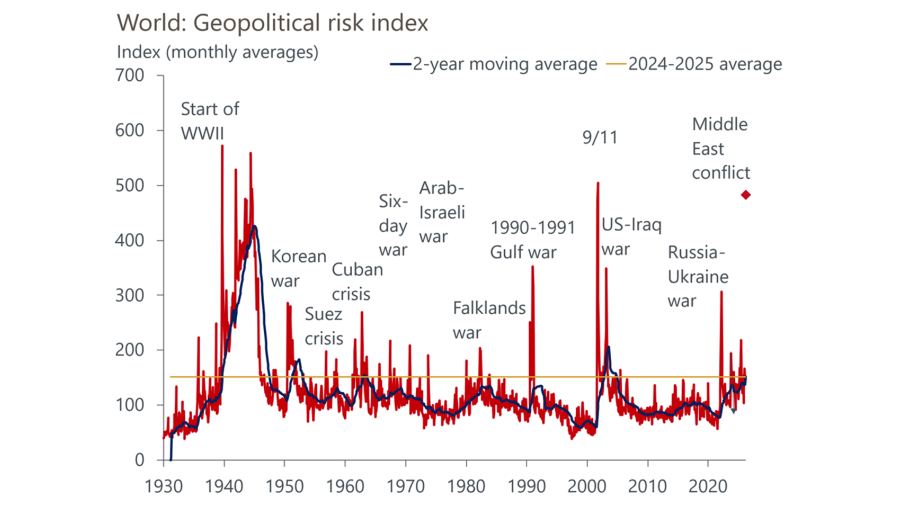
Gulf war tensions push geopolitical risk index to 9/11 highs - Oxford Economics

Gulf war tensions push geopolitical risk index to 9/11 highs - Oxford Economics
https://www.dropbox.com/scl/fi/gopzepe72wby4t038nejw/Screenshot-2026-03-13-at-19.20.19.png?rlkey=d4p99r4aeqfpogq22478bjqvh&dl=0 / bne IntelliNews
By Ben Aris in Berlin March 13, 2026

The outbreak of what has been called “the worst energy disruption in history” by the IEA International Energy Agency (IEA) has sent the global geopolitical risk index to levels not seen since the 9/11 terrorist attacks on New York.

The energy, stocks and debt market have been roiled by the collapse of oil and gas deliveries to the international market after Iran shut off the Straits of Hormuz on March 2 in a conflict with the US and Israel that shows no signs of coming to a quick end.

The IEA tried to calm traders by announcing the largest release of oil from reserves in history, but after oil prices briefly dropped from a peak of $120 on March 9 to $85 per barrel, they sprang back to $100 after three tankers were hit by Iranian rockets the next day. The newly appointed Iran's Supreme Leader Mojtaba Khamenei issued his first public statement and swore to seek revenge for the launch of Operation Epic Fury.

The Geopolitical Risk Index has surged since hostilities erupted, reaching its highest level since 2001, according to Oxford Economics. The current reading is also on par to the peak recorded during the Gulf War as uncertainty across global markets builds.

Economists warn that periods of elevated geopolitical tension tend to weigh on corporate decision-making, particularly when firms face uncertainty about energy markets, trade flows and the broader economic outlook.

“Higher geopolitical uncertainty may prompt firms to delay investment plans,” Oxford Economics said, adding that the ultimate economic impact will depend heavily on the duration and severity of the conflict. The consensus amongst analysts after the first ten days is that the conflict will likely be short, about a month, as the US navy would reopen the Straits of Hormuz. However, in just the last few days that confidence has started to fade after the navy admitted it could not send ships into the Straits as it is “too dangerous to traverse.”

The Gulf region is likely to suffer the most from the conflict, but the wider global economy is more inured to the crisis, as the Gulf accounts for only around 2% of global GDP. Moreover, unlike the 2022 energy crisis, since then many economies, led by China, have invested heavily into renewables and nuclear power and have more options to make use of alternative energy sources, including coal.

Oxford Economics noted that its investment outlook had already been relatively cautious before the conflict escalated. “Although there's likely to be a significant impact on the GCC, the ripple effects for the rest of the world will probably depend on the duration of the conflict and the extent to which firms see the global economic outlook as more uncertain,” the firm said.

“Prior to the conflict, our investment forecasts were relatively cautious, but a sustained disruption to energy markets would likely be the catalyst for further weakness,” the consultancy said.