Friday, March 27, 2026

UN resolution fuels global slavery reparations debate

DW
27/03/2026 - 

A landmark UN resoultion has intensified the debate over reparations for the transatlantic slave trade, with supporters arguing that recognition, apologies and structural reforms are long overdue.


At least 12.5 million Africans were kidnapped and trafficked to the Americas during the transatlantic slave trade
Image: The Print Collector/Heritage Images/picture alliance

The United Nations General Assembly this week adopted a landmark resolution declaring the transatlantic slave trade "the gravest crime against humanity."

It also calls on UN member nations to engage in talks "on reparatory justice, including a full and formal apology, measures of restitution, compensation, rehabilitation, satisfaction, guarantees of non-repetition and changes to laws, programs and services to address racism and systemic discrimination."


While not legally binding, the resolution is widely seen as a significant political milestone.

"It is a very important decision… it recognizes the fact that the transatlantic slave trade was a grave injustice to humanity," said Isa Sanusi, Amnesty International's executive director in Nigeria.

"This recognition alone, even though symbolic, will go a long way in opening the way for addressing that injustice," Sanusi told DW.

For many Africans and members of the diaspora, the vote signals a shift from symbolic recognition toward a more substantive global conversation about accountability.
From historical memory to global policy

Along Ghana's coastline, the push for reparations is often linked to historical sites where the legacy of the trade remains visible.


Elmina Castle, built in 1482, stands as one of the most prominent reminders of the transatlantic slave trade. Behind its walls, enslaved Africans were held in cramped dungeons before being forced onto ships bound for the Americas.

Today, visitors pass through those same spaces, confronting a past that many visitors describe as deeply personal.

"I can only imagine what they went through … this is worse than any story can ever tell you," said Charles Preston Britton, an ancestral seeker visiting the site. "There is no compensation you can do, but it is a start."

The sense of taking a first step is mirrored on the global stage, where calls for accountability are gaining new momentum.

"An apology is a sign of recognition that yes, we did it, and we acknowledge that it happened," said cultural heritage curator Michael Kunke. "It's a first step towards the other things … talk of reparations and all of that."

Michael Ndimancho, a political analyst at the University of Douala in Cameroon, agrees, describing acknowledgment as the foundation of any meaningful process.

"Apology is very, very important … everything starts with saying I'm sorry," he said. "When there is this regret, now we look for a way forward."

Sanusi also links historical injustice directly to present-day inequalities.

"The injustices we are facing across the world are connected to the injustices in the past," he said. "These things have a long-lasting impact … they do not just happen in a vacuum."
What form should reparations take?

While the call for reparations is gaining momentum, there is no consensus on what they should look like.


Ndimancho argues that focusing solely on financial compensation risks oversimplifying a complex historical injustice.

"Who are we compensating?" he asked. "If you want to estimate it in terms of money, how much would they pay, and what are the parameters?"

Instead, he suggests a more structural approach that addresses long-term development challenges across the continent.

"African countries should ask for the cancellation of their debt … assistance in terms of education, development, cultural and social development."

Amnesty's Sanusi also emphasized that reparations are an essential component of justice, "whether it takes the form of financial reward or other remedies, what matters is that injustice is recognized and addressed."

A contested history

The debate over reparations is further complicated by questions about African involvement in the slave trade.

Ndimancho acknowledges that some African leaders participated in the trade but stresses the broader context in which this occurred.

"It was a period whereby Africans only had to get involved … through coercion, through force," he said. "They came with intimidation."

He suggests that the focus should remain on the systemic nature of the transatlantic slave trade, which historians widely attribute to the economic interests of European imperial powers.

"The victims of the transatlantic slave trade are in their millions and are scattered all over the world," he told DW. "Many were disconnected from their roots … and families are still traumatized."


The cost of slavery

Historians estimate that at least 12.5 million Africans were forcibly taken during the transatlantic slave trade, with millions more dying during capture and transport. The long-term impact, analysts say, extends far beyond those numbers.

For Ndimancho, the removal of millions of people represented a profound loss of labor and development potential.

"We are talking here about 13 million Africans … this is quite some labor force that was taken out of Africa," he said.

Ndimancho describes this as a "development historic cost" — a factor he believes continues to shape the continent's economic trajectory, which he says has contributed to structural inequalities that persist today.

Sanusi argues that these consequences remain visible across societies.

"Many people are still facing exclusion, racism and discrimination … this is not just history — it is something we are still living with."

For some members of the diaspora, the consequences are equally significant.

"We have been double-robbed, double-lied to," said Dr. Lilieth Johnson Whittaker, an ancestral seeker. "And it's time to pay up."

For many, the UN resolution marks not closure, but the beginning of a long-delayed conversation about justice.


Edited by: Keith Walker


Mimi Mefo Newuh Mimi is an award-winning Cameroonian-born journalist.


Capitalism and Slavery by Eric Williams. Profile image of Ahmed Badran Ahmed Badran. visibility … description. 148 pages. descriptionSee full PDF


In a first, Trump signature to appear on all US dollar bills

DW with AFP, AP, Reuters
26/03/2026 - 

The signature on US currency is just the latest instance of the president’s name and likeness being stamped onto government projects.

Bar the signature, the overall designs of bills will not change
 [FILE: Apr 9, 2025]Image: Nathan Howard/REUTERS

The US Treasury Department says it is preparing to add President Donald Trump's signature to all dollar notes, a first for a sitting president.

It is expected to appear next to Treasury Secretary Scott Bessent's signature and take the place of the US treasurer's name, which has been on the currency for more than 100 years.

"Under President Trump's leadership, we are on a path toward unprecedented economic growth, lasting dollar dominance, and fiscal strength and stability," Treasury Secretary Scott Bessent said in a statement announcing the decision.

In 2025, during the first year of Trump's second term, the US dollar fell to its steepest annual drop in 50 years.

The Treasury told the Reuters news agency that the first $100 bills bearing the signatures will be printed in June, with other denominations to follow.

Efforts to put Trump's name on federal government projects

The signature change is the latest effort by the Trump administration and its allies to put the president's name on buildings, institutions, government programs, battleships and coins.

Earlier this month, a federal arts commission approved the design for a 24-karat gold commemorative coin bearing his likeness, set to mark America's 250th birthday on July 4.

"There is no more powerful way to recognize the historic achievements of our great country and President Donald J. Trump than US dollar bills bearing his name, and it is only appropriate that this historic currency be issued at the Semiquincentennial," Treasury Secretary Bessent said.


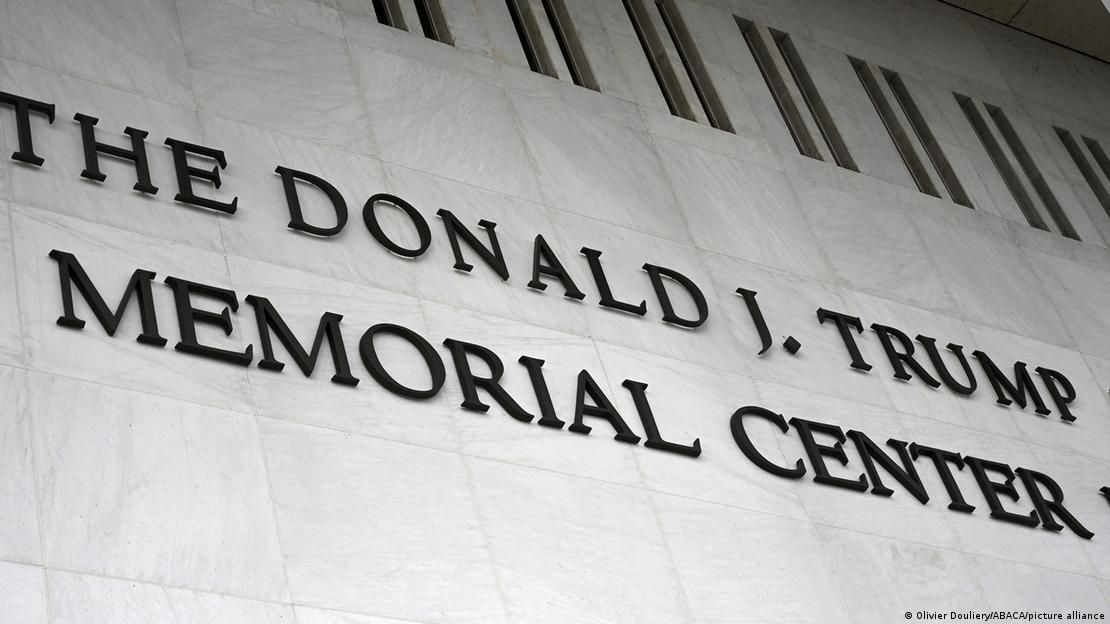
There was fierce backlash ​against the renaming of Washington's premier performance venue as the Donald J. Trump and John F. Kennedy Memorial Center for the Performing Arts
Image: Olivier Douliery/ABACA/picture alliance

National institutions, from federal buildings to naval ships, are also being renamed:

The Kennedy Center: A handpicked board of directors voted to rename it as the Trump-Kennedy Center

The US Institute of Peace: Renamed to the Donald J. Trump Institute of Peace

A new generation of US Navy vessels will be known as 'Trump-class' battleships

A new federal website for comparing and purchasing lower-priced prescription medication is called TrumpRx.gov

Not all of the name changes have been welcomed, and some are being legally challenged.

Edited by: Rana Taha

Louis Oelofse DW writer and editor
Whale swims to freedom after days stranded on German beach
DW with dpa, AFP
26/03/2026 - 


The whale was first spotted stuck on the beach on Monday.


The fate of the humpback whale drew dayslong media coverage in Germany
Image: Ulrich Perrey/dpa/picture alliance

Rescuers managed to free a humpback whale that had been stuck on a sand bank on Germany's Baltic coast on Friday.

The whale had been stranded for several days on the Timmendorfer Strand, with numerous rescue attempts failing to shift the marine mammal.

The 12 to 15-meter long (39 to 49-foot long) animal must now make its way along the complicated route past the Danish islands, out into the North Sea and then finally into the Atlantic Ocean.

Humpback whales are not native to the Baltic and experts suspect the whale in question was a young male as they, unlike females, migrate.

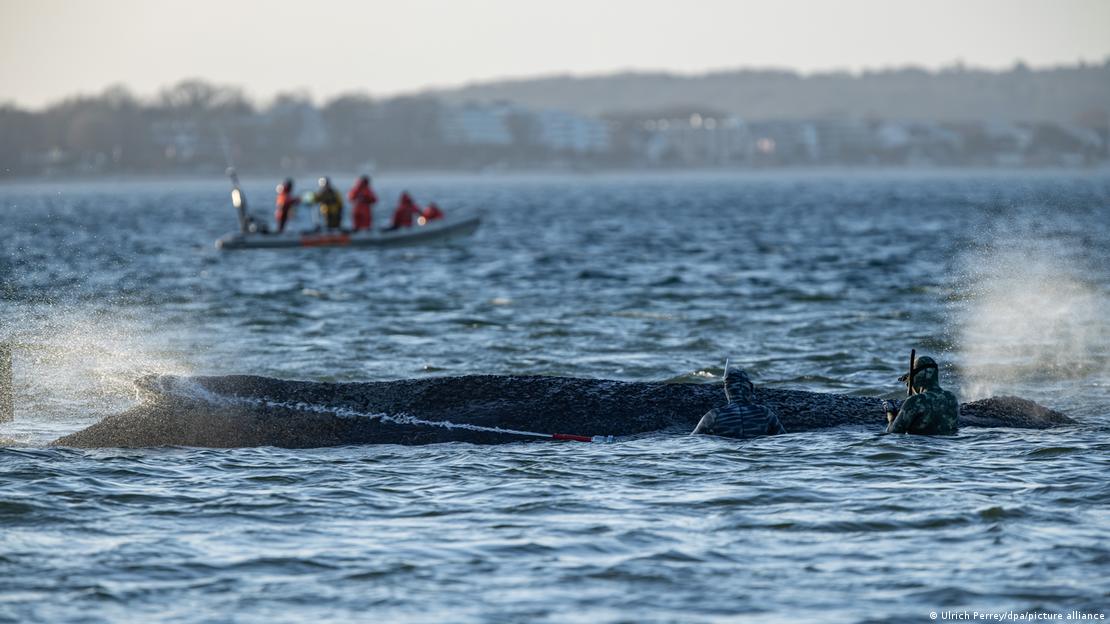
A large team of rescuers and animal specialists were involved in the operation
Image: Ulrich Perrey/dpa/picture alliance

How did the whale free itself from the German beach?


The animal was first noticed on Monday, but the first attempt to free it was unsuccessful.

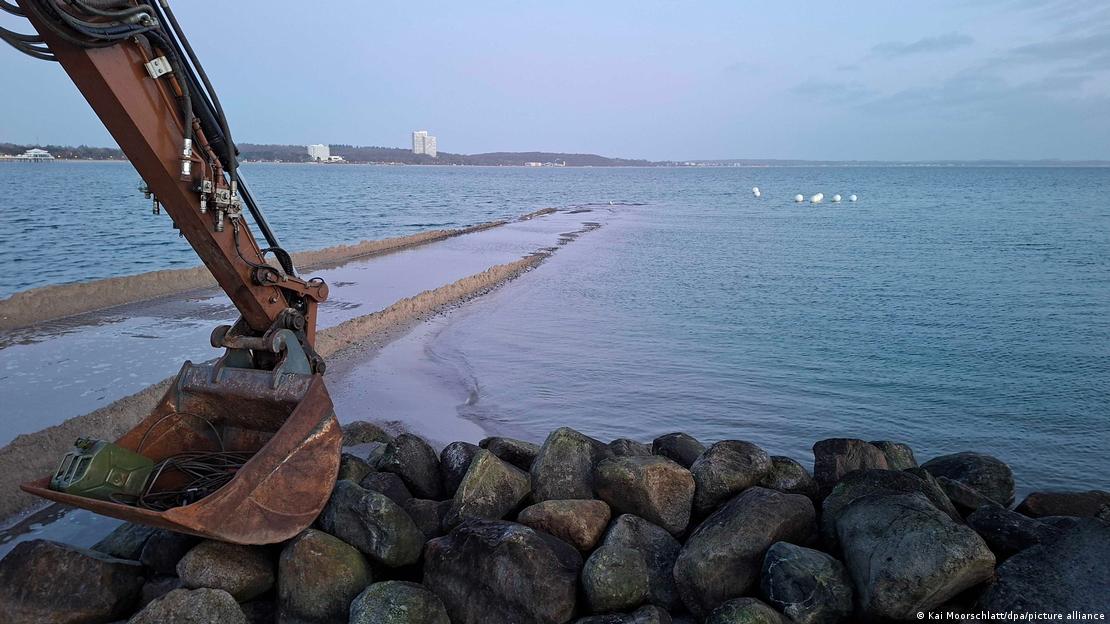
Efforts on Thursday to dig a channel with heavy machinery finally worked and the whale was able to return to the sea overnight.

The work was slow, with rescuers aiming to get the animal used to the noise of the machinery so as not to shock it.

By Thursday evening, the whale, which had been showing more signs of life, began to slowly make its way through the channel.

Diggers were deployed to dig a channel to help the whale get back to sea
Image: Kai Moorschlatt/dpa/picture alliance

The team of rescuers tried to encourage the animal to keep going with lots of noise, to which the whale reportedly responded with its own humming noise.

Marine biologist Robert Marc Lehmann told local media that the humpback had "gathered its strength" overnight and "freed itself by its own efforts."

On Friday morning, German media reported that the whale had been spotted swimming out in the Bay of Lübeck, to the south of Denmark.

Accompanied by a small armada of police, coast guard, volunteer and research vessels, the whale is now making its way to the open waters of the North Sea.


Edited by: Dmytro Hubenko
Jon Shelton Writer, translator and editor with DW's online news team.
CANADA IS A BILINGUAL COUNTRY

Air Canada CEO apologizes for English-only condolence video

PS.HE DOESN'T SPEAK FRENCH

Jenipher Camino Gonzalez
DW with AP, AFP
26/03/2026 - 

CEO Michael Rousseau's unilingual condolence message to the pilots killed in a collision in New York over the weekend was seen as "lacking judgement."

CEO of Air Canada, Michael Rousseau, apologized Thursday for his English-only message of condolence after a deadly airplane crash in a runway at New York's LaGuardia airport.

Two Air Canada pilots died when the Air Canada Jazz flight they were landing collided with a fire truck on the runway on Sunday. One of the pilots was from the French-speaking province of Quebec.

Air Canada is also headquartered in Quebec's largest city of Montreal.

Why did Air Canada's CEO stir controversy?

Rousseau was widely criticized for the four-minute condolence video posted online, which only included the French words "bonjour" and "merci." Many have called for his resignation over the incident.

"I am deeply saddened that my inability to speak French has diverted attention from the profound grief of the families and the great resilience of Air Canada's employees, who have demonstrated outstanding professionalism despite the events of the past few days," Rousseau said in a statement.

The CEO admitted that "despite many lessons over several years," he was still unable to express himself adequately in French.

Quebec Premier François Legault said that Rousseau had promised to learn the language upon his appointment as president of the airline in February 2021.

Canadian Prime Minister Mark Carney criticized Rousseau's conduct, saying he was "very disappointed, as others are, rightly so, in this unilingual message," noting that Canada is a bilingual country with two official languages.

Carney said it showed a "lack of judgement and a lack of compassion."

LaGuardia reopens runway

Meanwhile, in New York City, LaGuardia airport administrators reopened the runway where two pilots died.

The runway and its associated infrastructure were "repaired, inspected, and confirmed" to meet Federal Aviation Administration regulations for safe operation, the agency overseeing the region's airports said.

The US National Transportation Safety Board has continued its investigation into the crash. The plane's wreckage and the fire truck were both towed from the crash site late Wednesday.

Edited by: Rana Taha

Online porn sites putting kids' safety at risk, EU says
DW with AFP, dpa
26/03/2026 - 

Social media platform Snapchat and four adult websites put kids in danger by not enforcing age-limits to access content, according to the European Commission. An EU age-verification app is set to launch in 2027.

The EU is developing a age-verification app to confirm a user's age without sharing personal data with tech companies
Image: Yui Mok/empics/picture alliance

A report released by the European Commission on Thursday accused social media platform Snapchat as well as four online porn sites of endangering children's rights and wellbeing by allowing them to access adult content on their platforms.

The Commission said underage users can gain access to the sites by clicking a button confirming that they are 18 years of age rather than being asked to provide reliable age verification.

Lack of serious oversight breaches EU digital rules and could expose the companies in question to heavy fines.

In addition to Snapchat, the European Commission trained its sights on Pornhub, Stripchat, XNXX and XVideos, accusing all of failing to adequately enforce age restrictions on adult content.

"In the EU, online platforms have a responsibility," said European Commission Vice President Henna Virkkunen. "Children are accessing adult content at increasingly younger ages and these platforms must put in place robust, privacy-preserving and effective measures to keep minors off their services."

The Commission will now present companies with its preliminary findings, after which they are expected to take steps to comply with EU digital legislation.

Should companies fail to do so, they risk fines equal to 6% of their annual global revenues.


Tech companies in violation of EU Digital Services Act

Social media platform Snapchat has also come under scrutiny for similar reasons, namely whether the platform is doing enough to protect children and young people from accessing adult content.

The European Commission suspects the company of failing to prevent children from using the platform, exposing minors to myriad risks — including attempted cyber-grooming and criminal recruitment — according to a press release.

"From grooming and exposure to illegal products, to account settings that undermine minors' safety, Snapchat appears to have overlooked that the Digital Services Act demands high safety standards for all users," European Commission Vice President Virkkunen said in a statement.

"With this investigation, we will closely look into their compliance with our legislation," she added.

The Commission's investigation is looking into whether Snapchat is enforcing its own minimum age requirement (users must be 13 to access the site), and whether it is taking steps to protect kids from predators.

The US company says it will cooperate with EU authorities while claiming to "raise the bar on safety."

EU online age-verification app in the works


Although Snapchat and other social media companies have set minimum age limits to bar individuals from accessing content, the European Commission has railed against steps taken so far as insufficient.

In response, the EU has scrambled to develop its own age-verification app, one that would allow users to confirm their age without having to share personal data with tech companies.

The app is expected to be available by early 2027.

Edited by: Sean Sinico
Jon Shelton Writer, translator and editor with DW's online
INTERVIEW

Lukashenko 'not an independent actor’: opposition leader Tsikhanouskaya on why Belarus needs Russia

Belarusian President Alexander Lukashenko has recently embarked on a flurry of diplomatic activity, from US negotiations to an official visit to North Korea on Wednesday. But despite efforts to diversify relations with other countries, he ultimately remains dependent on Russia, said Sviatlana Tsikhanouskaya, the exiled Belarus opposition leade
r.


Issued on: 25/03/2026 - 
FRANCE24
By: Sonya CIESNIK


Sviatlana Tsikhanouskaya, President-elect of Belarus, speaks onstage on September 23, 2025 in New York City. © Riccardo Savi, Getty Images via AFP

Belarusian President Alexander Lukashenko, a close ally of Russian President Vladimir Putin, is warming up to the West.

In one of the most dramatic moments of the diplomatic thaw, 250 former Belarusian political prisoners – many of them visibly thin – stepped out of a bus on March 19 as part of the single largest prisoner release the US has negotiated with Belarus thus far. Belarus released 123 prisoners in December in exchange for an easing of US sanctions.

Many of the prisoners from last week’s release had been incarcerated for more than five years, ever since the disputed 2020 presidential election spurred mass protests and a brutal police crackdown in response. Opposition leader Sviatlana Tsikhanouskaya, who challenged Lukashenko for the presidency, was forced into exile – first in Lithuania and later in Poland, from where she now continues the fight for a democratic Belarus.

US President Donald Trump’s special envoy to Belarus, John Coale, called the prisoner’s release "a significant humanitarian milestone and a testament to the President’s commitment to direct, hard-nosed diplomacy".

Belarus' President Alexander Lukashenko meets with John Coale, deputy special envoy to US President Donald Trump, in Minsk in this handout picture taken and released by the Belarusian presidential press service on September 11, 2025. © Belarusian presidential press service via AFP


Fifteen of those freed were sent to neighbouring Lithuania, while the remainder stayed in Belarus.

As part of the deal, the US announced further sanctions relief for the Belarusian financial sector, including the finance ministry and the Development Bank of Belarus, as well as three potash companies: Belaruskali, Belusian Potash Company and Agrorozkvit.

Reports have now emerged of the US possibly inviting Lukashenko to meet with Trump at the White House or at his Mar-a-Lago home in Florida. Such a visit would be a boon for the Belarusian leader, who has faced international isolation and crippling sanctions for years.

But Lukashenko is not satisfied with only cultivating ties with the West.

After 2014, "the aim was to make Belarusian foreign policy genuinely ‘multi-vectoral’, or in Lukashenko’s clumsy phrase, ‘many-winged’", wrote Andrew Wilson in “Belarus: The last European dictatorship.”

Wilson noted that foreign policy discourse in Belarus was rife with terms like “balance”, “proportion” and “strategic hedging”. But the aim wasn’t to strike a “balance” in the literal sense, “with Belarus halfway along some metaphorical plank between Russia and the West”. Belarus’s main political and economic ties were still with Russia, yet Minsk “was making sovereign choices to stress its sovereignty”.

In this photo released by Belarus' Presidential Press Service, North Korea's leader Kim Jong Un, right, and Belarusian President Alexander Lukashenko, center, attend an official meeting ceremony in Pyongyang, North Korea, March 25, 2026. © Belarus' Presidential Press Service, AP


From this perspective, Lukashenko’s official state visit to Pyongyang on March 25 for talks with North Korean leader Kim Jong-un makes sense, even as Kim accuses Belarus's new ally in Washington of global “state terrorism and aggression”.

FRANCE 24 spoke to Tsikhanouskaya, who continues to challenge the Lukashenko dictatorship from exile, on why he cannot forego his relationship with Russia.
What is Lukashenko’s strategy in holding regular talks with US President Donald Trump’s special envoy to Belarus, John Coale?

We should be very clear: Lukashenko is not suddenly changing. He is adapting. He is trying to survive. His strategy is very simple. He wants to open a small door to the West – not to change the system, but to reduce pressure on himself. He tries to look like a partner. He continues repression inside the country. At the same time, we welcome any humanitarian results of such contacts. Every released political prisoner is a victory and a life saved. These are innocent people who have gone through immense suffering. I am grateful for efforts that help free them, especially to US Special Envoy John Coale.

But the regime is playing a cynical game – it releases some people, while taking new hostages. So, this is not a solution yet. The goal must be to end repression completely. Also, those released must be allowed to stay in the country and be safe.
This isn’t the first time that Lukashenko has received, and been received by, high-level representatives from the West. Are these efforts reducing Belarus’s dependence on Russia?

No, we have seen this before. Lukashenko has always played this game with the West – pretending that he might move away from Russia, signalling, “Give me more, engage me, and I will be with the West”. It was always just a game. Putin effectively gave him carte blanche to do this – to reduce the pressure on the Russian budget, which has long been sustaining Lukashenko’s regime. He simply allowed him to “graze in someone else’s pasture”.

Throughout all 30 years of his rule, Lukashenko has consistently oriented himself toward Russia. He does not see any alternative for himself other than a shared future with Russia. For all 30 years, he has systematically destroyed Belarusian identity and the Belarusian language. Russian propaganda flows into Belarus directly through Belarusian TV channels without any barriers. He is a product and an adherent of the “Russian world”. He is the most pro-Russian politician possible on the territory of Belarus. He is tied to Russia historically, ideologically, politically, economically and militarily. His future lies only with Russia.

He knows he lost in 2020. And he knows that he will only be able to stay in power with Russia – staying in power is the very meaning of his existence.

That is why these contacts with the United States do not change the strategic reality. Lukashenko is not an independent actor. It is an illusion to think that one can drive a wedge between Lukashenko and Putin. He is trying to gain some room for manoeuvre, but he cannot and does not want to move away from Moscow.

Has the thaw in relations between the Belarusian regime and the West been accompanied by any improvement in the human rights situation?

Unfortunately, no. Repression in Belarus is not decreasing. It is systemic. We continue to see new arrests and political trials. According to human rights defenders, around 900 political prisoners remain. Many are held in isolation, without contact with their families or lawyers. Many are also in serious health condition.

Those who have been released from prisons and expelled from Belarus have no documents, and their status is unclear. Those who have been released but remain in Belarus are not free: their rights are restricted, they are not even allowed to have a bank card or a bank account, and their status is also unclear. They are warned that they can be sent back to prison at any moment without an additional trial – for drinking alcohol, for example. During holidays, they may be detained and held behind bars without any grounds.

On the very same day when this conditional release of 250 people took place, for example, eight women were sentenced to eight years or more in prison for participating in a neighbourhood chat that dealt with minor social and everyday issues. Their activity was classified as extremist.

This shows the true nature of the regime. Talks with the West have not changed it. We welcome every release. But at the same time, new arrests continue. It is like a revolving door of repression. Until repression ends, pressure on the regime must continue.

Our formula is this: US sanctions in exchange for the release of people, and European sanctions in exchange for the release of the entire country – that is, for real steps toward democratisation.

This interview has been lightly edited for length and clarity.


A post-#MeToo reckoning in the French jazz scene


FRANCE24
Issued on: 26/03/2026 - 
Play (12:32 min)

Musicians from the world of jazz have been speaking out about the sexism and sexual violence that has long cast a shadow over their corner of the music industry. FRANCE 24’s reporters went to meet the women who are now working to change that culture and are demanding justice and accountability.

Meanwhile, after the summit of the Eiffel Tower at the Olympic opening ceremony, Céline Dion is set to return to a (slightly) lower stage in Paris, as the diva announces a string of hotly anticipated concerts in the French capital.

We also check out a major new exhibition zooming in on the twilight years of artist Henri Matisse.

Plus author Coco Mellors tells us about her second novel, "Blue Sisters", which tackles grief, addiction and the joy and pain of sisterhood.


Turkey-operated tanker carrying Russian oil struck by naval drone in Black Sea


A crude oil tanker sailing from the Russian port of Novorossiysk to Istanbul was hit by a naval drone near Istanbul's Bosphorus strait Thursday morning, Turkey's Transportation Minister Abdulkadir Uraloglu said. No one was injured in the attack, which Uraloglu said had targeted the ship's engine room.


Issued on: 26/03/2026 
By: FRANCE 24

Altura, a Turkish-operated crude oil tanker, transits the Bosphorus in Istanbul, Turkey, March 16, 2026. © Yoruk Isik, Reuters

A water-borne drone struck a Turkish-operated crude oil tanker that had departed Russia, causing an explosion in the Black Sea near Istanbul's Bosphorus ​strait ‌on Thursday, Turkey's transportation minister said.

The incident, one of several ⁠in recent months involving Western-sanctioned vessels heading to or from Russian ports, occurred in the early hours, minister ‌Abdulkadir Uraloglu told broadcaster Kanal 24.

"I can say that a foreign-flagged ship operated by a Turkish company, which had loaded crude oil from Russia, reported an explosion in its engine room after midnight to our emergency call centre," the minister said in a televised interview.

"We believe that the engine room was specifically targeted. We think the attack was not carried out by a drone, but by an unmanned surface vehicle at water level."

All 27 crew were safe, he ⁠said, adding that the coastguard had been dispatched to the vessel, the Altura, which was about 18 nautical miles (33 km) from the Bosphorus, a ​key commodities-shipping channel linking the Black Sea with the Marmara and ‌Mediterranean.

The attack took place just outside Turkish territorial waters.

Ship-tracking and ‌Refinitiv AIS data showed the Altura had left Russia's port of Novorossiysk with about 1 million barrels of crude ​oil and appeared almost fully laden.

The ship is sanctioned by the European Union and Britain.

The Black Sea is shared by Russia and Ukraine, which ​have been at war for more than four years, as well as ​other states.

Late last year, shipping insurance rates rose after ​Ukrainian naval drones hit Russia-bound tankers in the Black Sea, prompting Moscow to threaten retaliation and NATO-member Turkey to urge ​calm.

Other commercial tankers carrying crude oil from Russian ports have been targeted over the past year by what some experts suggest is a state-sponsored sabotage campaign using limpet mines and other explosives. Ukraine has not claimed responsibility for these attacks.

There was no immediate comment from Moscow or Kyiv on Thursday.

The registered owner of the latest ship to be hit is China-based Sea Grace Shipping Ltd and the manager is the Turkey-based Pergamon Denizcilik, according to Refinitiv data.

Reuters could not ⁠immediately contact Pergamon.

Broadcaster NTV earlier reported an explosion on the ship's bridge and water entering the ⁠engine room, ​before the crew sought assistance from Turkish authorities.

(FRANCE 24 with Reuters)
French population overexposed to cadmium through food, health agency says


The French population is overexposed to cadmium through food sources, according to a comprehensive report published Wednesday by the national environmental health agency. Cadmium is a toxic metal that is ubiquitous in the environment and can contaminate soil, water and air.


Issued on: 25/03/2026 
By: FRANCE 24

A supermarket in Paris, France. © Joel Saget, AFP

Studies have found that the French population is facing prolonged exposure to "concerning" levels of the toxic metal, according to the French Agency for Food, Environmental and Occupational Health & Safety (ANSES).

ANSES noted, "concerning cadmium levels at all ages, even in early childhood".

Cadmium is naturally present in the environment, but certain human activities can increase the presence of this metal, which can be toxic (carcinogenic or affecting reproduction, bones and kidneys) in cases of prolonged exposure.

"Cadmium is known to be carcinogenic, mutagenic and toxic to reproduction, and prolonged exposure causes kidney damage and bone fragility in humans, particularly from oral exposure via food and drinking water," ANSES says.

Cadmium can be ingested or inhaled via food, water, air, dust, soil, cosmetics and smoking. But ANSES said food stands out as the primary source of exposure, accounting for up to 98 percent of exposure in non-smokers.

Breakfast cereals, breads, pastries, cakes and sweet biscuits, pasta, rice, wheat, potatoes and certain vegetables are among the most contaminated foods.

For smokers, smoking and vaping constitute another significant source of exposure.

Read more on ANSES: What is cadmium, and how can we reduce our exposure to it?

To sustainably reduce cadmium exposure, ANSES called for action "first and foremost at the source" of food contamination: agricultural soils and fertilisers (including phosphate mineral fertilisers, livestock effluents and sewage sludge).

ANSES specifically called for the "application of cadmium limit values ​​for fertilisers as soon as possible", reiterating its 2019 recommendation of a maximum cadmium content of 20mg per kilogramme in phosphate mineral fertilisers, down from the current limits of 90mg in France and 60mg in the European Union.

"If current exposure levels persist and no action is taken, long-term adverse effects are likely for a growing segment of the population," Géraldine Carne, coordinator of the ANSES review, told reporters.

(FRANCE 24 with AFP)
NATO's European allies and Canada boosted military spending by 20% in 2025


A NATO report on Thursday said military spending by European allies and Canada rose by 20 percent in 2025. US President Donald Trump has repeatedly demanded that NATO partners significantly boost defence expenditures, with leaders agreeing at a summit last year to spend 5 percent ​of GDP on defence and related investments by 2035.


Issued on: 26/03/2026 - 
By: FRANCE 24

Hellenic Air Force Erieye EMB airborne, F-16 Falcon and Dassault Rafale fighting jets fly during a military parade marking Greece's Independence Day, in Athens, Greece, March 25, 2026. © Louiza Vradi, Reuters

NATO's European allies and Canada increased defence spending by 20 percent to $574 billion ​in 2025 compared to the previous year in real terms, alliance chief Mark Rutte said in his annual report published Thursday, urging NATO members to keep up ​the momentum.

"I ‌expect Allies at the next NATO Summit in ⁠Ankara to show they are on a clear and credible path towards the 5 percent objective," he wrote, ‌adding that "a strong transatlantic bond remains essential in an age of ⁠global uncertainty".

US President Donald Trump has repeatedly demanded that NATO partners significantly boost defence expenditures, as the US administration maintains that European ​allies should ultimately assume primary responsibility for the conventional defence of ‌the continent.

Trump criticised NATO allies on Thursday, writing in a Truth Social post that NATO countries have done "absolutely nothing" to help with Iran.

"THE U.S.A. NEEDS NOTHING ‌FROM NATO, BUT "NEVER FORGET" THIS VERY IMPORTANT POINT IN TIME!" he wrote.


THE DEBATE © FRANCE 24
43:55


In his annual report, Rutte said ​that last year "all Allies reported defence expenditure figures that met or went beyond the 2 percent target first set in 2014, with many making steep increases ​in spending."

NATO leaders agreed at a summit last year to spend 5 percent ​of GDP on defence and related investments by 2035.

Countries ​pledged to spend 3.5 percent of GDP on core defence - such as troops and weapons - and 1.5 percent on ​broader defence-related measures such as cyber security, protecting pipelines and adapting roads and bridges to handle heavy military vehicles.

Three NATO countries – Poland, Lithuania and Latvia – already exceeded the new 3.5 percent target last year, according to the report's estimates.

Several countries ⁠including Spain, Canada and Belgium, were at 2 percent.

In total, the alliance of 32 member countries ⁠spent 2.77 percent of GDP ​on defence in 2025.

The United States accounted for around 60 percent of alliance defence expenditure in 2025.


(FRANCE 24 with AFP and Reuters)