Wednesday, April 15, 2026


As Trump Pushes Privatization, Mexico’s Sheinbaum Embraces Healthcare as a Human Right

Healthcare is neither a commodity nor the exclusive privilege of the wealthy—it is a human right. Far from “outrageous,” guaranteeing healthcare to all is about ensuring that everyone can live a rich and fulfilling life.



President of Mexico Claudia Sheinbaum speaks during the daily morning briefing at Palacio Nacional on April 7, 2026 in Mexico City, Mexico.
(Photo by Jeannette Flores/ObturadorMX/Getty Images)


Jordan Liz
Apr 15, 2026
Common Dreams


On April 6, the Trump administration announced it will increase payments to privately-run Medicare Advantage, or MA, plans by 2.48% in 2027—this will result in more than $13 billion in additional payments to companies like UnitedHealth, CVS Health, and Humana. Unsurprisingly, following this announcement, shares of those companies rose by more than 9%.

MA plans have been a significant source of growth and profit for insurance companies. As the Medicare Rights Center reports, this profitability is driven by enormous overpayments, including from fraudulent billing practices such as “upcoding.” This involves submitting billing codes that make patients appear sicker than they really are to secure higher government payments than are warranted. Despite this, the Trump administration is currently considering a policy that would automatically enroll seniors into MA plans as the “default enrollment option”—a proposal outlined in the Heritage Foundation’s extremist Project 2025.


The Center for American Progress estimates that making MA the default option would generate nearly $2 trillion in overpayments over 10 years, while significantly jeopardizing traditional Medicare’s financial stability. It would give for-profit corporations more control to restrict patient choices and deny doctor-recommended care.

Instead of more privatization that puts profits over people, we should embrace Medicare For All (M4A). Yet, President Donald Trump contends that paying for our current safety nets is already too much for the wealthiest nation on Earth. He remarks: “It’s not possible for us to take care of day care, Medicaid, Medicare, all these individual things. They can do it on a state basis. You can’t do it on a federal. We have to take care of one thing: military protection. We have to guard the country.”

Sheinbaum’s embrace of universal healthcare—as well as her support of Cuba—shows us what is possible when the well-being of people is championed unconditionally.

For Trump, spending billions in an illegal war takes precedence over providing healthcare for Americans. His 2027 budget calls for a 10% reduction in all nondefense spending, including reducing funding to the Department of Health and Human Services by $15.8 billion. This, at the same time, that a measles outbreak sweeps the nation, uninsured rates continue to climb, and the prevalence of children with chronic conditions grows to unprecedented levels.

While Trump prioritizes death and destruction, Mexican President Claudia Sheinbaum offers a different vision. On April 7, she issued a presidential decree establishing the Universal Health Service (Servicio Universal de Salud), which will allow patients from across Mexico to seek free care at any public health institution. Universal access will be rolled out in phases starting with emergency care and continuity of care in early 2027. Radiotherapy, laboratory tests, imaging studies, and other specialized services will be added later that year. Finally, in 2028, universal prescription fulfillment and hospitalization will be consolidated. For Sheinbaum, “The goal is that when we leave the government [in 2030], any Mexican man or woman can go to any health institution for treatment for any ailment and be received.”

The transition to universal healthcare began on April 13 when Mexicans aged 85 and older were eligible to register for their new Universal Health Credential. As Deputy Health Minister Eduardo Clark notes, these new credentials are “the guarantee of the right to healthcare” for Mexican citizens and eligible foreign residents.

This is the fundamental difference. In Mexico, healthcare is recognized as a human right enshrined in their Constitution. In 2023, then-Secretary of Foreign Affairs Alicia Bárcena said before the United Nations General Assembly, “In Mexico, we believe that coverage must be universal, public and free, starting with the most marginalized areas and prioritizing, as always, the poorest.” She continued: “It is unacceptable to profit from illness. In Mexico, we know that public health is not for sale. It is a public and universal good, and we defend it.”

By contrast, for Trump, healthcare is a privilege meant solely for those who deserve it. During his first presidential campaign, he remarked: “Where I come from, you have to prove your worth. You have some guy with no college degree working a minimum wage job; no ambition, no goals, nothing to show for it. Yet for some reason, the current [Obama] administration believes he—and millions of people like him, should have access to health insurance. It’s outrageous.” While Mexico starts with “the poorest,” Trump finds it “outrageous” to provide healthcare to minimum wage workers.

Trump’s position is immoral and vile. Healthcare is neither a commodity nor the exclusive privilege of the wealthy—it is a human right. Far from “outrageous,” guaranteeing healthcare to all is about ensuring that everyone can live a rich and fulfilling life.

For most (if not everyone), lacking healthcare will prevent them from living the kind of life they desire. Those suffering from untreated illness may struggle to spend time with their loved ones, pursue the opportunities they desire, and exercise their political rights. Since, at some point, everyone will eventually get sick, healthcare is a universal good that benefits each of us. Moreover, as the Covid-19 pandemic made clear, our individual health is not solely a personal issue. My health impacts the lives of others around me just as their health impacts mine. Healthcare is thus a collective and communal good.

Still, one might object that even if healthcare is not a commodity, the market is still the best mechanism to allocate scarce resources; Trump’s push toward privatization will be better than Sheinbaum’s universal care.

Such blind faith in the market is misguided. Despite spending far more than other countries with universal coverage, more than a quarter of Americans report skipping consultations, tests, treatments and follow-ups because of costs. Roughly 21% report skipping medication for the same reason. Studies consistently find that universal care provides more access, better quality, and lower costs than privatized healthcare.

Ironically, Trump once understood this. In his 2000 The America We Deserve, he writes, “We must have universal healthcare. Just imagine the improved quality of life for our society as a whole if the issue of access to healthcare were dealt with imaginatively. With more than 40 million Americans living day to day in the fear that an illness or injury will wipe out their savings or drag them into bankruptcy, how can we truly engage in the ‘pursuit of happiness’ as our Founders intended?”

Trump was right. What we need is not more privatization that exploits the sick and dying, but rather a politic that works to radically defend life, liberty, and pursuit of happiness. What is needed is the imagination to rethink how we use (and misuse) our country’s wealth and resources. Sheinbaum’s embrace of universal healthcare—as well as her support of Cuba—shows us what is possible when the well-being of people is championed unconditionally.

A better future is possible—already, in the US, support for M4A continues to grow, and several 2026 midterm candidates have made it an explicit part of their platforms. Together, by embracing life and rejecting capitalism, we can make America great


Our work is licensed under Creative Commons (CC BY-NC-ND 3.0). Feel free to republish and share widely.


Jordan Liz
Jordan Liz is an Associate Professor of Philosophy at San José State University. He specializes in issues of race, immigration and the politics of belonging.
Full Bio >


‘A Sign of What’s to Come’: Super Typhoon Sinlaku Slams Into Remote US Islands in Pacific

The latest storm continues a trend of “unprecedented battering” by Category 4s and 5s for US territories.


Super Typhoon Sinlaku makes landfall the North Pacific Ocean, as seen in a satellite photo captured on April 13, 2026.
(Photo by NASA Earth Observatory/Michala Garrison)


Brad Reed
Apr 14, 2026
COMMON DREAMS

Super Typhoon Sinlaku slammed into the Northern Mariana Islands on Tuesday, causing severe damage to the US-controlled territories that are home to roughly 50,000 people.

According to a Tuesday report from The Associated Press, the typhoon that struck the islands of Tinian and Saipan was the strongest storm recorded so far this year, delivering sustained winds of up to 150 miles per hour.


‘We Lost Everything’: Hawaii Swamped by Worst Flooding in 20 Years


Saipan Mayor Ramon “RB” Jose Blas Camacho told the AP he was concerned about how the storm’s severity was hindering local rescue operations.

“It’s so difficult for us to respond with this heavy rain, heavy wind to rescue people,” he said. “Objects are just flying left and right.”

Marko Korosec, a storm chaser and weather forecaster, analyzed satellite images of the storm and predicted the Northern Mariana Islands would be hit with “violent, destructive winds, catastrophic storm surges, giant waves, and flooding rain.”

“The damage,” he wrote, “will be extreme.”

An analysis of the storm written by hurricane scientist Jeff Masters and published by Yale Climate Connections projected that “damage from Sinlaku will be severe on both islands.”

Masters also said Sinlaku was just the latest in what he described as an “unprecedented” number of Category 4 and Category 5 typhoons over the last decade, which he attributed to “a combination of natural variability and climate change.”

“Beginning in 2017, the US has gotten absolutely hammered by high-intensity Category 4 and 5 hurricanes,” Masters explained. “Seven have hit the continental US, one has hit Puerto Rico, and now two have hit the Northern Mariana Islands. That’s as many US Cat 4 and Cat 5 landfalls as had occurred in the prior 57 years.”

Later in his analysis, Masters pointed out that 10 of the 13 strongest tropical typhoons to make landfall in the last 80 years have occurred since 2006.

A Washington Post analysis of the typhoon published Tuesday noted that it’s “unusually early” for a superstorm of this caliber to form in the Pacific, warning it “may be a sign of what’s to come” this season.

“The season is expected to be anomalously active because of a burgeoning El Niño, which induces a warming of water temperatures,” explained the Post. “That helps air to rise, generating more, and stronger, storms.”

The Post added that Sinlaku is “the last in rare set of triplet cyclones that formed this month,” which it said is an “unusual pattern” that is “also contributing to a burst of winds that is expected to greatly boost the odds of a super El Niño later this year, pushing warm water west-to-east across the Pacific.”
‘Enough Is Enough’: Sanders Moves to Force Votes Against Trump Arms Sales to Israel

“The United States must use the leverage we have—tens of billions in arms and military aid—to demand that Israel ends these atrocities,” said Sen. Bernie Sanders.


US Sen. Bernie Sanders (I-Vt) speaks at a town hall event on February 20, 2026
 in Stanford, California.
(Photo by Benjamin Fanjoy/Getty Images)


Jake Johnson
Apr 15, 2026
COMMON DREAMS

US Sen. Bernie Sanders plans to force votes Wednesday on a pair of resolutions that, if enacted, would block the sale of roughly half a billion dollars of weaponry to the Israeli government, citing its bombardment and invasion of Lebanoncontinued assault on the Gaza Strip, and accelerating annexation of the West Bank.

In a statement previewing the Senate votes, Sanders (I-Vt.) said that “US taxpayers have spent tens of billions of dollars in support of the racist, extremist Netanyahu government. Enough is enough.”

“The United States must use the leverage we have—tens of billions in arms and military aid—to demand that Israel ends these atrocities,” the senator continued.

Sanders’ two resolutions would bar the sale of over $150 million worth of 1,000-pound gravity bombs and related support services, as well as the sale of nearly $300 million of Caterpillar bulldozers, which Israel uses to demolish homes in the illegally occupied Palestinian territories, Lebanon, and Syria.

“The arms sales in question violate the criteria laid out in the Foreign Assistance Act and the Arms Export Control Act,” Sanders’ office said Tuesday. “Secretary [of State] Marco Rubio signed an emergency determination just six days into the war with Iran in an attempt to bypass the statutory congressional notification period and immediately transfer these weapons.”

The resolutions face long odds in the Republican-controlled US Senate. But last year, a majority of the Senate Democratic caucus backed Sanders-led resolutions aimed at blocking earlier Trump administration sales of 1,000-pound bombs, assault rifles, and other military equipment to Israel.

“Polls show that over 70% of Democratic voters want to halt arms sales to Israel,” noted Dylan Williams, vice president for government affairs at the Center for International Policy. “Lawmakers should not be in positions of party leadership—or hope to be its presidential nominee—if they vote against their base to give Israel the bombs and bulldozers it uses to commit war crimes.”

Elizabeth Rghebi, Middle East-North Africa advocacy director at Amnesty International USA, urged Americans to call their senators at 202-224-3121 and demand that they support the new Sanders resolutions.

“Amnesty International has documented a clear and ongoing pattern by Israeli forces committing serious violations of international law, including war crimes, genocide, and apartheid,” Rghebi wrote Tuesday. “This includes evidence that Israeli forces have repeatedly carried out war crimes in Lebanon and Iran and the crime of genocide against Palestinians in the occupied Gaza Strip. Amnesty has also been able to identify the use of US-origin weapons, including a 1,000-pound bomb, in the occupied Gaza Strip.”

“All senators must take urgent action to ensure that the U.S. immediately suspends the supply, sale, or transfer to Israel of all weapons, munitions, and other military and security equipment, including the provision of training and other military and security assistance,” Rghebi added. “Supporting measures such as the Joint Resolutions of Disapproval is essential to stopping genocide and ensuring that the U.S. is not providing arms and equipment to Israel that can be used to carry out war crimes and genocide.”

Sanders’ resolutions have also received support from the pro-Israel liberal advocacy group J Street, which said in a policy memo earlier this week that “the United States should phase out direct financial support for arms sales to Israel and treat Israel as it does other wealthy US allies” rather than giving the country “unquestioning, blank-check support.”

In a social media post endorsing Sanders’ resolutions, J Street wrote that “at a moment of fragile ceasefires and continued violence across the region, approving these transfers would be seen as an American endorsement of the US and Israeli war with Iran and Israeli actions in Lebanon, Gaza, and the West Bank.”

“The weapons transfers being voted on include 1,000-pound bombs and D-9 bulldozers, which have been used by the Israeli government in ways that raise serious legal and moral concerns,” the group wrote. “Congress has a clear responsibility to ensure that US-supplied weapons are not contributing to civilian suffering or undermining the chances for diplomacy, de-escalation, and peace.”

With Congress Back in DC, Sanders Plans Another Vote on Blocking US Weapons to Israel Over Genocide


“The extremist Netanyahu government that has committed genocide in Gaza does not need more military support from American taxpayers.”

Jessica Corbett
Apr 13, 2026
COMMON DREAMS

With members of Congress returning to Washington, DC, Sen. Bernie Sanders on Monday pledged that he will, yet again, force a vote aimed at cutting off the flow of US weapons to Israel over its genocide against Palestinians in the Gaza Strip.

“I will be forcing a vote on legislation to block the sale of nearly half a billion dollars worth of bombs and bulldozers to the Israeli military,” Sanders (I-Vt.) said on social media, taking aim at Israeli Prime Minister Benjamin Netanyahu, who is wanted by the International Criminal Court over the mass slaughter in Gaza.

“The extremist Netanyahu government that has committed genocide in Gaza does not need more military support from American taxpayers,” declared Sanders, who has forced multiple votes on measures targeting US arms to Israel since it began bombarding Gaza in retaliation for the Hamas-led October 7, 2023 attack.

The next vote, which could come as soon as Wednesday, follows a similar effort last July, when a majority of the Senate Democratic Caucus backed his resolutions disapproving of the Trump administration’s sale of 1,000-pound bombs, Joint Direct Attack Munition guidance kits, and tens of thousands of assault rifles to the Israeli government. Previous votes had garnered less support.

“The American people do not want to spend billions to starve children in Gaza,” Sanders said last summer, after the resolutions failed. “The Democrats are moving forward on this issue, and I look forward to Republican support in the near future.”

Republicans currently have narrow majorities in both chambers of Congress, though Democrats aim to flip both in the November midterm elections.

According to a Pew Research poll released last week, 60% of US adults have an unfavorable view of Israel, up from 53% last year, and 59% have little or no confidence that Netanyahu will do the right thing regarding world affairs, up from 52% in 2025.

Although much of the world’s attention has been focused on Netanyahu and President Donald Trump’s war on Iran—and Israel’s related assault on Lebanon—in recent weeks, Israeli forces have also continued to kill Palestinians in Gaza, despite an October 2025 ceasefire agreement.

As of Monday, Gaza officials put the death toll at 72,333, with another 172,202 wounded, though global experts have warned the true figures could be far higher. Over 750 deaths and 2,100 injuries have been recorded since the ceasefire took effect, with another 760 bodies recovered during that time.

“At least two children a day have been killed or injured in the six months since the ceasefire for Gaza was agreed,” said Save the Children International CEO Inger Ashing last week, as her group and others released a report marking six months since the deal was reached. “This is not peace for children in Gaza. The ceasefire agreement has not translated into meaningful protection for children or created conditions for recovery.”

Among the children killed was Ritaj Rihan, a 9-year-old girl reportedly shot by Israeli forces in front of her third grade class at Abu Ubaida bin al-Jarrah School in Beit Lahiya last week. The Gaza Ministry of Health said that “it was not an isolated incident, but a direct extension of a systematic policy targeting the Palestinian people.”


‘Talk Is Cheap’: 100 Arrested at Sit-In Demanding Schumer, Gillibrand Vote No on More Arms for Israel

“We call on Senators Schumer and Gillibrand to follow the will of New Yorkers and vote to block weapons and bulldozer sales to Israel.”


An anti-war protester is carried away from a demonstration in New York City against funding for Israel’s military on April 13, 2026.

(Photo by Zachary Schulman/Jewish Voice for Peace)

Julia Conley
Apr 14, 2026
COMMON DREAMS


Whistleblower Chelsea Manning, MPower Change founder Linda Sarsour, and actor Hari Nef were three of around 100 people who were arrested outside the New York City offices of Senate Minority Leader Chuck Schumer and Sen. Kirsten Gillibrand on Monday after the activists joined hundreds of anti-war campaigners in demanding the two Democrats vote against more weapons for Israel and block the Pentagon’s $100 billion request to fund President Donald Trump’s deeply unpopular war on Iran.

More than 300 people assembled outside the two US senators’ offices, holding signs that read, “Fund People, Not Bombs” and “Stop Arming Israel.”

“Schumer, Gillibrand, talk is cheap,” the organizers chanted. “You’re sending bombs, how can you sleep?”


Jewish Voice for Peace (JVP), one of the groups that organized the protest, said descendants of Holocaust survivors were among those who were arrested for speaking out against the Israeli government and the unprovoked US-Israeli war on Iran, which has killed more than 3,300 people in the Middle Eastern country, according to Iranian officials, and has spread to countries including Lebanon and Iraq.

In Lebanon, which Israel has insisted is not covered by a ceasefire deal reached last week, Israeli officials have said they are using their destruction of Gaza as a “model” as they bomb heavily populated areas, healthcare facilities, and other civilian infrastructure. At least 2,089 Lebanese people have been killed since March 2.

Meanwhile, Israel has continued attacking Gaza, killing more than 700 Palestinians since a ceasefire deal was reached six months ago as it joins the US in bombing Iran.

The protest was held as Sen. Bernie Sanders (I-Vt.) planned to bring Joint Resolutions of Disapproval up for a vote this week to block the transfer of bulldozers and hundreds of millions of dollars in weapons to the Israeli military.


JVP joined the Palestinian Youth Movement, Democratic Socialists of America, Sunrise Movement, Jews for Racial and Economic Justice, and other groups in demanding “yes” votes from Schumer and Gillibrand, who last July voted in favor of more weapons shipments to Israel.

“The Joint Resolutions of Disapproval is a crucial effort to stop the US from committing war crimes in Iran and aiding and abetting war crimes in Palestine and Lebanon,” said Manijeh Moradian, a founding member of Raha Iranian Feminist Collective and a member of the Feminists For Jina Global Network, which also helped to organize the action. “As an Iranian American with loved ones who have survived more than a month of aerial bombardment, I am profoundly grateful to everyone in the United States who takes a stand and refuses to normalize the logics and instruments of mass death.”

Artists who have been outspoken in their support for Palestinian and Iranian people and their criticism of Israel were among those who joined the civil disobedience action, including actors Hannah Einbinder and Taylor Trensch. US congressional candidate Darializa Avila Chevalier and New York City Council members Alexa Avilés and Sandy Nurse also participated, and Chevalier and Avilés were among those arrested by the New York Police Department.


A poll taken by Quinnipiac University last year found that 60% of Americans want the US to suspend weapons transfers to Israel, and multiple surveys have recently found public support for Israel plummeting. The US-Israeli war in Iran is also broadly unpopular with Americans, with nearly six in ten saying late last month that it had gone too far.

“Our actions matter in shaping the course of history,” said Manning. “Senators Schumer and Gillibrand have repeatedly supported weapons sales to Israel that are being used to commit atrocities across Palestine, Lebanon, and Iran. We call on Senators Schumer and Gillibrand to follow the will of New Yorkers and vote to block weapons and bulldozer sales to Israel.”

THE EPSTEIN CLASS


Unearthed FBI doc undercuts White House denial about Epstein's connection to Melania Trump


Alexander Willis
April 14, 2026 
RAW STORY


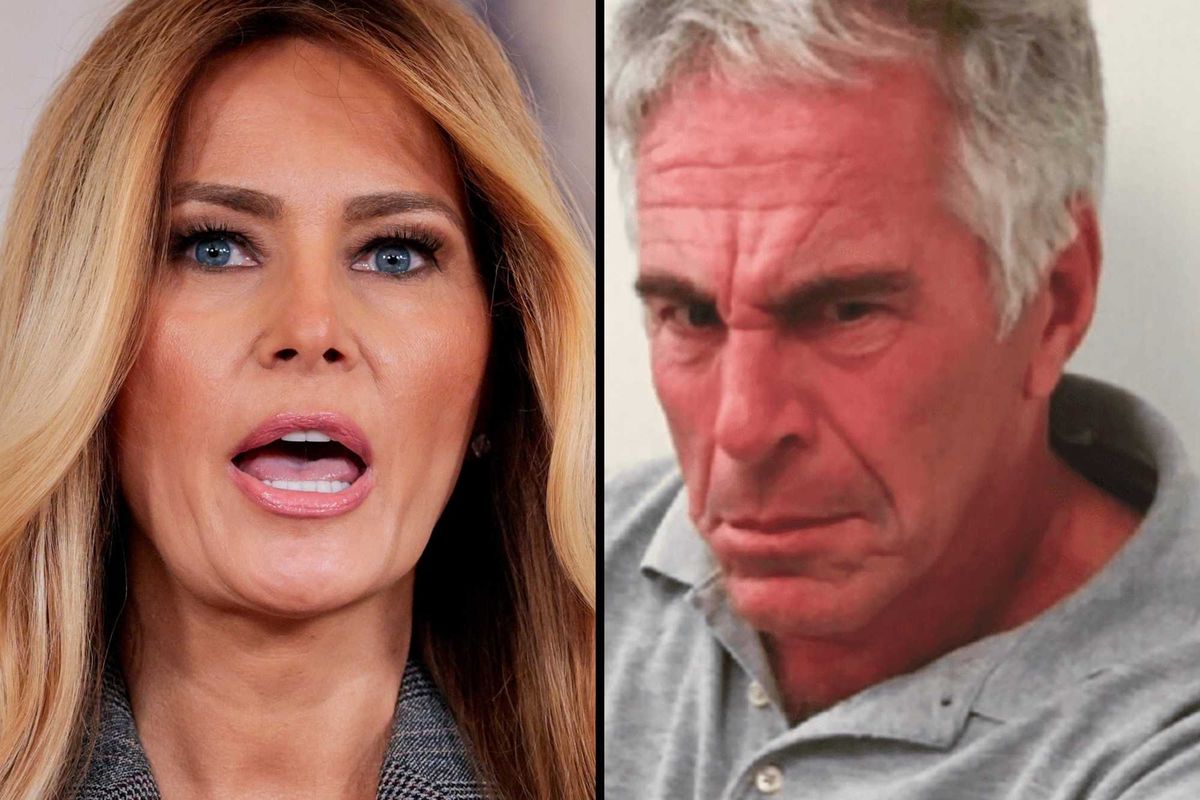
Left: U.S. first lady Melania Trump delivers remarks regarding the late financier and convicted child abuser Jeffrey Epstein from the Grand Foyer of the White House in Washington, D.C., U.S., April 9, 2026. 
Right: An undated photo of Jeffrey Epstein released by the Department of Justice. (DOJ)
REUTERS/Evan Vucci


A newly unearthed FBI document appears to directly contradict First Lady Melania Trump’s surprise statement last week regarding how she met her husband, President Donald Trump, and whether Jeffrey Epstein had played a role.

Last week, Mrs. Trump stunned onlookers by issuing a statement – seemingly unprompted – denying having had a relationship with Epstein, and denying allegations that the disgraced financier had been the one to introduce her to Trump. Paolo Zampolli, a former modeling agent who now serves as Trump’s special envoy, later claimed that he was the one to introduce Mrs. Trump to her future husband.

But according to a 2019 FBI interview summary report, one witness – a female from Poland who claimed to have worked for Epstein in the mid-2000s – it was not Zampolli who introduced Mrs. Trump to the future president, but rather, Epstein himself.

“EPSTEIN introduced MELANIA TRUMP to DONALD TRUMP,” the FBI summary document reads, written by an FBI special agent whose name was redacted in the document.

In her statement last week, Mrs. Trump explicitly denied that she had been introduced to her future husband by Epstein, saying that she instead met Mr. Trump “by chance, at a New York City party in 1998,” noting that further details of the encounter were “documented in detail in my book, MELANIA.” Zampolli, long a close friend to Mr. Trump, backed up Mrs. Trump’s claim that same week by calling the allegation that Epstein introduced the two “nonsense.”

According to the witness interview by the FBI in 2019, however, not only did Epstein introduce Mrs. Trump to Mr. Trump, but "the agent" – presumably Zompolli, based on context – had an “affair” with the witness, and had also attempted to purchase Elite Model Management – a French modeling agency that represented Trump’s daughter, Ivanka, when she was 15 years old – with Epstein.

“[Redacted] had an affair with the agent. ZEMPOLI was trying to buy Elite Models with EPSTEIN,” the report reads. “EPSTEIN was visiting ZEMPOLI at the agency when there were casting auditions for models. EPSTEIN was looking through portfolios and saw [Redacted’s] photograph of her wearing only swim bottoms.”

During her statement last week, Mrs. Trump also appeared to acknowledge sending a 2002 email to Epstein accomplice Ghislaine Maxwell, who’s currently serving a 20-year sentence for child abuse. In the email, a sender named “Melania” complimented who is believed to be Maxwell on her appearance in a New York Magazine article, and exchanged pleasantries. Mrs. Trump dismissed the email as nothing more than “casual correspondence.”

Trump, Mrs. Trump and Zampolli are not facing any criminal charges or accusations of wrongdoing. The claims of the witness whose interview was summarized by the FBI have not been verified by the agency.


Latest in the Epstein scandal makes Melania's tedious documentary worth watching


(REUTERS)

April 13, 2026
ALTERNET

Smack dab in the Rust Belt city of Allentown, Pennsylvania, the Movie Tavern Trexlertown is a welcome hybrid of multiplex and gastropub. Yet even though I was there to join a large audience to experience a sci-fi masterpiece called “Project Hail Mary,” I allowed my curiosity to briefly lead me on a tangent about a film with a drastically — um — different quality.

“Was there anything like these crowds for ‘Melania’?” I asked the employee who sold me my ticket. They bristled at the title; I clarified that I was a film critic seeking demographic information and not a supporter of President Donald Trump. They relaxed, then answered: “Not a lot of people saw that, but a few did.” “Melania” viewers tended to be groups of senior citizens turning out to support Trump.

I cannot imagine any form of political self-expression more masochistic than watching “Melania.” The literally plotless documentary about the 20 days before Trump’s second inauguration is, on its face, stupefyingly dull — a hagiographic non-portrait of a non-entity of a First Lady — and I cannot recommend it either as a genuinely good film or even as an ironically entertaining one. One scene cracks that facade, her attendance at President Jimmy Carter's memorial, and it exposes how narcissism-fueled deflection collapses when incompetently executed.

To understand that fascinating moment, which puts the “scene” in “obscene,” one must juxtapose it with Melania Trump’s recent speech about her husband's and her own controversial ties to the late Jeffrey Epstein, the infamous convicted child sex trafficker to the rich and powerful.

In terms of their legacies, Carter was as far removed from Epstein as two human beings can be from one another. He served a single distinguished presidential term from 1977 to 1981 and is best remembered for achieving a lasting peace between Israel and Egypt, returning the Panama Canal to Panama, supporting liberal social legislation (such as on women’s rights and disability rights), struggling with inflation and a hostage crisis with Iran.

You learn exactly none of this in “Melania.” In fact, from this movie, you know nothing about Carter’s life or achievements other than the fact that he once was a president and now he is dead. Instead all we hear about is Melania use the historic, solemn ceremony held in the January after his Dec. 29, 2024 passing as an opportunity to talk about her deceased mother. Given that the late Amalija Knavs did indeed pass away one year earlier, this is forgivable up to a point; it is understandable to mention her mother, but not to focus entirely on her — or, to be more precise, Melania’s performance of a grief response, which receives far more attention than any details about Kvans herself.

The problem, from a dramatic standpoint, is that Melania’s act is so hollow it becomes its own kind of confession. She talks about her mother in platitudes delivered with so little conviction, such a lack of emotion, that the matriarchal shift feels less like a sincere tribute than a roundabout opportunity to make Carter’s story about herself. One who watches “Melania” for the Carter scene will learn absolutely nothing about Carter, true, but they will also learn only slightly more about Amalija Knavs.

The scene is the thesis — a woman surrounded by weight and gravity, contributing nothing.

I’d like to contribute something from my own interaction with Carter, in the summer of 2018 for a Salon Magazine interview about the anniversary of his 1979 speech on America’s existential “crisis of confidence.” We spoke briefly twice, with his bristly demeanor on both occasions being not dissimilar to that of the aforementioned movie theater cashier. I don’t know why Carter felt this way, but I do know his ornery attitude fueled this observation about Trump’s presidency.

“I think that under Trump the government is worse than it has been before,” Carter explained by email. “This is the first time I remember when the truth is ignored, allies are deliberately aggravated, China, Europe, Mexico and Canada are hurt economically and have to hurt us in response, Americans see the future worse than the present, and immigrants are treated cruelly.”

When asked if America still has a “crisis of confidence,” he said that “we still have the same crises of that time.


He then added “plus a serious loss of faith in democracy, the truth, treating all people as equals, each generation believing life would be better, America has a good system of justice, etc.” When I pointed out that in 1979 he observed “what you see too often in Washington and elsewhere around the country is a system of government that seems incapable of action. You see a Congress twisted and pulled in every direction by hundreds of well-financed and powerful special interests,” he concluded “this is much worse than when I gave the speech.”

I could not help but think of these “hundreds of well-financed and powerful special interests” in both the White House and Congress when it comes to the Epstein scandal. Combined with my ongoing anger at Trump for refusing to keep the flag lowered after Carter’s death during his inaugural ceremonies, I felt indignant at the Trumps’ ostentatious neutrality toward Carter’s life and legacy. If nothing else, Trump could learn from Carter’s longevity; the health-conscious Baptist was the only president to make it to 100, which looks increasingly unlikely for Trump given his penchant for Franken-burgers and angry outbursts about things he can’t control.

This brings us back to Melania Trump’s White House speech, which in its angry defensiveness betrayed more authentic emotion in less than 10 minutes than “Melania” the film did in more than 100. The first lady’s speech was seemingly prompted by various impending salacious reports about the relationship between the future president and first lady and the notorious pedophile (including that the Trumps first slept together on an Epstein plane named after “Lolita,” a book about a fictional pedophile which inspired a classic 1962 black comedy film with the same title... which is also far better than “Melania,” directed by Epstein associate Brett Ratner).

Yet despite finally bringing some emotional realness to her public presence, Melania could not do the same with factual realness. For instance, despite saying she only interacted with Epstein’s close aide Ghislaine Maxwell casually, in 2002 Melania sent an email to Maxwell saying “HI!”, describing Maxwell’s travel plans and signing it “Love, Melania.” Maxwell meanwhile referred to then-Melania Knauss as “sweet pea.” Perhaps more damningly, a 2016 email to Epstein from a redacted sender alleged Melania actually met Donald through Epstein.


“I remember flying back with Donald on his plane the first weekend I went to visit you in Florida was the weekend he met Melania and he kept on coming out of the bedroom saying’ wow what a hot piece of a--,’” the unknown sender wrote in the email.

"These images and stories are completely false,” Melania Trump said in her speech. “I am not a witness or a named witness in connection with any of Epstein's crimes."

When I juxtapose the emptiness of these two moments — Melania’s reaction to Carter’s memorial service and her reaction to being confronted over her ties to Epstein — the bottomless abyss reflects the absolute self-involvement that permeates every level of both Trumps’ entire being.

When they talk constantly about themselves, and make every story one in which they are the central characters, we inevitably go along with them simply because they possess so much power that they can compel conversations in that direction through sheer brute force. In the process, we start viewing the tragedies of others — a former president who died, countless children who were exploited — not in terms of the actual suffering, but the narcissistic self-interest of those who wish to ignore them either out of indifference or something more sinister. Even worse, we do not learn lessons that they have to teach us about the injustices that those in power perpetrate.
Mockery as Pete Buttigieg fact-checks MAGA host into a live TV meltdown: 'Dogwalked!''

JOE KERNAN IS AN IDIOT

#BUTTIGIERPOTUS2028


Robert Davis
April 13, 2026
RAW STORY


CNBC screenshot

A political commentator mocked a MAGA TV host for having a complete meltdown after being fact-checked on air.

David Pakman, host of the liberal news commentary show, "The David Pakman Show," said in a new video that MAGA CNBC host Joe Kernan got "dogwalked" by Democrat Pete Buttigieg during an interview on Monday. Buttigieg fact-checked Kernan on a couple of claims he made about the economy during the Biden administration, which caused Kernan to lose his cool.

"It takes two to tango ... On the one hand, Pete Buttigieg is really good at this stuff. On the other hand, Joe Kernan, who has come after me on Twitter and is just a triggerly guy overall, is not well-suited to remaining calm when he's getting dogwalked by Pete," Pakman said.

In one exchange, Buttigieg said he doesn't see an "obvious" way out of the war in Iran, which has caused global energy prices to skyrocket since the skirmish began about six weeks ago. Rising energy prices have also driven consumer prices to the highest point in two years, according to the latest economic data.

Kernan claimed that Trump's economy is doing better than Biden's because inflation is lower. Buttigieg reminded Kernan that the latest data show prices increased by 3.3% year-over-year, compared with the 2.9% inflation rate under the Biden administration.

"He said on day one it would go down, and he came in, and now it's up," Buttigieg said.

Kerner lost his cool and continuously interrupted Buttigieg during the segment.

"This is not a debate in any sense of the word," Pakman said. "When one person loses control of their ability to think and their ability to remain calm, this is what it looks like."


'They're getting sick of him': Ex-GOP operative in awe as Trump booed at UFC Miami

Robert Davis
April 13, 2026 
RAW STORY


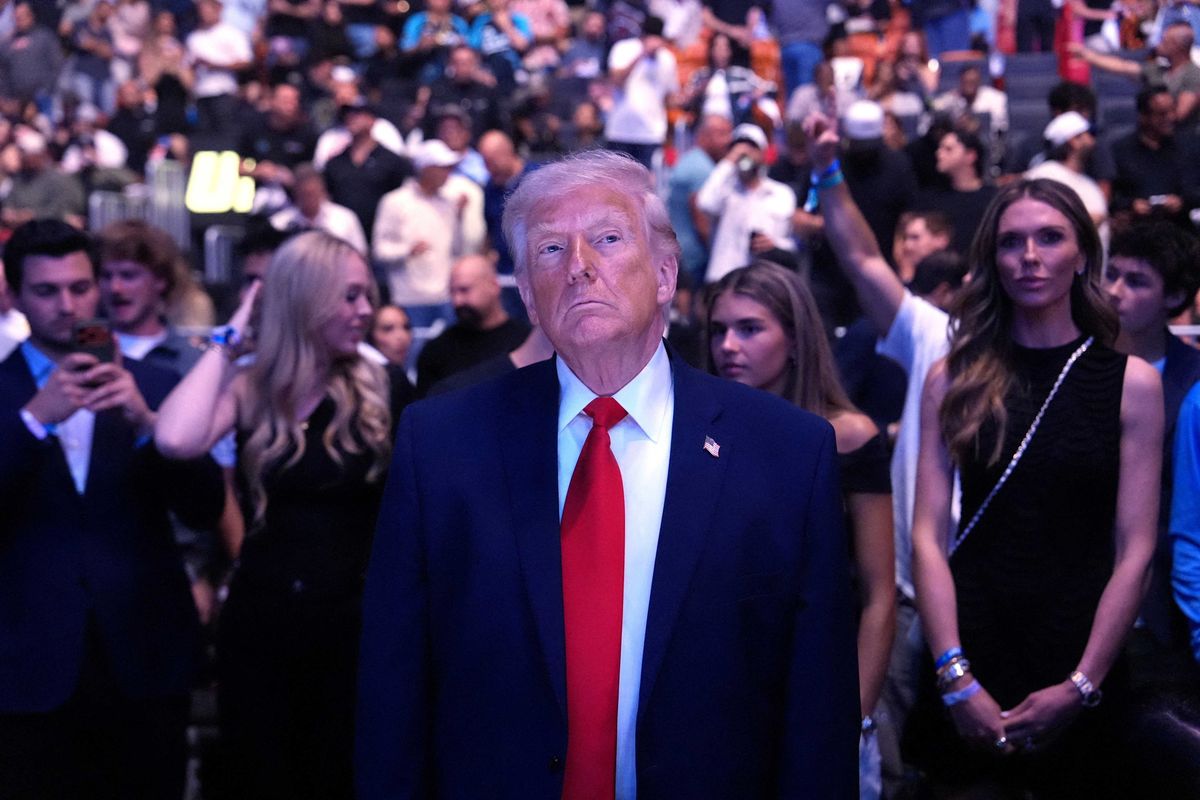
President Donald Trump attends UFC 327 at Kaseya Center in Miami, Florida, on April 11, 2026. Julia Demaree Nikhinson/Pool via REUTERS TPX IMAGES OF THE DAY

A former GOP operative said on Monday that he was in awe watching President Donald Trump get booed when he attended a UFC fight in Miami last week.

Trump was booed at the event on Saturday night while his family walked behind him as they entered the area. The event occurred as reports emerged that peace talks between the U.S. and Iran were falling apart.

Steve Schmidt, author of "The Warning" on Substack, said in a new video that the video of the event shows MAGA is getting sick of Trump.

"Can you hear the sound? The sound of the booing," Schmidt said. "This is a UFC match. This is Donald Trump's base in Miami. And it seems that if you listen to the crowd, they're getting sick of him."

Schmidt pointed to Trump's handling of the war in Iran as part of the reason why his fans were booing him.

"The war has traveled in unexpected directions," he said. "Who would have guessed at the beginning, when Donald Trump was saying the Iranians would soon make an unconditional surrender to him, that within 45 days' time the American position and the Iranian position would be the same."


Trump's attacks prompt key ally to cut US out of new defense plan: WSJ

Tom Boggioni
April 15, 2026 
RAW STORY


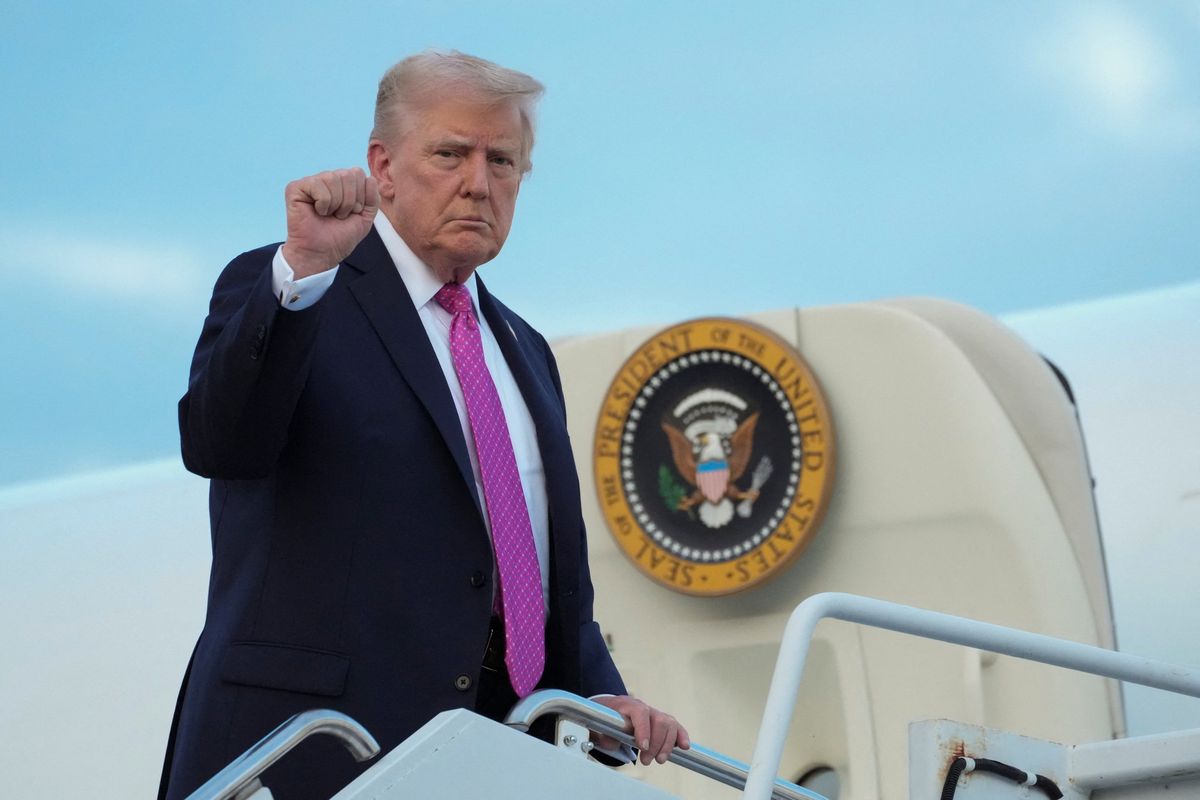
Donald Trump gestures as he boards Air Force One. REUTERS/Ken Cedeno

With Donald Trump becoming more erratic and lashing out at the traditional allies of the US, plans are afoot by members of the North Atlantic Treaty Organization (NATO) to create a separate version of the organization beyond the American president's reach.

According to the Wall Street Journal's Bojan Pancevski and Daniel Michaels, European officials are advancing informal plans for what some are calling "European NATO," a parallel structure that would give Europeans greater command-and-control authority and supplement U.S. military assets with their own capabilities.

The plans represent a massive shift in European strategic thinking now that Germany has ceased resisting French calls for greater European defense sovereignty, preferring American military guarantees. That calculus has fundamentally changed under German Chancellor Friedrich Merz, who is now actively participating in the initiative over concerns about U.S. dependability as an ally during the Trump presidency and beyond.

European officials are explicit about their purpose: preserve deterrence against Russia, operational continuity and nuclear credibility even if the Trump administration withdraws forces from Europe or refuses to come to its defense, as the president has repeatedly threatened.

Trump's recent rhetoric has only accelerated the timeline. He branded European allies as "cowards," called NATO "a paper tiger," and added menacingly, in reference to Putin: "Putin knows that too." He has also threatened to leave NATO entirely over Europe's refusal to support his Iran war, describing the move as already "beyond reconsideration," the Journal is reporting.

The momentum is undeniable. Finland's President Alexander Stubb, one of the leaders involved in the initiative, signaled the permanent nature of the shift: "A burden shifting from the U.S. toward Europe is ongoing and it will continue…as part of U.S. defense and national security strategy."

The report notes Europe is not waiting for Trump to make good on his threats. The plans, first conceived last year, have accelerated dramatically after Trump threatened to seize Greenland from NATO member Denmark and intensified amid the standoff over Europe's refusal to back the highly criticized Iran war.

Though congressional approval would be required for a formal NATO withdrawal, Trump retains broad authority as commander-in-chief to move troops or assets out of Europe or withhold support — a threat that has transformed European defense planning from theoretical to urgent.


Supreme Court justice's dire 1952 warning has come true: legal scholar


Daniel Hampton
April 14, 2026
RAW STORY

A Harvard-trained legal scholar sounded the alarm Tuesday that President Donald Trump has fulfilled a chilling Supreme Court prophecy from 1952 in which a justice warned that emergency powers, left unchecked, would "kindle emergencies."

Writing in Lawfare, Ben Diamond, a fellow at the Center for Applied Environmental Law and Policy, argued that Trump's second term has shattered historical norms around the use of emergency authority.

And Congress is powerless to stop it.

“Emergency powers would tend to kindle emergencies,” Justice Robert Jackson wrote in 1952, wrote Diamond, noting the warning came as the high court banned President Harry Truman from using emergency powers to seize the nation’s steel mills during the Korean War.

"Today, Justice Jackson’s words are more relevant than ever: In February, Chief Justice John Roberts echoed Jackson’s alarm in his opinion invalidating President Trump’s use of emergency authority to impose global tariffs," wrote Diamond.

In just one year, Trump issued roughly as many non-tariff emergency orders as any of his predecessors issued across their entire terms in office, he noted. Trump is on track to issue 6 1/2 times more emergency orders than the average president this century — more than every administration since 2000 combined.

"Justice Jackson's warning has become a reality," Diamond wrote.

Trump declared a "National Energy Emergency" on his first day back in office, then used it to kill renewable energy projects and prop up fossil fuels, canceling $35 billion in clean energy investments in the process. Diamond warned that MAGA activists are also lobbying the White House to use emergency powers to seize elections.

"At bottom, the administration is weaponizing emergency authority, transforming it from a tool for responding to crises into a means of kindling them," wrote Diamond.

With Congress unable to override a presidential veto and courts slow to intervene, Diamond said the judiciary must act before emergency powers become a permanent tool of authoritarian governance.

"Courts should continue to heed Justice Jackson’s prescient warnings and prevent this administration—and all future ones—from eroding the separation of powers under the guise of emergency," he concluded.
ANOTHER DAY, ANOTHER WAR  CRIME
Trump admin admits to striking another foreign boat and killing 4


Robert Davis
April 14, 2026 
RAW STORY


President Donald Trump's administration admitted on Tuesday to striking another foreign boat and killing four people, according to a new report.

The strike is the second in as many days, the New York Times reported, and marks the revival of one of the administration's most controversial policies. Since Trump began his second term, the administration has conducted 50 strikes against foreign boats, many of which were alleged to be carrying drugs. In all, the strikes have killed roughly 174 people.

"The U.S. Southern Command, led by Gen. Francis L. Donovan of the Marine Corps, announced the strike on social media with a 16-second video that showed a stationary boat floating in the water and then exploding," the report reads in part.

"Legal specialists on the use of lethal force have said the strikes are illegal, extrajudicial killings because the military cannot deliberately target civilians who do not pose an imminent threat of violence, even if those people are suspected of engaging in criminal acts," it added. "The Trump administration has not provided evidence of drug smuggling."

‘More Murder’: Trump Admin Kills Two People in Latest Illegal Boat Bombing

The attack was announced hours after Trump threatened Iranian vessels near the Strait of Hormuz with “the same system of kill that we use against the drug dealers on boats at Sea.”


A screengrab of video footage posted by US Southern Command shows a boat in the eastern Pacific just moments before it was bombed by American forces on April 13, 2026.
(Photo: US Southern Command)

Jake Johnson
Apr 14, 2026
COMMON DREAMS

The US military on Monday attacked a vessel in the eastern Pacific accused, without evidence, of engaging in “narco-trafficking operations.” The strike killed at least two people and brought the known death toll from the Trump administration’s lawless boat-bombing spree in international waters to more than 170.

As has been its custom since the boat bombings began last September, US Southern Command posted an unclassified video clip of the attack on social media. SOUTHCOM described the bombing as “a lethal kinetic strike on a vessel operated by Designated Terrorist Organizations,” but did not provide any evidence against the boat’s operators.

Monday’s deadly strike came days after the April 11 US bombings of two other boats in the eastern Pacific, attacks that killed at least five people. United Nations experts and human rights organizations have condemned the bombings in international waters as extrajudicial killings and murder—and argued those ordering and carrying out the attacks should be prosecuted for homicide.

“More murder,” The Intercept’s Nick Turse wrote in response to Monday’s boat bombing.

Hours before SOUTHCOM announced the latest strike, Turse reported that the Trump administration is “waging a pressure campaign against the leading inter-American human rights watchdog to squash a potential investigation into illegal US attacks on boats in the Caribbean Sea and the Pacific Ocean.”

Brian Finucane, a senior adviser to the US Program at the International Crisis Group, said Monday that it is “funny how the Trump administration is very happy to continue to post snuff films of these lawless killings but not defend the legal merits of these strikes.”

Last month, the Inter-American Commission on Human Rights held a hearing during which experts testified to the illegality of the boat strikes.

“The administration’s desire to play imperial superpower in the region cannot be a reason to completely displace the foundations of international law,” Angelo Guisado, senior staff attorney at the Center for Constitutional Rights, told the commission.

On Monday, US President Donald Trump threatened to expand his administration’s illegal boat-bombing spree to Iranian vessels that “come anywhere close” to the US naval blockade of the Strait of Hormuz that the president ordered over the weekend.

Trump wrote on social media that Iranian vessels seen approaching the blockade “will be immediately ELIMINATED, using the same system of kill that we use against the drug dealers on boats at Sea.”

“It is quick and brutal,” the president added.


Trump’s Military Murders 5 More People in ‘Lawless’ Boat Bombing Campaign

The Trump administration’s boat strikes have now killed at least 168 people, according to NPR.


US Southern Command shared on social media a 34-second clip of two strikes on boats in the eastern Pacific that killed five people on April 13, 2026.
(Photo: screen cap via SOUTHCOM / X)


Brad Reed
Apr 13, 2026
COMMON DREAMS

The United States military has killed five more people suspected of drug smuggling in the latest boat bombing operation that many international law experts consider to be acts of murder.

In a Sunday social media post, US Southern Command (SOUTHCOM) announced it had “conducted two lethal kinetic strikes on two vessels” that it had deemed to be run by “designated terrorist organizations.” As with the dozens of other boat bombings the Trump administration has conducted since last September, the military did not provide evidence that the vessels were involved in drug trafficking.

“Intelligence confirmed the vessels were transiting along known narco-trafficking routes in the Eastern Pacific and were engaged in narco-trafficking operations,” SOUTHCOM said. “Two male narco-terrorists were killed, and one narco-terrorist survived the first strike. Three male narco-terrorists were killed during the second strike.”

SOUTHCOM said that it had alerted the US Coast Guard to conduct a search and rescue operation of the lone survivor of the two strikes, although it provided no further details of his well-being.

According to NPR, the US has now killed at least 168 people with its strikes on suspected drug boats, which began in September and have since continued despite being denounced by human rights organizations such as Human Rights and Amnesty International.

Brian Finucane, senior adviser with the US Program at the International Crisis Group, took note of the latest boat strike by remarking, “The lawless killing spree at sea continues.”

A coalition of rights organizations led by the ACLU last year sued the Trump administration to demand it release documents that provide legal justification for its boat-bombing campaign.

The groups said that the Trump administration’s rationales for the strikes deserve special scrutiny because their justification hinges on claims that the US is in an “armed conflict” with international drug cartels akin to past conflicts between the US government and terrorist organizations such as al-Qaeda.

The groups argued there is simply no way that drug cartels can be classified under the same umbrella as terrorist organizations, given that the law regarding war with nonstate actors says that any organizations considered to be in armed conflict with the US must be an “organized armed group” that is structured like a conventional military and engaged in “protracted armed violence” with the US government.

Before President Donald Trump’s Pentagon began conducting the lethal boat strikes last year, drug trafficking in international waters was treated as a criminal offense, with law enforcement agencies and the US Coast Guard intercepting boats suspected of carrying drugs and arresting suspects.

Trump’s bombings of boats in the Caribbean and eastern Pacific have been called “extrajudicial killings” by advocacy groups including Amnesty International


State Department Pushes Human Rights Watchdog to Ignore Deadly, Illegal Boat Strike Campaign

As the Inter-American Commission on Human Rights was advised not to investigate the bombings, Pentagon officials expressed support for strikes on land, ostensibly against drug traffickers.


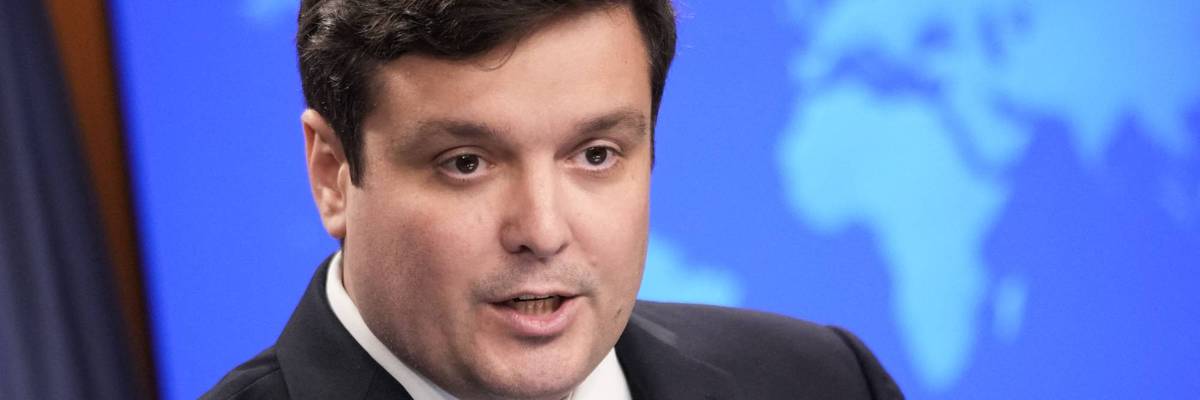
US Deputy State Department spokesperson Tommy Pigott speaks during a press briefing at the State Department in Washington, DC on July 31, 2025.
(Photo by Oliver Contreras/AFP via Getty Images)

Julia Conley
Apr 14, 2026
COMMON DREAMS


The former president of a top international human rights watchdog views the United States’ monthslong campaign of bombing boats in the Caribbean Sea and eastern Pacific Ocean as a clear-cut case of “murder,” he told The Intercept Monday, but he warned that pressure from the Trump administration may stop the body from investigating the Pentagon’s actions.

Juan Méndez, a former president of the Inter-American Commission on Human Rights, noted that a month after the IACHR held a hearing on the boat bombing campaign, officials “may well feel that this is a very delicate situation, and if they take the initiative, they’re going to incur the wrath of the United States.”


With Nearly 50 Boats Attacked, US Strikes Highlight ‘Pattern of Unlawful Use of Lethal Force’: Human Rights Watch


The hearing last month was the first of its kind and included testimonies from the ACLU, the Center for Constitutional Rights, International Crisis Group, and Ben Saul, the United Nations special rapporteur on counterterrorism and human rights. The groups presented evidence that the US has been violating both domestic and international law by bombing vessels that it has claimed—without making any evidence publicly available—are involved in drug trafficking. Nearly 170 people have been killed in dozens of strikes, and legal experts worldwide have asserted the US is violating international law and has committed extrajudicial killings—potentially making those involved in the strikes liable for murder.

The hearing was followed by a statement from Tommy Pigott, a State Department spokesperson, who said the IACHR had “strayed far outside its mandate” by looking into the boat attacks—as the family of one man killed in a bombing requested it to—and accused the ACLU of trying to manipulate the body.

“The United States calls on the commission to adhere to its statute and rules of procedure in the future and avoid inserting itself into matters that are in active domestic litigation and fall outside the human rights sphere,” said Pigott. “Convening hearings under these circumstances risks undermining—not strengthening—the credibility of the inter-American human rights system.”

Pigott also called on the commission to “redirect its focus toward the individual petitions languishing on its docket, sometimes for decades.” He did not mention specific petitions or issues the IACHR should focus on.

Carl Anderson, a legal adviser at the State Department, also rebuked the commission for holding the proceedings.

“If the United States cuts the funding, they probably would have to shut down—at least for a while.”

A person with close ties to the IACHR told The Intercept that Pigott’s demand that the commission focus on other topics pointed to a pressure campaign aimed at stoking fear that the IACHR could lose its funding.

President Donald Trump’s zeroed out US contributions to the commission during his first term in 2018, and withdrew some funding the following year due to its support for abortion rights. The administration terminated funding last year for at least 22 programs under the IACHR’s parent body, the Organization of American States, of which the US is the largest international funder.

“They are stretched for funding,” Méndez told The Intercept. “And if the United States cuts the funding, they probably would have to shut down—at least for a while.”

Stuardo Ralón, the IACHR’s current president, denied that there is “pressure from the United States on the Inter-American Commission on Human Rights,” but suggested it may not conduct a comprehensive investigation into the Trump administration’s boat bombings—saying the body “does not conduct investigations.”

The Intercept noted that the IACHR has conducted numerous investigations that it has publicly acknowledged and described as such, including into US immigration detention centers and the kidnapping and apparent killing of 43 students in Mexico in 2014.

Ralón told the outlet that it has not yet taken any steps to launch an investigation into the strikes following the hearing, and said it “will continue to monitor the situation in accordance with its mandate.”

Jamil Dakwar, director of the ACLU’s human rights program, emphasized that “the commission is within its competency and its bounds to fully investigate the egregious violations of international law happening in its own backyard.”

“We have asked the commission to fulfill its responsibilities as the premier regional human rights body to conduct a fact-finding investigation of these heinous killings,” Dakwar told The Intercept, “and to ensure that no country can act in this fashion because that will have severe implications on human rights in the region and beyond.”

As the State Department has pushed the IACHR away from probing the legality of the boat bombings, administration officials like Joseph Humire, acting assistant secretary of war for homeland defense and Americas security affairs, have warned that the attacks at sea are “just the beginning” of what officials claim is an effort to defeat drug cartels—against which Congress has not authorized any military action.

US Southern Command announced a joint ground operation with Ecuador last month to defeat “narco-terrorists.”

Humire said the Pentagon supports “joint land strikes,” while Gen. Francis Donovan, the head of US Southern Command who has been directing the boat attacks, told the Senate Armed Service Committee that the Pentagon is moving toward “a counter-cartel campaign process that puts total systemic friction across this network.”

“I believe,” he said, “these kinetic [boat] strikes are just one small part of that.”