Thursday, April 16, 2026


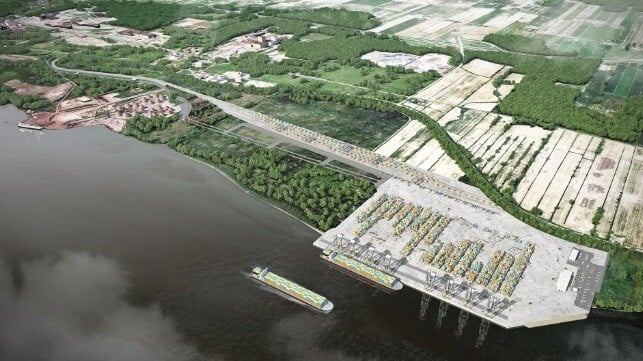
Construction Starts on Port of Montreal's Long-Delayed Container Terminal

Contrecouer
Courtesy Port of Montreal

Published Apr 13, 2026 9:31 PM by The Maritime Executive


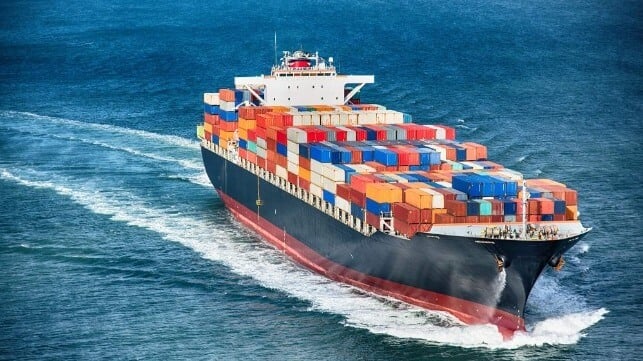
Canada has finally started the construction on the new Contrecoeur container terminal at the Port of Montreal. The megaproject, which was first proposed nearly 40 years ago and has been the subject of delays and controversies, is expected to expand the capacity of the port by approximately 60 percent, making it the largest Atlantic coast port expansion in the country's history. The project will add up to 1.15 million TEU in annual container handling capacity, effectively eliminating capacity constraints that have bogged down the facility.

Prime Minister Mark Carney broke ground on the project, stating that the federal government through the Canada Infrastructure Bank has committed US$839 million in financing. Other financiers include the Government of Quebec that is contributing $94 million and Transport Canada with $108.5 million.

For the current Canadian government, Contrecoeur is a priority project for ongoing efforts to double non-U.S. exports and diversify trade partnerships, particularly in Asian markets. The new terminal will offer the shortest shipping route from North America's industrial heartland to Europe and the Mediterranean, two of the most promising alternative markets for Canadian importers and exporters. To seize this opportunity, the administration launched the Major Projects Office (MPO) in August last year, which streamlined approvals for the project, developed the financing model and helped secure permits in record time.

The project involves the construction of two berths, a container handling area, an intermodal marshalling yard connected to the main rail network, a truck gate connected to the road network, and secondary facilities. Work on phase 1, which includes in-water works such as dredging and quay wall construction, started in October last year; phase 2 is set to begin next year. Commercial operations of the new terminal are targeted for 2030, with DP World Canada having secured the agreement to operate the facility for 40 years.

Montreal has built a reputation as one of Canada's critical gateways to the world, handling over 35 million tonnes of cargo annually and around 2,000 ship calls. The port generates nearly $72.3 billion for the economy annually and supports approximately 590,000 jobs.


Net Zero by 2050? This Decade's Fuel Choices Will Decide

iStock
iStock

Published Apr 12, 2026 2:24 PM by Daniel Bischofberger


Green-hydrogen based synthetic fuels are stalled by a coordination problem across industries. Pooling demand and investment across sectors could unlock the production scale needed for shipping and other hard-to-abate industries, while strengthening energy security in the transition to net zero.

The debate over whether net zero is possible by 2050 may continue for years, while global emissions and temperatures continue to rise. But the question of green hydrogen’s role in achieving it has swung from hype to skepticism to a pragmatic center: shipping and several other hard-to-abate sectors need green hydrogen to reach net zero. Yet, the hydrogen itself remains elusive. Demand waits for supply. Supply waits for demand. It’s an ouroboros.

Technology ahead of fuel

Taking shipping as an example, the industry has innovated and invested in dual-fuel ships capable of running on both conventional fuels and synthetic ammonia or methanol – and these ships are already setting sail. Their engines are designed to use fuel as efficiently as possible: today to reduce emissions from fossil fuels, and in the future, to make the most efficient use of the more expensive synthetic ammonia and methanol.

The problem is that while ship technology ran ahead, the fuel front was stalling.

First, hydrogen fuel production is a massive undertaking: renewable energy, electrolysis, synthesis plants, storage, pipelines, and ports.

Second, the bill. To reach net zero by 2050, shipping alone will need 100 to 150 million tons of green hydrogen annually as feedstock, even at maximum efficiency across the sector. The hard-to-abate sectors together will need 500 to 600 million, an investment of $9 trillion.

So, just for the feedstock, shipping would need to fund $2 to 3 trillion upfront. Which sector can afford today to commit three trillion dollars for a fuel that will be ready in 5-10 years and require upfront purchase contracts of 10 to 15 years?

And yet, that’s the timeline: 25 years to 2050.

The snake eating its tail

Meanwhile, the collapse of hydrogen projects around the world proves that the challenge is more than isolated anomalies; it is systemic.

Underpinning shipping’s deadlocked fuel transition is a set of five tightly linked factors – fuel fragmentation, geography, finance, regulation, and port constraints, that reinforce each other.

First, fuels. In the absence of synthetic fuels, shipping is trying to juggle oil, diesel, liquefied natural gas, and biofuels. This hedging is rational, but it dilutes investment and prevents any single fuel from scaling. It would be comparable to an electric vehicle charging infrastructure with 12 different types of current, which thankfully isn’t the case, or there would probably be no electric vehicles.

Second: geography. Following the oil and gas model, hydrogen production is concentrated in a few nation-scale projects – some as large as half of Switzerland. For shipping, 80% of the global fleet operates on flexible routes. An early market that forces trade to reroute from 6,000 ports to a mere handful of fuel supply hubs will limit adoption. Aviation would face a similar challenge.

Third: finance. Shipping’s low-cost, low-margin business model is predicated on the universal availability of the cheapest fuel in the global mix. Synthetic fuel contracts overturn every precedent: expensive, long-term, limited.

Fourth: regulation. Shipping’s global regulation should be a strength. Global carbon pricing could level the playing field for the entire industry. However, that strength depends on a two-thirds vote from member states. With the onus on national governments and local producers to assemble subsidies, permits, materials, and financing, many are reticent to approve the carbon pricing that would force demand. Aviation faces a similar challenge.

Fifth: ports. Ports are already stretched for power, land, and trained operators. Most cannot justify investment in new bunkering systems without predictable supply and demand.

The ouroboros tightens, and every hard-to-abate sector faces some version of this deadlock loop.

Breaking the loop

There is one way to get the snake to release its tail: give it more to eat – with coordinated demand across sectors.

Both shipping and aviation giants have tried to make their own hydrogen and synthetic fuel supplies. Each industry has tried to pool demand within the industry. It hasn’t worked, because no single company or sector can carry the cost and scale of green hydrogen alone. The balance sheet requires multiple industries. Shared offtake produces contracts large enough to start building, and allows sequential planning. Shared risk makes early projects insurable, and shared infrastructure avoids duplication.

Competition across sectors is stalling production, but collaboration can enable it.

Chance or illusion?

The willingness to embrace cross-sector collaboration depends on whether fossil fuels are still regarded as the safer economic bet.

However, even the oil majors are beginning to question that assumption. Wood Mackenzie estimates that oil and gas production could fall nearly 40% by 2040 without hundreds of billions of dollars in new upstream investment. Oil companies therefore face the same dilemma as hydrogen producers: demand uncertainty is freezing investment on both sides of the energy transition.

In the Asia-Pacific region, that same uncertainty, combined with volatile fossil import supply, is accelerating the shift toward carbon-neutral energy security.

China made that decision before many others had even asked the question. It cornered the global market in critical mineral processing for clean technologies, overbuilt renewables that can now be converted into hydrogen and synthetic fuels, and scaled its shipbuilding industry within four decades. As with electric vehicles, China can absorb early fuel price differentials through subsidies and leverage its domestic market to drive costs down.

China’s integrated energy, industrial, and shipping policy is material to developing the cross-sector sequencing required to make the transition work. Despite its size, it is also bringing smaller, modular e-fuel facilities online faster and cheaper, with one unit producing over 300,000 tons of green ammonia per year, already on export to Asia Pacific and Europe.

In Japan, Korea, and Singapore, the focus is on imports. Utilities are committing to ammonia offtake under national energy strategies, allowing safety standards, terminals, and bunkering systems to develop ahead of shipping demand.

Meanwhile, the Chinese modular approach is already being exported to Brazil. Vast land availability and very low solar power costs give Brazil a strong advantage in exporting synthetic fuels, and the country is already developing the ports of Açu and Pecém as green hydrogen and e-fuel hubs for power generation, industry, and shipping.

Across these cases, the pattern is consistent: land-based sectors lead; investment, risk, infrastructure, and offtake are shared and publicly supported; shipping follows once the regulatory framework is in place.

The decade of decision

At a time when the global debate between reinvesting in fossil systems and accelerating a fossil-free future is hardening once again, which path is industry betting on?

Is net zero possible by 2050? That depends on the decisions taken in this decade. The trade-offs will be felt by the next generation, one way or the other.

The task for industry and institutions is to move beyond siloed efforts and coordinate demand, infrastructure and investment across sectors to build a secure, net-zero energy future.

Daniel Bischofberger is chief executive of Accelleron, a maker of turbochargers, fuel-injection systems and digital technologies for the energy and shipping industries.


The opinions expressed herein are the author's and not necessarily those of The Maritime Executive.
S. Korea Donates Patrol Vessel to Help Ecuador Fight Drug Smuggling

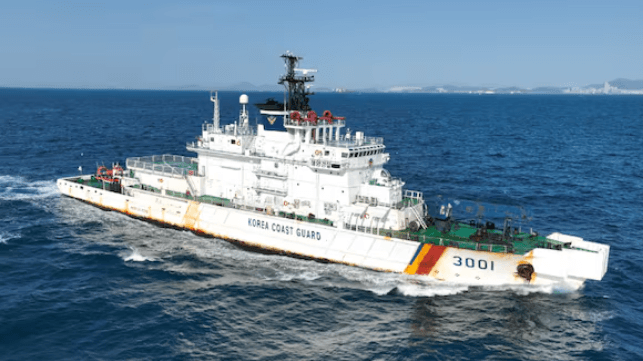
Korea Coast Guard's patrol ship 3001, recently refurbished and painted in haze gray to become BAE Jambeli (Korea Coast Guard file image)

Published Apr 13, 2026 6:05 PM by The Maritime Executive


Ecuador intends to push its full-scale war on drug trafficking and organized crime a notch higher with the impending arrival of a multipurpose vessel that was donated by South Korea in 2024.

The Ecuadorian Ministry of National Defense says that the BAE Jambelí is currently in San Diego, U.S, en route to South America. She is slated to become a key asset in the war against the cartels that have turned Ecuadorian waters into a haven of drug trafficking to key markets in Europe and the U.S.

Christened Jambelí, the vessel is a former Korea Coast Guard ship that was commissioned in 1994. The 3,000-tonnes Tae Pyung Yang-class offshore patrol vessel served for three decades before being decommissioned in March 2024. Measuring 105 meters in length with a 15-meter beam, the vessel underwent full modernization and refitting before departing South Korea in January this year for a 62-day journey.

Upon arrival in Ecuador, the vessel is expected to become a critical asset for the Ecuadorian Navy. Her primary mission will be the fight against drug trafficking and organized crime. Apart from being armed with two 20 mm six-barrel Sea Vulcan cannons, the ship can carry three pursuit boats, a medium helicopter and 60 personnel. Endurance is 40 days, ideal for extended coastal patrols.

Jambelí’s other critical missions will include maritime surveillance and control, search and rescue, deterring illegal fishing and protecting the country’s marine environment off the Galapagos Islands. She also expected to provide logistical support to other military units.

“The countdown has already begun. Ecuador is preparing to receive a new force at sea. The country is strengthened and will not take a single step backwards in the defense of its people,” said the Ministry of National Defense in a statement.

Owing to its geographical location between Colombia and Peru - the world's largest producers of cocaine - Ecuador has in recent years become a key transit country for illicit drugs destined for Europe and the U.S. Recent estimates show that as much as 70 percent of cocaine produced in Colombia and Peru is shipped through Ecuador. The country’s Pacific ports, especially those in Guayaquil, act as the most efficient gateways for bulk cocaine concealed in containerized cargo.

President Daniel Noboa, who came into office in November 2023, has prioritized the war against drug cartels that have seen the country become one of the most violent in the region. Last month, the government deployed more than 75,000 police officers and soldiers in some of the most dangerous regions and is also expanding cooperation with the U.S. military and private security.


Op-Ed: Mideast Conflict Provides a Test of Economic Resilience

Areiram / CC BY SA 4.0

Published Apr 14, 2026 6:13 PM by The Conversation


[By Adi Imsirovic and Antonio Fatas]

The world economy survived the shocks of the Ukraine-Russia conflict, which has had limited impact on economic growth. But the escalation of hostilities in the Middle East has transformed what had been, until early 2026, a surprisingly benign outlook into a far more uncertain one. It has created the ultimate test for how resilient the world economy really is.

Amid stalled ceasefire negotiations, the US president, Donald Trump, has threatened a blockade of vessels transiting through Iranian ports in the strait of Hormuz. This sent oil prices back up over US$100 (£74) a barrel. Meanwhile the current ceasefire is looking very shaky.

The key economic factor in this conflict is straightforward: the near-halting of shipments through the strait and the closure of energy infrastructure.

These elements have disrupted roughly one-fifth of global oil production and nearly another 20% of the world’s trade in liquefied natural gas (LNG). With little spare capacity elsewhere, the result has been a sharp and rapid surge in energy prices.

Forecasts of price surges for benchmark oils

This is a classic energy price shock. The consequences for the world economy are predictable in direction but uncertain in magnitude. The latest interim economic outlook from the Organisation for Economic Co-operation and Development (OECD) projects global GDP growth at 2.9% in 2026. This is almost unchanged from its forecast before the war started.

But the OECD report also highlights the conflict’s expected consequences: energy exporters gain from improved terms of trade, while importers – including most of Europe, Japan, Korea, and much of emerging Asia – face a squeeze on real incomes.

For example, US growth has been revised up by 0.3 percentage points (to 2%) while growth in the euro area and the UK have been revised down by 0.4 and 0.5 percentage points respectively.

When it comes to inflation, exporters and importers face similar cost increases. Inflation is expected to increase everywhere, with headline inflation in the group of G20 countries predicted to rise by 1.2 percentage points to 4%. The European Central Bank (ECB) has made similar predictions for growth and inflation.

But these estimates are based on specific (and possibly optimistic) assumptions about energy prices. In their baseline scenarios, energy prices are expected to peak below US$100 per barrel this quarter and begin falling gradually from the middle of the year – as priced in by oil futures markets.

And what about less benign scenarios such as a resumption of the conflict or Trump’s threatened blockade limiting traffic in the strait of Hormuz? Energy prices could stay higher for longer and would be unlikely to be eased by a temporary ceasefire.

The here and now

The most immediate impact of the war on the global economy has been a sharp shortage of distillate fuels, particularly gasoil and jet fuel. This disruption comes at a time of seasonally high demand, driven by agricultural planting and the approach of peak holiday travel, when air traffic typically rises.

Gulf oil producers are key suppliers of these fuels to Asian markets, leaving countries such as South Korea, Singapore, Taiwan and Australia especially vulnerable to supply constraints.

Compounding the problem, crude oil from the Gulf is particularly suited to producing jet fuel and diesel, and cannot easily be replaced by refining alternative grades of oil. As a result, distillate prices in affected markets have surged dramatically, in some cases rising by as much as 200%.

Further blockage of the strait will starve the global market of at least 10% of its demand. This would result in a “demand destruction” (the curtailment of demand for road and air travel in particular) that can only be achieved through raised prices.

If the war in Iran were to go on just for another couple of months, prices for Brent could reach US$120 per barrel. Six months of conflict could see prices exceed US$200 a barrel. This is because supply losses are cumulative – as commercial and strategic reserves are depleted, the supply risk increases.

Oil price projections if the hostilities continue

The ECB’s March 2026 projections for the euro area incorporate some of these scenarios. For example, in what it calls an adverse scenario where oil prices peak at US$120 and decline slowly, economic growth in the euro area becomes negative for 2026.

And in its most pessimistic scenario, oil prices shoot even higher (US$140), which results in a deeper recession and inflation reaching more than 6%.

The last two scenarios are the perfect example of the stagflationary world that policymakers dread: contracting output and high inflation. In this environment, the levers that they have at their disposal are severely constrained.

Central banks face a classic dilemma: raising interest rates to contain inflation risks slowing growth even more. But cutting them to encourage spending and faster growth risks increasing prices at precisely the wrong moment. The ECB’s data-dependent, meeting-by-meeting approach is the right posture, but it offers no easy exits.

Fiscal policy faces its own challenges. Governments will be tempted to protect households and firms from higher energy costs, as they did after the 2022 energy crisis. Some targeted support for the most vulnerable would be legitimate and necessary, but broad subsidies that suppress energy prices send the wrong signal.

Countries that import energy have become poorer, and policies that negate this fact will only sustain energy demand at a time when the opposite approach is required. Put simply, everyone needs to be more efficient or use less energy. And let’s not forget that governments, because of high levels of debt, now have even less fiscal room to support the economy through this crisis. With no clear path out of the hostilities, the resilience of the global economy is facing a very tough test.

Adi Imsirovic is a Lecturer in Energy Systems, University of Oxford.

Antonio Fatás is a Professor of Economics at INSEAD.


This article appears courtesy of The Conversation and may be found in its original form here

The Conversation

The opinions expressed herein are the author's and not necessarily those of The Maritime Executive.
 

IMF Warns Against Fuel Hoarding as Reality of Oil Supply Cut Sets In

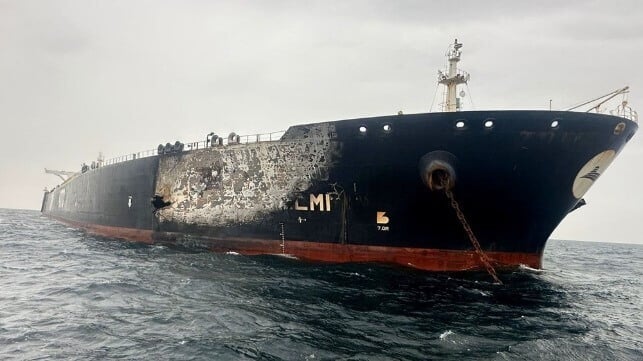
Damage to the tanker Al-Salmi after an Iranian attack, March 2026 (KPC)

Published Apr 13, 2026 7:49 PM by The Maritime Executive


Following news of a collapse in talks between the U.S. and Iran last weekend and the launch of a new U.S. Navy blockade at the Strait of Hormuz, oil markets are adapting to the prospect of a longer period of supply constraints. Benchmark Brent prices for June delivery remain below $100 per barrel, but the volume of physical barrels has not changed - and the last of the tankers that made it out of the Gulf before hostilities began will finish their delivery voyages soon, to be followed by a gap. 

From here out, energy analysts warn, the world must adapt to the reality of 10-15% less oil until several basic constraints are satisfied: a durable security arrangement at Hormuz that satisfies shipowners; inbound empty tankers arriving at Gulf loading terminals; and a restart of shut-in wells in Iraq, Kuwait, the UAE and Saudi Arabia. As onshore storage is limited in the GCC, the long process of restarting well production cannot begin until empty tankers pass westbound through Hormuz and reach loading berths, thereby providing a tank for the oil to go into. At present, about eight million bpd of wellhead production is offline, according to OPEC; even if the U.S. and Iran conclude a peace agreement, the process of restoring full flow will take several months. 

Adaptations to the limited oil supply are varied, from demand destruction (Sri Lanka and Thailand) to fuel tax breaks (Europe) to product export bans (China). On Monday, the International Energy Agency, World Bank and International Monetary Fund urged national governments to reject the temptation to hoard fuel supplies by closing down exports. "The first principle should be to not impose export controls that only make the imbalance worse," said IMF managing director Kristalina Georgieva at an event sponsored by the Atlantic Council. 

Fatih Birol, head of the IEA, told Reuters that the organization stands ready to authorize an additional release from the international petroleum reserve system. It has already green-lit a coordinated release of 400 million barrels, and has room to go further, though the speed of delivery to the global market is constrained by practical limits of storage and distribution infrastructure. 


MAIB: Lost Trawler's Crew Couldn't Isolate Source of Flooding

RNLI
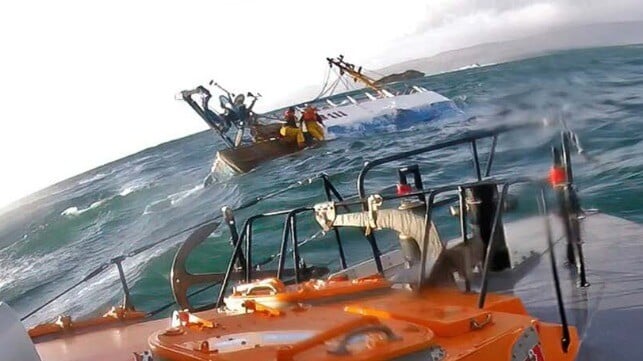
Freedom II capsizing (surveillance video frame courtesy RNLI)

Published Apr 13, 2026 10:05 PM by The Maritime Executive


The UK’s Marine Accident Investigation Branch (MAIB) is yet again putting the spotlight on safety standards in the fishing industry after publishing the investigation report on the flooding, capsizing and foundering of a fishing trawler in Scottish waters in 2024.

The prawn trawler Freedom II suffered engine room flooding at a position about  11 nautical miles southwest of Oban, Scotland, on February 21, 2024. The four crewmembers could not correctly identify the source of the flooding, and they had to be rescued by a Royal National Lifeboat Institution all-weather lifeboat.

According to investigators, a vibration-induced fracture of the seawater suction pipe for the deck wash pump was the most likely source for the flooding. The rate overwhelmed the available bilge pump, and the other pumps were disabled. Rising water caught by the main engine's flywheel sprayed the electrical panel for the auxiliary engine, preventing it from starting up and providing electrical power to the self-priming bilge pump and submersible pump. A portable salvage pump was deployed, but it failed to restart after it was shut down once for repositioning. 

The investigation found that the pumping capacity available was not enough to combat the volume of water; if all the pumps on board had been functional, it is possible that they could have bought enough time to allow for the transfer and use of another dewatering pump from the RNLI lifeboat, MAIB concluded. Other contributing factors included the lack of an effective response plan and the crew's mistaken conclusion about the likely source of the flood (they incorrectly believed it to be a stern tube seal leak) which may have distracted them from a more thorough search. 

On the fateful day, the vessel departed the port of Crinan at about 0400 to fish for prawns in Loch Linnhe. Due to weather, the skipper decided to head west through the Gulf of Corryvreckan to fish in the Firth of Lorn. By about 0700, the crew had deployed their fishing gear for the first trawl of the day and at about 1000, they started to recover the gear.  

At about the same time, the skipper noted a strong vibration coming from the propeller shaft. Though he tried to clear the fouled propeller by pulsing it ahead and astern about five times, the vibration did not improve, and he decided to head to Oban at low speed for repairs.

The vessel could not complete the four-hour transit because of significant flooding, despite efforts at containment by the crew. By 1302, the water level in the vessel’s engine room had reached halfway up the side of the engine, forcing the skipper to shut down propulsion. At 1535, Freedom II rolled to port and sank beneath the surface. While all the crewmembers were rescued, the vessel could not be located.

According to MAIB, the incident involving Freedom II was the latest in a long line of fishing vessels lost to engine flooding. Over the period between 2013 and 2022, the agency received 230 reports of fishing vessel flooding, including 78 that resulted in the loss of the vessel. The engine room was the most common location for fishing vessel flooding casualties.

“Without effective guidance on the management of floods, fishing vessels remain at significant risk of foundering should uncontrolled flooding occur,” stated MAIB in the report.


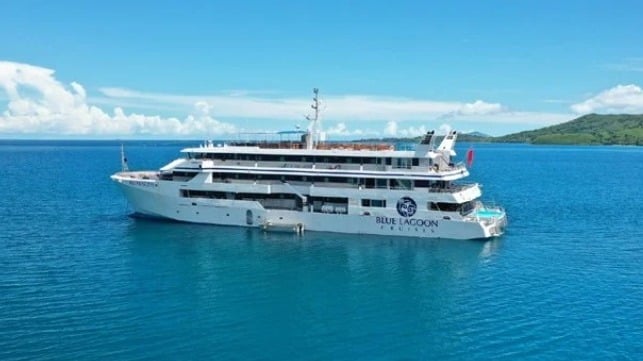
Cruise Ship That Grounded Near "Cast Away" Island Will Be Retired

Blue Lagoon
File image courtesy Blue Lagoon

Published Apr 13, 2026 5:45 PM by The Maritime Executive


A Fiji cruise ship that gained unprecedented global attention after grounding on an island where the 2000 Tom Hanks film “Cast Away” was filmed has been retired comparatively early after 22 years in service.

Blue Lagoon Cruises, the owner of the Fiji Princess, has announced that it has made the difficult decision to retire the vessel following her grounding at a reef near uninhabited Monuriki Island on April 4.

The ship had 30 passengers and 31 crewmembers aboard when she grounded in severe weather. The passengers and 17 crew members were safely disembarked with some crew remaining to support response operations.

“With much sadness and following initial recovery efforts, Blue Lagoon Cruises has made the difficult decision to retire MV. Fiji Princess following an incident on the 4th of April 2026,” said the operator in a social media post.

The company said that guests impacted by the retirement of the vessel will be contacted and provided with an array of alternate options.

The immediate retirement of the ship comes as the Maritime Safety Authority of Fiji (MSAF) continues to monitor the grounding site to prevent fuel leakage and prevent any environmental catastrophe. The vessel is said to have been loaded with approximately 20,000 liters of diesel fuel at the point of grounding.

According to MSAF, while initial assessment indicates significant damages to the vessel’s port-side stern, no damage has been detected on the fuel tanks.

Blue Lagoon Cruises has since engaged the services of Australian salvors to spearhead the technical recovery operations of the 55-meter vessel.

The Fiji Princess attracted global attention following her grounding on the Island from the famous Tom Hanks “Cast Away” movie. Located some 45 kilometers west of the city of Nadi, Monuriki Island is part of the Mamanuca Island chain, where the US version of reality show Survivor has been filmed since 2016.

The islands are popular tourist destinations with cruise companies operating trips around the region, including marketing Monuriki with a “Cast Away” theme.


Following the abrupt retirement of Fiji Princess, Blue Lagoon Cruises is hoping that her memories will live through the many passengers that boarded her voyages for over two decades.

“The team at Blue Lagoon Cruises appreciates the many guests who cruised on board Fiji Princess, and we know many amazing memories were created on board. We would therefore love for you to share your images, memories, or comments as a final salute and as a fitting end to an amazing era of cruising,” said the operator.

Coast Guard Completes Difficult Rescue to Save Hunters Trapped on Ice

Coast Guard rescue

Published Apr 15, 2026 2:54 PM by The Maritime Executive


On Sunday, the U.S. Coast Guard rescued four seal hunters from a small boat that had become trapped on an ice floe near the remote town of Chefornak, Alaska. 

At about 1630 hours on Saturday afternoon, Coast Guard Arctic District received word from the Alaska State Troopers that four people on a seal-hunting excursion had been trapped on the ice off Chefornak for more than 24 hours. They had freed their boat overnight, but could not reach a rescue party that was attempting to venture out from shore. Luckily they had satellite-based communications equipment, and were able to coordinate with rescuers directly.  

To get assets to the scene, the Coast Guard deployed both an HC-130 search aircraft and an MH-60 helicopter aircrew out of Air Station Kodiak, about 370 nautical miles away to the southeast on the other side of the Aleutian range. The helicopter's range is not sufficient to make this trip in one run, so the crew landed twice to refuel en route, once in King Salmon and again in Bethel. After fighting through difficult weather en route, they arrived at about 0500 hours on Sunday morning, about 12 hours after receiving the call. 

Weather on scene was difficult, with winds near 25 knots, temperatures below freezing and a low cloud ceiling. The helicopter's rescue swimmer deployed and helped hoist all four survivors aboard. They were delivered back to Chefornak in good health. 


Chefornak is a town on the Kinia River, on the mainland Alaska side of the Bering Sea. Located within a wildlife refuge, it is predominantly populated by Yup'ik Eskimo, who have Alaska Native subsistence hunting rights. 

“Our entire crew agreed this was one of the most challenging missions any of us had ever flown,” said Lt. Cmdr. Alexis Chavarria-Aguilar, pilot-in-command for the helicopter. “We battled nearly every Alaska-centric aviation weather hazard imaginable, such as flying over 800 miles in near-zero visibility through mountainous terrain, blowing snow and icing conditions."


Cefor: Machinery Damage and Fires Drive Increase in Claim Cost

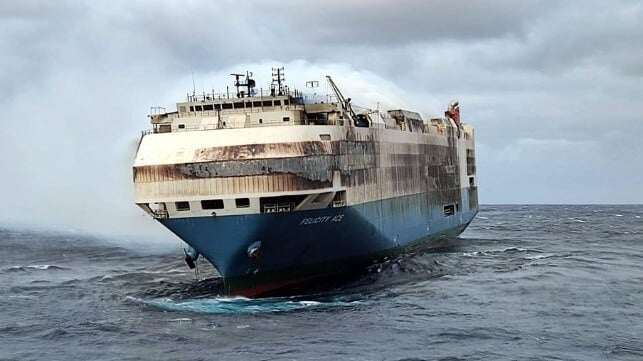
Felicity Ace
The 2022 fire aboard the PCTC Felicity Ace is an iconic example of a fire-driven total loss (File image courtesy Portuguese Navy)

Published Apr 15, 2026 8:27 PM by The Maritime Executive


Machinery damage and fires continue to dominate as the leading causes of elevated claim costs in the Nordic marine insurance market, according to the Nordic Association of Marine Insurers (Cefor). Cefor members underwrite Hull and Machinery for about 31% of the world fleet, including 3,538 vessels of more than 20,000 gross tons.

 2025 is the third consecutive year to record an increase in claims above $10 million, according to the year’s report by published this week. Notably, total losses on vessels with values above $10 million have also been on the increase. This is rather unusual as total losses historically have occurred on low-value vessels.  

These substantial losses have seen claim cost per vessel increase by 33 percent in 2024 and 2025 compared to 2021. In 2025, there were 13 claims of above $10 million, slightly lower than 18 reported in 2024. Fires dominate these high value losses, constituting 7 out of the 13 claims in 2025. In six of the past 10 years, fires accounted for 40- 70% of the costliest losses, increasingly affecting even younger vessels.

The frequency of machinery claims is also 30% higher in the period from 2022-2025 compared to prior years. Cefor said that the rise in machinery damage could be seen in the context of an ageing fleet. It is also coded as human error, which could be linked to crew shortages. 7 out of 18 claims above $10 million in 2024 were machinery claims, the same number as the total count over the previous six years.  

But even as fires and machinery damage drive up claims cost, inflation is another silent factor. Following the pandemic, inflation rates in major economies have been on the rise. As a result, steel prices, the cost of spare parts and labor costs have all surged, influencing repair costs.

“Bottom line is the claims environment is now costlier. We call for loss prevention, focus on manning, regulatory action on fire safety, and focus on reserving under inflationary pressure,” commented Cefor.


Court Approves Sweden's Icebreaker Contract Award to Korean Yard

As the U.S. contracts with Swedish yards to build icebreakers, Sweden is contracting out its own icebreaker order to South Korea

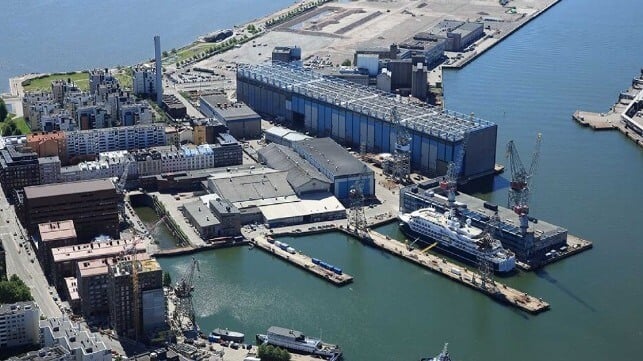
Helsinki Shipyard (above) sued to block the award to HHI (file image courtesy Helsinki Shipyard)

Published Apr 15, 2026 8:35 PM by The Maritime Executive


Sweden’s Court of Appeal has dismissed an appeal challenging the ongoing procurement of a new state-owned icebreaker. In June last year, the Swedish Maritime Administration (SMA) awarded South Korea’s Hyundai Heavy Industries (HHI) a contract to build the country’s next icebreaker. In the tendering process, Finland’s Helsinki Shipyard came in second but decided to appeal the award decision, citing irregularities.

The matter was initially filed in an administrative court, which upheld the award to HHI. Helsinki Shipyard appealed the decision at the Administrative Court of Appeal in Jönköping, asserting that the reference vessels submitted by HHI in its bid did not meet the requirements set by SMA. The appeals court affirmed the icebreaker procurement decision in a judgement rendered last week.

In a statement after its appeal was dismissed, Helsinki Shipyard said that although the company was deeply disappointed not to have been selected, it acknowledged the court’s ruling.

The tender document required bidding shipyards to submit three different reference vessels, which would prove technical capabilities in delivering an icebreaker. For the first reference, shipyards had to demonstrate they had constructed a vessel in Polar Class1 to 6 or equivalent, and delivered in year 2012 or later. For this requirement, HHI referenced the New Zealand Navy replenishment ship HMNZS Aotearoa, which it delivered in 2020. HHI stated the vessel has a polar class equivalent of PC 6. Helsinki Shipyard doubted this designation, claiming that it could not be verified in any ship registers as the vessel (now sunken) was in military service.

The next reference project was to show experience in construction and delivery of a vessel equipped with specific types of diesel-electric propulsion. HHI listed ROKS Donghae, a multi-purpose frigate of South Korea’s navy, which it delivered in 2021. The frigate utilized a combine diesel-electric or gas (CODLOG) propulsion system. Helsinki Shipyard argued this was a different propulsion system from the one specified by SMA. Further, the company argued that in icebreaking, there is constant change in propulsion force and direction, thus an AC/DC diesel-electric propulsion system is highly preferred.

With these arguments now set aside by the court, HHI will proceed with the construction of Sweden’s next icebreaker, valued at over $350 million. The EU will provide some funding, estimated to be around $35 million. Currently, Sweden has six state-owned icebreakers; Ale, Atle, Frej, Oden, Ymer and Idun. Most of these vessels were built in the 1970s and 80s and thus are nearing end of life. Icebreakers are critical to Swedish economy, specifically to support shipping in the Baltic Sea during winter.